

1© 2011 Maintenance Reliability Group, LLC. All rights reserved.
•An overview for wind turbine applications
Grease sampling & analysis in
Wind Turbines
1
2© 2011 Maintenance Reliability Group, LLC. All rights reserved.
2
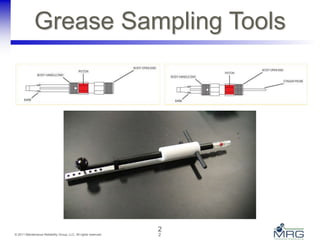
Grease Sampling Tools
3© 2011 Maintenance Reliability Group, LLC. All rights reserved.
3
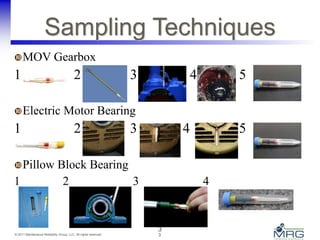
MOV Gearbox
1 2 3 4 5
Electric Motor Bearing
1 2 3 4 5
Pillow Block Bearing
1 2 3 4
Sampling Techniques
4© 2011 Maintenance Reliability Group, LLC. All rights reserved.
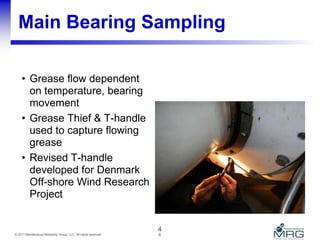
Main Bearing Sampling
• Grease flow dependent
on temperature, bearing
movement
• Grease Thief & T-handle
used to capture flowing
grease
• Revised T-handle
developed for Denmark
Off-shore Wind Research
Project
4
5© 2011 Maintenance Reliability Group, LLC. All rights reserved.
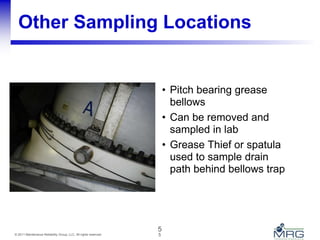
Other Sampling Locations
• Pitch bearing grease
bellows
• Can be removed and
sampled in lab
• Grease Thief or spatula
used to sample drain
path behind bellows trap
5
6© 2011 Maintenance Reliability Group, LLC. All rights reserved.
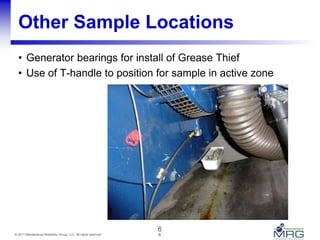
Other Sample Locations
• Generator bearings for install of Grease Thief
• Use of T-handle to position for sample in active zone
6
7© 2011 Maintenance Reliability Group, LLC. All rights reserved.
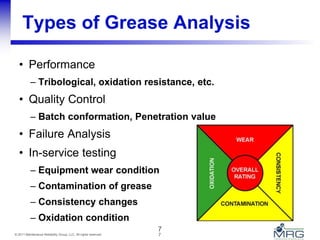
Types of Grease Analysis
• Performance
– Tribological, oxidation resistance, etc.
• Quality Control
– Batch conformation, Penetration value
• Failure Analysis
• In-service testing
– Equipment wear condition
– Contamination of grease
– Consistency changes
– Oxidation condition
7
8© 2011 Maintenance Reliability Group, LLC. All rights reserved.
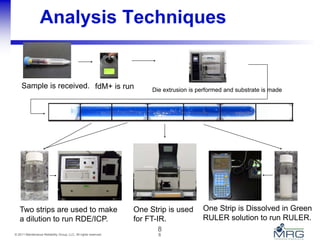
Analysis Techniques
Sample is received. fdM+ is run Die extrusion is performed and substrate is made
Two strips are used to make
a dilution to run RDE/ICP.
One Strip is used
for FT-IR.
One Strip is Dissolved in Green
RULER solution to run RULER.
8
9© 2011 Maintenance Reliability Group, LLC. All rights reserved.
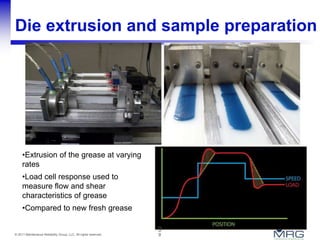
Die extrusion and sample preparation
•Extrusion of the grease at varying
rates
•Load cell response used to
measure flow and shear
characteristics of grease
•Compared to new fresh grease
9
10© 2011 Maintenance Reliability Group, LLC. All rights reserved.
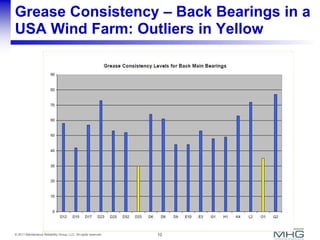
Grease Consistency – Back Bearings in a
USA Wind Farm: Outliers in Yellow
11© 2011 Maintenance Reliability Group, LLC. All rights reserved.
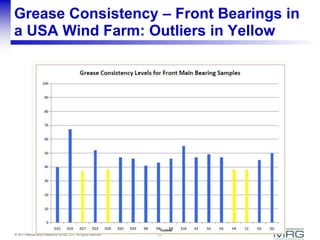
Grease Consistency – Front Bearings in
a USA Wind Farm: Outliers in Yellow
12© 2011 Maintenance Reliability Group, LLC. All rights reserved.
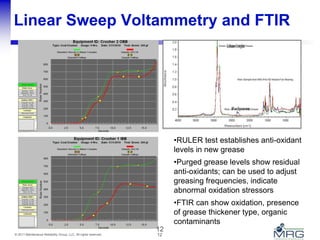
Linear Sweep Voltammetry and FTIR
•RULER test establishes anti-oxidant
levels in new grease
•Purged grease levels show residual
anti-oxidants; can be used to adjust
greasing frequencies, indicate
abnormal oxidation stressors
•FTIR can show oxidation, presence
of grease thickener type, organic
contaminants
12
13© 2011 Maintenance Reliability Group, LLC. All rights reserved.
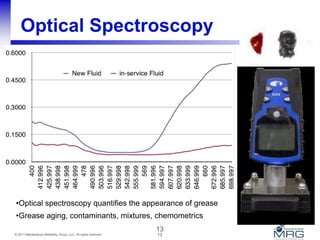
Optical Spectroscopy
•Optical spectroscopy quantifies the appearance of grease
•Grease aging, contaminants, mixtures, chemometrics
13
14© 2011 Maintenance Reliability Group, LLC. All rights reserved.
14
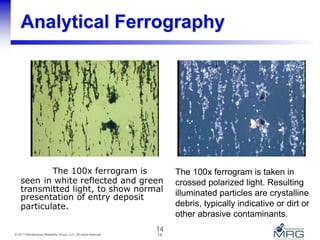
The 100x ferrogram is
seen in white reflected and green
transmitted light, to show normal
presentation of entry deposit
particulate.
The 100x ferrogram is taken in
crossed polarized light. Resulting
illuminated particles are crystalline
debris, typically indicative or dirt or
other abrasive contaminants.
Analytical Ferrography
15© 2011 Maintenance Reliability Group, LLC. All rights reserved.
Wear Levels Across a Fleet of
Wind Turbines-USA
15
16© 2011 Maintenance Reliability Group, LLC. All rights reserved.
Wind Turbine grease sampling and
analysis
• 2-year project conducted with DONG Energy and
Vattenfall, two largest offshore wind operators in the world
• Dr. Kim Esbensen, internationally recognized expert in
Theory of Sampling (TOS), Denmark
• Rich Wurzbach, MRG Labs, inventor of Grease Thief
• Systematic evaluation of grease heterogeneity, sampling
methodology, and analysis validity and repeatability for
wind turbine main bearings in on-shore and off-shore
applications
• Results published at OilDoc, LUBMAT, and AWEA
17© 2011 Maintenance Reliability Group, LLC. All rights reserved.
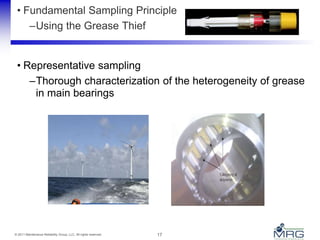
• Fundamental Sampling Principle
–Using the Grease Thief
• Representative sampling
–Thorough characterization of the heterogeneity of grease
in main bearings
18© 2011 Maintenance Reliability Group, LLC. All rights reserved.
Test parameters of Grease
• For the heterogeneity characterization of grease in main
bearings of wind turbines the following parameters were
used:
–Consistency and flow characteristics
–Ferromagnetic iron (Hall-effect sensor)
–Wear metals
–Particle characterization (size & distribution)
–Residual oil in grease
–Antioxidants
19© 2011 Maintenance Reliability Group, LLC. All rights reserved.
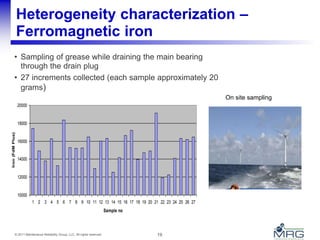
Heterogeneity characterization –
Ferromagnetic iron
• Sampling of grease while draining the main bearing
through the drain plug
• 27 increments collected (each sample approximately 20
grams)
On site sampling
10000
12000
14000
16000
18000
20000
1 2 3 4 5 6 7 8 9 10 11 12 13 14 15 16 17 18 19 20 21 22 23 24 25 26 27
Sample no
Iron(FdMPlus)
20© 2011 Maintenance Reliability Group, LLC. All rights reserved.
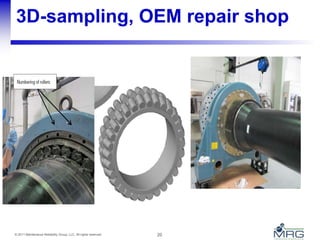
3D-sampling, OEM repair shop
21© 2011 Maintenance Reliability Group, LLC. All rights reserved.
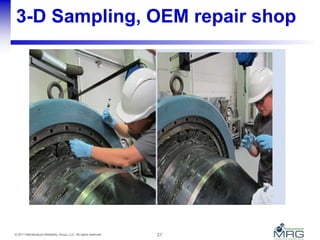
3-D Sampling, OEM repair shop
22© 2011 Maintenance Reliability Group, LLC. All rights reserved.
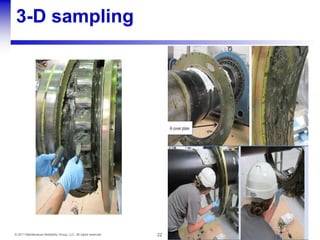
3-D sampling
23© 2011 Maintenance Reliability Group, LLC. All rights reserved.
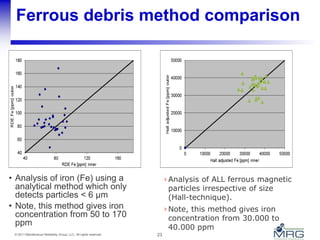
• Analysis of iron (Fe) using a
analytical method which only
detects particles < 6 µm
• Note, this method gives iron
concentration from 50 to 170
ppm
›Analysis of ALL ferrous magnetic
particles irrespective of size
(Hall-technique).
›Note, this method gives iron
concentration from 30.000 to
40.000 ppm
Ferrous debris method comparison
24© 2011 Maintenance Reliability Group, LLC. All rights reserved.
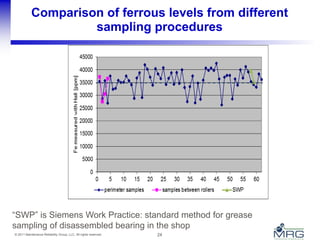
Comparison of ferrous levels from different
sampling procedures
“SWP” is Siemens Work Practice: standard method for grease
sampling of disassembled bearing in the shop
25© 2011 Maintenance Reliability Group, LLC. All rights reserved.
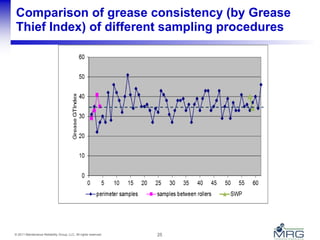
Comparison of grease consistency (by Grease
Thief Index) of different sampling procedures
26© 2011 Maintenance Reliability Group, LLC. All rights reserved.
Conclusions from 3-D sampling
OEM repair shop
• Analysis of analytical results reveal no statistically significant
differences between the 3D sample arrays extracted
• The grease is thoroughly well mixed
• Standard SWP bearing samples falls fully within the span of the 3D
experimental results. This also apply to samples taken close to
inspection cover
• It is concluded that standard bearing sampling (for the bearing
investigated) results in valid characterization of the grease.
27© 2011 Maintenance Reliability Group, LLC. All rights reserved.
Phase 2 – Field trials
• Grease analysis parameter
–Iron using a ferro-magnetic debris Monitor (fdM, "Hall-
monitor"). Measures all ferro-magnetic debris/particles in
the grease irrespective of size
–Iron (and other wear elements) using Rotating Disc
Electrode Atomic Emission Spectrometry (RDE). This
method only detects particle < 6-8 µm.
–Characterization of wear particles using optical
microscopy
–Moisture
–Consistency
–Anti-oxidants using RULER-technique
28© 2011 Maintenance Reliability Group, LLC. All rights reserved.
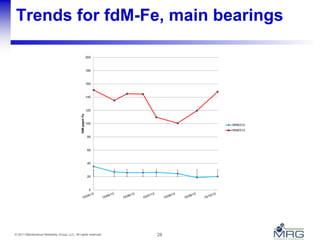
Trends for fdM-Fe, main bearings
0
20
40
60
80
100
120
140
160
180
200
fdM-pppmFe
WNE012
WNE013
29© 2011 Maintenance Reliability Group, LLC. All rights reserved.
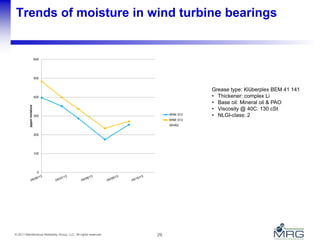
Trends of moisture in wind turbine bearings
Grease type: Klüberplex BEM 41 141
• Thickener: complex Li
• Base oil: Mineral oil & PAO
• Viscosity @ 40C: 130 cSt
• NLGI-class: 2
0
100
200
300
400
500
600
pppmmoisture
WNE 012
WNE 013
WHR2
30© 2011 Maintenance Reliability Group, LLC. All rights reserved.
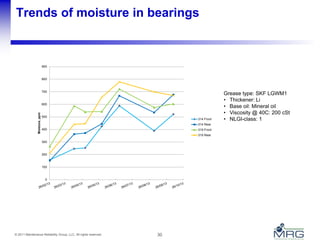
Trends of moisture in bearings
0
100
200
300
400
500
600
700
800
900
Moisture,ppm
314 Front
314 Rear
319 Front
319 Rear
Grease type: SKF LGWM1
• Thickener: Li
• Base oil: Mineral oil
• Viscosity @ 40C: 200 cSt
• NLGI-class: 1
31© 2011 Maintenance Reliability Group, LLC. All rights reserved.
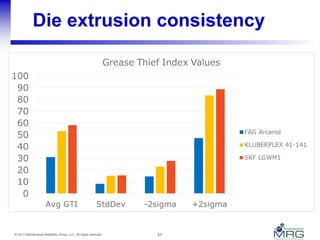
Die extrusion consistency
32© 2011 Maintenance Reliability Group, LLC. All rights reserved.
Analysis of consistency
• Die extrusion can be performed on Grease Thief sample with
only 1 gram
• While wear is a “lagging” indicator, consistency is among the
“leading” indicators; having a good monitoring criteria and action
for off-spec inservice grease could prevent future problems with
the bearing
• Of the three greases compared for this analysis, SKF and
Klueber grease are similar in average consistency values, while
FAG Arcanol greases are substantially lower in consistency
(softer) when compared to new, fresh reference
• Current values are compared to unworked new grease; better
comparison may be pre-working reference grease and
comparing to that for 100 index
33© 2011 Maintenance Reliability Group, LLC. All rights reserved.
Conclusions
• Grease in the area accessed by the Grease Thief is thoroughly
well mixed and comparable to the samples taken in the shop
between the rollers
• Bearings removed from service following field sampling and
analysis trials corresponded precisely to the predicted condition
when disassembled and characterized
• In-service grease analysis complements condition monitoring
systems (vibration analysis) and is particularly useful in slow-
speed shafts where some vibration trends lag grease condition
and wear particle indications
• Grease sampling can be cost-effectively deployed during
periodic uptower maintenance visits with easily understood and
utilized sampling kits and tools
• Early detection of abnormal conditions can be sometimes
rectified uptower (grease flushing, relubrication, etc)
substantially reducing the event cost and risk of failure

Wind turbine grease sampling and analysis

  • 1.
    1© 2011 MaintenanceReliability Group, LLC. All rights reserved. •An overview for wind turbine applications Grease sampling & analysis in Wind Turbines 1
  • 2.
    2© 2011 MaintenanceReliability Group, LLC. All rights reserved. 2 Grease Sampling Tools
  • 3.
    3© 2011 MaintenanceReliability Group, LLC. All rights reserved. 3 MOV Gearbox 1 2 3 4 5 Electric Motor Bearing 1 2 3 4 5 Pillow Block Bearing 1 2 3 4 Sampling Techniques
  • 4.
    4© 2011 MaintenanceReliability Group, LLC. All rights reserved. Main Bearing Sampling • Grease flow dependent on temperature, bearing movement • Grease Thief & T-handle used to capture flowing grease • Revised T-handle developed for Denmark Off-shore Wind Research Project 4
  • 5.
    5© 2011 MaintenanceReliability Group, LLC. All rights reserved. Other Sampling Locations • Pitch bearing grease bellows • Can be removed and sampled in lab • Grease Thief or spatula used to sample drain path behind bellows trap 5
  • 6.
    6© 2011 MaintenanceReliability Group, LLC. All rights reserved. Other Sample Locations • Generator bearings for install of Grease Thief • Use of T-handle to position for sample in active zone 6
  • 7.
    7© 2011 MaintenanceReliability Group, LLC. All rights reserved. Types of Grease Analysis • Performance – Tribological, oxidation resistance, etc. • Quality Control – Batch conformation, Penetration value • Failure Analysis • In-service testing – Equipment wear condition – Contamination of grease – Consistency changes – Oxidation condition 7
  • 8.
    8© 2011 MaintenanceReliability Group, LLC. All rights reserved. Analysis Techniques Sample is received. fdM+ is run Die extrusion is performed and substrate is made Two strips are used to make a dilution to run RDE/ICP. One Strip is used for FT-IR. One Strip is Dissolved in Green RULER solution to run RULER. 8
  • 9.
    9© 2011 MaintenanceReliability Group, LLC. All rights reserved. Die extrusion and sample preparation •Extrusion of the grease at varying rates •Load cell response used to measure flow and shear characteristics of grease •Compared to new fresh grease 9
  • 10.
    10© 2011 MaintenanceReliability Group, LLC. All rights reserved. Grease Consistency – Back Bearings in a USA Wind Farm: Outliers in Yellow
  • 11.
    11© 2011 MaintenanceReliability Group, LLC. All rights reserved. Grease Consistency – Front Bearings in a USA Wind Farm: Outliers in Yellow
  • 12.
    12© 2011 MaintenanceReliability Group, LLC. All rights reserved. Linear Sweep Voltammetry and FTIR •RULER test establishes anti-oxidant levels in new grease •Purged grease levels show residual anti-oxidants; can be used to adjust greasing frequencies, indicate abnormal oxidation stressors •FTIR can show oxidation, presence of grease thickener type, organic contaminants 12
  • 13.
    13© 2011 MaintenanceReliability Group, LLC. All rights reserved. Optical Spectroscopy •Optical spectroscopy quantifies the appearance of grease •Grease aging, contaminants, mixtures, chemometrics 13
  • 14.
    14© 2011 MaintenanceReliability Group, LLC. All rights reserved. 14 The 100x ferrogram is seen in white reflected and green transmitted light, to show normal presentation of entry deposit particulate. The 100x ferrogram is taken in crossed polarized light. Resulting illuminated particles are crystalline debris, typically indicative or dirt or other abrasive contaminants. Analytical Ferrography
  • 15.
    15© 2011 MaintenanceReliability Group, LLC. All rights reserved. Wear Levels Across a Fleet of Wind Turbines-USA 15
  • 16.
    16© 2011 MaintenanceReliability Group, LLC. All rights reserved. Wind Turbine grease sampling and analysis • 2-year project conducted with DONG Energy and Vattenfall, two largest offshore wind operators in the world • Dr. Kim Esbensen, internationally recognized expert in Theory of Sampling (TOS), Denmark • Rich Wurzbach, MRG Labs, inventor of Grease Thief • Systematic evaluation of grease heterogeneity, sampling methodology, and analysis validity and repeatability for wind turbine main bearings in on-shore and off-shore applications • Results published at OilDoc, LUBMAT, and AWEA
  • 17.
    17© 2011 MaintenanceReliability Group, LLC. All rights reserved. • Fundamental Sampling Principle –Using the Grease Thief • Representative sampling –Thorough characterization of the heterogeneity of grease in main bearings
  • 18.
    18© 2011 MaintenanceReliability Group, LLC. All rights reserved. Test parameters of Grease • For the heterogeneity characterization of grease in main bearings of wind turbines the following parameters were used: –Consistency and flow characteristics –Ferromagnetic iron (Hall-effect sensor) –Wear metals –Particle characterization (size & distribution) –Residual oil in grease –Antioxidants
  • 19.
    19© 2011 MaintenanceReliability Group, LLC. All rights reserved. Heterogeneity characterization – Ferromagnetic iron • Sampling of grease while draining the main bearing through the drain plug • 27 increments collected (each sample approximately 20 grams) On site sampling 10000 12000 14000 16000 18000 20000 1 2 3 4 5 6 7 8 9 10 11 12 13 14 15 16 17 18 19 20 21 22 23 24 25 26 27 Sample no Iron(FdMPlus)
  • 20.
    20© 2011 MaintenanceReliability Group, LLC. All rights reserved. 3D-sampling, OEM repair shop
  • 21.
    21© 2011 MaintenanceReliability Group, LLC. All rights reserved. 3-D Sampling, OEM repair shop
  • 22.
    22© 2011 MaintenanceReliability Group, LLC. All rights reserved. 3-D sampling
  • 23.
    23© 2011 MaintenanceReliability Group, LLC. All rights reserved. • Analysis of iron (Fe) using a analytical method which only detects particles < 6 µm • Note, this method gives iron concentration from 50 to 170 ppm ›Analysis of ALL ferrous magnetic particles irrespective of size (Hall-technique). ›Note, this method gives iron concentration from 30.000 to 40.000 ppm Ferrous debris method comparison
  • 24.
    24© 2011 MaintenanceReliability Group, LLC. All rights reserved. Comparison of ferrous levels from different sampling procedures “SWP” is Siemens Work Practice: standard method for grease sampling of disassembled bearing in the shop
  • 25.
    25© 2011 MaintenanceReliability Group, LLC. All rights reserved. Comparison of grease consistency (by Grease Thief Index) of different sampling procedures
  • 26.
    26© 2011 MaintenanceReliability Group, LLC. All rights reserved. Conclusions from 3-D sampling OEM repair shop • Analysis of analytical results reveal no statistically significant differences between the 3D sample arrays extracted • The grease is thoroughly well mixed • Standard SWP bearing samples falls fully within the span of the 3D experimental results. This also apply to samples taken close to inspection cover • It is concluded that standard bearing sampling (for the bearing investigated) results in valid characterization of the grease.
  • 27.
    27© 2011 MaintenanceReliability Group, LLC. All rights reserved. Phase 2 – Field trials • Grease analysis parameter –Iron using a ferro-magnetic debris Monitor (fdM, "Hall- monitor"). Measures all ferro-magnetic debris/particles in the grease irrespective of size –Iron (and other wear elements) using Rotating Disc Electrode Atomic Emission Spectrometry (RDE). This method only detects particle < 6-8 µm. –Characterization of wear particles using optical microscopy –Moisture –Consistency –Anti-oxidants using RULER-technique
  • 28.
    28© 2011 MaintenanceReliability Group, LLC. All rights reserved. Trends for fdM-Fe, main bearings 0 20 40 60 80 100 120 140 160 180 200 fdM-pppmFe WNE012 WNE013
  • 29.
    29© 2011 MaintenanceReliability Group, LLC. All rights reserved. Trends of moisture in wind turbine bearings Grease type: Klüberplex BEM 41 141 • Thickener: complex Li • Base oil: Mineral oil & PAO • Viscosity @ 40C: 130 cSt • NLGI-class: 2 0 100 200 300 400 500 600 pppmmoisture WNE 012 WNE 013 WHR2
  • 30.
    30© 2011 MaintenanceReliability Group, LLC. All rights reserved. Trends of moisture in bearings 0 100 200 300 400 500 600 700 800 900 Moisture,ppm 314 Front 314 Rear 319 Front 319 Rear Grease type: SKF LGWM1 • Thickener: Li • Base oil: Mineral oil • Viscosity @ 40C: 200 cSt • NLGI-class: 1
  • 31.
    31© 2011 MaintenanceReliability Group, LLC. All rights reserved. Die extrusion consistency
  • 32.
    32© 2011 MaintenanceReliability Group, LLC. All rights reserved. Analysis of consistency • Die extrusion can be performed on Grease Thief sample with only 1 gram • While wear is a “lagging” indicator, consistency is among the “leading” indicators; having a good monitoring criteria and action for off-spec inservice grease could prevent future problems with the bearing • Of the three greases compared for this analysis, SKF and Klueber grease are similar in average consistency values, while FAG Arcanol greases are substantially lower in consistency (softer) when compared to new, fresh reference • Current values are compared to unworked new grease; better comparison may be pre-working reference grease and comparing to that for 100 index
  • 33.
    33© 2011 MaintenanceReliability Group, LLC. All rights reserved. Conclusions • Grease in the area accessed by the Grease Thief is thoroughly well mixed and comparable to the samples taken in the shop between the rollers • Bearings removed from service following field sampling and analysis trials corresponded precisely to the predicted condition when disassembled and characterized • In-service grease analysis complements condition monitoring systems (vibration analysis) and is particularly useful in slow- speed shafts where some vibration trends lag grease condition and wear particle indications • Grease sampling can be cost-effectively deployed during periodic uptower maintenance visits with easily understood and utilized sampling kits and tools • Early detection of abnormal conditions can be sometimes rectified uptower (grease flushing, relubrication, etc) substantially reducing the event cost and risk of failure

Editor's Notes

  • #9 fdM+ ferrous debris analyzer Determines the amount of ferrous debris in a sample Grease Thief Analyzer Measures the consistency of the grease FT-IR Tests for mixing, contamination, and oxidation RULER Tests for amount of useful antioxidant life remaining RDE Spectroscopy metals spectroscopy Rheometer Tests the consistency, pumpability, and likeliness of tunneling