
HYDRAULIC TRAINING SERIES
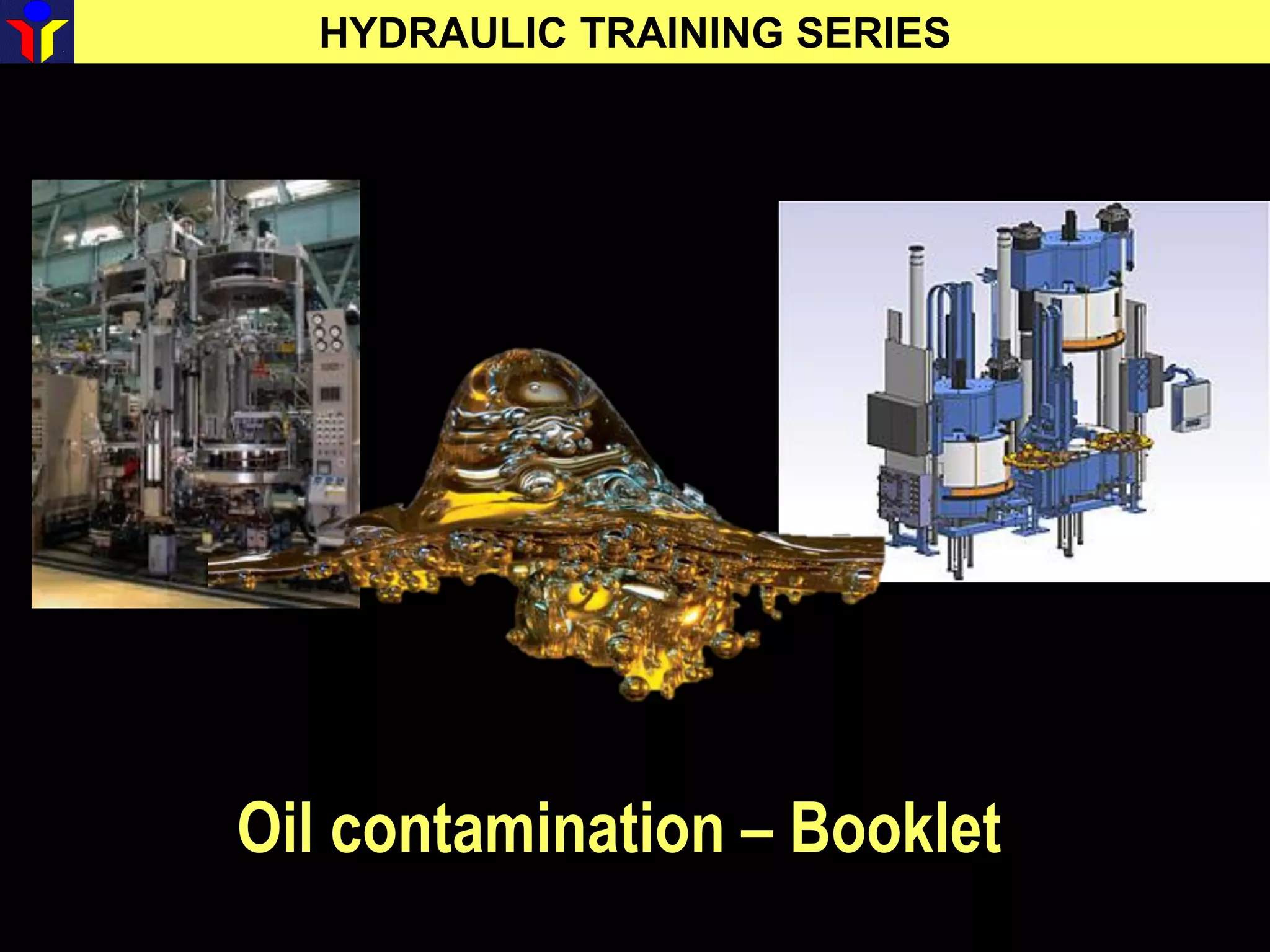
Oil contamination – Booklet
HYDRAULIC TRAINING SERIES
8
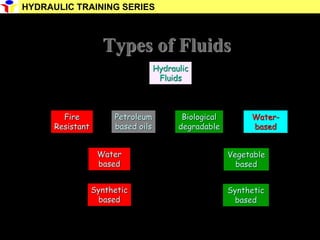
Types of Fluids
Hydraulic
Fluids
Fire
Resistant
Petroleum
based oils
Biological
degradable
Water-
based
Water
based
Synthetic
based
Vegetable
based
Synthetic
based
HYDRAULIC TRAINING SERIES
9
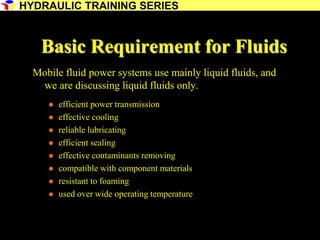
Basic Requirement for Fluids
Mobile fluid power systems use mainly liquid fluids, and
we are discussing liquid fluids only.
 efficient power transmission
 effective cooling
 reliable lubricating
 efficient sealing
 effective contaminants removing
 compatible with component materials
 resistant to foaming
 used over wide operating temperature
HYDRAULIC TRAINING SERIES
10
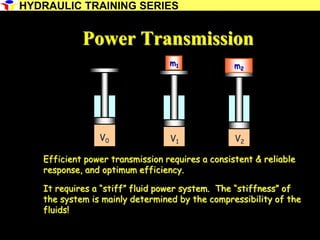
Power Transmission
m1 m2
V0 V1 V2
Efficient power transmission requires a consistent & reliable
response, and optimum efficiency.
It requires a “stiff” fluid power system. The “stiffness” of
the system is mainly determined by the compressibility of the
fluids!
HYDRAULIC TRAINING SERIES
11
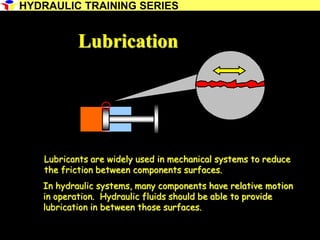
Lubrication
Lubricants are widely used in mechanical systems to reduce
the friction between components surfaces.
In hydraulic systems, many components have relative motion
in operation. Hydraulic fluids should be able to provide
lubrication in between those surfaces.
HYDRAULIC TRAINING SERIES
12
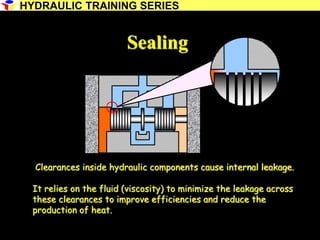
Sealing
Clearances inside hydraulic components cause internal leakage.
It relies on the fluid (viscosity) to minimize the leakage across
these clearances to improve efficiencies and reduce the
production of heat.
HYDRAULIC TRAINING SERIES
13
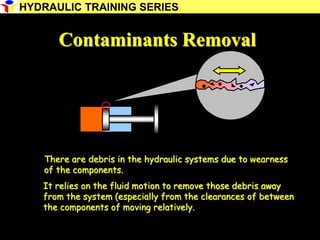
Contaminants Removal
There are debris in the hydraulic systems due to wearness
of the components.
It relies on the fluid motion to remove those debris away
from the system (especially from the clearances of between
the components of moving relatively.
HYDRAULIC TRAINING SERIES
14
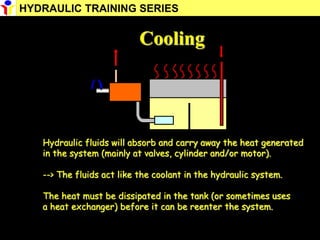
Cooling
Hydraulic fluids will absorb and carry away the heat generated
in the system (mainly at valves, cylinder and/or motor).
--> The fluids act like the coolant in the hydraulic system.
The heat must be dissipated in the tank (or sometimes uses
a heat exchanger) before it can be reenter the system.
HYDRAULIC TRAINING SERIES
15
Fluid Properties
To adequately carry out the desired functions of hydraulic
fluids, the following are the fluid properties we should pay
attention to in selection.
 viscosity
 lubricating ability
 pour point, oxidation resistance
 compatibility with system elements
 rust/corrosion protection
 demulsibility
 etc.
HYDRAULIC TRAINING SERIES
16
Fluid Selection
The general categories of available hydraulic fluids are
petroleum oils and fire resistant fluids. Bio-degradable
fluids are becoming popular recently. Water hydraulics is
a relative new technology.
 No single fluids can meet all the requirements.
 Lubricating & viscosity are important for mobile systems.
 Concerns on environment increased interests in biodegradable oils
(required in many European countries).
 Fire resistance is important for machinery working at the
flammable environment.
HYDRAULIC TRAINING SERIES
17
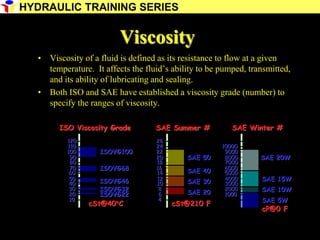
Viscosity
• Viscosity of a fluid is defined as its resistance to flow at a given
temperature. It affects the fluid’s ability to be pumped, transmitted,
and its ability of lubricating and sealing.
• Both ISO and SAE have established a viscosity grade (number) to
specify the ranges of viscosity.
cSt@210 F
ISO Viscosity Grade
10
20
30
40
50
60
70
80
90
100
110
120
ISOVG100
ISOVG68
ISOVG46
ISOVG32
ISOVG22
SAE Summer #
4
6
8
10
12
14
16
18
20
22
24
26
SAE 50
SAE 40
SAE 30
SAE 20
cSt@40C
SAE Winter #
1000
2000
3000
4000
5000
6000
7000
8000
9000
10000
SAE 20W
SAE 15W
SAE 10W
SAE 5W
cP@0 F
HYDRAULIC TRAINING SERIES
18
Fluid Conditioning & Devices
Fluid conditioning includes:
 Fluids storage & preparation
 Contamination prevention & control
 Temperature control
The main fluid conditioning devices include:
 Reservoir
 Filter
 Seals
 Cooler
HYDRAULIC TRAINING SERIES
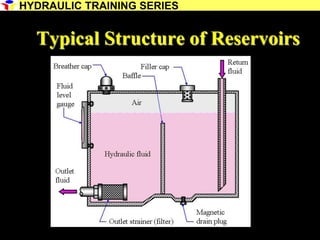
Typical Structure of Reservoirs
HYDRAULIC TRAINING SERIES
Key Functions of Reservoir
• Fluids container
– Provides a space on the vehicle to store hydraulic fluids.
• Fluids cooling device
– Discharges heat generated in the fluid power system.
• Air separator
– Removes as mush air as possible from the fluids.
• Debris separator
– Filters out debris to prevent possible damages.
• Inlet fluid conditioner
– Prepares the supplying fluids to the pump with a good inlet
condition for maximizing the pump efficiency.
HYDRAULIC TRAINING SERIES
Criteria for Sizing a Reservoirs
o Must make allowance for dirt and chips to settle and for air
to escape
o Must be able to hold all the oil that might drain into it from
the system
o Must maintain the oil level high enough to prevent a whirlpool
effect at the pump inlet line opening
o Should have a surface area large enough to dissipate most of
the heat generated by the system
o Should have adequate air space to allow for thermal expansion
of the oil
In General:
Reservoir size = 3pump flow-rate
(gal or L) (GPM or L/min)
HYDRAULIC TRAINING SERIES
22
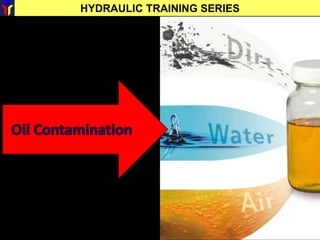
Types of Contaminations
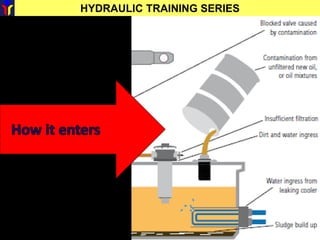
Most of the times, fluids contamination is the major
contributor to failures of hydraulic system.
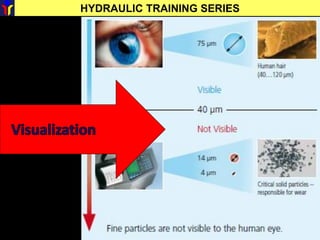
 Solid contamination: It may consists of dirt, metal particles,
seal materials, etc. It is the most common cause for failure of
mobile hydraulic systems.
 Thermal contamination: The useful life of most hydraulic
fluids will be significantly reduced by overheat.
 Air/gas contamination: Dissolved air affects system stiffness,
results in poor performance.
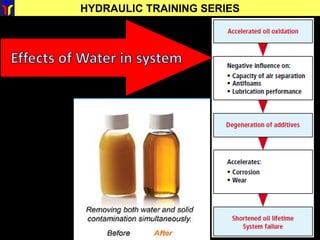
 Water contamination: Water will degrade the fluids in
numerous ways (max of 700 ppm is allowed).
HYDRAULIC TRAINING SERIES
23
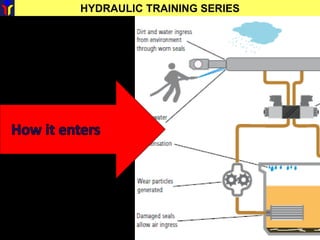
Major Sources of Solid Contaminations
Contamination can be introduced into the system from both
external and internal sources.
 Built-in contamination: Much of the solid contamination is
resulted from the manufacture and assembly of the hydraulic
systems.
 External contamination: Much of dirt, air, and water
contamination is resulted from operating environment.
 Internally generated contamination: It mainly caused by the
wear (esp. at break-in & wear out periods).
 Maintenance contamination: Could be all kinds of
contamination due improper maintenance procedure.
HYDRAULIC TRAINING SERIES
24
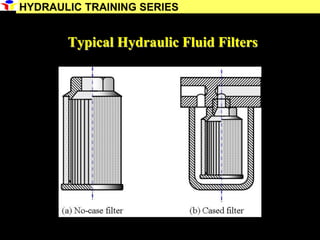
Typical Hydraulic Fluid Filters
HYDRAULIC TRAINING SERIES
25
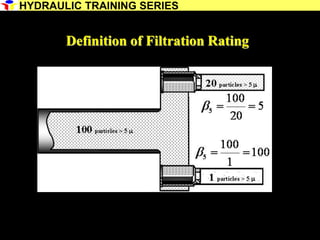
Definition of Filtration Rating
HYDRAULIC TRAINING SERIES
26
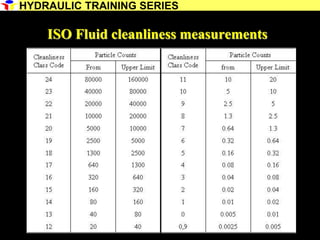
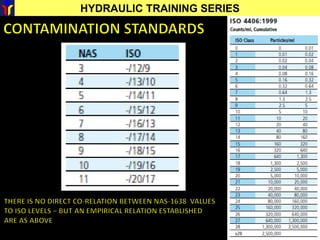
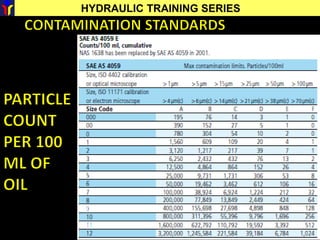
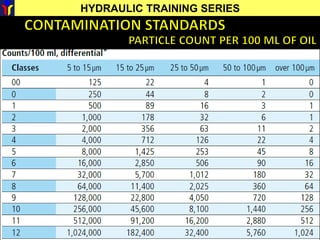
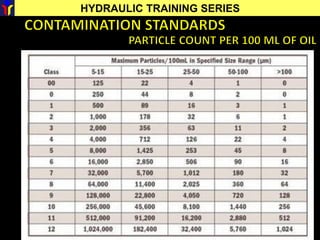
ISO Fluid cleanliness measurements
HYDRAULIC TRAINING SERIES
27
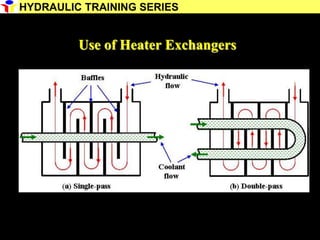
Use of Heater Exchangers
HYDRAULIC TRAINING SERIES
28
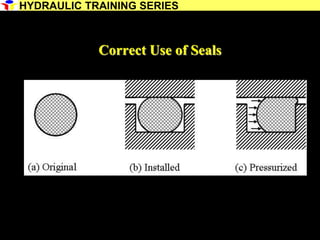
Correct Use of Seals
HYDRAULIC TRAINING SERIES
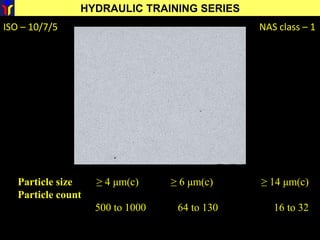
ISO – 10/7/5 NAS class – 1
Particle size ≥ 4 μm(c) ≥ 6 μm(c) ≥ 14 μm(c)
Particle count
500 to 1000 64 to 130 16 to 32
HYDRAULIC TRAINING SERIES
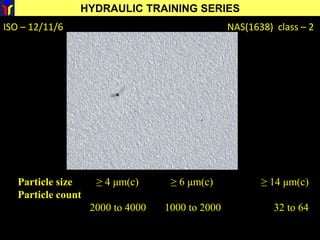
ISO – 12/11/6 NAS(1638) class – 2
Particle size ≥ 4 μm(c) ≥ 6 μm(c) ≥ 14 μm(c)
Particle count
2000 to 4000 1000 to 2000 32 to 64
HYDRAULIC TRAINING SERIES
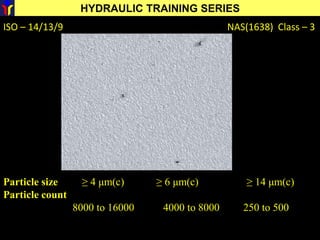
ISO – 14/13/9 NAS(1638) Class – 3
Particle size ≥ 4 μm(c) ≥ 6 μm(c) ≥ 14 μm(c)
Particle count
8000 to 16000 4000 to 8000 250 to 500
HYDRAULIC TRAINING SERIES
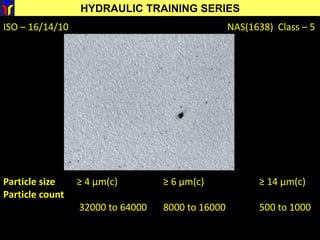
ISO – 16/14/10 NAS(1638) Class – 5
Particle size ≥ 4 μm(c) ≥ 6 μm(c) ≥ 14 μm(c)
Particle count
32000 to 64000 8000 to 16000 500 to 1000
HYDRAULIC TRAINING SERIES
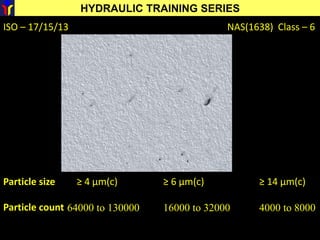
ISO – 17/15/13 NAS(1638) Class – 6
Particle size ≥ 4 μm(c) ≥ 6 μm(c) ≥ 14 μm(c)
Particle count 64000 to 130000 16000 to 32000 4000 to 8000
HYDRAULIC TRAINING SERIES
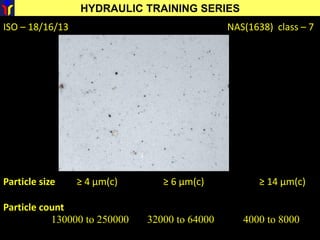
ISO – 18/16/13 NAS(1638) class – 7
Particle size ≥ 4 μm(c) ≥ 6 μm(c) ≥ 14 μm(c)
Particle count
130000 to 250000 32000 to 64000 4000 to 8000
HYDRAULIC TRAINING SERIES
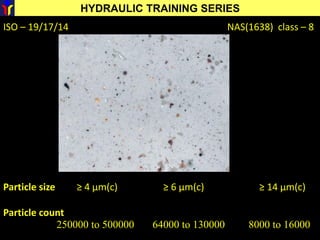
ISO – 19/17/14 NAS(1638) class – 8
Particle size ≥ 4 μm(c) ≥ 6 μm(c) ≥ 14 μm(c)
Particle count
250000 to 500000 64000 to 130000 8000 to 16000
HYDRAULIC TRAINING SERIES
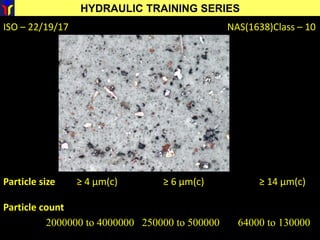
ISO – 22/19/17 NAS(1638)Class – 10
Particle size ≥ 4 μm(c) ≥ 6 μm(c) ≥ 14 μm(c)
Particle count
2000000 to 4000000 250000 to 500000 64000 to 130000
HYDRAULIC TRAINING SERIES
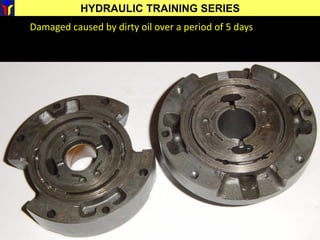
Damaged caused by dirty oil over a period of 5 days
HYDRAULIC TRAINING SERIES
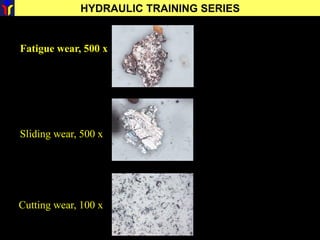
Fatigue wear, 500 x
Sliding wear, 500 x
Cutting wear, 100 x
HYDRAULIC TRAINING SERIES
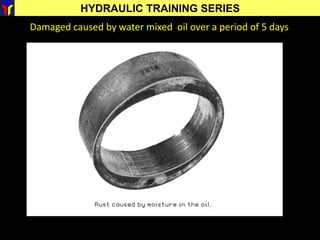
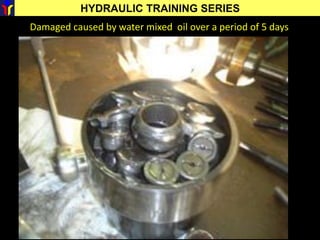
Damaged caused by water mixed oil over a period of 5 days
HYDRAULIC TRAINING SERIES
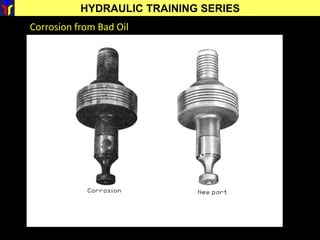
Corrosion from Bad Oil
HYDRAULIC TRAINING SERIES
Damaged caused by water mixed oil over a period of 5 days
HYDRAULIC TRAINING SERIES
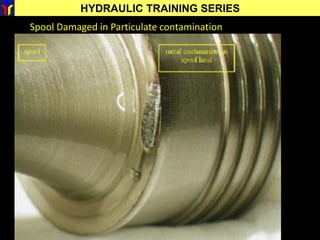
Spool Damaged in Particulate contamination
HYDRAULIC TRAINING SERIES
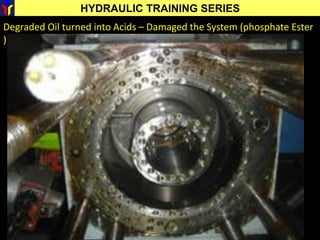
Degraded Oil turned into Acids – Damaged the System (phosphate Ester
)
HYDRAULIC TRAINING SERIES

Oil contamination

  • 1.
    HYDRAULIC TRAINING SERIES Oilcontamination – Booklet
  • 2.
  • 3.
  • 4.
  • 5.
  • 6.
  • 7.
  • 8.
    8 Types of Fluids Hydraulic Fluids Fire Resistant Petroleum basedoils Biological degradable Water- based Water based Synthetic based Vegetable based Synthetic based HYDRAULIC TRAINING SERIES
  • 9.
    9 Basic Requirement forFluids Mobile fluid power systems use mainly liquid fluids, and we are discussing liquid fluids only.  efficient power transmission  effective cooling  reliable lubricating  efficient sealing  effective contaminants removing  compatible with component materials  resistant to foaming  used over wide operating temperature HYDRAULIC TRAINING SERIES
  • 10.
    10 Power Transmission m1 m2 V0V1 V2 Efficient power transmission requires a consistent & reliable response, and optimum efficiency. It requires a “stiff” fluid power system. The “stiffness” of the system is mainly determined by the compressibility of the fluids! HYDRAULIC TRAINING SERIES
  • 11.
    11 Lubrication Lubricants are widelyused in mechanical systems to reduce the friction between components surfaces. In hydraulic systems, many components have relative motion in operation. Hydraulic fluids should be able to provide lubrication in between those surfaces. HYDRAULIC TRAINING SERIES
  • 12.
    12 Sealing Clearances inside hydrauliccomponents cause internal leakage. It relies on the fluid (viscosity) to minimize the leakage across these clearances to improve efficiencies and reduce the production of heat. HYDRAULIC TRAINING SERIES
  • 13.
    13 Contaminants Removal There aredebris in the hydraulic systems due to wearness of the components. It relies on the fluid motion to remove those debris away from the system (especially from the clearances of between the components of moving relatively. HYDRAULIC TRAINING SERIES
  • 14.
    14 Cooling Hydraulic fluids willabsorb and carry away the heat generated in the system (mainly at valves, cylinder and/or motor). --> The fluids act like the coolant in the hydraulic system. The heat must be dissipated in the tank (or sometimes uses a heat exchanger) before it can be reenter the system. HYDRAULIC TRAINING SERIES
  • 15.
    15 Fluid Properties To adequatelycarry out the desired functions of hydraulic fluids, the following are the fluid properties we should pay attention to in selection.  viscosity  lubricating ability  pour point, oxidation resistance  compatibility with system elements  rust/corrosion protection  demulsibility  etc. HYDRAULIC TRAINING SERIES
  • 16.
    16 Fluid Selection The generalcategories of available hydraulic fluids are petroleum oils and fire resistant fluids. Bio-degradable fluids are becoming popular recently. Water hydraulics is a relative new technology.  No single fluids can meet all the requirements.  Lubricating & viscosity are important for mobile systems.  Concerns on environment increased interests in biodegradable oils (required in many European countries).  Fire resistance is important for machinery working at the flammable environment. HYDRAULIC TRAINING SERIES
  • 17.
    17 Viscosity • Viscosity ofa fluid is defined as its resistance to flow at a given temperature. It affects the fluid’s ability to be pumped, transmitted, and its ability of lubricating and sealing. • Both ISO and SAE have established a viscosity grade (number) to specify the ranges of viscosity. cSt@210 F ISO Viscosity Grade 10 20 30 40 50 60 70 80 90 100 110 120 ISOVG100 ISOVG68 ISOVG46 ISOVG32 ISOVG22 SAE Summer # 4 6 8 10 12 14 16 18 20 22 24 26 SAE 50 SAE 40 SAE 30 SAE 20 cSt@40C SAE Winter # 1000 2000 3000 4000 5000 6000 7000 8000 9000 10000 SAE 20W SAE 15W SAE 10W SAE 5W cP@0 F HYDRAULIC TRAINING SERIES
  • 18.
    18 Fluid Conditioning &Devices Fluid conditioning includes:  Fluids storage & preparation  Contamination prevention & control  Temperature control The main fluid conditioning devices include:  Reservoir  Filter  Seals  Cooler HYDRAULIC TRAINING SERIES
  • 19.
    Typical Structure ofReservoirs HYDRAULIC TRAINING SERIES
  • 20.
    Key Functions ofReservoir • Fluids container – Provides a space on the vehicle to store hydraulic fluids. • Fluids cooling device – Discharges heat generated in the fluid power system. • Air separator – Removes as mush air as possible from the fluids. • Debris separator – Filters out debris to prevent possible damages. • Inlet fluid conditioner – Prepares the supplying fluids to the pump with a good inlet condition for maximizing the pump efficiency. HYDRAULIC TRAINING SERIES
  • 21.
    Criteria for Sizinga Reservoirs o Must make allowance for dirt and chips to settle and for air to escape o Must be able to hold all the oil that might drain into it from the system o Must maintain the oil level high enough to prevent a whirlpool effect at the pump inlet line opening o Should have a surface area large enough to dissipate most of the heat generated by the system o Should have adequate air space to allow for thermal expansion of the oil In General: Reservoir size = 3pump flow-rate (gal or L) (GPM or L/min) HYDRAULIC TRAINING SERIES
  • 22.
    22 Types of Contaminations Mostof the times, fluids contamination is the major contributor to failures of hydraulic system.  Solid contamination: It may consists of dirt, metal particles, seal materials, etc. It is the most common cause for failure of mobile hydraulic systems.  Thermal contamination: The useful life of most hydraulic fluids will be significantly reduced by overheat.  Air/gas contamination: Dissolved air affects system stiffness, results in poor performance.  Water contamination: Water will degrade the fluids in numerous ways (max of 700 ppm is allowed). HYDRAULIC TRAINING SERIES
  • 23.
    23 Major Sources ofSolid Contaminations Contamination can be introduced into the system from both external and internal sources.  Built-in contamination: Much of the solid contamination is resulted from the manufacture and assembly of the hydraulic systems.  External contamination: Much of dirt, air, and water contamination is resulted from operating environment.  Internally generated contamination: It mainly caused by the wear (esp. at break-in & wear out periods).  Maintenance contamination: Could be all kinds of contamination due improper maintenance procedure. HYDRAULIC TRAINING SERIES
  • 24.
    24 Typical Hydraulic FluidFilters HYDRAULIC TRAINING SERIES
  • 25.
    25 Definition of FiltrationRating HYDRAULIC TRAINING SERIES
  • 26.
    26 ISO Fluid cleanlinessmeasurements HYDRAULIC TRAINING SERIES
  • 27.
    27 Use of HeaterExchangers HYDRAULIC TRAINING SERIES
  • 28.
    28 Correct Use ofSeals HYDRAULIC TRAINING SERIES
  • 29.
  • 30.
  • 31.
  • 32.
  • 33.
    HYDRAULIC TRAINING SERIES ISO– 10/7/5 NAS class – 1 Particle size ≥ 4 μm(c) ≥ 6 μm(c) ≥ 14 μm(c) Particle count 500 to 1000 64 to 130 16 to 32
  • 34.
    HYDRAULIC TRAINING SERIES ISO– 12/11/6 NAS(1638) class – 2 Particle size ≥ 4 μm(c) ≥ 6 μm(c) ≥ 14 μm(c) Particle count 2000 to 4000 1000 to 2000 32 to 64
  • 35.
    HYDRAULIC TRAINING SERIES ISO– 14/13/9 NAS(1638) Class – 3 Particle size ≥ 4 μm(c) ≥ 6 μm(c) ≥ 14 μm(c) Particle count 8000 to 16000 4000 to 8000 250 to 500
  • 36.
    HYDRAULIC TRAINING SERIES ISO– 16/14/10 NAS(1638) Class – 5 Particle size ≥ 4 μm(c) ≥ 6 μm(c) ≥ 14 μm(c) Particle count 32000 to 64000 8000 to 16000 500 to 1000
  • 37.
    HYDRAULIC TRAINING SERIES ISO– 17/15/13 NAS(1638) Class – 6 Particle size ≥ 4 μm(c) ≥ 6 μm(c) ≥ 14 μm(c) Particle count 64000 to 130000 16000 to 32000 4000 to 8000
  • 38.
    HYDRAULIC TRAINING SERIES ISO– 18/16/13 NAS(1638) class – 7 Particle size ≥ 4 μm(c) ≥ 6 μm(c) ≥ 14 μm(c) Particle count 130000 to 250000 32000 to 64000 4000 to 8000
  • 39.
    HYDRAULIC TRAINING SERIES ISO– 19/17/14 NAS(1638) class – 8 Particle size ≥ 4 μm(c) ≥ 6 μm(c) ≥ 14 μm(c) Particle count 250000 to 500000 64000 to 130000 8000 to 16000
  • 40.
    HYDRAULIC TRAINING SERIES ISO– 22/19/17 NAS(1638)Class – 10 Particle size ≥ 4 μm(c) ≥ 6 μm(c) ≥ 14 μm(c) Particle count 2000000 to 4000000 250000 to 500000 64000 to 130000
  • 41.
    HYDRAULIC TRAINING SERIES Damagedcaused by dirty oil over a period of 5 days
  • 42.
    HYDRAULIC TRAINING SERIES Fatiguewear, 500 x Sliding wear, 500 x Cutting wear, 100 x
  • 43.
    HYDRAULIC TRAINING SERIES Damagedcaused by water mixed oil over a period of 5 days
  • 44.
  • 45.
    HYDRAULIC TRAINING SERIES Damagedcaused by water mixed oil over a period of 5 days
  • 46.
    HYDRAULIC TRAINING SERIES SpoolDamaged in Particulate contamination
  • 47.
    HYDRAULIC TRAINING SERIES DegradedOil turned into Acids – Damaged the System (phosphate Ester )
  • 48.