04/04/17 1
CS 332 - Algorithms
Dynamic programming
0-1 Knapsack problem
04/04/17 2
Review: Dynamic programming
DP is a method for solving certain kind of
problems
DP can be applied when the solution of a
problem includes solutions to subproblems
We need to find a recursive formula for the
solution
We can recursively solve subproblems,
starting from the trivial case, and save their
solutions in memory
In the end we’ll get the solution of the
whole problem
04/04/17 3
Properties of a problem that can be
solved with dynamic programming
Simple Subproblems
– We should be able to break the original
problem to smaller subproblems that have the
same structure
Optimal Substructure of the problems
– The solution to the problem must be a
composition of subproblem solutions
Subproblem Overlap
– Optimal subproblems to unrelated problems can
contain subproblems in common
04/04/17 4
Review: Longest Common
Subsequence (LCS)
Problem: how to find the longest pattern of
characters that is common to two text
strings X and Y
Dynamic programming algorithm: solve
subproblems until we get the final solution
Subproblem: first find the LCS of prefixes
of X and Y.
this problem has optimal substructure: LCS
of two prefixes is always a part of LCS of
bigger strings
04/04/17 5
Review: Longest Common
Subsequence (LCS) continued
Define Xi, Yj to be prefixes of X and Y of
length i and j; m = |X|, n = |Y|
We store the length of LCS(Xi, Yj) in c[i,j]
Trivial cases: LCS(X0 , Yj ) and LCS(Xi, Y0)
is empty (so c[0,j] = c[i,0] = 0 )
Recursive formula for c[i,j]:



−−
=+−−
=
otherwise]),1[],1,[max(
],[][if1]1,1[
],[
jicjic
jyixjic
jic
c[m,n] is the final solution
04/04/17 6
Review: Longest Common
Subsequence (LCS)
After we have filled the array c[ ], we can
use this data to find the characters that
constitute the Longest Common
Subsequence
Algorithm runs in O(m*n), which is much
better than the brute-force algorithm: O(n
2m
)
04/04/17 7
0-1 Knapsack problem
Given a knapsack with maximum capacity
W, and a set S consisting of n items
Each item i has some weight wi and benefit
value bi (all wi , biand W are integer values)
Problem: How to pack the knapsack to
achieve maximum total value of packed
items?
04/04/17 8
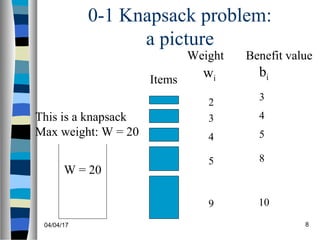
0-1 Knapsack problem:
a picture
W = 20
wi
bi
109
85
54
43
3
2
Weight Benefit value
This is a knapsack
Max weight: W = 20
Items
04/04/17 9
0-1 Knapsack problem
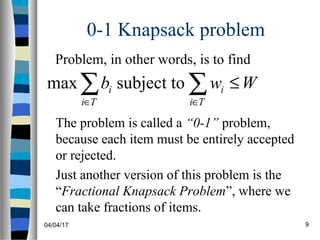
Problem, in other words, is to find
∑∑ ∈∈
≤
Ti
i
Ti
i Wwb subject tomax
The problem is called a “0-1” problem,
because each item must be entirely accepted
or rejected.
Just another version of this problem is the
“Fractional Knapsack Problem”, where we
can take fractions of items.
04/04/17 10
0-1 Knapsack problem: brute-
force approach
Let’s first solve this problem with a
straightforward algorithm
Since there are n items, there are 2n
possible
combinations of items.
We go through all combinations and find
the one with the most total value and with
total weight less or equal to W
Running time will be O(2n
)
04/04/17 11
0-1 Knapsack problem: brute-
force approach
Can we do better?
Yes, with an algorithm based on dynamic
programming
We need to carefully identify the
subproblems
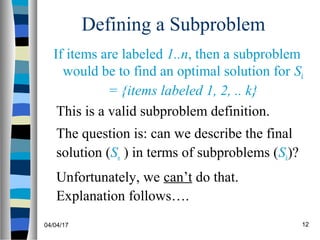
Let’s try this:
If items are labeled 1..n, then a subproblem
would be to find an optimal solution for
Sk = {items labeled 1, 2, .. k}
04/04/17 12
Defining a Subproblem
If items are labeled 1..n, then a subproblem
would be to find an optimal solution for Sk
= {items labeled 1, 2, .. k}
This is a valid subproblem definition.
The question is: can we describe the final
solution (Sn ) in terms of subproblems (Sk)?
Unfortunately, we can’t do that.
Explanation follows….
04/04/17 13
Defining a Subproblem
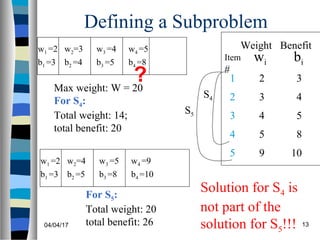
Max weight: W = 20
For S4:
Total weight: 14;
total benefit: 20
w1 =2
b1 =3
w2=3
b2 =4
w3 =4
b3 =5
w4 =5
b4 =8 wi bi
10
85
54
43
32
Weight Benefit
9
Item
#
4
3
2
1
5
S4
S5
w1 =2
b1 =3
w2=4
b2 =5
w3 =5
b3 =8
w4 =9
b4 =10
For S5:
Total weight: 20
total benefit: 26
Solution for S4 is
not part of the
solution for S5!!!
?
04/04/17 14
Defining a Subproblem
(continued)
As we have seen, the solution for S4 is not
part of the solution for S5
So our definition of a subproblem is flawed
and we need another one!
Let’s add another parameter: w, which will
represent the exact weight for each subset
of items
The subproblem then will be to compute
B[k,w]
04/04/17 15
Recursive Formula for
subproblems
It means, that the best subset of Sk that has
total weight w is one of the two:
1) the best subset of Sk-1 that has total weight
w, or
2) the best subset of Sk-1 that has total weight
w-wk plus the item k



+−−−
>−
=
else}],1[],,1[max{
if],1[
],[
kk
k
bwwkBwkB
wwwkB
wkB
Recursive formula for subproblems:
04/04/17 16
Recursive Formula
The best subset of Sk that has the total
weight w, either contains item k or not.
First case: wk>w. Item k can’t be part of the
solution, since if it was, the total weight
would be > w, which is unacceptable
Second case: wk <=w. Then the item k can
be in the solution, and we choose the case
with greater value



+−−−
>−
=
else}],1[],,1[max{
if],1[
],[
kk
k
bwwkBwkB
wwwkB
wkB
04/04/17 17
0-1 Knapsack Algorithm
for w = 0 to W
B[0,w] = 0
for i = 0 to n
B[i,0] = 0
for w = 0 to W
if wi <= w // item i can be part of the solution
if bi + B[i-1,w-wi] > B[i-1,w]
B[i,w] = bi + B[i-1,w- wi]
else
B[i,w] = B[i-1,w]
else B[i,w] = B[i-1,w] // wi > w
04/04/17 18
Running time
for w = 0 to W
B[0,w] = 0
for i = 0 to n
B[i,0] = 0
for w = 0 to W
< the rest of the code >
What is the running time of this
algorithm?
O(W)
O(W)
Repeat n times
O(n*W)
Remember that the brute-force algorithm
takes O(2n
)
04/04/17 19
Example
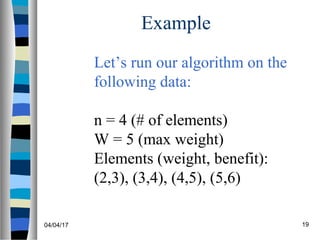
Let’s run our algorithm on the
following data:
n = 4 (# of elements)
W = 5 (max weight)
Elements (weight, benefit):
(2,3), (3,4), (4,5), (5,6)
04/04/17 20
Example (2)
for w = 0 to W
B[0,w] = 0
0
0
0
0
0
0
W
0
1
2
3
4
5
i 0 1 2 3
4
04/04/17 21
Example (3)
for i = 0 to n
B[i,0] = 0
0
0
0
0
0
0
W
0
1
2
3
4
5
i 0 1 2 3
0 0 0 0
4
04/04/17 22
Example (4)
if wi <= w // item i can be part of the solution
if bi + B[i-1,w-wi] > B[i-1,w]
B[i,w] = bi + B[i-1,w- wi]
else
B[i,w] = B[i-1,w]
else B[i,w] = B[i-1,w] // wi > w
0
0
0
0
0
0
W
0
1
2
3
4
5
i 0 1 2 3
0 0 0 0
i=1
bi=3
wi=2
w=1
w-wi =-1
Items:
1: (2,3)
2: (3,4)
3: (4,5)
4: (5,6)
4
0
04/04/17 23
Example (5)
if wi <= w // item i can be part of the solution
if bi + B[i-1,w-wi] > B[i-1,w]
B[i,w] = bi + B[i-1,w- wi]
else
B[i,w] = B[i-1,w]
else B[i,w] = B[i-1,w] // wi > w
0
0
0
0
0
0
W
0
1
2
3
4
5
i 0 1 2 3
0 0 0 0
i=1
bi=3
wi=2
w=2
w-wi =0
Items:
1: (2,3)
2: (3,4)
3: (4,5)
4: (5,6)
4
0
3
04/04/17 24
Example (6)
if wi <= w // item i can be part of the solution
if bi + B[i-1,w-wi] > B[i-1,w]
B[i,w] = bi + B[i-1,w- wi]
else
B[i,w] = B[i-1,w]
else B[i,w] = B[i-1,w] // wi > w
0
0
0
0
0
0
W
0
1
2
3
4
5
i 0 1 2 3
0 0 0 0
i=1
bi=3
wi=2
w=3
w-wi=1
Items:
1: (2,3)
2: (3,4)
3: (4,5)
4: (5,6)
4
0
3
3
04/04/17 25
Example (7)
if wi <= w // item i can be part of the solution
if bi + B[i-1,w-wi] > B[i-1,w]
B[i,w] = bi + B[i-1,w- wi]
else
B[i,w] = B[i-1,w]
else B[i,w] = B[i-1,w] // wi > w
0
0
0
0
0
0
W
0
1
2
3
4
5
i 0 1 2 3
0 0 0 0
i=1
bi=3
wi=2
w=4
w-wi=2
Items:
1: (2,3)
2: (3,4)
3: (4,5)
4: (5,6)
4
0
3
3
3
04/04/17 26
Example (8)
if wi <= w // item i can be part of the solution
if bi + B[i-1,w-wi] > B[i-1,w]
B[i,w] = bi + B[i-1,w- wi]
else
B[i,w] = B[i-1,w]
else B[i,w] = B[i-1,w] // wi > w
0
0
0
0
0
0
W
0
1
2
3
4
5
i 0 1 2 3
0 0 0 0
i=1
bi=3
wi=2
w=5
w-wi=2
Items:
1: (2,3)
2: (3,4)
3: (4,5)
4: (5,6)
4
0
3
3
3
3
04/04/17 27
Example (9)
if wi <= w // item i can be part of the solution
if bi + B[i-1,w-wi] > B[i-1,w]
B[i,w] = bi + B[i-1,w- wi]
else
B[i,w] = B[i-1,w]
else B[i,w] = B[i-1,w] // wi > w
0
0
0
0
0
0
W
0
1
2
3
4
5
i 0 1 2 3
0 0 0 0
i=2
bi=4
wi=3
w=1
w-wi=-2
Items:
1: (2,3)
2: (3,4)
3: (4,5)
4: (5,6)
4
0
3
3
3
3
0
04/04/17 28
Example (10)
if wi <= w // item i can be part of the solution
if bi + B[i-1,w-wi] > B[i-1,w]
B[i,w] = bi + B[i-1,w- wi]
else
B[i,w] = B[i-1,w]
else B[i,w] = B[i-1,w] // wi > w
0
0
0
0
0
0
W
0
1
2
3
4
5
i 0 1 2 3
0 0 0 0
i=2
bi=4
wi=3
w=2
w-wi=-1
Items:
1: (2,3)
2: (3,4)
3: (4,5)
4: (5,6)
4
0
3
3
3
3
0
3
04/04/17 29
Example (11)
if wi <= w // item i can be part of the solution
if bi + B[i-1,w-wi] > B[i-1,w]
B[i,w] = bi + B[i-1,w- wi]
else
B[i,w] = B[i-1,w]
else B[i,w] = B[i-1,w] // wi > w
0
0
0
0
0
0
W
0
1
2
3
4
5
i 0 1 2 3
0 0 0 0
i=2
bi=4
wi=3
w=3
w-wi=0
Items:
1: (2,3)
2: (3,4)
3: (4,5)
4: (5,6)
4
0
3
3
3
3
0
3
4
04/04/17 30
Example (12)
if wi <= w // item i can be part of the solution
if bi + B[i-1,w-wi] > B[i-1,w]
B[i,w] = bi + B[i-1,w- wi]
else
B[i,w] = B[i-1,w]
else B[i,w] = B[i-1,w] // wi > w
0
0
0
0
0
0
W
0
1
2
3
4
5
i 0 1 2 3
0 0 0 0
i=2
bi=4
wi=3
w=4
w-wi=1
Items:
1: (2,3)
2: (3,4)
3: (4,5)
4: (5,6)
4
0
3
3
3
3
0
3
4
4
04/04/17 31
Example (13)
if wi <= w // item i can be part of the solution
if bi + B[i-1,w-wi] > B[i-1,w]
B[i,w] = bi + B[i-1,w- wi]
else
B[i,w] = B[i-1,w]
else B[i,w] = B[i-1,w] // wi > w
0
0
0
0
0
0
W
0
1
2
3
4
5
i 0 1 2 3
0 0 0 0
i=2
bi=4
wi=3
w=5
w-wi=2
Items:
1: (2,3)
2: (3,4)
3: (4,5)
4: (5,6)
4
0
3
3
3
3
0
3
4
4
7
04/04/17 32
Example (14)
if wi <= w // item i can be part of the solution
if bi + B[i-1,w-wi] > B[i-1,w]
B[i,w] = bi + B[i-1,w- wi]
else
B[i,w] = B[i-1,w]
else B[i,w] = B[i-1,w] // wi > w
0
0
0
0
0
0
W
0
1
2
3
4
5
i 0 1 2 3
0 0 0 0
i=3
bi=5
wi=4
w=1..3
Items:
1: (2,3)
2: (3,4)
3: (4,5)
4: (5,6)
4
0
3
3
3
3
00
3
4
4
7
0
3
4
04/04/17 33
Example (15)
if wi <= w // item i can be part of the solution
if bi + B[i-1,w-wi] > B[i-1,w]
B[i,w] = bi + B[i-1,w- wi]
else
B[i,w] = B[i-1,w]
else B[i,w] = B[i-1,w] // wi > w
0
0
0
0
0
0
W
0
1
2
3
4
5
i 0 1 2 3
0 0 0 0
i=3
bi=5
wi=4
w=4
w- wi=0
Items:
1: (2,3)
2: (3,4)
3: (4,5)
4: (5,6)
4
0 00
3
4
4
7
0
3
4
5
3
3
3
3
04/04/17 34
Example (15)
if wi <= w // item i can be part of the solution
if bi + B[i-1,w-wi] > B[i-1,w]
B[i,w] = bi + B[i-1,w- wi]
else
B[i,w] = B[i-1,w]
else B[i,w] = B[i-1,w] // wi > w
0
0
0
0
0
0
W
0
1
2
3
4
5
i 0 1 2 3
0 0 0 0
i=3
bi=5
wi=4
w=5
w- wi=1
Items:
1: (2,3)
2: (3,4)
3: (4,5)
4: (5,6)
4
0 00
3
4
4
7
0
3
4
5
7
3
3
3
3
04/04/17 35
Example (16)
if wi <= w // item i can be part of the solution
if bi + B[i-1,w-wi] > B[i-1,w]
B[i,w] = bi + B[i-1,w- wi]
else
B[i,w] = B[i-1,w]
else B[i,w] = B[i-1,w] // wi > w
0
0
0
0
0
0
W
0
1
2
3
4
5
i 0 1 2 3
0 0 0 0
i=3
bi=5
wi=4
w=1..4
Items:
1: (2,3)
2: (3,4)
3: (4,5)
4: (5,6)
4
0 00
3
4
4
7
0
3
4
5
7
0
3
4
5
3
3
3
3
04/04/17 36
Example (17)
if wi <= w // item i can be part of the solution
if bi + B[i-1,w-wi] > B[i-1,w]
B[i,w] = bi + B[i-1,w- wi]
else
B[i,w] = B[i-1,w]
else B[i,w] = B[i-1,w] // wi > w
0
0
0
0
0
0
W
0
1
2
3
4
5
i 0 1 2 3
0 0 0 0
i=3
bi=5
wi=4
w=5
Items:
1: (2,3)
2: (3,4)
3: (4,5)
4: (5,6)
4
0 00
3
4
4
7
0
3
4
5
7
0
3
4
5
7
3
3
3
3
04/04/17 37
Comments
This algorithm only finds the max possible
value that can be carried in the knapsack
To know the items that make this maximum
value, an addition to this algorithm is
necessary
Please see LCS algorithm from the previous
lecture for the example how to extract this
data from the table we built
04/04/17 38
Conclusion
Dynamic programming is a useful
technique of solving certain kind of
problems
When the solution can be recursively
described in terms of partial solutions, we
can store these partial solutions and re-use
them as necessary
Running time (Dynamic Programming
algorithm vs. naïve algorithm):
– LCS: O(m*n) vs. O(n * 2m
)
– 0-1 Knapsack problem: O(W*n) vs. O(2n
)
04/04/17 39
The End

0/1 knapsack

  • 1.
    04/04/17 1 CS 332- Algorithms Dynamic programming 0-1 Knapsack problem
  • 2.
    04/04/17 2 Review: Dynamicprogramming DP is a method for solving certain kind of problems DP can be applied when the solution of a problem includes solutions to subproblems We need to find a recursive formula for the solution We can recursively solve subproblems, starting from the trivial case, and save their solutions in memory In the end we’ll get the solution of the whole problem
  • 3.
    04/04/17 3 Properties ofa problem that can be solved with dynamic programming Simple Subproblems – We should be able to break the original problem to smaller subproblems that have the same structure Optimal Substructure of the problems – The solution to the problem must be a composition of subproblem solutions Subproblem Overlap – Optimal subproblems to unrelated problems can contain subproblems in common
  • 4.
    04/04/17 4 Review: LongestCommon Subsequence (LCS) Problem: how to find the longest pattern of characters that is common to two text strings X and Y Dynamic programming algorithm: solve subproblems until we get the final solution Subproblem: first find the LCS of prefixes of X and Y. this problem has optimal substructure: LCS of two prefixes is always a part of LCS of bigger strings
  • 5.
    04/04/17 5 Review: LongestCommon Subsequence (LCS) continued Define Xi, Yj to be prefixes of X and Y of length i and j; m = |X|, n = |Y| We store the length of LCS(Xi, Yj) in c[i,j] Trivial cases: LCS(X0 , Yj ) and LCS(Xi, Y0) is empty (so c[0,j] = c[i,0] = 0 ) Recursive formula for c[i,j]:    −− =+−− = otherwise]),1[],1,[max( ],[][if1]1,1[ ],[ jicjic jyixjic jic c[m,n] is the final solution
  • 6.
    04/04/17 6 Review: LongestCommon Subsequence (LCS) After we have filled the array c[ ], we can use this data to find the characters that constitute the Longest Common Subsequence Algorithm runs in O(m*n), which is much better than the brute-force algorithm: O(n 2m )
  • 7.
    04/04/17 7 0-1 Knapsackproblem Given a knapsack with maximum capacity W, and a set S consisting of n items Each item i has some weight wi and benefit value bi (all wi , biand W are integer values) Problem: How to pack the knapsack to achieve maximum total value of packed items?
  • 8.
    04/04/17 8 0-1 Knapsackproblem: a picture W = 20 wi bi 109 85 54 43 3 2 Weight Benefit value This is a knapsack Max weight: W = 20 Items
  • 9.
    04/04/17 9 0-1 Knapsackproblem Problem, in other words, is to find ∑∑ ∈∈ ≤ Ti i Ti i Wwb subject tomax The problem is called a “0-1” problem, because each item must be entirely accepted or rejected. Just another version of this problem is the “Fractional Knapsack Problem”, where we can take fractions of items.
  • 10.
    04/04/17 10 0-1 Knapsackproblem: brute- force approach Let’s first solve this problem with a straightforward algorithm Since there are n items, there are 2n possible combinations of items. We go through all combinations and find the one with the most total value and with total weight less or equal to W Running time will be O(2n )
  • 11.
    04/04/17 11 0-1 Knapsackproblem: brute- force approach Can we do better? Yes, with an algorithm based on dynamic programming We need to carefully identify the subproblems Let’s try this: If items are labeled 1..n, then a subproblem would be to find an optimal solution for Sk = {items labeled 1, 2, .. k}
  • 12.
    04/04/17 12 Defining aSubproblem If items are labeled 1..n, then a subproblem would be to find an optimal solution for Sk = {items labeled 1, 2, .. k} This is a valid subproblem definition. The question is: can we describe the final solution (Sn ) in terms of subproblems (Sk)? Unfortunately, we can’t do that. Explanation follows….
  • 13.
    04/04/17 13 Defining aSubproblem Max weight: W = 20 For S4: Total weight: 14; total benefit: 20 w1 =2 b1 =3 w2=3 b2 =4 w3 =4 b3 =5 w4 =5 b4 =8 wi bi 10 85 54 43 32 Weight Benefit 9 Item # 4 3 2 1 5 S4 S5 w1 =2 b1 =3 w2=4 b2 =5 w3 =5 b3 =8 w4 =9 b4 =10 For S5: Total weight: 20 total benefit: 26 Solution for S4 is not part of the solution for S5!!! ?
  • 14.
    04/04/17 14 Defining aSubproblem (continued) As we have seen, the solution for S4 is not part of the solution for S5 So our definition of a subproblem is flawed and we need another one! Let’s add another parameter: w, which will represent the exact weight for each subset of items The subproblem then will be to compute B[k,w]
  • 15.
    04/04/17 15 Recursive Formulafor subproblems It means, that the best subset of Sk that has total weight w is one of the two: 1) the best subset of Sk-1 that has total weight w, or 2) the best subset of Sk-1 that has total weight w-wk plus the item k    +−−− >− = else}],1[],,1[max{ if],1[ ],[ kk k bwwkBwkB wwwkB wkB Recursive formula for subproblems:
  • 16.
    04/04/17 16 Recursive Formula Thebest subset of Sk that has the total weight w, either contains item k or not. First case: wk>w. Item k can’t be part of the solution, since if it was, the total weight would be > w, which is unacceptable Second case: wk <=w. Then the item k can be in the solution, and we choose the case with greater value    +−−− >− = else}],1[],,1[max{ if],1[ ],[ kk k bwwkBwkB wwwkB wkB
  • 17.
    04/04/17 17 0-1 KnapsackAlgorithm for w = 0 to W B[0,w] = 0 for i = 0 to n B[i,0] = 0 for w = 0 to W if wi <= w // item i can be part of the solution if bi + B[i-1,w-wi] > B[i-1,w] B[i,w] = bi + B[i-1,w- wi] else B[i,w] = B[i-1,w] else B[i,w] = B[i-1,w] // wi > w
  • 18.
    04/04/17 18 Running time forw = 0 to W B[0,w] = 0 for i = 0 to n B[i,0] = 0 for w = 0 to W < the rest of the code > What is the running time of this algorithm? O(W) O(W) Repeat n times O(n*W) Remember that the brute-force algorithm takes O(2n )
  • 19.
    04/04/17 19 Example Let’s runour algorithm on the following data: n = 4 (# of elements) W = 5 (max weight) Elements (weight, benefit): (2,3), (3,4), (4,5), (5,6)
  • 20.
    04/04/17 20 Example (2) forw = 0 to W B[0,w] = 0 0 0 0 0 0 0 W 0 1 2 3 4 5 i 0 1 2 3 4
  • 21.
    04/04/17 21 Example (3) fori = 0 to n B[i,0] = 0 0 0 0 0 0 0 W 0 1 2 3 4 5 i 0 1 2 3 0 0 0 0 4
  • 22.
    04/04/17 22 Example (4) ifwi <= w // item i can be part of the solution if bi + B[i-1,w-wi] > B[i-1,w] B[i,w] = bi + B[i-1,w- wi] else B[i,w] = B[i-1,w] else B[i,w] = B[i-1,w] // wi > w 0 0 0 0 0 0 W 0 1 2 3 4 5 i 0 1 2 3 0 0 0 0 i=1 bi=3 wi=2 w=1 w-wi =-1 Items: 1: (2,3) 2: (3,4) 3: (4,5) 4: (5,6) 4 0
  • 23.
    04/04/17 23 Example (5) ifwi <= w // item i can be part of the solution if bi + B[i-1,w-wi] > B[i-1,w] B[i,w] = bi + B[i-1,w- wi] else B[i,w] = B[i-1,w] else B[i,w] = B[i-1,w] // wi > w 0 0 0 0 0 0 W 0 1 2 3 4 5 i 0 1 2 3 0 0 0 0 i=1 bi=3 wi=2 w=2 w-wi =0 Items: 1: (2,3) 2: (3,4) 3: (4,5) 4: (5,6) 4 0 3
  • 24.
    04/04/17 24 Example (6) ifwi <= w // item i can be part of the solution if bi + B[i-1,w-wi] > B[i-1,w] B[i,w] = bi + B[i-1,w- wi] else B[i,w] = B[i-1,w] else B[i,w] = B[i-1,w] // wi > w 0 0 0 0 0 0 W 0 1 2 3 4 5 i 0 1 2 3 0 0 0 0 i=1 bi=3 wi=2 w=3 w-wi=1 Items: 1: (2,3) 2: (3,4) 3: (4,5) 4: (5,6) 4 0 3 3
  • 25.
    04/04/17 25 Example (7) ifwi <= w // item i can be part of the solution if bi + B[i-1,w-wi] > B[i-1,w] B[i,w] = bi + B[i-1,w- wi] else B[i,w] = B[i-1,w] else B[i,w] = B[i-1,w] // wi > w 0 0 0 0 0 0 W 0 1 2 3 4 5 i 0 1 2 3 0 0 0 0 i=1 bi=3 wi=2 w=4 w-wi=2 Items: 1: (2,3) 2: (3,4) 3: (4,5) 4: (5,6) 4 0 3 3 3
  • 26.
    04/04/17 26 Example (8) ifwi <= w // item i can be part of the solution if bi + B[i-1,w-wi] > B[i-1,w] B[i,w] = bi + B[i-1,w- wi] else B[i,w] = B[i-1,w] else B[i,w] = B[i-1,w] // wi > w 0 0 0 0 0 0 W 0 1 2 3 4 5 i 0 1 2 3 0 0 0 0 i=1 bi=3 wi=2 w=5 w-wi=2 Items: 1: (2,3) 2: (3,4) 3: (4,5) 4: (5,6) 4 0 3 3 3 3
  • 27.
    04/04/17 27 Example (9) ifwi <= w // item i can be part of the solution if bi + B[i-1,w-wi] > B[i-1,w] B[i,w] = bi + B[i-1,w- wi] else B[i,w] = B[i-1,w] else B[i,w] = B[i-1,w] // wi > w 0 0 0 0 0 0 W 0 1 2 3 4 5 i 0 1 2 3 0 0 0 0 i=2 bi=4 wi=3 w=1 w-wi=-2 Items: 1: (2,3) 2: (3,4) 3: (4,5) 4: (5,6) 4 0 3 3 3 3 0
  • 28.
    04/04/17 28 Example (10) ifwi <= w // item i can be part of the solution if bi + B[i-1,w-wi] > B[i-1,w] B[i,w] = bi + B[i-1,w- wi] else B[i,w] = B[i-1,w] else B[i,w] = B[i-1,w] // wi > w 0 0 0 0 0 0 W 0 1 2 3 4 5 i 0 1 2 3 0 0 0 0 i=2 bi=4 wi=3 w=2 w-wi=-1 Items: 1: (2,3) 2: (3,4) 3: (4,5) 4: (5,6) 4 0 3 3 3 3 0 3
  • 29.
    04/04/17 29 Example (11) ifwi <= w // item i can be part of the solution if bi + B[i-1,w-wi] > B[i-1,w] B[i,w] = bi + B[i-1,w- wi] else B[i,w] = B[i-1,w] else B[i,w] = B[i-1,w] // wi > w 0 0 0 0 0 0 W 0 1 2 3 4 5 i 0 1 2 3 0 0 0 0 i=2 bi=4 wi=3 w=3 w-wi=0 Items: 1: (2,3) 2: (3,4) 3: (4,5) 4: (5,6) 4 0 3 3 3 3 0 3 4
  • 30.
    04/04/17 30 Example (12) ifwi <= w // item i can be part of the solution if bi + B[i-1,w-wi] > B[i-1,w] B[i,w] = bi + B[i-1,w- wi] else B[i,w] = B[i-1,w] else B[i,w] = B[i-1,w] // wi > w 0 0 0 0 0 0 W 0 1 2 3 4 5 i 0 1 2 3 0 0 0 0 i=2 bi=4 wi=3 w=4 w-wi=1 Items: 1: (2,3) 2: (3,4) 3: (4,5) 4: (5,6) 4 0 3 3 3 3 0 3 4 4
  • 31.
    04/04/17 31 Example (13) ifwi <= w // item i can be part of the solution if bi + B[i-1,w-wi] > B[i-1,w] B[i,w] = bi + B[i-1,w- wi] else B[i,w] = B[i-1,w] else B[i,w] = B[i-1,w] // wi > w 0 0 0 0 0 0 W 0 1 2 3 4 5 i 0 1 2 3 0 0 0 0 i=2 bi=4 wi=3 w=5 w-wi=2 Items: 1: (2,3) 2: (3,4) 3: (4,5) 4: (5,6) 4 0 3 3 3 3 0 3 4 4 7
  • 32.
    04/04/17 32 Example (14) ifwi <= w // item i can be part of the solution if bi + B[i-1,w-wi] > B[i-1,w] B[i,w] = bi + B[i-1,w- wi] else B[i,w] = B[i-1,w] else B[i,w] = B[i-1,w] // wi > w 0 0 0 0 0 0 W 0 1 2 3 4 5 i 0 1 2 3 0 0 0 0 i=3 bi=5 wi=4 w=1..3 Items: 1: (2,3) 2: (3,4) 3: (4,5) 4: (5,6) 4 0 3 3 3 3 00 3 4 4 7 0 3 4
  • 33.
    04/04/17 33 Example (15) ifwi <= w // item i can be part of the solution if bi + B[i-1,w-wi] > B[i-1,w] B[i,w] = bi + B[i-1,w- wi] else B[i,w] = B[i-1,w] else B[i,w] = B[i-1,w] // wi > w 0 0 0 0 0 0 W 0 1 2 3 4 5 i 0 1 2 3 0 0 0 0 i=3 bi=5 wi=4 w=4 w- wi=0 Items: 1: (2,3) 2: (3,4) 3: (4,5) 4: (5,6) 4 0 00 3 4 4 7 0 3 4 5 3 3 3 3
  • 34.
    04/04/17 34 Example (15) ifwi <= w // item i can be part of the solution if bi + B[i-1,w-wi] > B[i-1,w] B[i,w] = bi + B[i-1,w- wi] else B[i,w] = B[i-1,w] else B[i,w] = B[i-1,w] // wi > w 0 0 0 0 0 0 W 0 1 2 3 4 5 i 0 1 2 3 0 0 0 0 i=3 bi=5 wi=4 w=5 w- wi=1 Items: 1: (2,3) 2: (3,4) 3: (4,5) 4: (5,6) 4 0 00 3 4 4 7 0 3 4 5 7 3 3 3 3
  • 35.
    04/04/17 35 Example (16) ifwi <= w // item i can be part of the solution if bi + B[i-1,w-wi] > B[i-1,w] B[i,w] = bi + B[i-1,w- wi] else B[i,w] = B[i-1,w] else B[i,w] = B[i-1,w] // wi > w 0 0 0 0 0 0 W 0 1 2 3 4 5 i 0 1 2 3 0 0 0 0 i=3 bi=5 wi=4 w=1..4 Items: 1: (2,3) 2: (3,4) 3: (4,5) 4: (5,6) 4 0 00 3 4 4 7 0 3 4 5 7 0 3 4 5 3 3 3 3
  • 36.
    04/04/17 36 Example (17) ifwi <= w // item i can be part of the solution if bi + B[i-1,w-wi] > B[i-1,w] B[i,w] = bi + B[i-1,w- wi] else B[i,w] = B[i-1,w] else B[i,w] = B[i-1,w] // wi > w 0 0 0 0 0 0 W 0 1 2 3 4 5 i 0 1 2 3 0 0 0 0 i=3 bi=5 wi=4 w=5 Items: 1: (2,3) 2: (3,4) 3: (4,5) 4: (5,6) 4 0 00 3 4 4 7 0 3 4 5 7 0 3 4 5 7 3 3 3 3
  • 37.
    04/04/17 37 Comments This algorithmonly finds the max possible value that can be carried in the knapsack To know the items that make this maximum value, an addition to this algorithm is necessary Please see LCS algorithm from the previous lecture for the example how to extract this data from the table we built
  • 38.
    04/04/17 38 Conclusion Dynamic programmingis a useful technique of solving certain kind of problems When the solution can be recursively described in terms of partial solutions, we can store these partial solutions and re-use them as necessary Running time (Dynamic Programming algorithm vs. naïve algorithm): – LCS: O(m*n) vs. O(n * 2m ) – 0-1 Knapsack problem: O(W*n) vs. O(2n )
  • 39.