Presented By :
Gavali Priyanka Shashikant
M . Pharmacy 2st Semister
Department Of Pharmaceutics
Appasaheb Birnale College Of
Pharmacy, Sangli .
1
 Definition and concept
 Objective and mechanism
 Granulation characteristic
 Technique for granulation process
 Direct compression
 Dry compression
 Wet granulation
 Novel techniques of granulation
 Conclusion 2
INTRODUCTION :DEFINITION AND CONCEPT
 A process whereby small particles gathered into large,
permanent masses in which the original particles can still be
identified.
 ‘‘Granulation is a part procedure with little fine particle be
agglomerate in big entity call granule.
 Granulation is Joining particles within a given granulation
process will improve flow and compression characteristics,
reduce segregation, improve content uniformity, and eliminate
excessive amounts of fine particles.
 The results will be improved yields, reduced tablet defects,
increased productivity, and reduced down time. The ability to
produce reproducible tablet , batch to batch, lot to lot, is
directly treated to the ability to produce reproducible
granulation.
3
 Granulation be a single mostly significant component
operation into manufacturing of oral dosage forms in
pharmaceutical industry.
 The result be there better yield, reduced drug defects and
improved efficiency.
 Pharmaceutical production be process all over the earth use
a direct-compression, dry-granulation and wet granulation
techniques.
 Which technique be selected depend going on ingredient
character with capability to correctly run, disintegrate,
compress with eject.
 Decide a technique require systematic examination of every
element within the method, mixture of ingredient, also job
by everyone. The correct granulation procedure is apply.
4
OBJECTIVE & MECHANISM
 The objective of the granulation process is to combine
ingredients to produce a quality tablet.
 Granulation is process of collecting particles together by
creating bonds between then and these bonds are formed
by compression or by using a binding agent.
 Particles-particles bonding mechanisms involved in
adhesion and cohesion of particles.
 Several forces that can be act : Valency, Vander waals
forces and electrostatic forces.
 In wet granulation
 Liquid bridges developed between particles with tensile
strength. Surface tension forces and capillary pressure
are primarily responsible for initial granulation and
strength.
5
MECHANISM
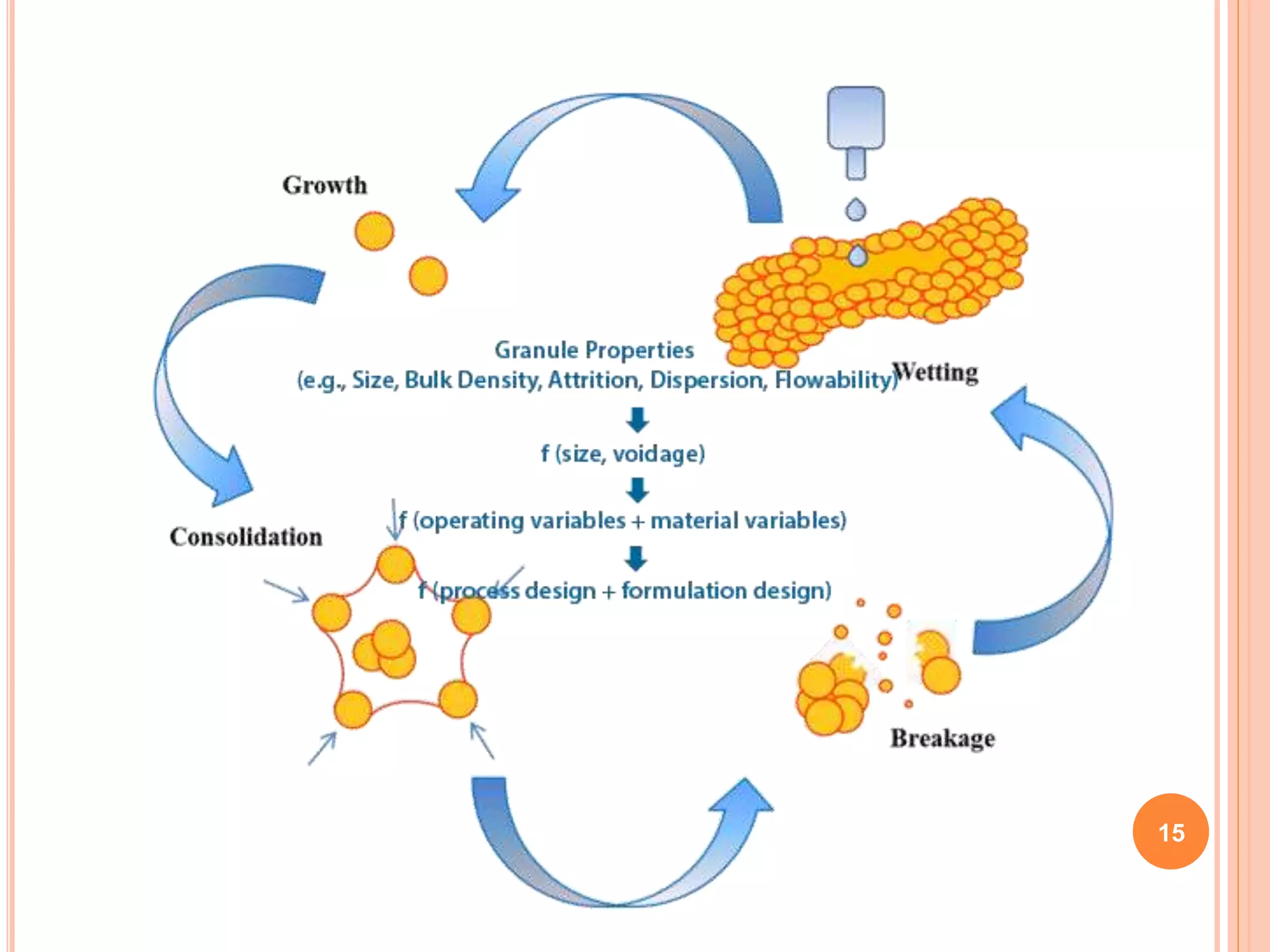
1) Nucleation:
Here, the particles adhere due to liquid bridges which
are the initiation step of Granulation. These adhered
particles play a role of nucleus for further enlargement of
granules.
2) Transition: Enlargement of nucleus takes place by
two possible mechanisms. Individual particle adhere to
the nucleus or two or more nuclei combine among
themselves.
3) Ball growth or enlargement of the granule.
6
GRANULES CHARACTERISTIC
 Particle size
 Av. Tablet weight
 Tablet weight variation
 Disintegration (DT)
 Granules friability
 Granules flow ability
 Dry rate kinetic of wet granules
 Surface area
 Dissolution rate
Methods:
Gas adsorption
Air permeability
Density
Compressibility
Tablet porosity
Dissolution and other
7
STAGES OF GRANULATION:
a)Pendular stage:
This is initial stage just after addition of binding
agent.
b) Funicular stage:
This is second stage where adequate binding
solution incorporated between the particles.
c) Capillary stage:
In this stage binding solution entrapped by
capillary action. This is a perfect stage where good
granules can be obtained.
d) Droplet stage:
Here over wetting, particles may form. This stage
is not desirable stage. 8
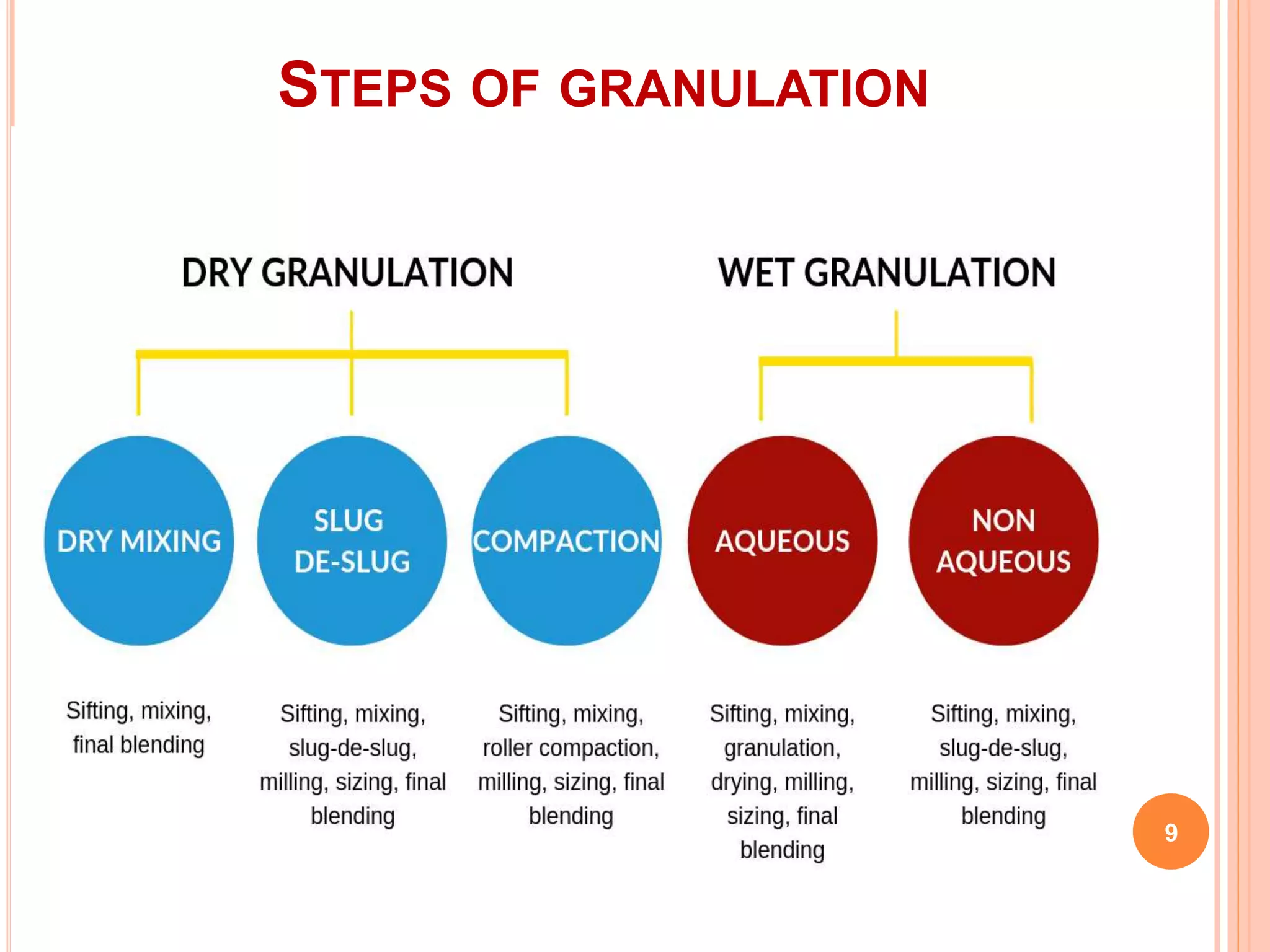
STEPS OF GRANULATION
9
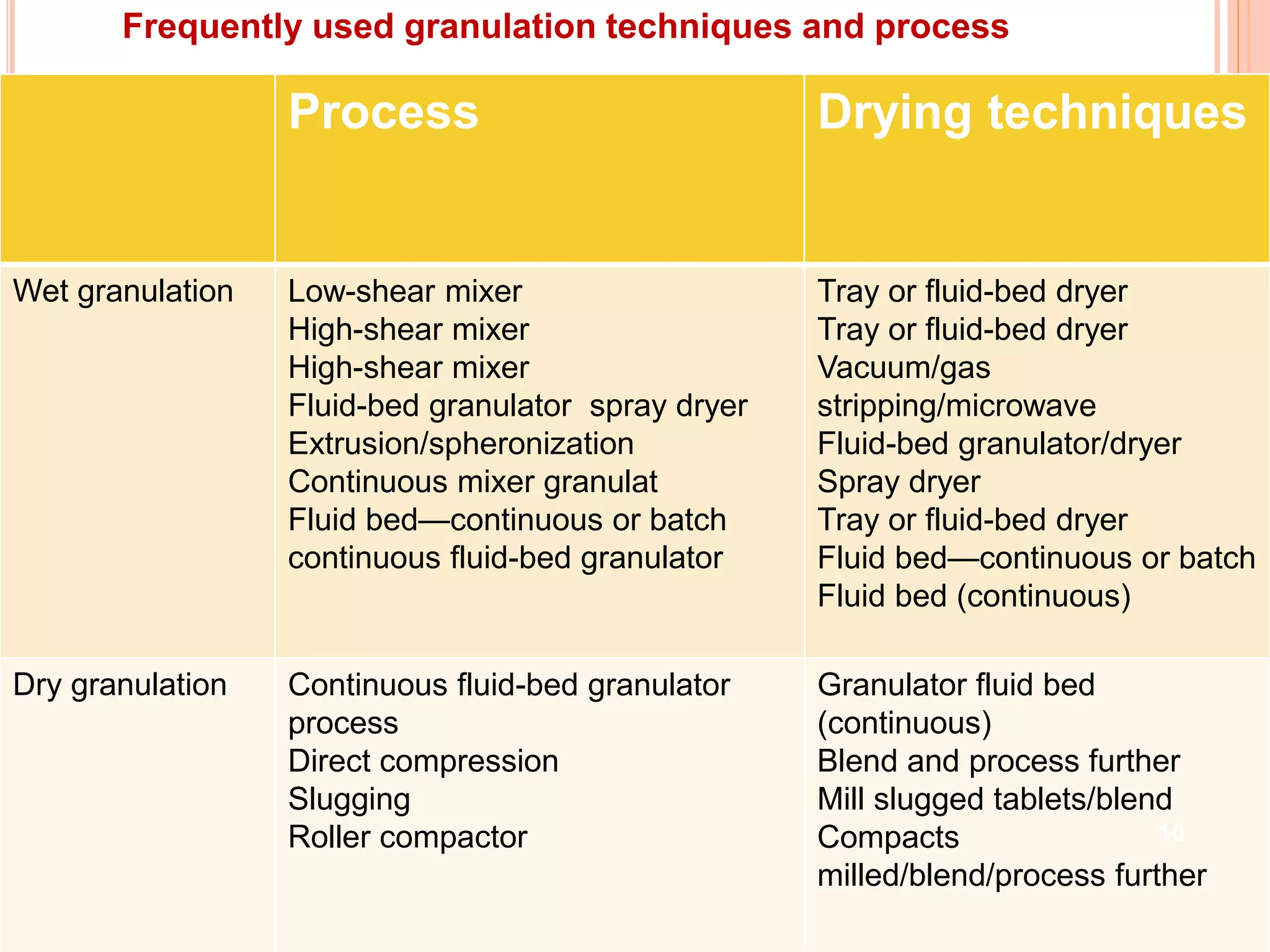
Process Drying techniques
Wet granulation Low-shear mixer
High-shear mixer
High-shear mixer
Fluid-bed granulator spray dryer
Extrusion/spheronization
Continuous mixer granulat
Fluid bed—continuous or batch
continuous fluid-bed granulator
Tray or fluid-bed dryer
Vacuum/gas
stripping/microwave
Fluid-bed granulator/dryer
Spray dryer
Tray or fluid-bed dryer
Fluid bed—continuous or batch
Fluid bed (continuous)
Dry granulation Continuous fluid-bed granulator
process
Direct compression
Slugging
Roller compactor
Granulator fluid bed
(continuous)
Blend and process further
Mill slugged tablets/blend
Compacts
milled/blend/process further
Frequently used granulation techniques and process
10
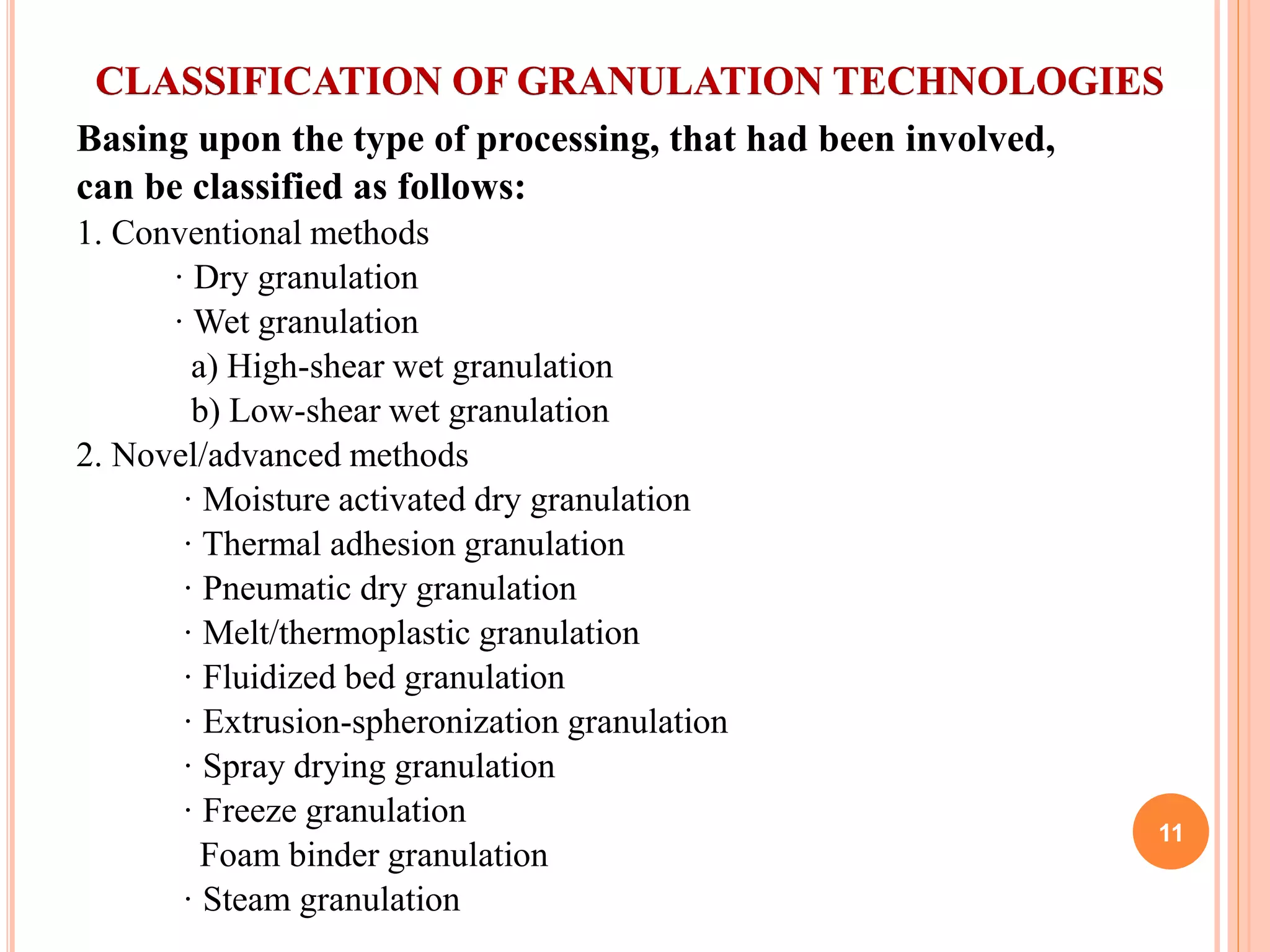
CLASSIFICATION OF GRANULATION TECHNOLOGIES
Basing upon the type of processing, that had been involved,
can be classified as follows:
1. Conventional methods
· Dry granulation
· Wet granulation
a) High-shear wet granulation
b) Low-shear wet granulation
2. Novel/advanced methods
· Moisture activated dry granulation
· Thermal adhesion granulation
· Pneumatic dry granulation
· Melt/thermoplastic granulation
· Fluidized bed granulation
· Extrusion-spheronization granulation
· Spray drying granulation
· Freeze granulation
Foam binder granulation
· Steam granulation
11
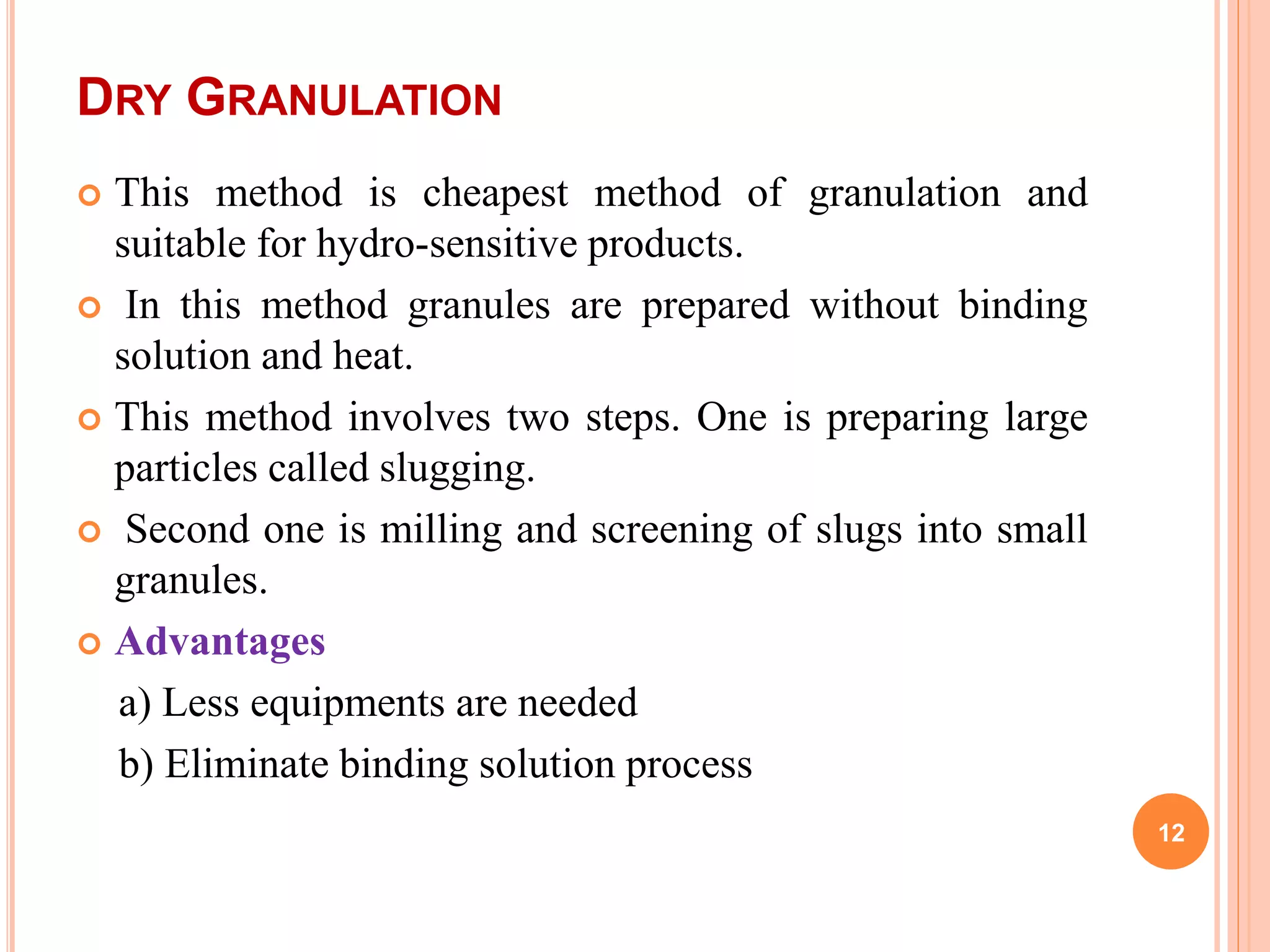
DRY GRANULATION
 This method is cheapest method of granulation and
suitable for hydro-sensitive products.
 In this method granules are prepared without binding
solution and heat.
 This method involves two steps. One is preparing large
particles called slugging.
 Second one is milling and screening of slugs into small
granules.
 Advantages
a) Less equipments are needed
b) Eliminate binding solution process
12
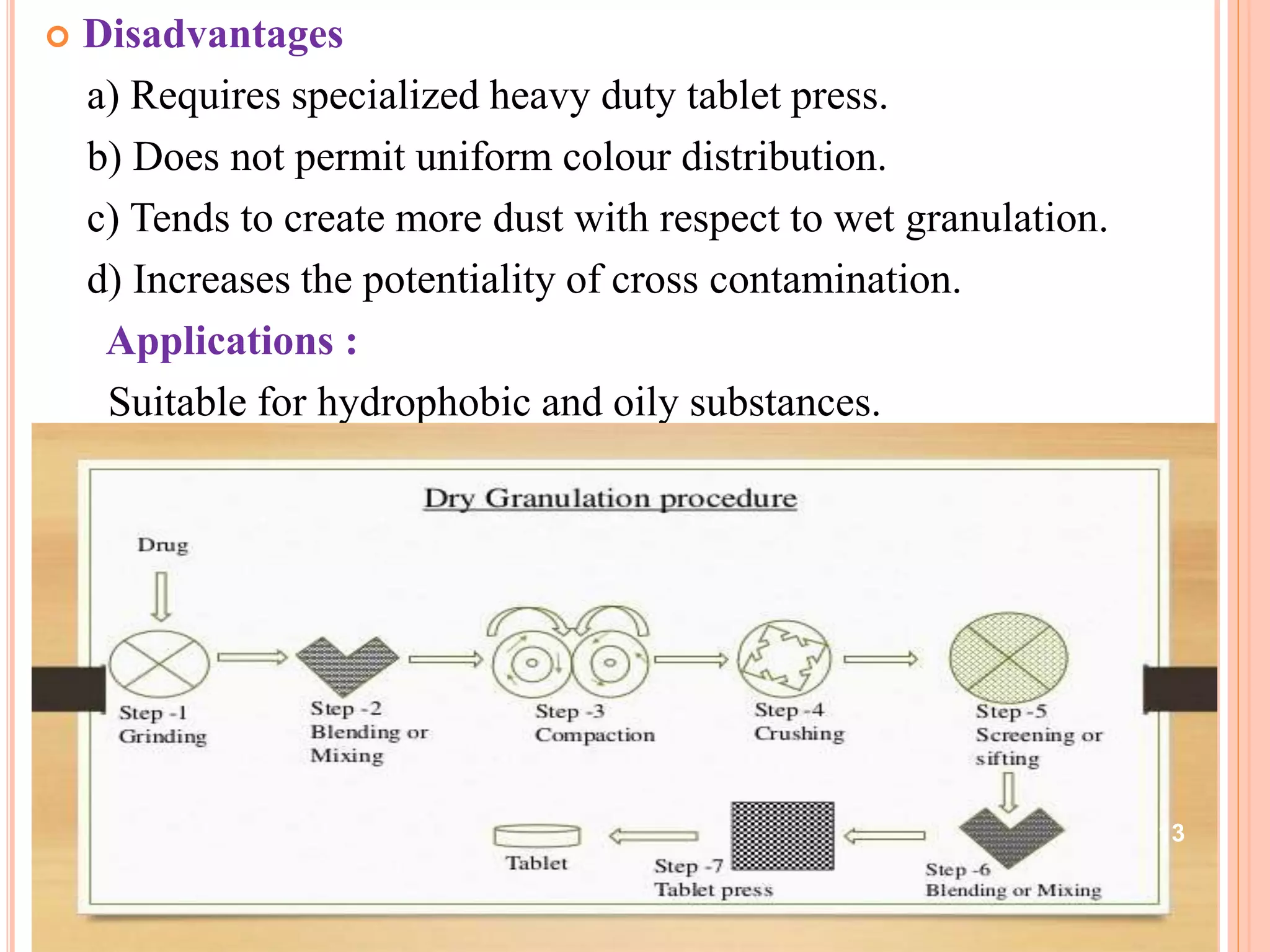
 Disadvantages
a) Requires specialized heavy duty tablet press.
b) Does not permit uniform colour distribution.
c) Tends to create more dust with respect to wet granulation.
d) Increases the potentiality of cross contamination.
Applications :
Suitable for hydrophobic and oily substances.
13
WET GRANULATION
 This method involves several steps. Initially by the
addition of binding agent (hydrophilic or hydrophobic)
to get wet mass. This wet mass is passed through the
sieves followed by drying.
 Advantages
Easy process and no need of experts
 Disadvantages
Time consuming, Labor cost is more, several steps are
involved
14
15
HIGH SHEAR MIXTURE GRANULATION
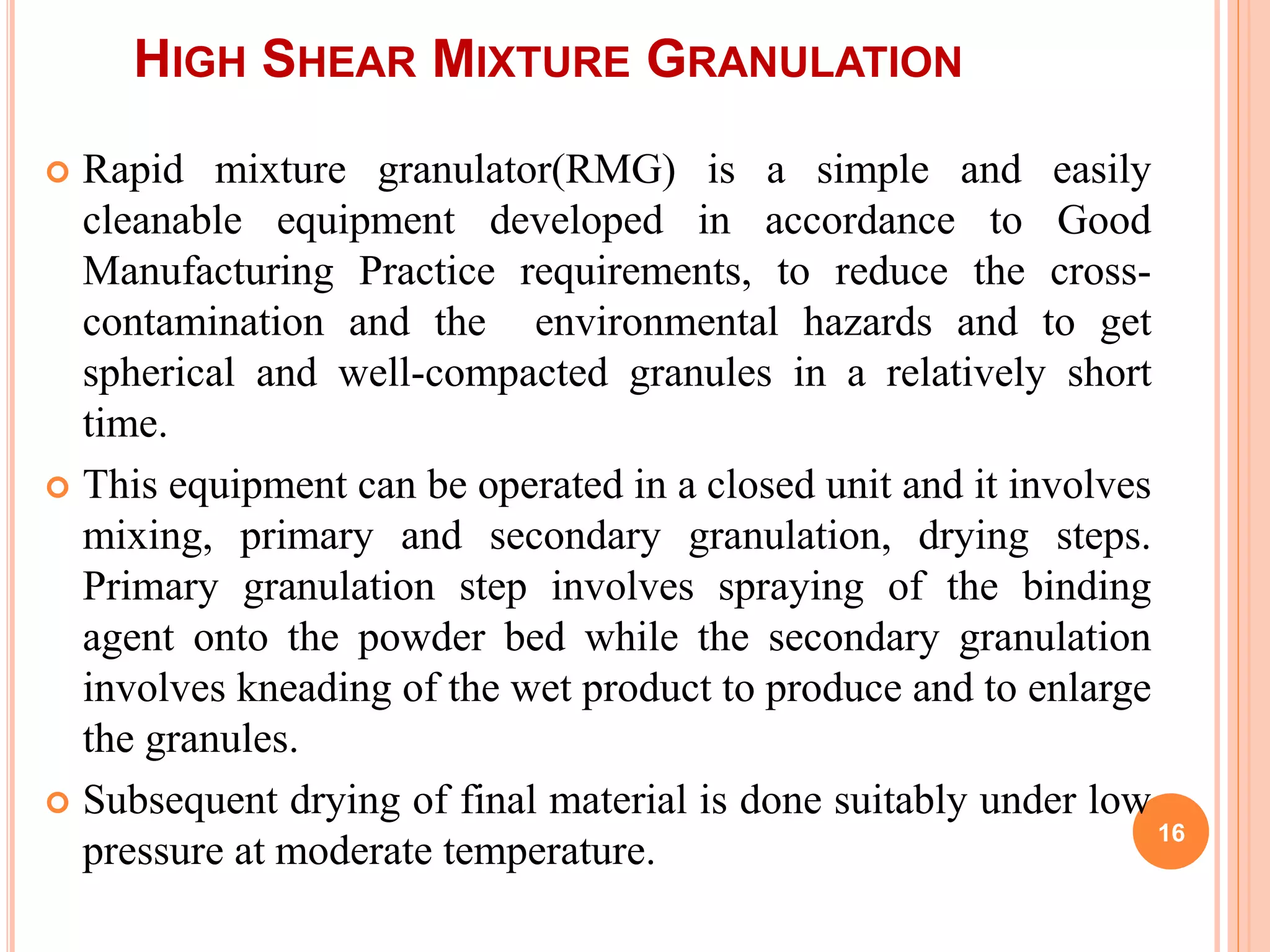
 Rapid mixture granulator(RMG) is a simple and easily
cleanable equipment developed in accordance to Good
Manufacturing Practice requirements, to reduce the cross-
contamination and the environmental hazards and to get
spherical and well-compacted granules in a relatively short
time.
 This equipment can be operated in a closed unit and it involves
mixing, primary and secondary granulation, drying steps.
Primary granulation step involves spraying of the binding
agent onto the powder bed while the secondary granulation
involves kneading of the wet product to produce and to enlarge
the granules.
 Subsequent drying of final material is done suitably under low
pressure at moderate temperature.
16
 Impeller speed, chopper speed, water addition method and
rate, massing (mixing) time, load of the RMG, feed material
characteristics, drug substance particle size are the granulation
process parameters that requires monitoring to get granules
with desired characteristics.
 Volume of load in RMG should be less than two-thirds of its
capacity.
17
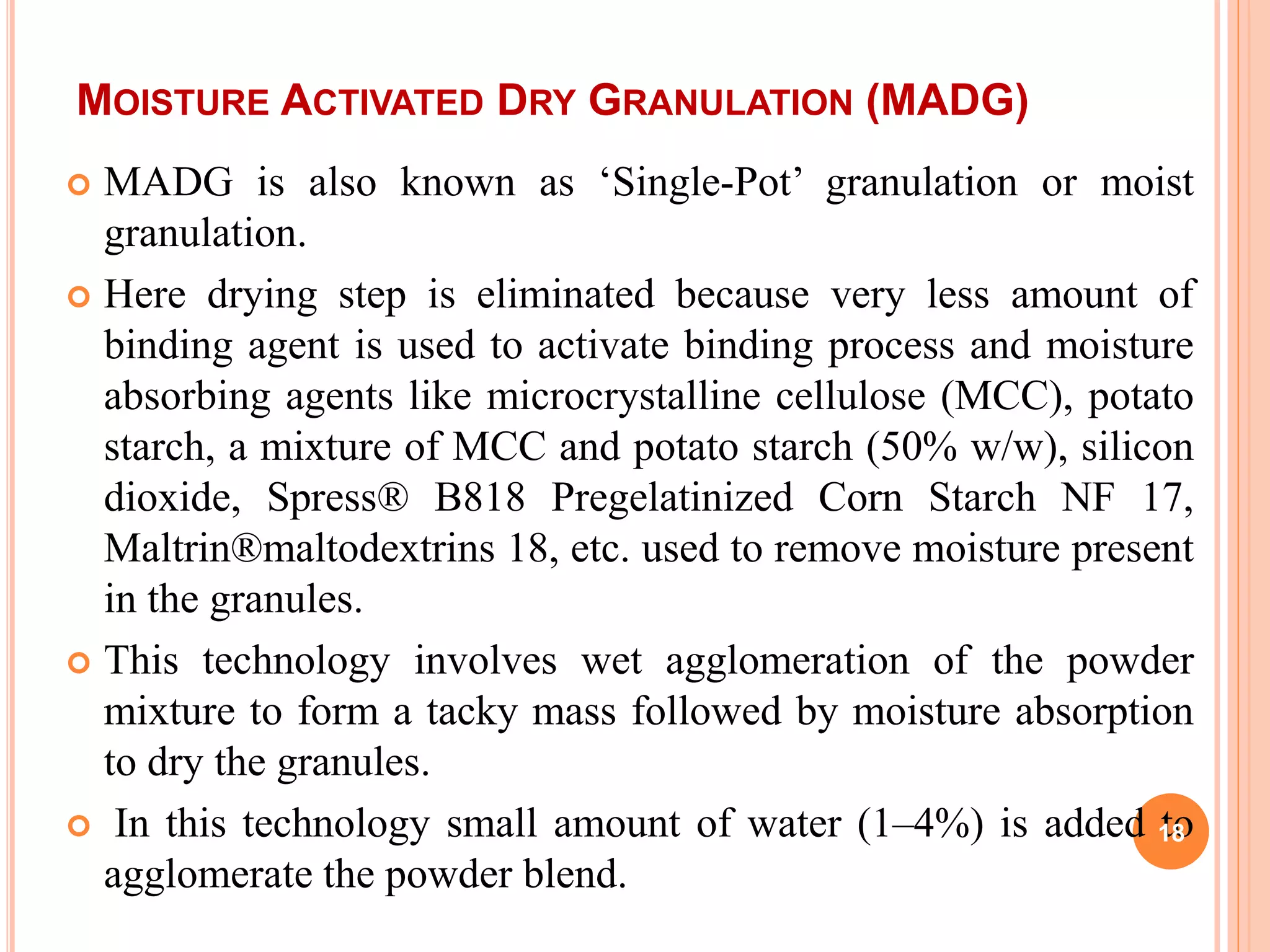
MOISTURE ACTIVATED DRY GRANULATION (MADG)
 MADG is also known as ‘Single-Pot’ granulation or moist
granulation.
 Here drying step is eliminated because very less amount of
binding agent is used to activate binding process and moisture
absorbing agents like microcrystalline cellulose (MCC), potato
starch, a mixture of MCC and potato starch (50% w/w), silicon
dioxide, Spress® B818 Pregelatinized Corn Starch NF 17,
Maltrin®maltodextrins 18, etc. used to remove moisture present
in the granules.
 This technology involves wet agglomeration of the powder
mixture to form a tacky mass followed by moisture absorption
to dry the granules.
 In this technology small amount of water (1–4%) is added to
agglomerate the powder blend.
18
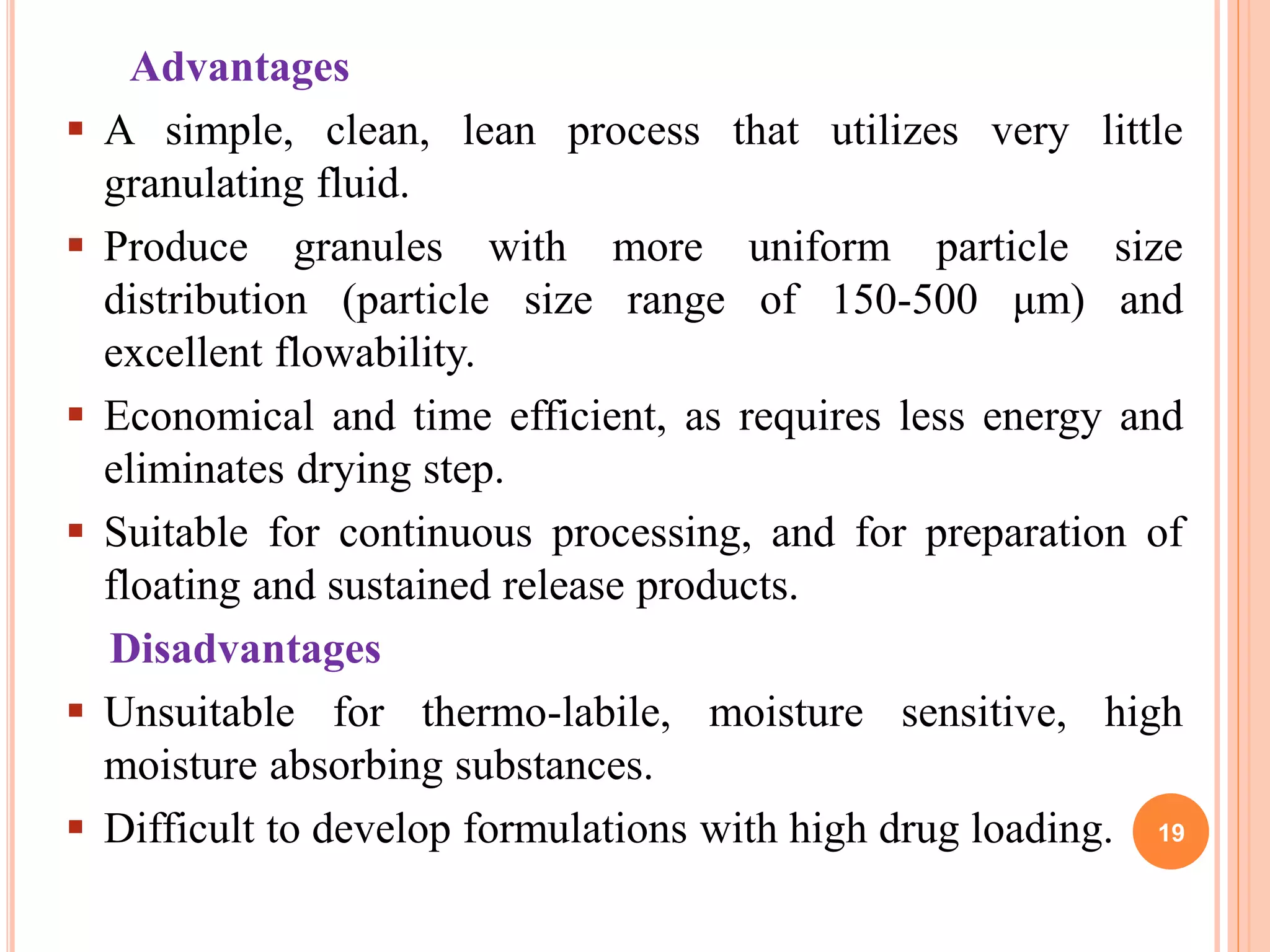
Advantages
 A simple, clean, lean process that utilizes very little
granulating fluid.
 Produce granules with more uniform particle size
distribution (particle size range of 150-500 μm) and
excellent flowability.
 Economical and time efficient, as requires less energy and
eliminates drying step.
 Suitable for continuous processing, and for preparation of
floating and sustained release products.
Disadvantages
 Unsuitable for thermo-labile, moisture sensitive, high
moisture absorbing substances.
 Difficult to develop formulations with high drug loading. 19
Applications
·Suitable for eutectic and hydro-phobic substances.
20
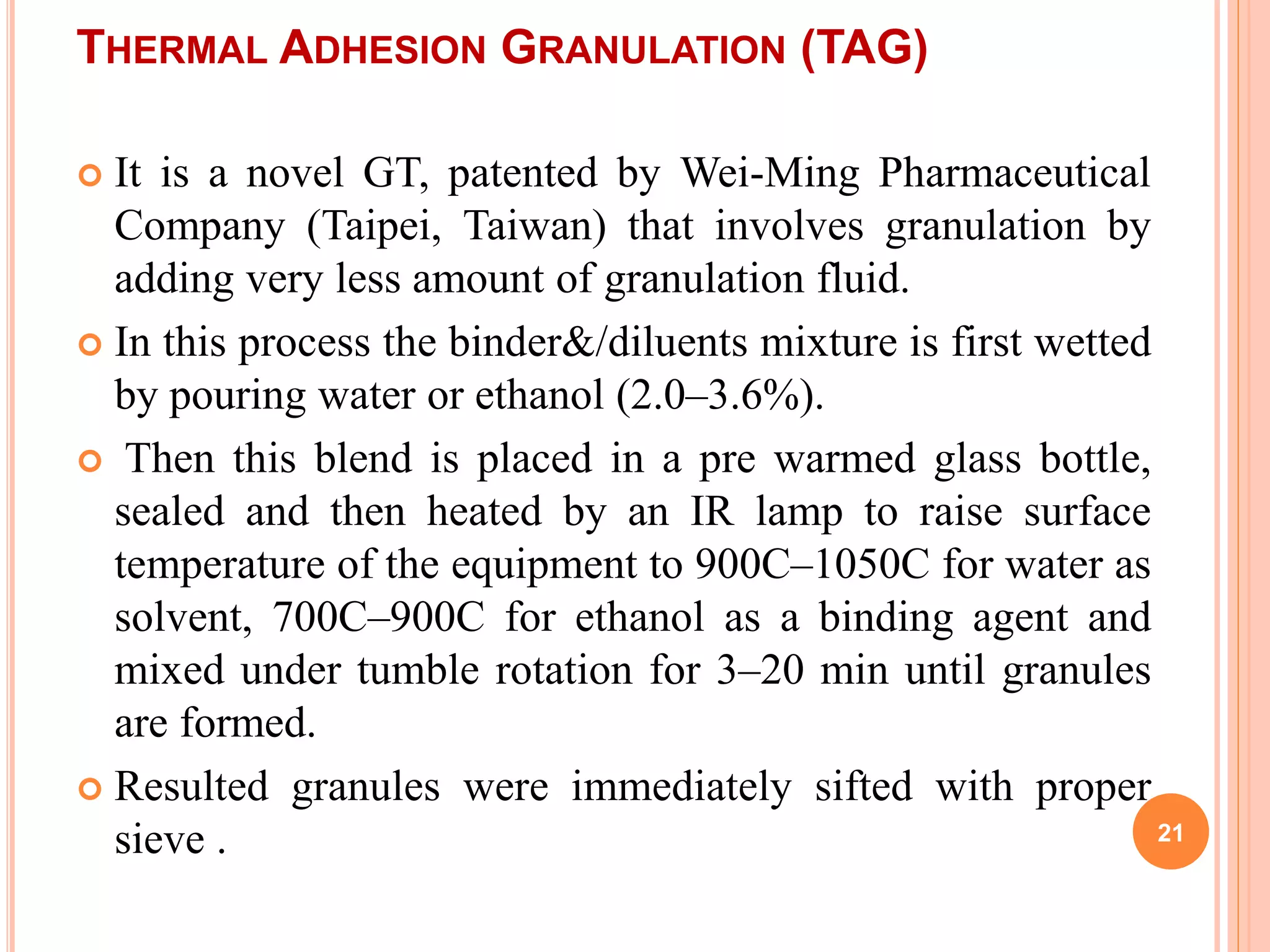
THERMAL ADHESION GRANULATION (TAG)
 It is a novel GT, patented by Wei-Ming Pharmaceutical
Company (Taipei, Taiwan) that involves granulation by
adding very less amount of granulation fluid.
 In this process the binder&/diluents mixture is first wetted
by pouring water or ethanol (2.0–3.6%).
 Then this blend is placed in a pre warmed glass bottle,
sealed and then heated by an IR lamp to raise surface
temperature of the equipment to 900C–1050C for water as
solvent, 700C–900C for ethanol as a binding agent and
mixed under tumble rotation for 3–20 min until granules
are formed.
 Resulted granules were immediately sifted with proper
sieve . 21
Advantages
 Requires less amount of granulation fluid and forms
 granules with good flow property
 Reduces the dust generation during powder processing.
Disadvantages
 Not suitable for substances with more than 1300C melting
 point and for materials with binding solvents other than
 water and ethanol.
Applications: Applicable in R&D systems
22
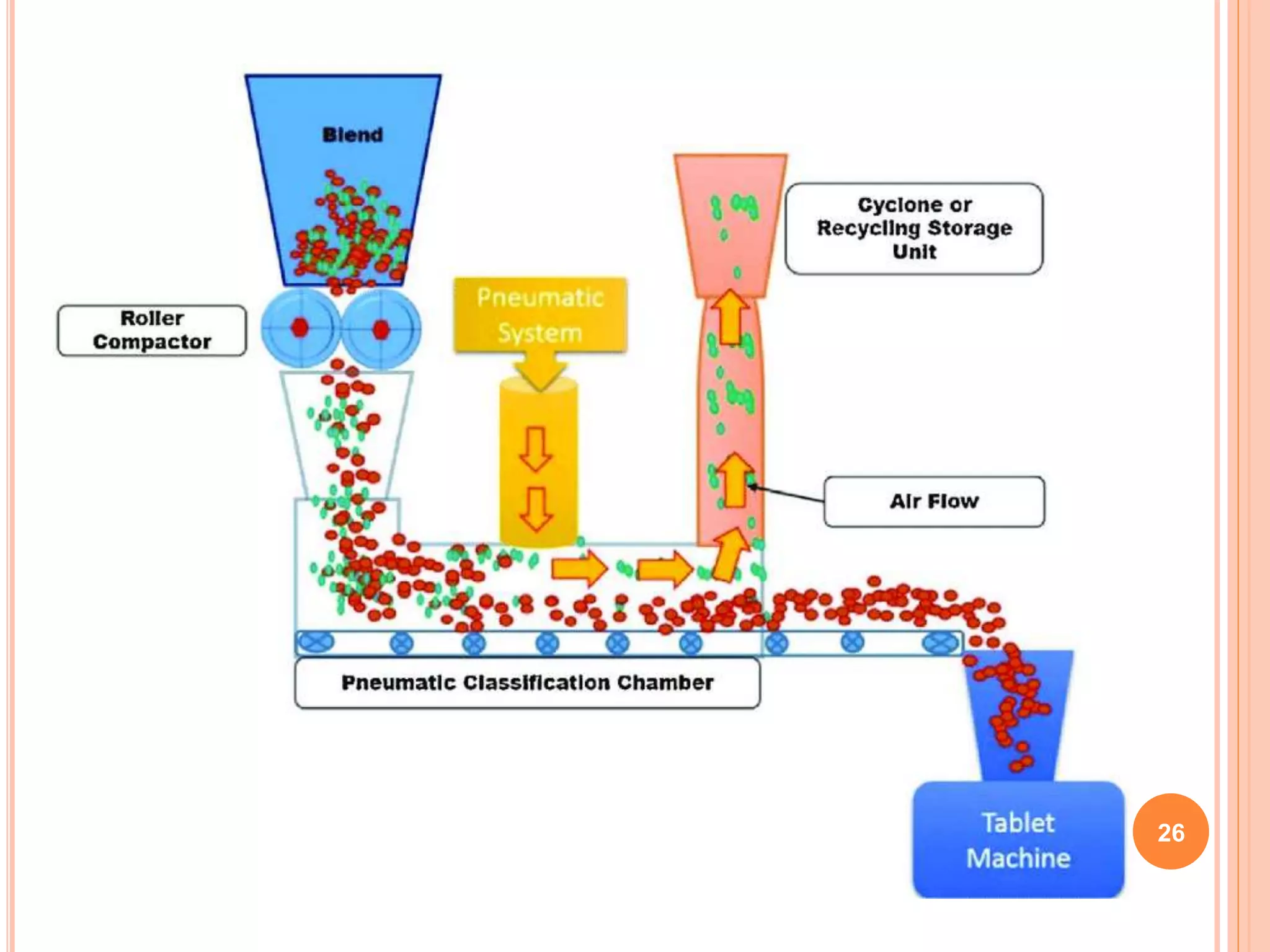
PNEUMATIC DRY GRANULATION (PDG):
 It is a novel dry granulation method developed by Atacama
Labs (Helsinki, Finland).
 It involves production of compact mass by using roller
compaction method with little compression force. This
material is introduced into a newly innovated fractionating
device that separates the granules and recycles rejected
fraction.
Advantages
 · Can achieve high drug loading of traditionally proven
difficult materials.
 · Faster development (within weeks) even with historically
proven difficult materials.
 · Decreases cost of product by minimizing waste through
recycling and production cost.
 · Excellent stability with enhanced shelf-life.
23
 Compatible with other technologies like coating,
sustained release, fast release.
 Suitable for thermo-labile and moisture sensitive drugs.
 Taste masking and tailoring of release rate and time can
be achieved.
 Produce soft and porous granules with high
compressibility and Flow ability.
 Possesses potentiality to handle sterile products or toxic
materials
 Lowers scale-up cost and problems.
24
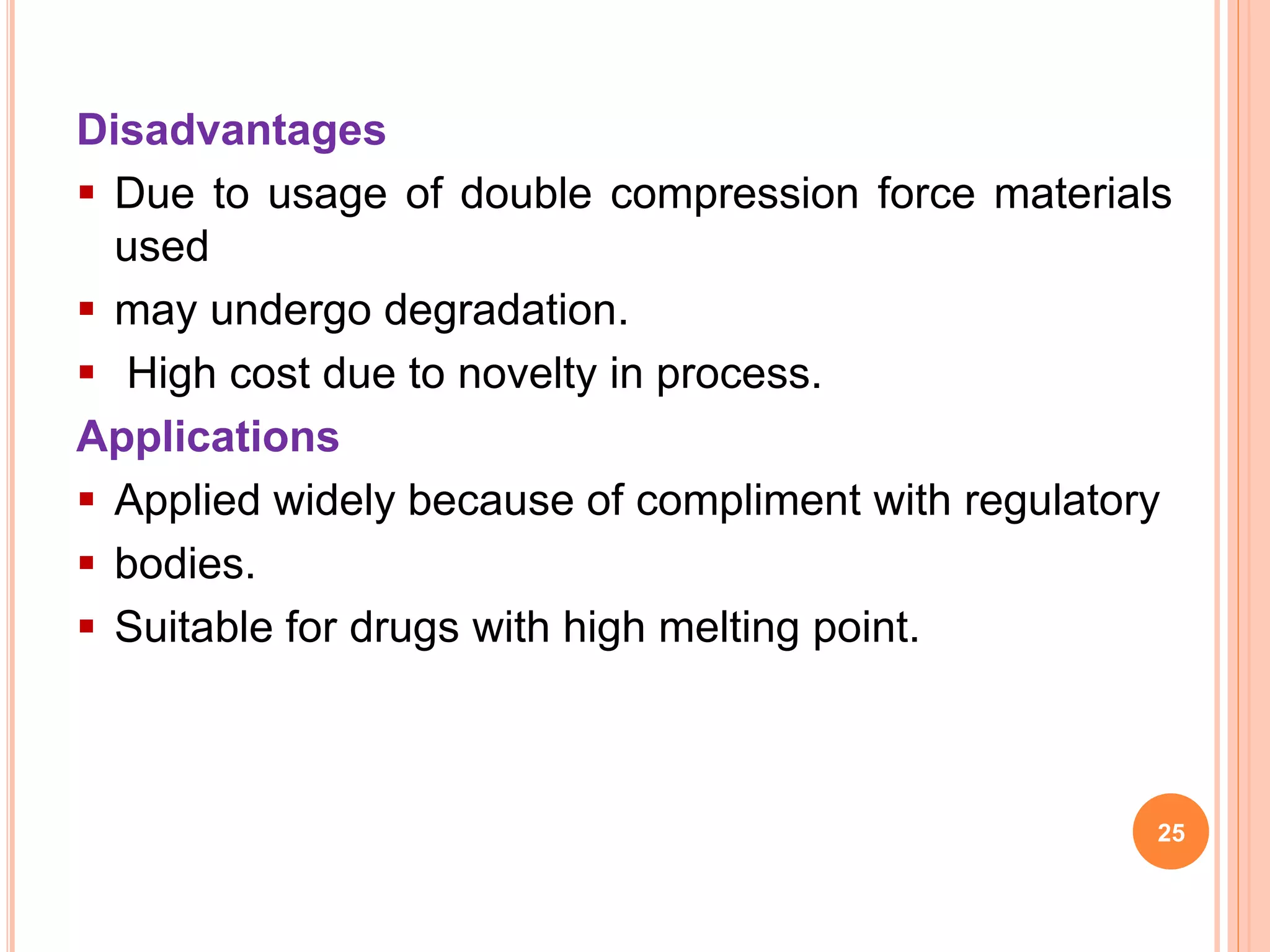
Disadvantages
 Due to usage of double compression force materials
used
 may undergo degradation.
 High cost due to novelty in process.
Applications
 Applied widely because of compliment with regulatory
 bodies.
 Suitable for drugs with high melting point.
25
26
FREEZE GRANULATION TECHNOLOGY
 Which enable conservation of homogeneity from
suspension to dry granule.
 With spraying fine particles suspension into fluid
nitrogen, the drops (granules) are instantaneously
frozen.
 freeze drying granule be dry with sublimation of the
frost with some separation result in case of
conservative dry in air .
 The result will be sphere, gratis flow granules, by best
homogeneity.
 FG provides optimized form successive process of
granules, for example simple crush to homogeneous
and dense powder compacts in a pressing operation 27
 Advantages :
 Granule density is controlled with solid contented of
suspension.
 Mild drying prevents highly corrosion of non oxides
and metals.
 No cavity within the granules.
 high yield and low matter waste
 Large and small granule quantity can be produce the
same quality.
 Latex binder can be used for equipment are easily
clean.
 opportunity to reprocess of organic solvent.
28
 Disadvantages
 Two process steps: freezing and batchwise freeze-
drying.
 Restriction in the option of solvent, freezing properties
base on a freezing point among 20 and +10 °C is
recommended.
 Large-scale equipment with a capability away from
35-45 kg granule for every day wants to be more
development.
29
Applications:
Applicable for granulation, drying, coating, mixing, etc.
30
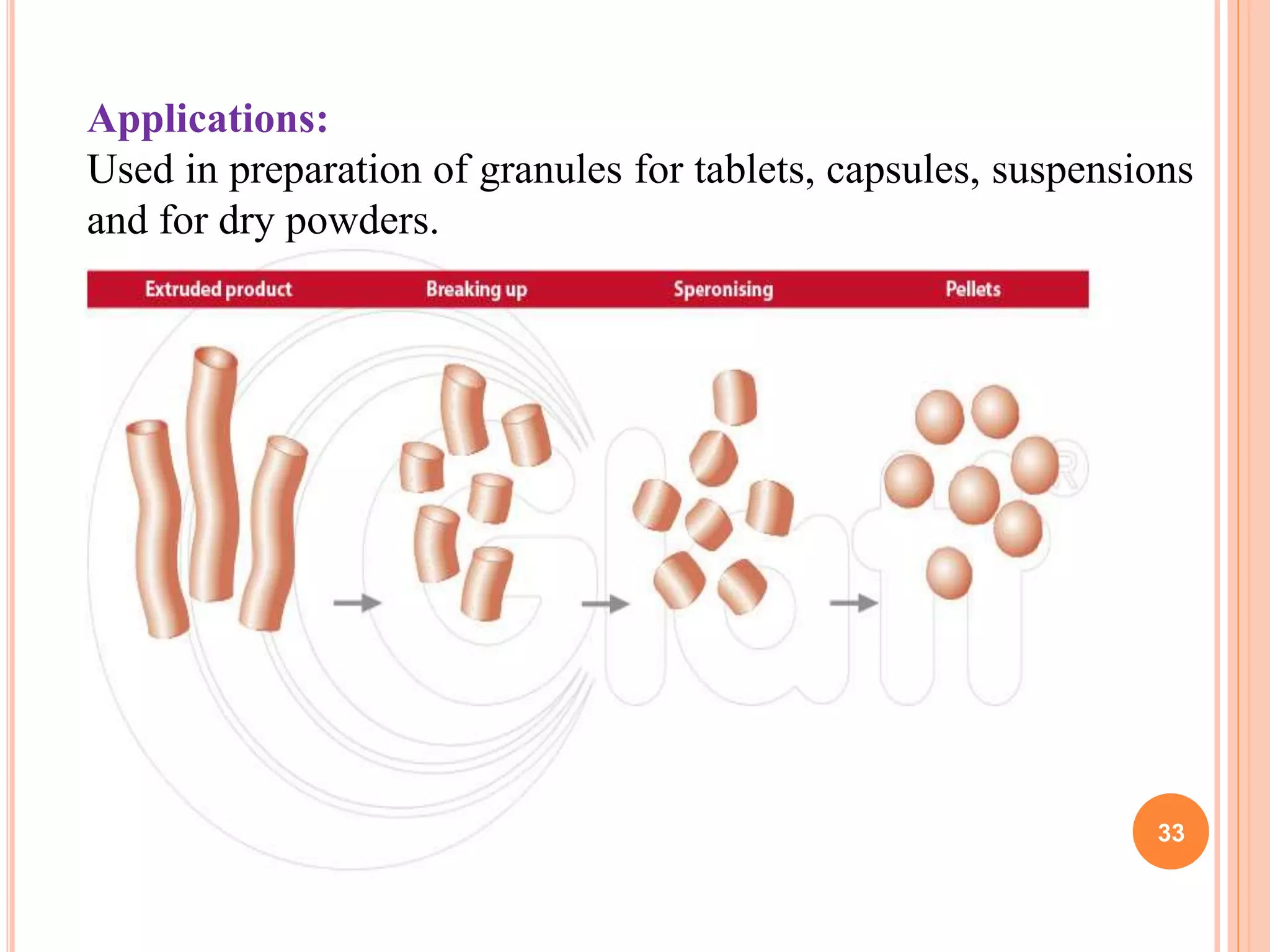
EXTRUSION-SPHERONIZATION GRANULATION
 A multiple step process involves five-steps capable of making
uniform sized spherical particles with narrow size distribution
that were suitable for controlled release formulations by
extruding the tacky mass through extruder and subsequent
pelletization or spheronization using pelletizer or spheronizer.
 31- 34 Pellets are prepared by employing wet or hot melt
extrusion techniques. Wet extrusion technique involves
extrusion of wet agglomerate (tacky mass) of the powder
mixture through extruder.
 Hot melt extrusion technique involves extrusion of
thermoplastic materials through a thermostatically controlled
extruder.
 Processing parameters like extruder pore size, spheronization
speed and operational conditions need to be optimized which
influences particle size, size distribution and morphology of
granules.
31
 Advantages
 Incorporates higher levels of active without producing
excessively larger particles
 Easy to combine two or more active agents within the same
unit, in any ratio
 Modification of physical characteristics of the active
ingredients and excipients
 Can produce spherical particles with high bulk density, low
hygroscopicity, narrow particle size distribution and smoother
surface.
 Disadvantages
 Needs more labor and time for granulation
 Cannot be used for moisture sensitive and thermo-labile
materials. 32
Applications:
Used in preparation of granules for tablets, capsules, suspensions
and for dry powders.
33
TECHNOLOGY OF FOAMED BINDER (FBT)
 Foam granulations technology involve adding of fluid binder as
foam of aqueous.
 Binder foamed techniques from The Chemical industry be able
to assist to achieve simpler, safer and faster wet granulating
process. Using familiar, proven methocel polymers, this
technology greatly improves binder distribution inside
formulation mix and yields a remarkable collection of process
compensation.
 compare to conservative spray process, technology of foamed
binder can shorter process in time with reduce water
requirements.
 It can improve productivity in consistent distribution of binder.
Moreover, it eliminate nozzle spray with their several variable
in granulation process apparatus. 34
 Foam process is offer improved finish point determination and
reduced equipment clean-up time.
 whereas process of foamed binder offers various benefits , this
technology doesn’t demand new equipment or radical changes in
processing techniques.
 You can very simply apply by familiar low shear, and high shear,
granulation apparatus in lab and manufacture level setting.
35
MELT GRANULATION
 Process of melt granulation a powder is agglomerate by the assist
of a binders, in also a or solid state or melt state to melt through
the procedure.
 The equipment of option is a high shear blender, Temperature of a
powders can be raise over the meling point of a melt able binders
by also frictional forces generated by the impeller blades.
 Liquid binding is possible by the molten binder, thus melt
granulation does not require utilize of solvents.
 The choice of the melt able binder play an significant task into the
process. It has to melt at a relatively low temperature of 50–80°C.
 Hydrophilic binder are used for that melts in low temp will aid in
the rapid release of drug. Passerini and co-workers used a
copolymer of propylene glycol and ethylene glycol as the surface
active agent, to get faster release ibuprofen granules. 36
 Dissolution profile of granule be establish to be superior physical
mixture of same compositions and the pure drug.
 They first formed a melt mixtures of drugs and polyglycolized
glycerides, which was the surface active agent employed, before
adding this to a surface adsorbent such as magnesium alumino
silicate.
 The utilize of a exterior adsorber is to form granule with
superior flow and compressibility properties.
37
SPRAY DRYING GRANULATION
 It is a continuous process where a dry granular product is
obtained by feeding a binding solution or a suspension of active
agent with or without excipients to the drying system where the
feed is atomized and dried with a heated gas stream followed by
subsequent separation of granular product from the gas stream.
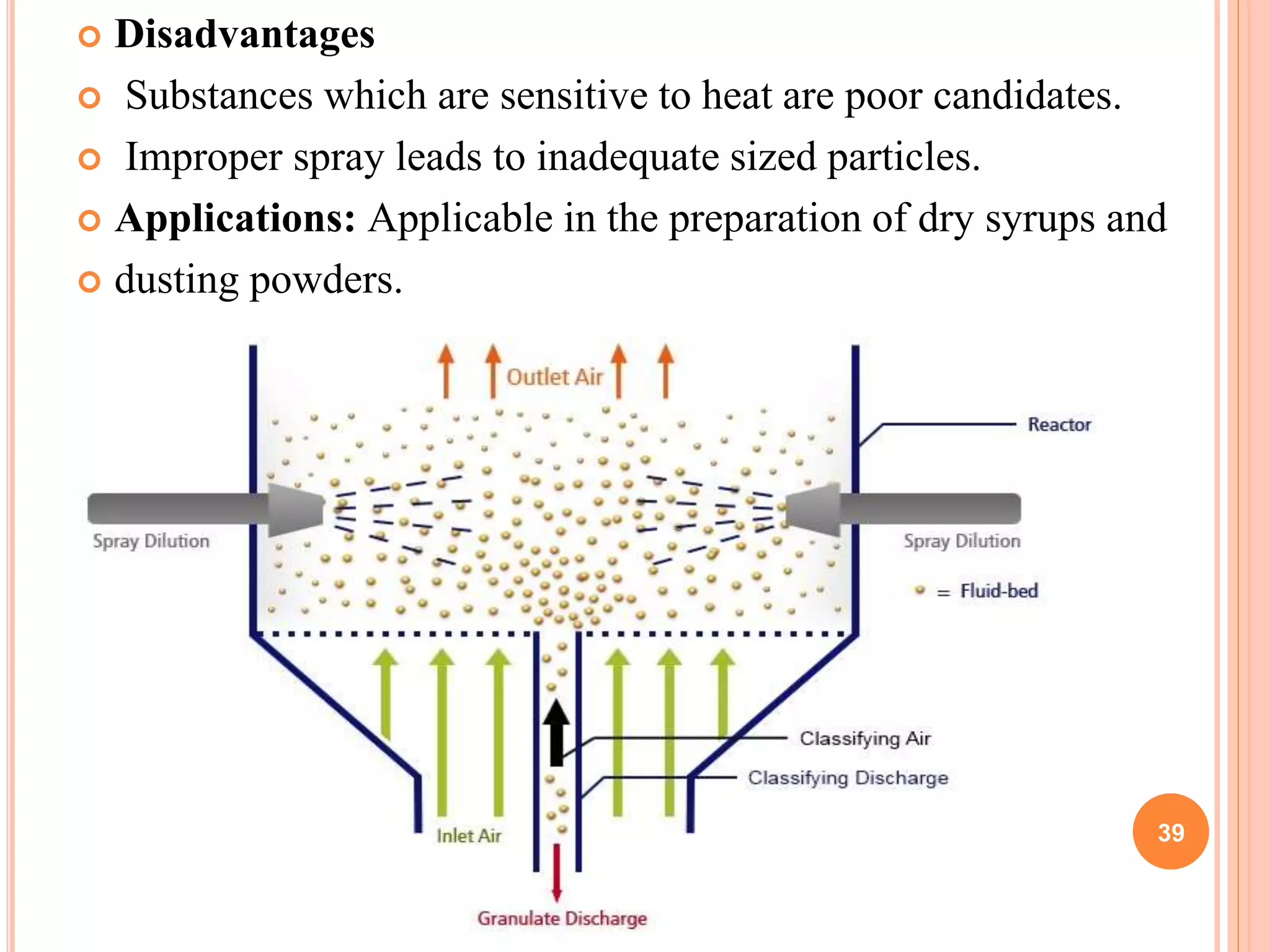
 Alternately particle agglomeration was brought about by
spraying the binder solution onto bed of powder particles in
fluidized state achieved with the passage of air followed by
drying using hot air.
 Advantages
 It is a fast and continuous process.
 Low cost.
 Reduces operator exposure to dust. 38
 Disadvantages
 Substances which are sensitive to heat are poor candidates.
 Improper spray leads to inadequate sized particles.
 Applications: Applicable in the preparation of dry syrups and
 dusting powders.
39
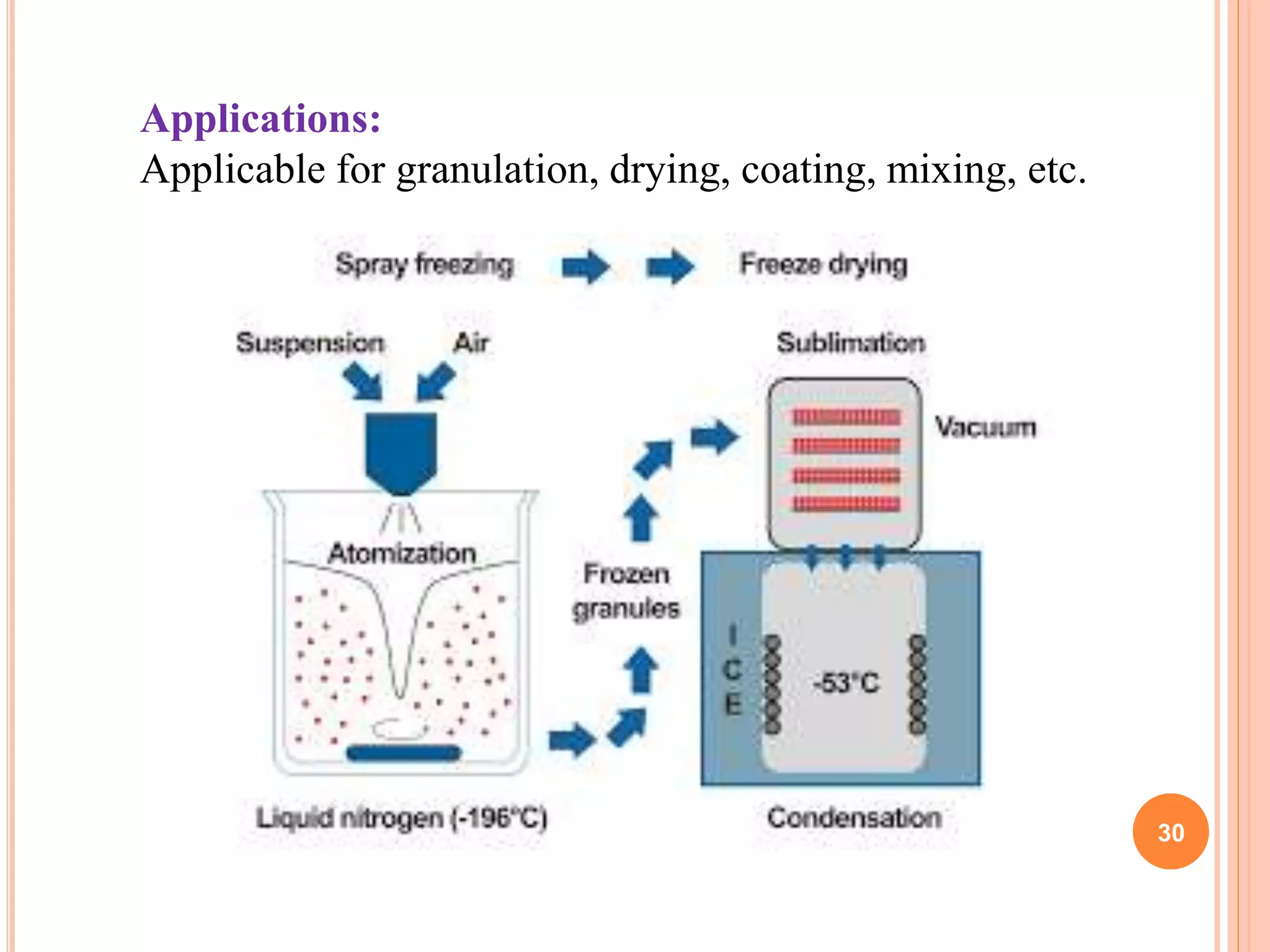
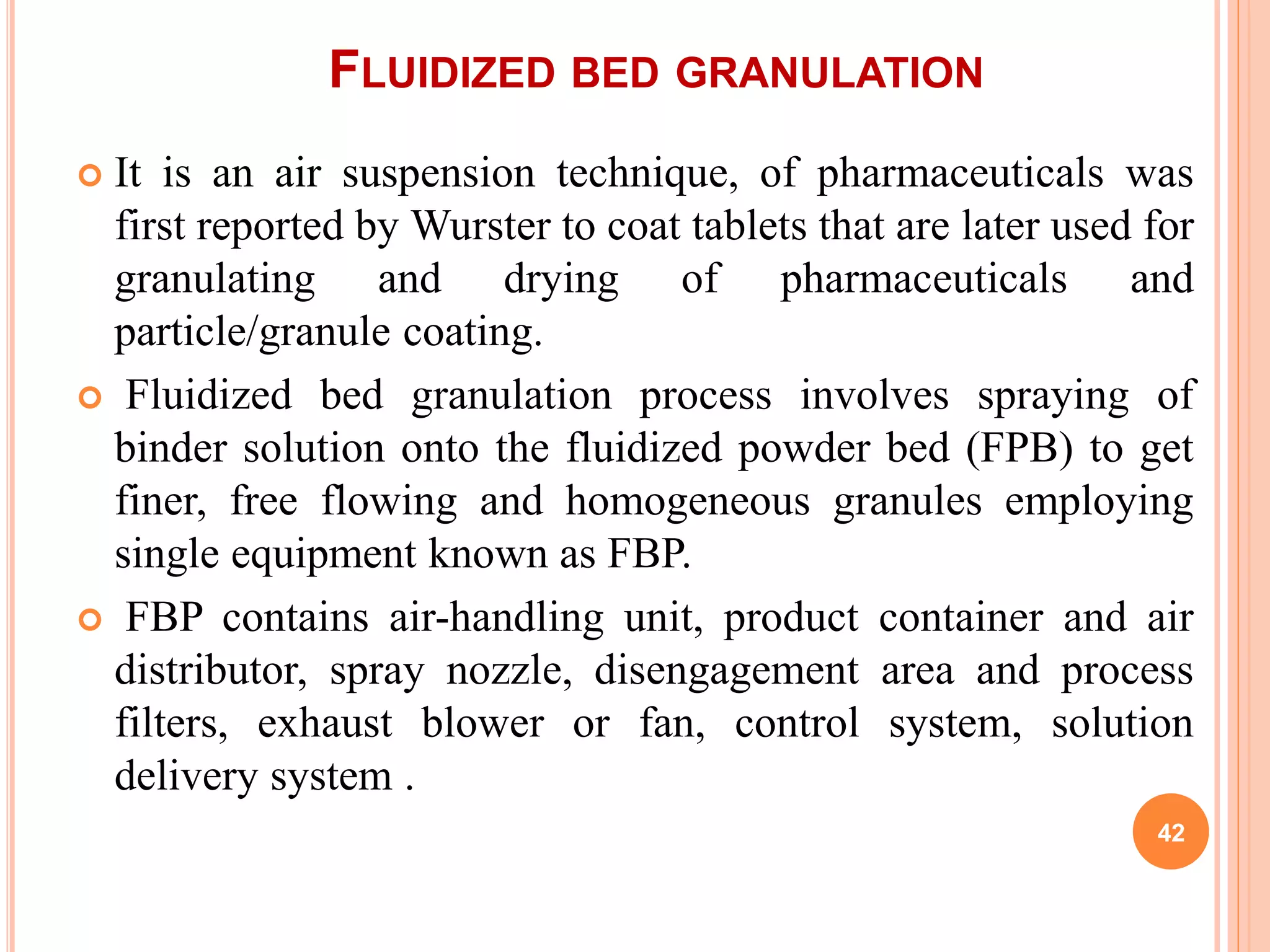
FREEZE GRANULATION
 Integrated Biosystems, Inc. (California, USA) had patented
freeze GT that results in spherical and free flowing granules
with optimal homogeneity.
 FG involves spraying of suspension containing powder into
liquid nitrogen where the drops were instantaneously frozen to
form granules which upon subsequent freeze-drying yields dry
granules.
 Advantages
 Granule density can be controlled by the solid contents of the
suspension.
 Non-oxides and metals can be handled as mild drying
prevents serious oxidation.
 Results solid granules with no cavities.
 High yield with low material waste.
40
 Low to high quantities of granules can be produced with
reproducibility.
 Equipment can be easily cleaned up and Organic solvents can
be recycled.
 Disadvantages :
 There may be a chance of degradation of drug due to use of
temperature which is less than 0 0C.
 Applications:
 In the formation of injectable granules
41
FLUIDIZED BED GRANULATION
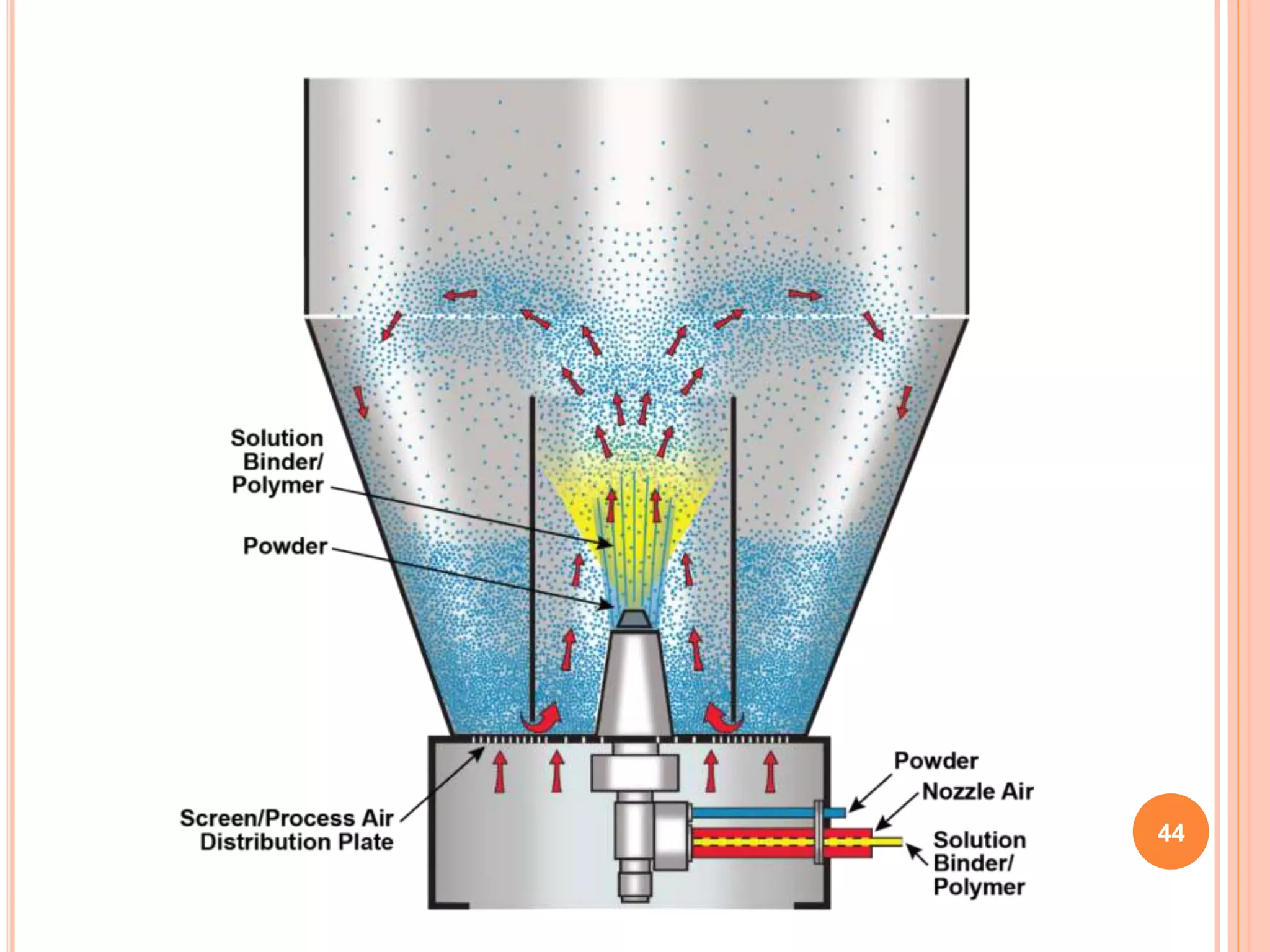
 It is an air suspension technique, of pharmaceuticals was
first reported by Wurster to coat tablets that are later used for
granulating and drying of pharmaceuticals and
particle/granule coating.
 Fluidized bed granulation process involves spraying of
binder solution onto the fluidized powder bed (FPB) to get
finer, free flowing and homogeneous granules employing
single equipment known as FBP.
 FBP contains air-handling unit, product container and air
distributor, spray nozzle, disengagement area and process
filters, exhaust blower or fan, control system, solution
delivery system .
42
 Advantages:
 Reduces dust formation during processing.
 Improves housekeeping and worker safety.
 Suitable for subsequent coating and controlled release
products and reduces product loss.
 Disadvantages:
 Cleaning was labor-intensive, time consuming an assuring
reproducibility was troublesome.
 Applications:
 Applicable for granulation, drying, coating,
 mixing, etc.
43
44
CONCLUSION
 The advances in granulation technology lead to the
formulation of better dosage forms in terms of content
uniformity and stability aspects. Still lot of research work
and study has to be done for the promotion of content
uniformity, stability not only in tablets and capsules but
also in dry syrups and various other formulations in
Pharmaceutical industries.
45
REFERENCE
 1.Srinivasan Shanmugam. Granulation techniques and
technologies: Recent progresses. Bioimpacts 2015;5(1):
55-63.
 P. Muralidhar *, E. Bhargav, C. Sowmya International
research journal of pharmacy, novel techniques of
granulation: a review P. Muralidhar et al. Int. Res. J.
Pharm. 2016, 7 (10) ISSN 2230 – 8407.
 Patil et al. World Journal of Pharmaceutical Research
Review on novel granulation Techniques Volume 5, Issue
7, XXX-XXX. Review Article ISSN 2277– 7105 .
 Ritala M, Jurgersen O, Holm P, Schaefer T, Kristensen
HG. A comparison between binders in the wet phase of
granulation in a high shear mixer. Drug Dev Ind Pharm
1986; 12: 1685-1700.
46

Granulation and its novel techniques

  • 1.
    Presented By : GavaliPriyanka Shashikant M . Pharmacy 2st Semister Department Of Pharmaceutics Appasaheb Birnale College Of Pharmacy, Sangli . 1
  • 2.
     Definition andconcept  Objective and mechanism  Granulation characteristic  Technique for granulation process  Direct compression  Dry compression  Wet granulation  Novel techniques of granulation  Conclusion 2
  • 3.
    INTRODUCTION :DEFINITION ANDCONCEPT  A process whereby small particles gathered into large, permanent masses in which the original particles can still be identified.  ‘‘Granulation is a part procedure with little fine particle be agglomerate in big entity call granule.  Granulation is Joining particles within a given granulation process will improve flow and compression characteristics, reduce segregation, improve content uniformity, and eliminate excessive amounts of fine particles.  The results will be improved yields, reduced tablet defects, increased productivity, and reduced down time. The ability to produce reproducible tablet , batch to batch, lot to lot, is directly treated to the ability to produce reproducible granulation. 3
  • 4.
     Granulation bea single mostly significant component operation into manufacturing of oral dosage forms in pharmaceutical industry.  The result be there better yield, reduced drug defects and improved efficiency.  Pharmaceutical production be process all over the earth use a direct-compression, dry-granulation and wet granulation techniques.  Which technique be selected depend going on ingredient character with capability to correctly run, disintegrate, compress with eject.  Decide a technique require systematic examination of every element within the method, mixture of ingredient, also job by everyone. The correct granulation procedure is apply. 4
  • 5.
    OBJECTIVE & MECHANISM The objective of the granulation process is to combine ingredients to produce a quality tablet.  Granulation is process of collecting particles together by creating bonds between then and these bonds are formed by compression or by using a binding agent.  Particles-particles bonding mechanisms involved in adhesion and cohesion of particles.  Several forces that can be act : Valency, Vander waals forces and electrostatic forces.  In wet granulation  Liquid bridges developed between particles with tensile strength. Surface tension forces and capillary pressure are primarily responsible for initial granulation and strength. 5
  • 6.
    MECHANISM 1) Nucleation: Here, theparticles adhere due to liquid bridges which are the initiation step of Granulation. These adhered particles play a role of nucleus for further enlargement of granules. 2) Transition: Enlargement of nucleus takes place by two possible mechanisms. Individual particle adhere to the nucleus or two or more nuclei combine among themselves. 3) Ball growth or enlargement of the granule. 6
  • 7.
    GRANULES CHARACTERISTIC  Particlesize  Av. Tablet weight  Tablet weight variation  Disintegration (DT)  Granules friability  Granules flow ability  Dry rate kinetic of wet granules  Surface area  Dissolution rate Methods: Gas adsorption Air permeability Density Compressibility Tablet porosity Dissolution and other 7
  • 8.
    STAGES OF GRANULATION: a)Pendularstage: This is initial stage just after addition of binding agent. b) Funicular stage: This is second stage where adequate binding solution incorporated between the particles. c) Capillary stage: In this stage binding solution entrapped by capillary action. This is a perfect stage where good granules can be obtained. d) Droplet stage: Here over wetting, particles may form. This stage is not desirable stage. 8
  • 9.
  • 10.
    Process Drying techniques Wetgranulation Low-shear mixer High-shear mixer High-shear mixer Fluid-bed granulator spray dryer Extrusion/spheronization Continuous mixer granulat Fluid bed—continuous or batch continuous fluid-bed granulator Tray or fluid-bed dryer Tray or fluid-bed dryer Vacuum/gas stripping/microwave Fluid-bed granulator/dryer Spray dryer Tray or fluid-bed dryer Fluid bed—continuous or batch Fluid bed (continuous) Dry granulation Continuous fluid-bed granulator process Direct compression Slugging Roller compactor Granulator fluid bed (continuous) Blend and process further Mill slugged tablets/blend Compacts milled/blend/process further Frequently used granulation techniques and process 10
  • 11.
    CLASSIFICATION OF GRANULATIONTECHNOLOGIES Basing upon the type of processing, that had been involved, can be classified as follows: 1. Conventional methods · Dry granulation · Wet granulation a) High-shear wet granulation b) Low-shear wet granulation 2. Novel/advanced methods · Moisture activated dry granulation · Thermal adhesion granulation · Pneumatic dry granulation · Melt/thermoplastic granulation · Fluidized bed granulation · Extrusion-spheronization granulation · Spray drying granulation · Freeze granulation Foam binder granulation · Steam granulation 11
  • 12.
    DRY GRANULATION  Thismethod is cheapest method of granulation and suitable for hydro-sensitive products.  In this method granules are prepared without binding solution and heat.  This method involves two steps. One is preparing large particles called slugging.  Second one is milling and screening of slugs into small granules.  Advantages a) Less equipments are needed b) Eliminate binding solution process 12
  • 13.
     Disadvantages a) Requiresspecialized heavy duty tablet press. b) Does not permit uniform colour distribution. c) Tends to create more dust with respect to wet granulation. d) Increases the potentiality of cross contamination. Applications : Suitable for hydrophobic and oily substances. 13
  • 14.
    WET GRANULATION  Thismethod involves several steps. Initially by the addition of binding agent (hydrophilic or hydrophobic) to get wet mass. This wet mass is passed through the sieves followed by drying.  Advantages Easy process and no need of experts  Disadvantages Time consuming, Labor cost is more, several steps are involved 14
  • 15.
  • 16.
    HIGH SHEAR MIXTUREGRANULATION  Rapid mixture granulator(RMG) is a simple and easily cleanable equipment developed in accordance to Good Manufacturing Practice requirements, to reduce the cross- contamination and the environmental hazards and to get spherical and well-compacted granules in a relatively short time.  This equipment can be operated in a closed unit and it involves mixing, primary and secondary granulation, drying steps. Primary granulation step involves spraying of the binding agent onto the powder bed while the secondary granulation involves kneading of the wet product to produce and to enlarge the granules.  Subsequent drying of final material is done suitably under low pressure at moderate temperature. 16
  • 17.
     Impeller speed,chopper speed, water addition method and rate, massing (mixing) time, load of the RMG, feed material characteristics, drug substance particle size are the granulation process parameters that requires monitoring to get granules with desired characteristics.  Volume of load in RMG should be less than two-thirds of its capacity. 17
  • 18.
    MOISTURE ACTIVATED DRYGRANULATION (MADG)  MADG is also known as ‘Single-Pot’ granulation or moist granulation.  Here drying step is eliminated because very less amount of binding agent is used to activate binding process and moisture absorbing agents like microcrystalline cellulose (MCC), potato starch, a mixture of MCC and potato starch (50% w/w), silicon dioxide, Spress® B818 Pregelatinized Corn Starch NF 17, Maltrin®maltodextrins 18, etc. used to remove moisture present in the granules.  This technology involves wet agglomeration of the powder mixture to form a tacky mass followed by moisture absorption to dry the granules.  In this technology small amount of water (1–4%) is added to agglomerate the powder blend. 18
  • 19.
    Advantages  A simple,clean, lean process that utilizes very little granulating fluid.  Produce granules with more uniform particle size distribution (particle size range of 150-500 μm) and excellent flowability.  Economical and time efficient, as requires less energy and eliminates drying step.  Suitable for continuous processing, and for preparation of floating and sustained release products. Disadvantages  Unsuitable for thermo-labile, moisture sensitive, high moisture absorbing substances.  Difficult to develop formulations with high drug loading. 19
  • 20.
    Applications ·Suitable for eutecticand hydro-phobic substances. 20
  • 21.
    THERMAL ADHESION GRANULATION(TAG)  It is a novel GT, patented by Wei-Ming Pharmaceutical Company (Taipei, Taiwan) that involves granulation by adding very less amount of granulation fluid.  In this process the binder&/diluents mixture is first wetted by pouring water or ethanol (2.0–3.6%).  Then this blend is placed in a pre warmed glass bottle, sealed and then heated by an IR lamp to raise surface temperature of the equipment to 900C–1050C for water as solvent, 700C–900C for ethanol as a binding agent and mixed under tumble rotation for 3–20 min until granules are formed.  Resulted granules were immediately sifted with proper sieve . 21
  • 22.
    Advantages  Requires lessamount of granulation fluid and forms  granules with good flow property  Reduces the dust generation during powder processing. Disadvantages  Not suitable for substances with more than 1300C melting  point and for materials with binding solvents other than  water and ethanol. Applications: Applicable in R&D systems 22
  • 23.
    PNEUMATIC DRY GRANULATION(PDG):  It is a novel dry granulation method developed by Atacama Labs (Helsinki, Finland).  It involves production of compact mass by using roller compaction method with little compression force. This material is introduced into a newly innovated fractionating device that separates the granules and recycles rejected fraction. Advantages  · Can achieve high drug loading of traditionally proven difficult materials.  · Faster development (within weeks) even with historically proven difficult materials.  · Decreases cost of product by minimizing waste through recycling and production cost.  · Excellent stability with enhanced shelf-life. 23
  • 24.
     Compatible withother technologies like coating, sustained release, fast release.  Suitable for thermo-labile and moisture sensitive drugs.  Taste masking and tailoring of release rate and time can be achieved.  Produce soft and porous granules with high compressibility and Flow ability.  Possesses potentiality to handle sterile products or toxic materials  Lowers scale-up cost and problems. 24
  • 25.
    Disadvantages  Due tousage of double compression force materials used  may undergo degradation.  High cost due to novelty in process. Applications  Applied widely because of compliment with regulatory  bodies.  Suitable for drugs with high melting point. 25
  • 26.
  • 27.
    FREEZE GRANULATION TECHNOLOGY Which enable conservation of homogeneity from suspension to dry granule.  With spraying fine particles suspension into fluid nitrogen, the drops (granules) are instantaneously frozen.  freeze drying granule be dry with sublimation of the frost with some separation result in case of conservative dry in air .  The result will be sphere, gratis flow granules, by best homogeneity.  FG provides optimized form successive process of granules, for example simple crush to homogeneous and dense powder compacts in a pressing operation 27
  • 28.
     Advantages : Granule density is controlled with solid contented of suspension.  Mild drying prevents highly corrosion of non oxides and metals.  No cavity within the granules.  high yield and low matter waste  Large and small granule quantity can be produce the same quality.  Latex binder can be used for equipment are easily clean.  opportunity to reprocess of organic solvent. 28
  • 29.
     Disadvantages  Twoprocess steps: freezing and batchwise freeze- drying.  Restriction in the option of solvent, freezing properties base on a freezing point among 20 and +10 °C is recommended.  Large-scale equipment with a capability away from 35-45 kg granule for every day wants to be more development. 29
  • 30.
    Applications: Applicable for granulation,drying, coating, mixing, etc. 30
  • 31.
    EXTRUSION-SPHERONIZATION GRANULATION  Amultiple step process involves five-steps capable of making uniform sized spherical particles with narrow size distribution that were suitable for controlled release formulations by extruding the tacky mass through extruder and subsequent pelletization or spheronization using pelletizer or spheronizer.  31- 34 Pellets are prepared by employing wet or hot melt extrusion techniques. Wet extrusion technique involves extrusion of wet agglomerate (tacky mass) of the powder mixture through extruder.  Hot melt extrusion technique involves extrusion of thermoplastic materials through a thermostatically controlled extruder.  Processing parameters like extruder pore size, spheronization speed and operational conditions need to be optimized which influences particle size, size distribution and morphology of granules. 31
  • 32.
     Advantages  Incorporateshigher levels of active without producing excessively larger particles  Easy to combine two or more active agents within the same unit, in any ratio  Modification of physical characteristics of the active ingredients and excipients  Can produce spherical particles with high bulk density, low hygroscopicity, narrow particle size distribution and smoother surface.  Disadvantages  Needs more labor and time for granulation  Cannot be used for moisture sensitive and thermo-labile materials. 32
  • 33.
    Applications: Used in preparationof granules for tablets, capsules, suspensions and for dry powders. 33
  • 34.
    TECHNOLOGY OF FOAMEDBINDER (FBT)  Foam granulations technology involve adding of fluid binder as foam of aqueous.  Binder foamed techniques from The Chemical industry be able to assist to achieve simpler, safer and faster wet granulating process. Using familiar, proven methocel polymers, this technology greatly improves binder distribution inside formulation mix and yields a remarkable collection of process compensation.  compare to conservative spray process, technology of foamed binder can shorter process in time with reduce water requirements.  It can improve productivity in consistent distribution of binder. Moreover, it eliminate nozzle spray with their several variable in granulation process apparatus. 34
  • 35.
     Foam processis offer improved finish point determination and reduced equipment clean-up time.  whereas process of foamed binder offers various benefits , this technology doesn’t demand new equipment or radical changes in processing techniques.  You can very simply apply by familiar low shear, and high shear, granulation apparatus in lab and manufacture level setting. 35
  • 36.
    MELT GRANULATION  Processof melt granulation a powder is agglomerate by the assist of a binders, in also a or solid state or melt state to melt through the procedure.  The equipment of option is a high shear blender, Temperature of a powders can be raise over the meling point of a melt able binders by also frictional forces generated by the impeller blades.  Liquid binding is possible by the molten binder, thus melt granulation does not require utilize of solvents.  The choice of the melt able binder play an significant task into the process. It has to melt at a relatively low temperature of 50–80°C.  Hydrophilic binder are used for that melts in low temp will aid in the rapid release of drug. Passerini and co-workers used a copolymer of propylene glycol and ethylene glycol as the surface active agent, to get faster release ibuprofen granules. 36
  • 37.
     Dissolution profileof granule be establish to be superior physical mixture of same compositions and the pure drug.  They first formed a melt mixtures of drugs and polyglycolized glycerides, which was the surface active agent employed, before adding this to a surface adsorbent such as magnesium alumino silicate.  The utilize of a exterior adsorber is to form granule with superior flow and compressibility properties. 37
  • 38.
    SPRAY DRYING GRANULATION It is a continuous process where a dry granular product is obtained by feeding a binding solution or a suspension of active agent with or without excipients to the drying system where the feed is atomized and dried with a heated gas stream followed by subsequent separation of granular product from the gas stream.  Alternately particle agglomeration was brought about by spraying the binder solution onto bed of powder particles in fluidized state achieved with the passage of air followed by drying using hot air.  Advantages  It is a fast and continuous process.  Low cost.  Reduces operator exposure to dust. 38
  • 39.
     Disadvantages  Substanceswhich are sensitive to heat are poor candidates.  Improper spray leads to inadequate sized particles.  Applications: Applicable in the preparation of dry syrups and  dusting powders. 39
  • 40.
    FREEZE GRANULATION  IntegratedBiosystems, Inc. (California, USA) had patented freeze GT that results in spherical and free flowing granules with optimal homogeneity.  FG involves spraying of suspension containing powder into liquid nitrogen where the drops were instantaneously frozen to form granules which upon subsequent freeze-drying yields dry granules.  Advantages  Granule density can be controlled by the solid contents of the suspension.  Non-oxides and metals can be handled as mild drying prevents serious oxidation.  Results solid granules with no cavities.  High yield with low material waste. 40
  • 41.
     Low tohigh quantities of granules can be produced with reproducibility.  Equipment can be easily cleaned up and Organic solvents can be recycled.  Disadvantages :  There may be a chance of degradation of drug due to use of temperature which is less than 0 0C.  Applications:  In the formation of injectable granules 41
  • 42.
    FLUIDIZED BED GRANULATION It is an air suspension technique, of pharmaceuticals was first reported by Wurster to coat tablets that are later used for granulating and drying of pharmaceuticals and particle/granule coating.  Fluidized bed granulation process involves spraying of binder solution onto the fluidized powder bed (FPB) to get finer, free flowing and homogeneous granules employing single equipment known as FBP.  FBP contains air-handling unit, product container and air distributor, spray nozzle, disengagement area and process filters, exhaust blower or fan, control system, solution delivery system . 42
  • 43.
     Advantages:  Reducesdust formation during processing.  Improves housekeeping and worker safety.  Suitable for subsequent coating and controlled release products and reduces product loss.  Disadvantages:  Cleaning was labor-intensive, time consuming an assuring reproducibility was troublesome.  Applications:  Applicable for granulation, drying, coating,  mixing, etc. 43
  • 44.
  • 45.
    CONCLUSION  The advancesin granulation technology lead to the formulation of better dosage forms in terms of content uniformity and stability aspects. Still lot of research work and study has to be done for the promotion of content uniformity, stability not only in tablets and capsules but also in dry syrups and various other formulations in Pharmaceutical industries. 45
  • 46.
    REFERENCE  1.Srinivasan Shanmugam.Granulation techniques and technologies: Recent progresses. Bioimpacts 2015;5(1): 55-63.  P. Muralidhar *, E. Bhargav, C. Sowmya International research journal of pharmacy, novel techniques of granulation: a review P. Muralidhar et al. Int. Res. J. Pharm. 2016, 7 (10) ISSN 2230 – 8407.  Patil et al. World Journal of Pharmaceutical Research Review on novel granulation Techniques Volume 5, Issue 7, XXX-XXX. Review Article ISSN 2277– 7105 .  Ritala M, Jurgersen O, Holm P, Schaefer T, Kristensen HG. A comparison between binders in the wet phase of granulation in a high shear mixer. Drug Dev Ind Pharm 1986; 12: 1685-1700. 46