A
SEMINAR
ON
GRANULATION
PRESENTED BY-
T N PURNIMA
14T21R0083
B.Pharm IV year
UNDER THE GUIDANCE OF-
Mr. Shireesh Kiran M.Pharm
Assistant professor
Department of Pharmaceutics
CMR COLLEGE OF PHARMACY
INTRODUCTION
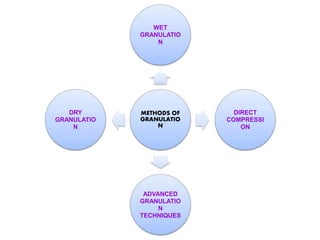
METHODS OF GRANULATION
ADVANCED GRANULATION TECHNIQUES
CONCLUSION
REFERENCES
CONTENTS
INTRODUCTION
 Granulation-Granulation is the process in which the powder particles
are made to adhere to form large particles called granules.
Pharmaceutical granules typically have a size range between 0.2-4mm ,
depending on their subsequent use.
 Granulation Technology
Why we prepare granules when we have
powders….?
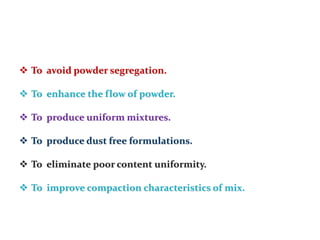
 To avoid powder segregation.
 To enhance the flow of powder.
 To produce uniform mixtures.
 To produce dust free formulations.
 To eliminate poor content uniformity.
 To improve compaction characteristics of mix.
METHODS OF
GRANULATIO
N
WET
GRANULATIO
N
DIRECT
COMPRESSI
ON
ADVANCED
GRANULATIO
N
TECHNIQUES
DRY
GRANULATIO
N
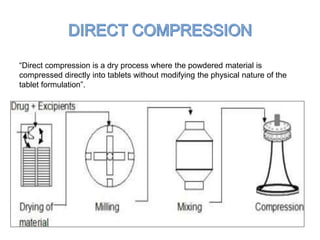
“Direct compression is a dry process where the powdered material is
compressed directly into tablets without modifying the physical nature of the
tablet formulation”.
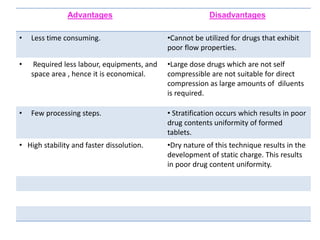
Advantages Disadvantages
• Less time consuming. •Cannot be utilized for drugs that exhibit
poor flow properties.
• Required less labour, equipments, and
space area , hence it is economical.
•Large dose drugs which are not self
compressible are not suitable for direct
compression as large amounts of diluents
is required.
• Few processing steps. • Stratification occurs which results in poor
drug contents uniformity of formed
tablets.
• High stability and faster dissolution. •Dry nature of this technique results in the
development of static charge. This results
in poor drug content uniformity.
When To Choose DRY method?
 Drug dose is too high.
 Do not compress well after wet granulation.
 Heat sensitive drugs.
 Moisture sensitive drugs.
e.g. Aspirin , Vitamins
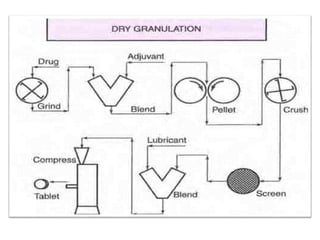
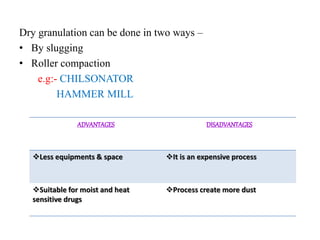
Dry granulation can be done in two ways –
• By slugging
• Roller compaction
e.g:- CHILSONATOR
HAMMER MILL
ADVANTAGES DISADVANTAGES
Less equipments & space It is an expensive process
Suitable for moist and heat
sensitive drugs
Process create more dust
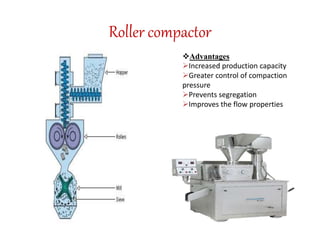
Roller compactor
Advantages
Increased production capacity
Greater control of compaction
pressure
Prevents segregation
Improves the flow properties
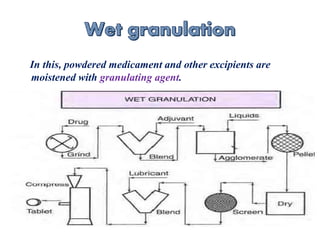
In this, powdered medicament and other excipients are
moistened with granulating agent.
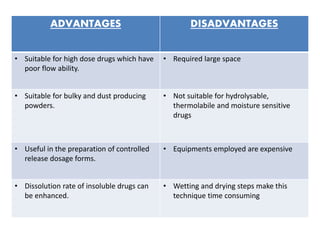
ADVANTAGES DISADVANTAGES
• Suitable for high dose drugs which have
poor flow ability.
• Required large space
• Suitable for bulky and dust producing
powders.
• Not suitable for hydrolysable,
thermolabile and moisture sensitive
drugs
• Useful in the preparation of controlled
release dosage forms.
• Equipments employed are expensive
• Dissolution rate of insoluble drugs can
be enhanced.
• Wetting and drying steps make this
technique time consuming
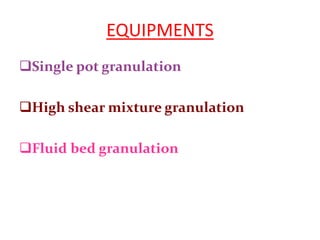
EQUIPMENTS
Single pot granulation
High shear mixture granulation
Fluid bed granulation
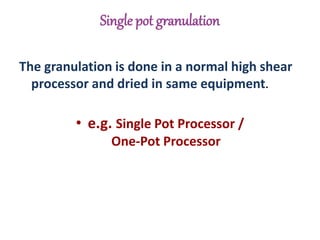
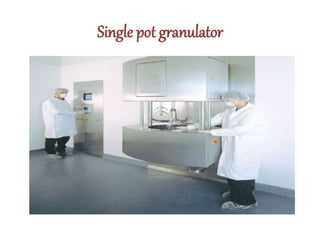
Single pot granulation
The granulation is done in a normal high shear
processor and dried in same equipment.
• e.g. Single Pot Processor /
One-Pot Processor
Single pot granulator
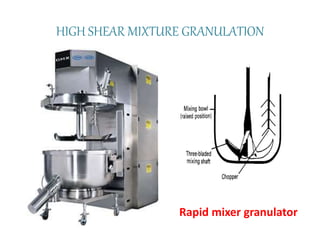
HIGH SHEAR MIXTURE GRANULATION
Rapid mixer granulator
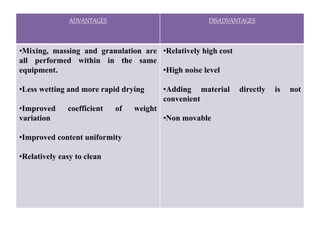
ADVANTAGES DISADVANTAGES
•Mixing, massing and granulation are
all performed within in the same
equipment.
•Less wetting and more rapid drying
•Improved coefficient of weight
variation
•Improved content uniformity
•Relatively easy to clean
•Relatively high cost
•High noise level
•Adding material directly is not
convenient
•Non movable
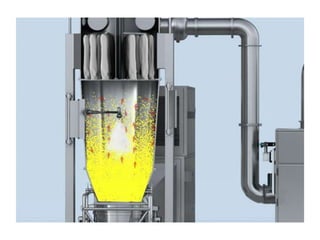
Fluidization is the operation by which fine solids are
transformed into a fluid like state through contact with
a gas.
Granulating and drying can be completed in one step
inside the machine.
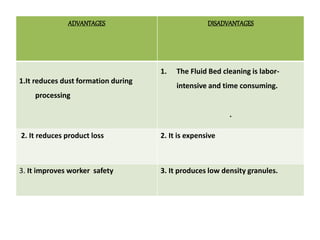
Fluidbed granulation
ADVANTAGES DISADVANTAGES
1.It reduces dust formation during
processing
1. The Fluid Bed cleaning is labor-
intensive and time consuming.
.
2. It reduces product loss 2. It is expensive
3. It improves worker safety 3. It produces low density granules.
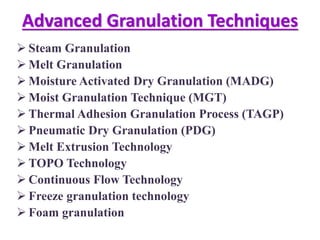
Advanced Granulation Techniques
 Steam Granulation
 Melt Granulation
 Moisture Activated Dry Granulation (MADG)
 Moist Granulation Technique (MGT)
 Thermal Adhesion Granulation Process (TAGP)
 Pneumatic Dry Granulation (PDG)
 Melt Extrusion Technology
 TOPO Technology
 Continuous Flow Technology
 Freeze granulation technology
 Foam granulation
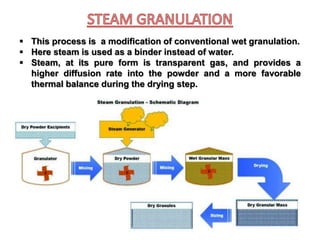
 This process is a modification of conventional wet granulation.
 Here steam is used as a binder instead of water.
 Steam, at its pure form is transparent gas, and provides a
higher diffusion rate into the powder and a more favorable
thermal balance during the drying step.
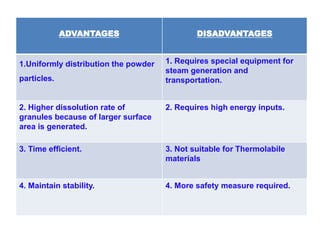
ADVANTAGES DISADVANTAGES
1.Uniformly distribution the powder
particles.
1. Requires special equipment for
steam generation and
transportation.
2. Higher dissolution rate of
granules because of larger surface
area is generated.
2. Requires high energy inputs.
3. Time efficient. 3. Not suitable for Thermolabile
materials
4. Maintain stability. 4. More safety measure required.
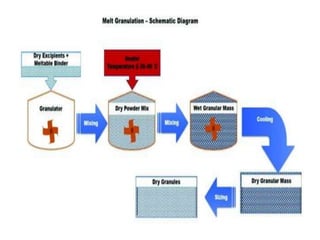
 This granulation method is also know as theromplastic granulation.
 Here granulation is achieved by the addition of meltable binder.
e.g:- Water soluble binders
Polyethylene Glycol (PEG - 2000 to 8000)
[40-60 0C]
Water insoluble binders
Stearic acid [46-59 0C]
Stearyl alcohol [56-60 0C]
 Binder is in solid state at room temperature but melts in the temperature range of
50 – 90˚C.
 Melted binder then acts like a binding liquid.
 There is no need of drying phase since dried granules are obtained by cooling it to
room temperature.
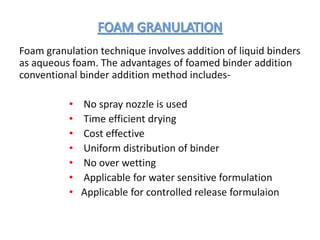
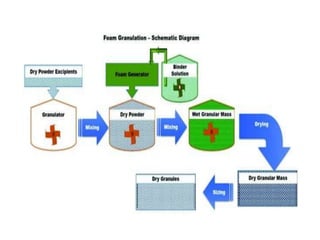
Foam granulation technique involves addition of liquid binders
as aqueous foam. The advantages of foamed binder addition
conventional binder addition method includes-
• No spray nozzle is used
• Time efficient drying
• Cost effective
• Uniform distribution of binder
• No over wetting
• Applicable for water sensitive formulation
• Applicable for controlled release formulaion
CONCLUSION
 Today Granulation Technology represents an efficient pathway
for manufacture of various drug delivery systems.
 Advanced Granulation Techniques is applicable to improve
the dissolution characteristics of a poorly water soluble drug
by improving the dissolution rate and bioavailability of the
drug by forming a solid solution.
 Granulation techniques are economic and less time consuming.
 Lachman L., Lieberman H.A., and Kanig J.L. The theory and
practice of industrial pharmacy. Third edition; Varghese
publishing house, Bombay; 1991.
 Lieberman H.A. and Lachman L. Pharmaceutical dosage
forms: tablet. Vol 1; Marcel Dekker, INC. New York; 1980.
 Lieberman H.A. and Lachman L. Pharmaceutical dosage
forms: tablet. Vol 2; Marcel Dekker, INC. New York; 1980.
 http://www.pharmpedia.com/Tablet:Formulation_of_tablets/Bi
nders .
 https://en.wikipedia.org/wiki/Granulation_(process).
REFERENCES
THANK
you…..

Seminar on granulation by purnima

  • 1.
    A SEMINAR ON GRANULATION PRESENTED BY- T NPURNIMA 14T21R0083 B.Pharm IV year UNDER THE GUIDANCE OF- Mr. Shireesh Kiran M.Pharm Assistant professor Department of Pharmaceutics CMR COLLEGE OF PHARMACY
  • 2.
    INTRODUCTION METHODS OF GRANULATION ADVANCEDGRANULATION TECHNIQUES CONCLUSION REFERENCES CONTENTS
  • 3.
    INTRODUCTION  Granulation-Granulation isthe process in which the powder particles are made to adhere to form large particles called granules. Pharmaceutical granules typically have a size range between 0.2-4mm , depending on their subsequent use.  Granulation Technology
  • 4.
    Why we preparegranules when we have powders….?
  • 5.
     To avoidpowder segregation.  To enhance the flow of powder.  To produce uniform mixtures.  To produce dust free formulations.  To eliminate poor content uniformity.  To improve compaction characteristics of mix.
  • 6.
  • 7.
    “Direct compression isa dry process where the powdered material is compressed directly into tablets without modifying the physical nature of the tablet formulation”.
  • 8.
    Advantages Disadvantages • Lesstime consuming. •Cannot be utilized for drugs that exhibit poor flow properties. • Required less labour, equipments, and space area , hence it is economical. •Large dose drugs which are not self compressible are not suitable for direct compression as large amounts of diluents is required. • Few processing steps. • Stratification occurs which results in poor drug contents uniformity of formed tablets. • High stability and faster dissolution. •Dry nature of this technique results in the development of static charge. This results in poor drug content uniformity.
  • 9.
    When To ChooseDRY method?  Drug dose is too high.  Do not compress well after wet granulation.  Heat sensitive drugs.  Moisture sensitive drugs. e.g. Aspirin , Vitamins
  • 11.
    Dry granulation canbe done in two ways – • By slugging • Roller compaction e.g:- CHILSONATOR HAMMER MILL ADVANTAGES DISADVANTAGES Less equipments & space It is an expensive process Suitable for moist and heat sensitive drugs Process create more dust
  • 12.
    Roller compactor Advantages Increased productioncapacity Greater control of compaction pressure Prevents segregation Improves the flow properties
  • 13.
    In this, powderedmedicament and other excipients are moistened with granulating agent.
  • 14.
    ADVANTAGES DISADVANTAGES • Suitablefor high dose drugs which have poor flow ability. • Required large space • Suitable for bulky and dust producing powders. • Not suitable for hydrolysable, thermolabile and moisture sensitive drugs • Useful in the preparation of controlled release dosage forms. • Equipments employed are expensive • Dissolution rate of insoluble drugs can be enhanced. • Wetting and drying steps make this technique time consuming
  • 15.
    EQUIPMENTS Single pot granulation Highshear mixture granulation Fluid bed granulation
  • 16.
    Single pot granulation Thegranulation is done in a normal high shear processor and dried in same equipment. • e.g. Single Pot Processor / One-Pot Processor
  • 17.
  • 18.
    HIGH SHEAR MIXTUREGRANULATION Rapid mixer granulator
  • 19.
    ADVANTAGES DISADVANTAGES •Mixing, massingand granulation are all performed within in the same equipment. •Less wetting and more rapid drying •Improved coefficient of weight variation •Improved content uniformity •Relatively easy to clean •Relatively high cost •High noise level •Adding material directly is not convenient •Non movable
  • 20.
    Fluidization is theoperation by which fine solids are transformed into a fluid like state through contact with a gas. Granulating and drying can be completed in one step inside the machine. Fluidbed granulation
  • 21.
    ADVANTAGES DISADVANTAGES 1.It reducesdust formation during processing 1. The Fluid Bed cleaning is labor- intensive and time consuming. . 2. It reduces product loss 2. It is expensive 3. It improves worker safety 3. It produces low density granules.
  • 23.
    Advanced Granulation Techniques Steam Granulation  Melt Granulation  Moisture Activated Dry Granulation (MADG)  Moist Granulation Technique (MGT)  Thermal Adhesion Granulation Process (TAGP)  Pneumatic Dry Granulation (PDG)  Melt Extrusion Technology  TOPO Technology  Continuous Flow Technology  Freeze granulation technology  Foam granulation
  • 24.
     This processis a modification of conventional wet granulation.  Here steam is used as a binder instead of water.  Steam, at its pure form is transparent gas, and provides a higher diffusion rate into the powder and a more favorable thermal balance during the drying step.
  • 25.
    ADVANTAGES DISADVANTAGES 1.Uniformly distributionthe powder particles. 1. Requires special equipment for steam generation and transportation. 2. Higher dissolution rate of granules because of larger surface area is generated. 2. Requires high energy inputs. 3. Time efficient. 3. Not suitable for Thermolabile materials 4. Maintain stability. 4. More safety measure required.
  • 26.
     This granulationmethod is also know as theromplastic granulation.  Here granulation is achieved by the addition of meltable binder. e.g:- Water soluble binders Polyethylene Glycol (PEG - 2000 to 8000) [40-60 0C] Water insoluble binders Stearic acid [46-59 0C] Stearyl alcohol [56-60 0C]  Binder is in solid state at room temperature but melts in the temperature range of 50 – 90˚C.  Melted binder then acts like a binding liquid.  There is no need of drying phase since dried granules are obtained by cooling it to room temperature.
  • 28.
    Foam granulation techniqueinvolves addition of liquid binders as aqueous foam. The advantages of foamed binder addition conventional binder addition method includes- • No spray nozzle is used • Time efficient drying • Cost effective • Uniform distribution of binder • No over wetting • Applicable for water sensitive formulation • Applicable for controlled release formulaion
  • 30.
    CONCLUSION  Today GranulationTechnology represents an efficient pathway for manufacture of various drug delivery systems.  Advanced Granulation Techniques is applicable to improve the dissolution characteristics of a poorly water soluble drug by improving the dissolution rate and bioavailability of the drug by forming a solid solution.  Granulation techniques are economic and less time consuming.
  • 31.
     Lachman L.,Lieberman H.A., and Kanig J.L. The theory and practice of industrial pharmacy. Third edition; Varghese publishing house, Bombay; 1991.  Lieberman H.A. and Lachman L. Pharmaceutical dosage forms: tablet. Vol 1; Marcel Dekker, INC. New York; 1980.  Lieberman H.A. and Lachman L. Pharmaceutical dosage forms: tablet. Vol 2; Marcel Dekker, INC. New York; 1980.  http://www.pharmpedia.com/Tablet:Formulation_of_tablets/Bi nders .  https://en.wikipedia.org/wiki/Granulation_(process). REFERENCES
  • 32.