Grammar
Comma 

Use
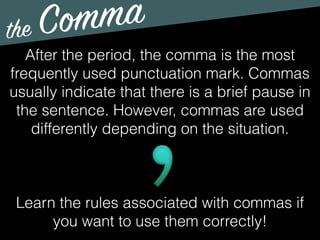
the Comma
After the period, the comma is the most
frequently used punctuation mark. Commas
usually indicate that there is a brief pause in
the sentence. However, commas are used
differently depending on the situation.
Learn the rules associated with commas if
you want to use them correctly!
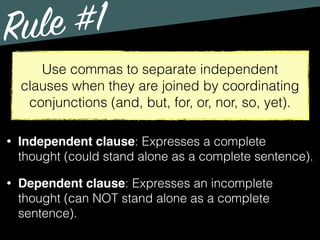
Rule #1
• Independent clause: Expresses a complete
thought (could stand alone as a complete sentence).
• Dependent clause: Expresses an incomplete
thought (can NOT stand alone as a complete
sentence).
Use commas to separate independent
clauses when they are joined by coordinating
conjunctions (and, but, for, or, nor, so, yet).
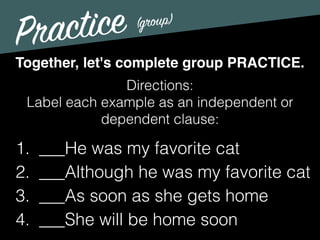
Practice
Directions:
Label each example as an independent or
dependent clause:
Together, let's complete group PRACTICE.
1. ___He was my favorite cat
2. ___Although he was my favorite cat
3. ___As soon as she gets home
4. ___She will be home soon
(group)
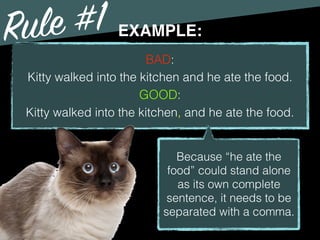
Rule #1
BAD:
Kitty walked into the kitchen and he ate the food.
GOOD:
Kitty walked into the kitchen, and he ate the food.
EXAMPLE:
Because “he ate the
food” could stand alone
as its own complete
sentence, it needs to be
separated with a comma.
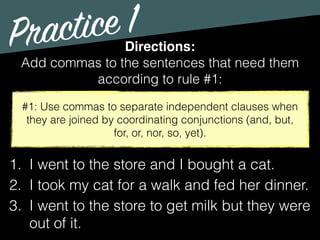
Practice 1Directions:
Add commas to the sentences that need them
according to rule #1:
1. I went to the store and I bought a cat.
2. I took my cat for a walk and fed her dinner.
3. I went to the store to get milk but they were
out of it.
#1: Use commas to separate independent clauses when
they are joined by coordinating conjunctions (and, but,
for, or, nor, so, yet).
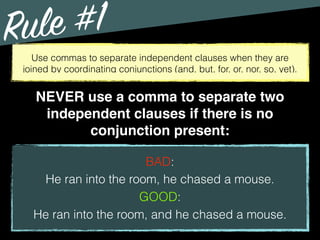
Rule #1
NEVER use a comma to separate two
independent clauses if there is no
conjunction present:
Use commas to separate independent clauses when they are
joined by coordinating conjunctions (and, but, for, or, nor, so, yet).
BAD:
He ran into the room, he chased a mouse.
GOOD:
He ran into the room, and he chased a mouse.
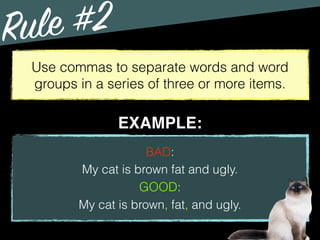
Rule #2
Use commas to separate words and word
groups in a series of three or more items.
BAD:
My cat is brown fat and ugly.
GOOD:
My cat is brown, fat, and ugly.
EXAMPLE:
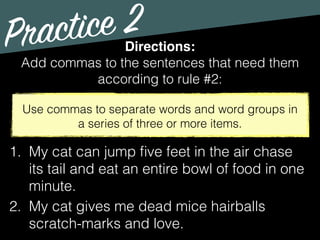
Practice 2Directions:
Add commas to the sentences that need them
according to rule #2:
1. My cat can jump five feet in the air chase
its tail and eat an entire bowl of food in one
minute.
2. My cat gives me dead mice hairballs
scratch-marks and love.
Use commas to separate words and word groups in
a series of three or more items.
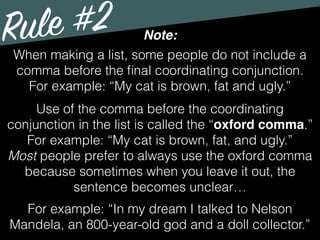
Rule #2 Note:
When making a list, some people do not include a
comma before the final coordinating conjunction.
For example: “My cat is brown, fat and ugly.”
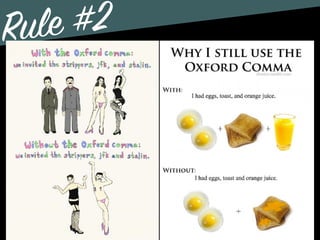
Use of the comma before the coordinating
conjunction in the list is called the “oxford comma.”
For example: “My cat is brown, fat, and ugly.”
Most people prefer to always use the oxford comma
because sometimes when you leave it out, the
sentence becomes unclear…
For example: “In my dream I talked to Nelson
Mandela, an 800-year-old god and a doll collector.”
Rule #2
Rule #3
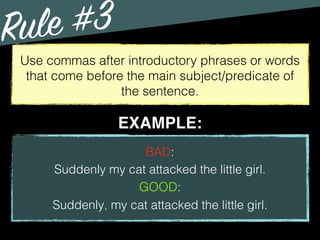
Use commas after introductory phrases or words
that come before the main subject/predicate of
the sentence.
BAD:
Suddenly my cat attacked the little girl.
GOOD:
Suddenly, my cat attacked the little girl.
EXAMPLE:
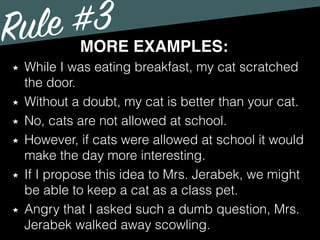
Rule #3MORE EXAMPLES:
While I was eating breakfast, my cat scratched
the door.
Without a doubt, my cat is better than your cat.
No, cats are not allowed at school.
However, if cats were allowed at school it would
make the day more interesting.
If I propose this idea to Mrs. Jerabek, we might
be able to keep a cat as a class pet.
Angry that I asked such a dumb question, Mrs.
Jerabek walked away scowling.
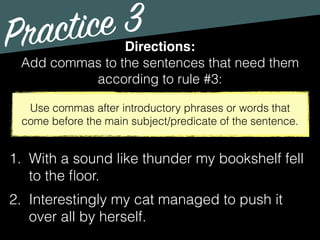
Practice 3Directions:
Add commas to the sentences that need them
according to rule #3:
1. With a sound like thunder my bookshelf fell
to the floor.
2. Interestingly my cat managed to push it
over all by herself.
Use commas after introductory phrases or words that
come before the main subject/predicate of the sentence.
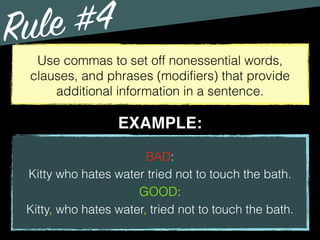
Rule #4
Use commas to set off nonessential words,
clauses, and phrases (modifiers) that provide
additional information in a sentence.
BAD:
Kitty who hates water tried not to touch the bath.
GOOD:
Kitty, who hates water, tried not to touch the bath.
EXAMPLE:
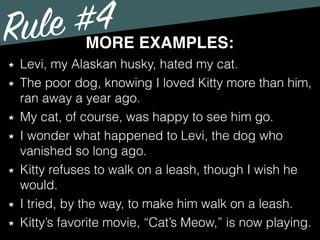
Rule #4MORE EXAMPLES:
Levi, my Alaskan husky, hated my cat.
The poor dog, knowing I loved Kitty more than him,
ran away a year ago.
My cat, of course, was happy to see him go.
I wonder what happened to Levi, the dog who
vanished so long ago.
Kitty refuses to walk on a leash, though I wish he
would.
I tried, by the way, to make him walk on a leash.
Kitty’s favorite movie, “Cat’s Meow,” is now playing.
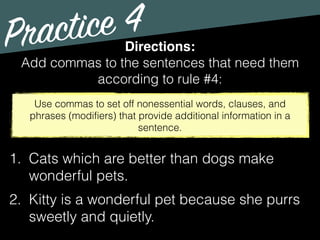
Practice 4Directions:
Add commas to the sentences that need them
according to rule #4:
1. Cats which are better than dogs make
wonderful pets.
2. Kitty is a wonderful pet because she purrs
sweetly and quietly.
Use commas to set off nonessential words, clauses, and
phrases (modifiers) that provide additional information in a
sentence.
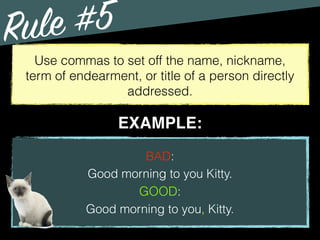
Rule #5
Use commas to set off the name, nickname,
term of endearment, or title of a person directly
addressed.
BAD:
Good morning to you Kitty.
GOOD:
Good morning to you, Kitty.
EXAMPLE:
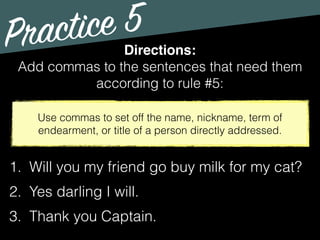
Practice 5
Directions:
Add commas to the sentences that need them
according to rule #5:
1. Will you my friend go buy milk for my cat?
2. Yes darling I will.
3. Thank you Captain.
Use commas to set off the name, nickname, term of
endearment, or title of a person directly addressed.
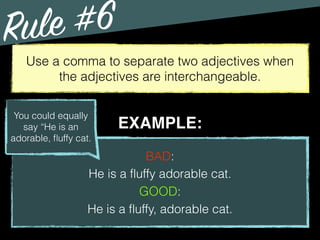
Rule #6
Use a comma to separate two adjectives when
the adjectives are interchangeable.
BAD:
He is a fluffy adorable cat.
GOOD:
He is a fluffy, adorable cat.
EXAMPLE:
You could equally
say “He is an
adorable, fluffy cat.
Rule #6 Note:
Rule #6 has a catch: you don’t put a comma between
adjectives when one of the adjectives forms a meaningful
“unit” with the noun it modifies.
For example: “Kitty has a fancy, custom collar.” (BAD)
For example: “Kitty has a fancy custom collar.” (GOOD)
“Custom collar” becomes
a meaningful unit, and
now “fancy” is modifying
“custom collar” instead
of just “collar.”
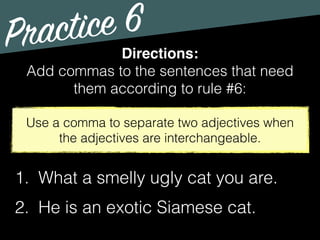
Practice 6
Directions:
Add commas to the sentences that need
them according to rule #6:
1. What a smelly ugly cat you are.
2. He is an exotic Siamese cat.
Use a comma to separate two adjectives when
the adjectives are interchangeable.
Good
Luck!

Grammar - Comma Use

  • 1.
  • 2.
    the Comma After theperiod, the comma is the most frequently used punctuation mark. Commas usually indicate that there is a brief pause in the sentence. However, commas are used differently depending on the situation. Learn the rules associated with commas if you want to use them correctly!
  • 3.
    Rule #1 • Independentclause: Expresses a complete thought (could stand alone as a complete sentence). • Dependent clause: Expresses an incomplete thought (can NOT stand alone as a complete sentence). Use commas to separate independent clauses when they are joined by coordinating conjunctions (and, but, for, or, nor, so, yet).
  • 4.
    Practice Directions: Label each exampleas an independent or dependent clause: Together, let's complete group PRACTICE. 1. ___He was my favorite cat 2. ___Although he was my favorite cat 3. ___As soon as she gets home 4. ___She will be home soon (group)
  • 5.
    Rule #1 BAD: Kitty walkedinto the kitchen and he ate the food. GOOD: Kitty walked into the kitchen, and he ate the food. EXAMPLE: Because “he ate the food” could stand alone as its own complete sentence, it needs to be separated with a comma.
  • 6.
    Practice 1Directions: Add commasto the sentences that need them according to rule #1: 1. I went to the store and I bought a cat. 2. I took my cat for a walk and fed her dinner. 3. I went to the store to get milk but they were out of it. #1: Use commas to separate independent clauses when they are joined by coordinating conjunctions (and, but, for, or, nor, so, yet).
  • 7.
    Rule #1 NEVER usea comma to separate two independent clauses if there is no conjunction present: Use commas to separate independent clauses when they are joined by coordinating conjunctions (and, but, for, or, nor, so, yet). BAD: He ran into the room, he chased a mouse. GOOD: He ran into the room, and he chased a mouse.
  • 8.
    Rule #2 Use commasto separate words and word groups in a series of three or more items. BAD: My cat is brown fat and ugly. GOOD: My cat is brown, fat, and ugly. EXAMPLE:
  • 9.
    Practice 2Directions: Add commasto the sentences that need them according to rule #2: 1. My cat can jump five feet in the air chase its tail and eat an entire bowl of food in one minute. 2. My cat gives me dead mice hairballs scratch-marks and love. Use commas to separate words and word groups in a series of three or more items.
  • 10.
    Rule #2 Note: Whenmaking a list, some people do not include a comma before the final coordinating conjunction. For example: “My cat is brown, fat and ugly.” Use of the comma before the coordinating conjunction in the list is called the “oxford comma.” For example: “My cat is brown, fat, and ugly.” Most people prefer to always use the oxford comma because sometimes when you leave it out, the sentence becomes unclear… For example: “In my dream I talked to Nelson Mandela, an 800-year-old god and a doll collector.”
  • 11.
  • 12.
    Rule #3 Use commasafter introductory phrases or words that come before the main subject/predicate of the sentence. BAD: Suddenly my cat attacked the little girl. GOOD: Suddenly, my cat attacked the little girl. EXAMPLE:
  • 13.
    Rule #3MORE EXAMPLES: WhileI was eating breakfast, my cat scratched the door. Without a doubt, my cat is better than your cat. No, cats are not allowed at school. However, if cats were allowed at school it would make the day more interesting. If I propose this idea to Mrs. Jerabek, we might be able to keep a cat as a class pet. Angry that I asked such a dumb question, Mrs. Jerabek walked away scowling.
  • 14.
    Practice 3Directions: Add commasto the sentences that need them according to rule #3: 1. With a sound like thunder my bookshelf fell to the floor. 2. Interestingly my cat managed to push it over all by herself. Use commas after introductory phrases or words that come before the main subject/predicate of the sentence.
  • 15.
    Rule #4 Use commasto set off nonessential words, clauses, and phrases (modifiers) that provide additional information in a sentence. BAD: Kitty who hates water tried not to touch the bath. GOOD: Kitty, who hates water, tried not to touch the bath. EXAMPLE:
  • 16.
    Rule #4MORE EXAMPLES: Levi,my Alaskan husky, hated my cat. The poor dog, knowing I loved Kitty more than him, ran away a year ago. My cat, of course, was happy to see him go. I wonder what happened to Levi, the dog who vanished so long ago. Kitty refuses to walk on a leash, though I wish he would. I tried, by the way, to make him walk on a leash. Kitty’s favorite movie, “Cat’s Meow,” is now playing.
  • 17.
    Practice 4Directions: Add commasto the sentences that need them according to rule #4: 1. Cats which are better than dogs make wonderful pets. 2. Kitty is a wonderful pet because she purrs sweetly and quietly. Use commas to set off nonessential words, clauses, and phrases (modifiers) that provide additional information in a sentence.
  • 18.
    Rule #5 Use commasto set off the name, nickname, term of endearment, or title of a person directly addressed. BAD: Good morning to you Kitty. GOOD: Good morning to you, Kitty. EXAMPLE:
  • 19.
    Practice 5 Directions: Add commasto the sentences that need them according to rule #5: 1. Will you my friend go buy milk for my cat? 2. Yes darling I will. 3. Thank you Captain. Use commas to set off the name, nickname, term of endearment, or title of a person directly addressed.
  • 20.
    Rule #6 Use acomma to separate two adjectives when the adjectives are interchangeable. BAD: He is a fluffy adorable cat. GOOD: He is a fluffy, adorable cat. EXAMPLE: You could equally say “He is an adorable, fluffy cat.
  • 21.
    Rule #6 Note: Rule#6 has a catch: you don’t put a comma between adjectives when one of the adjectives forms a meaningful “unit” with the noun it modifies. For example: “Kitty has a fancy, custom collar.” (BAD) For example: “Kitty has a fancy custom collar.” (GOOD) “Custom collar” becomes a meaningful unit, and now “fancy” is modifying “custom collar” instead of just “collar.”
  • 22.
    Practice 6 Directions: Add commasto the sentences that need them according to rule #6: 1. What a smelly ugly cat you are. 2. He is an exotic Siamese cat. Use a comma to separate two adjectives when the adjectives are interchangeable.
  • 23.