WHAT YOU NEED 
Packet 
Drill Sheet (On front table) 
Writing Utensil
DRILL 
1. Name all the modifiers you can? 
2. What do participle phrases usually end with? 
3. How can you identify what an infinitive is? 
4. What is another name for a subordinate 
clause? 
5. What are the 5 areas adverbs express relation 
to?
The Modifier 
 There are 8 types of modifiers we will 
learn about 
 Adjective 
 Adjective Clause 
 Adverb 
 Adverb Clause 
 Absolute Phrase 
 Infinitive Phrase 
 Participle Phrase 
 Prepositional Phrase
Modifier #1 
The Adjective 
 a word or phrase naming an attribute, 
added to or grammatically related to a 
noun to modify or describe it. 
Example: The old door was falling 
apart. 
Now let’s look at our packet. Complete 
pages 222 & 223 on your own.
Modifier #2 
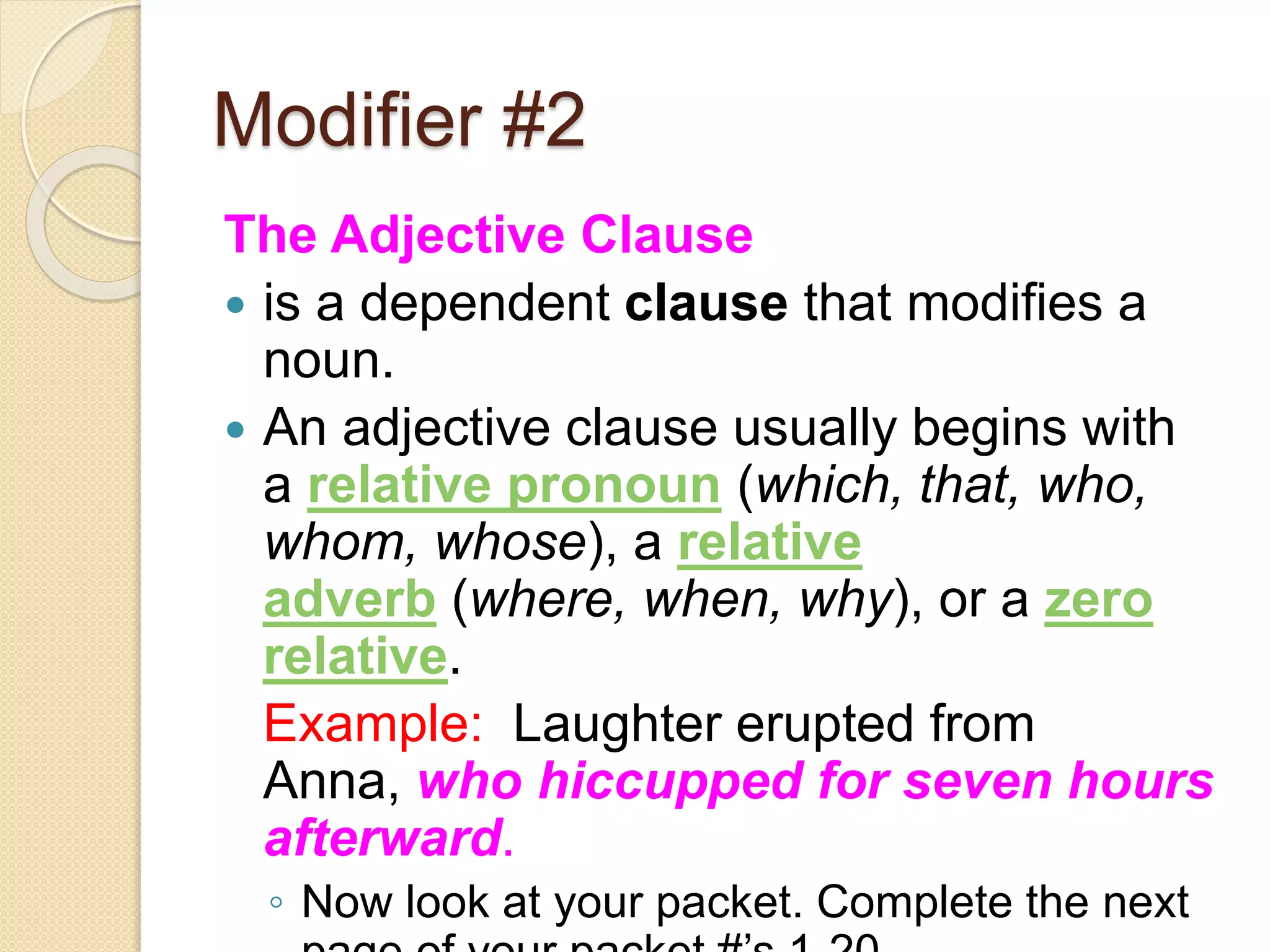
The Adjective Clause 
 is a dependent clause that modifies a 
noun. 
 An adjective clause usually begins with 
a relative pronoun (which, that, who, 
whom, whose), a relative 
adverb (where, when, why), or a zero 
relative. 
Example: Laughter erupted from 
Anna, who hiccupped for seven hours 
afterward. 
◦ Now look at your packet. Complete the next 
page of your packet #’s 1-20.
Modifier #3 
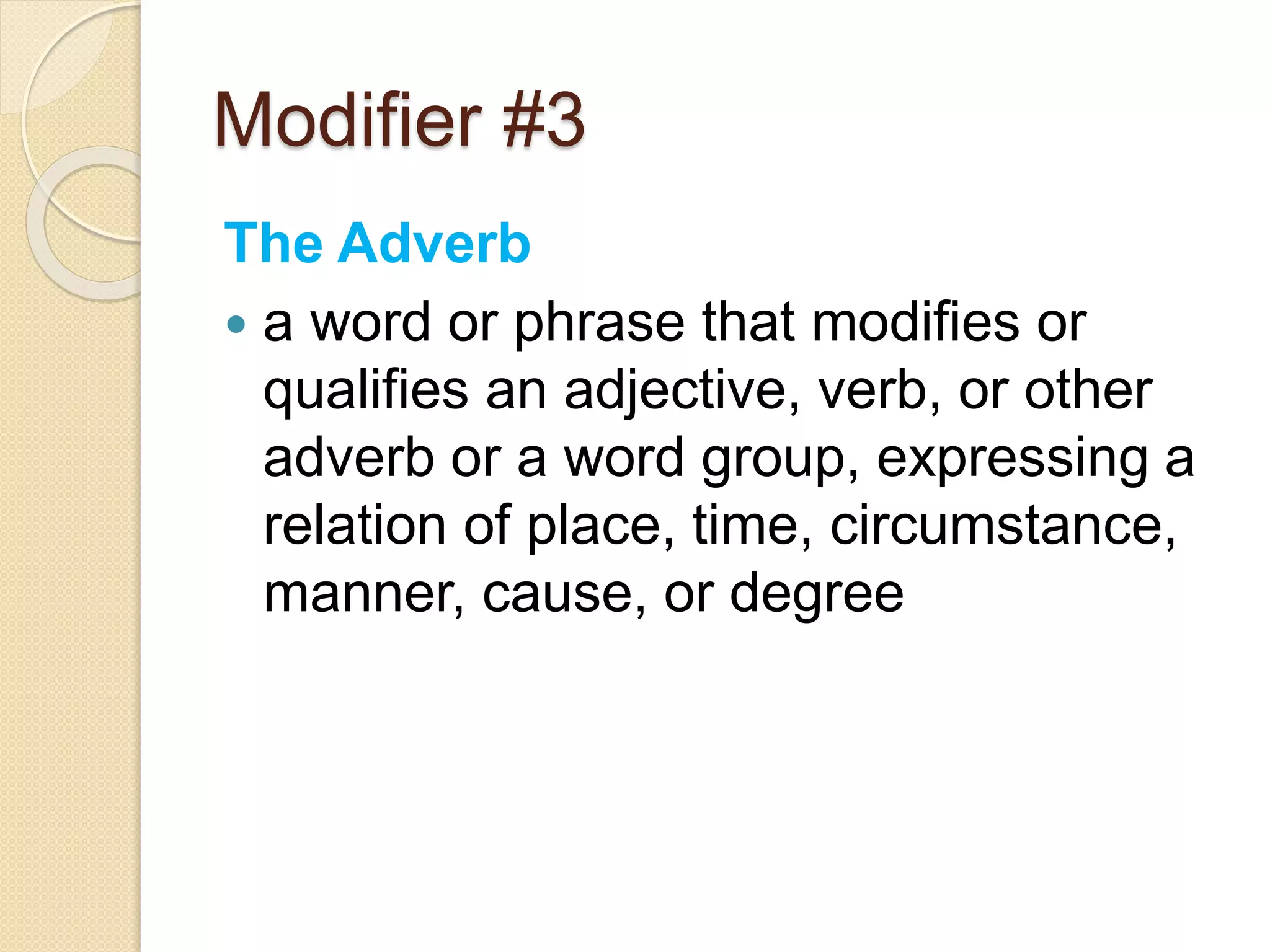
The Adverb 
 a word or phrase that modifies or 
qualifies an adjective, verb, or other 
adverb or a word group, expressing a 
relation of place, time, circumstance, 
manner, cause, or degree
Modifier #3 Continued 
The Adverb 
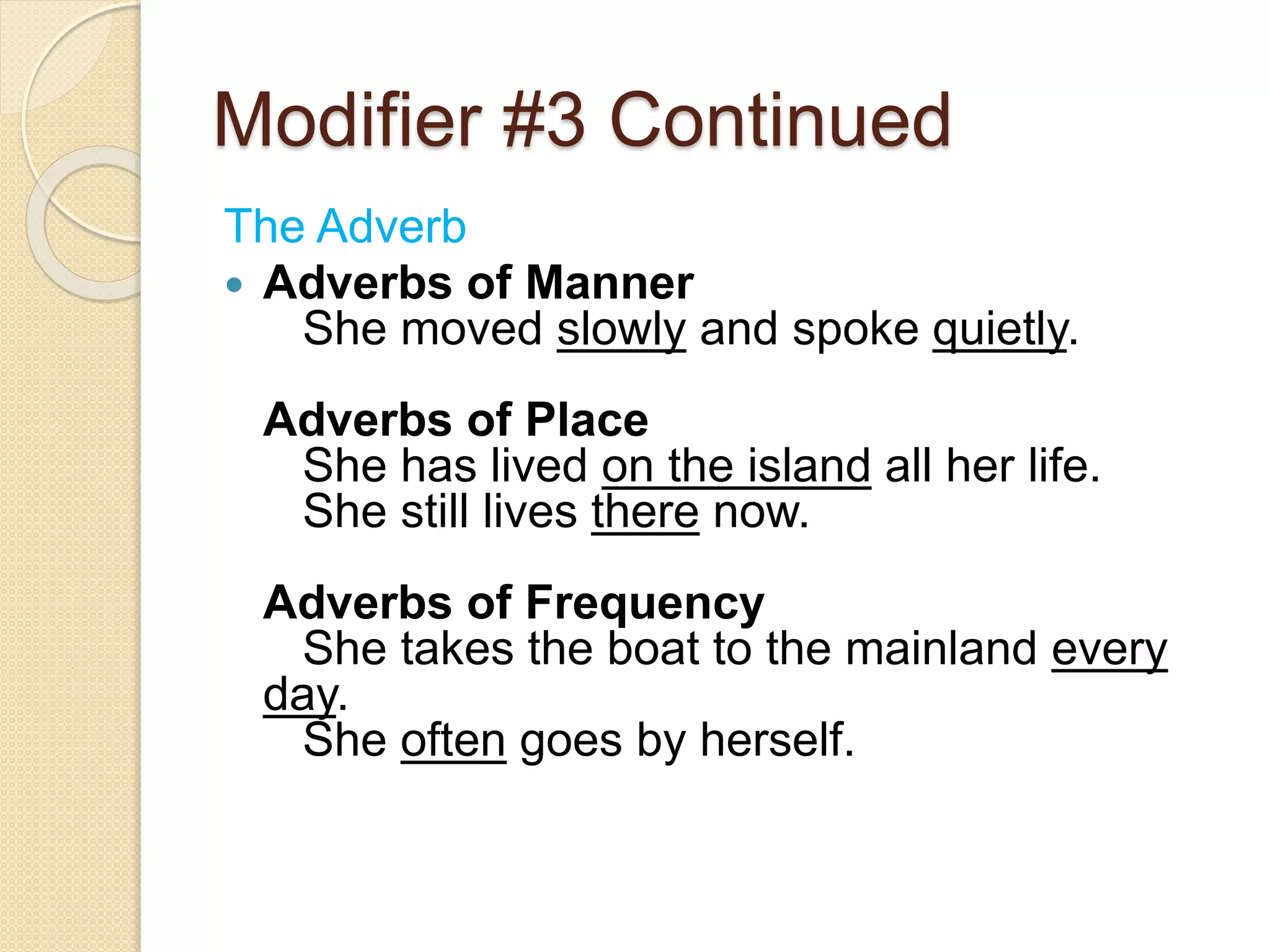
 Adverbs of Manner 
She moved slowly and spoke quietly. 
Adverbs of Place 
She has lived on the island all her life. 
She still lives there now. 
Adverbs of Frequency 
She takes the boat to the mainland every 
day. 
She often goes by herself.
Modifier #3 Continued 
The Adverb 
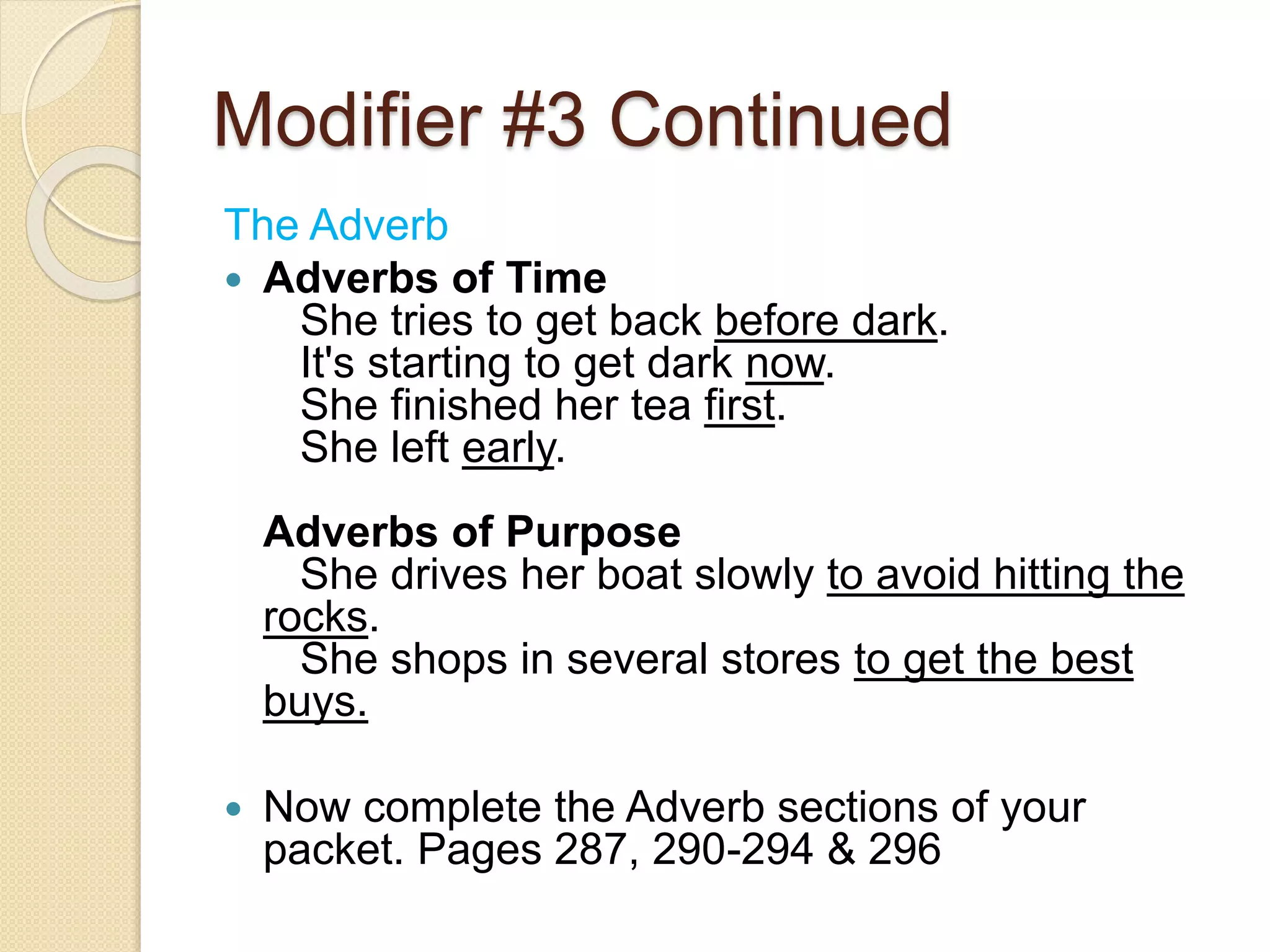
 Adverbs of Time 
She tries to get back before dark. 
It's starting to get dark now. 
She finished her tea first. 
She left early. 
Adverbs of Purpose 
She drives her boat slowly to avoid hitting the 
rocks. 
She shops in several stores to get the best 
buys. 
 Now complete the Adverb sections of your 
packet. Pages 287, 290-294 & 296
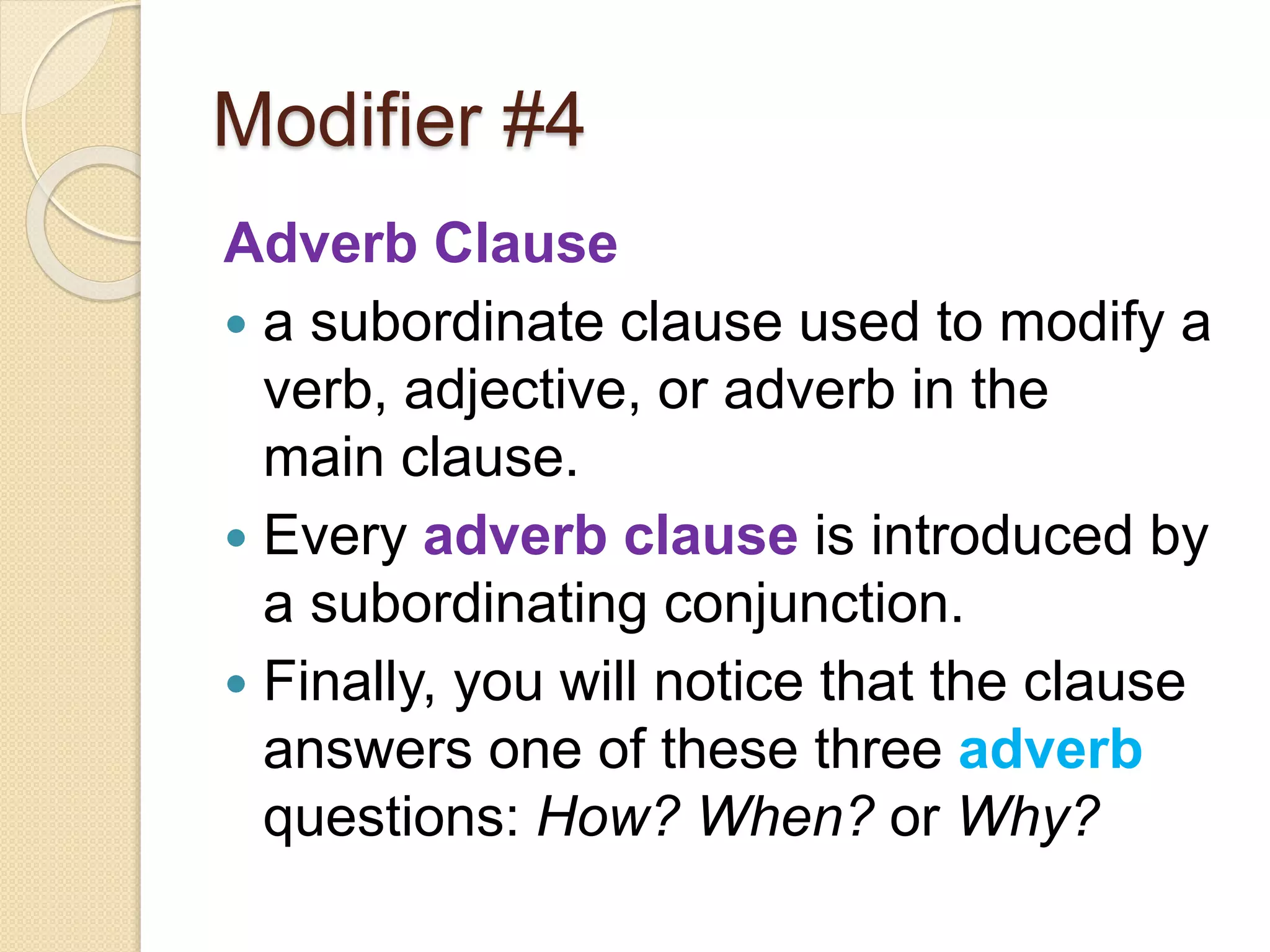
Modifier #4 
Adverb Clause 
 a subordinate clause used to modify a 
verb, adjective, or adverb in the 
main clause. 
 Every adverb clause is introduced by 
a subordinating conjunction. 
 Finally, you will notice that the clause 
answers one of these three adverb 
questions: How? When? or Why?
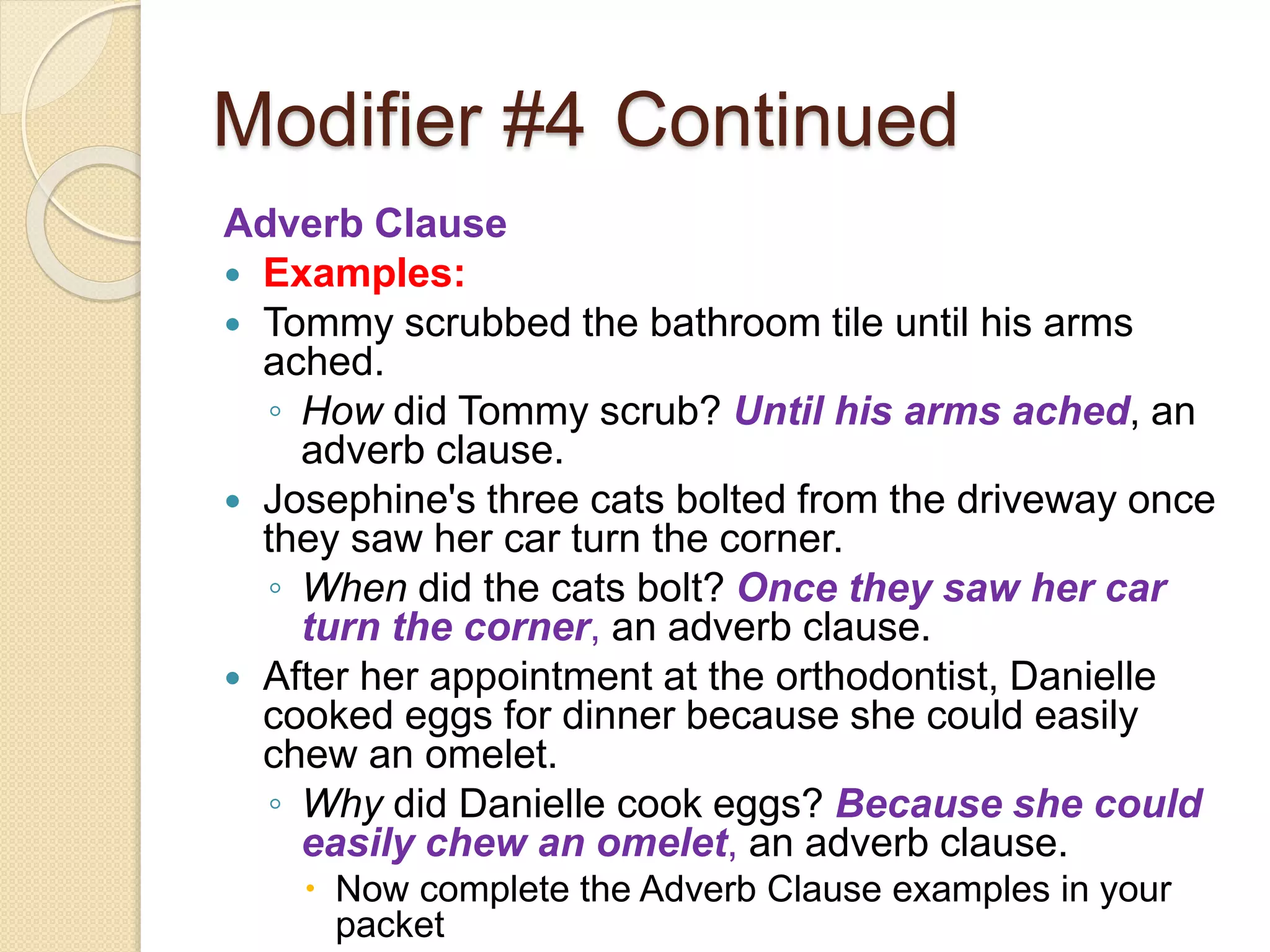
Modifier #4 Continued 
Adverb Clause 
 Examples: 
 Tommy scrubbed the bathroom tile until his arms 
ached. 
◦ How did Tommy scrub? Until his arms ached, an 
adverb clause. 
 Josephine's three cats bolted from the driveway once 
they saw her car turn the corner. 
◦ When did the cats bolt? Once they saw her car 
turn the corner, an adverb clause. 
 After her appointment at the orthodontist, Danielle 
cooked eggs for dinner because she could easily 
chew an omelet. 
◦ Why did Danielle cook eggs? Because she could 
easily chew an omelet, an adverb clause. 
 Now complete the Adverb Clause examples in your 
packet
Modifier #5 
Absolute Phrase 
 An absolute phrase combines a noun and 
a participle with any 
accompanying modifiers or objects. 
 NOUN + PARTICIPLE + OPTIONAL MODIFIER(S) AND/OR OBJECT(S) 
 EXAMPLES: 
 Legs quivering 
Legs = noun; quivering = participle. 
 Her arms folded across her chest 
Arms = noun; folded = participle; her, across her chest = 
modifiers. 
 Our fingers scraping the leftover frosting off the plates 
Fingers = noun; scraping = participle; frosting = direct 
object; our, the, leftover, off the plates = modifiers.
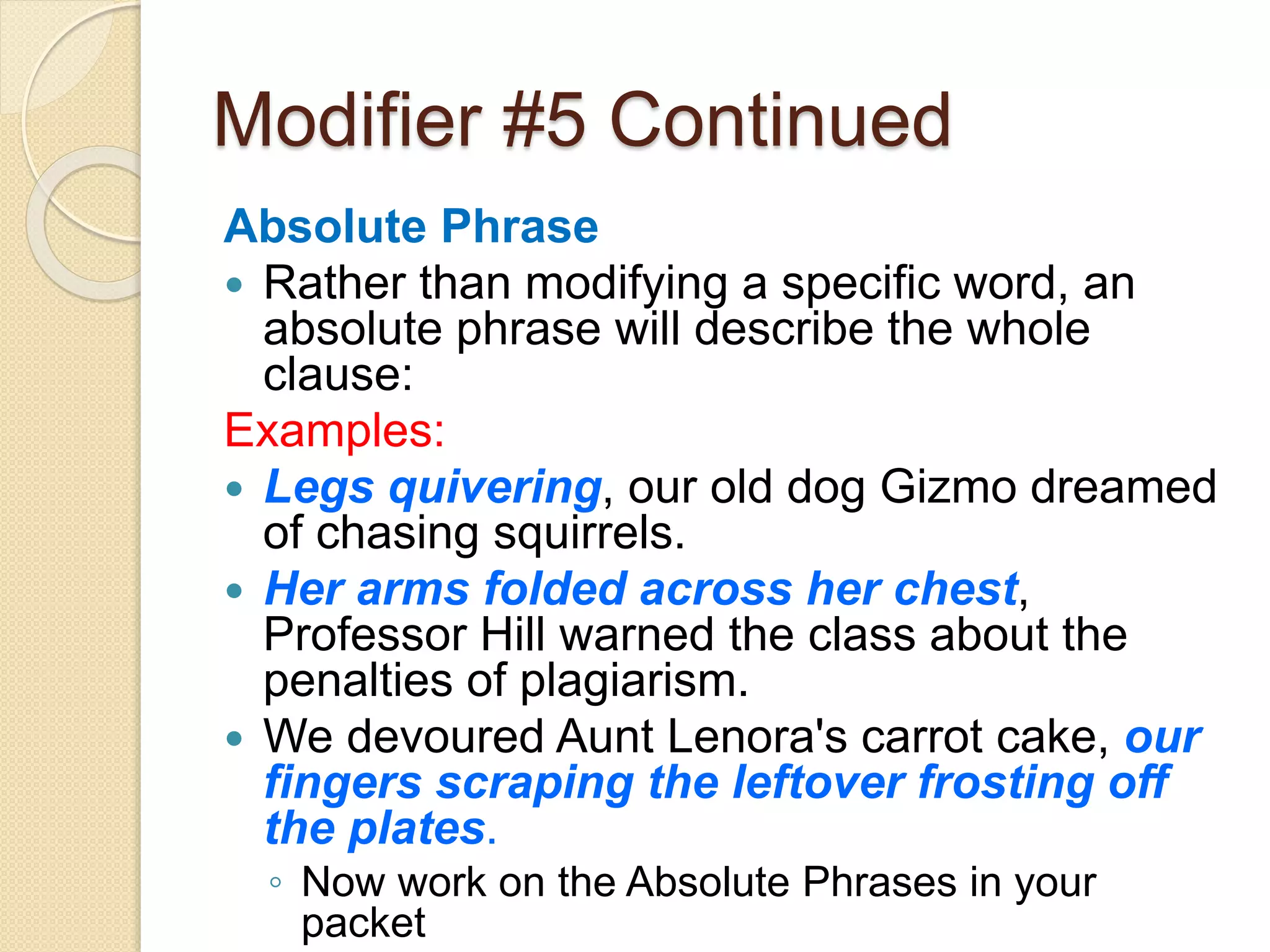
Modifier #5 Continued 
Absolute Phrase 
 Rather than modifying a specific word, an 
absolute phrase will describe the whole 
clause: 
Examples: 
 Legs quivering, our old dog Gizmo dreamed 
of chasing squirrels. 
 Her arms folded across her chest, 
Professor Hill warned the class about the 
penalties of plagiarism. 
 We devoured Aunt Lenora's carrot cake, our 
fingers scraping the leftover frosting off 
the plates. 
◦ Now work on the Absolute Phrases in your 
packet
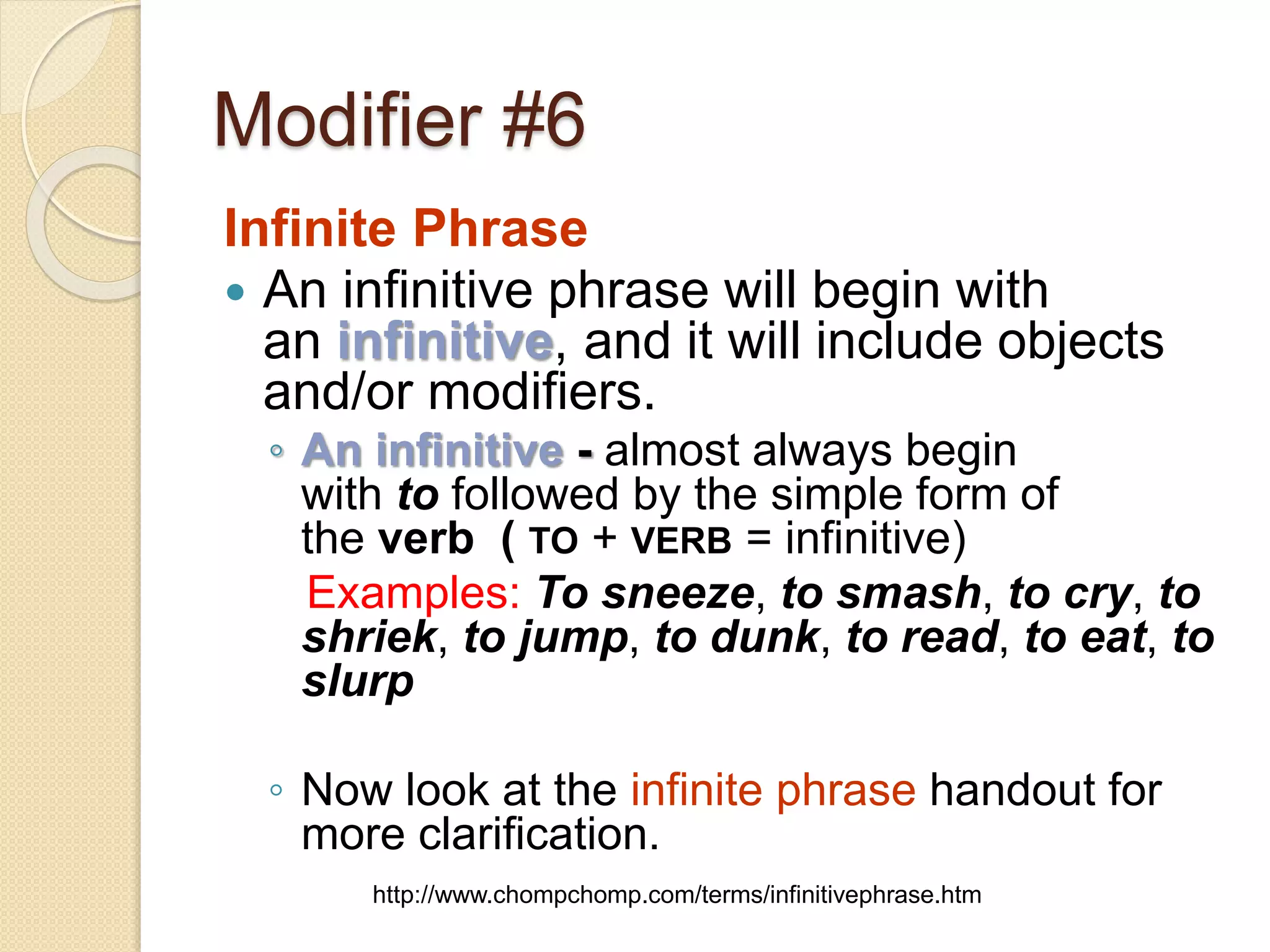
Modifier #6 
Infinite Phrase 
 An infinitive phrase will begin with 
an infinitive, and it will include objects 
and/or modifiers. 
◦ An infinitive - almost always begin 
with to followed by the simple form of 
the verb ( TO + VERB = infinitive) 
Examples: To sneeze, to smash, to cry, to 
shriek, to jump, to dunk, to read, to eat, to 
slurp 
◦ Now look at the infinite phrase handout for 
more clarification. 
http://www.chompchomp.com/terms/infinitivephrase.htm
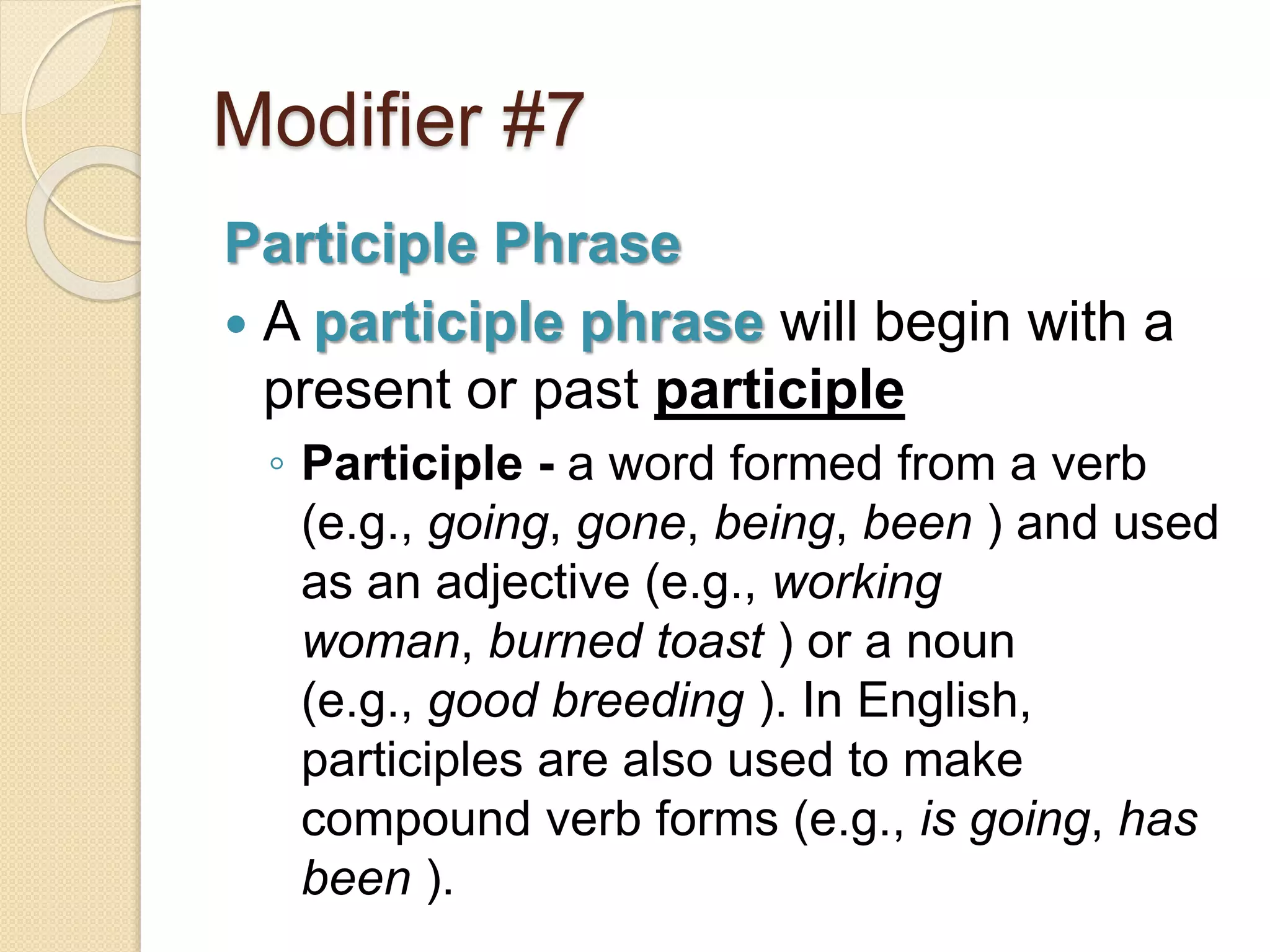
Modifier #7 
Participle Phrase 
 A participle phrase will begin with a 
present or past participle 
◦ Participle - a word formed from a verb 
(e.g., going, gone, being, been ) and used 
as an adjective (e.g., working 
woman, burned toast ) or a noun 
(e.g., good breeding ). In English, 
participles are also used to make 
compound verb forms (e.g., is going, has 
been ).
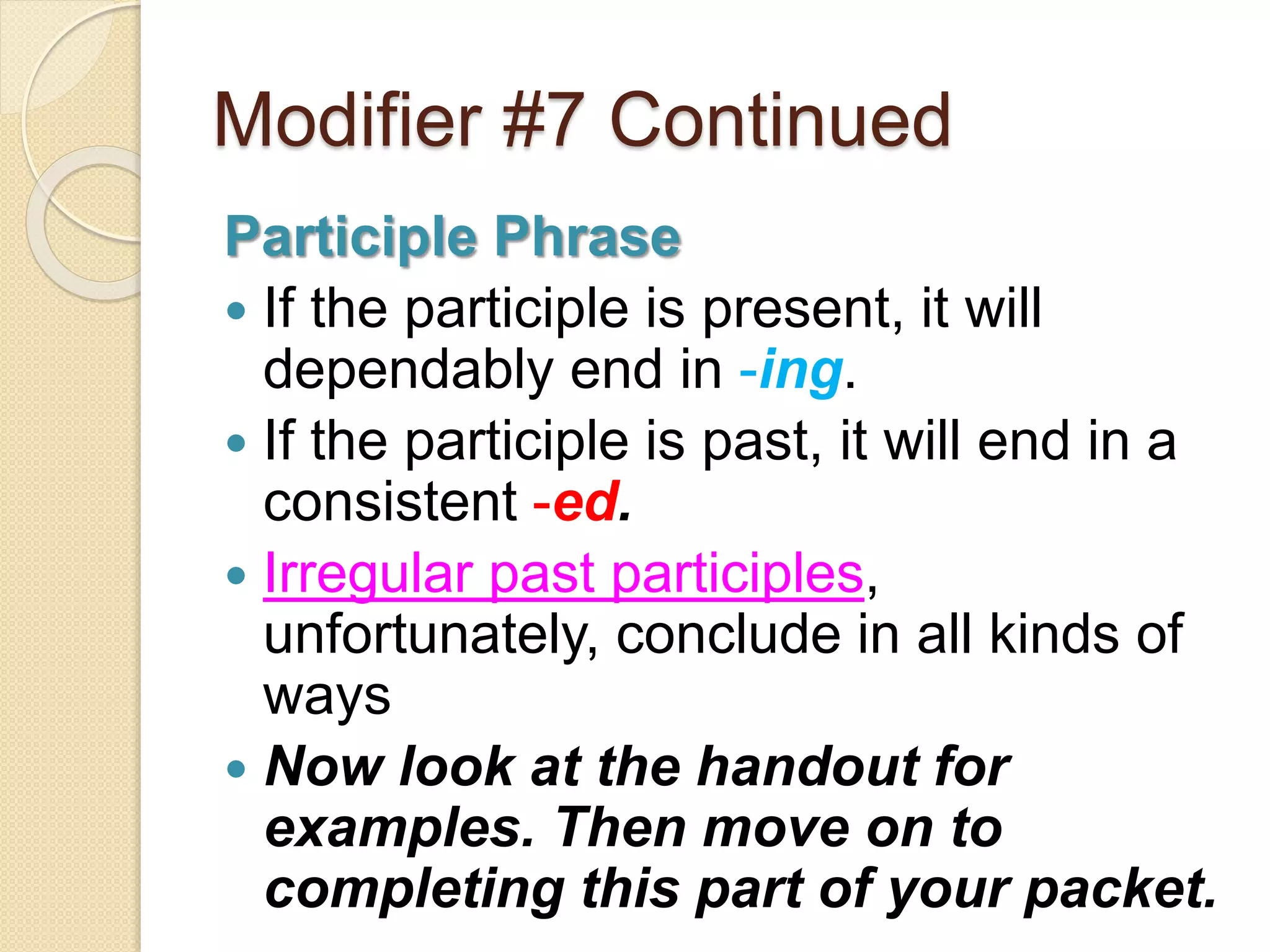
Modifier #7 Continued 
Participle Phrase 
 If the participle is present, it will 
dependably end in -ing. 
 If the participle is past, it will end in a 
consistent -ed. 
 Irregular past participles, 
unfortunately, conclude in all kinds of 
ways 
 Now look at the handout for 
examples. Then move on to 
completing this part of your packet.
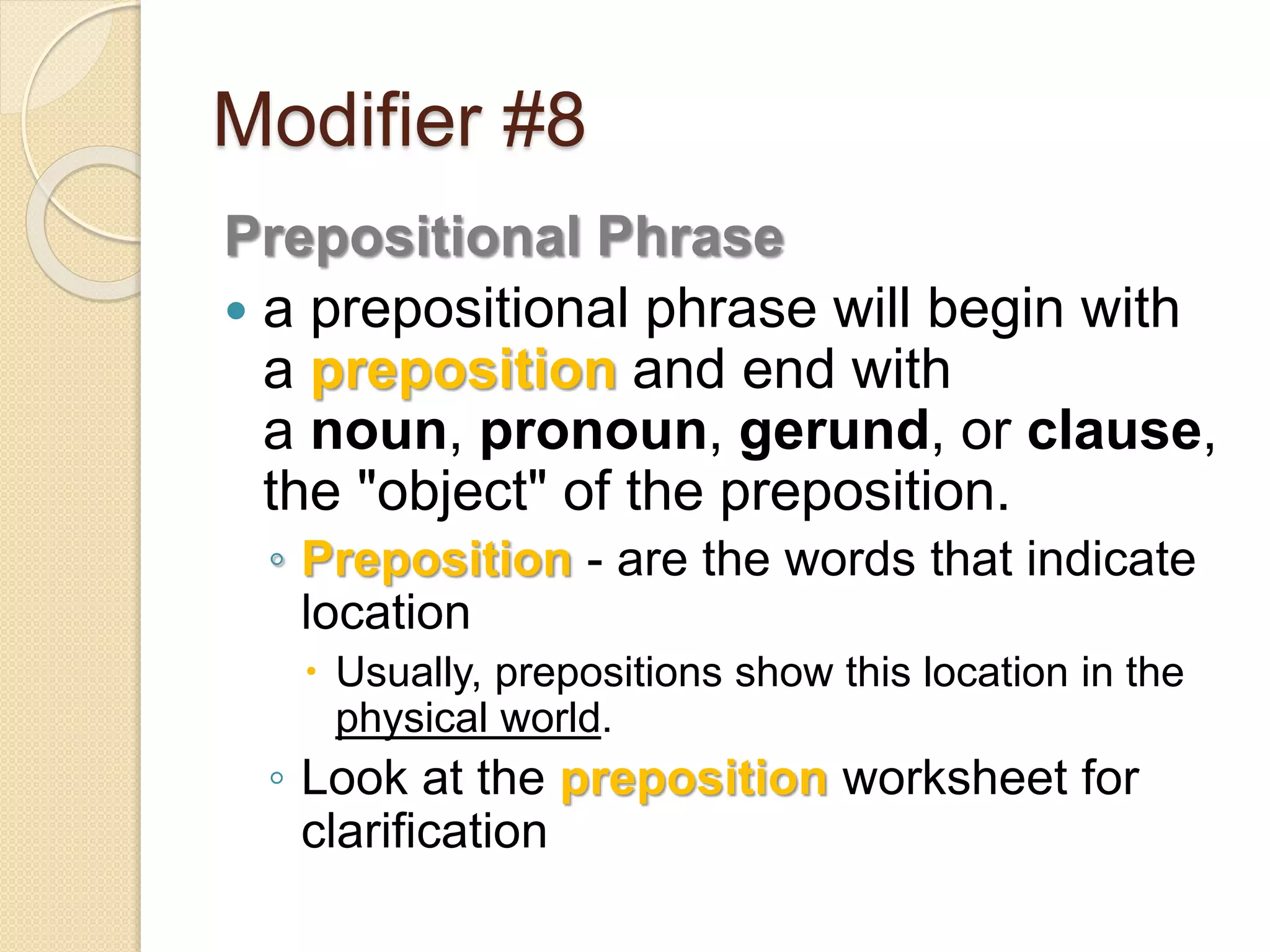
Modifier #8 
Prepositional Phrase 
 a prepositional phrase will begin with 
a preposition and end with 
a noun, pronoun, gerund, or clause, 
the "object" of the preposition. 
◦ Preposition - are the words that indicate 
location 
 Usually, prepositions show this location in the 
physical world. 
◦ Look at the preposition worksheet for 
clarification
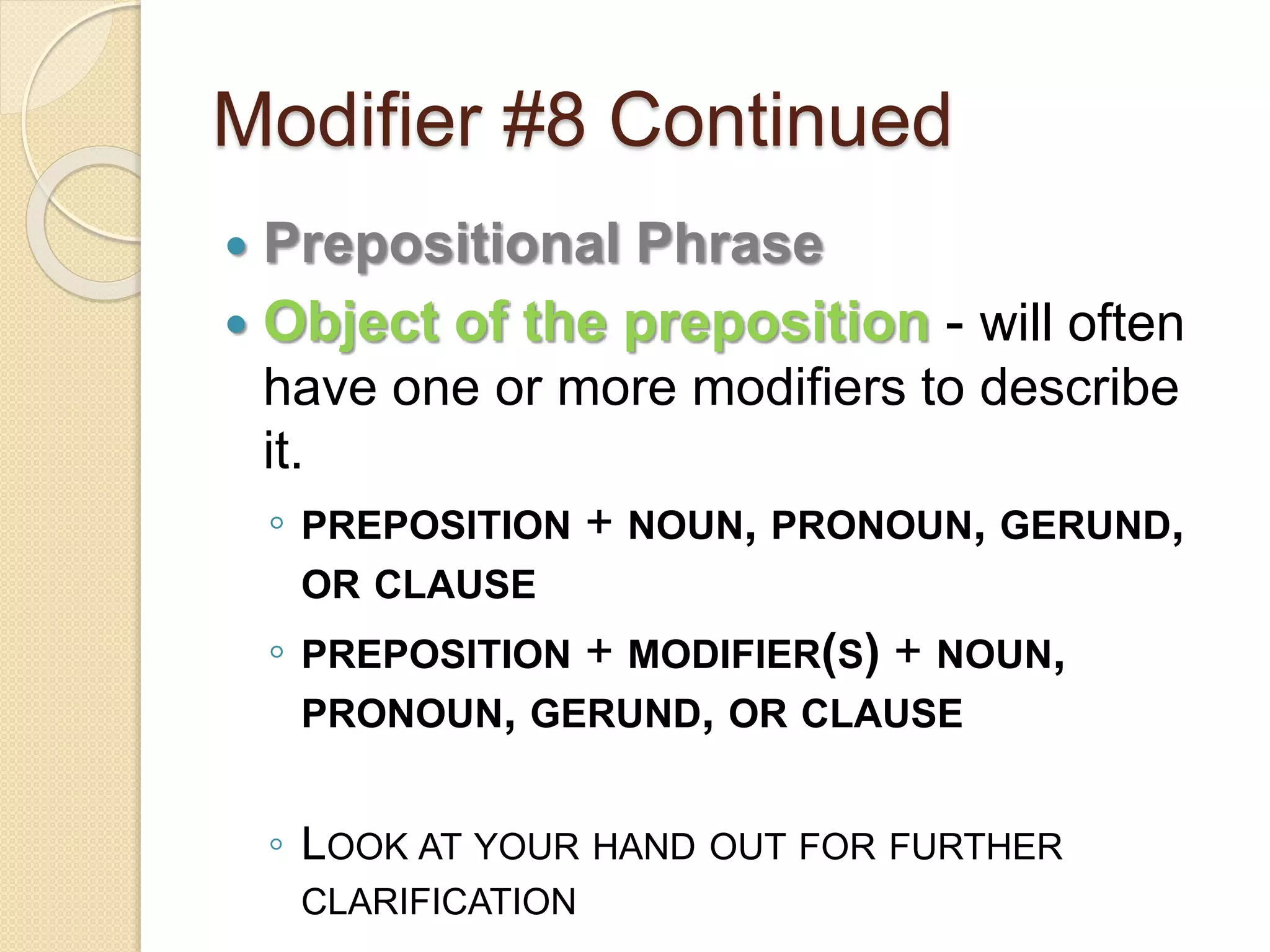
Modifier #8 Continued 
 Prepositional Phrase 
 Object of the preposition - will often 
have one or more modifiers to describe 
it. 
◦ PREPOSITION + NOUN, PRONOUN, GERUND, 
OR CLAUSE 
◦ PREPOSITION + MODIFIER(S) + NOUN, 
PRONOUN, GERUND, OR CLAUSE 
◦ LOOK AT YOUR HAND OUT FOR FURTHER 
CLARIFICATION

Modifiers

  • 1.
    WHAT YOU NEED Packet Drill Sheet (On front table) Writing Utensil
  • 2.
    DRILL 1. Nameall the modifiers you can? 2. What do participle phrases usually end with? 3. How can you identify what an infinitive is? 4. What is another name for a subordinate clause? 5. What are the 5 areas adverbs express relation to?
  • 3.
    The Modifier There are 8 types of modifiers we will learn about  Adjective  Adjective Clause  Adverb  Adverb Clause  Absolute Phrase  Infinitive Phrase  Participle Phrase  Prepositional Phrase
  • 4.
    Modifier #1 TheAdjective  a word or phrase naming an attribute, added to or grammatically related to a noun to modify or describe it. Example: The old door was falling apart. Now let’s look at our packet. Complete pages 222 & 223 on your own.
  • 5.
    Modifier #2 TheAdjective Clause  is a dependent clause that modifies a noun.  An adjective clause usually begins with a relative pronoun (which, that, who, whom, whose), a relative adverb (where, when, why), or a zero relative. Example: Laughter erupted from Anna, who hiccupped for seven hours afterward. ◦ Now look at your packet. Complete the next page of your packet #’s 1-20.
  • 6.
    Modifier #3 TheAdverb  a word or phrase that modifies or qualifies an adjective, verb, or other adverb or a word group, expressing a relation of place, time, circumstance, manner, cause, or degree
  • 7.
    Modifier #3 Continued The Adverb  Adverbs of Manner She moved slowly and spoke quietly. Adverbs of Place She has lived on the island all her life. She still lives there now. Adverbs of Frequency She takes the boat to the mainland every day. She often goes by herself.
  • 8.
    Modifier #3 Continued The Adverb  Adverbs of Time She tries to get back before dark. It's starting to get dark now. She finished her tea first. She left early. Adverbs of Purpose She drives her boat slowly to avoid hitting the rocks. She shops in several stores to get the best buys.  Now complete the Adverb sections of your packet. Pages 287, 290-294 & 296
  • 9.
    Modifier #4 AdverbClause  a subordinate clause used to modify a verb, adjective, or adverb in the main clause.  Every adverb clause is introduced by a subordinating conjunction.  Finally, you will notice that the clause answers one of these three adverb questions: How? When? or Why?
  • 10.
    Modifier #4 Continued Adverb Clause  Examples:  Tommy scrubbed the bathroom tile until his arms ached. ◦ How did Tommy scrub? Until his arms ached, an adverb clause.  Josephine's three cats bolted from the driveway once they saw her car turn the corner. ◦ When did the cats bolt? Once they saw her car turn the corner, an adverb clause.  After her appointment at the orthodontist, Danielle cooked eggs for dinner because she could easily chew an omelet. ◦ Why did Danielle cook eggs? Because she could easily chew an omelet, an adverb clause.  Now complete the Adverb Clause examples in your packet
  • 11.
    Modifier #5 AbsolutePhrase  An absolute phrase combines a noun and a participle with any accompanying modifiers or objects.  NOUN + PARTICIPLE + OPTIONAL MODIFIER(S) AND/OR OBJECT(S)  EXAMPLES:  Legs quivering Legs = noun; quivering = participle.  Her arms folded across her chest Arms = noun; folded = participle; her, across her chest = modifiers.  Our fingers scraping the leftover frosting off the plates Fingers = noun; scraping = participle; frosting = direct object; our, the, leftover, off the plates = modifiers.
  • 12.
    Modifier #5 Continued Absolute Phrase  Rather than modifying a specific word, an absolute phrase will describe the whole clause: Examples:  Legs quivering, our old dog Gizmo dreamed of chasing squirrels.  Her arms folded across her chest, Professor Hill warned the class about the penalties of plagiarism.  We devoured Aunt Lenora's carrot cake, our fingers scraping the leftover frosting off the plates. ◦ Now work on the Absolute Phrases in your packet
  • 13.
    Modifier #6 InfinitePhrase  An infinitive phrase will begin with an infinitive, and it will include objects and/or modifiers. ◦ An infinitive - almost always begin with to followed by the simple form of the verb ( TO + VERB = infinitive) Examples: To sneeze, to smash, to cry, to shriek, to jump, to dunk, to read, to eat, to slurp ◦ Now look at the infinite phrase handout for more clarification. http://www.chompchomp.com/terms/infinitivephrase.htm
  • 14.
    Modifier #7 ParticiplePhrase  A participle phrase will begin with a present or past participle ◦ Participle - a word formed from a verb (e.g., going, gone, being, been ) and used as an adjective (e.g., working woman, burned toast ) or a noun (e.g., good breeding ). In English, participles are also used to make compound verb forms (e.g., is going, has been ).
  • 15.
    Modifier #7 Continued Participle Phrase  If the participle is present, it will dependably end in -ing.  If the participle is past, it will end in a consistent -ed.  Irregular past participles, unfortunately, conclude in all kinds of ways  Now look at the handout for examples. Then move on to completing this part of your packet.
  • 16.
    Modifier #8 PrepositionalPhrase  a prepositional phrase will begin with a preposition and end with a noun, pronoun, gerund, or clause, the "object" of the preposition. ◦ Preposition - are the words that indicate location  Usually, prepositions show this location in the physical world. ◦ Look at the preposition worksheet for clarification
  • 17.
    Modifier #8 Continued  Prepositional Phrase  Object of the preposition - will often have one or more modifiers to describe it. ◦ PREPOSITION + NOUN, PRONOUN, GERUND, OR CLAUSE ◦ PREPOSITION + MODIFIER(S) + NOUN, PRONOUN, GERUND, OR CLAUSE ◦ LOOK AT YOUR HAND OUT FOR FURTHER CLARIFICATION