NARRATIVE WRITING
Writing a story
TYPES OF NARRATIVE
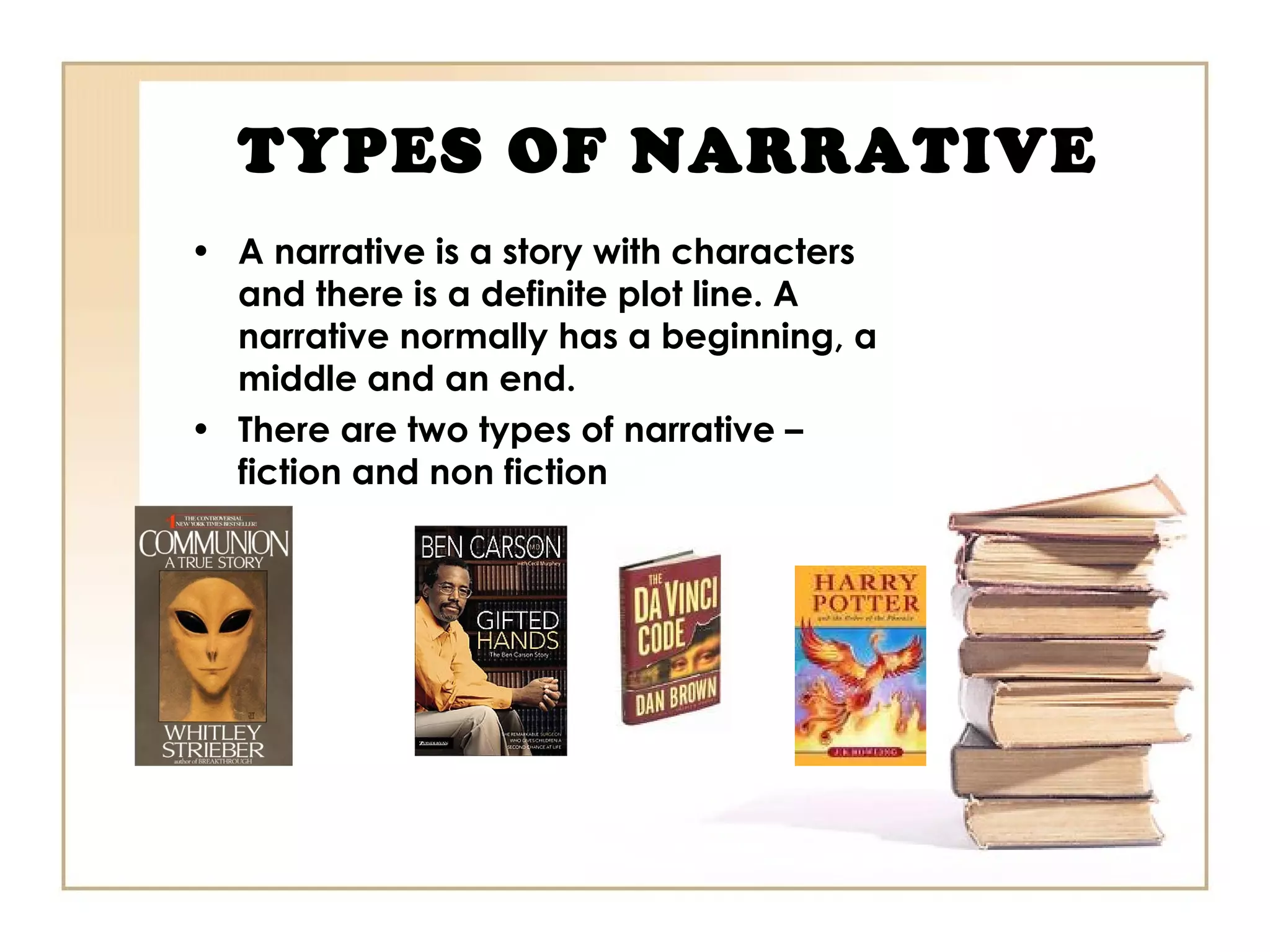
• A narrative is a story with characters
and there is a definite plot line. A
narrative normally has a beginning, a
middle and an end.
• There are two types of narrative –
fiction and non fiction
FICTIONAL NARRATIVE
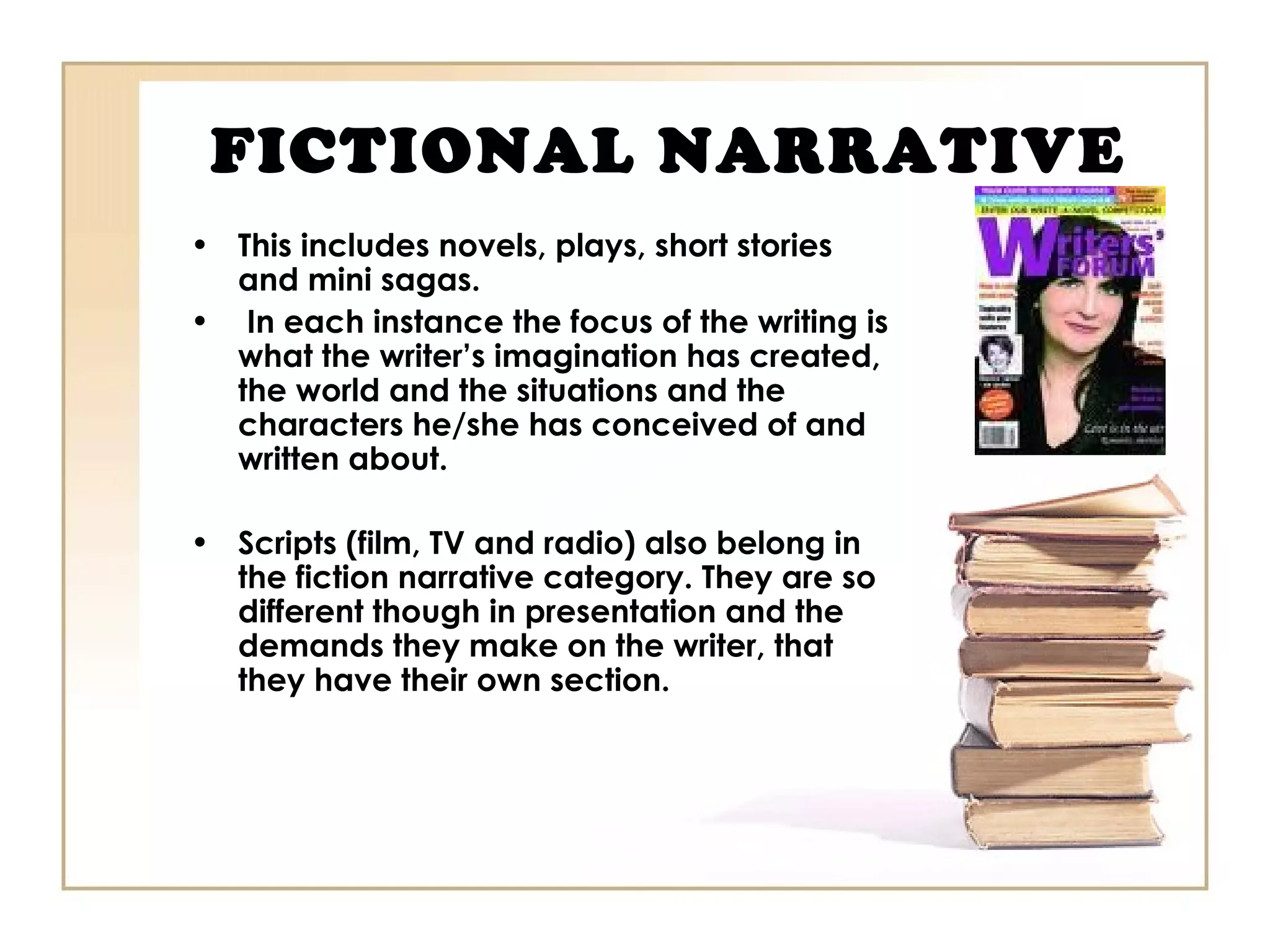
• This includes novels, plays, short stories
and mini sagas.
• In each instance the focus of the writing is
what the writer’s imagination has created,
the world and the situations and the
characters he/she has conceived of and
written about.
• Scripts (film, TV and radio) also belong in
the fiction narrative category. They are so
different though in presentation and the
demands they make on the writer, that
they have their own section.
FICTIONAL STORIES
Have you ever read a story that stays with you long after you finished reading
it? Or where you can’t wait to find out what happens next?.......
The light faded slowly from the screen
even as Santron tried frantically to
reset the controls. It was no good.
Something was jamming the signal. At
this rate, the entire ship would be
blacked out within….Santron checked
the time dial. Three minutes at most.
Santron frowned. Three minutes to fix
the problem or face obliteration!
When the sensor buzzed overhead,
Santron swallowed. If ever she
needed to call on her Frontline
Trooper skills to get her out of trouble it
was now……
NON-FICTION
NARRATIVE
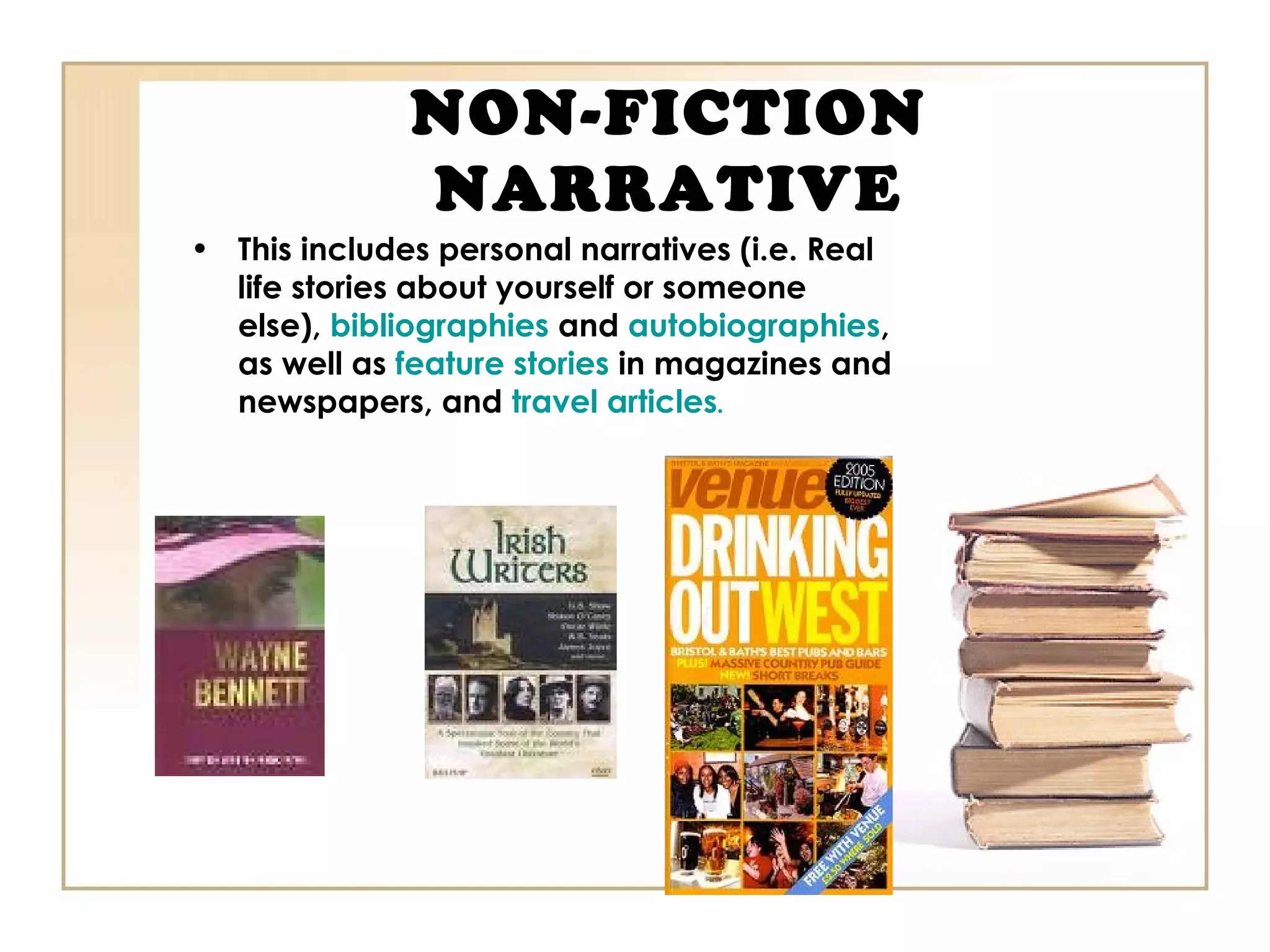
• This includes personal narratives (i.e. Real
life stories about yourself or someone
else), bibliographies and autobiographies,
as well as feature stories in magazines and
newspapers, and travel articles.
NARRATIVE STRUCTURE AND
VOICE
ONCE A WRITER HAS A CHARACTER AND A PLOT THEY NEED TO
DECIDE HOW THE STORY WILL BE TOLD.
NARRATIVE STRUCTURE:
(1) Some stories are told in chronological fashion (in order of
time)
ie. EVENT A EVENT B EVENT C
…
Tony and Will get a band together from the
musicians cast off by the school’s music
department. They call the band Frizzard, and
with effort and determination manage to
transform this motley group into a band with
grunt and stage presence. Determined to
show that they are not losers, Frizzard tries
out for the end of year school concert but are
turned down. Disappointed but unfazed, the
band decides they have just one option; gate
crash the concert!....
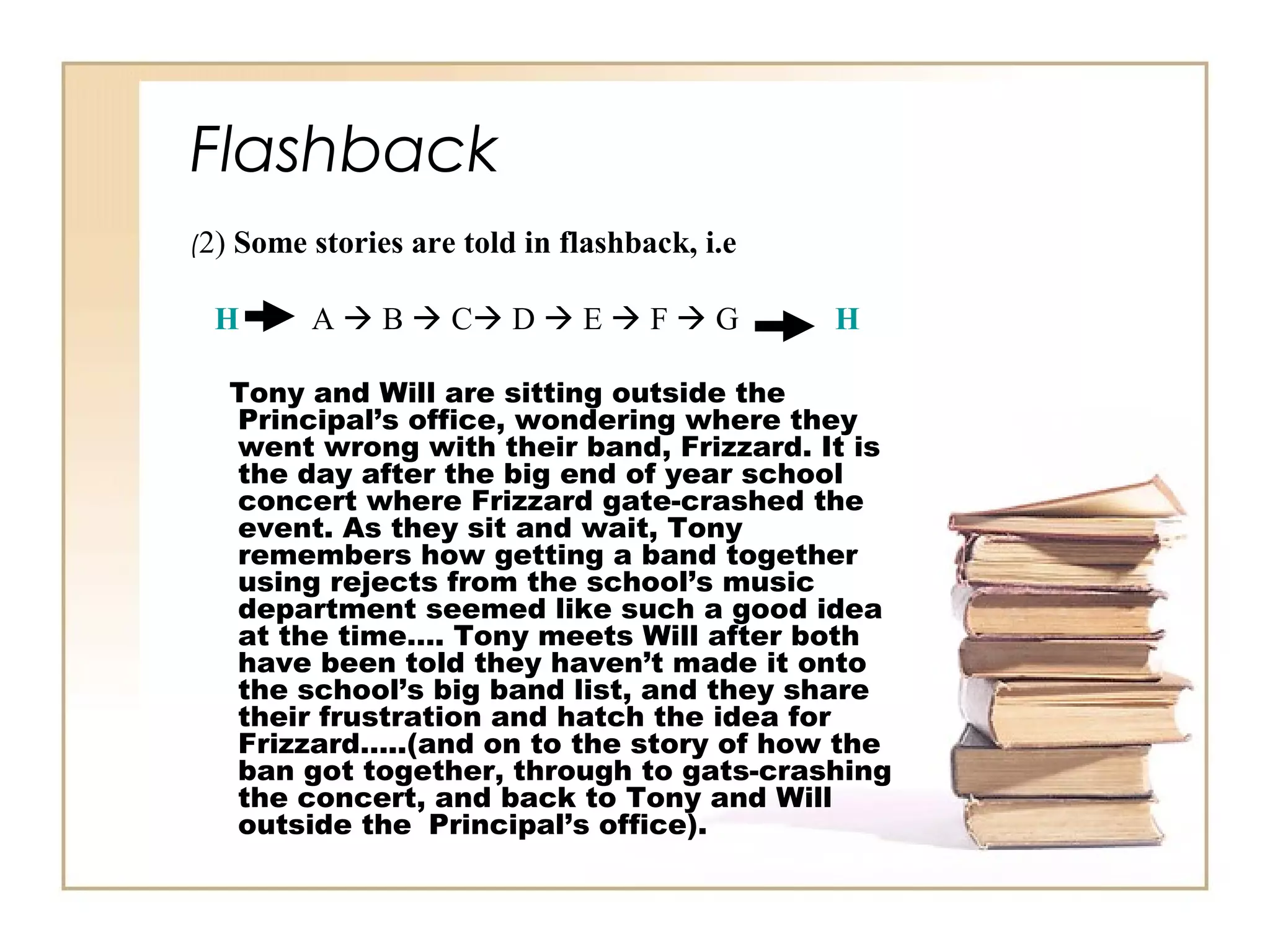
(2) Some stories are told in flashback, i.e
H A  B  C D  E  F  G H
Tony and Will are sitting outside the
Principal’s office, wondering where they
went wrong with their band, Frizzard. It is
the day after the big end of year school
concert where Frizzard gate-crashed the
event. As they sit and wait, Tony
remembers how getting a band together
using rejects from the school’s music
department seemed like such a good idea
at the time…. Tony meets Will after both
have been told they haven’t made it onto
the school’s big band list, and they share
their frustration and hatch the idea for
Frizzard…..(and on to the story of how the
ban got together, through to gats-crashing
the concert, and back to Tony and Will
outside the Principal’s office).
Flashback
CHARACTER, SETTING AND
PLOT
• Telling a story is not something that
happens by accident. Even a true- life
story has to be ‘shaped’ with an
interesting beginning, a ‘page-turning’
development, and a clear and satisfying
ending.
• It is important to bring out character, to
sketch in the setting, and to create energy
of some kind – whether by structuring the
piece around what amounts to a plot or at
least adding a strong dramatic element
(tension between characters). An
interesting tone, like humour or satire, can
add flavour.
• Compare the two stories that follow. Which
one is more effective?
Narrative Writing Tips
• What can we do to make our story writing
more exciting to read?
• Use these tips in your writing to help.
Writing Tip 1
Having too many characters can be a disadvantage as it may be
difficult for your reader to distinguish between them.
Try to stick to two or three characters and really concentrate on
letting your reader know what they are like by describing their
appearance and revealing their personality.
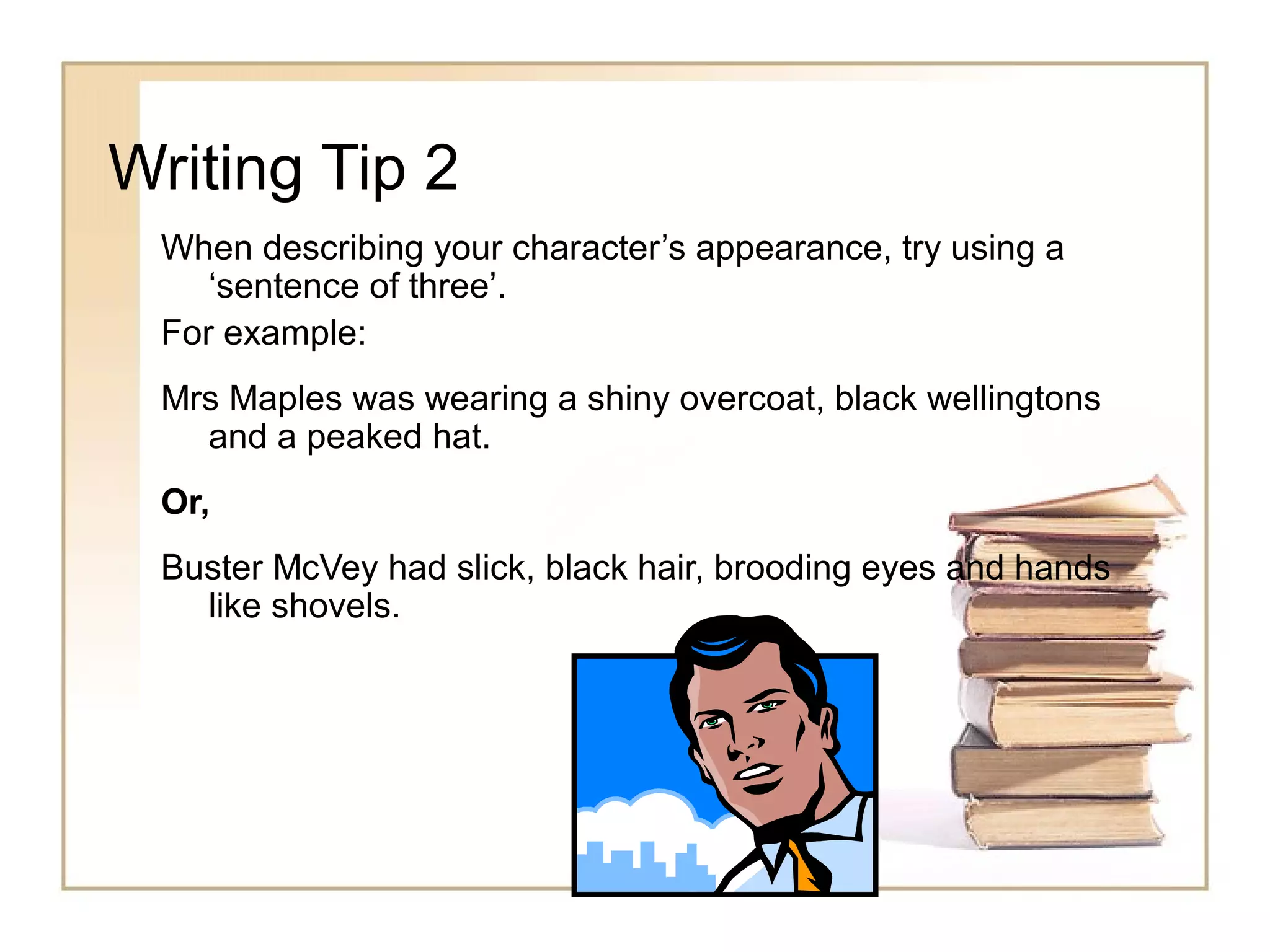
Writing Tip 2
When describing your character’s appearance, try using a
‘sentence of three’.
For example:
Mrs Maples was wearing a shiny overcoat, black wellingtons
and a peaked hat.
Or,
Buster McVey had slick, black hair, brooding eyes and hands
like shovels.
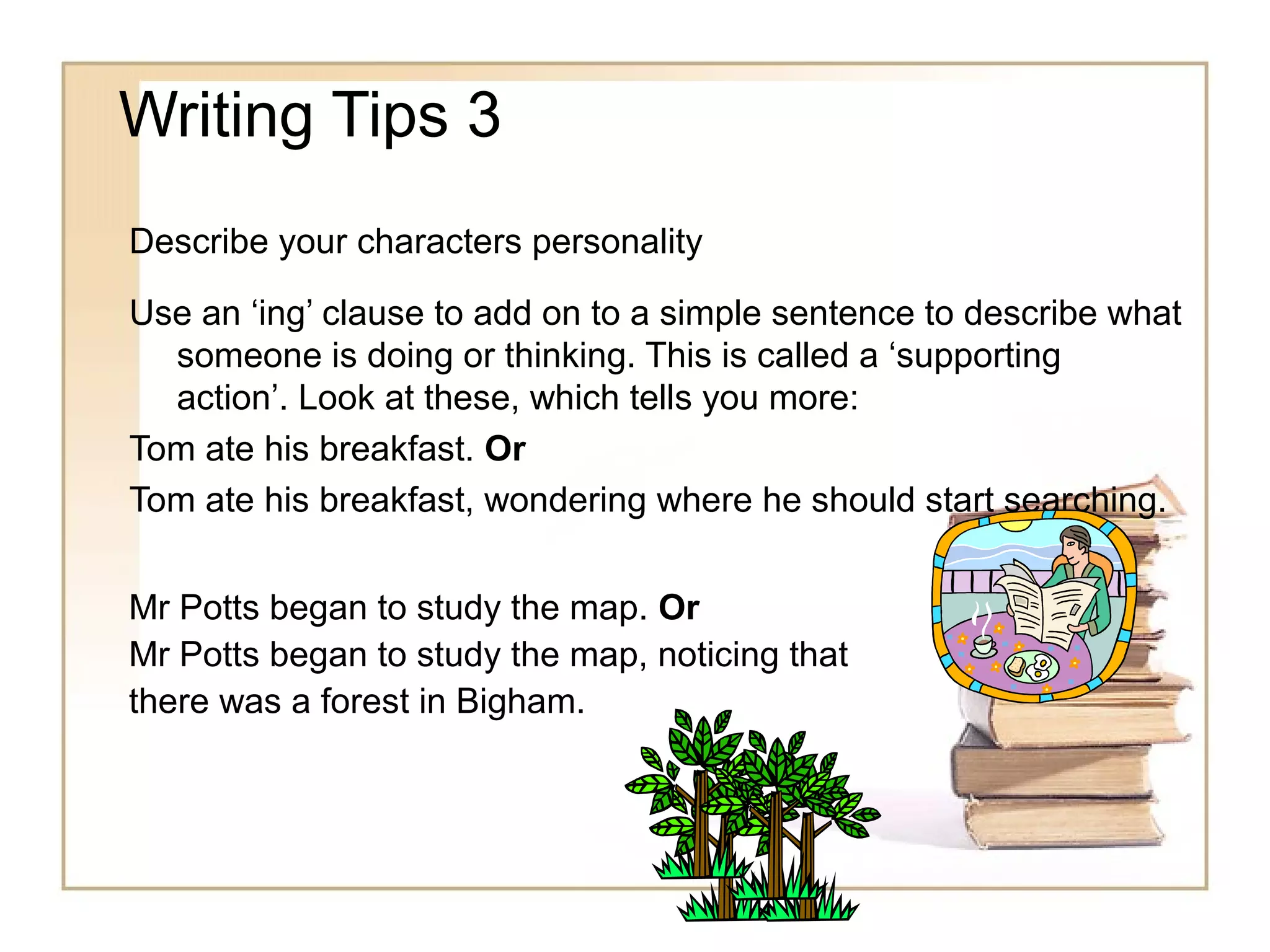
Writing Tips 3
Describe your characters personality
Use an ‘ing’ clause to add on to a simple sentence to describe what
someone is doing or thinking. This is called a ‘supporting
action’. Look at these, which tells you more:
Tom ate his breakfast. Or
Tom ate his breakfast, wondering where he should start searching.
Mr Potts began to study the map. Or
Mr Potts began to study the map, noticing that
there was a forest in Bigham.
Writing Tip 4
Remember:
1. The beginning where you introduce the
characters, set the scene and set up the
problem.
2. The middle in which the hero has to deal
with the problem.
3. The end where the characters sort out the
problem (or not!) and the story finishes.
Writing Tip 5
Use a good story starter to grip your readers
attention. You could:
1. Start with action
2. Use speech to introduce a character
3. Describe the setting
Writing Tip 6
Editing your story is a very important part of the process.
No-one gets it right first time around!
Make sure you read it through carefully and check:
1. Will your story makes sense to your reader and will it interest them?
2. Are your characters believable?
3. Have you given a satisfactory ending?
4. Are your spellings correct?
5. Make sure you have used a range of punctuation , . ! “ “ ? ( )
(Look at your notes to help you).
6. Long paragraphs can be off putting. Start a new paragraph for:
• A change of time, e.g. Early the next morning…
• A change of place e.g. On the other side of the mountain stood…
• A change of action e.g. At that moment the lights went out.
• A change of character e.g. Unexpectedly, Dr Townley rounded the
corner.
Writing Tip 7
Don’t forget to give your story a catchy title.
This is easier to do at the end because a good
title might come to you
as you are writing
your story.
Best of luck and
enjoy writing!
Narrative Writing PPT

Narrative Writing PPT

  • 1.
  • 2.
    TYPES OF NARRATIVE •A narrative is a story with characters and there is a definite plot line. A narrative normally has a beginning, a middle and an end. • There are two types of narrative – fiction and non fiction
  • 3.
    FICTIONAL NARRATIVE • Thisincludes novels, plays, short stories and mini sagas. • In each instance the focus of the writing is what the writer’s imagination has created, the world and the situations and the characters he/she has conceived of and written about. • Scripts (film, TV and radio) also belong in the fiction narrative category. They are so different though in presentation and the demands they make on the writer, that they have their own section.
  • 4.
    FICTIONAL STORIES Have youever read a story that stays with you long after you finished reading it? Or where you can’t wait to find out what happens next?....... The light faded slowly from the screen even as Santron tried frantically to reset the controls. It was no good. Something was jamming the signal. At this rate, the entire ship would be blacked out within….Santron checked the time dial. Three minutes at most. Santron frowned. Three minutes to fix the problem or face obliteration! When the sensor buzzed overhead, Santron swallowed. If ever she needed to call on her Frontline Trooper skills to get her out of trouble it was now……
  • 5.
    NON-FICTION NARRATIVE • This includespersonal narratives (i.e. Real life stories about yourself or someone else), bibliographies and autobiographies, as well as feature stories in magazines and newspapers, and travel articles.
  • 6.
    NARRATIVE STRUCTURE AND VOICE ONCEA WRITER HAS A CHARACTER AND A PLOT THEY NEED TO DECIDE HOW THE STORY WILL BE TOLD. NARRATIVE STRUCTURE: (1) Some stories are told in chronological fashion (in order of time) ie. EVENT A EVENT B EVENT C … Tony and Will get a band together from the musicians cast off by the school’s music department. They call the band Frizzard, and with effort and determination manage to transform this motley group into a band with grunt and stage presence. Determined to show that they are not losers, Frizzard tries out for the end of year school concert but are turned down. Disappointed but unfazed, the band decides they have just one option; gate crash the concert!....
  • 7.
    (2) Some storiesare told in flashback, i.e H A  B  C D  E  F  G H Tony and Will are sitting outside the Principal’s office, wondering where they went wrong with their band, Frizzard. It is the day after the big end of year school concert where Frizzard gate-crashed the event. As they sit and wait, Tony remembers how getting a band together using rejects from the school’s music department seemed like such a good idea at the time…. Tony meets Will after both have been told they haven’t made it onto the school’s big band list, and they share their frustration and hatch the idea for Frizzard…..(and on to the story of how the ban got together, through to gats-crashing the concert, and back to Tony and Will outside the Principal’s office). Flashback
  • 8.
    CHARACTER, SETTING AND PLOT •Telling a story is not something that happens by accident. Even a true- life story has to be ‘shaped’ with an interesting beginning, a ‘page-turning’ development, and a clear and satisfying ending. • It is important to bring out character, to sketch in the setting, and to create energy of some kind – whether by structuring the piece around what amounts to a plot or at least adding a strong dramatic element (tension between characters). An interesting tone, like humour or satire, can add flavour. • Compare the two stories that follow. Which one is more effective?
  • 9.
    Narrative Writing Tips •What can we do to make our story writing more exciting to read? • Use these tips in your writing to help.
  • 10.
    Writing Tip 1 Havingtoo many characters can be a disadvantage as it may be difficult for your reader to distinguish between them. Try to stick to two or three characters and really concentrate on letting your reader know what they are like by describing their appearance and revealing their personality.
  • 11.
    Writing Tip 2 Whendescribing your character’s appearance, try using a ‘sentence of three’. For example: Mrs Maples was wearing a shiny overcoat, black wellingtons and a peaked hat. Or, Buster McVey had slick, black hair, brooding eyes and hands like shovels.
  • 12.
    Writing Tips 3 Describeyour characters personality Use an ‘ing’ clause to add on to a simple sentence to describe what someone is doing or thinking. This is called a ‘supporting action’. Look at these, which tells you more: Tom ate his breakfast. Or Tom ate his breakfast, wondering where he should start searching. Mr Potts began to study the map. Or Mr Potts began to study the map, noticing that there was a forest in Bigham.
  • 13.
    Writing Tip 4 Remember: 1.The beginning where you introduce the characters, set the scene and set up the problem. 2. The middle in which the hero has to deal with the problem. 3. The end where the characters sort out the problem (or not!) and the story finishes.
  • 14.
    Writing Tip 5 Usea good story starter to grip your readers attention. You could: 1. Start with action 2. Use speech to introduce a character 3. Describe the setting
  • 15.
    Writing Tip 6 Editingyour story is a very important part of the process. No-one gets it right first time around! Make sure you read it through carefully and check: 1. Will your story makes sense to your reader and will it interest them? 2. Are your characters believable? 3. Have you given a satisfactory ending? 4. Are your spellings correct? 5. Make sure you have used a range of punctuation , . ! “ “ ? ( ) (Look at your notes to help you). 6. Long paragraphs can be off putting. Start a new paragraph for: • A change of time, e.g. Early the next morning… • A change of place e.g. On the other side of the mountain stood… • A change of action e.g. At that moment the lights went out. • A change of character e.g. Unexpectedly, Dr Townley rounded the corner.
  • 16.
    Writing Tip 7 Don’tforget to give your story a catchy title. This is easier to do at the end because a good title might come to you as you are writing your story. Best of luck and enjoy writing!