THOSE PESKY COMMAS!   14 COMMA RULES TO MAKE YOU A BETTER WRITER
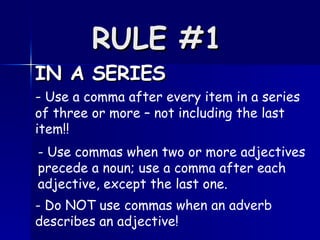
RULE #1   IN A SERIES  - Use commas when two or more adjectives precede a noun; use a comma after each adjective, except the last one.  -  Use a comma after every item in a series of three or more – not including the last item!!  - Do NOT use commas when an adverb describes an adjective!
RULE #1   In a series of 3 or more…  I like  nachos   burritos   and  tamales .  , , 3 items = 2 commas I brought my  sleeping bag   sleeping   pad   Nalgene bottle   and  a tent  on the trip. , , , 4 items = 3 commas
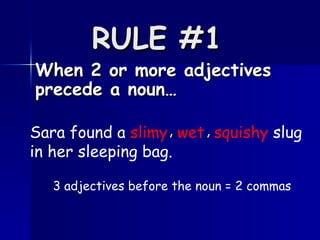
RULE #1   When 2 or more adjectives precede a noun… Sara found a  slimy   wet   squishy  slug in her sleeping bag.   , , 3 adjectives before the noun = 2 commas
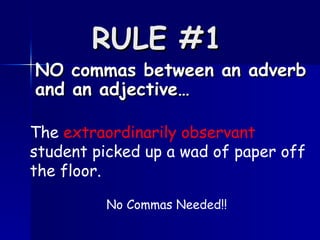
RULE #1   NO commas between an adverb and an adjective… The  extraordinarily   observant  student picked up a wad of paper off the floor.  No Commas Needed!!
RULE #2   QUOTATION MARKS - Use commas to set off explanatory words (such as  Rachel said ,  replied Maggie, announced Tim)  of a  direct quotation .
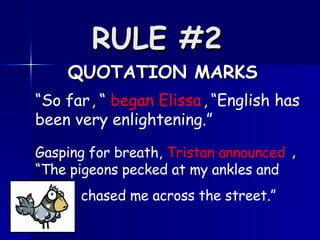
RULE #2   QUOTATION MARKS “ So far  “  began Elissa   “English has been very enlightening.” , , Gasping for breath,  Tristan announced   “The pigeons pecked at my ankles and  chased me across the street.”  ,
RULE #3   TOO MEANS ALSO -Use commas to separate “too” from the rest of the sentence when it can be replaced by the word “also.”
RULE #3   TOO MEANS ALSO I want to go to Culver’s for dinner  too .  , , Running 26.2 miles would make my legs ache  too .
RULE 4   IN DATES -Use commas  between the day of the month and the year.  -In a sentence, the comma follows the year.
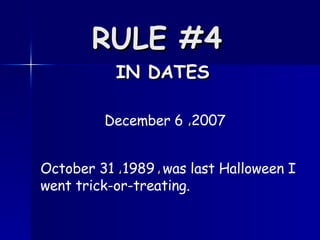
RULE #4   IN DATES December 6  2007 , October 31  1989  was last Halloween I went trick-or-treating.  , ,
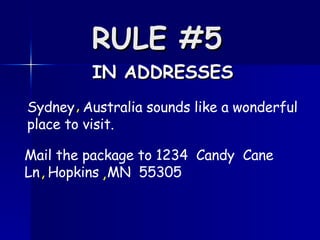
RULE #5   IN ADDRESSES -Use commas between the name of the city or town and the name of its state or country and the rest of the sentence.  -In writing the address in a sentence, use a comma after each item ( Except  between state and zip code).
RULE #5   IN ADDRESSES Sydney  Australia sounds like a wonderful place to visit.  , , Mail the package to 1234  Candy  Cane  Ln  Hopkins  MN  55305  ,
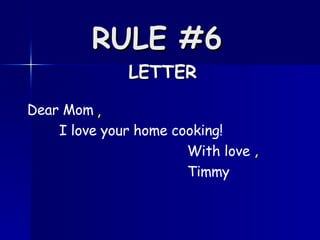
RULE #6   LETTER - Use commas after the greeting and closing of a letter.
RULE #6   LETTER Dear Mom  I love your home cooking!  With love  Timmy , ,
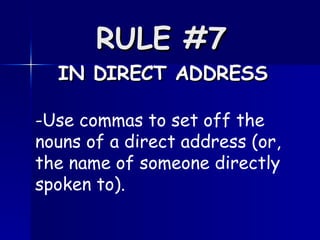
RULE #7   IN DIRECT ADDRESS -Use commas to set off the nouns of a direct address (or, the name of someone directly spoken to).
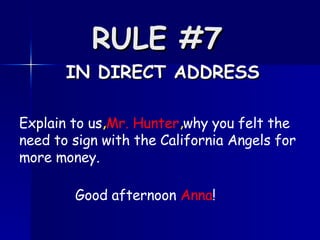
RULE #7   IN DIRECT ADDRESS Explain to us  Mr. Hunter  why you felt the need to sign with the California Angels for more money.  , , Good afternoon  Anna !  ,
RULE #8   INTERJECTIONS - Use commas before and/or after words that are interjected into sentences.  Interjection words include  yes, no, well, oh.
RULE #8   INTERJECTIONS Yes  I would love to go see  High School Musical on Ice !  , , Well  I wasn’t sure whether the note was from him or not, so I threw it away!
RULE #9   INTRODUCTORY WORDS/PHRASES - Use commas to separate introductory words or phrases from the rest of the sentence.
RULE #9   INTRODUCTORY WORDS/PHRASES Key words that indicate an introductory phrase –  when, while, after, before, if, so, since. If these words begin a sentence, use a comma after the phrase, but ignore them in the middle of a sentence.
RULE #9   INTRODUCTORY WORDS/PHRASES Since  hearing the prognosis  I   have been  a nervous wreck.   , , After the movie we went for ice cream.  Unfortunately the game cannot be rescheduled.  ,
RULE #10   INTERRUPTERS (PARENTHENTICAL EXPRESSIONS) - Use commas to set off words or groups of words that interrupt the flow of thought in a sentence.
RULE #10   INTERRUPTERS (PARENTHETICAL EXPRESSIONS) I  on the other hand  love to eat chocolate cookies.  , , Change I believe is life’s only constant.   , , Learning about commas for example helps us become better writers.  , ,
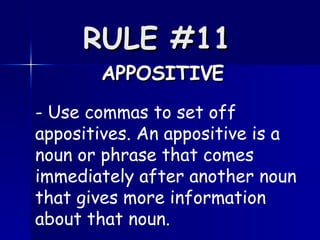
RULE #11   APPOSITIVE - Use commas to set off appositives. An appositive is a noun or phrase that comes immediately after another noun that gives more information about that noun.
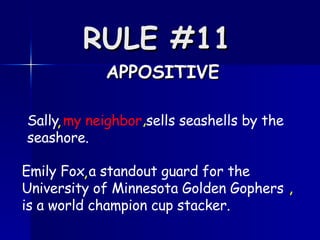
RULE #11   APPOSITIVE Sally  my neighbor  sells seashells by the seashore.  , , Emily Fox a standout guard for the University of Minnesota Golden Gophers is a world champion cup stacker.  , ,
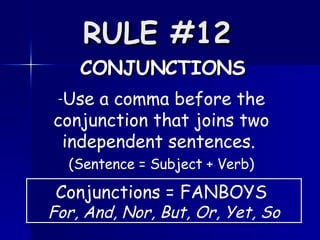
RULE #12   CONJUNCTIONS Use a comma before the conjunction that joins two independent sentences.  (Sentence = Subject + Verb) Conjunctions = FANBOYS  For, And, Nor, But, Or, Yet, So
RULE #12   CONJUNCTIONS Rebecca wants to learn to play the guitar  but  her guitar only has two strings.  , , James dreams of becoming a rock star so he rehearses every day.
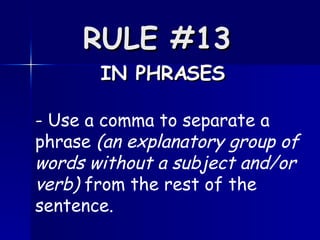
RULE #13   IN PHRASES - Use a comma to separate a phrase  (an explanatory group of words without a subject and/or verb)  from the rest of the sentence.
RULE #13   IN PHRASES Running through the woods  I tripped on a log and scraped by knee.  , , The window cracked from the cold needed to be replaced.  ,
RULE #14   IN CLAUSES - Use a comma to separate a clause (a group of words with its own subject and verb) from the rest of the sentence.
RULE #14   IN CLAUSES The snow storm  which was the worst of the year  made driving terrible.  , , My neighbor who lives in a tent values the preservation of our environment.  , ,

Those Pesky Commas! Powe#D6

  • 1.
    THOSE PESKY COMMAS! 14 COMMA RULES TO MAKE YOU A BETTER WRITER
  • 2.
    RULE #1 IN A SERIES - Use commas when two or more adjectives precede a noun; use a comma after each adjective, except the last one. - Use a comma after every item in a series of three or more – not including the last item!! - Do NOT use commas when an adverb describes an adjective!
  • 3.
    RULE #1 In a series of 3 or more… I like nachos burritos and tamales . , , 3 items = 2 commas I brought my sleeping bag sleeping pad Nalgene bottle and a tent on the trip. , , , 4 items = 3 commas
  • 4.
    RULE #1 When 2 or more adjectives precede a noun… Sara found a slimy wet squishy slug in her sleeping bag. , , 3 adjectives before the noun = 2 commas
  • 5.
    RULE #1 NO commas between an adverb and an adjective… The extraordinarily observant student picked up a wad of paper off the floor. No Commas Needed!!
  • 6.
    RULE #2 QUOTATION MARKS - Use commas to set off explanatory words (such as Rachel said , replied Maggie, announced Tim) of a direct quotation .
  • 7.
    RULE #2 QUOTATION MARKS “ So far “ began Elissa “English has been very enlightening.” , , Gasping for breath, Tristan announced “The pigeons pecked at my ankles and chased me across the street.” ,
  • 8.
    RULE #3 TOO MEANS ALSO -Use commas to separate “too” from the rest of the sentence when it can be replaced by the word “also.”
  • 9.
    RULE #3 TOO MEANS ALSO I want to go to Culver’s for dinner too . , , Running 26.2 miles would make my legs ache too .
  • 10.
    RULE 4 IN DATES -Use commas between the day of the month and the year. -In a sentence, the comma follows the year.
  • 11.
    RULE #4 IN DATES December 6 2007 , October 31 1989 was last Halloween I went trick-or-treating. , ,
  • 12.
    RULE #5 IN ADDRESSES -Use commas between the name of the city or town and the name of its state or country and the rest of the sentence. -In writing the address in a sentence, use a comma after each item ( Except between state and zip code).
  • 13.
    RULE #5 IN ADDRESSES Sydney Australia sounds like a wonderful place to visit. , , Mail the package to 1234 Candy Cane Ln Hopkins MN 55305 ,
  • 14.
    RULE #6 LETTER - Use commas after the greeting and closing of a letter.
  • 15.
    RULE #6 LETTER Dear Mom I love your home cooking! With love Timmy , ,
  • 16.
    RULE #7 IN DIRECT ADDRESS -Use commas to set off the nouns of a direct address (or, the name of someone directly spoken to).
  • 17.
    RULE #7 IN DIRECT ADDRESS Explain to us Mr. Hunter why you felt the need to sign with the California Angels for more money. , , Good afternoon Anna ! ,
  • 18.
    RULE #8 INTERJECTIONS - Use commas before and/or after words that are interjected into sentences. Interjection words include yes, no, well, oh.
  • 19.
    RULE #8 INTERJECTIONS Yes I would love to go see High School Musical on Ice ! , , Well I wasn’t sure whether the note was from him or not, so I threw it away!
  • 20.
    RULE #9 INTRODUCTORY WORDS/PHRASES - Use commas to separate introductory words or phrases from the rest of the sentence.
  • 21.
    RULE #9 INTRODUCTORY WORDS/PHRASES Key words that indicate an introductory phrase – when, while, after, before, if, so, since. If these words begin a sentence, use a comma after the phrase, but ignore them in the middle of a sentence.
  • 22.
    RULE #9 INTRODUCTORY WORDS/PHRASES Since hearing the prognosis I have been a nervous wreck. , , After the movie we went for ice cream. Unfortunately the game cannot be rescheduled. ,
  • 23.
    RULE #10 INTERRUPTERS (PARENTHENTICAL EXPRESSIONS) - Use commas to set off words or groups of words that interrupt the flow of thought in a sentence.
  • 24.
    RULE #10 INTERRUPTERS (PARENTHETICAL EXPRESSIONS) I on the other hand love to eat chocolate cookies. , , Change I believe is life’s only constant. , , Learning about commas for example helps us become better writers. , ,
  • 25.
    RULE #11 APPOSITIVE - Use commas to set off appositives. An appositive is a noun or phrase that comes immediately after another noun that gives more information about that noun.
  • 26.
    RULE #11 APPOSITIVE Sally my neighbor sells seashells by the seashore. , , Emily Fox a standout guard for the University of Minnesota Golden Gophers is a world champion cup stacker. , ,
  • 27.
    RULE #12 CONJUNCTIONS Use a comma before the conjunction that joins two independent sentences. (Sentence = Subject + Verb) Conjunctions = FANBOYS For, And, Nor, But, Or, Yet, So
  • 28.
    RULE #12 CONJUNCTIONS Rebecca wants to learn to play the guitar but her guitar only has two strings. , , James dreams of becoming a rock star so he rehearses every day.
  • 29.
    RULE #13 IN PHRASES - Use a comma to separate a phrase (an explanatory group of words without a subject and/or verb) from the rest of the sentence.
  • 30.
    RULE #13 IN PHRASES Running through the woods I tripped on a log and scraped by knee. , , The window cracked from the cold needed to be replaced. ,
  • 31.
    RULE #14 IN CLAUSES - Use a comma to separate a clause (a group of words with its own subject and verb) from the rest of the sentence.
  • 32.
    RULE #14 IN CLAUSES The snow storm which was the worst of the year made driving terrible. , , My neighbor who lives in a tent values the preservation of our environment. , ,