Combining Sentences
One plus one equals
one.
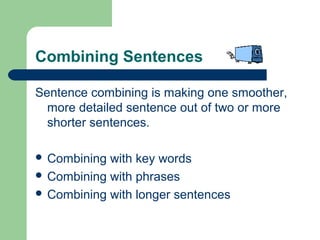
Combining Sentences
Sentence combining is making one smoother,
more detailed sentence out of two or more
shorter sentences.
 Combining with key words
 Combining with phrases
 Combining with longer sentences
Combining with KEY WORDS
 Use a key word:
Ideas included in short sentences can be
combined by moving a key word from one
sentence to the other.
Use an adjective
 Short sentences:
Kelly’s necklace sparkles.
It is beaded.
 Combined with an adjective:
Kelly’s beaded necklace sparkles.
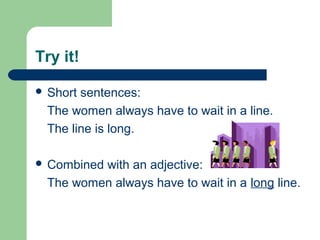
Try it!
 Short sentences:
The women always have to wait in a line.
The line is long.
 Combined with an adjective:
The women always have to wait in a long line.
Use an adverb
 Short sentences:
I am going to a sleepover.
I ‘m going tomorrow.
 Combined with an adverb:
Tomorrow I am going to a sleepover.
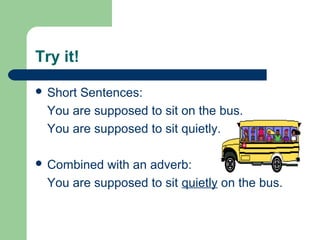
Try it!
 Short Sentences:
You are supposed to sit on the bus.
You are supposed to sit quietly.
 Combined with an adverb:
You are supposed to sit quietly on the bus.
Use a series of words or phrases
 Short sentences:
The reading teacher is organized.
The reading teacher is funny.
The reading teacher is helpful.
 Combined with a series of words:
The reading teacher is organized, funny,
and helpful.
Try it!
 Short sentences:
On Thanksgiving, we have turkey.
We also have stuffing.
We also have gravy.
 Combined with a series of words:
On Thanksgiving, we have turkey, stuffing, and
gravy.
REMEMBER!
All of the words or phrases in a series should be
parallel (stated in the same way).
Otherwise, the sentences will be unbalanced.
Incorrect: My dog is friendly, playful, and he is
smart, too. (The modifiers in the series are not parallel.)
Correct: My dog is friendly, playful, and
smart. (All the words in the series are single-word adjectives.
They are parallel.)
Correct it!
 Incorrect:
We can hike, ski, or we can snowboard down
the mountain, too.
 Correct:
We can hike, ski, or snowboard down the
mountain.
Combining with PHRASES
 Use phrases:
Ideas from short sentences can be combined
into one sentence using phrases.
Combined with a prepositional
phrase
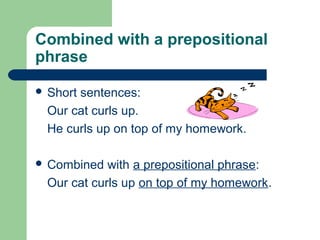
 Short sentences:
Our cat curls up.
He curls up on top of my homework.
 Combined with a prepositional phrase:
Our cat curls up on top of my homework.
Try it!
 Short sentences:
He signed his name.
He signed it on a football.
 Combined with a prepositional phrase:
He signed his name on a football.
Combined with an appositive
phrase
 Short sentences:
Mrs. Brown makes the best cookies on the
block.
Mrs. Brown is our next-door neighbor.
 Combined with an appositive phrase:
Mrs. Brown, our next-door neighbor, makes the
best cookies on the block.
Try it!
 Short sentences:
Sam wants to be a professional baseball
player.
He is my brother’s best friend.
 Combined with an appositive phrase:
Sam, my brother’s best friend, wants to be a
professional baseball player.
Use compound subjects and/or
compound verbs
 A compound subject is two or more subjects
connected by a conjunction.
 A compound verb is two or more verbs
connected by a conjunction.
Combined with a compound
subject
 Short sentences:
Jamie danced around the room.
Mary danced around the room, too.
 Combined with a compound subject:
Jamie and Mary danced around the room.
Try it!
 Short sentences:
Sue rode her horse today.
Scott rode his horse today.
 Combined with a compound subject:
Sue and Scott rode their horses today.
Combined with a compound verb
 Short sentences:
Janet skated onto the pond.
She made a perfect figure eight.
 Combined with a compound verb:
Janet skated onto the pond and made a perfect
figure eight.
Try it!
 Short sentences:
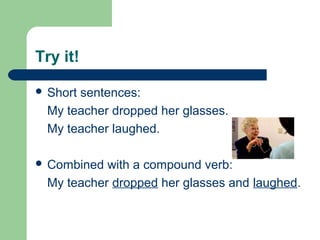
My teacher dropped her glasses.
My teacher laughed.
 Combined with a compound verb:
My teacher dropped her glasses and laughed.
Combining with LONGER
SENTENCES
 Use compound sentences
 Use complex sentences
Use compound sentences
 A compound sentence is made up of two or
more simple sentences joined together. The
conjunction and, but, or, nor, for, so, and yet
are used to connect the simple sentences.
 Remember to place a comma before a
conjunction!
Use compound sentences
 Simple sentences:
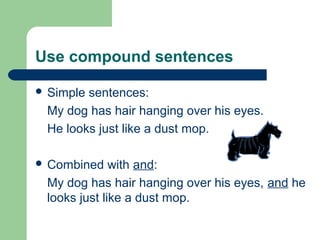
My dog has hair hanging over his eyes.
He looks just like a dust mop.
 Combined with and:
My dog has hair hanging over his eyes, and he
looks just like a dust mop.
Try it!
 Simple sentences:
Mary wrote a book about the seasons.
It was interesting.
Combined with and:
Mary wrote a book about the seasons, and it
was interesting.
Use complex sentences
 A complex sentence is made up of two ideas
connected by a subordinating conjunction
(because, when, since, after, before, though,
although, if, unless, when, where, while, etc.).
 A complex sentence can also be combined by
a relative pronoun (who, whose, which, and
that).
Combine sentences using a
subordinating conjunction
 Simple sentences:
My friend shares her lunch with me.
She doesn’t like what her dad packs.
 Combined with because:
My friend shares her lunch with me because
she doesn’t like what her dad packs.
Try it!
 Simple sentences:
We took the elevator to the second floor.
The stairs were closed for repairs.
 Combined with because:
We took the elevator to the second floor
because the stairs were closed for repairs.
Combine sentences using a relative
pronoun
 Simple sentences:
Very cold weather closed school for a day.
The cold weather came down from Canada.
Combined with which:
Very cold weather, which came down from
Canada, closed school for a day.
Try it!
 Simple sentences:
Jack ran all the way to school.
Jack was late this morning.
 Combined using who:
Jack, who was late this morning, ran all the
way to school.

Combining sentences ppt

  • 1.
  • 2.
    Combining Sentences Sentence combiningis making one smoother, more detailed sentence out of two or more shorter sentences.  Combining with key words  Combining with phrases  Combining with longer sentences
  • 3.
    Combining with KEYWORDS  Use a key word: Ideas included in short sentences can be combined by moving a key word from one sentence to the other.
  • 4.
    Use an adjective Short sentences: Kelly’s necklace sparkles. It is beaded.  Combined with an adjective: Kelly’s beaded necklace sparkles.
  • 5.
    Try it!  Shortsentences: The women always have to wait in a line. The line is long.  Combined with an adjective: The women always have to wait in a long line.
  • 6.
    Use an adverb Short sentences: I am going to a sleepover. I ‘m going tomorrow.  Combined with an adverb: Tomorrow I am going to a sleepover.
  • 7.
    Try it!  ShortSentences: You are supposed to sit on the bus. You are supposed to sit quietly.  Combined with an adverb: You are supposed to sit quietly on the bus.
  • 8.
    Use a seriesof words or phrases  Short sentences: The reading teacher is organized. The reading teacher is funny. The reading teacher is helpful.  Combined with a series of words: The reading teacher is organized, funny, and helpful.
  • 9.
    Try it!  Shortsentences: On Thanksgiving, we have turkey. We also have stuffing. We also have gravy.  Combined with a series of words: On Thanksgiving, we have turkey, stuffing, and gravy.
  • 10.
    REMEMBER! All of thewords or phrases in a series should be parallel (stated in the same way). Otherwise, the sentences will be unbalanced. Incorrect: My dog is friendly, playful, and he is smart, too. (The modifiers in the series are not parallel.) Correct: My dog is friendly, playful, and smart. (All the words in the series are single-word adjectives. They are parallel.)
  • 11.
    Correct it!  Incorrect: Wecan hike, ski, or we can snowboard down the mountain, too.  Correct: We can hike, ski, or snowboard down the mountain.
  • 12.
    Combining with PHRASES Use phrases: Ideas from short sentences can be combined into one sentence using phrases.
  • 13.
    Combined with aprepositional phrase  Short sentences: Our cat curls up. He curls up on top of my homework.  Combined with a prepositional phrase: Our cat curls up on top of my homework.
  • 14.
    Try it!  Shortsentences: He signed his name. He signed it on a football.  Combined with a prepositional phrase: He signed his name on a football.
  • 15.
    Combined with anappositive phrase  Short sentences: Mrs. Brown makes the best cookies on the block. Mrs. Brown is our next-door neighbor.  Combined with an appositive phrase: Mrs. Brown, our next-door neighbor, makes the best cookies on the block.
  • 16.
    Try it!  Shortsentences: Sam wants to be a professional baseball player. He is my brother’s best friend.  Combined with an appositive phrase: Sam, my brother’s best friend, wants to be a professional baseball player.
  • 17.
    Use compound subjectsand/or compound verbs  A compound subject is two or more subjects connected by a conjunction.  A compound verb is two or more verbs connected by a conjunction.
  • 18.
    Combined with acompound subject  Short sentences: Jamie danced around the room. Mary danced around the room, too.  Combined with a compound subject: Jamie and Mary danced around the room.
  • 19.
    Try it!  Shortsentences: Sue rode her horse today. Scott rode his horse today.  Combined with a compound subject: Sue and Scott rode their horses today.
  • 20.
    Combined with acompound verb  Short sentences: Janet skated onto the pond. She made a perfect figure eight.  Combined with a compound verb: Janet skated onto the pond and made a perfect figure eight.
  • 21.
    Try it!  Shortsentences: My teacher dropped her glasses. My teacher laughed.  Combined with a compound verb: My teacher dropped her glasses and laughed.
  • 22.
    Combining with LONGER SENTENCES Use compound sentences  Use complex sentences
  • 23.
    Use compound sentences A compound sentence is made up of two or more simple sentences joined together. The conjunction and, but, or, nor, for, so, and yet are used to connect the simple sentences.  Remember to place a comma before a conjunction!
  • 24.
    Use compound sentences Simple sentences: My dog has hair hanging over his eyes. He looks just like a dust mop.  Combined with and: My dog has hair hanging over his eyes, and he looks just like a dust mop.
  • 25.
    Try it!  Simplesentences: Mary wrote a book about the seasons. It was interesting. Combined with and: Mary wrote a book about the seasons, and it was interesting.
  • 26.
    Use complex sentences A complex sentence is made up of two ideas connected by a subordinating conjunction (because, when, since, after, before, though, although, if, unless, when, where, while, etc.).  A complex sentence can also be combined by a relative pronoun (who, whose, which, and that).
  • 27.
    Combine sentences usinga subordinating conjunction  Simple sentences: My friend shares her lunch with me. She doesn’t like what her dad packs.  Combined with because: My friend shares her lunch with me because she doesn’t like what her dad packs.
  • 28.
    Try it!  Simplesentences: We took the elevator to the second floor. The stairs were closed for repairs.  Combined with because: We took the elevator to the second floor because the stairs were closed for repairs.
  • 29.
    Combine sentences usinga relative pronoun  Simple sentences: Very cold weather closed school for a day. The cold weather came down from Canada. Combined with which: Very cold weather, which came down from Canada, closed school for a day.
  • 30.
    Try it!  Simplesentences: Jack ran all the way to school. Jack was late this morning.  Combined using who: Jack, who was late this morning, ran all the way to school.