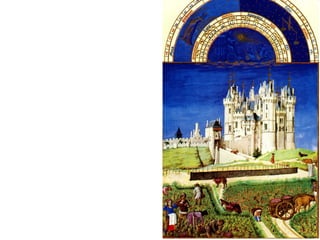
Unit 4:
Printmaking &
Career Research
Career Research
You will research a career related to visual arts. You will
choose your career from the list provided. Each student
must choose a different career.
You will create a poster that communicates the key
information about your career. Your poster should include
pictures and word design.
You will also provide a one-page written description of the
key information about that career.
When you are finished, you will present your poster in a
Gallery Walk allowing your classmates to learn about your
career.
Career Research
Key Information About Your Career:
1) Name of the Career
2) Description of Duties
3) Tools required
4) Skills needed
5) Education needed
6) Starting salary
7) Availability
Career Research Requirements
You must include a bibliography (a list of your
sources).
Www.careercruising.com is an excellent
resource.
Failure to hand in a bibliography will result in a
ZERO due to plagiarism. NO SECOND
CHANCES!
Medieval Art VS. Renaissance Art


Using the following images, you will analyze the
differences between Medieval art and
Renaissance art.



Consider these aspects of artistic style:
1) use of perspective (realistic or not)
2) flat space VS. natural depth
3) use of symbolism (i.e. religious symbols)
4) use of negative space (is there any empty
space?)
5) understanding of human anatomy
Medieval VS. Renaissance Art
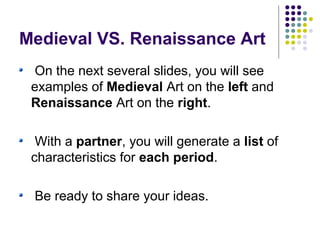
On the next several slides, you will see
examples of Medieval Art on the left and
Renaissance Art on the right.
With a partner, you will generate a list of
characteristics for each period.
Be ready to share your ideas.
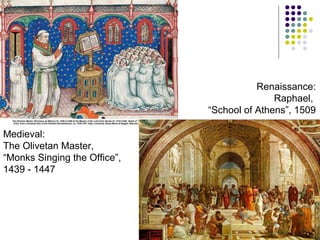
Renaissance:
Raphael,
“School of Athens”, 1509
Medieval:
The Olivetan Master,
“Monks Singing the Office”,
1439 - 1447
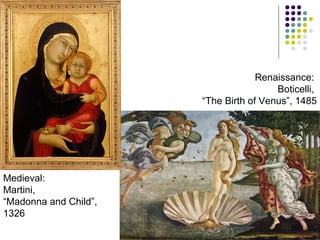
Renaissance:
Boticelli,
“The Birth of Venus”, 1485

Medieval:
Martini,
“Madonna and Child”,
1326
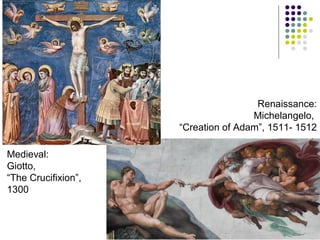
Renaissance:
Michelangelo,
“Creation of Adam”, 1511- 1512
Medieval:
Giotto,
“The Crucifixion”,
1300
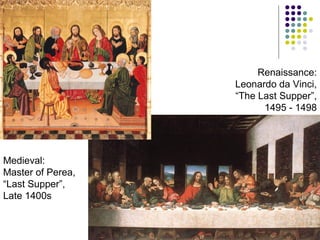
Renaissance:
Leonardo da Vinci,
“The Last Supper”,
1495 - 1498

Medieval:
Master of Perea,
“Last Supper”,
Late 1400s
Medieval VS. Renaissance Art


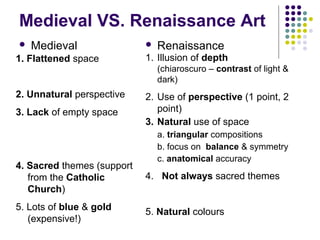
Medieval



Renaissance

1. Flattened space

1. Illusion of depth

2. Unnatural perspective

2. Use of perspective (1 point, 2
point)
3. Natural use of space

3. Lack of empty space

(chiaroscuro – contrast of light &
dark)

a. triangular compositions
b. focus on balance & symmetry
c. anatomical accuracy

4. Sacred themes (support
from the Catholic
Church)

4. Not always sacred themes

5. Lots of blue & gold
(expensive!)

5. Natural colours
Math & Measurement in Art


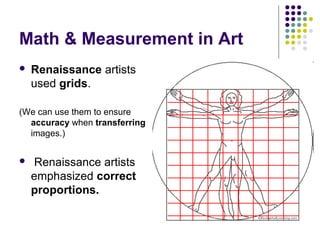
Renaissance artists
used grids.

(We can use them to ensure
accuracy when transferring
images.)


Renaissance artists
emphasized correct
proportions.
Math & Measurement in Art


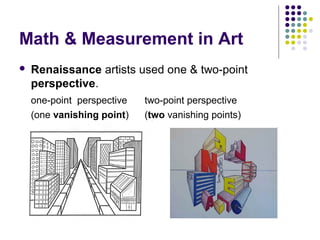
Renaissance artists used one & two-point
perspective.
one-point perspective
(one vanishing point)

two-point perspective
(two vanishing points)
Math & Measurement in Art


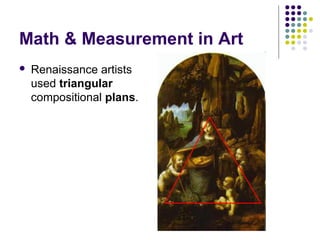
Renaissance artists
used triangular
compositional plans.
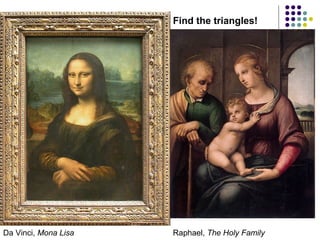
Find the triangles!

Da Vinci, Mona Lisa

Raphael, The Holy Family
Math & Measurement in Art


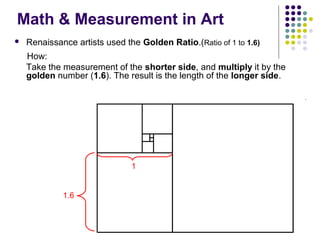
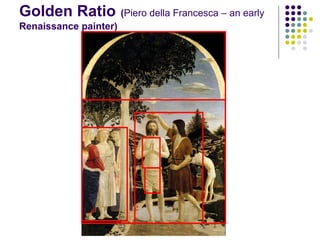
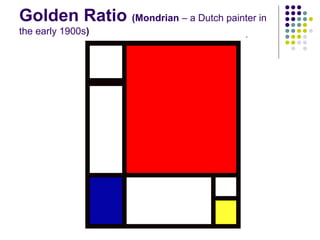
Renaissance artists used the Golden Ratio.(Ratio of 1 to 1.6)
How:
Take the measurement of the shorter side, and multiply it by the
golden number (1.6). The result is the length of the longer side.

1

1.6
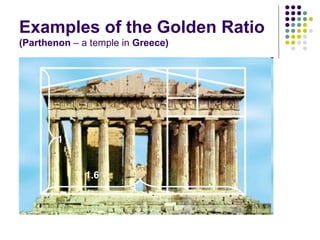
Examples of the Golden Ratio
(Parthenon – a temple in Greece)

1
1.6
Golden Ratio
Renaissance painter)

(Piero della Francesca – an early
Golden Ratio (Mondrian – a Dutch painter in
the early 1900s)
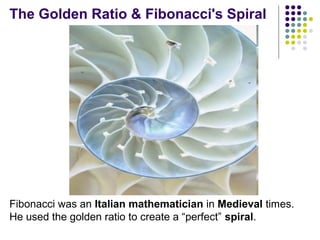
The Golden Ratio & Fibonacci's Spiral

Fibonacci was an Italian mathematician in Medieval times.
He used the golden ratio to create a “perfect” spiral.
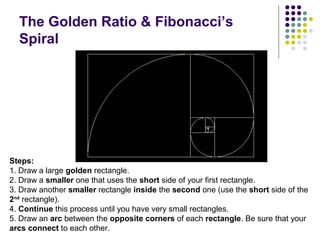
The Golden Ratio & Fibonacci’s
Spiral

Steps:
1. Draw a large golden rectangle.
2. Draw a smaller one that uses the short side of your first rectangle.
3. Draw another smaller rectangle inside the second one (use the short side of the
2nd rectangle).
4. Continue this process until you have very small rectangles.
5. Draw an arc between the opposite corners of each rectangle. Be sure that your
arcs connect to each other.
Printmaking


The process is capable of producing multiple copies of the
same design. Each copy is known as a print.



Painting or drawing, on the other hand, create a unique,
original piece of artwork.



Works printed from a single original create an edition. Each print
should be signed and numbered to form a limited edition.
Printmaking


Prints are created from a single original surface, known technically
as a plate/matrix.



Common types of plates include:
1. metal - usually copper or zinc for engraving
or etching,
2. stone - used for lithography,
3. blocks of wood for woodcuts,
4. linoleum for linocuts, and
5. stencils



You can even use clay or potatoes to make stamps.
Printing with Linoleum
 Linoleum

 Heat

is solidified linseed oil.

it to soften it. Carve a design into it.

 Relief

print: the high parts of your carving
will pick up the ink, and print a mirror image
of your carving.
Printmaking Tools
 Brayer

– used to roll out the ink

 Carving

tools – U-blades, V-blades, large
and small
(BOTH HANDS BEHIND THE BLADE!)
Reductive Print Project


You will create a linocut (like a stamp) of a symbol that
means something to you.



Your design must have 3 layers (a different colour will be
used for each layer).



You will learn how to make a reductive print.

(1. Carve a little; print 10 copies in a light colour.
2. Carve a bit more; print on your 10 copies in a medium
colour.
3. Carve more; print on your 10 copies in a dark colour.)


You will print an edition of 10 prints to develop your printing
skills.
Reductive Print Project:
Artist’s Statement
1) Explain why you chose your design for the linocut.
What does your symbol mean to you?
2) Explain the order in which you carved your design to
get three layers of colour.
3) Evaluate your artwork. Describe how you think you
did well. Describe the areas you think should be
different. How would you change them?
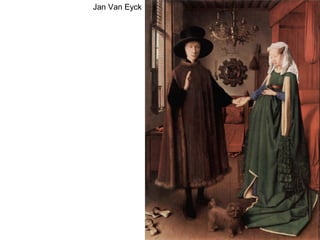
Jan Van Eyck
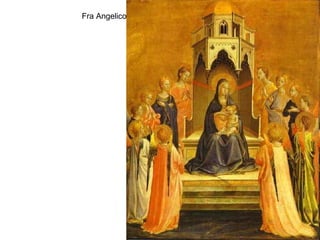
Fra Angelico
Gr10 u4 printmaking

Gr10 u4 printmaking

  • 1.
  • 2.
    Career Research You willresearch a career related to visual arts. You will choose your career from the list provided. Each student must choose a different career. You will create a poster that communicates the key information about your career. Your poster should include pictures and word design. You will also provide a one-page written description of the key information about that career. When you are finished, you will present your poster in a Gallery Walk allowing your classmates to learn about your career.
  • 3.
    Career Research Key InformationAbout Your Career: 1) Name of the Career 2) Description of Duties 3) Tools required 4) Skills needed 5) Education needed 6) Starting salary 7) Availability
  • 4.
    Career Research Requirements Youmust include a bibliography (a list of your sources). Www.careercruising.com is an excellent resource. Failure to hand in a bibliography will result in a ZERO due to plagiarism. NO SECOND CHANCES!
  • 5.
    Medieval Art VS.Renaissance Art  Using the following images, you will analyze the differences between Medieval art and Renaissance art.  Consider these aspects of artistic style: 1) use of perspective (realistic or not) 2) flat space VS. natural depth 3) use of symbolism (i.e. religious symbols) 4) use of negative space (is there any empty space?) 5) understanding of human anatomy
  • 6.
    Medieval VS. RenaissanceArt On the next several slides, you will see examples of Medieval Art on the left and Renaissance Art on the right. With a partner, you will generate a list of characteristics for each period. Be ready to share your ideas.
  • 7.
    Renaissance: Raphael, “School of Athens”,1509 Medieval: The Olivetan Master, “Monks Singing the Office”, 1439 - 1447
  • 8.
    Renaissance: Boticelli, “The Birth ofVenus”, 1485 Medieval: Martini, “Madonna and Child”, 1326
  • 9.
    Renaissance: Michelangelo, “Creation of Adam”,1511- 1512 Medieval: Giotto, “The Crucifixion”, 1300
  • 10.
    Renaissance: Leonardo da Vinci, “TheLast Supper”, 1495 - 1498 Medieval: Master of Perea, “Last Supper”, Late 1400s
  • 11.
    Medieval VS. RenaissanceArt  Medieval  Renaissance 1. Flattened space 1. Illusion of depth 2. Unnatural perspective 2. Use of perspective (1 point, 2 point) 3. Natural use of space 3. Lack of empty space (chiaroscuro – contrast of light & dark) a. triangular compositions b. focus on balance & symmetry c. anatomical accuracy 4. Sacred themes (support from the Catholic Church) 4. Not always sacred themes 5. Lots of blue & gold (expensive!) 5. Natural colours
  • 12.
    Math & Measurementin Art  Renaissance artists used grids. (We can use them to ensure accuracy when transferring images.)  Renaissance artists emphasized correct proportions.
  • 13.
    Math & Measurementin Art  Renaissance artists used one & two-point perspective. one-point perspective (one vanishing point) two-point perspective (two vanishing points)
  • 14.
    Math & Measurementin Art  Renaissance artists used triangular compositional plans.
  • 15.
    Find the triangles! DaVinci, Mona Lisa Raphael, The Holy Family
  • 16.
    Math & Measurementin Art  Renaissance artists used the Golden Ratio.(Ratio of 1 to 1.6) How: Take the measurement of the shorter side, and multiply it by the golden number (1.6). The result is the length of the longer side. 1 1.6
  • 17.
    Examples of theGolden Ratio (Parthenon – a temple in Greece) 1 1.6
  • 18.
    Golden Ratio Renaissance painter) (Pierodella Francesca – an early
  • 19.
    Golden Ratio (Mondrian– a Dutch painter in the early 1900s)
  • 20.
    The Golden Ratio& Fibonacci's Spiral Fibonacci was an Italian mathematician in Medieval times. He used the golden ratio to create a “perfect” spiral.
  • 21.
    The Golden Ratio& Fibonacci’s Spiral Steps: 1. Draw a large golden rectangle. 2. Draw a smaller one that uses the short side of your first rectangle. 3. Draw another smaller rectangle inside the second one (use the short side of the 2nd rectangle). 4. Continue this process until you have very small rectangles. 5. Draw an arc between the opposite corners of each rectangle. Be sure that your arcs connect to each other.
  • 22.
    Printmaking  The process iscapable of producing multiple copies of the same design. Each copy is known as a print.  Painting or drawing, on the other hand, create a unique, original piece of artwork.  Works printed from a single original create an edition. Each print should be signed and numbered to form a limited edition.
  • 23.
    Printmaking  Prints are createdfrom a single original surface, known technically as a plate/matrix.  Common types of plates include: 1. metal - usually copper or zinc for engraving or etching, 2. stone - used for lithography, 3. blocks of wood for woodcuts, 4. linoleum for linocuts, and 5. stencils  You can even use clay or potatoes to make stamps.
  • 24.
    Printing with Linoleum Linoleum  Heat is solidified linseed oil. it to soften it. Carve a design into it.  Relief print: the high parts of your carving will pick up the ink, and print a mirror image of your carving.
  • 25.
    Printmaking Tools  Brayer –used to roll out the ink  Carving tools – U-blades, V-blades, large and small (BOTH HANDS BEHIND THE BLADE!)
  • 26.
    Reductive Print Project  Youwill create a linocut (like a stamp) of a symbol that means something to you.  Your design must have 3 layers (a different colour will be used for each layer).  You will learn how to make a reductive print. (1. Carve a little; print 10 copies in a light colour. 2. Carve a bit more; print on your 10 copies in a medium colour. 3. Carve more; print on your 10 copies in a dark colour.)  You will print an edition of 10 prints to develop your printing skills.
  • 27.
    Reductive Print Project: Artist’sStatement 1) Explain why you chose your design for the linocut. What does your symbol mean to you? 2) Explain the order in which you carved your design to get three layers of colour. 3) Evaluate your artwork. Describe how you think you did well. Describe the areas you think should be different. How would you change them?
  • 28.
  • 29.