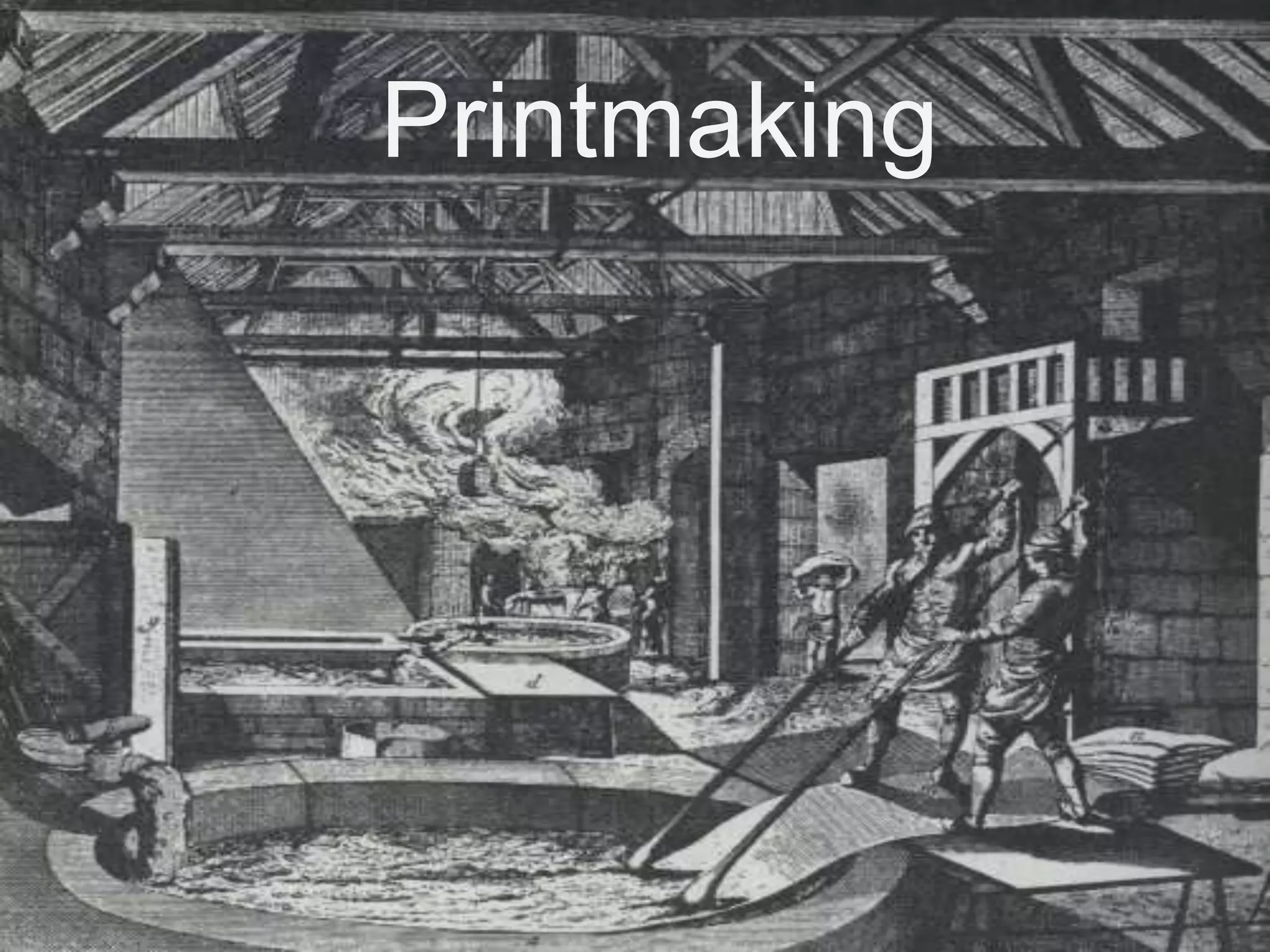
Printmaking
A Brief History of the Printing Press
• The movable type printing press was first invented and developed
in China between the years 1041 and 1048. It was then further
developed in Korea, where Korean inventors made improvements
and modifications resulting in the first moveable type system for
printing in 1234, 216 years before Gutenberg, The worlds oldest
book, made on a movable press system, was printed in 1377. In
the late 1430’s a German, Johann Gutenberg came up with the
idea of using seperate metal blocks so each block ( representing
a letter) could be moved around to form sentences-making printing
books much faster. Gutenberg printed the very first (European)
book-the bible. Initially the noble classes didn’t embrace the
invention-hand inked books were a sign of wealth and grandeur
and mass produced books were looked down upon. It was very
popular with the ‘ lower classes’. Soon, however, word spread, the
innovation was soon revered by all .Print shops opened
everywhere. Mass printed books and material enabled academics
to effectively share ideas and philosophies
Politicians could reach a wider audience through pamplets.
Probably most importantly, the masses, previously largely illiterate,
could learn to read and increase their knowledge. It also increased
the use of regional languages. From the printing of books the press
also began to be used by artisans to print artworks. The art of
etching developed from the etching of armour and swords. Printing
on plates began in Germany, then Italy, and then spread to the rest of
Europe. The Germans and the Italians were arguably the masters of
the technique during the early and high Renaissance. The timeline
for the different forms of printmaking are roughly shown as follows;
Woodcuts (by hand) 200CE
Movable type 1040
The invention of the Printing Press 1377
Etching 1515
Mezzotint 1642
Aquatint 1772
Lithography 1796
(PS Print 2013, Wikipedia 2015)
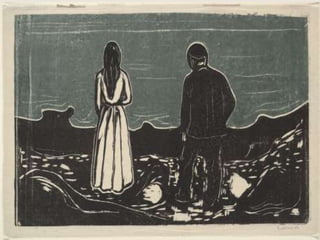
Edvard Munch- 1863–1944
• Edvard Munch was a painter and printmaker. His preferred
method of printmaking was the woodcut. He looked inward for his
subject matter, he did not engage with the interests of the
impressionists of the time who were exploring the effects of
light on the external world. He chose instead to focus on themes
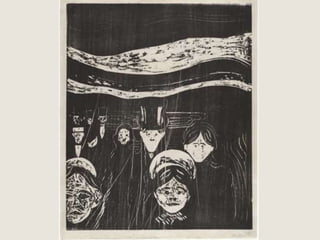
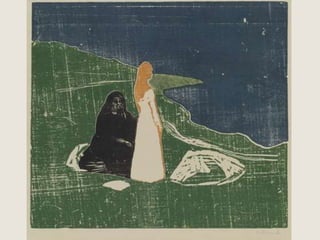
associated with the human condition-love, anxiety, jealousy,
loneliness , sickness and death. He had suffered great
misfortune in his life, with the death of his mother and sister at
an early age and was unlucky in love. These experiences left him
with a great source of subject matter. He was a prolific artist
and made nearly 30,000 impressions from his wood-cuts. He
often investigated the same themes over and over, exploring the
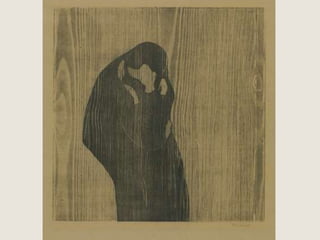
same imagery both in his paintings and prints. He used the
pattern of the grain to aesthetically enhance his compositions
and used a ‘jig-saw’ method of cutting up his woodblock so he
could ink each colour seperately then ‘rejoin’ the sections so he
could print with one pass.(Moma, 2015)
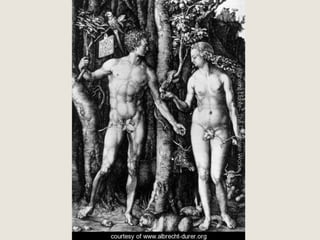
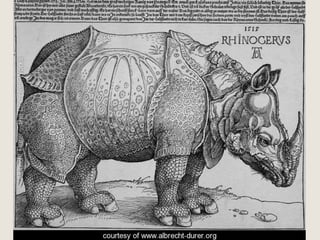
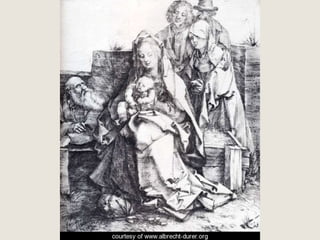
Albrecht Durer 1471-1528
• Albrecht Durer was one of Printmaking’s pioneers. His
engravings , drypoints, woodcuts and etchings are world
reknowned for their intricacy, draftsmanship and skillHe
was born in Germany and started his career as an
apprentice goldsmith to his father. Two years later he quit
to become an apprentice to painter/printmaker and book
maker Michael Wolgemut. Although he was a skilled painter
his preferred artmaking practice was drawing and
printmaking. Durer was also a business man and making
plates for books was a lucrative way of making a living
during these times, it also sustained his art practice. He
recieved many commissions. He was a brilliant draftsman
and was interested in perspective and humanism. He images
often centred on portraiture , biblical and mythological
themes. His work was laden with symbology.(Clark Art
Institute, 2010)
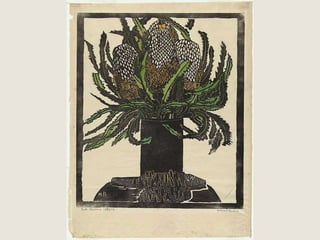
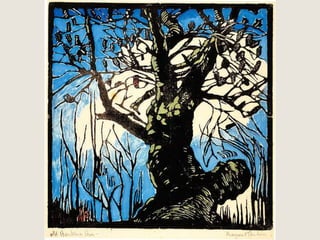
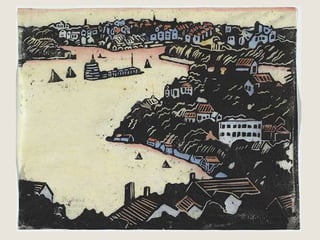
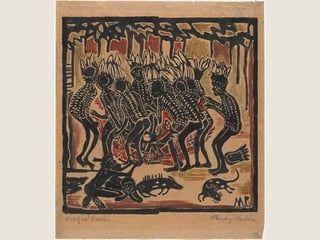
Margaret Preston (1875–1963)
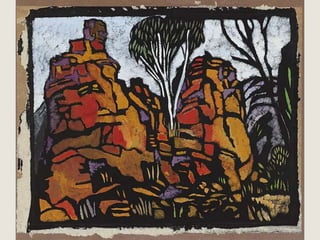
• Margaret Preston is one of Australia’s best known
printmakers. She was an artist, lecturer and educater and
was widely travelled. Although her earliest prints were
etchings she worked primarily in woodcuts, usually from the
one block, preferring to hand colour prints rather than
create multiple blocks. In later years she used paper stencils
to create colour. Her subject matter was undisputedly
‘Australian’. Inspired by her surroundings she did many prints
of her home city of Sydney. She left Sydney and moved to
Berowra’ and surrounded by the bush she produced many
more prints of Australian wildflowers, trees and landscapes.
Her move also increased what was to become a life-long
interest in aborigines and aboriginal art. In the 1940’s
Aboriginal motifs and designs started to appear in her work,
this was also reflected in the color scheme of her work. Her
designs were also influenced by Eastern sensibilities after a
trip to Japan.(Australian National Gallery, 2015)
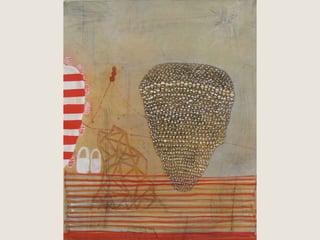
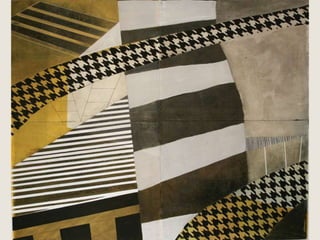
Sarah Amos
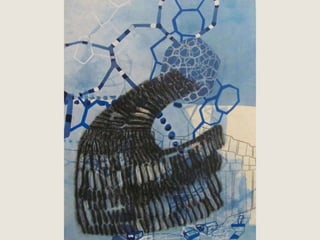
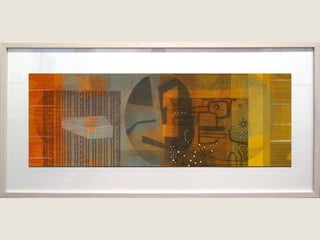
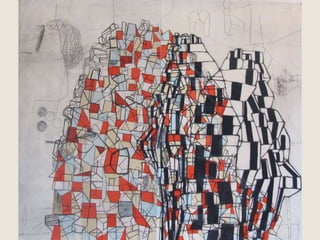
• Australian born artist Sarah Amos is known for large
collagraphs. She uses a variety of printmaking
methods such drypoint, etching and uses carborundum
grit and glue to create areas of tone and line on her
collagraphs. She often uses a roulette in her work.
She is as interested in intricate detail and linework as
she is in large areas of tone and shape. Although she
has created, and creates, mono coloured works her
use of colour can be compared to a painters palette.
Her work is characterised by the interplay of the
elements of shape, space , colour and line. One of
her greatest sources of inspiration is the landscape,
particulary the Australian landscape. She works in
many layers, working and reworking plates and often
pretints the paper before printing and hand colouring
the prints after printing. (The Art Blog, 2009)
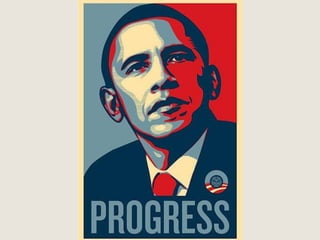
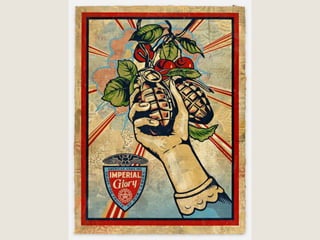
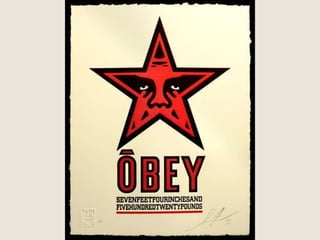
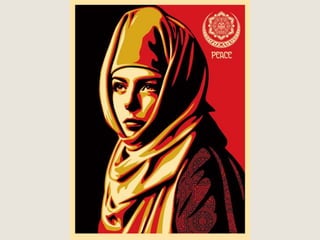
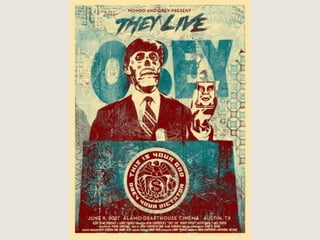
Shepard Fairey 1970-
• American born Shepard Fairey started out as a street artist and
during his time at University he worked in a skate shop and
created stickers and graphic images to adorn skateboard
paraphernalia. He began by wheatpasting printed designs and
tagging surfaces and distributing stickers around urban centres.
He then began to make screenprints. His works shifts between
fine art and graphic and commercial art. His work is laden with
political and/or social messages and he often uses appropriation
which has caused him some problems in the copyright realm. His
work draws on many influences-from Pop Art to constructivism.
His work has a distinctive strong graphic style and he uses a
variety of mediums including photo-etching, and collage although
his main preference is still screen-printing. Watch the video of
him printing at Pace Studio’s under ‘Interesting Links’, under
‘Printmaking’. He discusses his ideas and influences and talks
about his work and techniques. (About Education 2015, The
Institue of Contemporary Art/Boston)
Answer these questions. Most can be answered in a
few sentences, no more than a paragraph. Please
acknowledge your information source.
1) What is a print?
2) Name two important things that the invention of the
printing press enabled
3)What is a screen-print?
4) What is an intaglio print?
5) Name two forms of intaglio printing
6)What is a woodcut?
7) What is a linocut?
8) What is a relief print?
9) What is a collagraph?
10) What is a proof?
11) What is an edition?
12) What is a monoprint?
13) Look at the prezi ‘Signs and Symbols’ Then go to the
web-site ‘The Strange World of Albrecht Durer’.
http://www.clarkart.edu/exhibitions/durer/content/about-the-
artist.cfm
Several of Durer’s prints I have featured in this
presentation are discussed in terms of symbolism on this
site. You can locate this information from the main page of
the site under ‘Durer’s Symbolism’. Please read and study
the works. We will be discussing it in class in the first
•Although there is already a good
glossary on the gallery site I have
included this link because has quite a
few references to printmaking terms-
which many glossaries don’t-
http://www.artistterms.com/index.htm
Please familiarise yourselves with this
terminology.
Check out links under the subheading of
Printmaking under ‘Interesting Links’. It
contains information about different
types of prints, printing techniques and
vocabulary.
Glossary
Find the description and use for the following commonly
used printmaking materials/tools-more terms can be found
in the blog’s glossary
• Plate
• Etching Needle
• Roulette
• Scraper
• Burnisher
• Printing Ink (Block and Etching)
• Blankets(For an etching press)
• Bitumen
• Shellac
• Backing sheet
• Stencil
• Carborundum

Printmaking

  • 1.
  • 2.
    A Brief Historyof the Printing Press • The movable type printing press was first invented and developed in China between the years 1041 and 1048. It was then further developed in Korea, where Korean inventors made improvements and modifications resulting in the first moveable type system for printing in 1234, 216 years before Gutenberg, The worlds oldest book, made on a movable press system, was printed in 1377. In the late 1430’s a German, Johann Gutenberg came up with the idea of using seperate metal blocks so each block ( representing a letter) could be moved around to form sentences-making printing books much faster. Gutenberg printed the very first (European) book-the bible. Initially the noble classes didn’t embrace the invention-hand inked books were a sign of wealth and grandeur and mass produced books were looked down upon. It was very popular with the ‘ lower classes’. Soon, however, word spread, the innovation was soon revered by all .Print shops opened everywhere. Mass printed books and material enabled academics to effectively share ideas and philosophies
  • 3.
    Politicians could reacha wider audience through pamplets. Probably most importantly, the masses, previously largely illiterate, could learn to read and increase their knowledge. It also increased the use of regional languages. From the printing of books the press also began to be used by artisans to print artworks. The art of etching developed from the etching of armour and swords. Printing on plates began in Germany, then Italy, and then spread to the rest of Europe. The Germans and the Italians were arguably the masters of the technique during the early and high Renaissance. The timeline for the different forms of printmaking are roughly shown as follows; Woodcuts (by hand) 200CE Movable type 1040 The invention of the Printing Press 1377 Etching 1515 Mezzotint 1642 Aquatint 1772 Lithography 1796 (PS Print 2013, Wikipedia 2015)
  • 4.
    Edvard Munch- 1863–1944 •Edvard Munch was a painter and printmaker. His preferred method of printmaking was the woodcut. He looked inward for his subject matter, he did not engage with the interests of the impressionists of the time who were exploring the effects of light on the external world. He chose instead to focus on themes associated with the human condition-love, anxiety, jealousy, loneliness , sickness and death. He had suffered great misfortune in his life, with the death of his mother and sister at an early age and was unlucky in love. These experiences left him with a great source of subject matter. He was a prolific artist and made nearly 30,000 impressions from his wood-cuts. He often investigated the same themes over and over, exploring the same imagery both in his paintings and prints. He used the pattern of the grain to aesthetically enhance his compositions and used a ‘jig-saw’ method of cutting up his woodblock so he could ink each colour seperately then ‘rejoin’ the sections so he could print with one pass.(Moma, 2015)
  • 9.
    Albrecht Durer 1471-1528 •Albrecht Durer was one of Printmaking’s pioneers. His engravings , drypoints, woodcuts and etchings are world reknowned for their intricacy, draftsmanship and skillHe was born in Germany and started his career as an apprentice goldsmith to his father. Two years later he quit to become an apprentice to painter/printmaker and book maker Michael Wolgemut. Although he was a skilled painter his preferred artmaking practice was drawing and printmaking. Durer was also a business man and making plates for books was a lucrative way of making a living during these times, it also sustained his art practice. He recieved many commissions. He was a brilliant draftsman and was interested in perspective and humanism. He images often centred on portraiture , biblical and mythological themes. His work was laden with symbology.(Clark Art Institute, 2010)
  • 15.
    Margaret Preston (1875–1963) •Margaret Preston is one of Australia’s best known printmakers. She was an artist, lecturer and educater and was widely travelled. Although her earliest prints were etchings she worked primarily in woodcuts, usually from the one block, preferring to hand colour prints rather than create multiple blocks. In later years she used paper stencils to create colour. Her subject matter was undisputedly ‘Australian’. Inspired by her surroundings she did many prints of her home city of Sydney. She left Sydney and moved to Berowra’ and surrounded by the bush she produced many more prints of Australian wildflowers, trees and landscapes. Her move also increased what was to become a life-long interest in aborigines and aboriginal art. In the 1940’s Aboriginal motifs and designs started to appear in her work, this was also reflected in the color scheme of her work. Her designs were also influenced by Eastern sensibilities after a trip to Japan.(Australian National Gallery, 2015)
  • 21.
    Sarah Amos • Australianborn artist Sarah Amos is known for large collagraphs. She uses a variety of printmaking methods such drypoint, etching and uses carborundum grit and glue to create areas of tone and line on her collagraphs. She often uses a roulette in her work. She is as interested in intricate detail and linework as she is in large areas of tone and shape. Although she has created, and creates, mono coloured works her use of colour can be compared to a painters palette. Her work is characterised by the interplay of the elements of shape, space , colour and line. One of her greatest sources of inspiration is the landscape, particulary the Australian landscape. She works in many layers, working and reworking plates and often pretints the paper before printing and hand colouring the prints after printing. (The Art Blog, 2009)
  • 27.
    Shepard Fairey 1970- •American born Shepard Fairey started out as a street artist and during his time at University he worked in a skate shop and created stickers and graphic images to adorn skateboard paraphernalia. He began by wheatpasting printed designs and tagging surfaces and distributing stickers around urban centres. He then began to make screenprints. His works shifts between fine art and graphic and commercial art. His work is laden with political and/or social messages and he often uses appropriation which has caused him some problems in the copyright realm. His work draws on many influences-from Pop Art to constructivism. His work has a distinctive strong graphic style and he uses a variety of mediums including photo-etching, and collage although his main preference is still screen-printing. Watch the video of him printing at Pace Studio’s under ‘Interesting Links’, under ‘Printmaking’. He discusses his ideas and influences and talks about his work and techniques. (About Education 2015, The Institue of Contemporary Art/Boston)
  • 33.
    Answer these questions.Most can be answered in a few sentences, no more than a paragraph. Please acknowledge your information source. 1) What is a print? 2) Name two important things that the invention of the printing press enabled 3)What is a screen-print? 4) What is an intaglio print? 5) Name two forms of intaglio printing 6)What is a woodcut? 7) What is a linocut? 8) What is a relief print?
  • 34.
    9) What isa collagraph? 10) What is a proof? 11) What is an edition? 12) What is a monoprint? 13) Look at the prezi ‘Signs and Symbols’ Then go to the web-site ‘The Strange World of Albrecht Durer’. http://www.clarkart.edu/exhibitions/durer/content/about-the- artist.cfm Several of Durer’s prints I have featured in this presentation are discussed in terms of symbolism on this site. You can locate this information from the main page of the site under ‘Durer’s Symbolism’. Please read and study the works. We will be discussing it in class in the first
  • 35.
    •Although there isalready a good glossary on the gallery site I have included this link because has quite a few references to printmaking terms- which many glossaries don’t- http://www.artistterms.com/index.htm Please familiarise yourselves with this terminology. Check out links under the subheading of Printmaking under ‘Interesting Links’. It contains information about different types of prints, printing techniques and vocabulary.
  • 36.
    Glossary Find the descriptionand use for the following commonly used printmaking materials/tools-more terms can be found in the blog’s glossary • Plate • Etching Needle • Roulette • Scraper • Burnisher • Printing Ink (Block and Etching) • Blankets(For an etching press) • Bitumen • Shellac • Backing sheet • Stencil • Carborundum

Editor's Notes

  • #3 PS Print, 2013, retrieved February 6, 2015, <http://www.psprint.com/resources/printing-press/> Wikipedia, 2015, retrieved February 6, 2015, < http://en.wikipedia.org/wiki/Printing_press>
  • #4 PS Print, 2013,retrieved February 6, 2015, <http://www.psprint.com/resources/printing-press/> Wikipedia, 2015, retrieved February 6, 2015, < http://en.wikipedia.org/wiki/Printing_press>
  • #5 Moma 2015, The Collection, retrieved February 6, 2015, <http://www.moma.org/collection/object.php?object_id=67456>
  • #6  Edward Munch, ‘Angst’, 1896, signed 1897, Woodcut, 45.7 x 37.6 cm; sheet 49 x 40 cm, Edition:approximately 50 (26 printed in black) Moma 2015, Edward Munch, , retrieved February 6, 2015,<http://www.moma.org/collection/object.php?object_id=67456>
  • #7  Edward Munch, ‘Two women on the shore’, 1898, Woodcut, 45.5 x 51.5 cm; sheet (irreg.): 51.3 x 56.9 cm) Edition:approximately 50 impressions in several color and compositional variations Moma 2015, Edward Munch, retrieved February 6, 2015, < <http://www.moma.org/collection/object.php?object_id=75977>
  • #8  Edward Munch, ‘The Kiss’, 1897-1902, Woodcut, 46.7 x 46.4 cm, sheet : 61 x 60 cm, Edition: 50-100 in several color and compositional variations Moma 2015, Edward Munch, retrieved February 6, 2015, <http://www.moma.org/collection/object.php?object_id=60565>
  • #9  Edvard Munch, ‘Two People. The Lonely Ones (To mennesker. De ensomme) 1899,Woodcut, 39.4 x 55.3 cm, sheet: 43.5 x 59.4 cm, Edition:approximately 100 in several color and compositional variations Moma 2015, The Collection, Edvard Munch, retrieved February 6, 2015, < <http://www.moma.org/collection/object.php?object_id=67881>
  • #10 The Clark Art Institute, 2010, Albrecht Durer, retrieved February 6, 2015, <http://www.clarkart.edu/exhibitions/durer/content/about-the-artist.cfm>
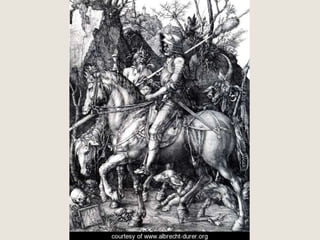
  • #11 Albrecht Durer, ‘The Knight Death And The Devil’, 1513, Engraving Albrecht Durer, The complete works, , retrieved February 6, 2015, <http://www.albrecht-durer.org/The-Knight--Death-And-The-Devil-large.html>
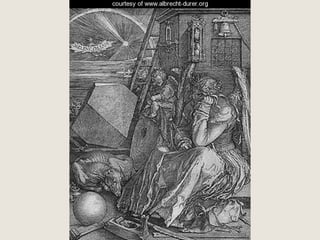
  • #12 Albrecht Durer,’Melencolia’, 1514, Engraving Albrecht Durer, The complete works, , retrieved February 6, 2015, <http://www.albrecht-durer.org/Melencolia-large.html>
  • #13 Albrecht Durer,’Adam and Eve(The fall of man’, 1504, Engraving Albrecht Durer, The complete works, , retrieved February 6, 2015, <http://www.albrecht-durer.org/Adam-and-Eve-%28The-Fall-of-Man%29-large.html>
  • #14 Albrecht Durer,’ Dürer's Rhinoceros’, 1515, woodcut, 23.5 cm × 29.8 cm Albrecht Durer, The complete works, , retrieved February 6, 2015, <http://www.albrecht-durer.org/Rhinoceros-large.html>
  • #15 Albrecht Durer, ‘The Magdalen and Nicodemus’, 1512, Drypoint Albrecht Durer, The complete works, , retrieved February 6, 2015, <http://www.albrecht-durer.org/The-Holy-Family-With-St--John--The-Magdalen-And-Nicodemus-large.html>
  • #16 Australian National Gallery (NGV) 2015, retrieved February 6, 2015,<http://nga.gov.au/preston/> Australian National Gallery (NGV) 2015, , retrieved February 6, 2015,<http://nga.gov.au/preston/essay.cfm>
  • #17 Margaret Preston, ‘West Australian banksia’, [W.A. Banksia, Banksia] 1929, woodcut, 44.2 h x 38.0 w cm, printed in black ink, from one block; hand-coloured Impression: 10/?, Edition: edition unknown, uncoloured; edition unknown, hand-colouredMargaret Preston, 1929, Inscribed lower left below printed image in black pencil, '10th proof'. National Gallery Australia 2015, Collection: Margaret Preston, retrieved February 6, 2015, <http://cs.nga.gov.au/Detail.cfm?IRN=103952>
  • #18 Margaret Preston, ‘The Banksia tree’, [Old banksia tree], woodcut, printed image: 24.8 h x 24.6 w cm, sheet size: 44.2 h x 38.0 w cm, printed in black ink, from one block; hand-coloured, Impression: undesignated impression, Edition: edition unknown, Primary Insc: Signed lower right below printed image in black pencil, 'Margaret Preston'. Not dated National Gallery Australia 2015, Collection: Margaret Preston, , retrieved February 6, 2015, <http://cs.nga.gov.au/Detail.cfm?IRN=58900>
  • #19 Margaret Preston, ‘Shell Cove, Sydney'. 1920, woodcut, printed image: 21.6 h x 27.1 w cm, sheet size: 21.6 h x 27.1 w cm, printed in black ink, from one block; hand-coloured, Impression: undesignated impression, Edition: edition unknown National Gallery of Australia (NGA) 2015, Collection: Margaret Preston , retrieved February 6, 2015, <http://cs.nga.gov.au/Detail-LRG.cfm?IRN=37475>
  • #20 Margaret Preston, Australian legend, number 4: Kangaroo dance and pointing the bone ( Pointing the bone No. 1), circa 1957), colour woodcut on buff Japanese paper Edition Unknown edition, 29.9 x 29.6 cm blockmark; 36.0 x 29.6 cm sheet Art Gallery New South Wales, Collection, Margaret Preston, retrieved February 6, 2015, <http://www.artgallery.nsw.gov.au/collection/works/DA7.1959/>
  • #21 Rocks in Roper River. [Rocks in Roper River Valley, N.T.] 1953, printed image 46.5 h x 58.0 w cm, stencil, printed in colour, from one hand-cut paper stencil, Impression: undesignated impression, Edition: edition of 3 Art Gallery New South Wales, Collection, Margaret Preston, retrieved February 6, 2015, <<http://cs.nga.gov.au/Detail.cfm?IRN=134532>
  • #22 The Art Blog, 2009, Interview with Sarah Amos–the printer’s territories, retrieved January 20, 2015, <http://www.theartblog.org/2009/11/interview-with-sarah-amos-the-printers-territories/>
  • #23 Sarah Amos, ‘Blue Ferry’, 2014, collagraph on paper with gouache, 50 x 40 cm, Ocula 2015, Sarah Amos, retrieved February 6, < http://ocula.com/artists/sarah-amos/>
  • #24 Sarah Amos, 'Four Pipes’, 2011, collograph and gouache, 38cm x 99cm Image Archive, Amos, retrieved February 6, 2015, <http://archive.flg.com.au/Images/Artists_large/Artists%20lge%202011/Amos%20lge%202011/Amos_FOUR-PIPES-COLLAGRAPH-AND-GOUACHE-2011-38X99-CM.jpg
  • #25 Sarah Amos, Lunette 12, 2013, collagraph on japanese paper with gouache on canvas stretcher, 50 x 40 cm, Ocula 2015, Sarah Amos, retrieved January 20, 2015<http://ocula.com/artists/sarah-amos/>
  • #26 Sarah Amos, ‘Over and Yonder’, Collagraph and Gouche, 2011, 200 x 195 cm, Image Archive, Amos, retrieved February 6, 2015, <http://archive.flg.com.au/Images/Artists_large/Artists%20lge%202011/Amos%20lge%202011/Amos_OVER-AND-YONDER-COLLAGRAPH-AND-GOUACHE-200X195-2011.jpg>
  • #27 Black Box Gum, 2013, Collagraph on Japanese paper with Gouache (diptych) , 164cm x 198cm Image Archive, 2013, retrieved February 6, 2015, <http://www.archive.flg.com.au/Images/Artists_large/Artists%20lge%202013/Amos%20Sarah/BLACK-BOX-GUM-2-182CM-X-152-CM-2013.jpg>
  • #28 About education 2015,’ Artists in 60 seconds: Shepard Fairey, retrieved February’ 6, 2015, <http://arthistory.about.com/od/namesff/p/fairey.htm> The Institute of Contemporary Art/Boston,’Exhibitions: Shepard Fairey’, retrieved February 6, 2015,<http://www.icaboston.org/exhibitions/exhibit/fairey/>
  • #29 Shepard Fairey, ‘Obama (Progress)’, 2008, Silkscreen on paper, Edition of 350 Obey, 2015, retrieved February 6, 2015, <http://www.obeygiant.com/headlines/obama>
  • #30 Shepard Fairey, ‘Harmony and Discord (Imperial Glory)’, 2012, Collage, Six colour Screenprint, Spray-paint, Stencil, Edition of 50, printed by Pace Studios Leslie Park, n.d, ‘The Print Project: Shepard Fairey: Harmony & Discord-A Layered Approach to Prints, retrieved February 6, 2015,<http://www.leslieparke.com/2012/05/print-porject-shepard-fairey-harmony-discord-a-layered-approach-to-prints/> This is a great video where Shepard Fairey speaks about his work, in particular the prints from the exhibition ‘Harmony and Discord’-how they were made, printed, techniques used and the subject matter. The link is repeated also under ‘Interesting Links’ in the Gallery blog. Pace Paper and Watanabe Press, 2012< http://www.youtube.com/watch?v=LM2IW8hv5m8>
  • #31 Shepard Fairey, ‘Obey Icon Star’, 2013, 2 color on . Letterpress 100% cotton Lettre paper, 110lb, deckled edges, Signed and numbered edition of 400.  OBEY publishing chop on left corner,10 inches x 13 inches Obey, 2015, retrieved February 6, 2015, <http://www.obeygiant.com/prints/obey-star-letterpress>
  • #32 Shepard Fairey, ‘Universal Personhood’, 2013, Three colour screen print, 18 x 24 inches, Signed and numbered edition of 450.  Obey, 2015, retrieved February 6, 2015, <http://www.obeygiant.com/prints/universal-personhood-print>
  • #33 Shepard Fairey, ‘They Live’, 2011, 18 x 24″ Two Colour Screen print on Collaged Paper, Edition of 500.  $50.  Obey, 2015, retrieved February 6, 2015, < http://www.obeygiant.com/prints/they-live-2>