Unit 5: Lesson 1
The Birth of Ceramic Art
● In the early 1900s, factories had taken over
almost all aspects of production of useful
ceramics.
● As a result, in the 1940s & 50s, British potter
Bernard Leach (1887 – 1979) pushed for the
revival of handmade ceramics.
● This movement was known as the Studio Potter
Movement.
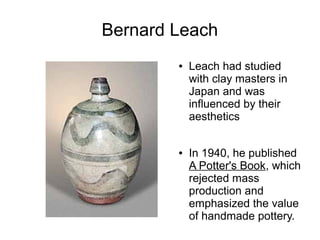
Bernard Leach
● Leach had studied
with clay masters in
Japan and was
influenced by their
aesthetics
● In 1940, he published
A Potter's Book, which
rejected mass
production and
emphasized the value
of handmade pottery.
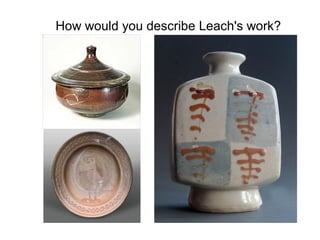
How would you describe Leach's work?
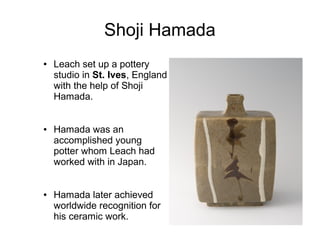
Shoji Hamada
● Leach set up a pottery
studio in St. Ives, England
with the help of Shoji
Hamada.
● Hamada was an
accomplished young
potter whom Leach had
worked with in Japan.
● Hamada later achieved
worldwide recognition for
his ceramic work.
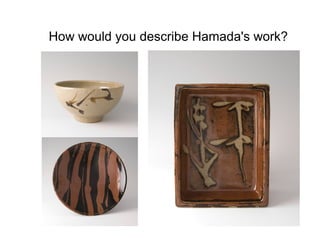
How would you describe Hamada's work?
The Leach Pottery Studio
● St. Ives became a place where potters were
trained to produce simple, straightforward pots
that focused primarily on function.
● Later Leach and Hamada travelled the world
teaching the fundamental principles of clay
design.
● American & Canadian pottery in the 1950s was
heavily influenced by Leach and Hamada views.
Peter Voulkos
● Voulkos was a talented potter and teacher
in west coast California.
● He met Leach and Hamada when they
toured the U.S.A. in 1952.
● He was inspired to become part of the
movement to emphasize the importance of
ceramics.
Peter Voulkos
● In 1953, he met and was influenced by
artists involved in the Abstract
Expressionist movement.
● Abstract Expressionism is a type of art in
which the artist expresses himself using
form and colour. It is non-
representational, which means that there
are no actual objects represented.
Peter Voulkos
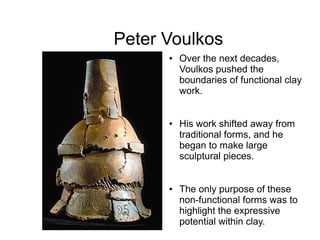
● Over the next decades,
Voulkos pushed the
boundaries of functional clay
work.
● His work shifted away from
traditional forms, and he
began to make large
sculptural pieces.
● The only purpose of these
non-functional forms was to
highlight the expressive
potential within clay.
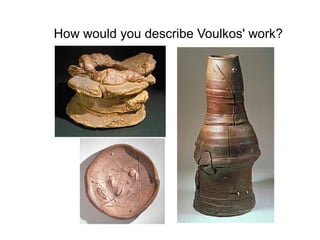
How would you describe Voulkos' work?
Craft VS. Art
● Until Voulkos, the boundary between craft and art
had been clear.
● Voulkos' abstract expressionist pots blurred the
boundary between craft and art.
● A new concept: Ceramic Art came into being.
● A clay object could now be valued solely for its
sensory and aesthetic properties.
Contemporary Ceramic Sculptors
Beth Lo
(Montana)
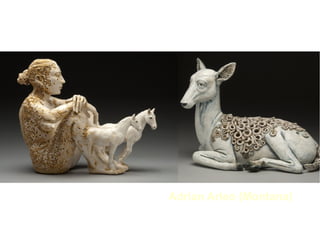
Adrian Arleo (Montana)
Tom Bartel (Indiana)
Pattie Chalmers
(from Manitoba,
Currently in Illinois)
Magda Gluszek
(Florida)
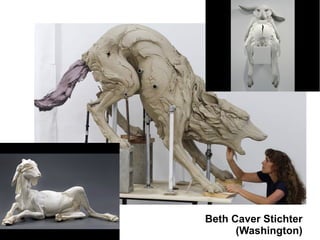
Beth Caver Stichter
(Washington)
REFLECTION: UNIT 5
1) How did you come up with your idea for your Culminating
Activity? Why did you make this?
2) What techniques did you use to build your project?
3) How successful were you in shaping the clay into the form
you wanted? Were you able to smooth bumps and cracks?
4) Were you successful in glazing your project? Did you add
enough decoration? Did you use enough colours and
textures?
5) What parts of your project need improvement?

Ceramics Unit 5

  • 1.
    Unit 5: Lesson1 The Birth of Ceramic Art
  • 2.
    The Birth ofCeramic Art ● In the early 1900s, factories had taken over almost all aspects of production of useful ceramics. ● As a result, in the 1940s & 50s, British potter Bernard Leach (1887 – 1979) pushed for the revival of handmade ceramics. ● This movement was known as the Studio Potter Movement.
  • 3.
    Bernard Leach ● Leachhad studied with clay masters in Japan and was influenced by their aesthetics ● In 1940, he published A Potter's Book, which rejected mass production and emphasized the value of handmade pottery.
  • 4.
    How would youdescribe Leach's work?
  • 5.
    Shoji Hamada ● Leachset up a pottery studio in St. Ives, England with the help of Shoji Hamada. ● Hamada was an accomplished young potter whom Leach had worked with in Japan. ● Hamada later achieved worldwide recognition for his ceramic work.
  • 6.
    How would youdescribe Hamada's work?
  • 7.
    The Leach PotteryStudio ● St. Ives became a place where potters were trained to produce simple, straightforward pots that focused primarily on function. ● Later Leach and Hamada travelled the world teaching the fundamental principles of clay design. ● American & Canadian pottery in the 1950s was heavily influenced by Leach and Hamada views.
  • 8.
    Peter Voulkos ● Voulkoswas a talented potter and teacher in west coast California. ● He met Leach and Hamada when they toured the U.S.A. in 1952. ● He was inspired to become part of the movement to emphasize the importance of ceramics.
  • 9.
    Peter Voulkos ● In1953, he met and was influenced by artists involved in the Abstract Expressionist movement. ● Abstract Expressionism is a type of art in which the artist expresses himself using form and colour. It is non- representational, which means that there are no actual objects represented.
  • 10.
    Peter Voulkos ● Overthe next decades, Voulkos pushed the boundaries of functional clay work. ● His work shifted away from traditional forms, and he began to make large sculptural pieces. ● The only purpose of these non-functional forms was to highlight the expressive potential within clay.
  • 11.
    How would youdescribe Voulkos' work?
  • 12.
    Craft VS. Art ●Until Voulkos, the boundary between craft and art had been clear. ● Voulkos' abstract expressionist pots blurred the boundary between craft and art. ● A new concept: Ceramic Art came into being. ● A clay object could now be valued solely for its sensory and aesthetic properties.
  • 13.
  • 14.
  • 15.
  • 16.
  • 17.
  • 18.
  • 19.
  • 20.
    REFLECTION: UNIT 5 1)How did you come up with your idea for your Culminating Activity? Why did you make this? 2) What techniques did you use to build your project? 3) How successful were you in shaping the clay into the form you wanted? Were you able to smooth bumps and cracks? 4) Were you successful in glazing your project? Did you add enough decoration? Did you use enough colours and textures? 5) What parts of your project need improvement?