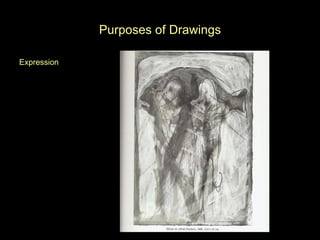
Drawing Everybody  draws. There can scarcely be a person above the age of two who has never made a drawing. Two qualities often associated with drawing are familiarity and intimacy. Drawing is familiar in that it uses the materials we are accustomed to – the pencil, the pen, the stick of chalk.  Drawing seems intimate because it is frequently the artist’s note-taking. We think of drawings as direct expression, from brain to hand.
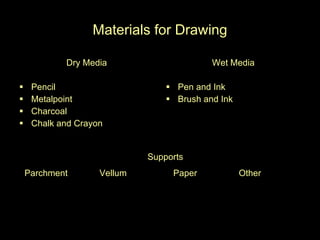
Materials for Drawing Dry Media Pencil Metalpoint Charcoal Chalk and Crayon Wet Media Pen and Ink Brush and Ink Supports Parchment  Vellum  Paper  Other
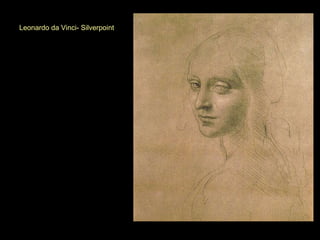
Dry Media Silverpoint Uses a  ground  of bone or chalk mixed with  gum , water and  pigment . Drag a silver tipped instrument over the surface and the partials stick to the ground.  Tom make a area darker you have to use cross hatching.  Very delicate in appearance .
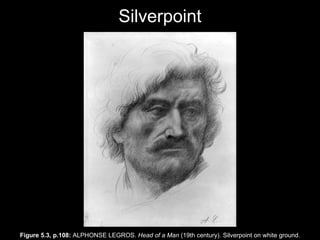
Silverpoint Figure 5.3, p.108:  ALPHONSE LEGROS.  Head of a Man  (19th century). Silverpoint on white ground.
Leonardo da Vinci- Silverpoint
Dry Media continued… Pencil Most traditional media Replaced silverpoint Capable of creating a wide range of effects.  History: Came into use in the 1500s Mass produced pencils invented in late eighteenth century.  Uses a thin rod of  graphite  encased in wood or paper.  The graphite is ground to dust, mixed with clay and baked.  The more clay, the harder the pencil.
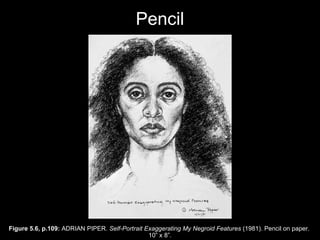
Pencil Figure 5.6, p.109:  ADRIAN PIPER.  Self-Portrait Exaggerating My Negroid Features  (1981). Pencil on paper.  10 ” x  8 ” .
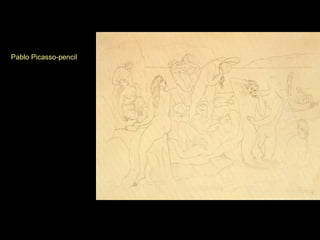
Pablo Picasso-pencil
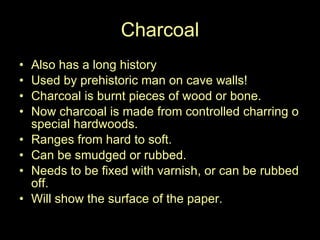
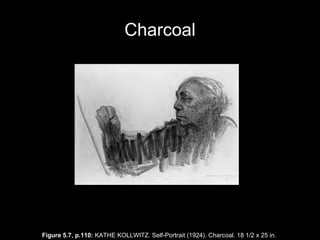
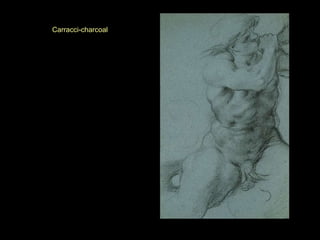
Charcoal Also has a long history Used by prehistoric man on cave walls! Charcoal is burnt pieces of wood or bone.  Now charcoal is made from controlled charring o special hardwoods.  Ranges from hard to soft.  Can be smudged or rubbed.  Needs to be fixed with varnish, or can be rubbed off.  Will show the surface of the paper.
Charcoal Figure 5.7, p.110:  KATHE KOLLWITZ. Self-Portrait (1924). Charcoal. 18 1/2 x 25 in.
Carracci-charcoal
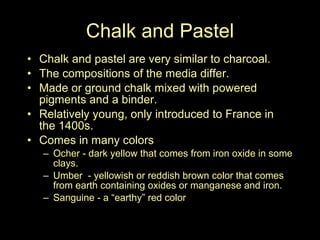
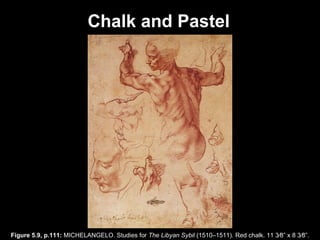
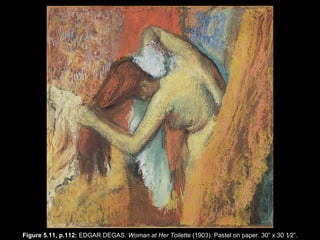
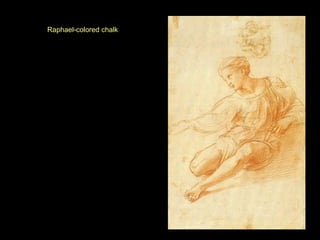
Chalk and Pastel Chalk and pastel are very similar to charcoal. The compositions of the media differ. Made or ground chalk mixed with powered pigments and a binder.  Relatively young, only introduced to France in the 1400s.  Comes in many colors Ocher - dark yellow that comes from iron oxide in some clays.  Umber  - yellowish or reddish brown color that comes from earth containing oxides or manganese and iron. Sanguine - a “earthy” red color
Figure 5.9, p.111:  MICHELANGELO. Studies for  The Libyan Sybil  (1510–1511). Red chalk. 11   3⁄8 ”   x  8   3⁄8 ” . Chalk and Pastel
Figure 5.11, p.112:  EDGAR DEGAS.  Woman at Her Toilette  (1903). Pastel on paper. 30 ” x  30   1⁄2 ” .
Raphael-colored chalk
Pen and Ink Used since ancient times Earliest were s reeds Quills , plucked from live birds, were sue in the Middle Ages.  Replaced in the nineteenth century with mass produced metal  nib , which is slipped into a  stylus .
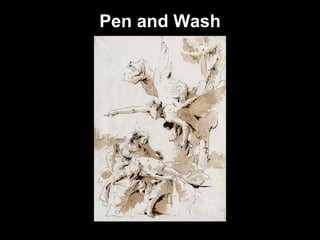
Pen and Wash Wash  - diluted ink that is applied with  brush. Often combined with fine clear lines of pure ink to provide tonal emphasis.
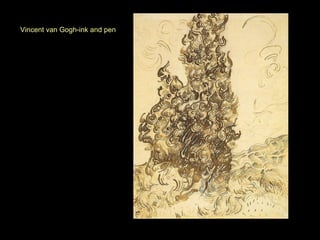
Vincent van Gogh-ink and pen
Figure 5.18, p.115:  GIOVANNI BATTISTA TIEPOLO.  Hagar and Ishmael in the Wilderness  (c. 1725–1735).  Pen, brush and brown ink, and wash, over sketch in black chalk. 16   1⁄2 ” x  11   1⁄8 ” . Pen and Wash
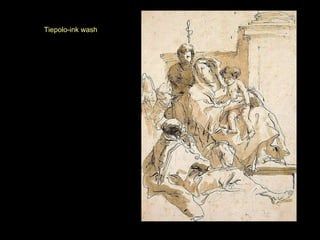
Tiepolo-ink wash
New  Approaches to Drawing Drawing display endless versatility in: Purpose Media Technique So what is drawing?
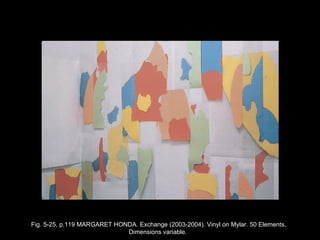
Fig. 5-25, p.119 MARGARET HONDA. Exchange (2003-2004). Vinyl on Mylar. 50 Elements, Dimensions variable.
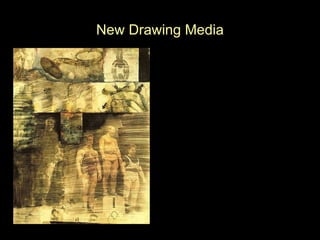
New Drawing Media
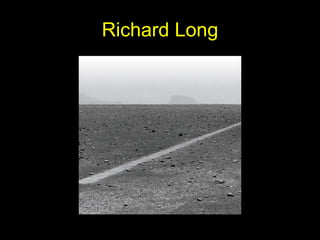
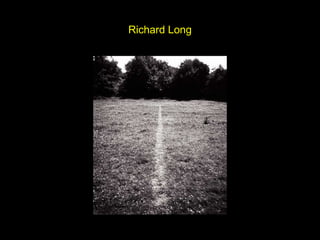
Richard Long
Richard Long
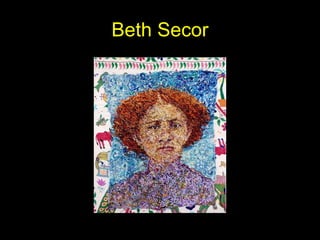
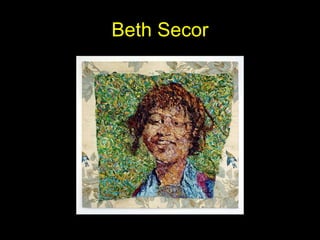
Beth Secor
Beth Secor
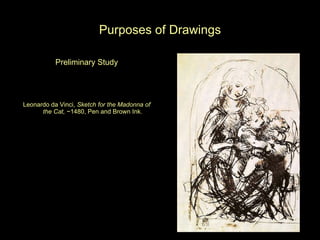
Purposes of Drawings Preliminary Study Leonardo da Vinci,  Sketch for the Madonna of the Cat,  ~1480, Pen and Brown Ink.
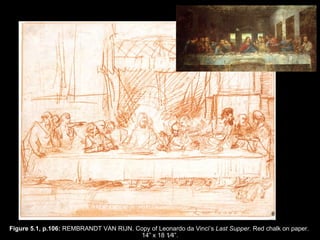
Figure 5.1, p.106:  REMBRANDT VAN RIJN. Copy of Leonardo da Vinci’s  Last Supper.  Red chalk on paper.  14 ”   x  18   1⁄4 ” .
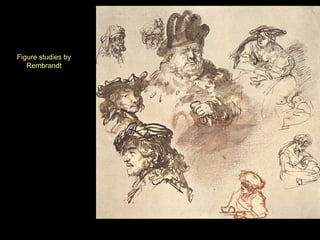
Figure studies by Rembrandt
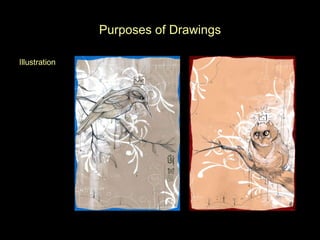
Purposes of Drawings Illustration
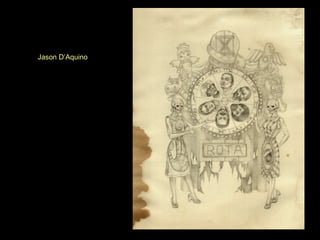
Jason D’Aquino
Purposes of Drawings Expression
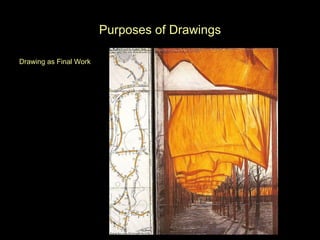
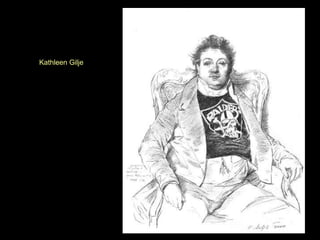
Purposes of Drawings Drawing as Final Work
Kathleen Gilje
Painting Painting is the queen of the arts. Ask ten people to form a quick mental image of “art,” nine of them are likely to visualize a painting on a wall. There are several reasons for the prominence of painting. For one thing, paintings are usually full of color which is an important visual stimuli. For another, paintings are often framed, some quite elaborately, so that one has the impression of a very special object.
Types of Painting Fresco Encaustic Tempera Oil Acrylic Watercolor Spray Paint
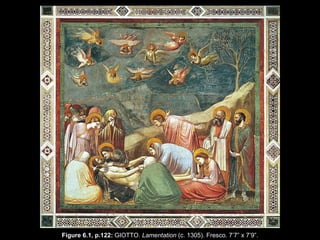
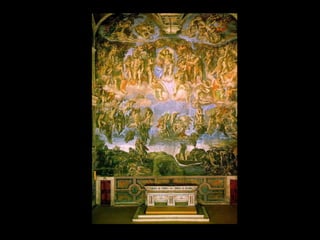
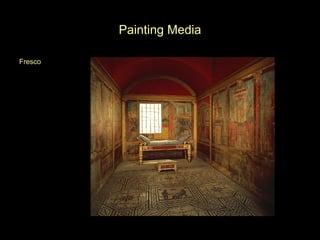
Fresco Fresco  - the art of painting on plaster.  Was popular in the Renaissance  And was revived in Mexico after WWI.  Buon fresco or true fresco  - done on damp, lime plaster.  Fresco secco  - painting on dry plaster.  Problems with fresco: Have to work fast, you can only paint what can be completed in one day. This can create visible seams. Some color don’t work well with lime.  (like blue)
Painting Media Fresco
Figure 6.1, p.122:  GIOTTO.  Lamentation  (c. 1305). Fresco. 7 ’ 7 ” x  7 ’ 9 ” .
 
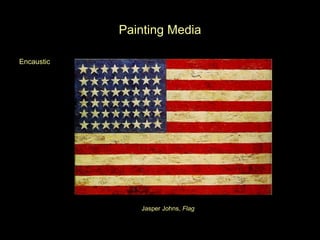
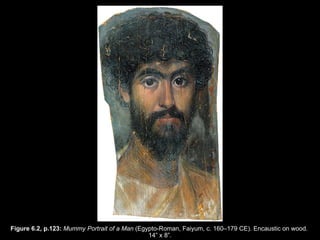
Encaustic Encaustic  - One of the earliest methods of applying color to a surface. Uses a pigment in a wax vehicle that has been heated to a liquid state.  Very old Extremely durable Colors remain vibrant Surface will retain a hard luster Used by the Egyptians and the Romans
Painting Media Encaustic Jasper Johns,  Flag
Figure 6.2, p.123:  Mummy Portrait of a Man  (Egypto-Roman, Faiyum, c. 160–179 CE). Encaustic on wood.  14 ” x  8 ” .
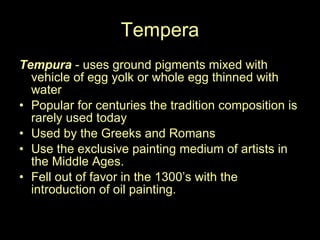
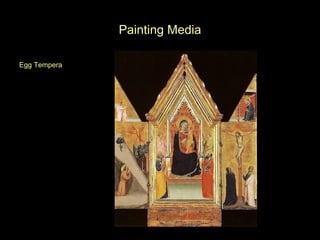
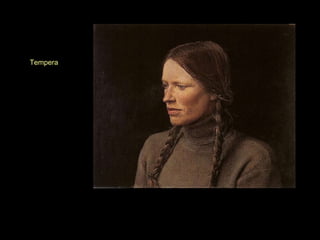
Tempera Tempura  - uses ground pigments mixed with vehicle of egg yolk or whole egg thinned with water Popular for centuries the tradition composition is rarely used today Used by the Greeks and Romans Use the exclusive painting medium of artists in the Middle Ages.  Fell out of favor in the 1300’s with the introduction of oil painting.
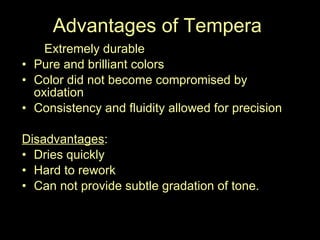
Advantages of Tempera to Extremely durable Pure and brilliant colors Color did not become compromised by oxidation  Consistency and fluidity allowed for precision Disadvantages :  Dries quickly Hard to rework Can not provide subtle gradation of tone.
Painting Media Egg Tempera
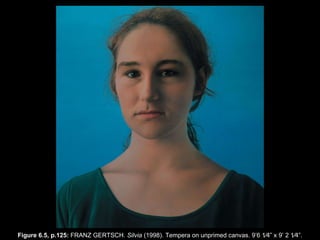
Figure 6.5, p.125:  FRANZ GERTSCH.  Silvia  (1998). Tempera on unprimed canvas. 9 ’ 6   1⁄4 ” x  9 ’  2   1⁄4 ” .
Tempera
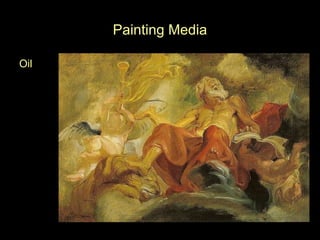
Oil Oil painting  - consists of ground pigments combined with a linseed oil vehicle and a turpentine medium or thinner. The transition from tempera to oil was gradual. Naturally slow drying – can be speeded up with agents The first oils were on wood panels. Glazing  - the application of multiple layers of transparent films of paint to a surface.
Oil’s Advantages Colors can be blended easily. Slow drying lets you rework problem areas.  Can creates nice delicate colors. The eventual use of canvas as a ground allowed paintings to get much bigger.
Painting Media Oil
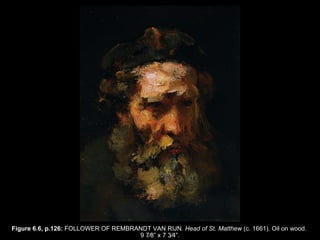
Figure 6.6, p.126:  FOLLOWER OF REMBRANDT VAN RIJN.  Head of St. Matthew  (c. 1661). Oil on wood.  9   7⁄8 ” x  7   3⁄4 ” .
 
Painting Media Watercolor
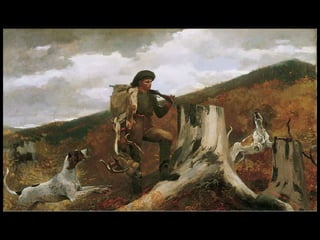
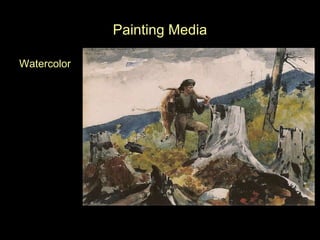
Watercolor Watercolor  - originally defined as any painting medium that employs water as a solvent. Today refers to a specific technique really called  aquarelle .  Aquarelle  - Transparent films of paint are applied to a white absorbent surface.  Egyptian artist used a form of watercolor painting.  Also used in the Middle Ages Gouache  - watercolor mixed with a high concentration of vehicle and opaque ingredients such as chalk primarily used during the Byzantine and Romanesque eras of Christian art.
Advantages and Disadvantages of Watercolor White does not exist.  White is created by letting the paper shine through.  The artist must plan ahead.  Corrections are not possible.  Portable Great for sketches and impressions.  Or can be a used as a final piece.
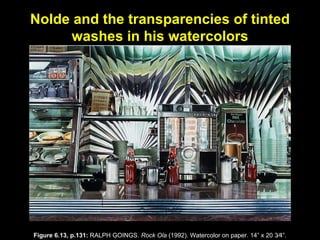
Figure 6.13, p.131:  RALPH GOINGS.  Rock Ola  (1992). Watercolor on paper. 14 ” x  20   3⁄4 ” . Nolde and the transparencies of tinted washes in his watercolors
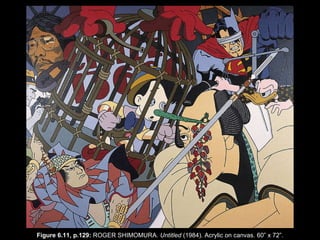
Acrylic Acrylic - is a mixture of pigment and a plastic vehicle that can be thinned with water.  Advantages of acrylic paint over oil paint: “ No mess” Can be used on a variety of surface Surfaces don’t need special preparation.
Painting Media Acrylic
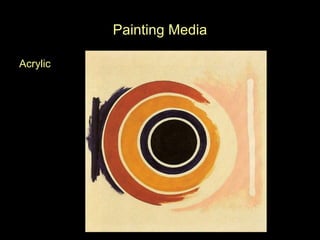
Figure 6.11, p.129:  ROGER SHIMOMURA.  Untitled  (1984). Acrylic on canvas. 60 ” x  72 ” .
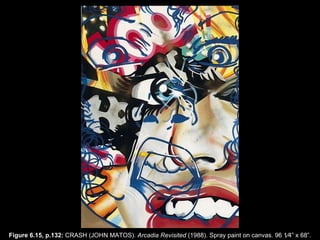
Spray Paint Is spray painting like prehistoric cave painting? It raises similar questions: Why do they do it? Is it art? Is it urban ritual? Will is speak in history to the trails of inner-city living?
Figure 6.15, p.132:  CRASH (JOHN MATOS).  Arcadia Revisited  (1988). Spray paint on canvas. 96   1⁄4 ” x  68 ” .
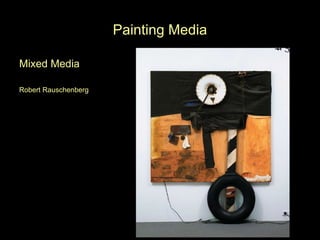
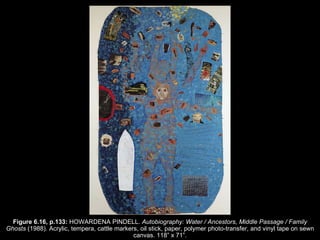
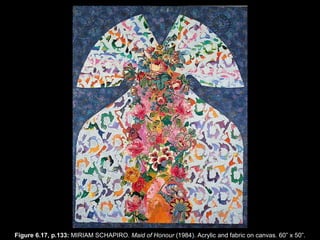
Mixed Media Collage  or papiers colles - Picasso and Braque were the first to incorporate pieces of newsprint, wallpaper, labels from wine bottles, and oilcloth into their paintings.  Miriam Schapiro create what she calls “femmage” with is a version of collage using feminine imagery and materials
Painting Media Mixed Media Robert Rauschenberg
Figure 6.16, p.133:  HOWARDENA PINDELL.  Autobiography: Water / Ancestors, Middle Passage / Family Ghosts  (1988). Acrylic, tempera, cattle markers, oil stick, paper, polymer photo-transfer, and vinyl tape on sewn canvas. 118 ” x  71 ” .
Figure 6.17, p.133:  MIRIAM SCHAPIRO.  Maid of Honour  (1984). Acrylic and fabric on canvas. 60 ” x  50 ” .
 
If you have ever received a a handmade greeting card for Christmas or for your birthday or as an invitation to a party, then you will appreciate the difference between an art print and a mass-produced reproduction. Commercial greeting cards are cranked out by the thousands, even the millions, by the major card manufacturers. A homemade card has a more personal touch. The design is unique- a personal expression of the individual who created it. Also, each card will be slightly different due to the human touch which we find missing from commercial products.
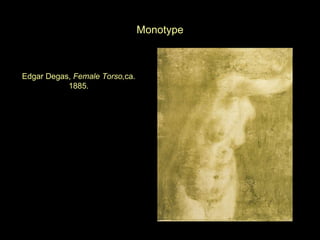
Monotype Edgar Degas,  Female Torso, ca. 1885.
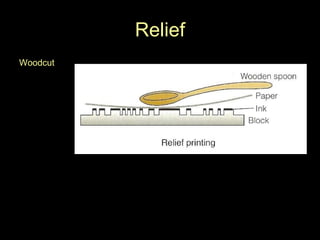
Relief Woodcut
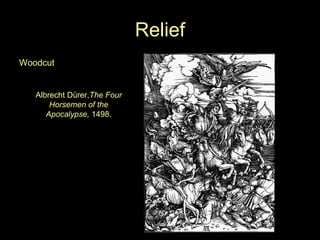
Relief Woodcut Albrecht D ürer, The Four Horsemen of the Apocalypse,  1498.
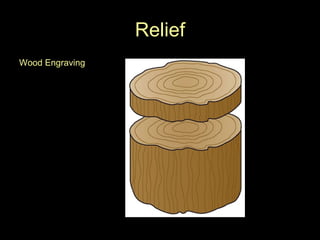
Relief Wood Engraving
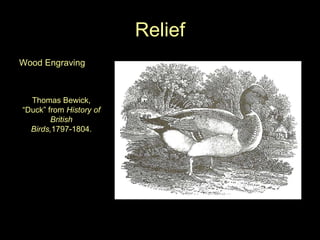
Relief Wood Engraving Thomas Bewick,   “Duck” from  History of British Birds, 1797-1804.
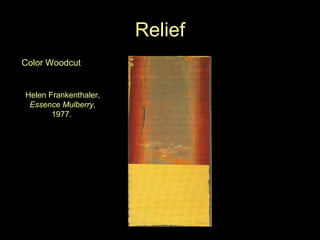
Relief Color Woodcut Helen Frankenthaler,  Essence Mulberry,  1977.
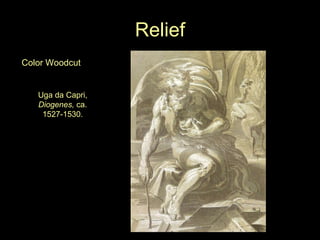
Relief Color Woodcut Uga da Capri,  Diogenes,  ca. 1527-1530.
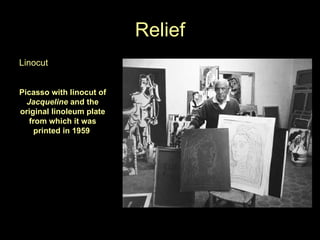
Relief Linocut Picasso with linocut of  Jacqueline  and the original linoleum plate from which it was printed in 1959
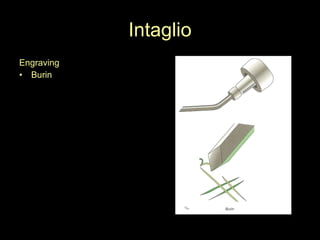
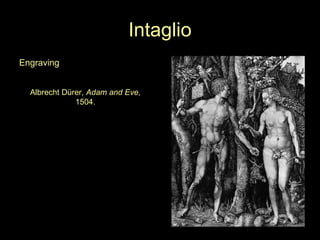
Intaglio Engraving Burin
Intaglio Engraving Albrecht Dürer,  Adam and Eve,  1504.
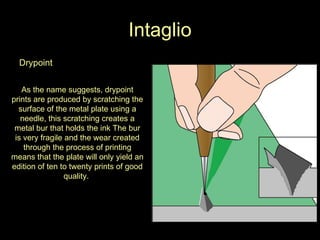
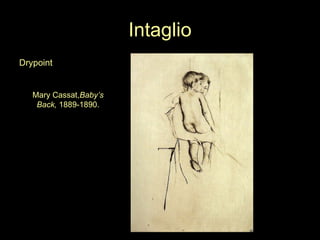
Intaglio Drypoint As the name suggests, drypoint prints are produced by scratching the surface of the metal plate using a needle, this scratching creates a metal bur that holds the ink The bur is very fragile and the wear created through the process of printing means that the plate will only yield an edition of ten to twenty prints of good quality.
Intaglio Drypoint Mary Cassat, Baby’s Back,  1889-1890.
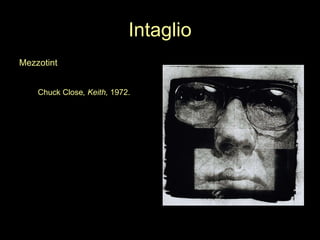
Intaglio Mezzotint Chuck Close , Keith,  1972.
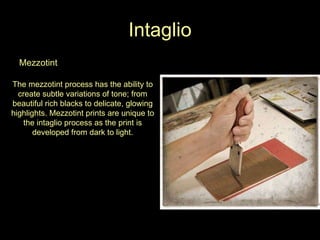
Intaglio Mezzotint The mezzotint process has the ability to create subtle variations of tone; from beautiful rich blacks to delicate, glowing highlights. Mezzotint prints are unique to the intaglio process as the print is developed from dark to light.
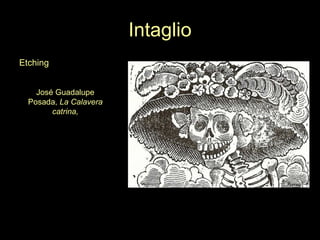
Intaglio Etching Jos é Guadalupe Posada,  La Calavera catrina,
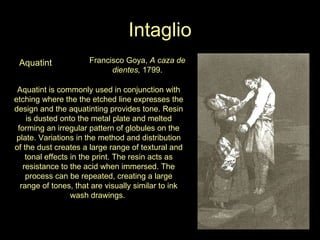
Intaglio Aquatint Francisco Goya,  A caza de dientes,  1799. Aquatint is commonly used in conjunction with etching where the the etched line expresses the design and the aquatinting provides tone. Resin is dusted onto the metal plate and melted forming an irregular pattern of globules on the plate. Variations in the method and distribution of the dust creates a large range of textural and tonal effects in the print. The resin acts as resistance to the acid when immersed. The process can be repeated, creating a large range of tones, that are visually similar to ink wash drawings.
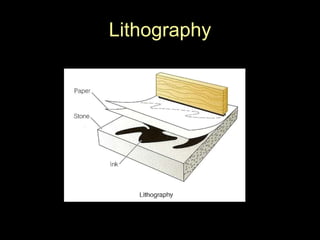
Lithography
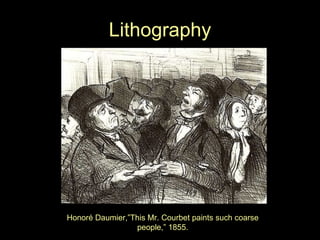
Lithography Honor é Daumier,”This Mr. Courbet paints such coarse people,” 1855.
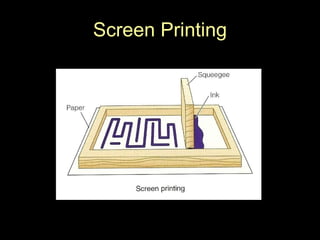
Screen Printing
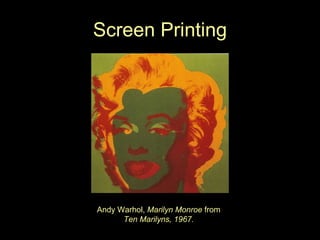
Screen Printing Andy Warhol,  Marilyn Monroe  from  Ten Marilyns, 1967.

Drawing, Painting and Printmaking

  • 1.
    Drawing Everybody draws. There can scarcely be a person above the age of two who has never made a drawing. Two qualities often associated with drawing are familiarity and intimacy. Drawing is familiar in that it uses the materials we are accustomed to – the pencil, the pen, the stick of chalk. Drawing seems intimate because it is frequently the artist’s note-taking. We think of drawings as direct expression, from brain to hand.
  • 2.
    Materials for DrawingDry Media Pencil Metalpoint Charcoal Chalk and Crayon Wet Media Pen and Ink Brush and Ink Supports Parchment Vellum Paper Other
  • 3.
    Dry Media SilverpointUses a ground of bone or chalk mixed with gum , water and pigment . Drag a silver tipped instrument over the surface and the partials stick to the ground. Tom make a area darker you have to use cross hatching. Very delicate in appearance .
  • 4.
    Silverpoint Figure 5.3,p.108: ALPHONSE LEGROS. Head of a Man (19th century). Silverpoint on white ground.
  • 5.
    Leonardo da Vinci-Silverpoint
  • 6.
    Dry Media continued…Pencil Most traditional media Replaced silverpoint Capable of creating a wide range of effects. History: Came into use in the 1500s Mass produced pencils invented in late eighteenth century. Uses a thin rod of graphite encased in wood or paper. The graphite is ground to dust, mixed with clay and baked. The more clay, the harder the pencil.
  • 7.
    Pencil Figure 5.6,p.109: ADRIAN PIPER. Self-Portrait Exaggerating My Negroid Features (1981). Pencil on paper. 10 ” x 8 ” .
  • 8.
  • 9.
    Charcoal Also hasa long history Used by prehistoric man on cave walls! Charcoal is burnt pieces of wood or bone. Now charcoal is made from controlled charring o special hardwoods. Ranges from hard to soft. Can be smudged or rubbed. Needs to be fixed with varnish, or can be rubbed off. Will show the surface of the paper.
  • 10.
    Charcoal Figure 5.7,p.110: KATHE KOLLWITZ. Self-Portrait (1924). Charcoal. 18 1/2 x 25 in.
  • 11.
  • 12.
    Chalk and PastelChalk and pastel are very similar to charcoal. The compositions of the media differ. Made or ground chalk mixed with powered pigments and a binder. Relatively young, only introduced to France in the 1400s. Comes in many colors Ocher - dark yellow that comes from iron oxide in some clays. Umber - yellowish or reddish brown color that comes from earth containing oxides or manganese and iron. Sanguine - a “earthy” red color
  • 13.
    Figure 5.9, p.111: MICHELANGELO. Studies for The Libyan Sybil (1510–1511). Red chalk. 11 3⁄8 ” x 8 3⁄8 ” . Chalk and Pastel
  • 14.
    Figure 5.11, p.112: EDGAR DEGAS. Woman at Her Toilette (1903). Pastel on paper. 30 ” x 30 1⁄2 ” .
  • 15.
  • 16.
    Pen and InkUsed since ancient times Earliest were s reeds Quills , plucked from live birds, were sue in the Middle Ages. Replaced in the nineteenth century with mass produced metal nib , which is slipped into a stylus .
  • 17.
    Pen and WashWash - diluted ink that is applied with brush. Often combined with fine clear lines of pure ink to provide tonal emphasis.
  • 18.
  • 19.
    Figure 5.18, p.115: GIOVANNI BATTISTA TIEPOLO. Hagar and Ishmael in the Wilderness (c. 1725–1735). Pen, brush and brown ink, and wash, over sketch in black chalk. 16 1⁄2 ” x 11 1⁄8 ” . Pen and Wash
  • 20.
  • 21.
    New Approachesto Drawing Drawing display endless versatility in: Purpose Media Technique So what is drawing?
  • 22.
    Fig. 5-25, p.119MARGARET HONDA. Exchange (2003-2004). Vinyl on Mylar. 50 Elements, Dimensions variable.
  • 23.
  • 24.
  • 25.
  • 26.
  • 27.
  • 28.
    Purposes of DrawingsPreliminary Study Leonardo da Vinci, Sketch for the Madonna of the Cat, ~1480, Pen and Brown Ink.
  • 29.
    Figure 5.1, p.106: REMBRANDT VAN RIJN. Copy of Leonardo da Vinci’s Last Supper. Red chalk on paper. 14 ” x 18 1⁄4 ” .
  • 30.
  • 31.
  • 32.
  • 33.
  • 34.
    Purposes of DrawingsDrawing as Final Work
  • 35.
  • 36.
    Painting Painting isthe queen of the arts. Ask ten people to form a quick mental image of “art,” nine of them are likely to visualize a painting on a wall. There are several reasons for the prominence of painting. For one thing, paintings are usually full of color which is an important visual stimuli. For another, paintings are often framed, some quite elaborately, so that one has the impression of a very special object.
  • 37.
    Types of PaintingFresco Encaustic Tempera Oil Acrylic Watercolor Spray Paint
  • 38.
    Fresco Fresco - the art of painting on plaster. Was popular in the Renaissance And was revived in Mexico after WWI. Buon fresco or true fresco - done on damp, lime plaster. Fresco secco - painting on dry plaster. Problems with fresco: Have to work fast, you can only paint what can be completed in one day. This can create visible seams. Some color don’t work well with lime. (like blue)
  • 39.
  • 40.
    Figure 6.1, p.122: GIOTTO. Lamentation (c. 1305). Fresco. 7 ’ 7 ” x 7 ’ 9 ” .
  • 41.
  • 42.
    Encaustic Encaustic - One of the earliest methods of applying color to a surface. Uses a pigment in a wax vehicle that has been heated to a liquid state. Very old Extremely durable Colors remain vibrant Surface will retain a hard luster Used by the Egyptians and the Romans
  • 43.
    Painting Media EncausticJasper Johns, Flag
  • 44.
    Figure 6.2, p.123: Mummy Portrait of a Man (Egypto-Roman, Faiyum, c. 160–179 CE). Encaustic on wood. 14 ” x 8 ” .
  • 45.
    Tempera Tempura - uses ground pigments mixed with vehicle of egg yolk or whole egg thinned with water Popular for centuries the tradition composition is rarely used today Used by the Greeks and Romans Use the exclusive painting medium of artists in the Middle Ages. Fell out of favor in the 1300’s with the introduction of oil painting.
  • 46.
    Advantages of Temperato Extremely durable Pure and brilliant colors Color did not become compromised by oxidation Consistency and fluidity allowed for precision Disadvantages : Dries quickly Hard to rework Can not provide subtle gradation of tone.
  • 47.
  • 48.
    Figure 6.5, p.125: FRANZ GERTSCH. Silvia (1998). Tempera on unprimed canvas. 9 ’ 6 1⁄4 ” x 9 ’ 2 1⁄4 ” .
  • 49.
  • 50.
    Oil Oil painting - consists of ground pigments combined with a linseed oil vehicle and a turpentine medium or thinner. The transition from tempera to oil was gradual. Naturally slow drying – can be speeded up with agents The first oils were on wood panels. Glazing - the application of multiple layers of transparent films of paint to a surface.
  • 51.
    Oil’s Advantages Colorscan be blended easily. Slow drying lets you rework problem areas. Can creates nice delicate colors. The eventual use of canvas as a ground allowed paintings to get much bigger.
  • 52.
  • 53.
    Figure 6.6, p.126: FOLLOWER OF REMBRANDT VAN RIJN. Head of St. Matthew (c. 1661). Oil on wood. 9 7⁄8 ” x 7 3⁄4 ” .
  • 54.
  • 55.
  • 56.
    Watercolor Watercolor - originally defined as any painting medium that employs water as a solvent. Today refers to a specific technique really called aquarelle . Aquarelle - Transparent films of paint are applied to a white absorbent surface. Egyptian artist used a form of watercolor painting. Also used in the Middle Ages Gouache - watercolor mixed with a high concentration of vehicle and opaque ingredients such as chalk primarily used during the Byzantine and Romanesque eras of Christian art.
  • 57.
    Advantages and Disadvantagesof Watercolor White does not exist. White is created by letting the paper shine through. The artist must plan ahead. Corrections are not possible. Portable Great for sketches and impressions. Or can be a used as a final piece.
  • 58.
    Figure 6.13, p.131: RALPH GOINGS. Rock Ola (1992). Watercolor on paper. 14 ” x 20 3⁄4 ” . Nolde and the transparencies of tinted washes in his watercolors
  • 59.
    Acrylic Acrylic -is a mixture of pigment and a plastic vehicle that can be thinned with water. Advantages of acrylic paint over oil paint: “ No mess” Can be used on a variety of surface Surfaces don’t need special preparation.
  • 60.
  • 61.
    Figure 6.11, p.129: ROGER SHIMOMURA. Untitled (1984). Acrylic on canvas. 60 ” x 72 ” .
  • 62.
    Spray Paint Isspray painting like prehistoric cave painting? It raises similar questions: Why do they do it? Is it art? Is it urban ritual? Will is speak in history to the trails of inner-city living?
  • 63.
    Figure 6.15, p.132: CRASH (JOHN MATOS). Arcadia Revisited (1988). Spray paint on canvas. 96 1⁄4 ” x 68 ” .
  • 64.
    Mixed Media Collage or papiers colles - Picasso and Braque were the first to incorporate pieces of newsprint, wallpaper, labels from wine bottles, and oilcloth into their paintings. Miriam Schapiro create what she calls “femmage” with is a version of collage using feminine imagery and materials
  • 65.
    Painting Media MixedMedia Robert Rauschenberg
  • 66.
    Figure 6.16, p.133: HOWARDENA PINDELL. Autobiography: Water / Ancestors, Middle Passage / Family Ghosts (1988). Acrylic, tempera, cattle markers, oil stick, paper, polymer photo-transfer, and vinyl tape on sewn canvas. 118 ” x 71 ” .
  • 67.
    Figure 6.17, p.133: MIRIAM SCHAPIRO. Maid of Honour (1984). Acrylic and fabric on canvas. 60 ” x 50 ” .
  • 68.
  • 69.
    If you haveever received a a handmade greeting card for Christmas or for your birthday or as an invitation to a party, then you will appreciate the difference between an art print and a mass-produced reproduction. Commercial greeting cards are cranked out by the thousands, even the millions, by the major card manufacturers. A homemade card has a more personal touch. The design is unique- a personal expression of the individual who created it. Also, each card will be slightly different due to the human touch which we find missing from commercial products.
  • 70.
    Monotype Edgar Degas, Female Torso, ca. 1885.
  • 71.
  • 72.
    Relief Woodcut AlbrechtD ürer, The Four Horsemen of the Apocalypse, 1498.
  • 73.
  • 74.
    Relief Wood EngravingThomas Bewick, “Duck” from History of British Birds, 1797-1804.
  • 75.
    Relief Color WoodcutHelen Frankenthaler, Essence Mulberry, 1977.
  • 76.
    Relief Color WoodcutUga da Capri, Diogenes, ca. 1527-1530.
  • 77.
    Relief Linocut Picassowith linocut of Jacqueline and the original linoleum plate from which it was printed in 1959
  • 78.
  • 79.
    Intaglio Engraving AlbrechtDürer, Adam and Eve, 1504.
  • 80.
    Intaglio Drypoint Asthe name suggests, drypoint prints are produced by scratching the surface of the metal plate using a needle, this scratching creates a metal bur that holds the ink The bur is very fragile and the wear created through the process of printing means that the plate will only yield an edition of ten to twenty prints of good quality.
  • 81.
    Intaglio Drypoint MaryCassat, Baby’s Back, 1889-1890.
  • 82.
    Intaglio Mezzotint ChuckClose , Keith, 1972.
  • 83.
    Intaglio Mezzotint Themezzotint process has the ability to create subtle variations of tone; from beautiful rich blacks to delicate, glowing highlights. Mezzotint prints are unique to the intaglio process as the print is developed from dark to light.
  • 84.
    Intaglio Etching José Guadalupe Posada, La Calavera catrina,
  • 85.
    Intaglio Aquatint FranciscoGoya, A caza de dientes, 1799. Aquatint is commonly used in conjunction with etching where the the etched line expresses the design and the aquatinting provides tone. Resin is dusted onto the metal plate and melted forming an irregular pattern of globules on the plate. Variations in the method and distribution of the dust creates a large range of textural and tonal effects in the print. The resin acts as resistance to the acid when immersed. The process can be repeated, creating a large range of tones, that are visually similar to ink wash drawings.
  • 86.
  • 87.
    Lithography Honor éDaumier,”This Mr. Courbet paints such coarse people,” 1855.
  • 88.
  • 89.
    Screen Printing AndyWarhol, Marilyn Monroe from Ten Marilyns, 1967.