Portfolio Project: Musical Response
 Pick a song that has a strong mood.
 While you listen to it, you will respond to it by drawing. In
your sketchbook, create 3 practise responses.
Somehow you must incorporate your first and last
name into your design.
 Focus on the different rhythms, tonal changes, pitch,
harmony, and complexity.
Portfolio Project: Musical Response
 You will pick your best response from your sketchbook,
and transfer it onto your Portfolio. You may use
coloured pencils, markers, and oil pastels.
 You will be marked on these categories:
 Creativity – unique images, no copying (10 pts)
 Complexity/ Detail – layers (background), blended
colours, fill the space (10 pts)
 Neatness – no accidental smudges, tears or wrinkles
(10 pts)
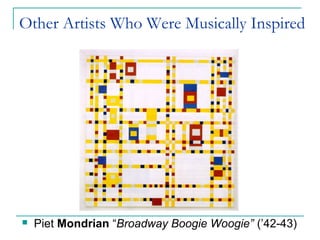
Other Artists Who Were Musically Inspired
 Piet Mondrian “Broadway Boogie Woogie” (’42-43)
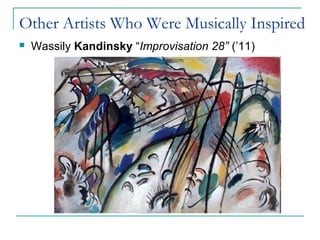
Other Artists Who Were Musically Inspired
 Wassily Kandinsky “Improvisation 28” (’11)
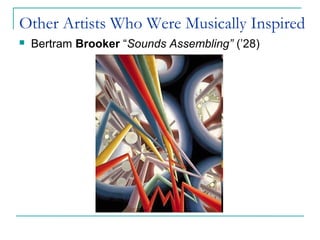
Other Artists Who Were Musically Inspired
 Bertram Brooker “Sounds Assembling” (’28)
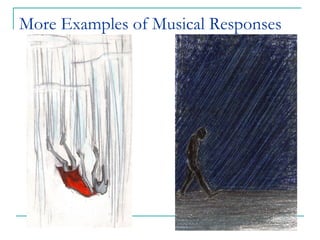
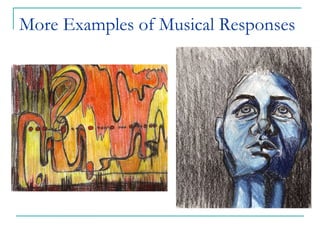
More Examples of Musical Responses
Artist’s Statement: Musical Response
1)Describe the mood of the song you responded to.
Be sure to discuss how certain instruments and
melodies contributed to the mood.
1)Explain how you came up with your design. Why did
you pick certain colours and shapes?
1)Do you think your design is successful overall?
Explain.
Your Inspirations
 No artist works alone.
 Use your sketchbook to record the artists
who inspire you.
 Cut out pictures, jot down ideas and quotes,
doodle!
Still Life Project
 You will experiment with 3 types of drawing to build up your
confidence.
 You will create a still life, incorporating at least 3 different
objects.
 After practise using calligraphy pens, you will create value
using ink!
 GOALS:
 To create chiaroscuro (extreme contrast between light and
dark)
 To make objects look 3D
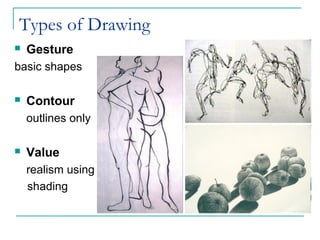
Types of Drawing
 Gesture
basic shapes
 Contour
outlines only
 Value
realism using
shading
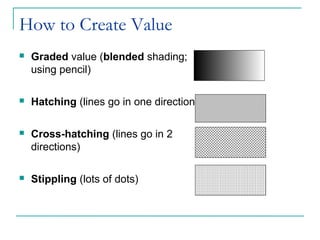
How to Create Value
 Graded value (blended shading;
using pencil)
 Hatching (lines go in one direction)
 Cross-hatching (lines go in 2
directions)
 Stippling (lots of dots)
Using India ink
 It stains! Be careful!
Clean all spills immediately!
 Demonstrations:
hatching / cross-hatching all applicable to
stippling watercolours also
masking
Practise drawing and shading basic objects with pen &
ink.
Artist’s Statement: Still Life
1)Why did you choose to draw these objects?
1)How successful were you in portraying the
still life realistically? Explain how certain
areas could have been better.
1)Explain what you enjoyed or didn't enjoy in
this project? Explain what you found difficult.
Architecture
 Compare the following
pairs of architectural
structures in the T-charts
provided on your note.
 Consider the following:
structure, scale, materials,
interior space,
decoration (colour), rhythm,
distinctive elements (unique
pieces)
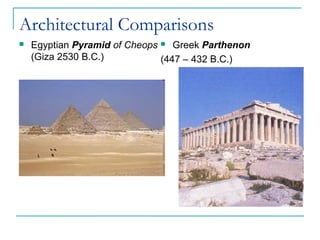
Architectural Comparisons
 Egyptian Pyramid of Cheops
(Giza 2530 B.C.)
 Greek Parthenon
(447 – 432 B.C.)
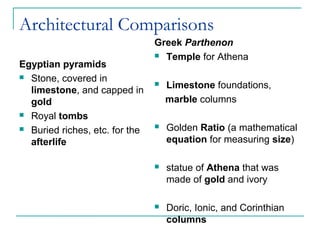
Architectural Comparisons
Egyptian pyramids
 Stone, covered in
limestone, and capped in
gold
 Royal tombs
 Buried riches, etc. for the
afterlife
Greek Parthenon
 Temple for Athena
 Limestone foundations,
marble columns
 Golden Ratio (a mathematical
equation for measuring size)
 statue of Athena that was
made of gold and ivory
 Doric, Ionic, and Corinthian
columns
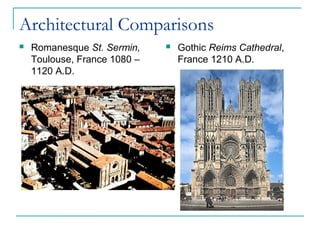
Architectural Comparisons
 Romanesque St. Sermin,
Toulouse, France 1080 –
1120 A.D.
 Gothic Reims Cathedral,
France 1210 A.D.
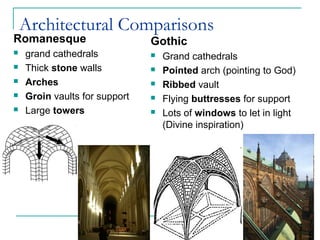
Architectural Comparisons
Romanesque
 grand cathedrals
 Thick stone walls
 Arches
 Groin vaults for support
 Large towers
Gothic
 Grand cathedrals
 Pointed arch (pointing to God)
 Ribbed vault
 Flying buttresses for support
 Lots of windows to let in light
(Divine inspiration)
Architectural Comparisons
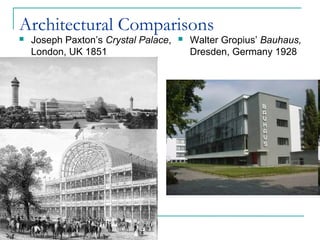
 Joseph Paxton’s Crystal Palace,
London, UK 1851
 Walter Gropius’ Bauhaus,
Dresden, Germany 1928
Architectural Comparisons
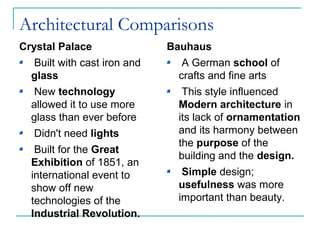
Crystal Palace
Built with cast iron and
glass
New technology
allowed it to use more
glass than ever before
Didn't need lights
Built for the Great
Exhibition of 1851, an
international event to
show off new
technologies of the
Industrial Revolution.
Bauhaus
A German school of
crafts and fine arts
This style influenced
Modern architecture in
its lack of ornamentation
and its harmony between
the purpose of the
building and the design.
Simple design;
usefulness was more
important than beauty.
Architectural Comparisons
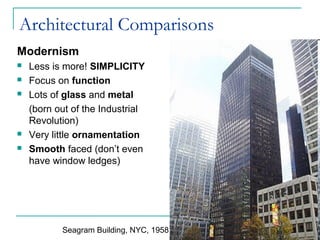
Modernism
 Less is more! SIMPLICITY
 Focus on function
 Lots of glass and metal
(born out of the Industrial
Revolution)
 Very little ornamentation
 Smooth faced (don’t even
have window ledges)
Seagram Building, NYC, 1958
Architectural Comparisons
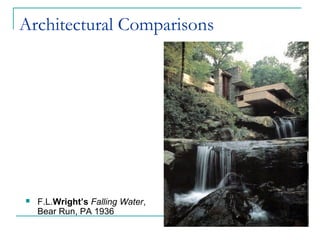
 F.L.Wright’s Falling Water,
Bear Run, PA 1936
Architectural Comparisons
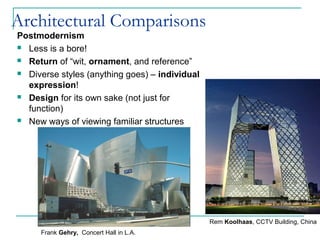
Postmodernism
 Less is a bore!
 Return of “wit, ornament, and reference”
 Diverse styles (anything goes) – individual
expression!
 Design for its own sake (not just for
function)
 New ways of viewing familiar structures
Frank Gehry, Concert Hall in L.A.
Rem Koolhaas, CCTV Building, China
Architectural Design
 Design your own building for whatever
purpose you want. (Keep it appropriate)
 Incorporate 2 characteristics from the
architectural periods that we’ve studied.
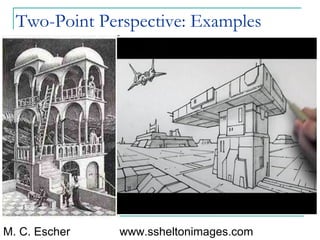
 Draw your building using 2 - Point
Perspective.
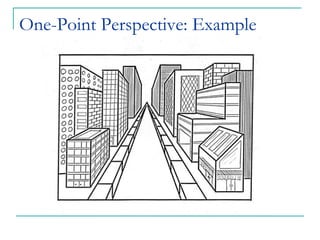
One-Point Perspective
 Creates the illusion of deep space.
 The illusion is created by using a vanishing
point & guidelines.
 Either lines are vertical or they connect to
your vanishing point.
One-Point Perspective: Example
Two-Point Perspective
 Creates the illusion of deep space that starts at a
corner.
 The illusion is created by using two vanishing
points & guidelines.
 Either lines are vertical or they connect to one of
your vanishing points.
 Demo (lines on the right side  right v.p.
lines on the left side  left v.p.)
Two-Point Perspective: Examples
M. C. Escher www.ssheltonimages.com

Gr 10 u1 drawing

  • 1.
    Portfolio Project: MusicalResponse  Pick a song that has a strong mood.  While you listen to it, you will respond to it by drawing. In your sketchbook, create 3 practise responses. Somehow you must incorporate your first and last name into your design.  Focus on the different rhythms, tonal changes, pitch, harmony, and complexity.
  • 2.
    Portfolio Project: MusicalResponse  You will pick your best response from your sketchbook, and transfer it onto your Portfolio. You may use coloured pencils, markers, and oil pastels.  You will be marked on these categories:  Creativity – unique images, no copying (10 pts)  Complexity/ Detail – layers (background), blended colours, fill the space (10 pts)  Neatness – no accidental smudges, tears or wrinkles (10 pts)
  • 3.
    Other Artists WhoWere Musically Inspired  Piet Mondrian “Broadway Boogie Woogie” (’42-43)
  • 4.
    Other Artists WhoWere Musically Inspired  Wassily Kandinsky “Improvisation 28” (’11)
  • 5.
    Other Artists WhoWere Musically Inspired  Bertram Brooker “Sounds Assembling” (’28)
  • 6.
    More Examples ofMusical Responses
  • 7.
    More Examples ofMusical Responses
  • 8.
    Artist’s Statement: MusicalResponse 1)Describe the mood of the song you responded to. Be sure to discuss how certain instruments and melodies contributed to the mood. 1)Explain how you came up with your design. Why did you pick certain colours and shapes? 1)Do you think your design is successful overall? Explain.
  • 9.
    Your Inspirations  Noartist works alone.  Use your sketchbook to record the artists who inspire you.  Cut out pictures, jot down ideas and quotes, doodle!
  • 10.
    Still Life Project You will experiment with 3 types of drawing to build up your confidence.  You will create a still life, incorporating at least 3 different objects.  After practise using calligraphy pens, you will create value using ink!  GOALS:  To create chiaroscuro (extreme contrast between light and dark)  To make objects look 3D
  • 11.
    Types of Drawing Gesture basic shapes  Contour outlines only  Value realism using shading
  • 12.
    How to CreateValue  Graded value (blended shading; using pencil)  Hatching (lines go in one direction)  Cross-hatching (lines go in 2 directions)  Stippling (lots of dots)
  • 13.
    Using India ink It stains! Be careful! Clean all spills immediately!  Demonstrations: hatching / cross-hatching all applicable to stippling watercolours also masking Practise drawing and shading basic objects with pen & ink.
  • 14.
    Artist’s Statement: StillLife 1)Why did you choose to draw these objects? 1)How successful were you in portraying the still life realistically? Explain how certain areas could have been better. 1)Explain what you enjoyed or didn't enjoy in this project? Explain what you found difficult.
  • 15.
    Architecture  Compare thefollowing pairs of architectural structures in the T-charts provided on your note.  Consider the following: structure, scale, materials, interior space, decoration (colour), rhythm, distinctive elements (unique pieces) Architectural Comparisons
  • 16.
    Architectural Comparisons  EgyptianPyramid of Cheops (Giza 2530 B.C.)  Greek Parthenon (447 – 432 B.C.)
  • 17.
    Architectural Comparisons Egyptian pyramids Stone, covered in limestone, and capped in gold  Royal tombs  Buried riches, etc. for the afterlife Greek Parthenon  Temple for Athena  Limestone foundations, marble columns  Golden Ratio (a mathematical equation for measuring size)  statue of Athena that was made of gold and ivory  Doric, Ionic, and Corinthian columns
  • 18.
    Architectural Comparisons  RomanesqueSt. Sermin, Toulouse, France 1080 – 1120 A.D.  Gothic Reims Cathedral, France 1210 A.D.
  • 19.
    Architectural Comparisons Romanesque  grandcathedrals  Thick stone walls  Arches  Groin vaults for support  Large towers Gothic  Grand cathedrals  Pointed arch (pointing to God)  Ribbed vault  Flying buttresses for support  Lots of windows to let in light (Divine inspiration)
  • 20.
    Architectural Comparisons  JosephPaxton’s Crystal Palace, London, UK 1851  Walter Gropius’ Bauhaus, Dresden, Germany 1928
  • 21.
    Architectural Comparisons Crystal Palace Builtwith cast iron and glass New technology allowed it to use more glass than ever before Didn't need lights Built for the Great Exhibition of 1851, an international event to show off new technologies of the Industrial Revolution. Bauhaus A German school of crafts and fine arts This style influenced Modern architecture in its lack of ornamentation and its harmony between the purpose of the building and the design. Simple design; usefulness was more important than beauty.
  • 22.
    Architectural Comparisons Modernism  Lessis more! SIMPLICITY  Focus on function  Lots of glass and metal (born out of the Industrial Revolution)  Very little ornamentation  Smooth faced (don’t even have window ledges) Seagram Building, NYC, 1958
  • 23.
    Architectural Comparisons  F.L.Wright’sFalling Water, Bear Run, PA 1936
  • 24.
    Architectural Comparisons Postmodernism  Lessis a bore!  Return of “wit, ornament, and reference”  Diverse styles (anything goes) – individual expression!  Design for its own sake (not just for function)  New ways of viewing familiar structures Frank Gehry, Concert Hall in L.A. Rem Koolhaas, CCTV Building, China
  • 25.
    Architectural Design  Designyour own building for whatever purpose you want. (Keep it appropriate)  Incorporate 2 characteristics from the architectural periods that we’ve studied.  Draw your building using 2 - Point Perspective.
  • 26.
    One-Point Perspective  Createsthe illusion of deep space.  The illusion is created by using a vanishing point & guidelines.  Either lines are vertical or they connect to your vanishing point.
  • 27.
  • 28.
    Two-Point Perspective  Createsthe illusion of deep space that starts at a corner.  The illusion is created by using two vanishing points & guidelines.  Either lines are vertical or they connect to one of your vanishing points.  Demo (lines on the right side  right v.p. lines on the left side  left v.p.)
  • 29.
    Two-Point Perspective: Examples M.C. Escher www.ssheltonimages.com