GCSE Art and Design: Graphic
Design and Communication
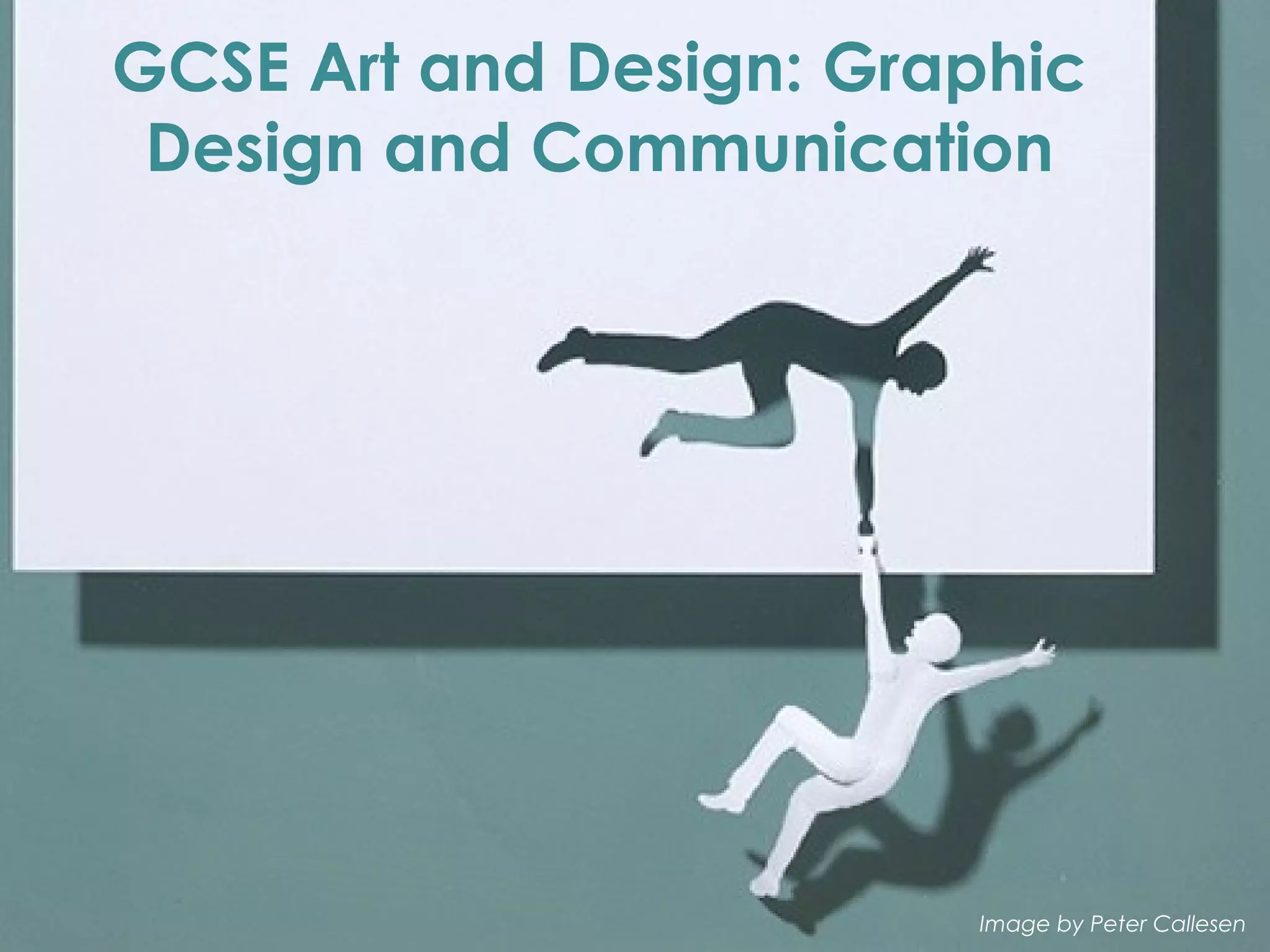
Image by Peter Callesen
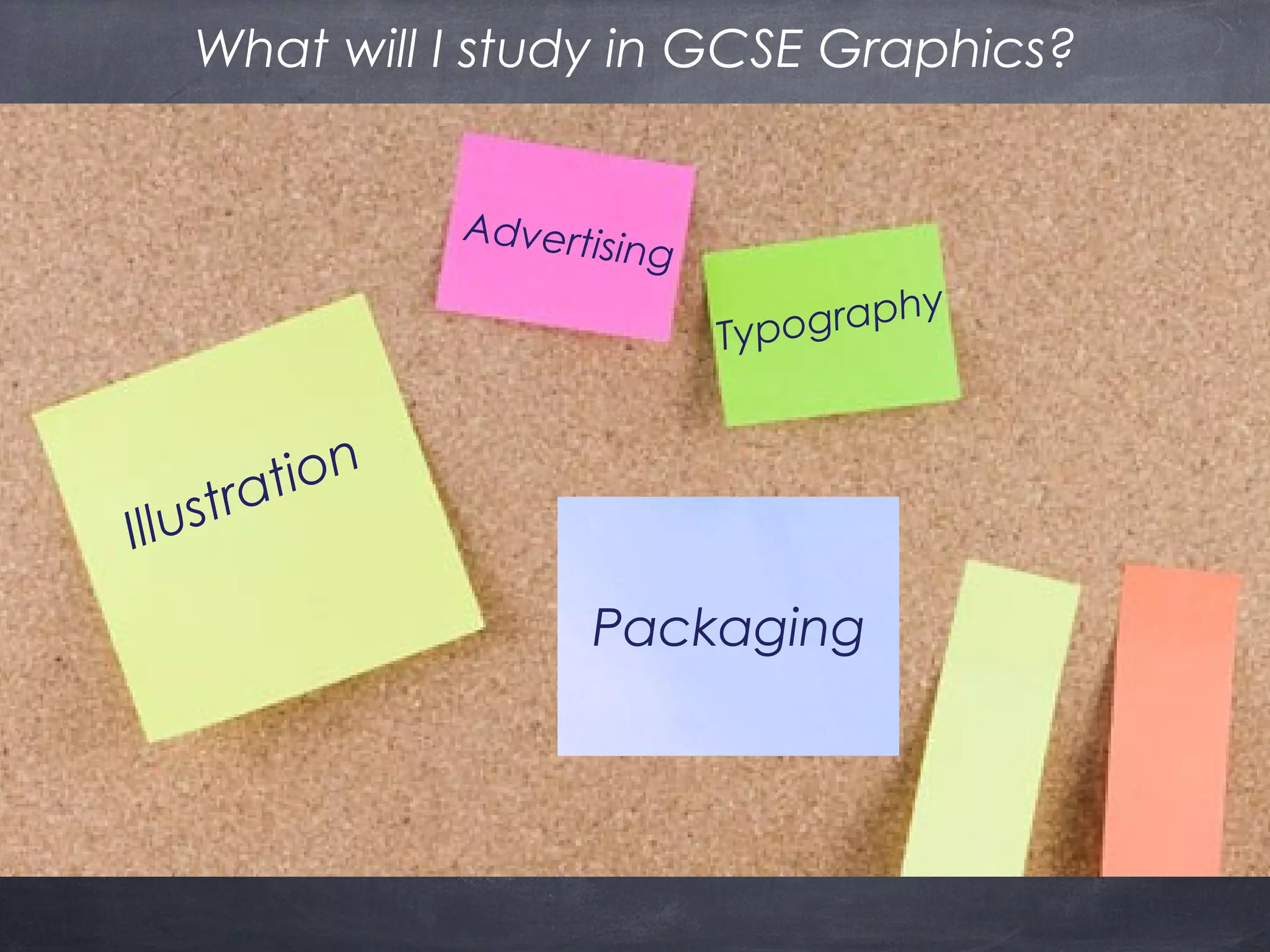
What will I study in GCSE Graphics?
Illustration
Typography
Advertising
Packaging
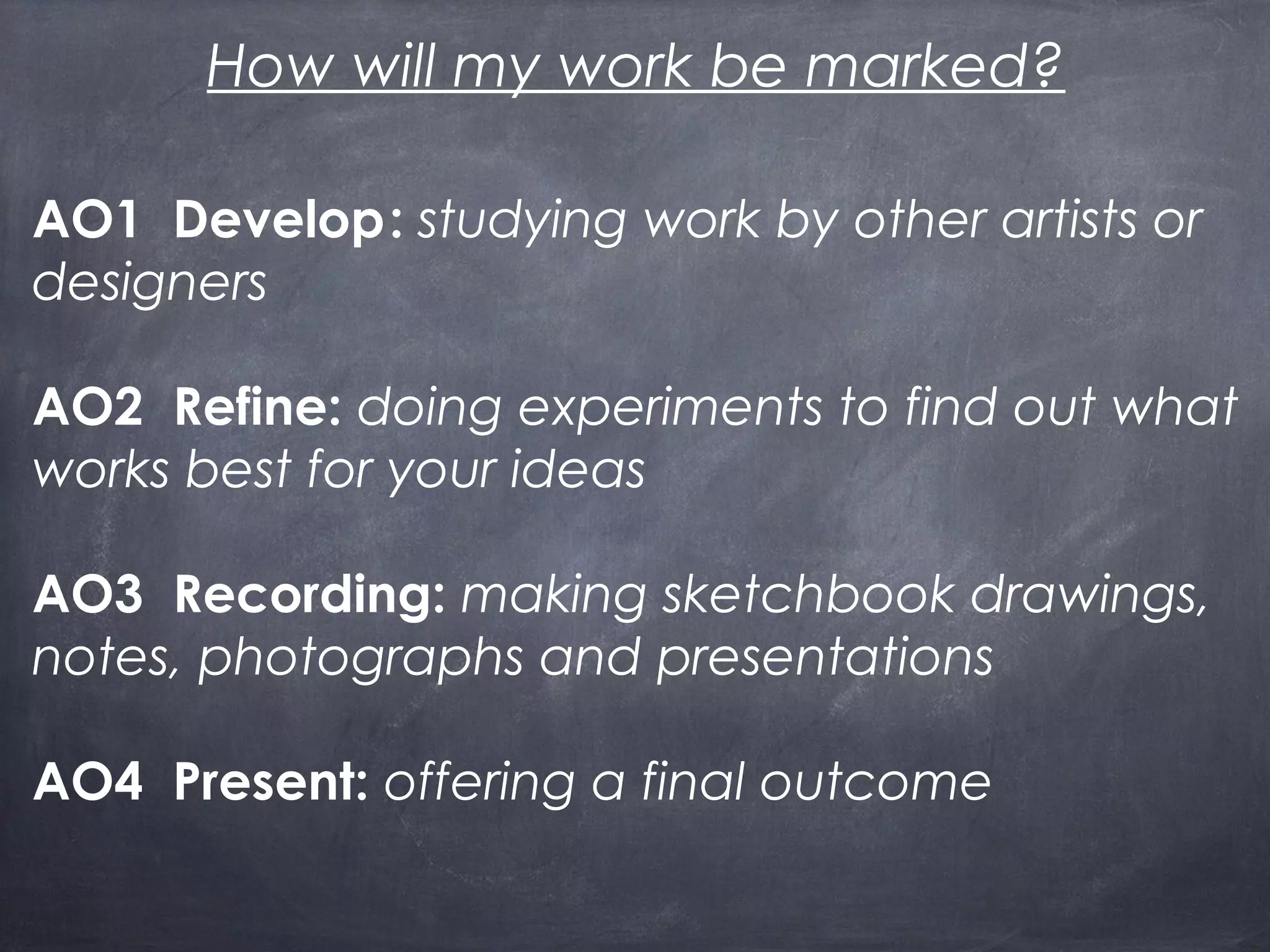
AO1  Develop: studying work by other artists or
designers
AO2  Refine: doing experiments to find out what
works best for your ideas
AO3  Recording: making sketchbook drawings,
notes, photographs and presentations
AO4  Present: offering a final outcome
How will my work be marked?
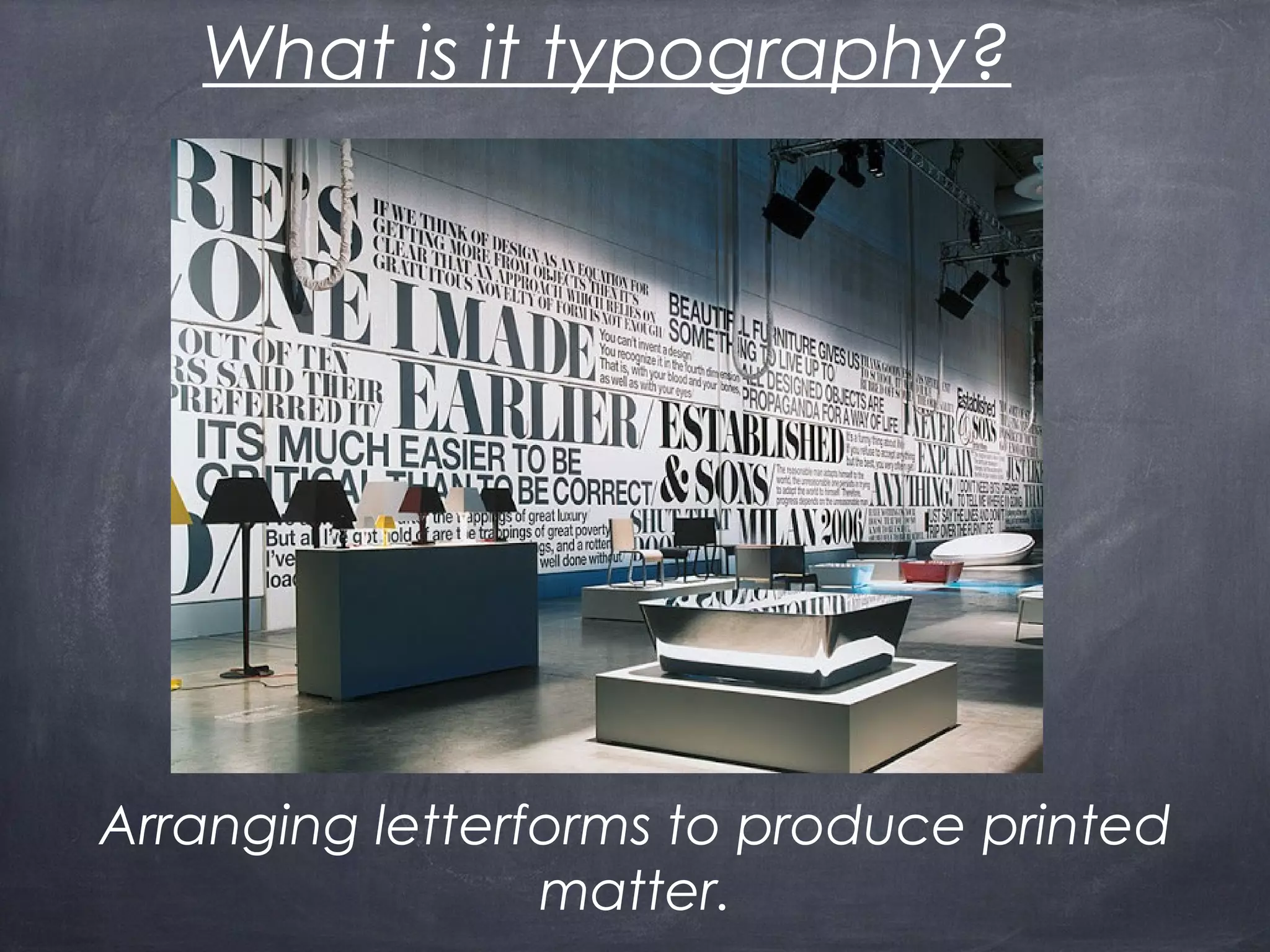
What is it typography?
Arranging letterforms to produce printed
matter.
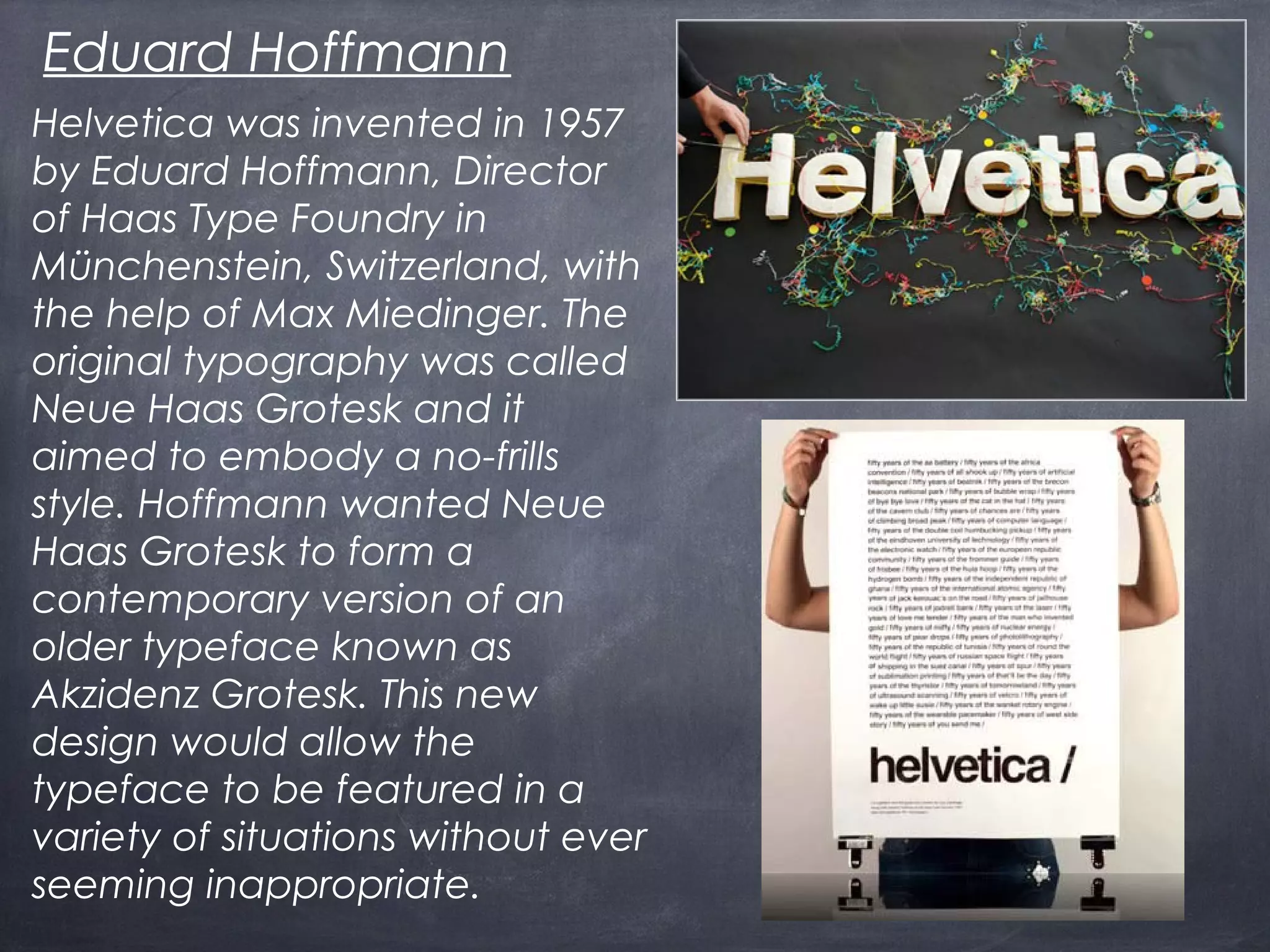
Helvetica was invented in 1957
by Eduard Hoffmann, Director
of Haas Type Foundry in
Münchenstein, Switzerland, with
the help of Max Miedinger. The
original typography was called
Neue Haas Grotesk and it
aimed to embody a no-frills
style. Hoffmann wanted Neue
Haas Grotesk to form a
contemporary version of an
older typeface known as
Akzidenz Grotesk. This new
design would allow the
typeface to be featured in a
variety of situations without ever
seeming inappropriate.
Eduard Hoffmann
Task 1
Grungvetica
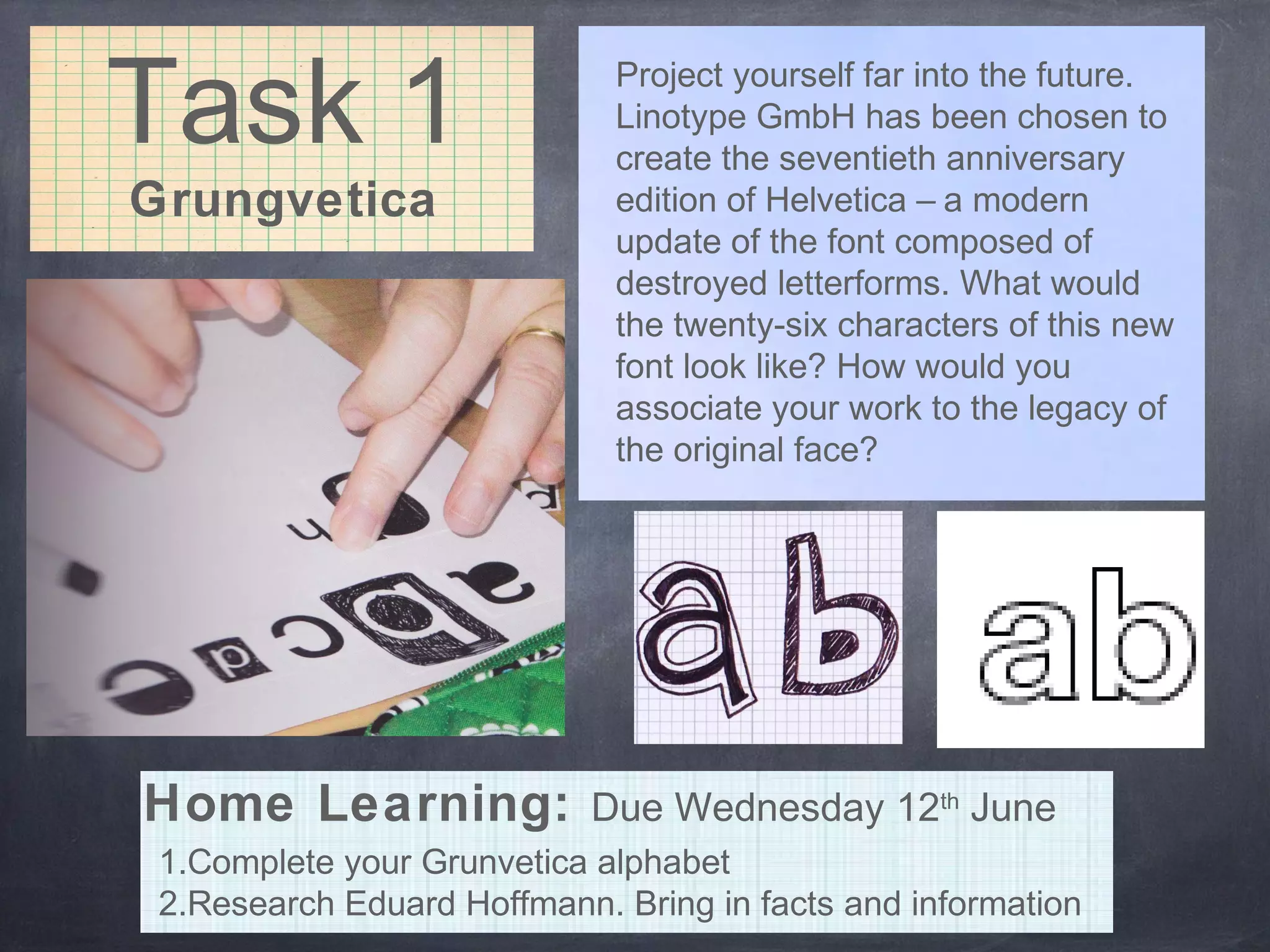
Project yourself far into the future.
Linotype GmbH has been chosen to
create the seventieth anniversary
edition of Helvetica – a modern
update of the font composed of
destroyed letterforms. What would
the twenty-six characters of this new
font look like? How would you
associate your work to the legacy of
the original face?
1.Complete your Grunvetica alphabet
2.Research Eduard Hoffmann. Bring in facts and information
Home Learning: Due Wednesday 12th
June
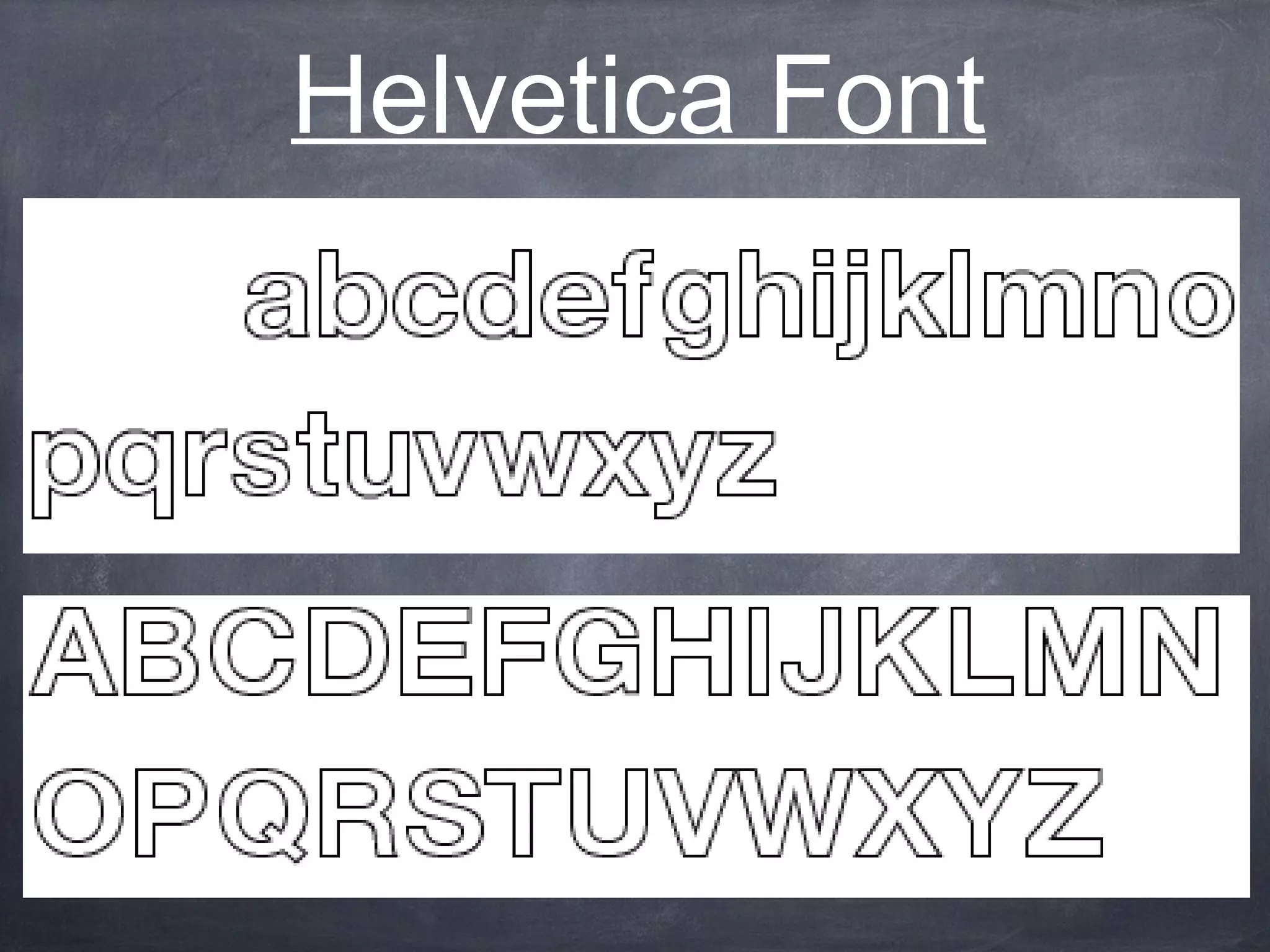
Helvetica Font
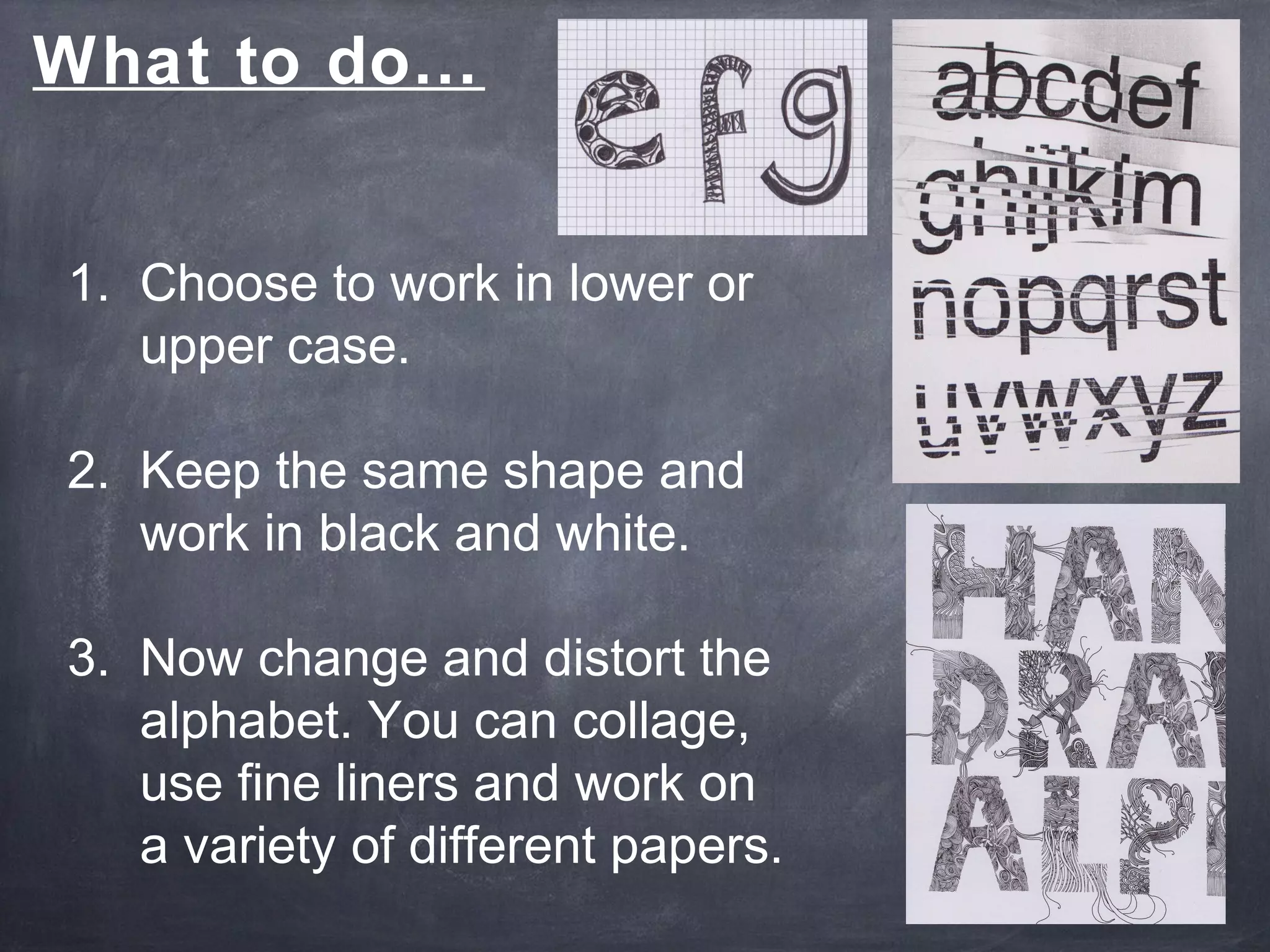
1. Choose to work in lower or
upper case.
2. Keep the same shape and
work in black and white.
3. Now change and distort the
alphabet. You can collage,
use fine liners and work on
a variety of different papers.
What to do…
Task 2
Artist Research
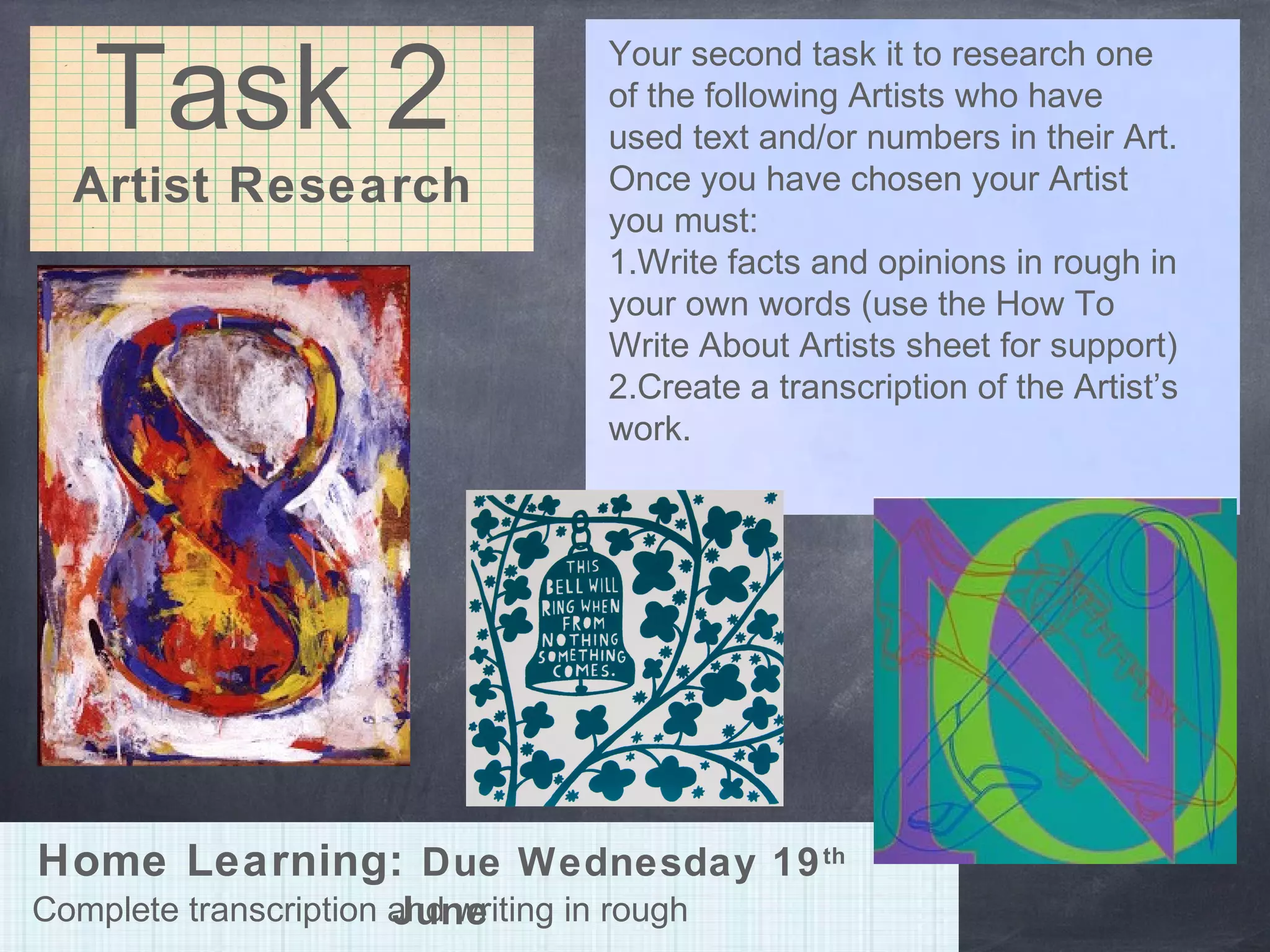
Your second task it to research one
of the following Artists who have
used text and/or numbers in their Art.
Once you have chosen your Artist
you must:
1.Write facts and opinions in rough in
your own words (use the How To
Write About Artists sheet for support)
2.Create a transcription of the Artist’s
work.
Complete transcription and writing in rough
Home Learning: Due Wednesday 19th
June
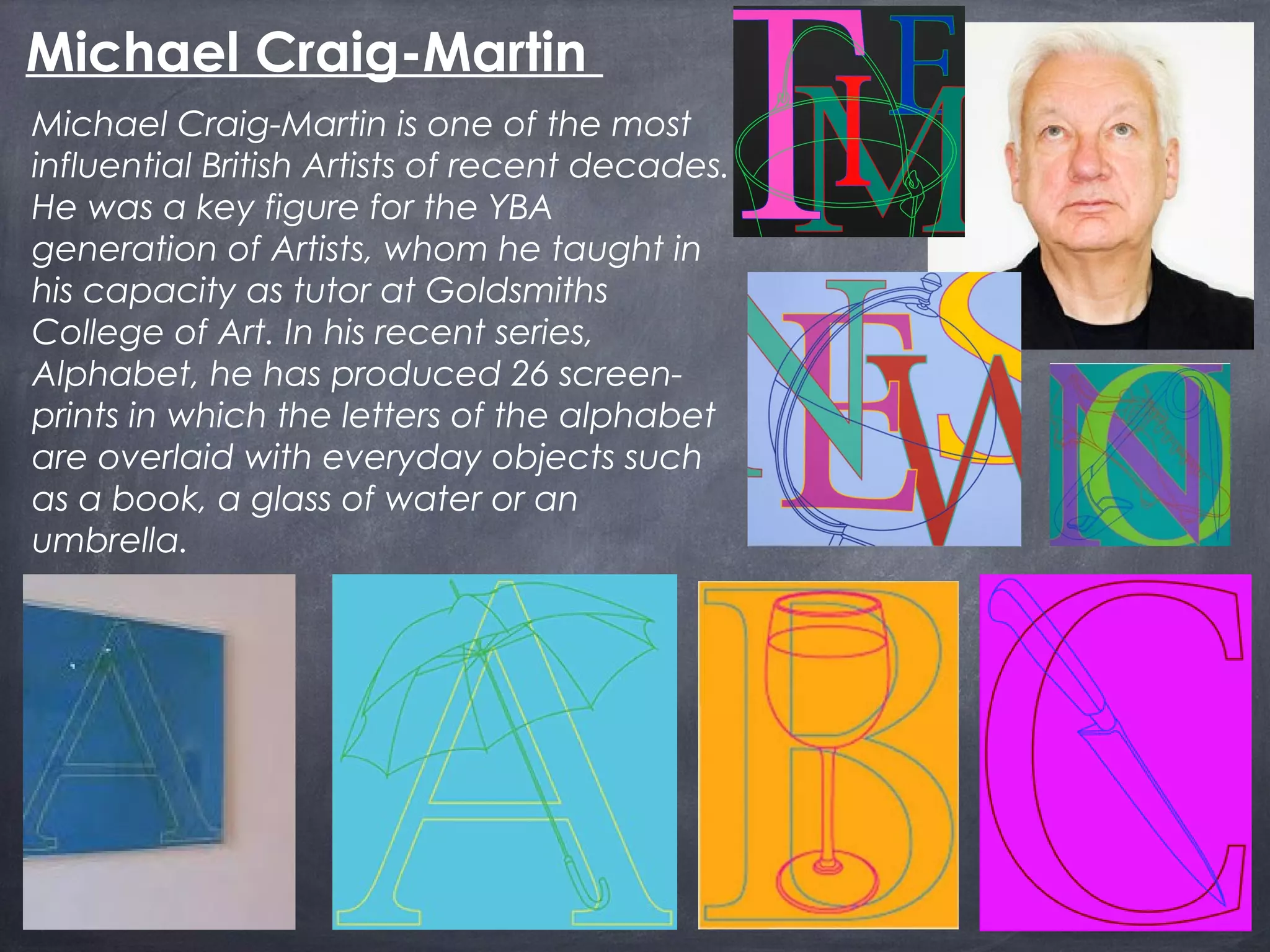
Michael Craig-Martin is one of the most
influential British Artists of recent decades.
He was a key figure for the YBA
generation of Artists, whom he taught in
his capacity as tutor at Goldsmiths
College of Art. In his recent series,
Alphabet, he has produced 26 screen-
prints in which the letters of the alphabet
are overlaid with everyday objects such
as a book, a glass of water or an
umbrella.
Michael Craig-Martin
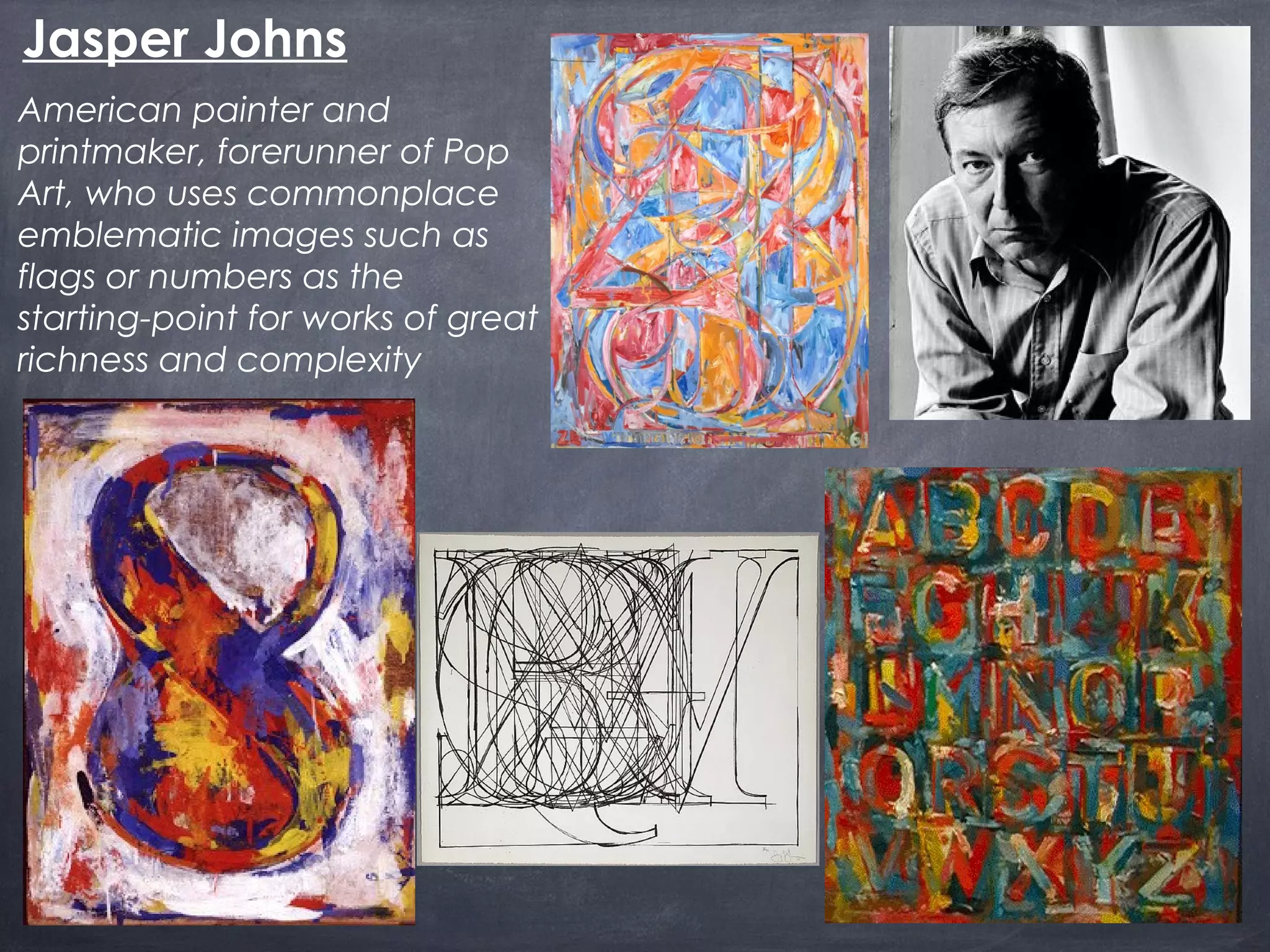
American painter and
printmaker, forerunner of Pop
Art, who uses commonplace
emblematic images such as
flags or numbers as the
starting-point for works of great
richness and complexity
Jasper Johns
Rob Ryan
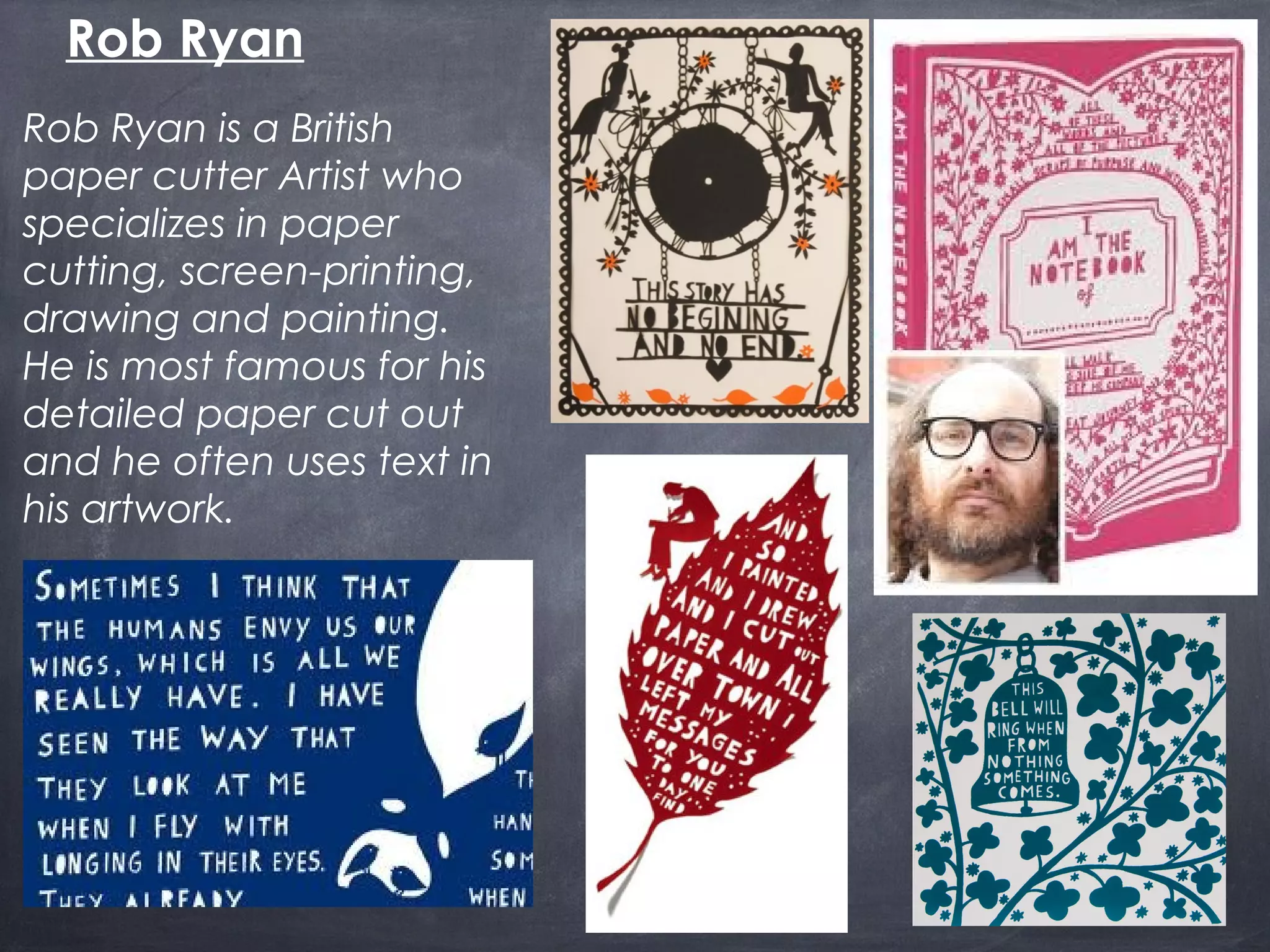
Rob Ryan is a British
paper cutter Artist who
specializes in paper
cutting, screen-printing,
drawing and painting.
He is most famous for his
detailed paper cut out
and he often uses text in
his artwork.
Task 3
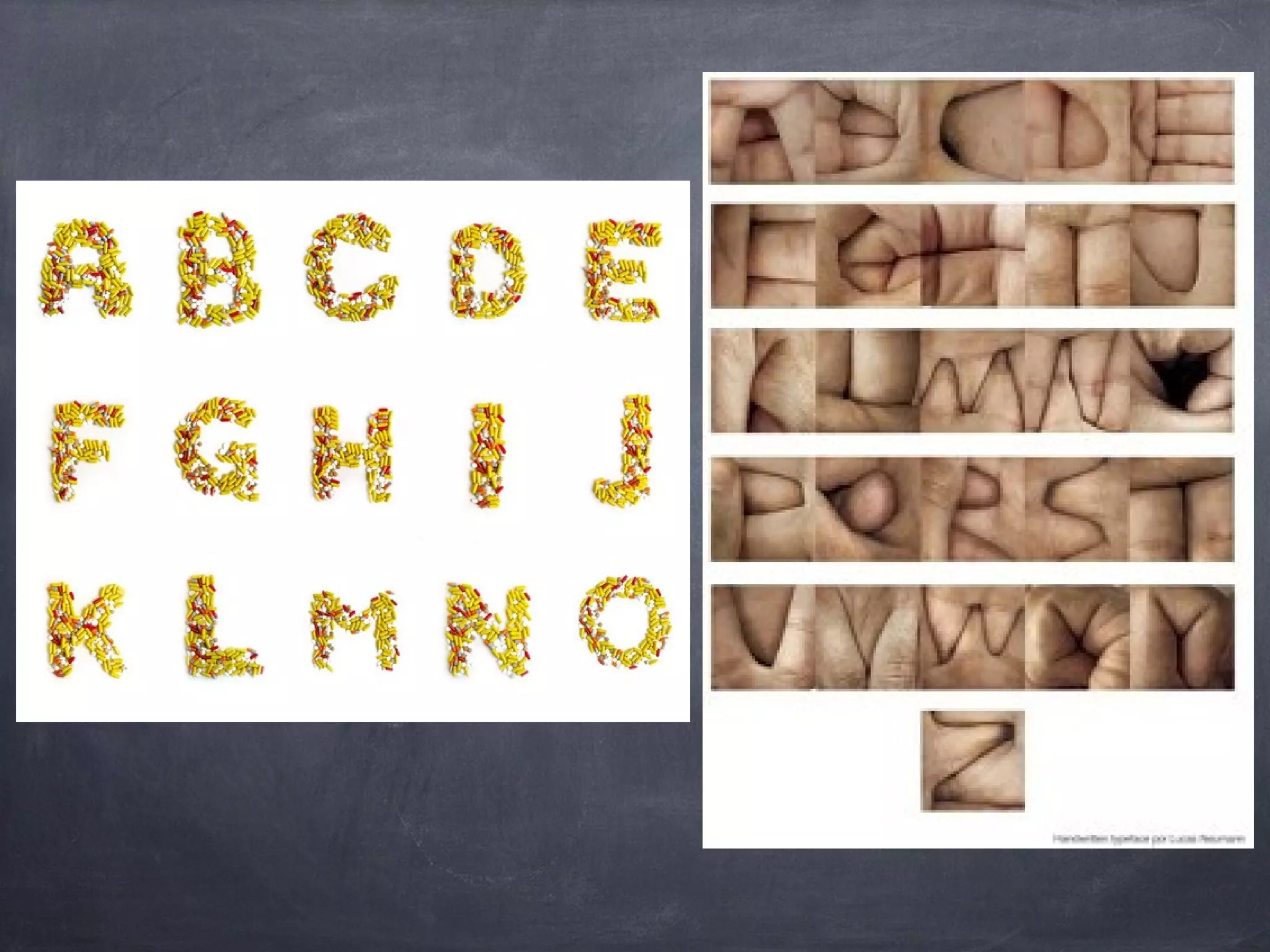
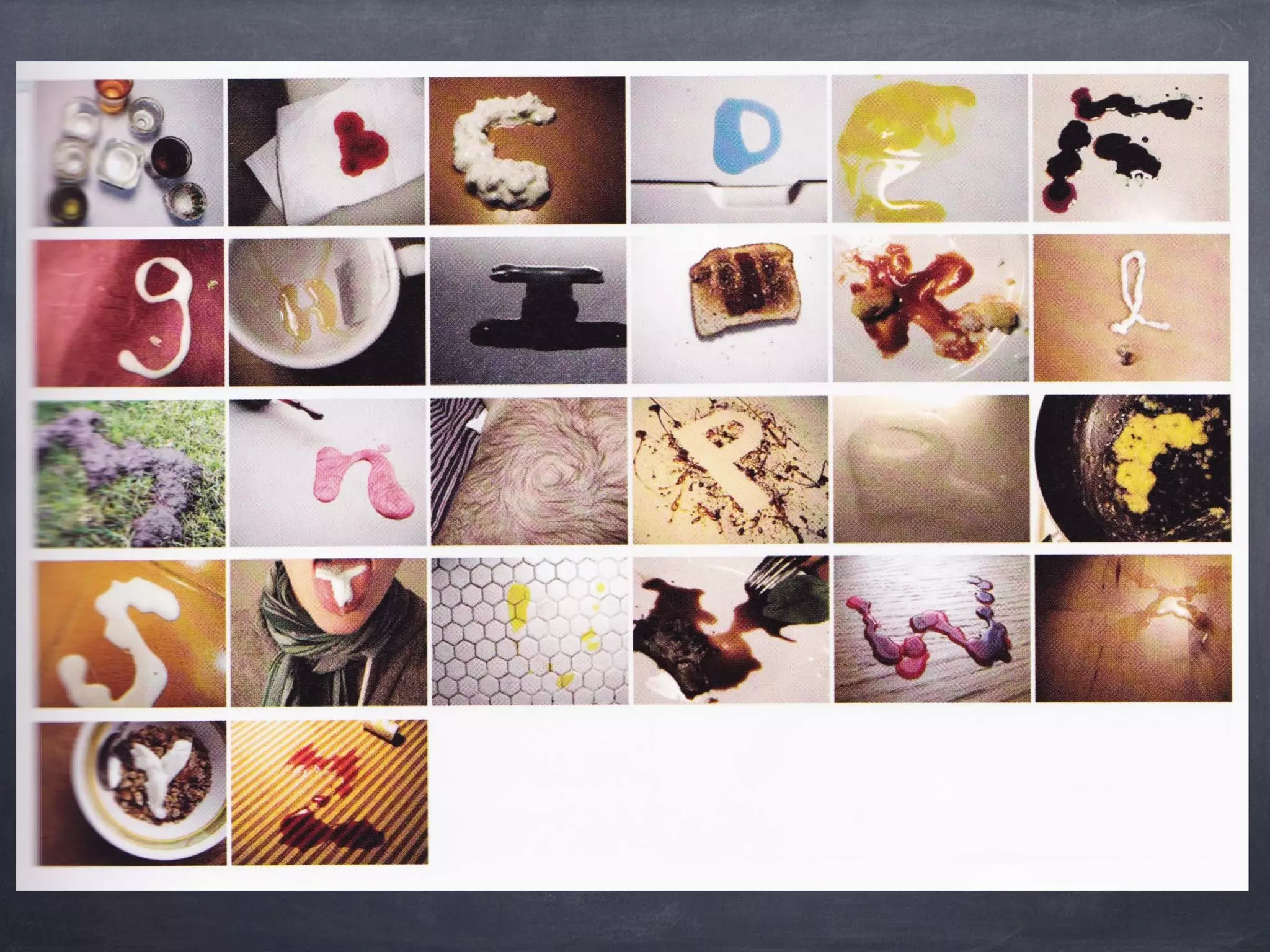
Easy as ABC
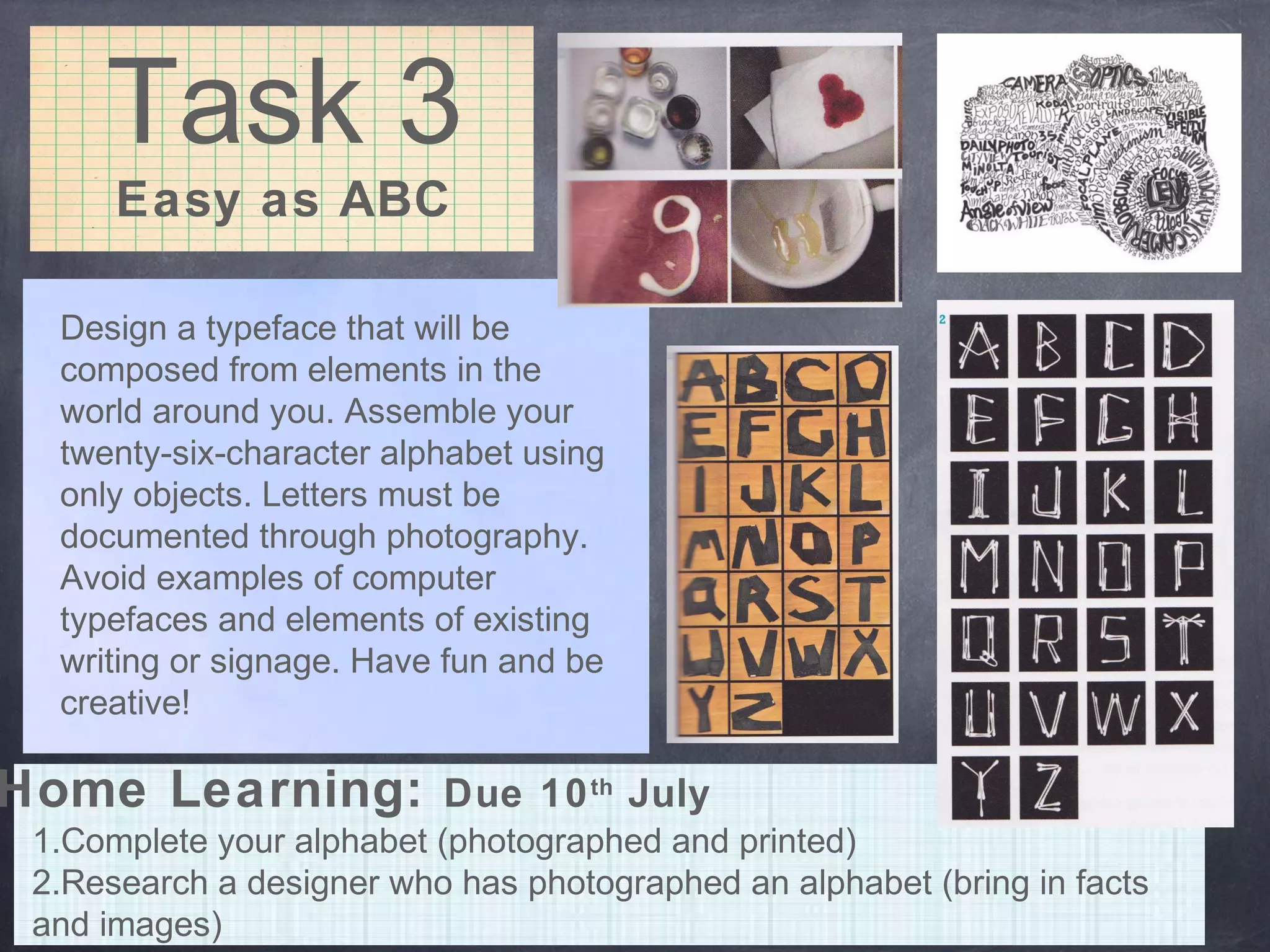
Design a typeface that will be
composed from elements in the
world around you. Assemble your
twenty-six-character alphabet using
only objects. Letters must be
documented through photography.
Avoid examples of computer
typefaces and elements of existing
writing or signage. Have fun and be
creative!
Home Learning: Due 10th
July
1.Complete your alphabet (photographed and printed)
2.Research a designer who has photographed an alphabet (bring in facts
and images)
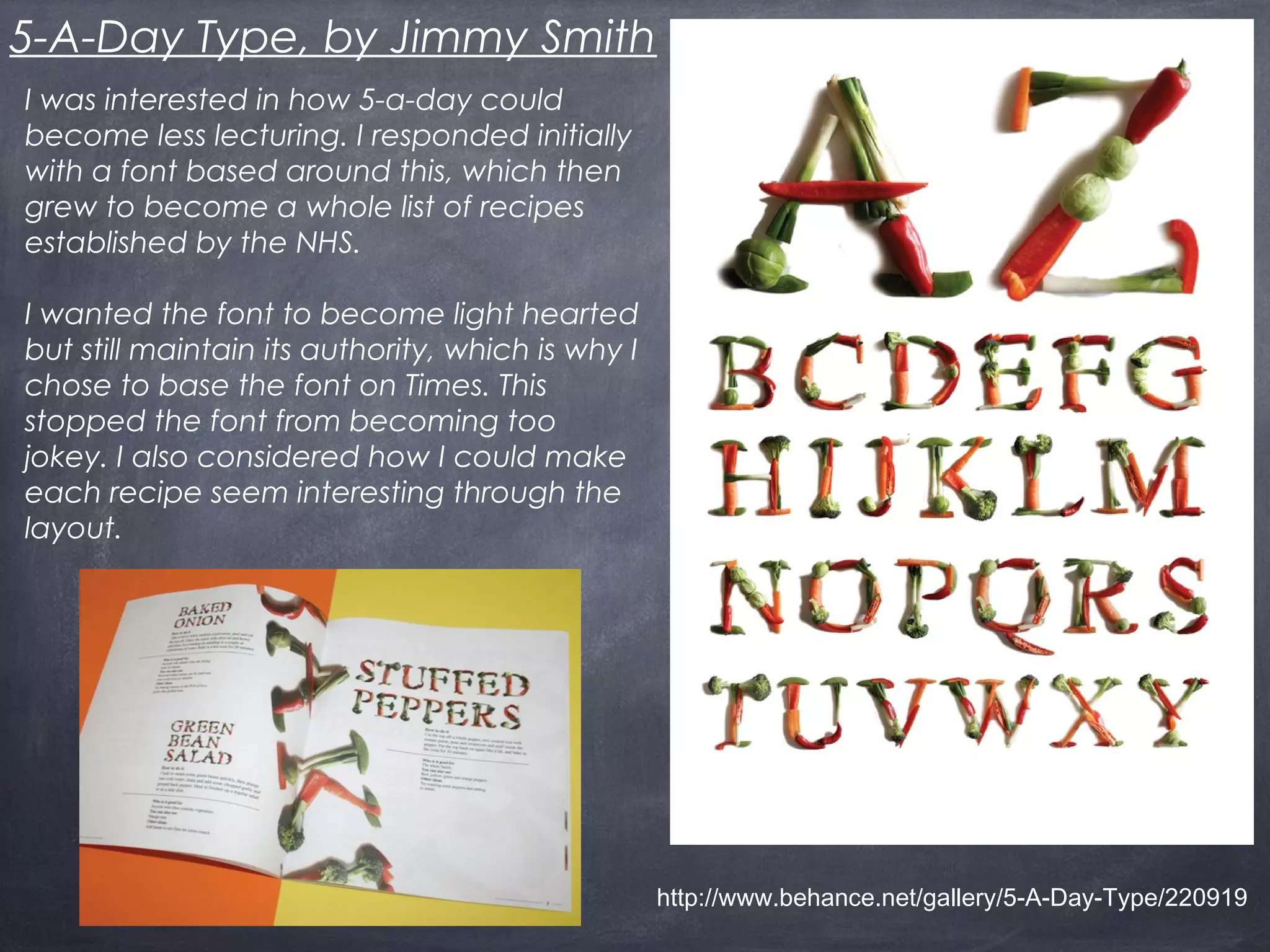
5-A-Day Type, by Jimmy Smith
I was interested in how 5-a-day could
become less lecturing. I responded initially
with a font based around this, which then
grew to become a whole list of recipes
established by the NHS.
I wanted the font to become light hearted
but still maintain its authority, which is why I
chose to base the font on Times. This
stopped the font from becoming too
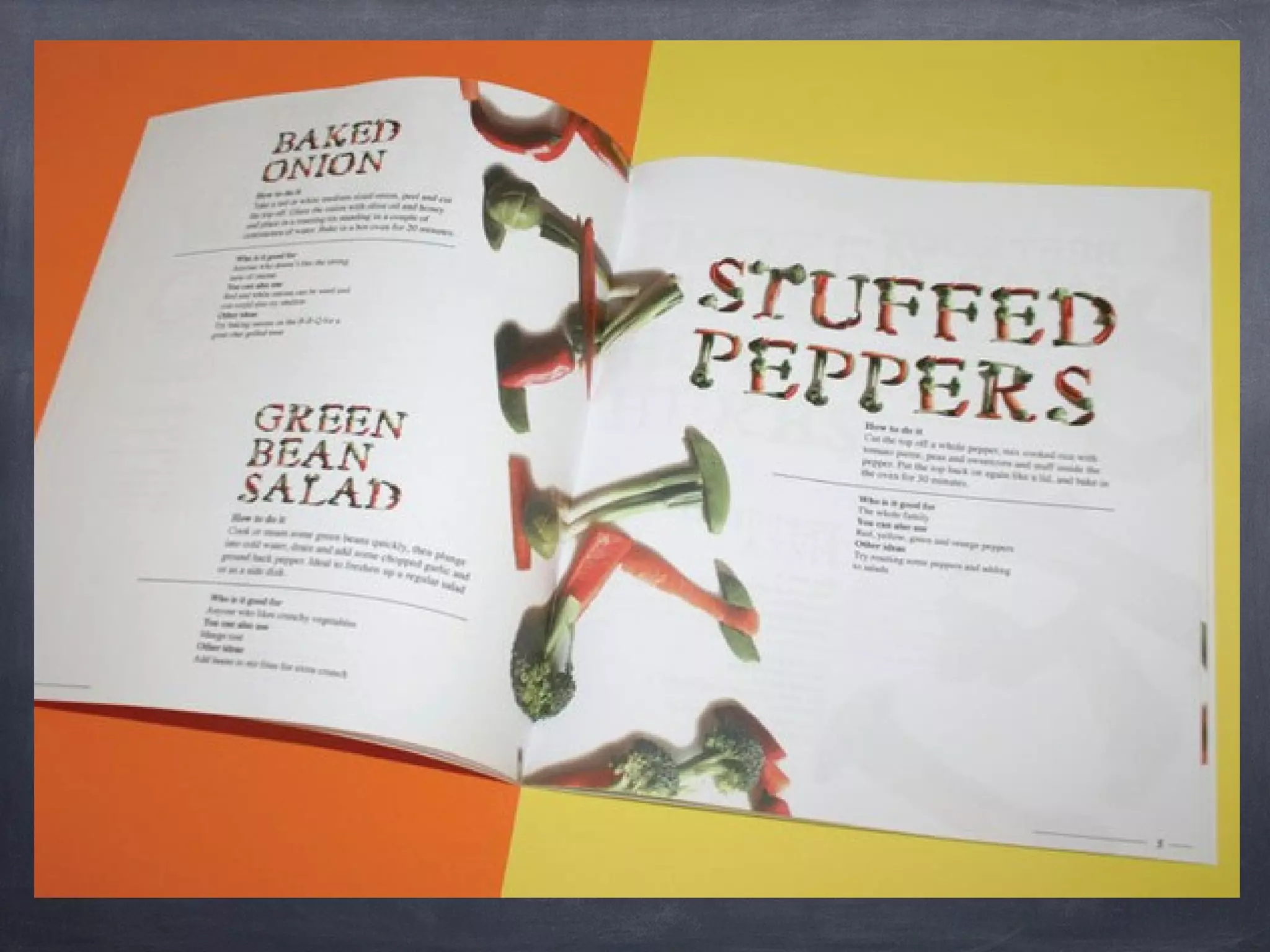
jokey. I also considered how I could make
each recipe seem interesting through the
layout.
http://www.behance.net/gallery/5-A-Day-Type/220919
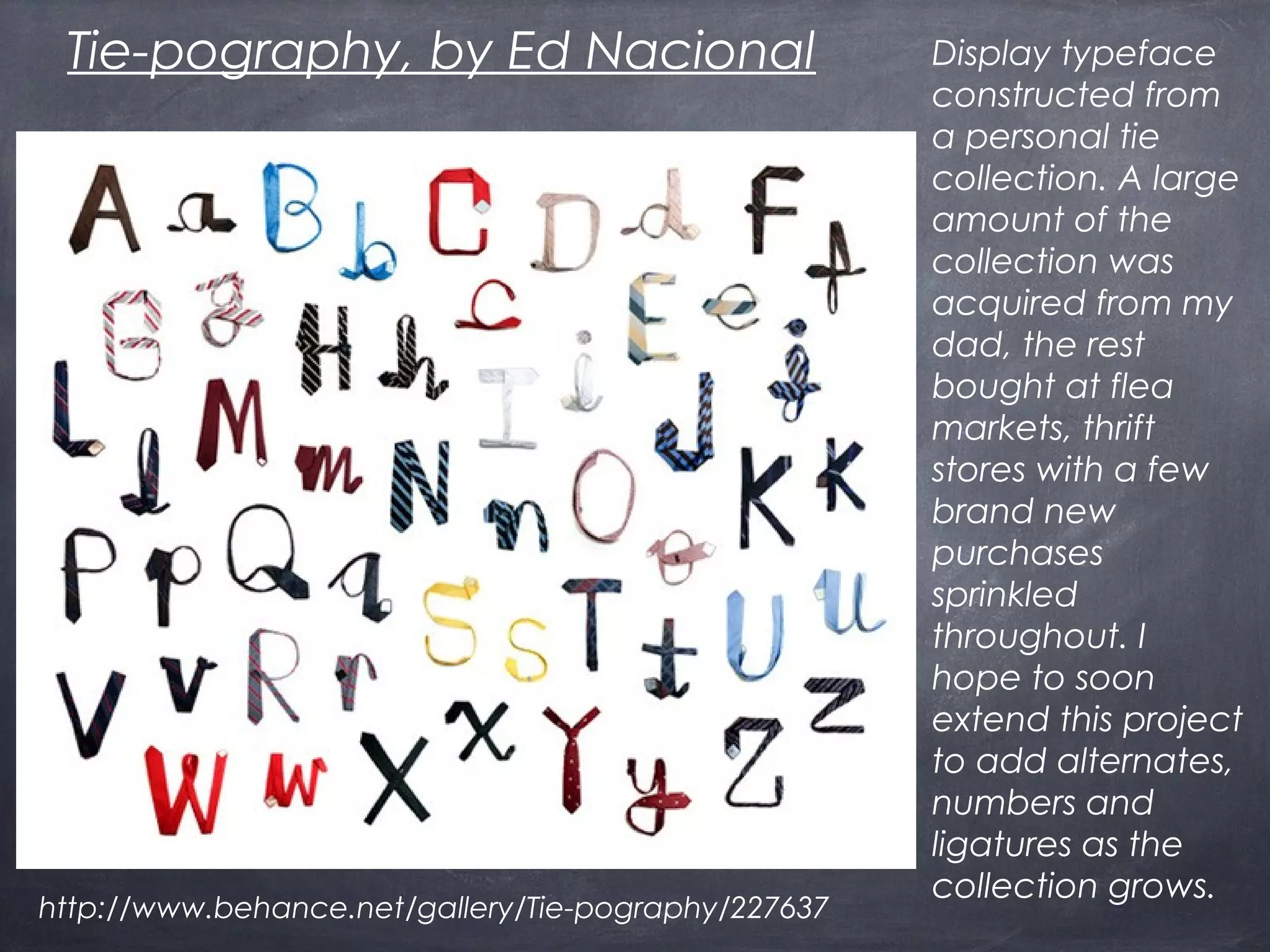
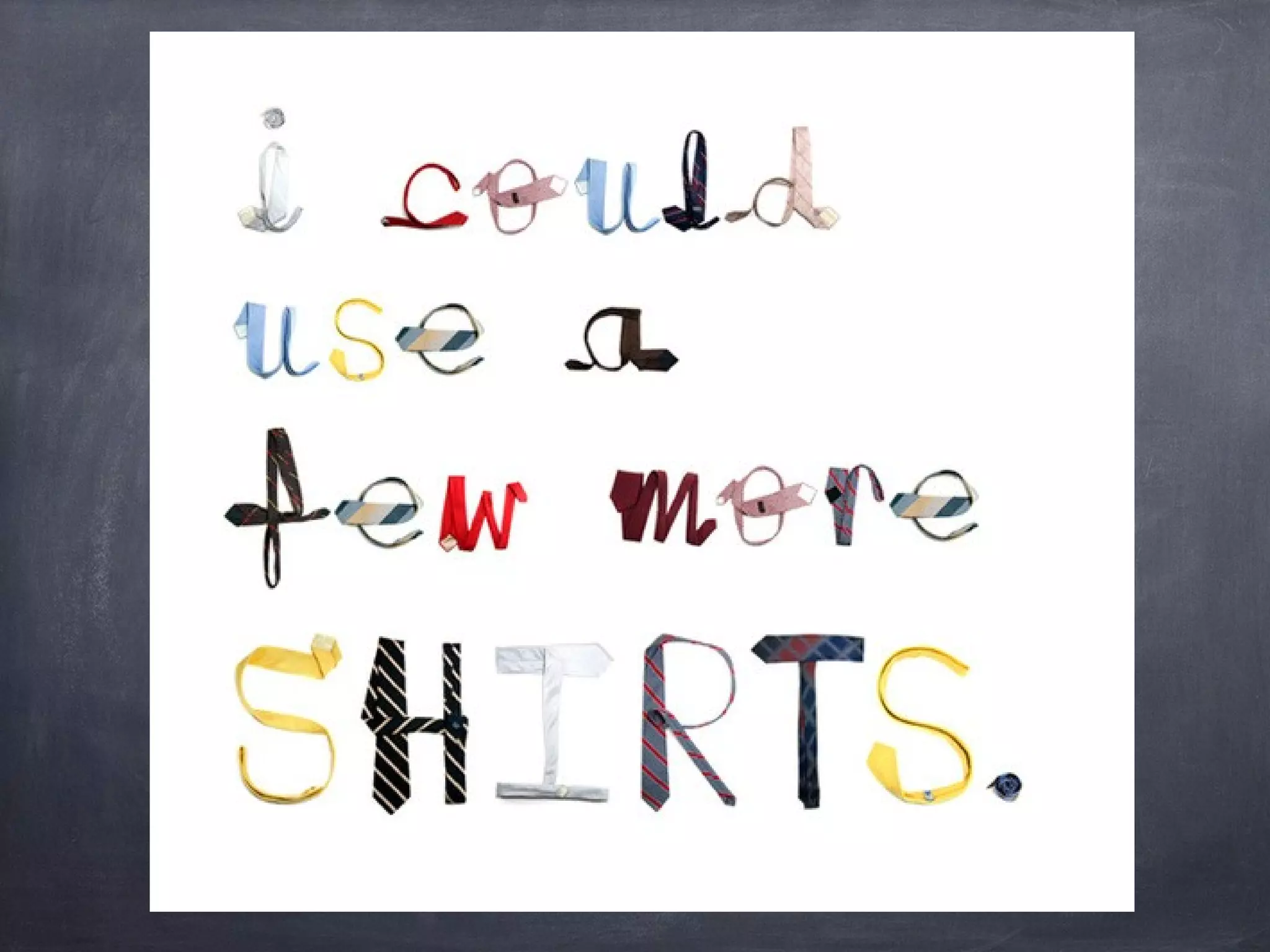
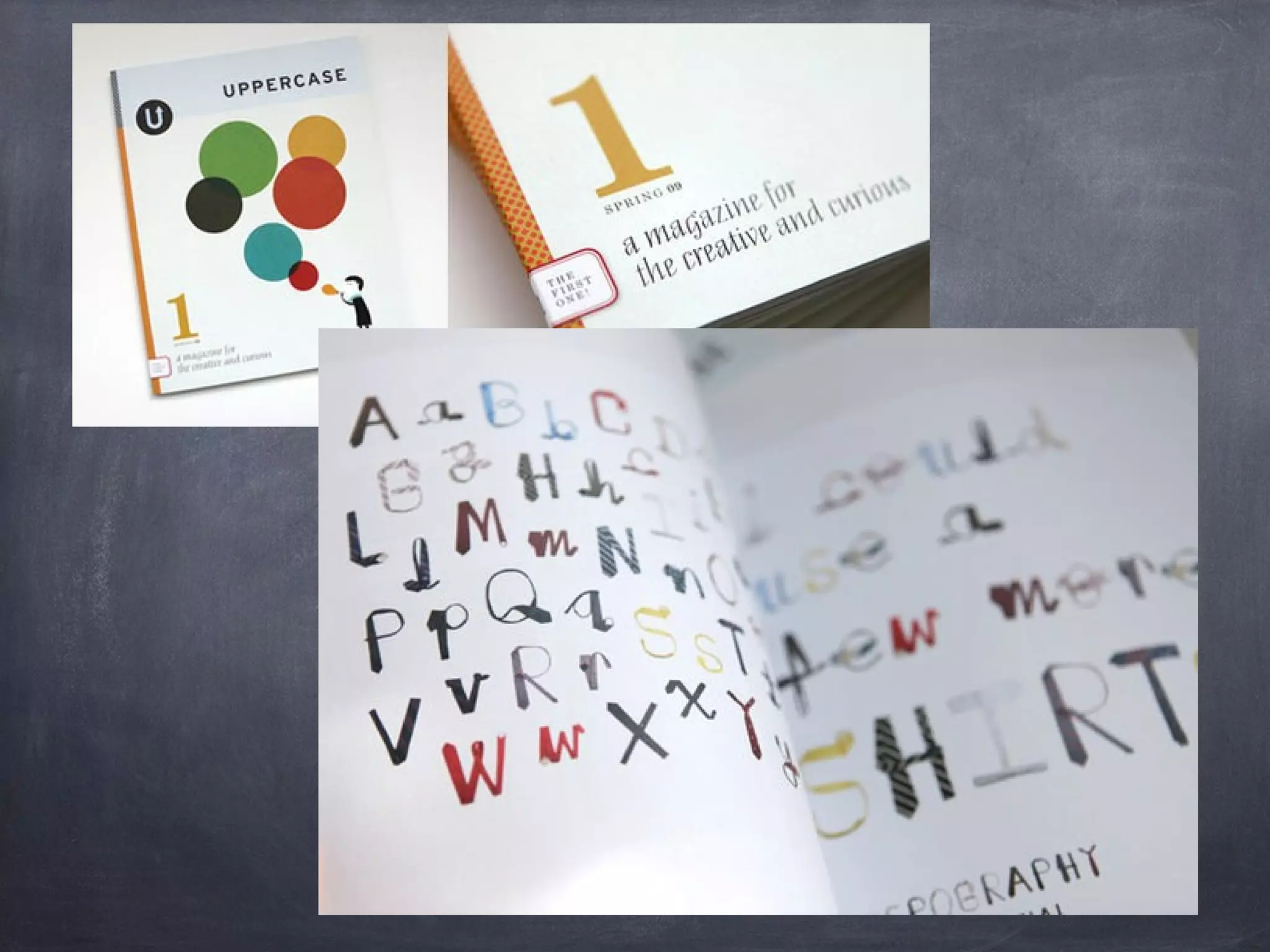
Display typeface
constructed from
a personal tie
collection. A large
amount of the
collection was
acquired from my
dad, the rest
bought at flea
markets, thrift
stores with a few
brand new
purchases
sprinkled
throughout. I
hope to soon
extend this project
to add alternates,
numbers and
ligatures as the
collection grows.
Tie-pography, by Ed Nacional
http://www.behance.net/gallery/Tie-pography/227637
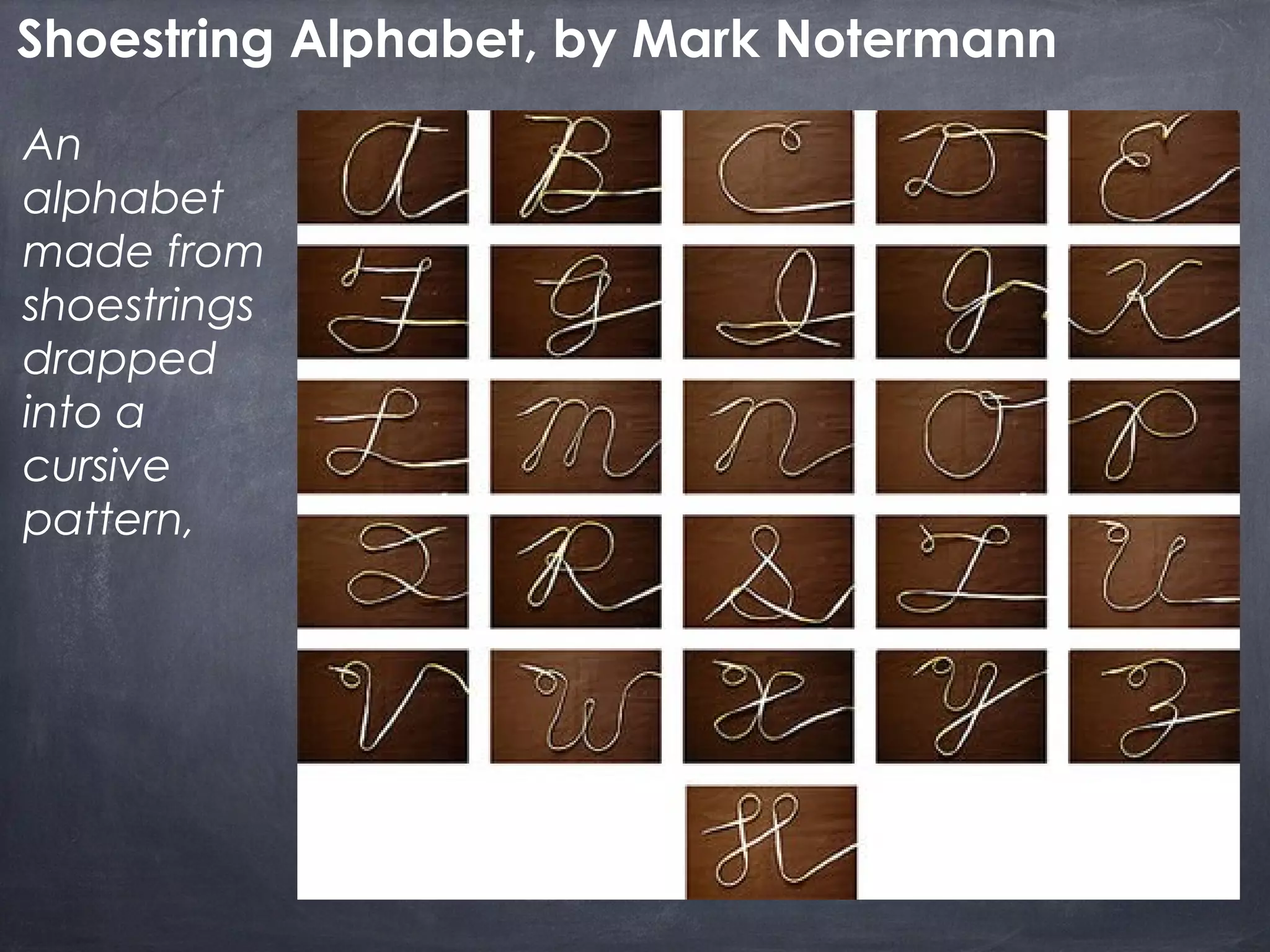
Shoestring Alphabet, by Mark Notermann
An
alphabet
made from
shoestrings
drapped
into a
cursive
pattern,
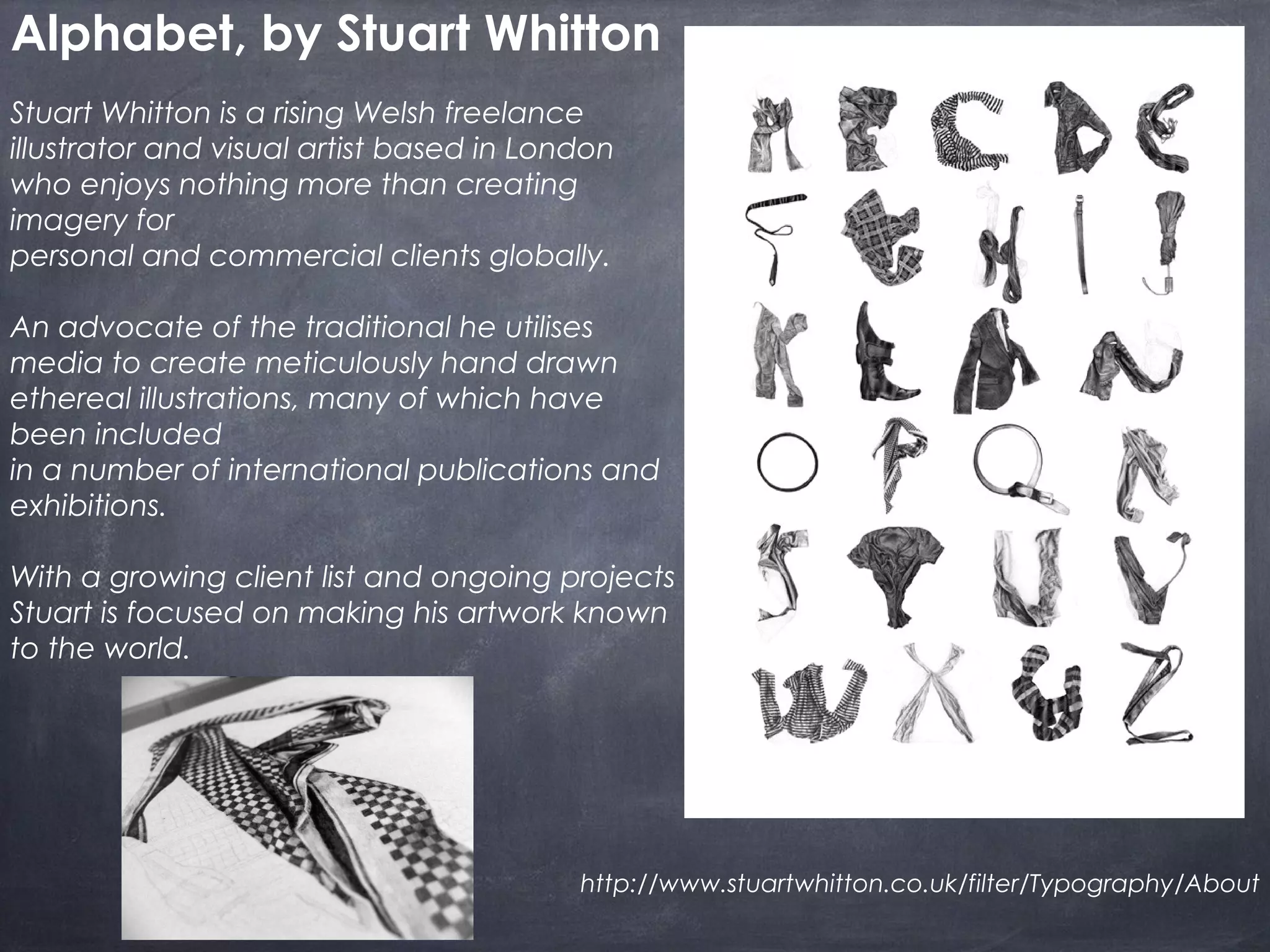
Stuart Whitton is a rising Welsh freelance
illustrator and visual artist based in London
who enjoys nothing more than creating
imagery for
personal and commercial clients globally.
An advocate of the traditional he utilises
media to create meticulously hand drawn
ethereal illustrations, many of which have
been included
in a number of international publications and
exhibitions.
With a growing client list and ongoing projects
Stuart is focused on making his artwork known
to the world.
Alphabet, by Stuart Whitton
http://www.stuartwhitton.co.uk/filter/Typography/About
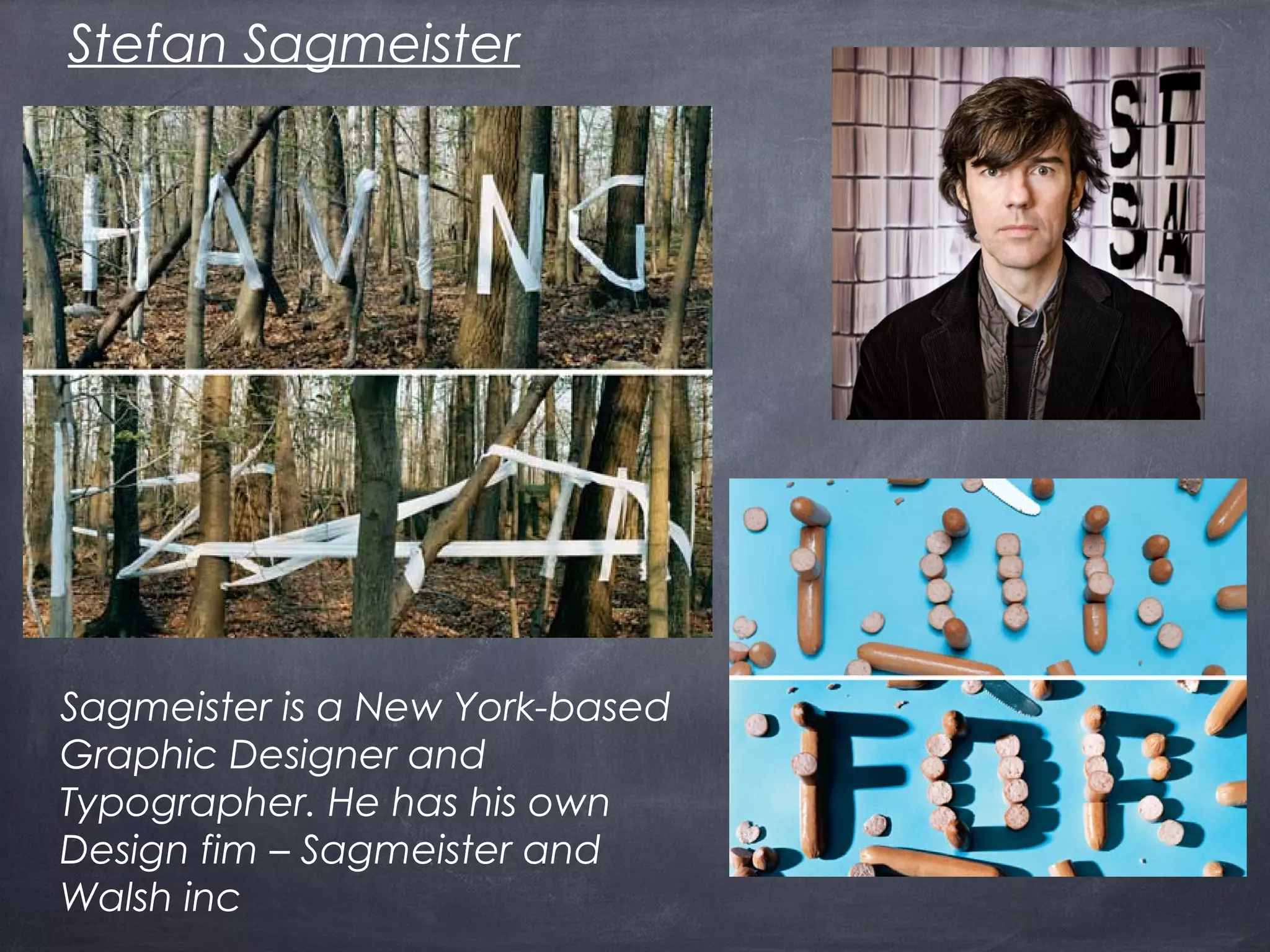
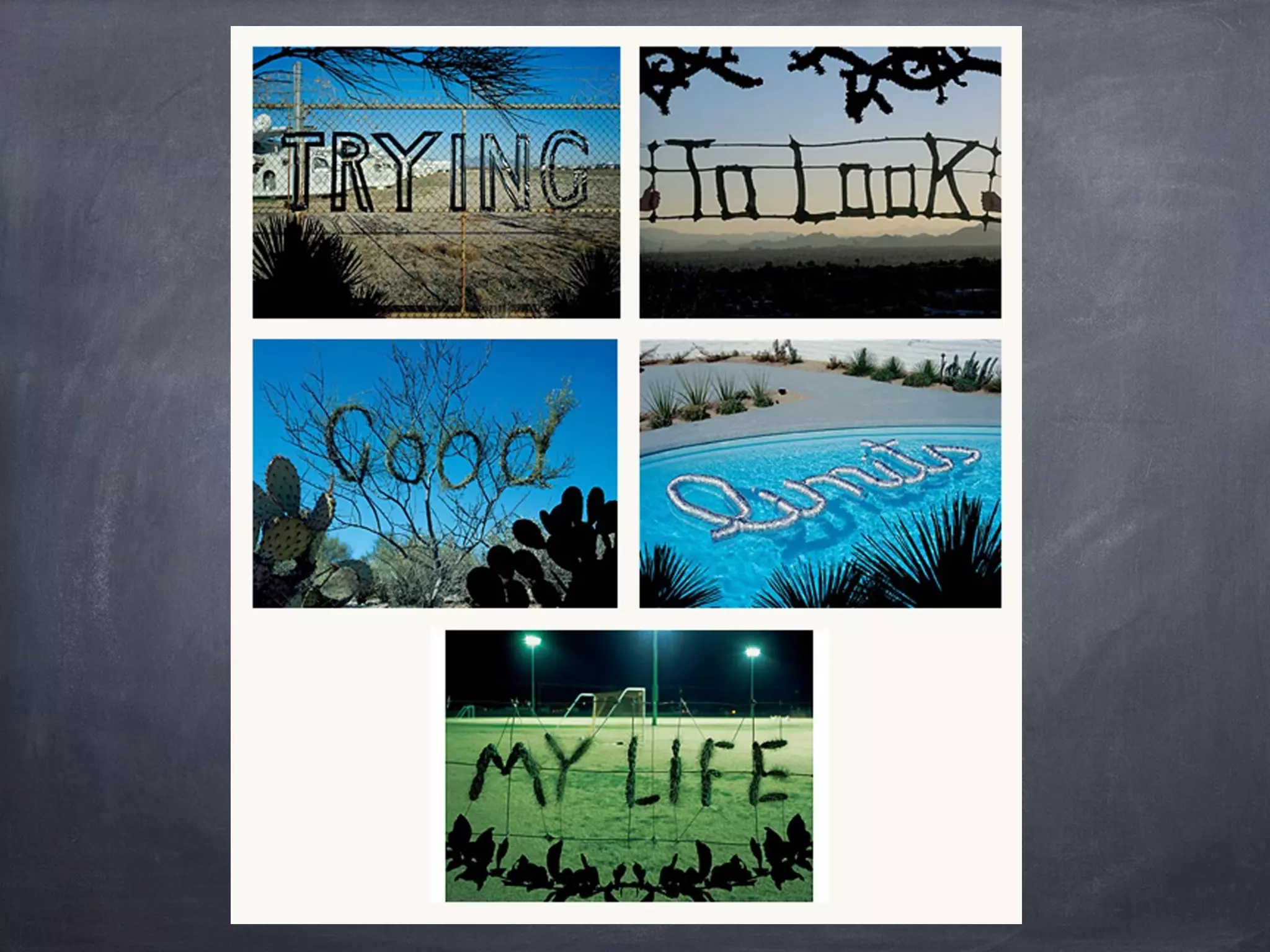
Stefan Sagmeister
Sagmeister is a New York-based
Graphic Designer and
Typographer. He has his own
Design fim – Sagmeister and
Walsh inc
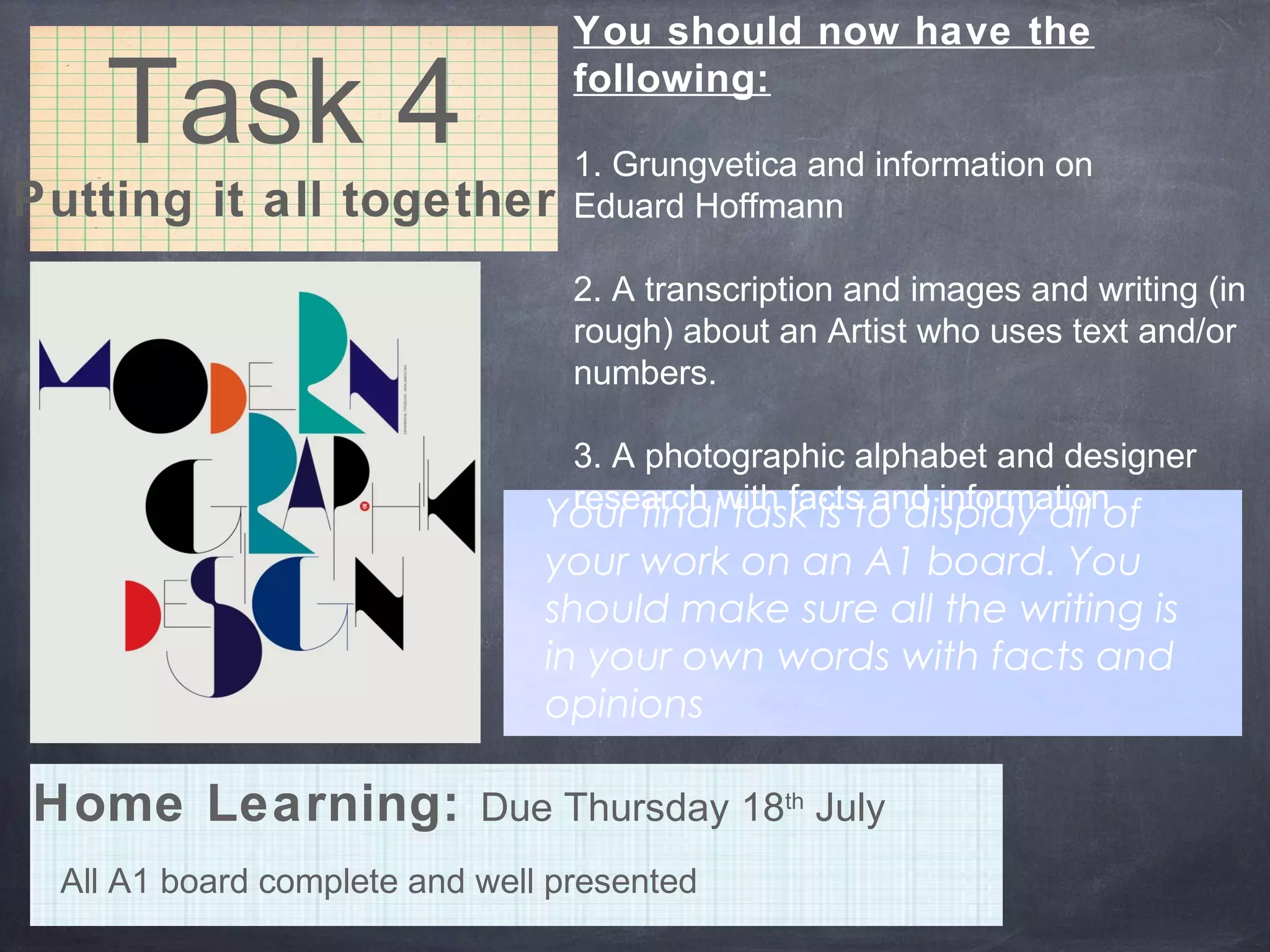
Task 4
Putting it all together
You should now have the
following:
1. Grungvetica and information on
Eduard Hoffmann
2. A transcription and images and writing (in
rough) about an Artist who uses text and/or
numbers.
3. A photographic alphabet and designer
research with facts and information
Your final task is to display all of
your work on an A1 board. You
should make sure all the writing is
in your own words with facts and
opinions
All A1 board complete and well presented
Home Learning: Due Thursday 18th
July

Yr9 gcse graphics

  • 1.
    GCSE Art andDesign: Graphic Design and Communication Image by Peter Callesen
  • 5.
    What will Istudy in GCSE Graphics? Illustration Typography Advertising Packaging
  • 6.
    AO1  Develop: studying workby other artists or designers AO2  Refine: doing experiments to find out what works best for your ideas AO3  Recording: making sketchbook drawings, notes, photographs and presentations AO4  Present: offering a final outcome How will my work be marked?
  • 8.
    What is ittypography? Arranging letterforms to produce printed matter.
  • 9.
    Helvetica was inventedin 1957 by Eduard Hoffmann, Director of Haas Type Foundry in Münchenstein, Switzerland, with the help of Max Miedinger. The original typography was called Neue Haas Grotesk and it aimed to embody a no-frills style. Hoffmann wanted Neue Haas Grotesk to form a contemporary version of an older typeface known as Akzidenz Grotesk. This new design would allow the typeface to be featured in a variety of situations without ever seeming inappropriate. Eduard Hoffmann
  • 10.
    Task 1 Grungvetica Project yourselffar into the future. Linotype GmbH has been chosen to create the seventieth anniversary edition of Helvetica – a modern update of the font composed of destroyed letterforms. What would the twenty-six characters of this new font look like? How would you associate your work to the legacy of the original face? 1.Complete your Grunvetica alphabet 2.Research Eduard Hoffmann. Bring in facts and information Home Learning: Due Wednesday 12th June
  • 11.
  • 12.
    1. Choose towork in lower or upper case. 2. Keep the same shape and work in black and white. 3. Now change and distort the alphabet. You can collage, use fine liners and work on a variety of different papers. What to do…
  • 13.
    Task 2 Artist Research Yoursecond task it to research one of the following Artists who have used text and/or numbers in their Art. Once you have chosen your Artist you must: 1.Write facts and opinions in rough in your own words (use the How To Write About Artists sheet for support) 2.Create a transcription of the Artist’s work. Complete transcription and writing in rough Home Learning: Due Wednesday 19th June
  • 14.
    Michael Craig-Martin isone of the most influential British Artists of recent decades. He was a key figure for the YBA generation of Artists, whom he taught in his capacity as tutor at Goldsmiths College of Art. In his recent series, Alphabet, he has produced 26 screen- prints in which the letters of the alphabet are overlaid with everyday objects such as a book, a glass of water or an umbrella. Michael Craig-Martin
  • 15.
    American painter and printmaker,forerunner of Pop Art, who uses commonplace emblematic images such as flags or numbers as the starting-point for works of great richness and complexity Jasper Johns
  • 16.
    Rob Ryan Rob Ryanis a British paper cutter Artist who specializes in paper cutting, screen-printing, drawing and painting. He is most famous for his detailed paper cut out and he often uses text in his artwork.
  • 17.
    Task 3 Easy asABC Design a typeface that will be composed from elements in the world around you. Assemble your twenty-six-character alphabet using only objects. Letters must be documented through photography. Avoid examples of computer typefaces and elements of existing writing or signage. Have fun and be creative! Home Learning: Due 10th July 1.Complete your alphabet (photographed and printed) 2.Research a designer who has photographed an alphabet (bring in facts and images)
  • 18.
    5-A-Day Type, byJimmy Smith I was interested in how 5-a-day could become less lecturing. I responded initially with a font based around this, which then grew to become a whole list of recipes established by the NHS. I wanted the font to become light hearted but still maintain its authority, which is why I chose to base the font on Times. This stopped the font from becoming too jokey. I also considered how I could make each recipe seem interesting through the layout. http://www.behance.net/gallery/5-A-Day-Type/220919
  • 20.
    Display typeface constructed from apersonal tie collection. A large amount of the collection was acquired from my dad, the rest bought at flea markets, thrift stores with a few brand new purchases sprinkled throughout. I hope to soon extend this project to add alternates, numbers and ligatures as the collection grows. Tie-pography, by Ed Nacional http://www.behance.net/gallery/Tie-pography/227637
  • 23.
    Shoestring Alphabet, byMark Notermann An alphabet made from shoestrings drapped into a cursive pattern,
  • 24.
    Stuart Whitton isa rising Welsh freelance illustrator and visual artist based in London who enjoys nothing more than creating imagery for personal and commercial clients globally. An advocate of the traditional he utilises media to create meticulously hand drawn ethereal illustrations, many of which have been included in a number of international publications and exhibitions. With a growing client list and ongoing projects Stuart is focused on making his artwork known to the world. Alphabet, by Stuart Whitton http://www.stuartwhitton.co.uk/filter/Typography/About
  • 25.
    Stefan Sagmeister Sagmeister isa New York-based Graphic Designer and Typographer. He has his own Design fim – Sagmeister and Walsh inc
  • 29.
    Task 4 Putting itall together You should now have the following: 1. Grungvetica and information on Eduard Hoffmann 2. A transcription and images and writing (in rough) about an Artist who uses text and/or numbers. 3. A photographic alphabet and designer research with facts and information Your final task is to display all of your work on an A1 board. You should make sure all the writing is in your own words with facts and opinions All A1 board complete and well presented Home Learning: Due Thursday 18th July