Unit 3: Surreal Painting
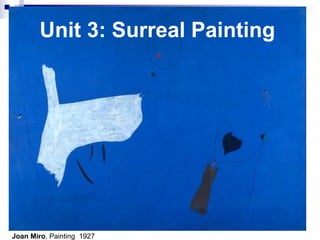
Joan Miro, Painting 1927
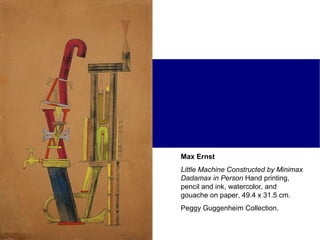
Max Ernst
Little Machine Constructed by Minimax
Dadamax in Person Hand printing,
pencil and ink, watercolor, and
gouache on paper, 49.4 x 31.5 cm.
Peggy Guggenheim Collection.
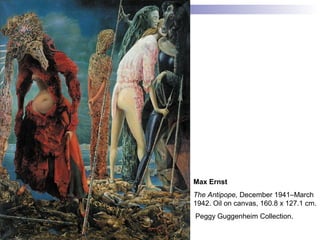
Max Ernst
The Antipope, December 1941–March
1942. Oil on canvas, 160.8 x 127.1 cm.
Peggy Guggenheim Collection.
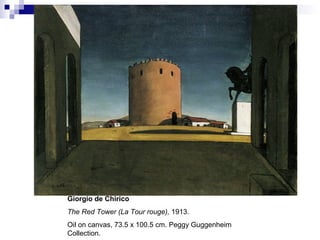
Giorgio de Chirico
The Red Tower (La Tour rouge), 1913.
Oil on canvas, 73.5 x 100.5 cm. Peggy Guggenheim
Collection.
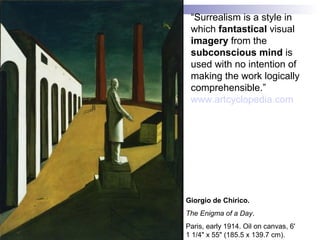
Giorgio de Chirico.
The Enigma of a Day.
Paris, early 1914. Oil on canvas, 6'
1 1/4" x 55" (185.5 x 139.7 cm).
“Surrealism is a style in
which fantastical visual
imagery from the
subconscious mind is
used with no intention of
making the work logically
comprehensible.”
www.artcyclopedia.com
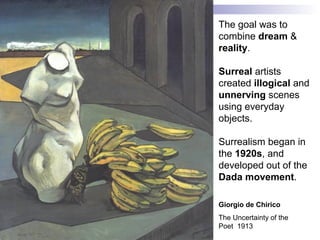
Giorgio de Chirico
The Uncertainty of the
Poet 1913
The goal was to
combine dream &
reality.
Surreal artists
created illogical and
unnerving scenes
using everyday
objects.
Surrealism began in
the 1920s, and
developed out of the
Dada movement.
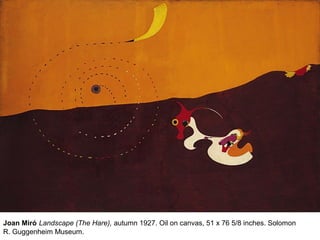
Joan Miró Landscape (The Hare), autumn 1927. Oil on canvas, 51 x 76 5/8 inches. Solomon
R. Guggenheim Museum.
René Magritte
Voice of Space, 1931.
Oil on canvas, 72.7 x 54.2 cm.
Peggy Guggenheim Collection.
“Dada was a protest by a
group of European artists
against World War I, [high
class] society, and
[conservative, traditional
thought].”
These artists created things
without meaning as an act
of defiance of the rational
thought that resulted in war.
Dada began around 1915.
www.artcyclopedia.com
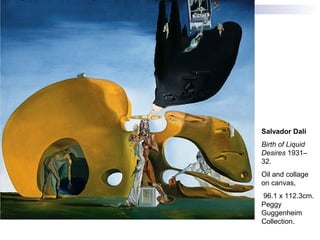
Salvador Dalí
Birth of Liquid
Desires 1931–
32.
Oil and collage
on canvas,
96.1 x 112.3cm.
Peggy
Guggenheim
Collection.
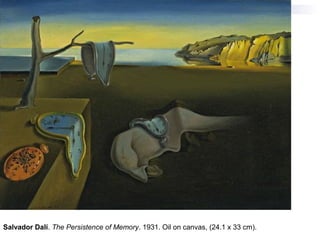
Salvador Dalí. The Persistence of Memory. 1931. Oil on canvas, (24.1 x 33 cm).
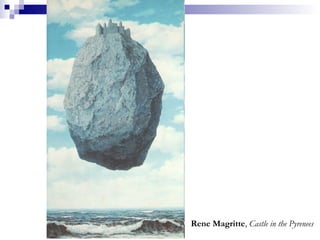
Rene Magritte, Castle in the Pyrenees
Surreal Landscape
 You will create a surreal landscape.
 This will be done using acrylic paint on a found
surface (cardboard, an empty pizza box, a scrap of
wood, an old shoe, etc.).
 Find your surface first. Then generate 3 ideas in your
sketchbook for how you will paint your surreal
landscape on it.
 You will have the opportunity to experiment with paint to
learn some techniques before starting your project.
Sketching Ideas:
Consider Your Viewpoint
 Bird’s Eye View – viewing from above; makes the
subject look weak
 Worm’s Eye View – viewing from below; makes the
subject look intimidating
 Eye Level View – puts the viewer at an equal level
with the subject
Experimenting with Paint
1) You will create a Colour Wheel using
only primary colours.
1) You will practise shading basic forms
with paint.
1) You will practise parts of your 3 designs
on paper, while trying different techniques.
Painting Techniques (demo)
1) Tinting – adding white to lighten your colour
2) Shading – adding the complementary colour to create a natural
black tone
3) Impasto – applying paint thickly
4) Knife Painting – using a palette knife to apply paint
5) Sgraffito – scratching through a wet layer of paint to reveal what's
underneath
6) Scumbling – adding a broken layer of dry colour over a dry layer
of paint (light over dark works best)
7) Masking – using tape or paper to block off areas
8) Stencilling – using store-bought or hand-made stencils to add
designs
Surreal Landscape:
Artist's Statement
1) Explain how you came up with your design. Where did
you find your surface? How did you decide what design
would work best?
1) What painting techniques did you incorporate? Explain
whether or not you were successful in using these
techniques.
1) Evaluate your artwork. Describe what you think you did
well. Describe the areas you think need improvement.
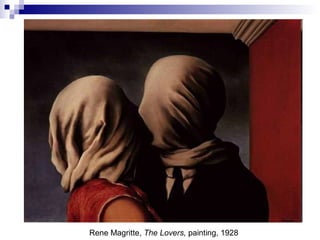
Rene Magritte, The Lovers, painting, 1928

Gr10 u3 painting

  • 1.
    Unit 3: SurrealPainting Joan Miro, Painting 1927
  • 2.
    Max Ernst Little MachineConstructed by Minimax Dadamax in Person Hand printing, pencil and ink, watercolor, and gouache on paper, 49.4 x 31.5 cm. Peggy Guggenheim Collection.
  • 3.
    Max Ernst The Antipope,December 1941–March 1942. Oil on canvas, 160.8 x 127.1 cm. Peggy Guggenheim Collection.
  • 4.
    Giorgio de Chirico TheRed Tower (La Tour rouge), 1913. Oil on canvas, 73.5 x 100.5 cm. Peggy Guggenheim Collection.
  • 5.
    Giorgio de Chirico. TheEnigma of a Day. Paris, early 1914. Oil on canvas, 6' 1 1/4" x 55" (185.5 x 139.7 cm). “Surrealism is a style in which fantastical visual imagery from the subconscious mind is used with no intention of making the work logically comprehensible.” www.artcyclopedia.com
  • 6.
    Giorgio de Chirico TheUncertainty of the Poet 1913 The goal was to combine dream & reality. Surreal artists created illogical and unnerving scenes using everyday objects. Surrealism began in the 1920s, and developed out of the Dada movement.
  • 7.
    Joan Miró Landscape(The Hare), autumn 1927. Oil on canvas, 51 x 76 5/8 inches. Solomon R. Guggenheim Museum.
  • 8.
    René Magritte Voice ofSpace, 1931. Oil on canvas, 72.7 x 54.2 cm. Peggy Guggenheim Collection. “Dada was a protest by a group of European artists against World War I, [high class] society, and [conservative, traditional thought].” These artists created things without meaning as an act of defiance of the rational thought that resulted in war. Dada began around 1915. www.artcyclopedia.com
  • 9.
    Salvador Dalí Birth ofLiquid Desires 1931– 32. Oil and collage on canvas, 96.1 x 112.3cm. Peggy Guggenheim Collection.
  • 10.
    Salvador Dalí. ThePersistence of Memory. 1931. Oil on canvas, (24.1 x 33 cm).
  • 11.
    Rene Magritte, Castlein the Pyrenees
  • 12.
    Surreal Landscape  Youwill create a surreal landscape.  This will be done using acrylic paint on a found surface (cardboard, an empty pizza box, a scrap of wood, an old shoe, etc.).  Find your surface first. Then generate 3 ideas in your sketchbook for how you will paint your surreal landscape on it.  You will have the opportunity to experiment with paint to learn some techniques before starting your project.
  • 13.
    Sketching Ideas: Consider YourViewpoint  Bird’s Eye View – viewing from above; makes the subject look weak  Worm’s Eye View – viewing from below; makes the subject look intimidating  Eye Level View – puts the viewer at an equal level with the subject
  • 14.
    Experimenting with Paint 1)You will create a Colour Wheel using only primary colours. 1) You will practise shading basic forms with paint. 1) You will practise parts of your 3 designs on paper, while trying different techniques.
  • 15.
    Painting Techniques (demo) 1)Tinting – adding white to lighten your colour 2) Shading – adding the complementary colour to create a natural black tone 3) Impasto – applying paint thickly 4) Knife Painting – using a palette knife to apply paint 5) Sgraffito – scratching through a wet layer of paint to reveal what's underneath 6) Scumbling – adding a broken layer of dry colour over a dry layer of paint (light over dark works best) 7) Masking – using tape or paper to block off areas 8) Stencilling – using store-bought or hand-made stencils to add designs
  • 16.
    Surreal Landscape: Artist's Statement 1)Explain how you came up with your design. Where did you find your surface? How did you decide what design would work best? 1) What painting techniques did you incorporate? Explain whether or not you were successful in using these techniques. 1) Evaluate your artwork. Describe what you think you did well. Describe the areas you think need improvement.
  • 17.
    Rene Magritte, TheLovers, painting, 1928