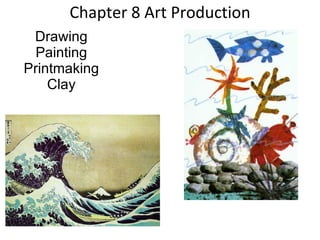
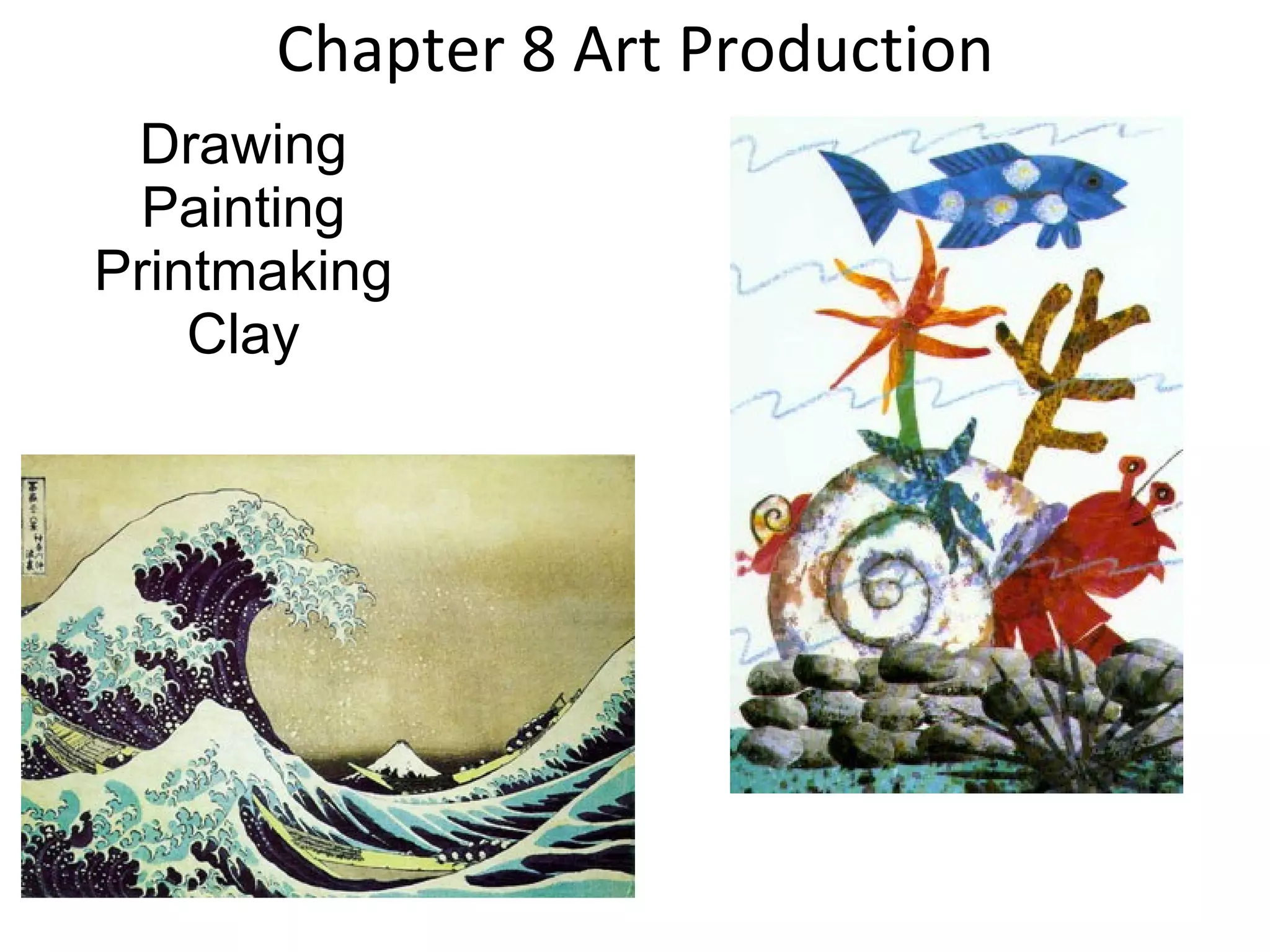
Chapter 8 Art Production Drawing Painting Printmaking Clay
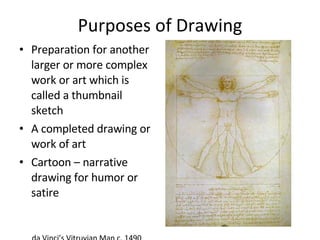
Purposes of Drawing Preparation for another larger or more complex work or art which is called a thumbnail sketch A completed drawing or work of art Cartoon – narrative drawing for humor or satire da Vinci’s Vitruvian Man c. 1490
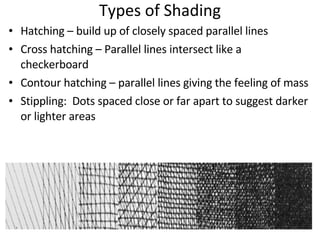
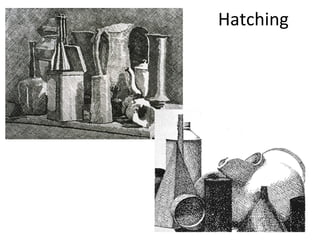
Types of Shading Hatching – build up of closely spaced parallel lines Cross hatching – Parallel lines intersect like a checkerboard Contour hatching – parallel lines giving the feeling of mass Stippling:  Dots spaced close or far apart to suggest darker or lighter areas
Hatching
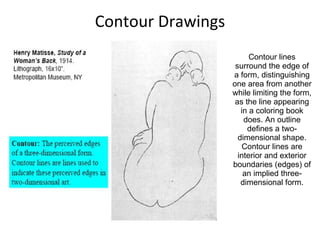
Contour Drawings Contour lines surround the edge of a form, distinguishing one area from another while limiting the form, as the line appearing in a coloring book does. An outline defines a two-dimensional shape. Contour lines are interior and exterior boundaries (edges) of an implied three-dimensional form.
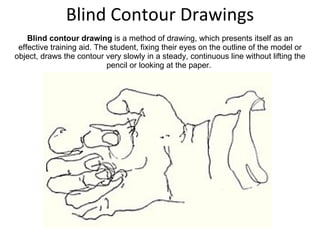
Blind Contour Drawings Blind contour drawing  is a method of drawing, which presents itself as an effective training aid. The student, fixing their eyes on the outline of the model or object, draws the contour very slowly in a steady, continuous line without lifting the pencil or looking at the paper.
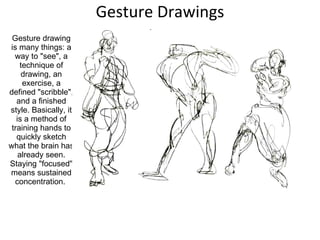
Gesture Drawings Gesture drawing is many things: a way to "see", a technique of drawing, an exercise, a defined "scribble", and a finished style. Basically, it is a method of training hands to quickly sketch what the brain has already seen. Staying "focused" means sustained concentration.
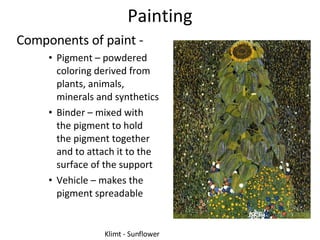
Painting Components of paint - Pigment – powdered coloring derived from plants, animals, minerals and synthetics Binder – mixed with the pigment to hold the pigment together and to attach it to the surface of the support Vehicle – makes the pigment spreadable Klimt - Sunflower
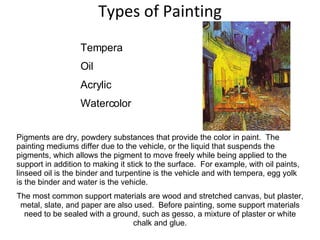
Types of Painting Tempera Oil Acrylic Watercolor Pigments are dry, powdery substances that provide the color in paint.  The painting mediums differ due to the vehicle, or the liquid that suspends the pigments, which allows the pigment to move freely while being applied to the support in addition to making it stick to the surface.  For example, with oil paints, linseed oil is the binder and turpentine is the vehicle and with tempera, egg yolk is the binder and water is the vehicle.  The most common support materials are wood and stretched canvas, but plaster, metal, slate, and paper are also used.  Before painting, some support materials need to be sealed with a ground, such as gesso, a mixture of plaster or white chalk and glue.
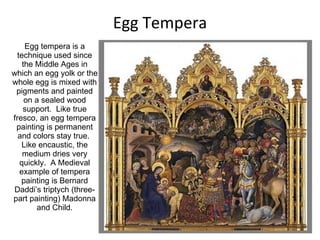
Egg Tempera Egg tempera is a technique used since the Middle Ages in which an egg yolk or the whole egg is mixed with pigments and painted on a sealed wood support.  Like true fresco, an egg tempera painting is permanent and colors stay true.  Like encaustic, the medium dries very quickly.  A Medieval example of tempera painting is Bernard Daddi’s triptych (three-part painting) Madonna and Child.
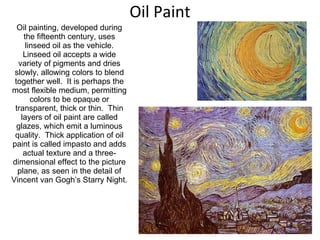
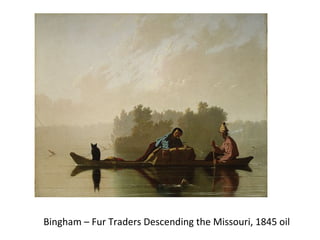
Oil Paint Oil painting, developed during the fifteenth century, uses linseed oil as the vehicle. Linseed oil accepts a wide variety of pigments and dries slowly, allowing colors to blend together well.  It is perhaps the most flexible medium, permitting colors to be opaque or transparent, thick or thin.  Thin layers of oil paint are called glazes, which emit a luminous quality.  Thick application of oil paint is called impasto and adds actual texture and a three-dimensional effect to the picture plane, as seen in the detail of Vincent van Gogh’s Starry Night.
Bingham – Fur Traders Descending the Missouri, 1845 oil
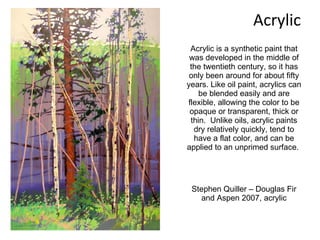
Acrylic Acrylic is a synthetic paint that was developed in the middle of the twentieth century, so it has only been around for about fifty years. Like oil paint, acrylics can be blended easily and are flexible, allowing the color to be opaque or transparent, thick or thin.  Unlike oils, acrylic paints dry relatively quickly, tend to have a flat color, and can be applied to an unprimed surface.  Stephen Quiller – Douglas Fir and Aspen 2007, acrylic
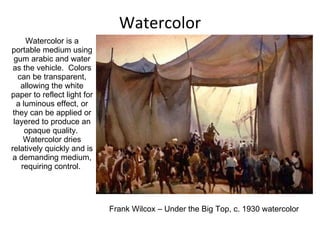
Watercolor Watercolor is a portable medium using gum arabic and water as the vehicle.  Colors can be transparent, allowing the white paper to reflect light for a luminous effect, or they can be applied or layered to produce an opaque quality.  Watercolor dries relatively quickly and is a demanding medium, requiring control.  Frank Wilcox – Under the Big Top, c. 1930 watercolor
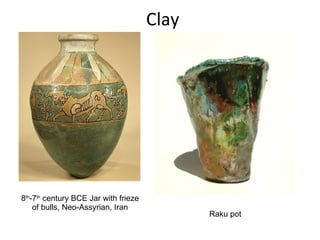
Clay 8 th -7 th  century BCE Jar with frieze of bulls, Neo-Assyrian, Iran Raku pot
Clay Terms Ceramics – making objects from clay Firing – clay exposed to heat hardens in a process called firing  Potter – a person who works with clay Earthenware – fired at a relatively low temperature and is porous after firing Stoneware – fired at a high temperature and is not porous Porcelain – fired at a high temperature, rare, non porous, first developed in China
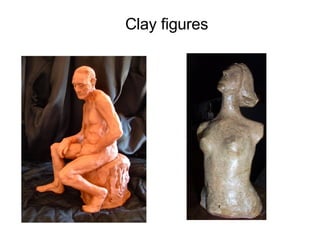
Clay figures
Kiln – a clay oven that bakes the clay at temperatures of 2200 degrees and more Slip – liquid clay used to secure pieces together.  Can be colored for use in decoration of clay called underglazes. Glaze – liquid with a silica base that turns into a glass like substance when fired.  Glaze creates a nonporous surface and can be glossy, matte, translucent or opaque depending on the chemical composition used. Raku – a form of firing where the bisque is pulled from a hot kiln and put into a fire proof container with combustible materials
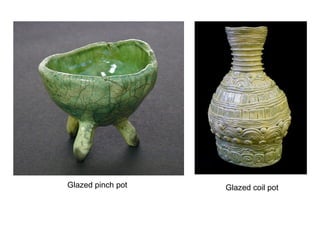
Glazed pinch pot Glazed coil pot
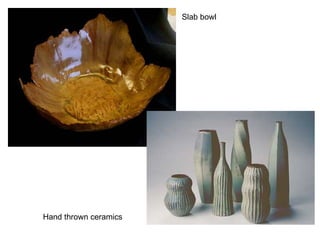
Slab bowl Hand thrown ceramics
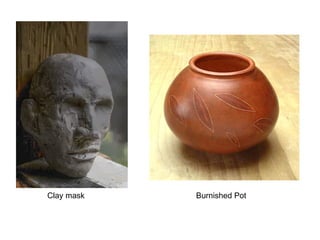
Clay mask   Burnished Pot
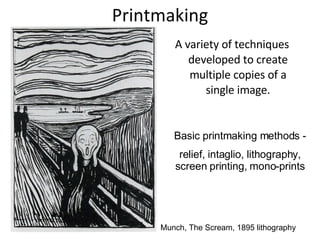
Printmaking A variety of techniques developed to create multiple copies of a single image. Basic printmaking methods - relief, intaglio, lithography, screen printing, mono-prints Munch, The Scream, 1895 lithography
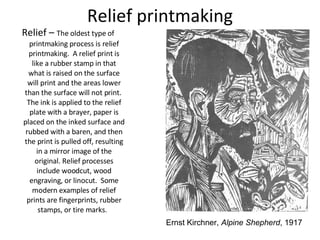
Relief printmaking Relief –  The oldest type of printmaking process is relief printmaking.  A relief print is like a rubber stamp in that what is raised on the surface will print and the areas lower than the surface will not print.  The ink is applied to the relief plate with a brayer, paper is placed on the inked surface and rubbed with a baren, and then the print is pulled off, resulting in a mirror image of the original. Relief processes include woodcut, wood engraving, or linocut.  Some modern examples of relief prints are fingerprints, rubber stamps, or tire marks.  Ernst Kirchner,  Alpine Shepherd , 1917
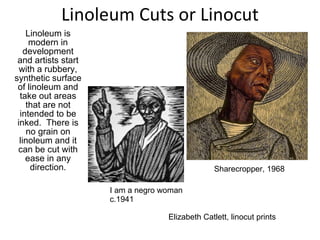
Linoleum Cuts or Linocut Linoleum is modern in development and artists start with a rubbery, synthetic surface of linoleum and take out areas that are not intended to be inked.  There is no grain on linoleum and it can be cut with ease in any direction. Elizabeth Catlett, linocut prints I am a negro woman c.1941 Sharecropper, 1968

KCC Art 141 Chapter 8 Art Production

  • 1.
    Chapter 8 ArtProduction Drawing Painting Printmaking Clay
  • 2.
    Purposes of DrawingPreparation for another larger or more complex work or art which is called a thumbnail sketch A completed drawing or work of art Cartoon – narrative drawing for humor or satire da Vinci’s Vitruvian Man c. 1490
  • 3.
    Types of ShadingHatching – build up of closely spaced parallel lines Cross hatching – Parallel lines intersect like a checkerboard Contour hatching – parallel lines giving the feeling of mass Stippling: Dots spaced close or far apart to suggest darker or lighter areas
  • 4.
  • 5.
    Contour Drawings Contourlines surround the edge of a form, distinguishing one area from another while limiting the form, as the line appearing in a coloring book does. An outline defines a two-dimensional shape. Contour lines are interior and exterior boundaries (edges) of an implied three-dimensional form.
  • 6.
    Blind Contour DrawingsBlind contour drawing is a method of drawing, which presents itself as an effective training aid. The student, fixing their eyes on the outline of the model or object, draws the contour very slowly in a steady, continuous line without lifting the pencil or looking at the paper.
  • 7.
    Gesture Drawings Gesturedrawing is many things: a way to "see", a technique of drawing, an exercise, a defined "scribble", and a finished style. Basically, it is a method of training hands to quickly sketch what the brain has already seen. Staying "focused" means sustained concentration.
  • 8.
    Painting Components ofpaint - Pigment – powdered coloring derived from plants, animals, minerals and synthetics Binder – mixed with the pigment to hold the pigment together and to attach it to the surface of the support Vehicle – makes the pigment spreadable Klimt - Sunflower
  • 9.
    Types of PaintingTempera Oil Acrylic Watercolor Pigments are dry, powdery substances that provide the color in paint. The painting mediums differ due to the vehicle, or the liquid that suspends the pigments, which allows the pigment to move freely while being applied to the support in addition to making it stick to the surface. For example, with oil paints, linseed oil is the binder and turpentine is the vehicle and with tempera, egg yolk is the binder and water is the vehicle. The most common support materials are wood and stretched canvas, but plaster, metal, slate, and paper are also used. Before painting, some support materials need to be sealed with a ground, such as gesso, a mixture of plaster or white chalk and glue.
  • 10.
    Egg Tempera Eggtempera is a technique used since the Middle Ages in which an egg yolk or the whole egg is mixed with pigments and painted on a sealed wood support. Like true fresco, an egg tempera painting is permanent and colors stay true. Like encaustic, the medium dries very quickly. A Medieval example of tempera painting is Bernard Daddi’s triptych (three-part painting) Madonna and Child.
  • 11.
    Oil Paint Oilpainting, developed during the fifteenth century, uses linseed oil as the vehicle. Linseed oil accepts a wide variety of pigments and dries slowly, allowing colors to blend together well. It is perhaps the most flexible medium, permitting colors to be opaque or transparent, thick or thin. Thin layers of oil paint are called glazes, which emit a luminous quality. Thick application of oil paint is called impasto and adds actual texture and a three-dimensional effect to the picture plane, as seen in the detail of Vincent van Gogh’s Starry Night.
  • 12.
    Bingham – FurTraders Descending the Missouri, 1845 oil
  • 13.
    Acrylic Acrylic isa synthetic paint that was developed in the middle of the twentieth century, so it has only been around for about fifty years. Like oil paint, acrylics can be blended easily and are flexible, allowing the color to be opaque or transparent, thick or thin. Unlike oils, acrylic paints dry relatively quickly, tend to have a flat color, and can be applied to an unprimed surface. Stephen Quiller – Douglas Fir and Aspen 2007, acrylic
  • 14.
    Watercolor Watercolor isa portable medium using gum arabic and water as the vehicle. Colors can be transparent, allowing the white paper to reflect light for a luminous effect, or they can be applied or layered to produce an opaque quality. Watercolor dries relatively quickly and is a demanding medium, requiring control. Frank Wilcox – Under the Big Top, c. 1930 watercolor
  • 15.
    Clay 8 th-7 th century BCE Jar with frieze of bulls, Neo-Assyrian, Iran Raku pot
  • 16.
    Clay Terms Ceramics– making objects from clay Firing – clay exposed to heat hardens in a process called firing Potter – a person who works with clay Earthenware – fired at a relatively low temperature and is porous after firing Stoneware – fired at a high temperature and is not porous Porcelain – fired at a high temperature, rare, non porous, first developed in China
  • 17.
  • 18.
    Kiln – aclay oven that bakes the clay at temperatures of 2200 degrees and more Slip – liquid clay used to secure pieces together. Can be colored for use in decoration of clay called underglazes. Glaze – liquid with a silica base that turns into a glass like substance when fired. Glaze creates a nonporous surface and can be glossy, matte, translucent or opaque depending on the chemical composition used. Raku – a form of firing where the bisque is pulled from a hot kiln and put into a fire proof container with combustible materials
  • 19.
    Glazed pinch potGlazed coil pot
  • 20.
    Slab bowl Handthrown ceramics
  • 21.
    Clay mask Burnished Pot
  • 22.
    Printmaking A varietyof techniques developed to create multiple copies of a single image. Basic printmaking methods - relief, intaglio, lithography, screen printing, mono-prints Munch, The Scream, 1895 lithography
  • 23.
    Relief printmaking Relief– The oldest type of printmaking process is relief printmaking. A relief print is like a rubber stamp in that what is raised on the surface will print and the areas lower than the surface will not print. The ink is applied to the relief plate with a brayer, paper is placed on the inked surface and rubbed with a baren, and then the print is pulled off, resulting in a mirror image of the original. Relief processes include woodcut, wood engraving, or linocut. Some modern examples of relief prints are fingerprints, rubber stamps, or tire marks. Ernst Kirchner, Alpine Shepherd , 1917
  • 24.
    Linoleum Cuts orLinocut Linoleum is modern in development and artists start with a rubbery, synthetic surface of linoleum and take out areas that are not intended to be inked. There is no grain on linoleum and it can be cut with ease in any direction. Elizabeth Catlett, linocut prints I am a negro woman c.1941 Sharecropper, 1968