Presented by- Guided by -
Mr. Shubham Badhe Dr. P.K.Deshmukh
First year M.Pharm Dept. of Pharmaceutics.
Dept. of pharmaceutics .
H. R. Patel Institute of Pharmaceutical
Education & Research , Shirpur.
1
Definition of cGMP
 Objectives of cGMP
Policies of cGMP
 Equipment & their Maintenance
Layout of buildings
Conclusion
Reference
2
3
 cGMP :
It is defined in simple words as “that
part of quality assurance which ensures that
products are consistently produced and
controlled to the quality standards appropriate
for their intended use & legal requirements”.
cGMP is thus concerned with both
production & quality control matters.
4
 In manufacture of cosmetic product, overall
control & monitoring.
 Ensure that product are consistently
manufactured controlled to the specified quality.
 Concerned with all aspects of production &
quality control.
 Ensure that the consumer receives products,
overall of specified quality.
 The quality of product depend on the starting
material, production & quality control processes,
building equipment & personnel involed.
5
 Quality management system
 Personnel
 Organisation, qualification, & responsibilities
 Training
 Premises
 Equipment
 Sanitation & hygiene
 Production
6
 Equipment should be designed and
located to suit the production of the
product.
A. Design and Construction :
 The equipment surfaces coming into
contact with any in-process material
should not react with or adsorb the
materials being processed.
 Equipment should not adversely affect
the product through leaking valves,
lubricant drips and through
inappropriate modifications or
adaptations.
 Equipment should be easily cleaned.
 Equipment used for flammable
substances should be explosion proof.
7
B. Installation and Location :
 Equipment should be located to
avoid congestion and should be
properly identified to assure that
products do not become admixed or
confused with one another.
 Water, steam and pressure or
vacuum lines, where
applicable,should be installed so as
to be easily accessible during all
phases of operation. They should be
clearly identified.
 Support systems such as heating,
ventilation, air conditioning, water
(such as potable, purified, distilled),
steam, compressed air and gases
(example nitrogen) should function
as designed and identifiable.
8
C. Maintenance :
 Weighing, measuring, testing and recording
equipment should be serviced and calibrated regularly.
 All records should be maintained.
9
10
 Premises :
The location of factory premises should be such that
the surroundings (External environment ) should be
free from unsanitory condition such as objectionable
odour, air, water pollutants, sanitation hazards,
insects and vermin.
11
 Building & Facilities :
 The design & construction of buildings should be such
that it facilitates cleaning & maintenance operations.
 The walls, floors & ceilings shall be made up of hard,
non-porous & non-shedding materials & should be free
from cracks & holes.
12
 Lighting :
 Adequate lighting shall be provided in all area.
 “Adequate”.Define the amount of light (lux or foot-candles)
reaching the working surface for each area involed in the
production of pharmaceuticals.
 Public standards exist for some type of work. Normally a
range of 30-50 foot- candles ensure worker comfort & have
ability to perform efficiently & effectively, however, 100
foot- candles may be needed in some areas, as well as
special lighting for some operations, such as inspection of
filled vials.
13
 Ventilation, air filtration, air heating &
cooling :
 Adequate ventilation shall be provided as per
the need of operations in all areas.
 Adequate ventilation & if necessary air
conditioning to maintain a satisfactory
temperature & relative humidity that will not
adversely affect the drug during
manufacturing & storage shall be provided.
 Air filtration systems, including prefilters &
particulate matters air filters shall be used
when appropriate on air supplies to production
areas.
14
 Disposal of waste :
Waste water & other residues from the laboratory
which might be prejudicinal to the workers or to public
health shall be disposed of after suitable treatment as
per the prevailing requirements of the water pollution
control authorities to render them harmless.
 Water supply :
The water used in manufacture shall be pure & of a
drinkable quality, free from pathogenic micro-
organism.
15
 Requirements for sterile products
manufacturing area :
 Sterile manufacturing, filling & handling
spaces requires special air processing.
 A separate enclosed area specifically designed
for the purpose shall be provided.
 In special area, laminar flow units are to be
used to avoid airborne contamination of
product.
16
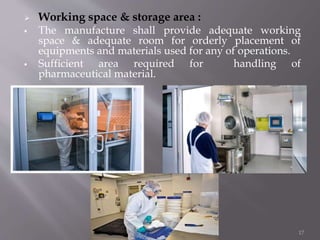
 Working space & storage area :
 The manufacture shall provide adequate working
space & adequate room for orderly placement of
equipments and materials used for any of operations.
 Sufficient area required for handling of
pharmaceutical material.
17
 Health clothing :
 To protect the drug products from contamination by
the personnel working in the manufacture, processing,
packaging or holding drug product.
 Medical services :
 The manufacturer shall provide adequate first aid
facilities.
 The workers periodic health check-up once in year
shall be performed.
18
 Sanitation in the manufacturing premises :
 The manufacturing premises shall be
maintained in clean & sanitary condition.
19
 Production & process control :
 There shall be written procedure for production &
control designed to assure that the drug products have
the identity, strength, quality & purity.
Precautions against contamination & mix-up :
- Use suitable exhaust system.
- Use laminar air flow for sterile product.
- To control humidity.
- To control temperature.
20
Is the written document that contain all information for
manufacturing of product.
 Product details :
- Name, logo & address of the manufacturing company.
- Dosage form name.
- Brand name.
- Generic name.
- Product code.
- Label claim of all ingredient.
- Product description.
- Batch size.
- Pack size & packaging style.
- Shelf life.
- Storage condition.
- MFR number & date.
- Supersade MFR number & date.
- Effective batch number.
- Authorization by the production and quality assurance head.
Master formula record
21
22
 Batch manufacturing Record :
 The license shall maintain batch
manufacturing record as per schedule “U”
for each batch of drug product.
 According to schedule “U” contain the
particular manufacturing record has
follows :
23
- Serial number.
- Name of the product.
- Lot/batch size.
- Lot/batch number.
- Date of commencement of mfg & date of completion.
- Name of all ingredients quantity required for lot/
batch size, quantities actually.
- Control reference number .
- Date of release of finished packing for distribution or
sale.
- Signature of expert staff.
24
 Labeling & packaging :
All labels for containers, carton & boxes & all circulars,
inserts & leaflets shall be examined & released as
satisfactory for use by the quality control & personnel.
Also the packaging of the product should be properly.
25
 GMP compliance is not an option.
 Quality should be built into the product.
 GMP's are very similar and are really Good
Common Sense.
 Good Practices cover all aspects of
manufacturing activities prior to supply.
 The role and involvement of senior
management is crucial.
26
 Dr.R.S.Gaud, Dr.A.V.Yadav, Dr.P.G.Yeole,
Dr.S.B.Gokhle, “Pharmaceutics” nirali
prakashan, page no. 7.2-7.7.
 Manohar.A.Potdar, “Current good
manufacturing practises for
pharmaceuticals”pharmamed press, 2009
page no. 605,613,624,630,638,643.
27
28

Mph 02 (shubham)

  • 1.
    Presented by- Guidedby - Mr. Shubham Badhe Dr. P.K.Deshmukh First year M.Pharm Dept. of Pharmaceutics. Dept. of pharmaceutics . H. R. Patel Institute of Pharmaceutical Education & Research , Shirpur. 1
  • 2.
    Definition of cGMP Objectives of cGMP Policies of cGMP  Equipment & their Maintenance Layout of buildings Conclusion Reference 2
  • 3.
  • 4.
     cGMP : Itis defined in simple words as “that part of quality assurance which ensures that products are consistently produced and controlled to the quality standards appropriate for their intended use & legal requirements”. cGMP is thus concerned with both production & quality control matters. 4
  • 5.
     In manufactureof cosmetic product, overall control & monitoring.  Ensure that product are consistently manufactured controlled to the specified quality.  Concerned with all aspects of production & quality control.  Ensure that the consumer receives products, overall of specified quality.  The quality of product depend on the starting material, production & quality control processes, building equipment & personnel involed. 5
  • 6.
     Quality managementsystem  Personnel  Organisation, qualification, & responsibilities  Training  Premises  Equipment  Sanitation & hygiene  Production 6
  • 7.
     Equipment shouldbe designed and located to suit the production of the product. A. Design and Construction :  The equipment surfaces coming into contact with any in-process material should not react with or adsorb the materials being processed.  Equipment should not adversely affect the product through leaking valves, lubricant drips and through inappropriate modifications or adaptations.  Equipment should be easily cleaned.  Equipment used for flammable substances should be explosion proof. 7
  • 8.
    B. Installation andLocation :  Equipment should be located to avoid congestion and should be properly identified to assure that products do not become admixed or confused with one another.  Water, steam and pressure or vacuum lines, where applicable,should be installed so as to be easily accessible during all phases of operation. They should be clearly identified.  Support systems such as heating, ventilation, air conditioning, water (such as potable, purified, distilled), steam, compressed air and gases (example nitrogen) should function as designed and identifiable. 8
  • 9.
    C. Maintenance : Weighing, measuring, testing and recording equipment should be serviced and calibrated regularly.  All records should be maintained. 9
  • 10.
  • 11.
     Premises : Thelocation of factory premises should be such that the surroundings (External environment ) should be free from unsanitory condition such as objectionable odour, air, water pollutants, sanitation hazards, insects and vermin. 11
  • 12.
     Building &Facilities :  The design & construction of buildings should be such that it facilitates cleaning & maintenance operations.  The walls, floors & ceilings shall be made up of hard, non-porous & non-shedding materials & should be free from cracks & holes. 12
  • 13.
     Lighting : Adequate lighting shall be provided in all area.  “Adequate”.Define the amount of light (lux or foot-candles) reaching the working surface for each area involed in the production of pharmaceuticals.  Public standards exist for some type of work. Normally a range of 30-50 foot- candles ensure worker comfort & have ability to perform efficiently & effectively, however, 100 foot- candles may be needed in some areas, as well as special lighting for some operations, such as inspection of filled vials. 13
  • 14.
     Ventilation, airfiltration, air heating & cooling :  Adequate ventilation shall be provided as per the need of operations in all areas.  Adequate ventilation & if necessary air conditioning to maintain a satisfactory temperature & relative humidity that will not adversely affect the drug during manufacturing & storage shall be provided.  Air filtration systems, including prefilters & particulate matters air filters shall be used when appropriate on air supplies to production areas. 14
  • 15.
     Disposal ofwaste : Waste water & other residues from the laboratory which might be prejudicinal to the workers or to public health shall be disposed of after suitable treatment as per the prevailing requirements of the water pollution control authorities to render them harmless.  Water supply : The water used in manufacture shall be pure & of a drinkable quality, free from pathogenic micro- organism. 15
  • 16.
     Requirements forsterile products manufacturing area :  Sterile manufacturing, filling & handling spaces requires special air processing.  A separate enclosed area specifically designed for the purpose shall be provided.  In special area, laminar flow units are to be used to avoid airborne contamination of product. 16
  • 17.
     Working space& storage area :  The manufacture shall provide adequate working space & adequate room for orderly placement of equipments and materials used for any of operations.  Sufficient area required for handling of pharmaceutical material. 17
  • 18.
     Health clothing:  To protect the drug products from contamination by the personnel working in the manufacture, processing, packaging or holding drug product.  Medical services :  The manufacturer shall provide adequate first aid facilities.  The workers periodic health check-up once in year shall be performed. 18
  • 19.
     Sanitation inthe manufacturing premises :  The manufacturing premises shall be maintained in clean & sanitary condition. 19
  • 20.
     Production &process control :  There shall be written procedure for production & control designed to assure that the drug products have the identity, strength, quality & purity. Precautions against contamination & mix-up : - Use suitable exhaust system. - Use laminar air flow for sterile product. - To control humidity. - To control temperature. 20
  • 21.
    Is the writtendocument that contain all information for manufacturing of product.  Product details : - Name, logo & address of the manufacturing company. - Dosage form name. - Brand name. - Generic name. - Product code. - Label claim of all ingredient. - Product description. - Batch size. - Pack size & packaging style. - Shelf life. - Storage condition. - MFR number & date. - Supersade MFR number & date. - Effective batch number. - Authorization by the production and quality assurance head. Master formula record 21
  • 22.
  • 23.
     Batch manufacturingRecord :  The license shall maintain batch manufacturing record as per schedule “U” for each batch of drug product.  According to schedule “U” contain the particular manufacturing record has follows : 23
  • 24.
    - Serial number. -Name of the product. - Lot/batch size. - Lot/batch number. - Date of commencement of mfg & date of completion. - Name of all ingredients quantity required for lot/ batch size, quantities actually. - Control reference number . - Date of release of finished packing for distribution or sale. - Signature of expert staff. 24
  • 25.
     Labeling &packaging : All labels for containers, carton & boxes & all circulars, inserts & leaflets shall be examined & released as satisfactory for use by the quality control & personnel. Also the packaging of the product should be properly. 25
  • 26.
     GMP complianceis not an option.  Quality should be built into the product.  GMP's are very similar and are really Good Common Sense.  Good Practices cover all aspects of manufacturing activities prior to supply.  The role and involvement of senior management is crucial. 26
  • 27.
     Dr.R.S.Gaud, Dr.A.V.Yadav,Dr.P.G.Yeole, Dr.S.B.Gokhle, “Pharmaceutics” nirali prakashan, page no. 7.2-7.7.  Manohar.A.Potdar, “Current good manufacturing practises for pharmaceuticals”pharmamed press, 2009 page no. 605,613,624,630,638,643. 27
  • 28.