Prepared by:
Eng.Haitham Shehata Hussein
Eng.Ahmed Safwat
Index
1. Capacity Planning Using
Overall Factors (CPOF).
2. Capacity Bills.
3. Resource Profiles.
4. Capacity Requirements
Planning (CRP).
5. Input/Output Control
6. The Capacity "BathTub“
Capacity Planning
CAPACITY PLANNING'S ROLE IN
MPC SYSTEMS.
CAPACITY PLANNING AND
CONTROLTECHNIQUES.
MANAGEMENT AND CAPACITY
PLANNING.
DATA BASE REQUIREMENTS.
EXAMPLES OF APPLICATIONS.
1. Hierarchy of Capacity Planning Decisions.
2. Links to Other MPC System Modules.
1. Capacity Planning in the MPC System
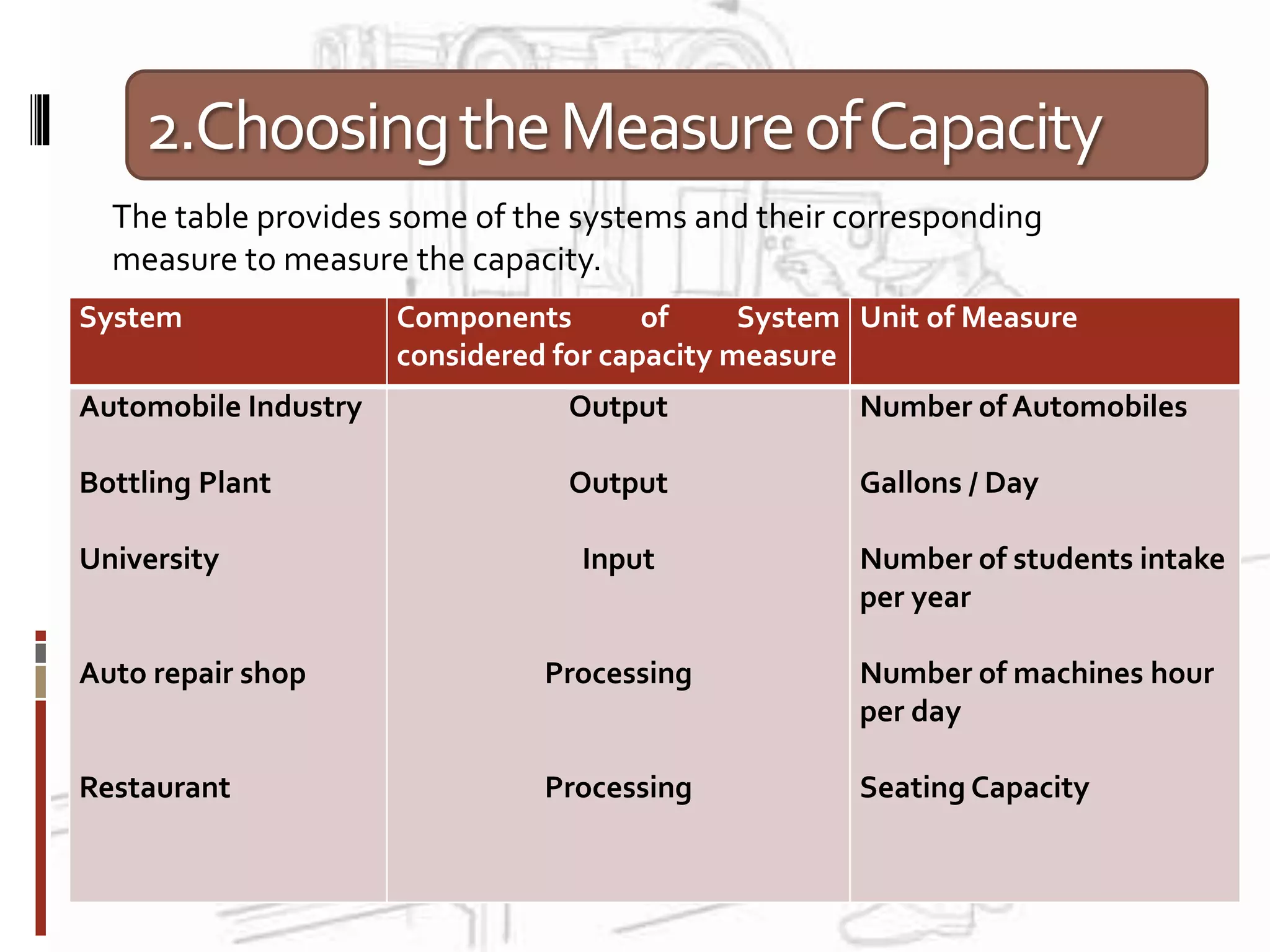
2. Choosing the Measure of Capacity
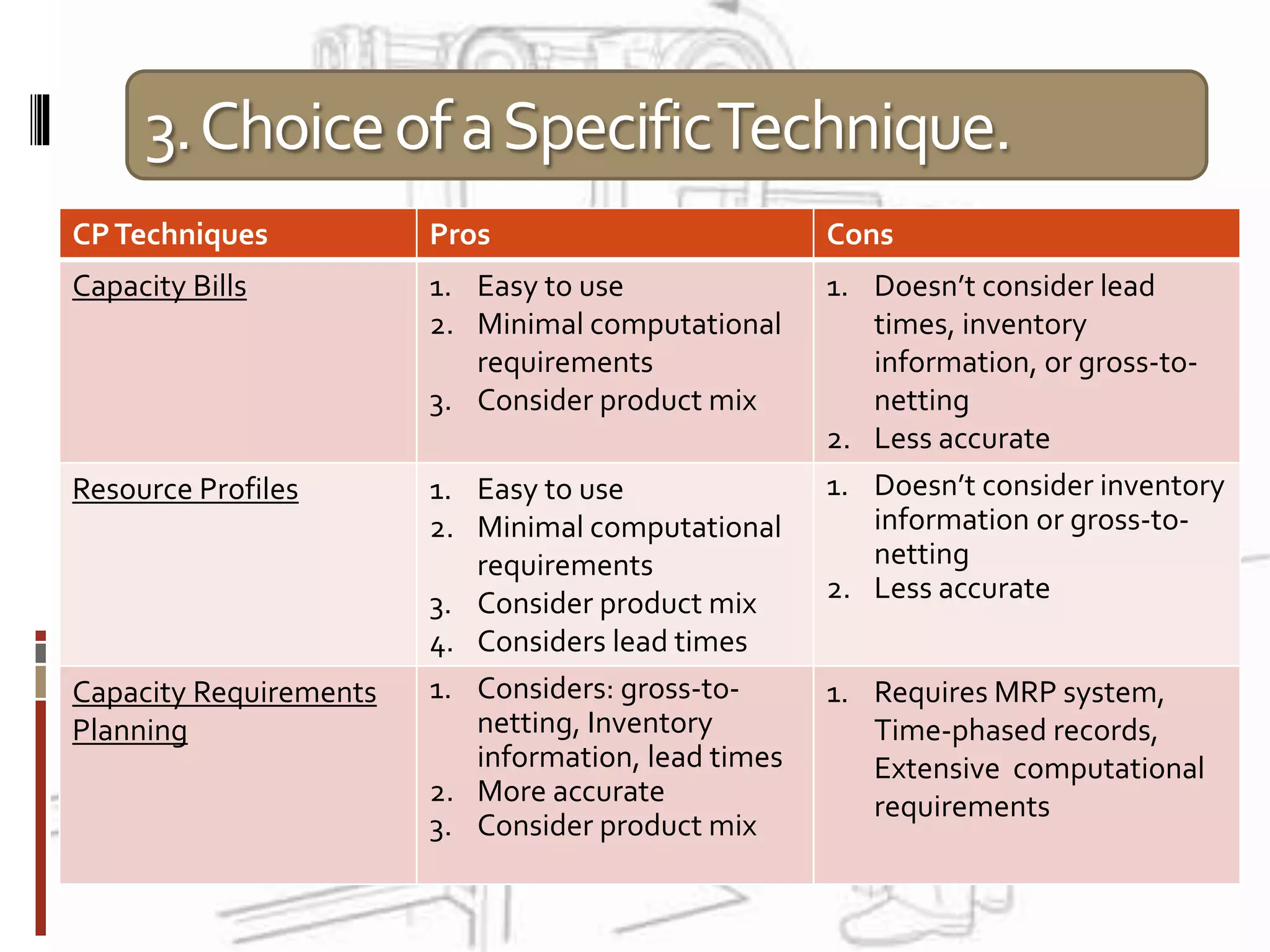
3. Choice of a SpecificTechnique
4. Using the Capacity Plan•Data Base Design Considerations
1. Capacity Planning at Montell USA, Inc.
2. Capacity Planning atTwin Disc
3. Capacity Planning at Applicon
1. Definition
CapacityPlanning
Capacity is defined as the ability to achieve, store or produce.
For an organization, capacity would be the ability of a given
system to produce output within the specific time period.
In operations, management capacity is referred as an amount
of the input resources available to produce relative output over
period of time.
In general, terms capacity is referred as maximum production
capacity, which can be attained within a normal working
schedule.
CapacityPlanning
Capacity planning is essential to be determining optimum
utilization of resource and plays an important role in decision-
making process.
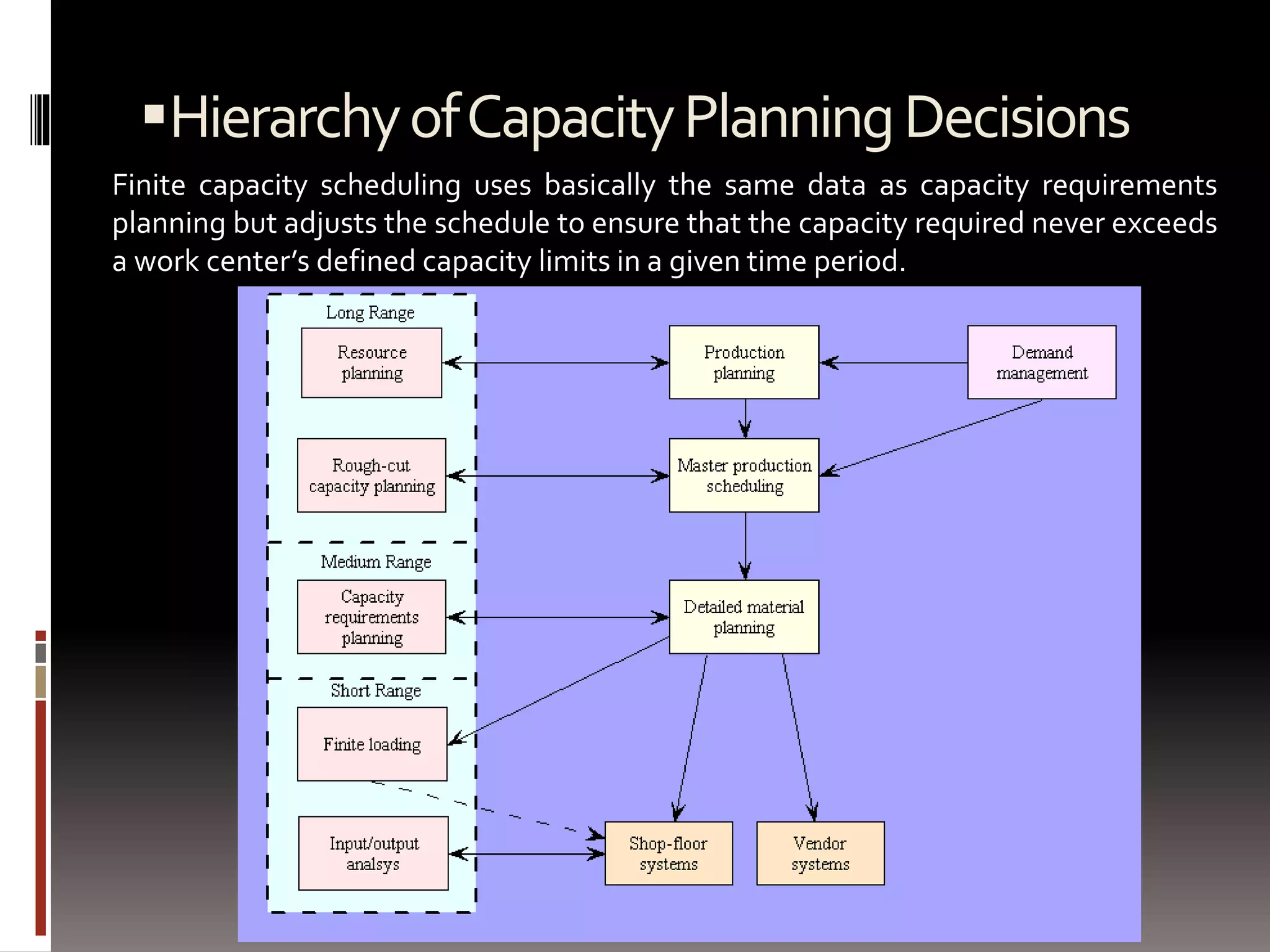
HierarchyofCapacityPlanningDecisions
Finite capacity scheduling uses basically the same data as capacity requirements
planning but adjusts the schedule to ensure that the capacity required never exceeds
a work center’s defined capacity limits in a given time period.
HierarchyofCapacityPlanningDecisions
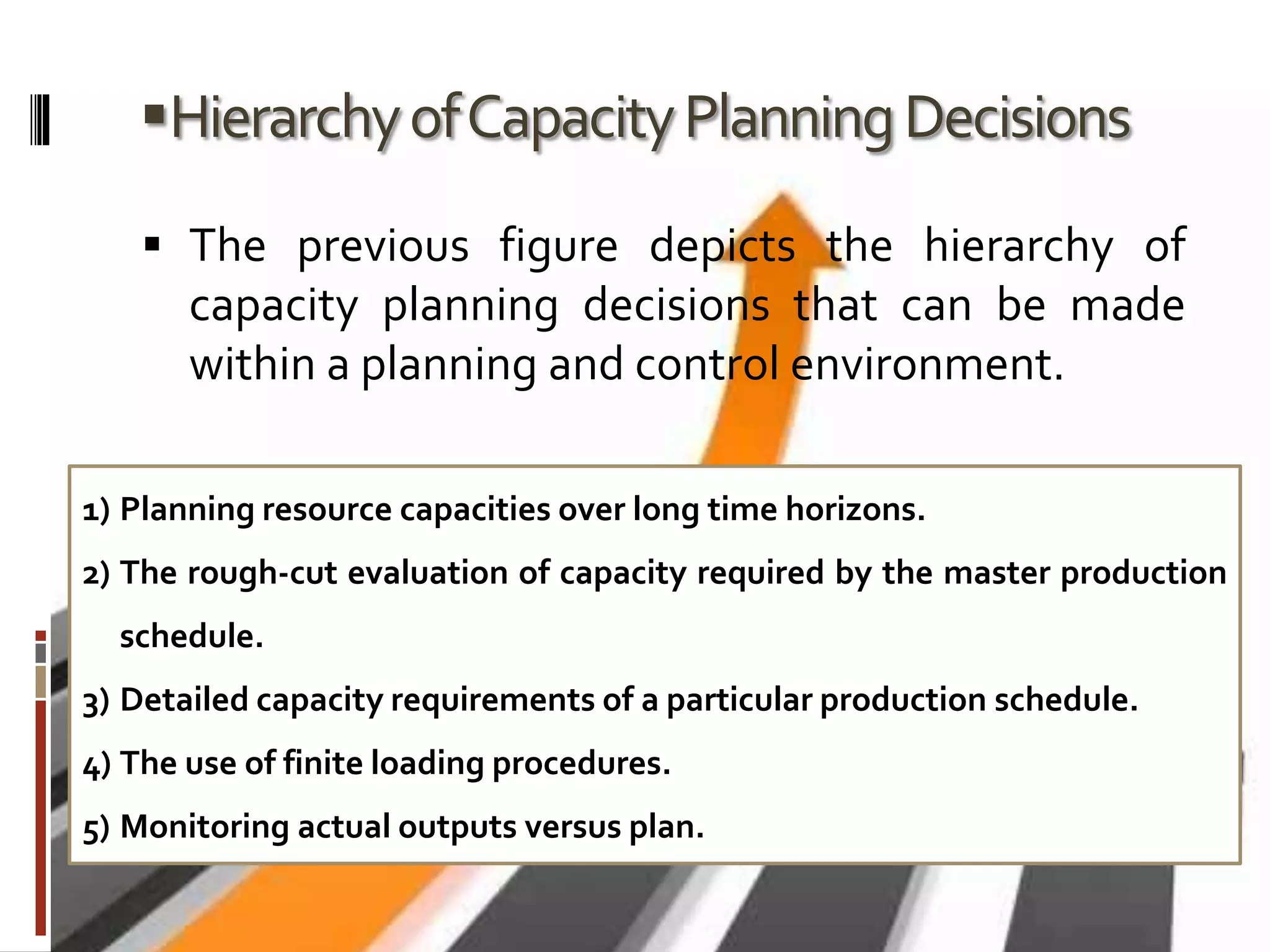
 The previous figure depicts the hierarchy of
capacity planning decisions that can be made
within a planning and control environment.
1) Planning resource capacities over long time horizons.
2) The rough-cut evaluation of capacity required by the master production
schedule.
3) Detailed capacity requirements of a particular production schedule.
4) The use of finite loading procedures.
5) Monitoring actual outputs versus plan.
LinkstoOtherMPCSystemModules
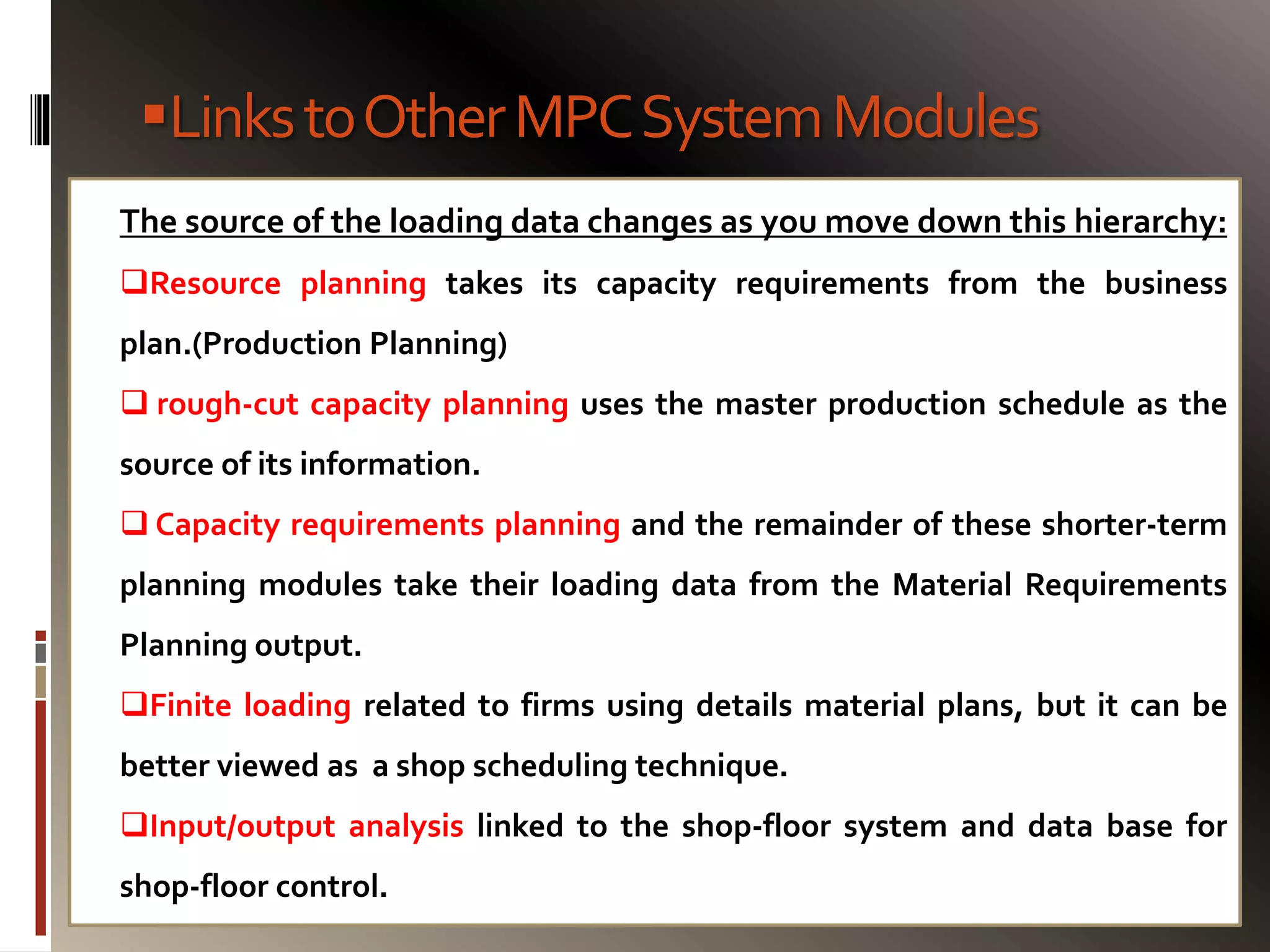
The source of the loading data changes as you move down this hierarchy:
Resource planning takes its capacity requirements from the business
plan.(Production Planning)
 rough-cut capacity planning uses the master production schedule as the
source of its information.
 Capacity requirements planning and the remainder of these shorter-term
planning modules take their loading data from the Material Requirements
Planning output.
Finite loading related to firms using details material plans, but it can be
better viewed as a shop scheduling technique.
Input/output analysis linked to the shop-floor system and data base for
shop-floor control.
CapacityPlanningandControlTechniques.
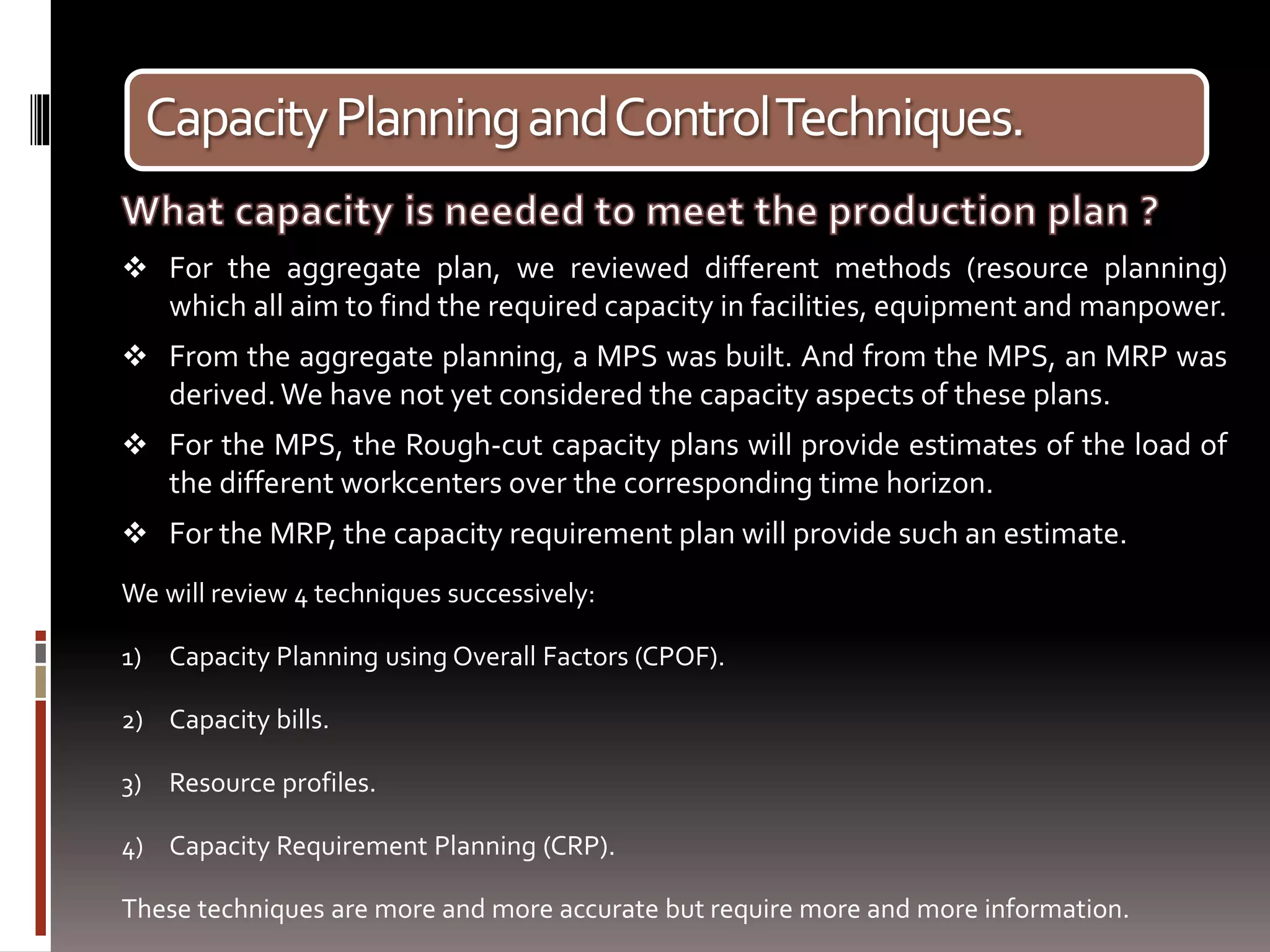
 For the aggregate plan, we reviewed different methods (resource planning)
which all aim to find the required capacity in facilities, equipment and manpower.
 From the aggregate planning, a MPS was built. And from the MPS, an MRP was
derived.We have not yet considered the capacity aspects of these plans.
 For the MPS, the Rough-cut capacity plans will provide estimates of the load of
the different workcenters over the corresponding time horizon.
 For the MRP, the capacity requirement plan will provide such an estimate.
We will review 4 techniques successively:
1) Capacity Planning using Overall Factors (CPOF).
2) Capacity bills.
3) Resource profiles.
4) Capacity Requirement Planning (CRP).
These techniques are more and more accurate but require more and more information.
1.CapacityPlanningusingOverallFactors(CPOF).
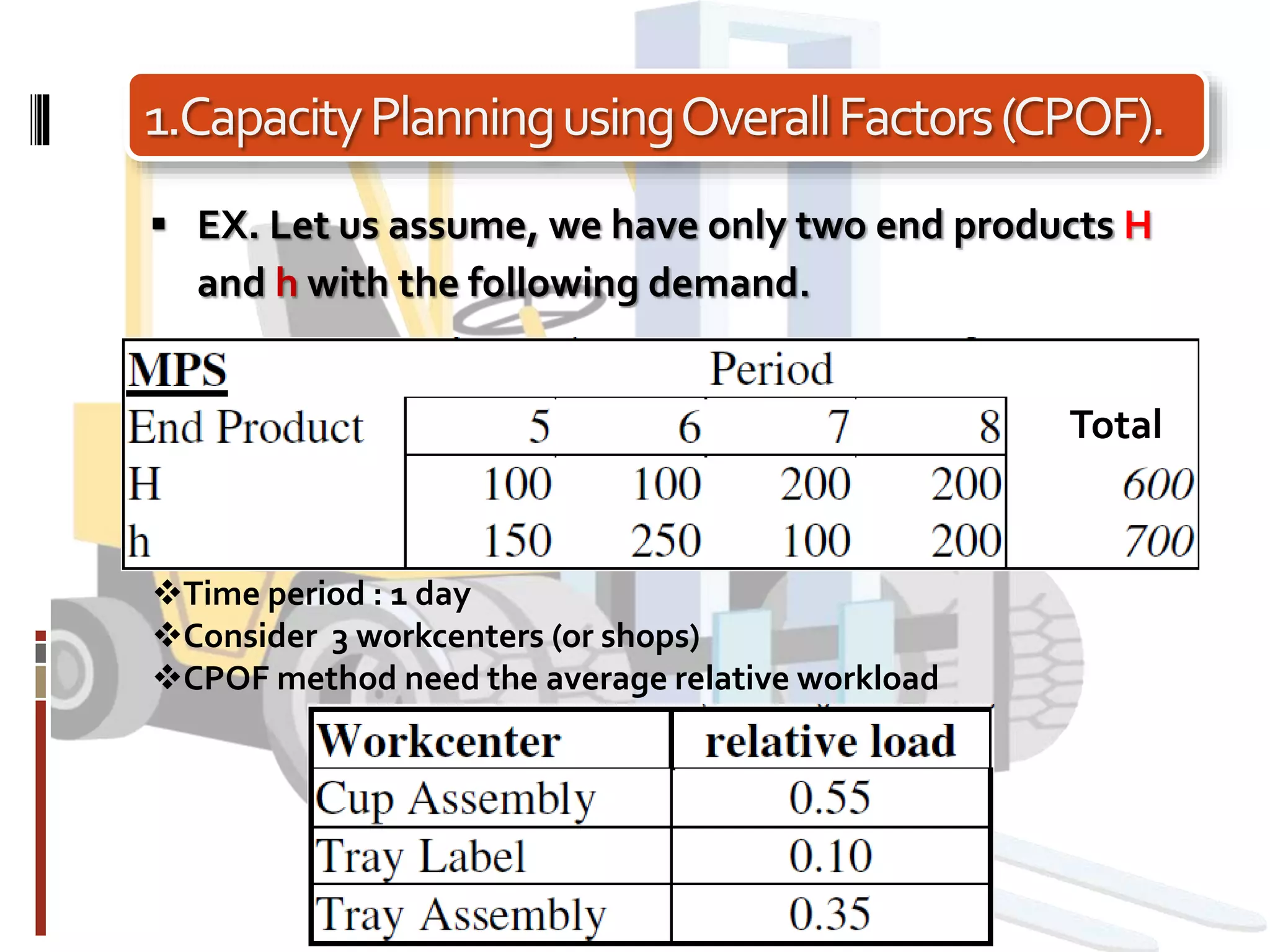
 EX. Let us assume, we have only two end products H
and h with the following demand.
Total
Time period : 1 day
Consider 3 workcenters (or shops)
CPOF method need the average relative workload
1.CapacityPlanningusingOverallFactors(CPOF).
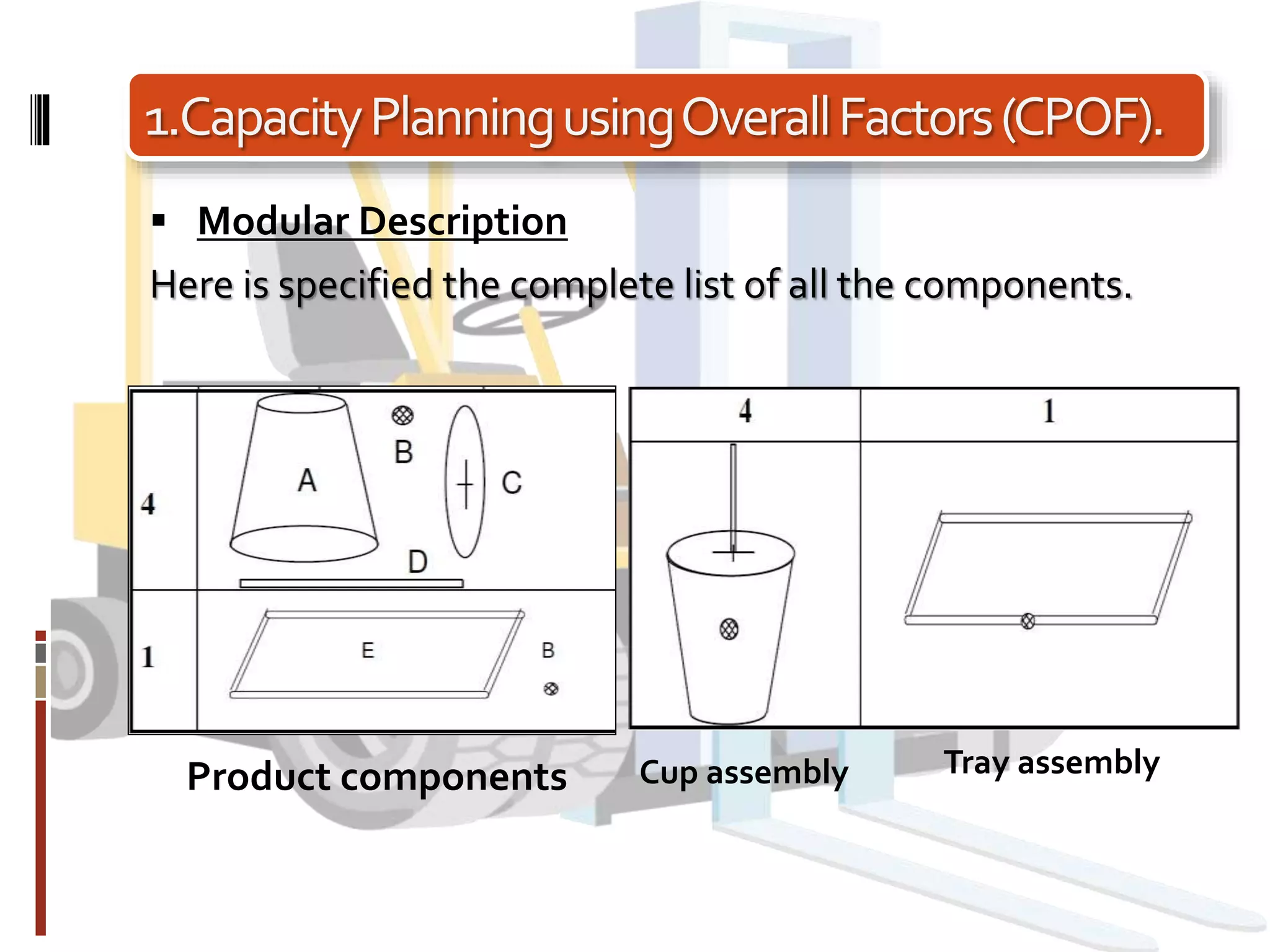
 Modular Description
Here is specified the complete list of all the components.
Product components Cup assembly Tray assembly
1.CapacityPlanningusingOverallFactors(CPOF).
 CPOF needTotal amount of resource for producing
one unit of each end products.
 Assume the unit to be the working hour.
1 H requires 0.15 hour = 9 min.
1 h requires 0.1 hour = 6 min.
Workcenter load = [(H total capacity/product)x(H product/period)
+ (h total capacity/product )x (h product/period)] x relative load Eq.1
1.CapacityPlanningusingOverallFactors(CPOF).
At period time 5
 Cup assembly = [9*100+6*150]*0.55 = 990 min = 990/60 = 16.5 hours
 Tray label = [9*100 +6*150]*0.10 = 180 min = 180/60 = 3 hours
 Tray assembly = [9*100+6*150]*.35= 630 min = 630/60 = 10.5 hours
 Total capacity = 16.5 + 3 + 10.5 =30 hours
 The same calc with period 6,7,8
The method implicitly assume that for every production hour, 55 % are spent at
the Cup Assembly, 35 % at the Tray Assembly and 10 % at the Tray Label.
Total
55%
10%
35%
Hours
2.CapacityBills.
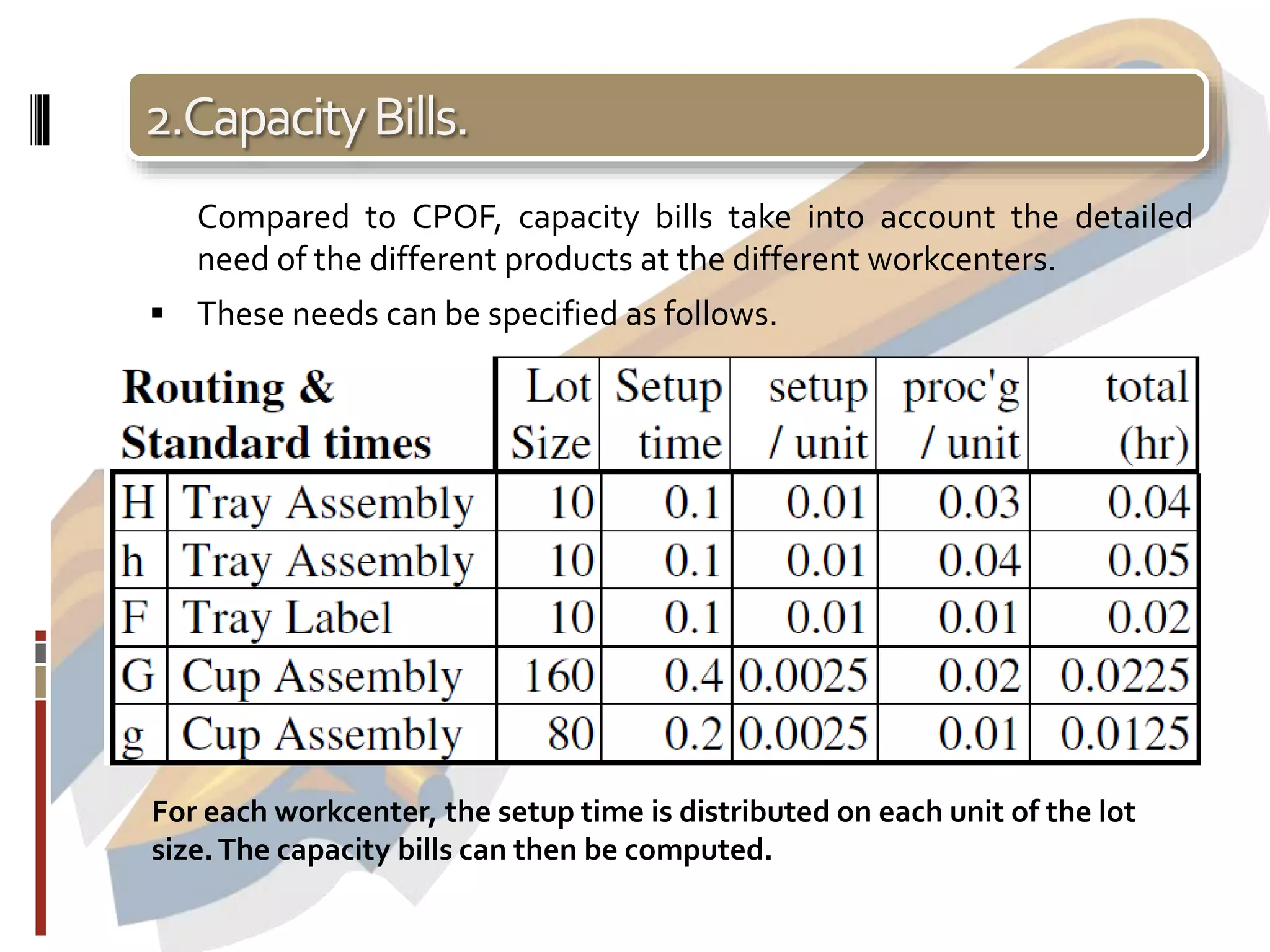
Compared to CPOF, capacity bills take into account the detailed
need of the different products at the different workcenters.
 These needs can be specified as follows.
For each workcenter, the setup time is distributed on each unit of the lot
size.The capacity bills can then be computed.
2.CapacityBills.
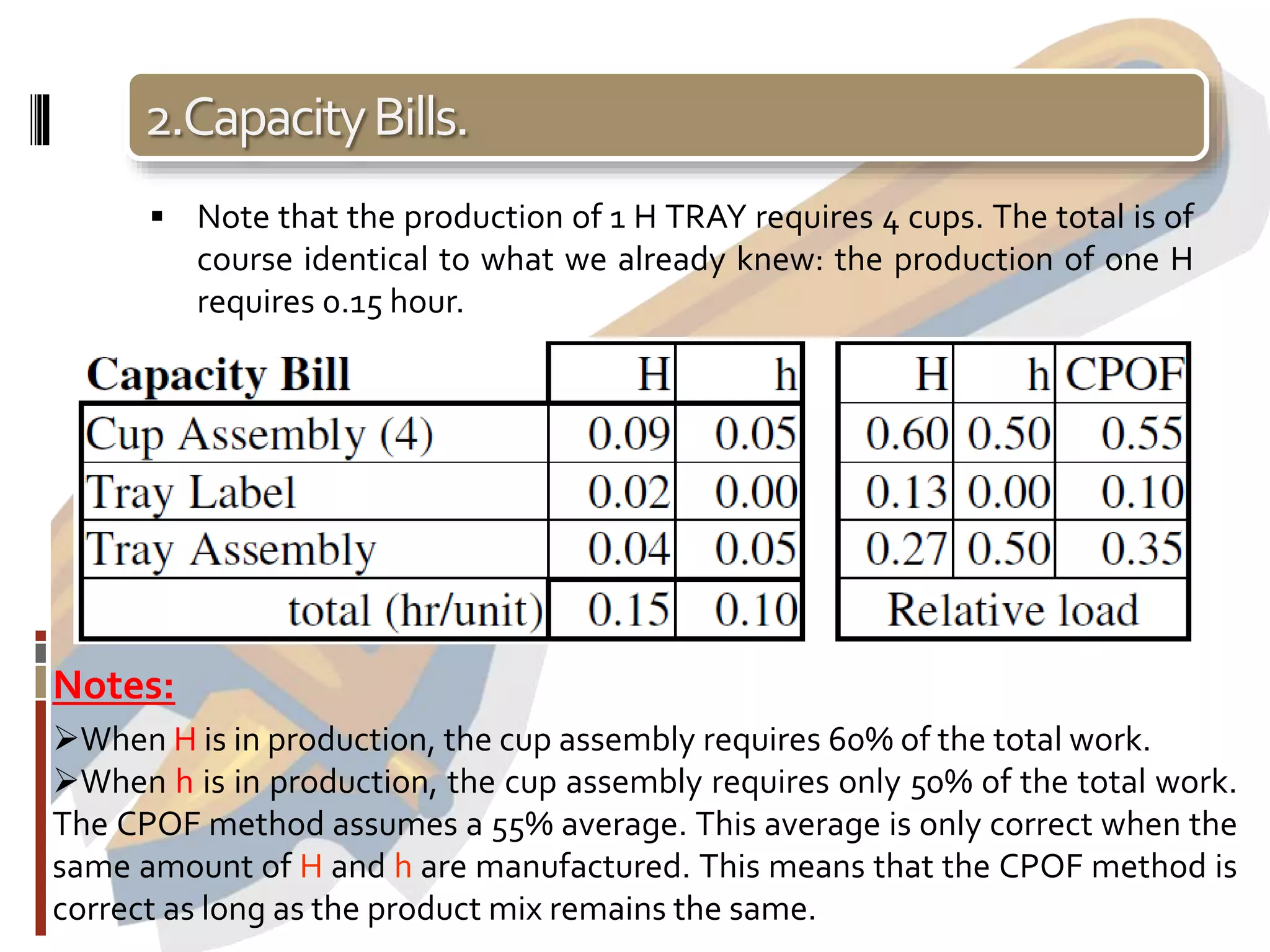
 Note that the production of 1 H TRAY requires 4 cups. The total is of
course identical to what we already knew: the production of one H
requires 0.15 hour.
Notes:
When H is in production, the cup assembly requires 60% of the total work.
When h is in production, the cup assembly requires only 50% of the total work.
The CPOF method assumes a 55% average. This average is only correct when the
same amount of H and h are manufactured. This means that the CPOF method is
correct as long as the product mix remains the same.
2.CapacityBills.
 Capacity requirements Using Capacity Bills
Workcenter load = [H capacity bill/product )x (H products/period)
+ (h capacity bill/product )x (h products/period)]  Eq.2
At period time 5
Cup assembly = [0.09*100+0.05*150] = 16.5 hours
Tray label = [0.02*100 +0*150] = 2 hours
Tray assembly = [0.04*100+0.1*150]= 11.5 hours
Hours
3.ResourceProfiles
 The idea here is to take the timing of the
different workcenters into account.
Example. The production of 100 H units in period 5
will lead to a workload of the workshops. However,
this load will not be in period 5 but earlier, maybe in
period 4 or 3 depending on the lead times.
3.ResourceProfiles
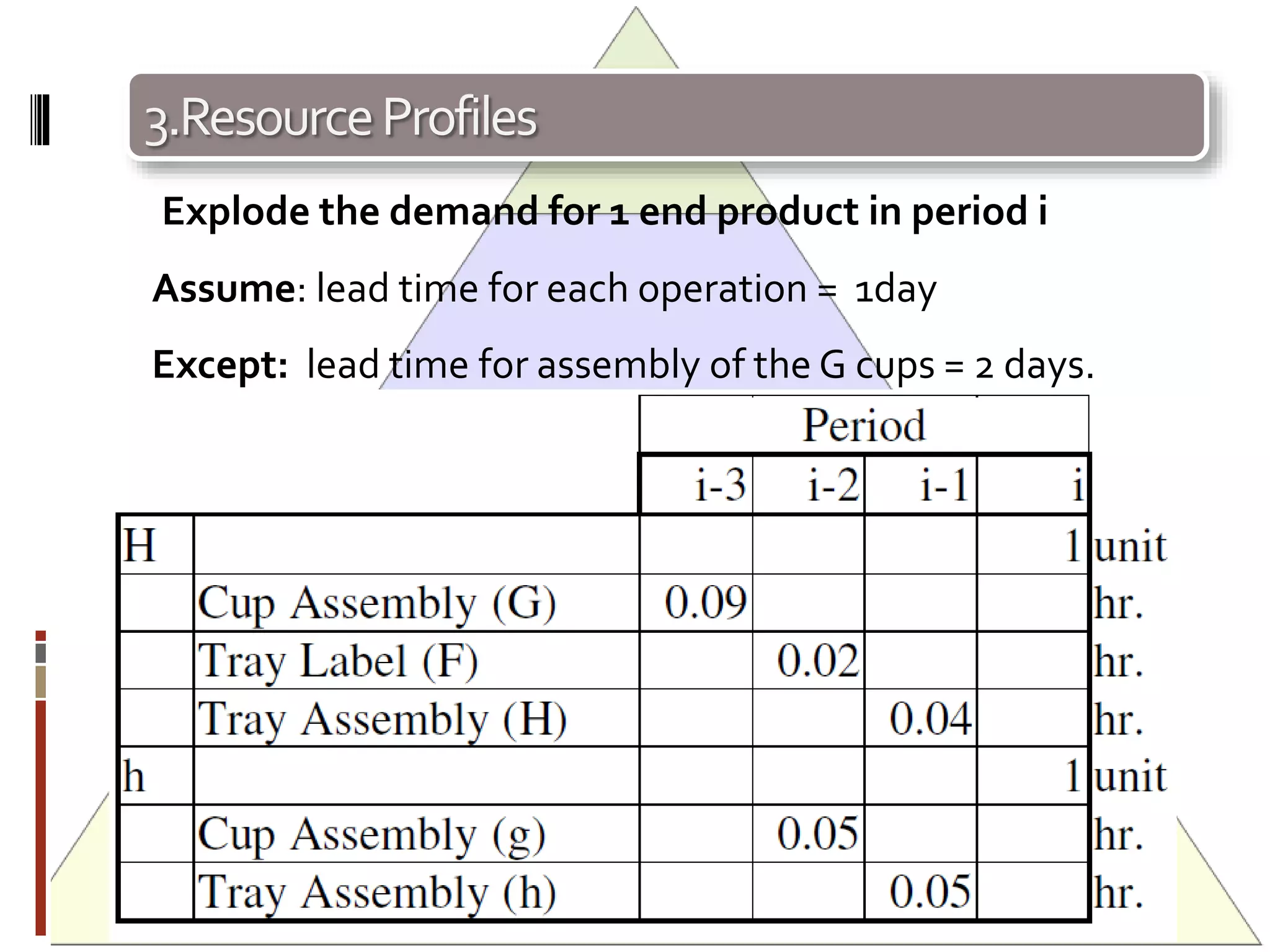
Explode the demand for 1 end product in period i
Assume: lead time for each operation = 1day
Except: lead time for assembly of the G cups = 2 days.
3.ResourceProfiles
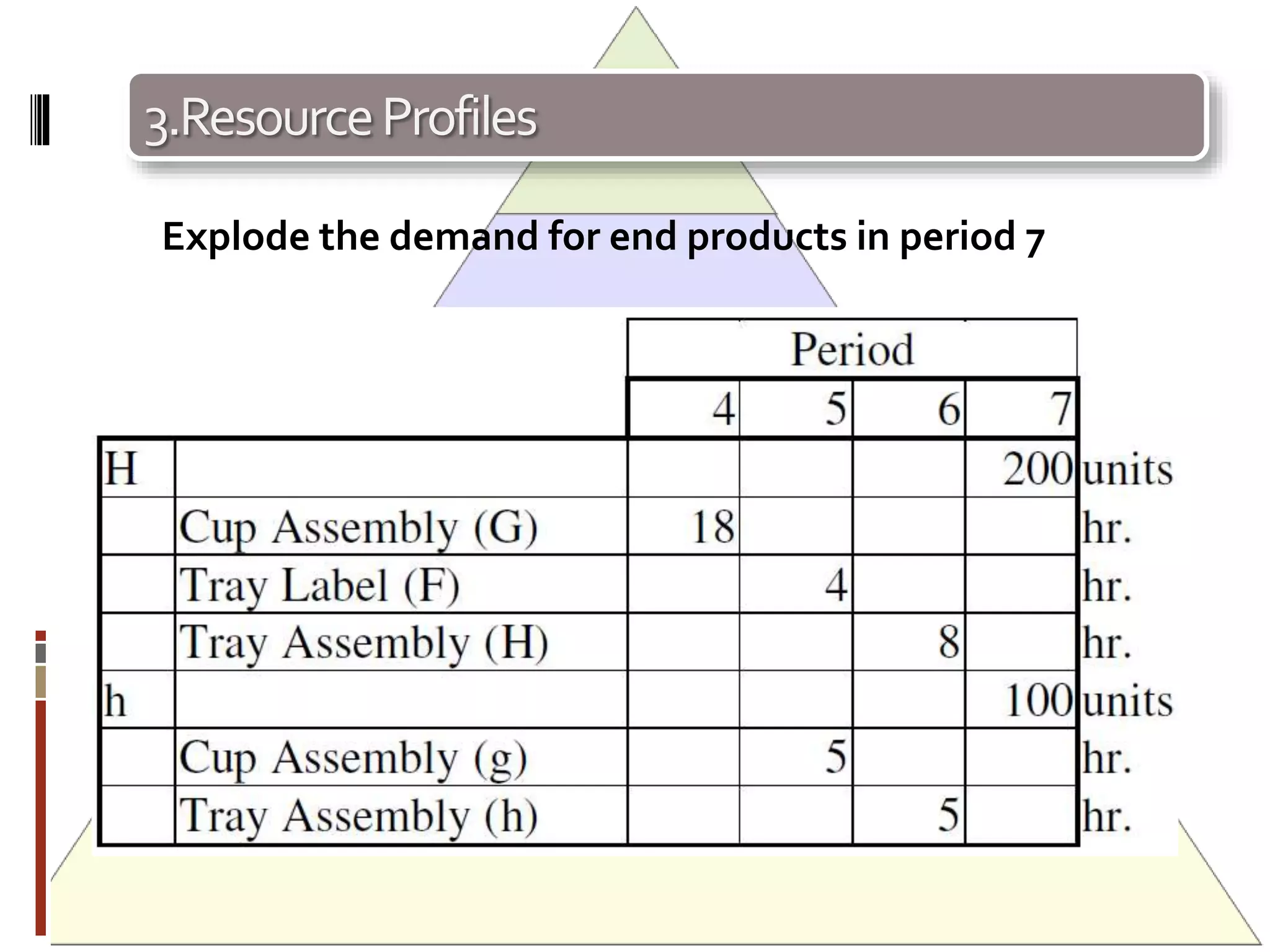
Explode the demand for end products in period 7
3.ResourceProfiles
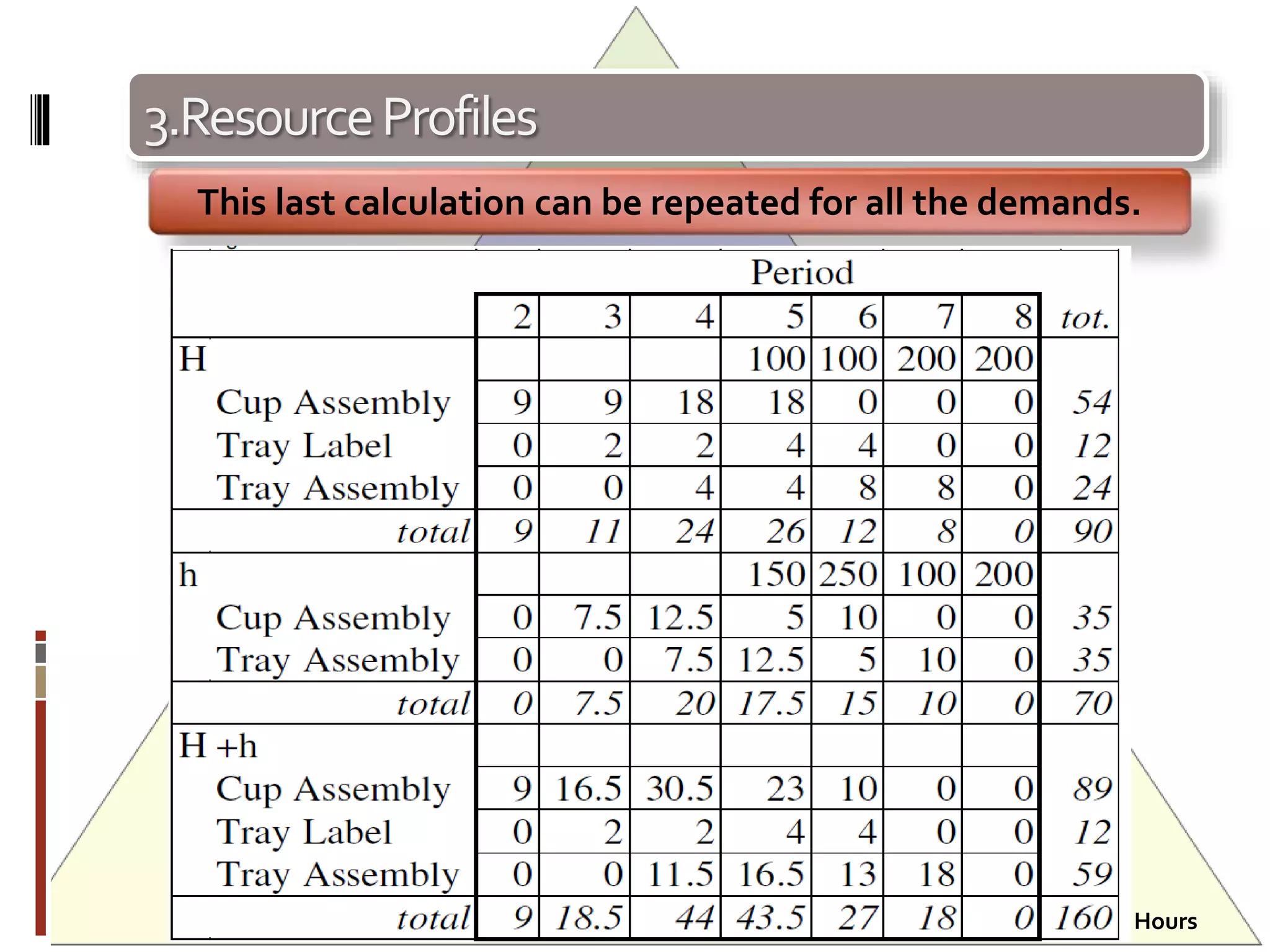
This last calculation can be repeated for all the demands.
Hours
4.CapacityRequirementsplanning
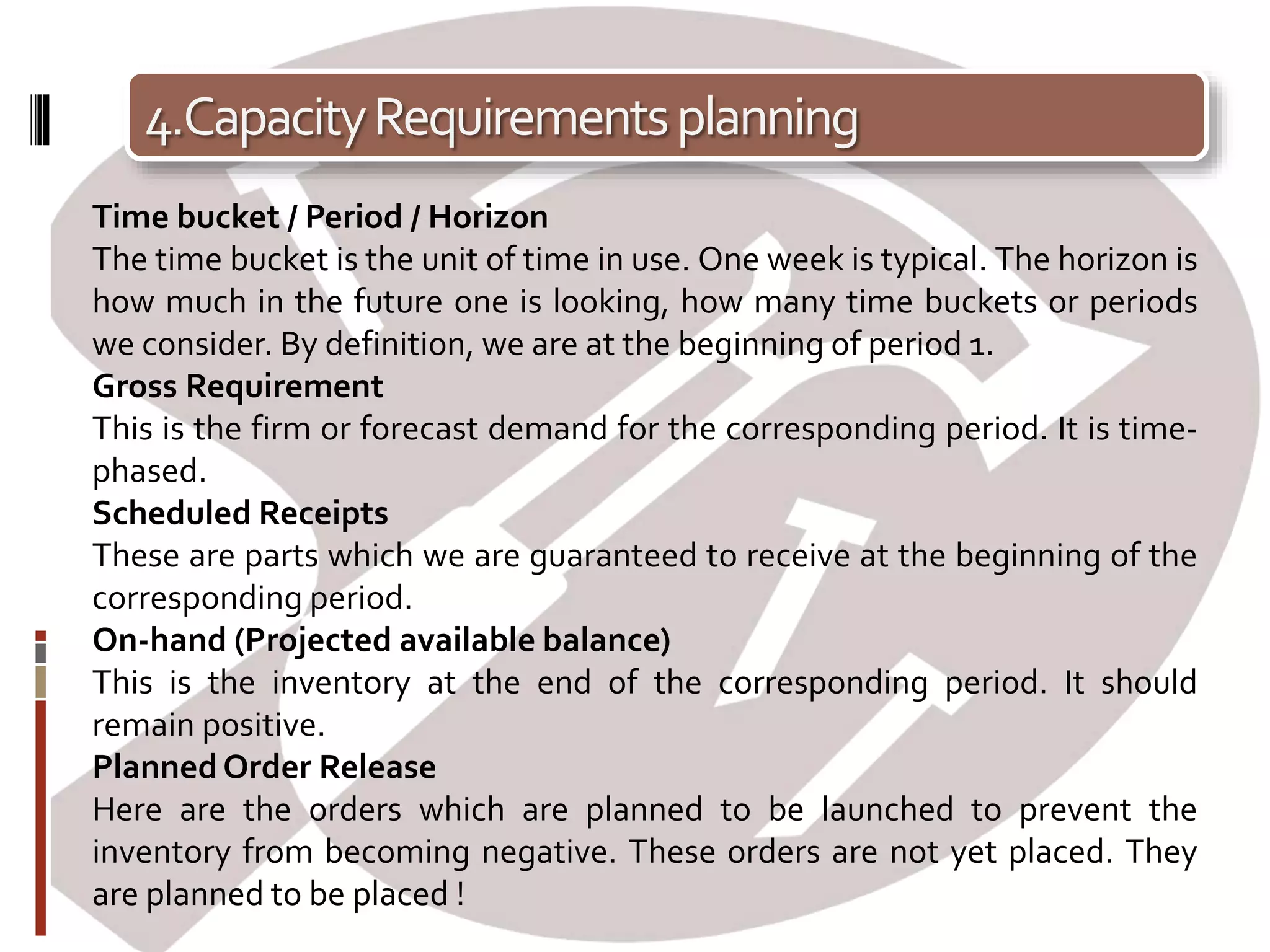
Time bucket / Period / Horizon
The time bucket is the unit of time in use. One week is typical. The horizon is
how much in the future one is looking, how many time buckets or periods
we consider. By definition, we are at the beginning of period 1.
Gross Requirement
This is the firm or forecast demand for the corresponding period. It is time-
phased.
Scheduled Receipts
These are parts which we are guaranteed to receive at the beginning of the
corresponding period.
On-hand (Projected available balance)
This is the inventory at the end of the corresponding period. It should
remain positive.
Planned Order Release
Here are the orders which are planned to be launched to prevent the
inventory from becoming negative. These orders are not yet placed. They
are planned to be placed !
4.CapacityRequirementsplanning
Lead time
This is the time required for an order to be completed. It is the time
between the moment an order is placed and the the moment the products
are delivered. It is made of 4 main parts.
Move - Queue - Setup - Run
Note that queuing time depends on the workload and on the schedule !
Safety time
This is a time which is added to the lead time for safety reasons, typically
when the lead time is not very reliable.
Lot size
This is the technique used for deciding how much to order. The "lot for lot"
technique means that we order exactly what is needed. Other methods are
reviewed at the end of the chapter.
Safety stock
By principle, an order is launched to prevent the inventory from becoming
negative. With a safety stock, an order is launched as soon as the inventory
would drop below this safety stock level. This security is often needed when
scrap is common.
4.CapacityRequirementsplanning
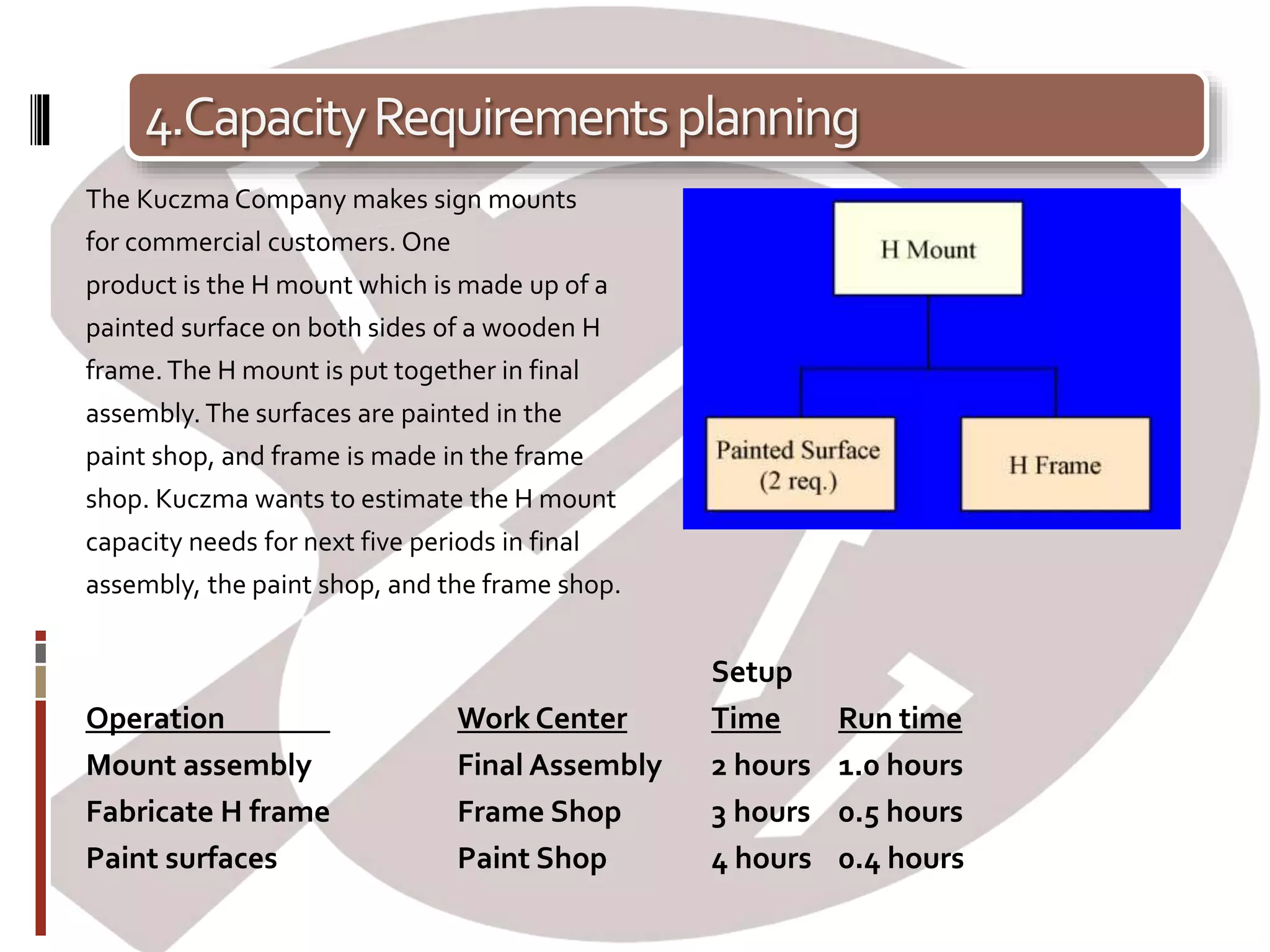
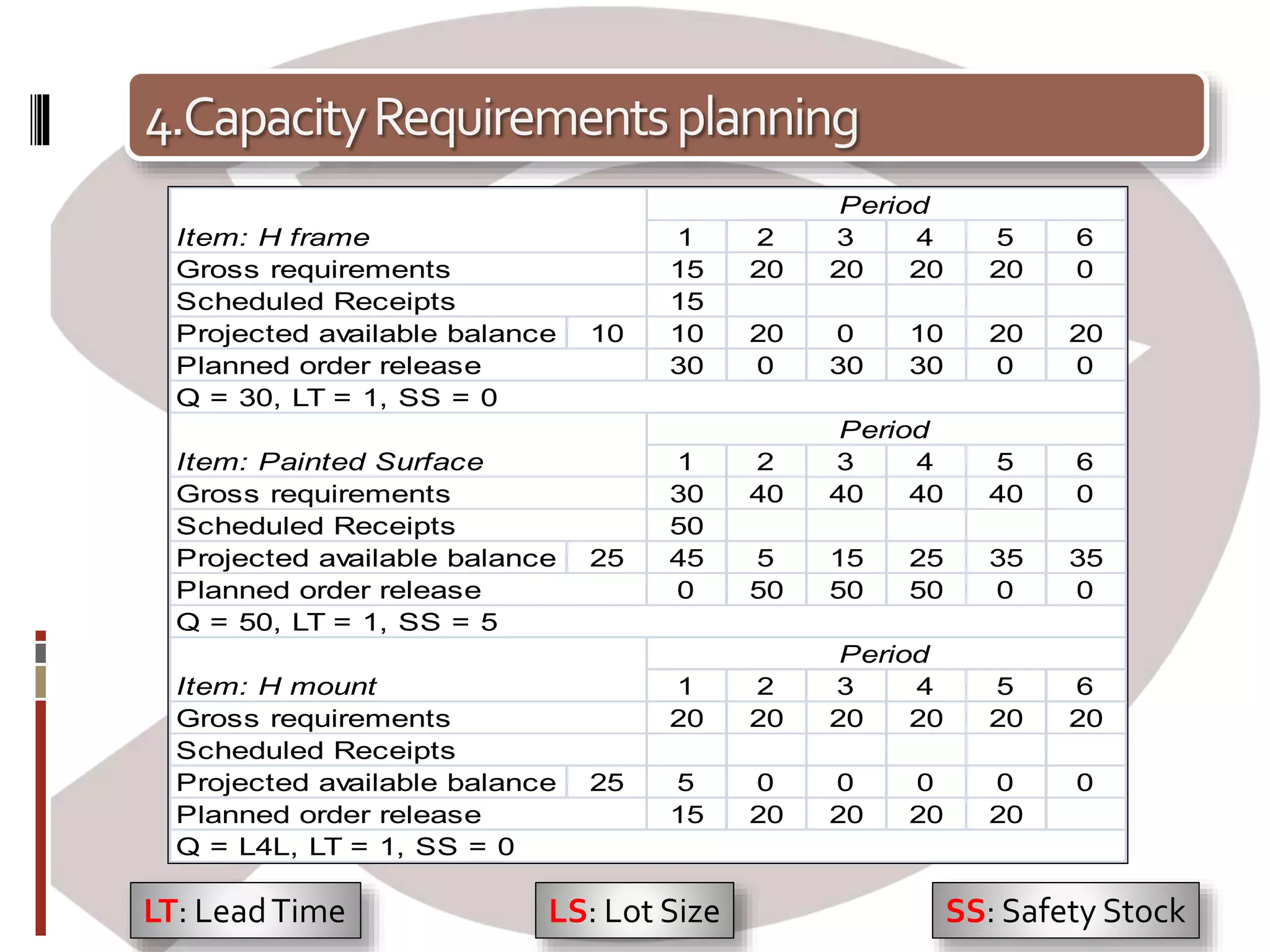
The Kuczma Company makes sign mounts
for commercial customers. One
product is the H mount which is made up of a
painted surface on both sides of a wooden H
frame. The H mount is put together in final
assembly. The surfaces are painted in the
paint shop, and frame is made in the frame
shop. Kuczma wants to estimate the H mount
capacity needs for next five periods in final
assembly, the paint shop, and the frame shop.
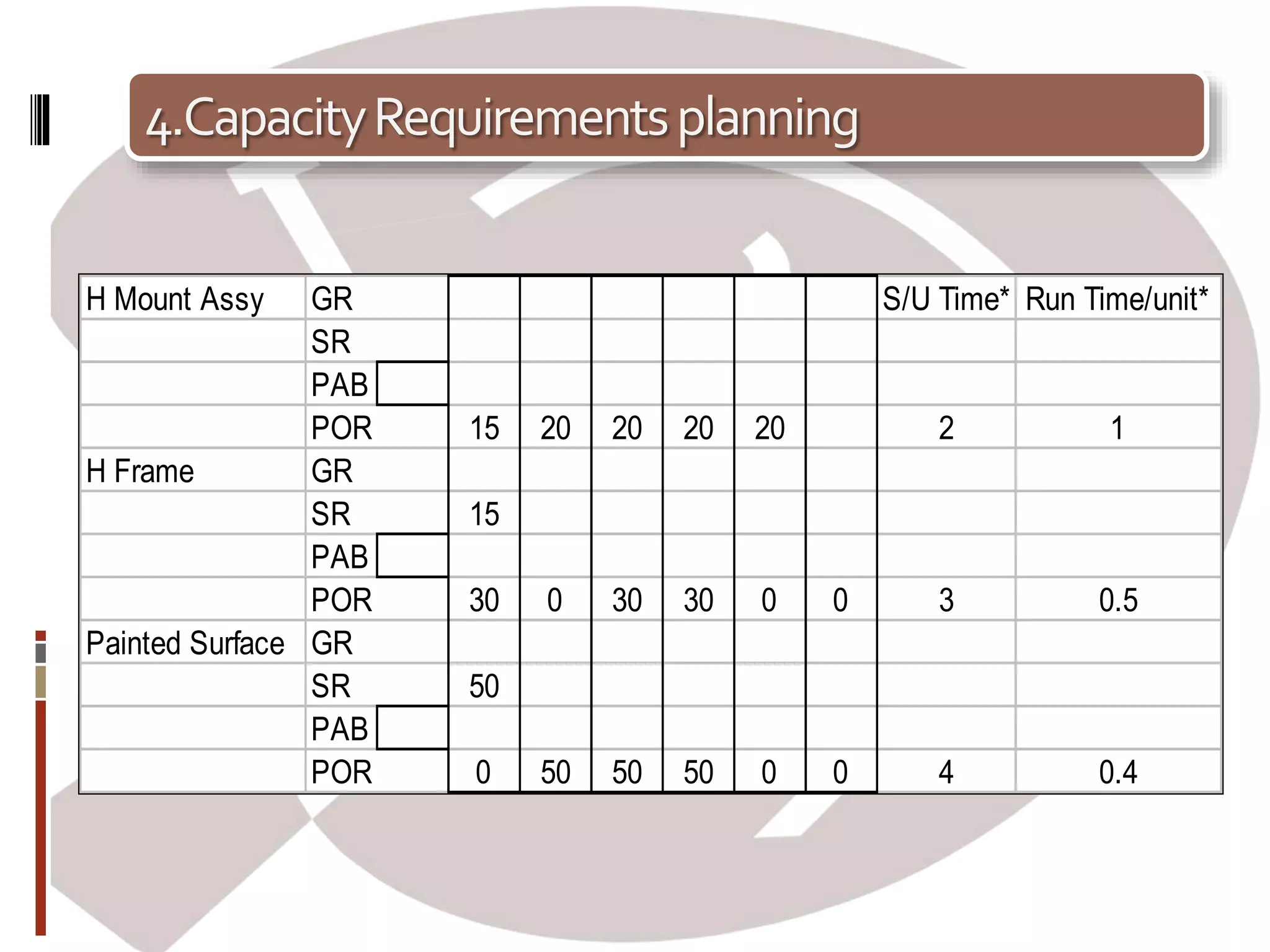
Setup
Operation Work Center Time Run time
Mount assembly Final Assembly 2 hours 1.0 hours
Fabricate H frame Frame Shop 3 hours 0.5 hours
Paint surfaces Paint Shop 4 hours 0.4 hours
4.CapacityRequirementsplanning
1 2 3 4 5 6
15 20 20 20 20 0
15
Projected available balance 10 10 20 0 10 20 20
30 0 30 30 0 0
1 2 3 4 5 6
30 40 40 40 40 0
50
Projected available balance 25 45 5 15 25 35 35
0 50 50 50 0 0
1 2 3 4 5 6
20 20 20 20 20 20
Projected available balance 25 5 0 0 0 0 0
15 20 20 20 20
Item: H frame
Period
Gross requirements
Scheduled Receipts
Gross requirements
Scheduled Receipts
Planned order release
Q = 50, LT = 1, SS = 5
Planned order release
Q = 30, LT = 1, SS = 0
Item: Painted Surface
Period
Planned order release
Q = L4L, LT = 1, SS = 0
Item: H mount
Period
Gross requirements
Scheduled Receipts
LT: LeadTime LS: Lot Size SS: Safety Stock
4.CapacityRequirementsplanning
H Mount Assy S/U Time* Run Time/unit*
PAB
15 20 20 20 20 2 1
H Frame
15
PAB
30 0 30 30 0 0 3 0.5
Painted Surface
50
PAB
0 50 50 50 0 0 4 0.4
GR
SR
POR
GR
SR
POR
GR
SR
POR
4.CapacityRequirementsplanning
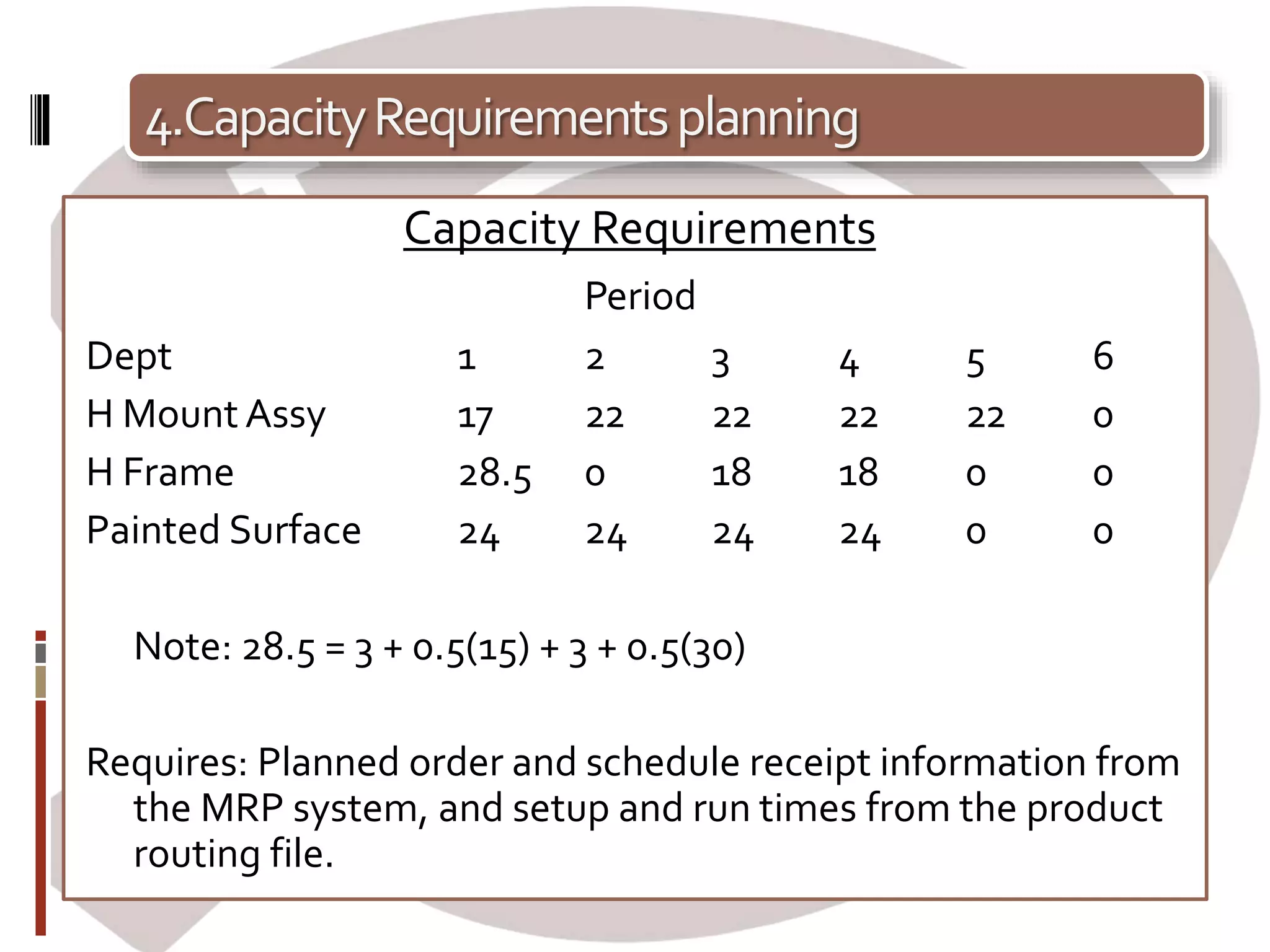
Capacity Requirements
Period
Dept 1 2 3 4 5 6
H Mount Assy 17 22 22 22 22 0
H Frame 28.5 0 18 18 0 0
Painted Surface 24 24 24 24 0 0
Note: 28.5 = 3 + 0.5(15) + 3 + 0.5(30)
Requires: Planned order and schedule receipt information from
the MRP system, and setup and run times from the product
routing file.
5.Input/outputcontrol.
Input-output Control is a technique that allows operation to manage facility work
flow.
It is used to control the size of the queues in front of work centers, thereby helping to
control manufacturing lead times. Refer to as "push system" of linking work centers.
When a batch of items is completed at one work centre, it is pushed to the next work
centre, where it waits in a queue until it is selected to be worked at that work centre.
Input-output Control is important because it is a form of queue control, and a great
portion of the time that a job spends in a plant is spent waiting in queues. In many
job shops and batch manufacturing factories 80 to 95 percent of the total time is
queue time.
5.Input/outputcontrol.
Advantages of using Input-output Control
Customer service may improve due to the items or products are produced
on time.
Efficiency may be improved because of the less work-in-process in
cluttering the work centre and adding to overhead costs.
Quality may be improved because less work-in-process hides fewer
problems.
1.CapacityPlanningInMPCSystem
 From Hierarchy of Capacity Planning figure there
are relationship between MPC framework and
various capacity planning modules (five modules
range [long range –day to day] ):
o Vertical relationship among the capacity
planning modules
o Horizontal relationship with the material
planning modules of the MPC system .
1.CapacityPlanningInMPCSystem
These relationships can affect managerial
choices for capacity planning systems
design and use in a specific firm.
1.CapacityPlanningInMPCSystem
To illustrate the importance of cps, let consider the impact of
production planning and resource planning decisions on short-
term capacity planning decisions.
To extent the production planning and resource planning are
done well, problems faced in capacity planning can be reduced,
since appropriate resources have been provided.
1.CapacityPlanningInMPCSystem
For example: the production plan specifies a very
stable rate of output, then changes in MPS
requiring capacity changes are minimal .
If the material planning modules functions
effectively, the MPS will be converted into detailed
component production plans with relatively few
unexpected execution problems.
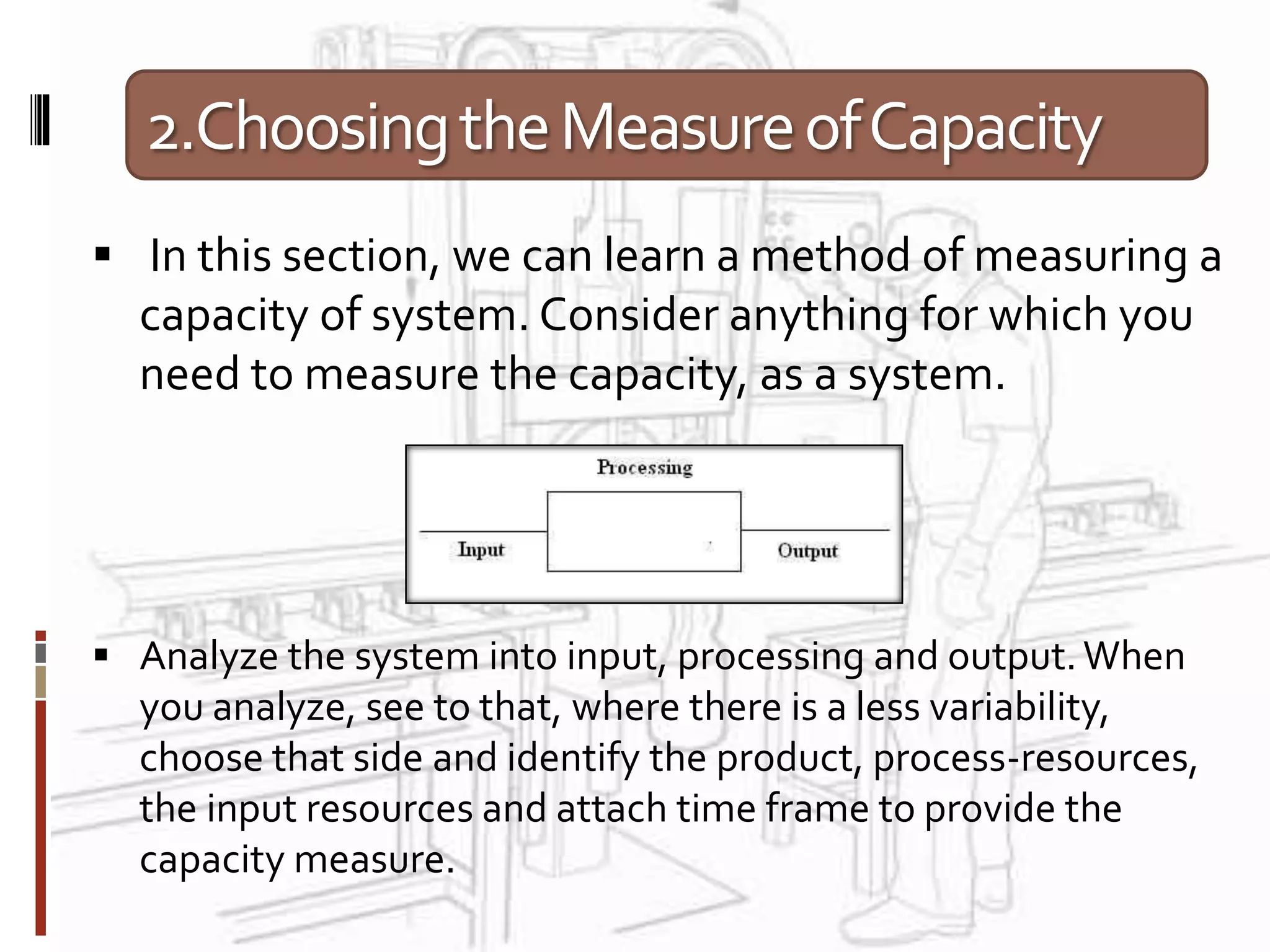
2.ChoosingtheMeasureofCapacity
 In this section, we can learn a method of measuring a
capacity of system. Consider anything for which you
need to measure the capacity, as a system.
 Analyze the system into input, processing and output.When
you analyze, see to that, where there is a less variability,
choose that side and identify the product, process-resources,
the input resources and attach time frame to provide the
capacity measure.
2.ChoosingtheMeasureofCapacity
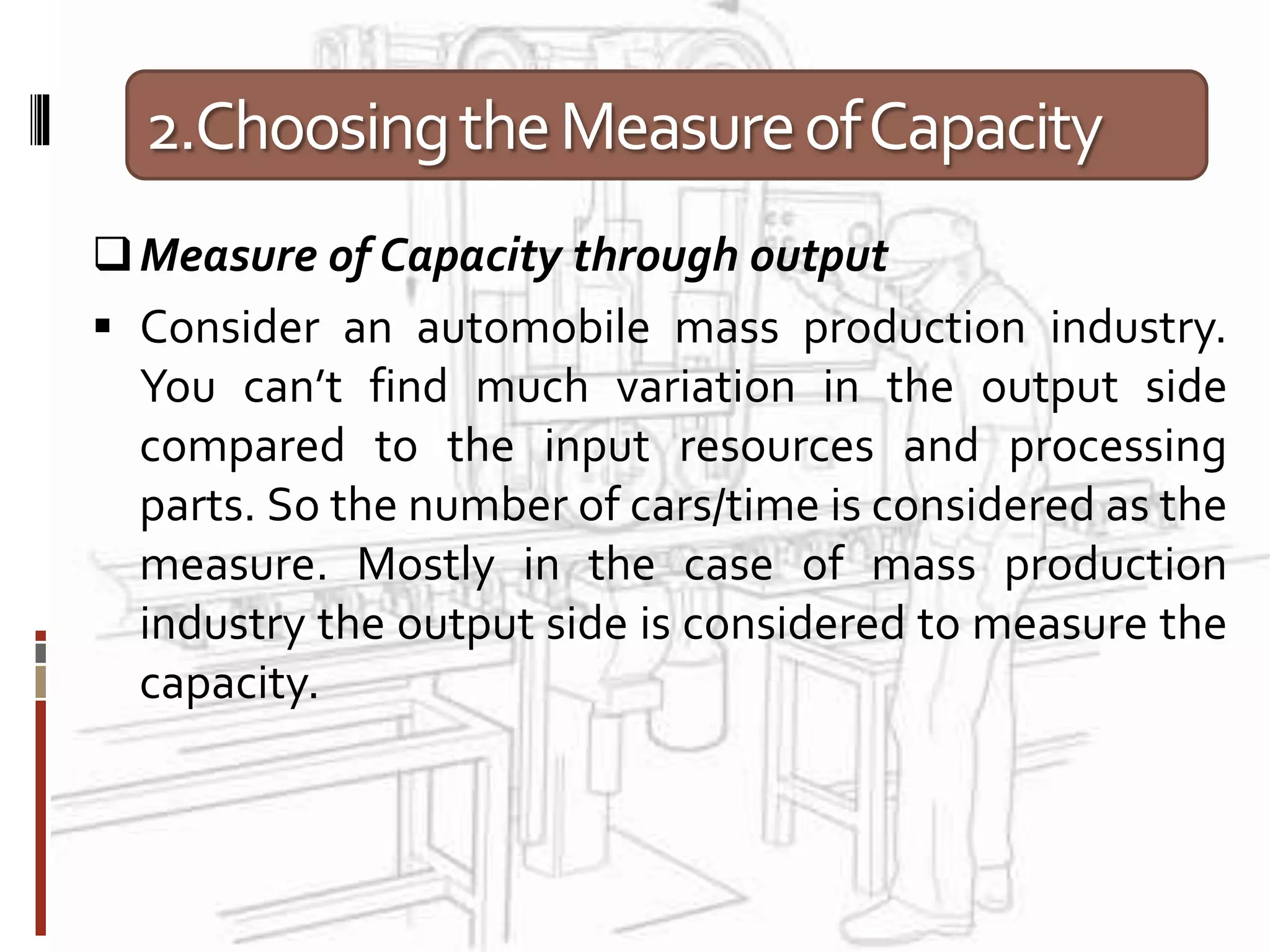
Measure of Capacity through output
 Consider an automobile mass production industry.
You can’t find much variation in the output side
compared to the input resources and processing
parts. So the number of cars/time is considered as the
measure. Mostly in the case of mass production
industry the output side is considered to measure the
capacity.
2.ChoosingtheMeasureofCapacity
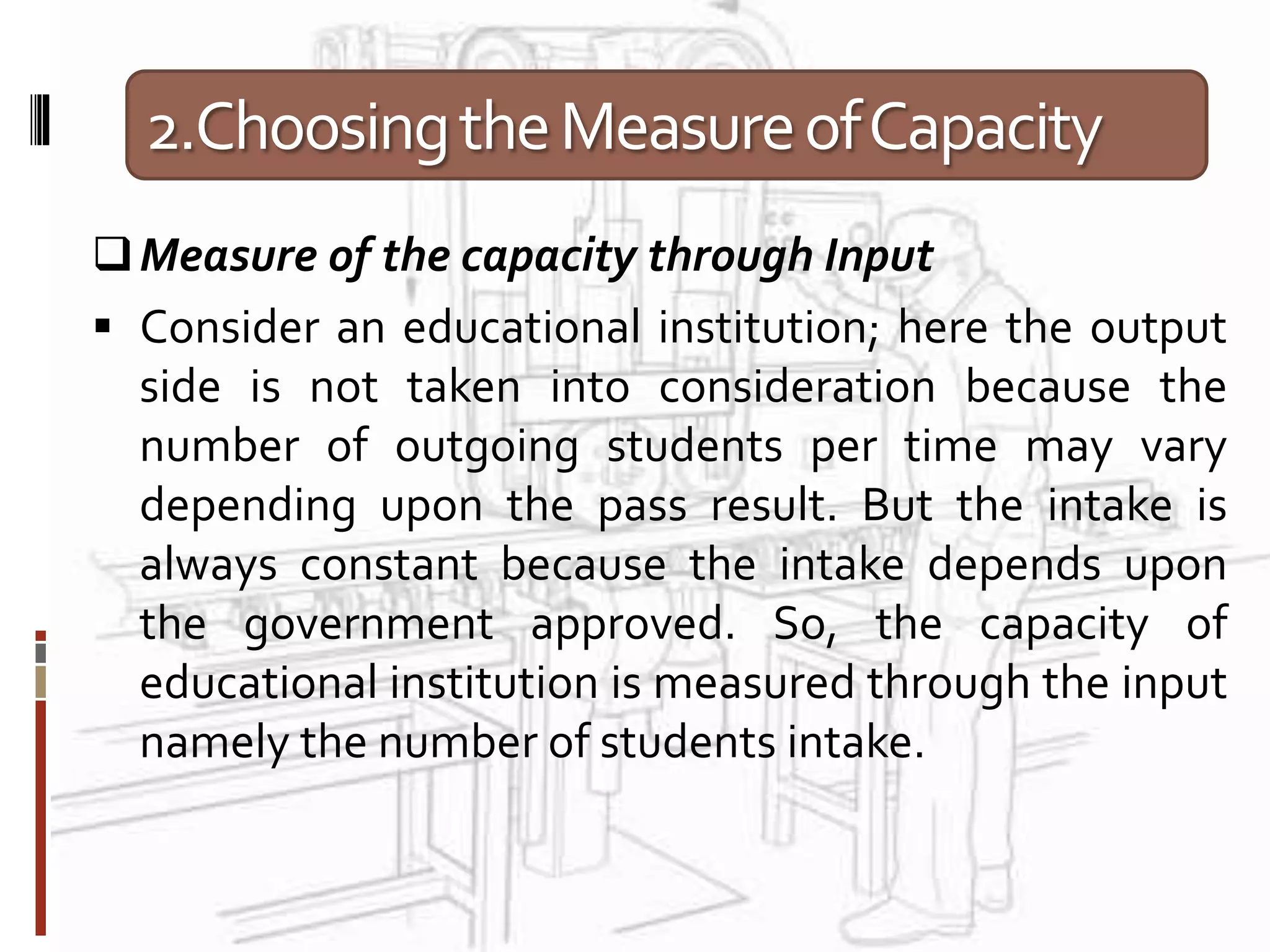
Measure of the capacity through Input
 Consider an educational institution; here the output
side is not taken into consideration because the
number of outgoing students per time may vary
depending upon the pass result. But the intake is
always constant because the intake depends upon
the government approved. So, the capacity of
educational institution is measured through the input
namely the number of students intake.
2.ChoosingtheMeasureofCapacity
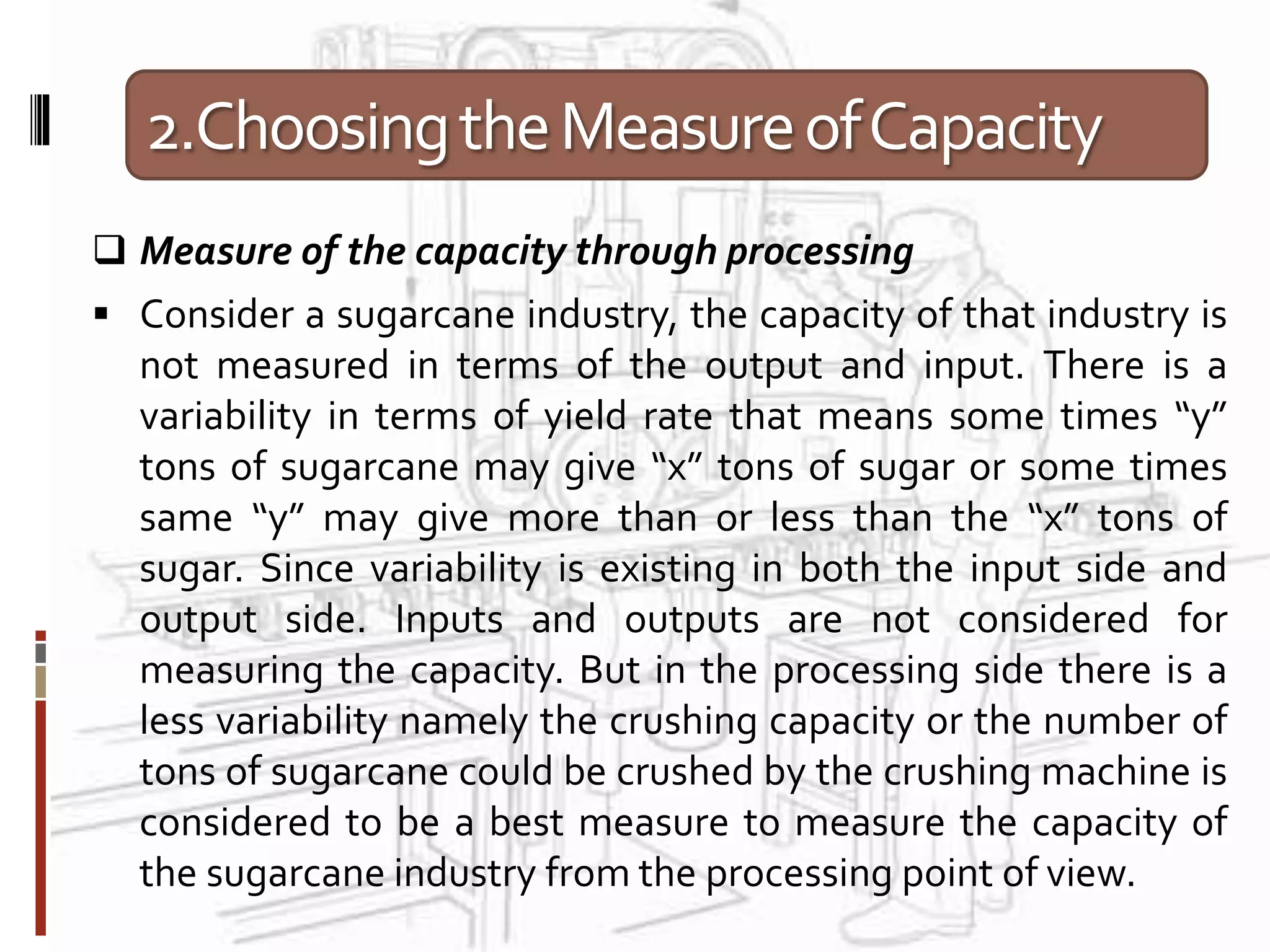
 Measure of the capacity through processing
 Consider a sugarcane industry, the capacity of that industry is
not measured in terms of the output and input. There is a
variability in terms of yield rate that means some times “y”
tons of sugarcane may give “x” tons of sugar or some times
same “y” may give more than or less than the “x” tons of
sugar. Since variability is existing in both the input side and
output side. Inputs and outputs are not considered for
measuring the capacity. But in the processing side there is a
less variability namely the crushing capacity or the number of
tons of sugarcane could be crushed by the crushing machine is
considered to be a best measure to measure the capacity of
the sugarcane industry from the processing point of view.
2.ChoosingtheMeasureofCapacity
System Components of System
considered for capacity measure
Unit of Measure
Automobile Industry
Bottling Plant
University
Auto repair shop
Restaurant
Output
Output
Input
Processing
Processing
Number of Automobiles
Gallons / Day
Number of students intake
per year
Number of machines hour
per day
Seating Capacity
The table provides some of the systems and their corresponding
measure to measure the capacity.
2.ChoosingtheMeasureofCapacity
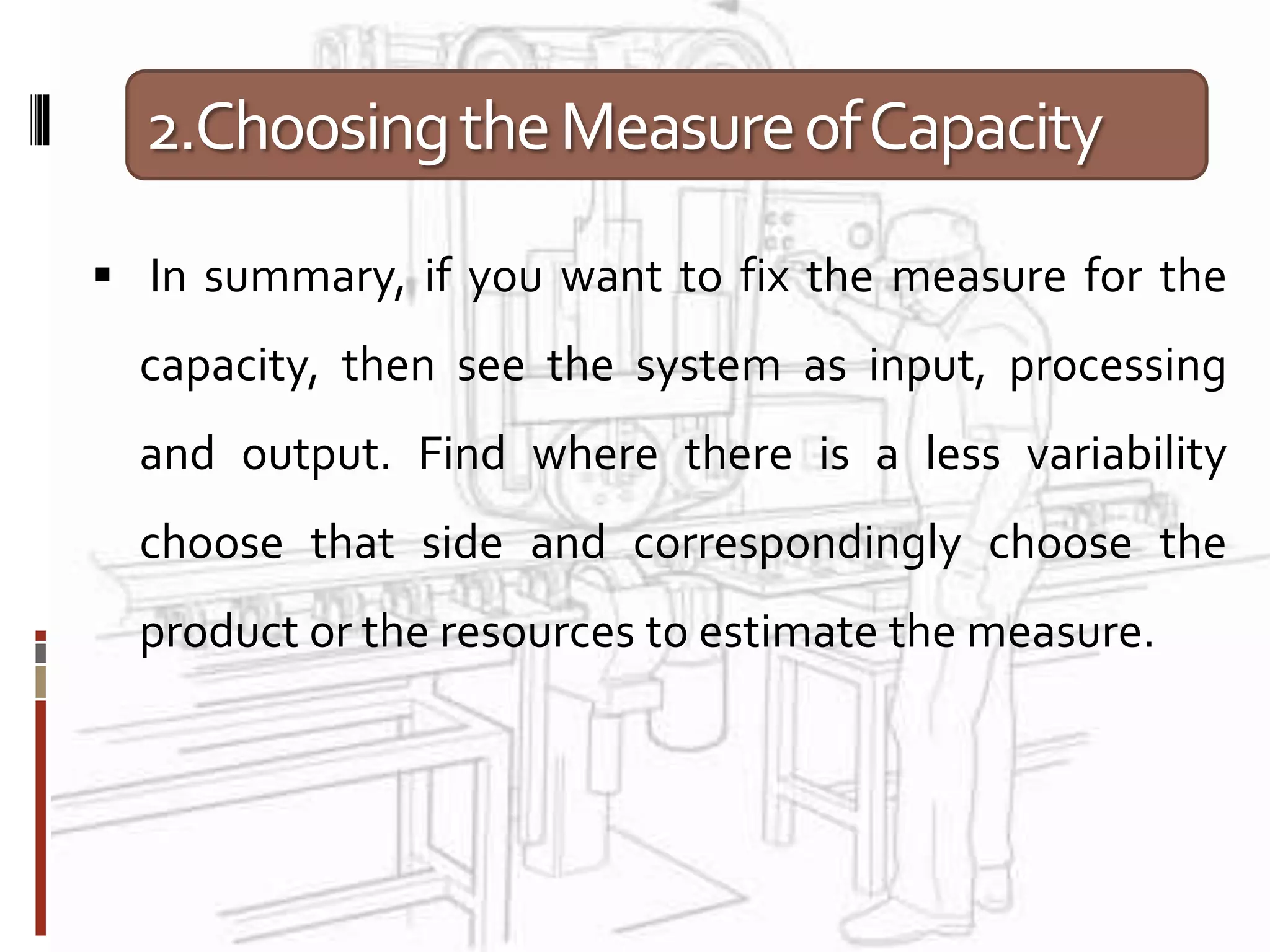
 In summary, if you want to fix the measure for the
capacity, then see the system as input, processing
and output. Find where there is a less variability
choose that side and correspondingly choose the
product or the resources to estimate the measure.
3.ChoiceofaSpecificTechnique.
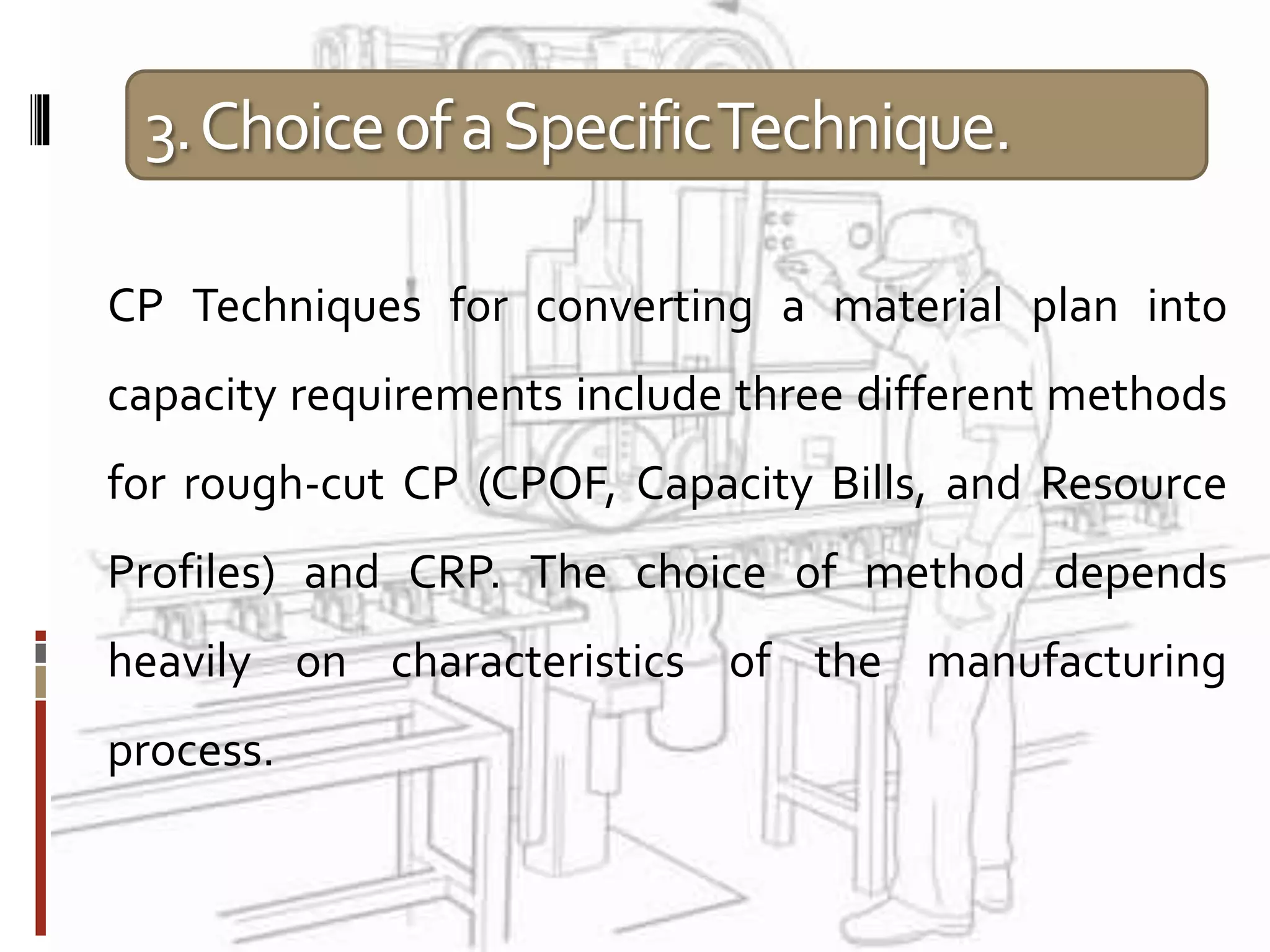
CP Techniques for converting a material plan into
capacity requirements include three different methods
for rough-cut CP (CPOF, Capacity Bills, and Resource
Profiles) and CRP. The choice of method depends
heavily on characteristics of the manufacturing
process.
3.ChoiceofaSpecificTechnique.
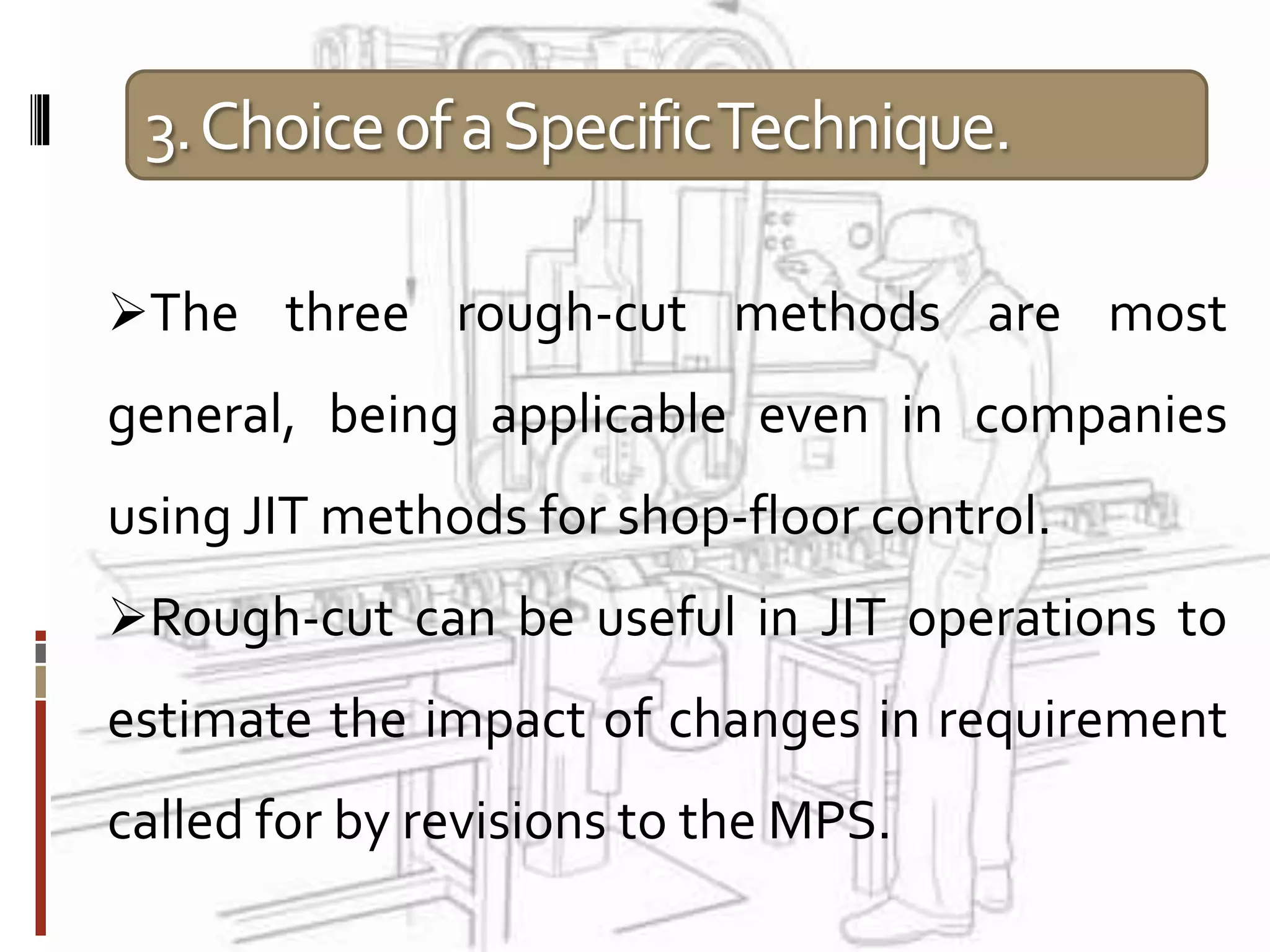
The three rough-cut methods are most
general, being applicable even in companies
using JIT methods for shop-floor control.
Rough-cut can be useful in JIT operations to
estimate the impact of changes in requirement
called for by revisions to the MPS.
3.ChoiceofaSpecificTechnique.
CPTechniques Pros Cons
Capacity Bills 1. Easy to use
2. Minimal computational
requirements
3. Consider product mix
1. Doesn’t consider lead
times, inventory
information, or gross-to-
netting
2. Less accurate
Resource Profiles 1. Easy to use
2. Minimal computational
requirements
3. Consider product mix
4. Considers lead times
1. Doesn’t consider inventory
information or gross-to-
netting
2. Less accurate
Capacity Requirements
Planning
1. Considers: gross-to-
netting, Inventory
information, lead times
2. More accurate
3. Consider product mix
1. Requires MRP system,
Time-phased records,
Extensive computational
requirements
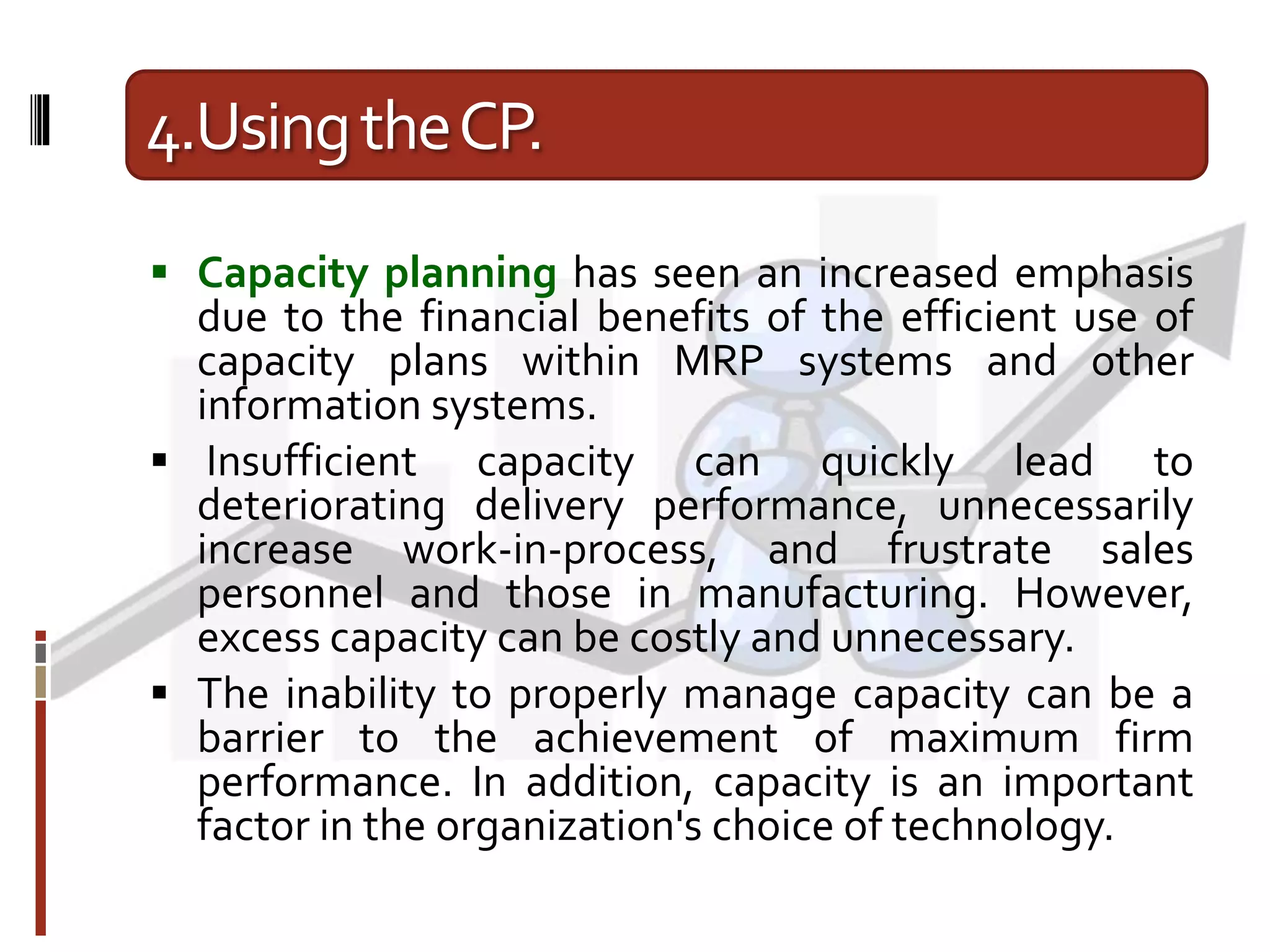
4.UsingtheCP.
 Capacity planning has seen an increased emphasis
due to the financial benefits of the efficient use of
capacity plans within MRP systems and other
information systems.
 Insufficient capacity can quickly lead to
deteriorating delivery performance, unnecessarily
increase work-in-process, and frustrate sales
personnel and those in manufacturing. However,
excess capacity can be costly and unnecessary.
 The inability to properly manage capacity can be a
barrier to the achievement of maximum firm
performance. In addition, capacity is an important
factor in the organization's choice of technology.
DataBaseDesignConsiderations
To be continue

Manufacturing planning and control systems

  • 1.
    Prepared by: Eng.Haitham ShehataHussein Eng.Ahmed Safwat
  • 2.
    Index 1. Capacity PlanningUsing Overall Factors (CPOF). 2. Capacity Bills. 3. Resource Profiles. 4. Capacity Requirements Planning (CRP). 5. Input/Output Control 6. The Capacity "BathTub“ Capacity Planning CAPACITY PLANNING'S ROLE IN MPC SYSTEMS. CAPACITY PLANNING AND CONTROLTECHNIQUES. MANAGEMENT AND CAPACITY PLANNING. DATA BASE REQUIREMENTS. EXAMPLES OF APPLICATIONS. 1. Hierarchy of Capacity Planning Decisions. 2. Links to Other MPC System Modules. 1. Capacity Planning in the MPC System 2. Choosing the Measure of Capacity 3. Choice of a SpecificTechnique 4. Using the Capacity Plan•Data Base Design Considerations 1. Capacity Planning at Montell USA, Inc. 2. Capacity Planning atTwin Disc 3. Capacity Planning at Applicon 1. Definition
  • 4.
    CapacityPlanning Capacity is definedas the ability to achieve, store or produce. For an organization, capacity would be the ability of a given system to produce output within the specific time period. In operations, management capacity is referred as an amount of the input resources available to produce relative output over period of time. In general, terms capacity is referred as maximum production capacity, which can be attained within a normal working schedule.
  • 5.
    CapacityPlanning Capacity planning isessential to be determining optimum utilization of resource and plays an important role in decision- making process.
  • 7.
    HierarchyofCapacityPlanningDecisions Finite capacity schedulinguses basically the same data as capacity requirements planning but adjusts the schedule to ensure that the capacity required never exceeds a work center’s defined capacity limits in a given time period.
  • 8.
    HierarchyofCapacityPlanningDecisions  The previousfigure depicts the hierarchy of capacity planning decisions that can be made within a planning and control environment. 1) Planning resource capacities over long time horizons. 2) The rough-cut evaluation of capacity required by the master production schedule. 3) Detailed capacity requirements of a particular production schedule. 4) The use of finite loading procedures. 5) Monitoring actual outputs versus plan.
  • 9.
    LinkstoOtherMPCSystemModules The source ofthe loading data changes as you move down this hierarchy: Resource planning takes its capacity requirements from the business plan.(Production Planning)  rough-cut capacity planning uses the master production schedule as the source of its information.  Capacity requirements planning and the remainder of these shorter-term planning modules take their loading data from the Material Requirements Planning output. Finite loading related to firms using details material plans, but it can be better viewed as a shop scheduling technique. Input/output analysis linked to the shop-floor system and data base for shop-floor control.
  • 11.
    CapacityPlanningandControlTechniques.  For theaggregate plan, we reviewed different methods (resource planning) which all aim to find the required capacity in facilities, equipment and manpower.  From the aggregate planning, a MPS was built. And from the MPS, an MRP was derived.We have not yet considered the capacity aspects of these plans.  For the MPS, the Rough-cut capacity plans will provide estimates of the load of the different workcenters over the corresponding time horizon.  For the MRP, the capacity requirement plan will provide such an estimate. We will review 4 techniques successively: 1) Capacity Planning using Overall Factors (CPOF). 2) Capacity bills. 3) Resource profiles. 4) Capacity Requirement Planning (CRP). These techniques are more and more accurate but require more and more information.
  • 12.
    1.CapacityPlanningusingOverallFactors(CPOF).  EX. Letus assume, we have only two end products H and h with the following demand. Total Time period : 1 day Consider 3 workcenters (or shops) CPOF method need the average relative workload
  • 13.
    1.CapacityPlanningusingOverallFactors(CPOF).  Modular Description Hereis specified the complete list of all the components. Product components Cup assembly Tray assembly
  • 14.
    1.CapacityPlanningusingOverallFactors(CPOF).  CPOF needTotalamount of resource for producing one unit of each end products.  Assume the unit to be the working hour. 1 H requires 0.15 hour = 9 min. 1 h requires 0.1 hour = 6 min. Workcenter load = [(H total capacity/product)x(H product/period) + (h total capacity/product )x (h product/period)] x relative load Eq.1
  • 15.
    1.CapacityPlanningusingOverallFactors(CPOF). At period time5  Cup assembly = [9*100+6*150]*0.55 = 990 min = 990/60 = 16.5 hours  Tray label = [9*100 +6*150]*0.10 = 180 min = 180/60 = 3 hours  Tray assembly = [9*100+6*150]*.35= 630 min = 630/60 = 10.5 hours  Total capacity = 16.5 + 3 + 10.5 =30 hours  The same calc with period 6,7,8 The method implicitly assume that for every production hour, 55 % are spent at the Cup Assembly, 35 % at the Tray Assembly and 10 % at the Tray Label. Total 55% 10% 35% Hours
  • 16.
    2.CapacityBills. Compared to CPOF,capacity bills take into account the detailed need of the different products at the different workcenters.  These needs can be specified as follows. For each workcenter, the setup time is distributed on each unit of the lot size.The capacity bills can then be computed.
  • 17.
    2.CapacityBills.  Note thatthe production of 1 H TRAY requires 4 cups. The total is of course identical to what we already knew: the production of one H requires 0.15 hour. Notes: When H is in production, the cup assembly requires 60% of the total work. When h is in production, the cup assembly requires only 50% of the total work. The CPOF method assumes a 55% average. This average is only correct when the same amount of H and h are manufactured. This means that the CPOF method is correct as long as the product mix remains the same.
  • 18.
    2.CapacityBills.  Capacity requirementsUsing Capacity Bills Workcenter load = [H capacity bill/product )x (H products/period) + (h capacity bill/product )x (h products/period)]  Eq.2 At period time 5 Cup assembly = [0.09*100+0.05*150] = 16.5 hours Tray label = [0.02*100 +0*150] = 2 hours Tray assembly = [0.04*100+0.1*150]= 11.5 hours Hours
  • 19.
    3.ResourceProfiles  The ideahere is to take the timing of the different workcenters into account. Example. The production of 100 H units in period 5 will lead to a workload of the workshops. However, this load will not be in period 5 but earlier, maybe in period 4 or 3 depending on the lead times.
  • 20.
    3.ResourceProfiles Explode the demandfor 1 end product in period i Assume: lead time for each operation = 1day Except: lead time for assembly of the G cups = 2 days.
  • 21.
    3.ResourceProfiles Explode the demandfor end products in period 7
  • 22.
    3.ResourceProfiles This last calculationcan be repeated for all the demands. Hours
  • 23.
    4.CapacityRequirementsplanning Time bucket /Period / Horizon The time bucket is the unit of time in use. One week is typical. The horizon is how much in the future one is looking, how many time buckets or periods we consider. By definition, we are at the beginning of period 1. Gross Requirement This is the firm or forecast demand for the corresponding period. It is time- phased. Scheduled Receipts These are parts which we are guaranteed to receive at the beginning of the corresponding period. On-hand (Projected available balance) This is the inventory at the end of the corresponding period. It should remain positive. Planned Order Release Here are the orders which are planned to be launched to prevent the inventory from becoming negative. These orders are not yet placed. They are planned to be placed !
  • 24.
    4.CapacityRequirementsplanning Lead time This isthe time required for an order to be completed. It is the time between the moment an order is placed and the the moment the products are delivered. It is made of 4 main parts. Move - Queue - Setup - Run Note that queuing time depends on the workload and on the schedule ! Safety time This is a time which is added to the lead time for safety reasons, typically when the lead time is not very reliable. Lot size This is the technique used for deciding how much to order. The "lot for lot" technique means that we order exactly what is needed. Other methods are reviewed at the end of the chapter. Safety stock By principle, an order is launched to prevent the inventory from becoming negative. With a safety stock, an order is launched as soon as the inventory would drop below this safety stock level. This security is often needed when scrap is common.
  • 25.
    4.CapacityRequirementsplanning The Kuczma Companymakes sign mounts for commercial customers. One product is the H mount which is made up of a painted surface on both sides of a wooden H frame. The H mount is put together in final assembly. The surfaces are painted in the paint shop, and frame is made in the frame shop. Kuczma wants to estimate the H mount capacity needs for next five periods in final assembly, the paint shop, and the frame shop. Setup Operation Work Center Time Run time Mount assembly Final Assembly 2 hours 1.0 hours Fabricate H frame Frame Shop 3 hours 0.5 hours Paint surfaces Paint Shop 4 hours 0.4 hours
  • 26.
    4.CapacityRequirementsplanning 1 2 34 5 6 15 20 20 20 20 0 15 Projected available balance 10 10 20 0 10 20 20 30 0 30 30 0 0 1 2 3 4 5 6 30 40 40 40 40 0 50 Projected available balance 25 45 5 15 25 35 35 0 50 50 50 0 0 1 2 3 4 5 6 20 20 20 20 20 20 Projected available balance 25 5 0 0 0 0 0 15 20 20 20 20 Item: H frame Period Gross requirements Scheduled Receipts Gross requirements Scheduled Receipts Planned order release Q = 50, LT = 1, SS = 5 Planned order release Q = 30, LT = 1, SS = 0 Item: Painted Surface Period Planned order release Q = L4L, LT = 1, SS = 0 Item: H mount Period Gross requirements Scheduled Receipts LT: LeadTime LS: Lot Size SS: Safety Stock
  • 27.
    4.CapacityRequirementsplanning H Mount AssyS/U Time* Run Time/unit* PAB 15 20 20 20 20 2 1 H Frame 15 PAB 30 0 30 30 0 0 3 0.5 Painted Surface 50 PAB 0 50 50 50 0 0 4 0.4 GR SR POR GR SR POR GR SR POR
  • 28.
    4.CapacityRequirementsplanning Capacity Requirements Period Dept 12 3 4 5 6 H Mount Assy 17 22 22 22 22 0 H Frame 28.5 0 18 18 0 0 Painted Surface 24 24 24 24 0 0 Note: 28.5 = 3 + 0.5(15) + 3 + 0.5(30) Requires: Planned order and schedule receipt information from the MRP system, and setup and run times from the product routing file.
  • 29.
    5.Input/outputcontrol. Input-output Control isa technique that allows operation to manage facility work flow. It is used to control the size of the queues in front of work centers, thereby helping to control manufacturing lead times. Refer to as "push system" of linking work centers. When a batch of items is completed at one work centre, it is pushed to the next work centre, where it waits in a queue until it is selected to be worked at that work centre. Input-output Control is important because it is a form of queue control, and a great portion of the time that a job spends in a plant is spent waiting in queues. In many job shops and batch manufacturing factories 80 to 95 percent of the total time is queue time.
  • 30.
    5.Input/outputcontrol. Advantages of usingInput-output Control Customer service may improve due to the items or products are produced on time. Efficiency may be improved because of the less work-in-process in cluttering the work centre and adding to overhead costs. Quality may be improved because less work-in-process hides fewer problems.
  • 32.
    1.CapacityPlanningInMPCSystem  From Hierarchyof Capacity Planning figure there are relationship between MPC framework and various capacity planning modules (five modules range [long range –day to day] ): o Vertical relationship among the capacity planning modules o Horizontal relationship with the material planning modules of the MPC system .
  • 33.
    1.CapacityPlanningInMPCSystem These relationships canaffect managerial choices for capacity planning systems design and use in a specific firm.
  • 34.
    1.CapacityPlanningInMPCSystem To illustrate theimportance of cps, let consider the impact of production planning and resource planning decisions on short- term capacity planning decisions. To extent the production planning and resource planning are done well, problems faced in capacity planning can be reduced, since appropriate resources have been provided.
  • 35.
    1.CapacityPlanningInMPCSystem For example: theproduction plan specifies a very stable rate of output, then changes in MPS requiring capacity changes are minimal . If the material planning modules functions effectively, the MPS will be converted into detailed component production plans with relatively few unexpected execution problems.
  • 36.
    2.ChoosingtheMeasureofCapacity  In thissection, we can learn a method of measuring a capacity of system. Consider anything for which you need to measure the capacity, as a system.  Analyze the system into input, processing and output.When you analyze, see to that, where there is a less variability, choose that side and identify the product, process-resources, the input resources and attach time frame to provide the capacity measure.
  • 37.
    2.ChoosingtheMeasureofCapacity Measure of Capacitythrough output  Consider an automobile mass production industry. You can’t find much variation in the output side compared to the input resources and processing parts. So the number of cars/time is considered as the measure. Mostly in the case of mass production industry the output side is considered to measure the capacity.
  • 38.
    2.ChoosingtheMeasureofCapacity Measure of thecapacity through Input  Consider an educational institution; here the output side is not taken into consideration because the number of outgoing students per time may vary depending upon the pass result. But the intake is always constant because the intake depends upon the government approved. So, the capacity of educational institution is measured through the input namely the number of students intake.
  • 39.
    2.ChoosingtheMeasureofCapacity  Measure ofthe capacity through processing  Consider a sugarcane industry, the capacity of that industry is not measured in terms of the output and input. There is a variability in terms of yield rate that means some times “y” tons of sugarcane may give “x” tons of sugar or some times same “y” may give more than or less than the “x” tons of sugar. Since variability is existing in both the input side and output side. Inputs and outputs are not considered for measuring the capacity. But in the processing side there is a less variability namely the crushing capacity or the number of tons of sugarcane could be crushed by the crushing machine is considered to be a best measure to measure the capacity of the sugarcane industry from the processing point of view.
  • 40.
    2.ChoosingtheMeasureofCapacity System Components ofSystem considered for capacity measure Unit of Measure Automobile Industry Bottling Plant University Auto repair shop Restaurant Output Output Input Processing Processing Number of Automobiles Gallons / Day Number of students intake per year Number of machines hour per day Seating Capacity The table provides some of the systems and their corresponding measure to measure the capacity.
  • 41.
    2.ChoosingtheMeasureofCapacity  In summary,if you want to fix the measure for the capacity, then see the system as input, processing and output. Find where there is a less variability choose that side and correspondingly choose the product or the resources to estimate the measure.
  • 42.
    3.ChoiceofaSpecificTechnique. CP Techniques forconverting a material plan into capacity requirements include three different methods for rough-cut CP (CPOF, Capacity Bills, and Resource Profiles) and CRP. The choice of method depends heavily on characteristics of the manufacturing process.
  • 43.
    3.ChoiceofaSpecificTechnique. The three rough-cutmethods are most general, being applicable even in companies using JIT methods for shop-floor control. Rough-cut can be useful in JIT operations to estimate the impact of changes in requirement called for by revisions to the MPS.
  • 44.
    3.ChoiceofaSpecificTechnique. CPTechniques Pros Cons CapacityBills 1. Easy to use 2. Minimal computational requirements 3. Consider product mix 1. Doesn’t consider lead times, inventory information, or gross-to- netting 2. Less accurate Resource Profiles 1. Easy to use 2. Minimal computational requirements 3. Consider product mix 4. Considers lead times 1. Doesn’t consider inventory information or gross-to- netting 2. Less accurate Capacity Requirements Planning 1. Considers: gross-to- netting, Inventory information, lead times 2. More accurate 3. Consider product mix 1. Requires MRP system, Time-phased records, Extensive computational requirements
  • 45.
    4.UsingtheCP.  Capacity planninghas seen an increased emphasis due to the financial benefits of the efficient use of capacity plans within MRP systems and other information systems.  Insufficient capacity can quickly lead to deteriorating delivery performance, unnecessarily increase work-in-process, and frustrate sales personnel and those in manufacturing. However, excess capacity can be costly and unnecessary.  The inability to properly manage capacity can be a barrier to the achievement of maximum firm performance. In addition, capacity is an important factor in the organization's choice of technology.
  • 47.