GOOD  LABORATORY  PRACTICE
Do, what you write Write, what you do
GLP goes hand-in-hand with QA  (quality assurance) GLP without quality is useless

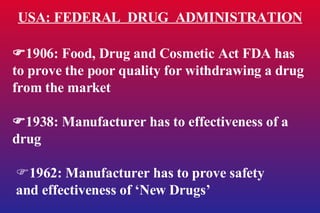
USA: FEDERAL  DRUG  ADMINISTRATION  1906: Food, Drug and Cosmetic Act FDA has to prove the poor quality for withdrawing a drug from the market  1938: Manufacturer has to effectiveness of a drug  1962: Manufacturer has to prove safety  and effectiveness of ‘New Drugs’
USA FEDERAL  DRUG  ADMINISTRATION  1979: Good Laboratory Practice Regulations (Revised several times)  Other agencies had endorsed the concept Eg: Environmental Protection Agency (EPA)
GLP is not an Act/Legislation/Statute GLP is a regulation/guideline
Code of Federal regulations (Food and Drug Administration)  Part 58 Good Laboratory practice for non-clinical Laboratory studies
Organisation for Economic Co-operation and Development (OECD) 1997 Principles of Good Laboratory Practice Objective To promote the quality and validity of test data used for determining the safety of chemicals and chemical products
Scope    Industrial chemicals    Pharmaceuticals    Veterinary drugs    Pesticides, Cosmetics    Food additives preservatives    Basic Research    Any laboratory procedure
What GLP is not    Excellence of a laboratory    Quality of an organisation    Quality of a product    Professional competence
Then, what is GLP ? GLP indicates quality of a study/procedure.
Definition Good Laboratory Practice is a quality system concerned with the organisational process and the conditions under which non-clinical health and environmental safety studies are planned, performed, monitored, recorded, archived and reported (OECD, 1997)
Acceptability Credibility
Do not assume anything  Good science = Compliance
Do not invent good practice Compliance with national legislation Compliance with national standards Compliance with international  standards Validation of own standards
Terminology  Quality System  Quality and Requirement    Calibration and Traceability  Standard  Reference Material  Standardisation/validation  Accreditation  Inter-laboratory Comparison  Proficiency Testing  Auditing
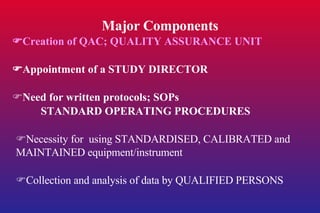
Major Components  Creation of QAC; QUALITY ASSURANCE UNIT  Appointment of a STUDY DIRECTOR  Need for written protocols; SOPs STANDARD OPERATING PROCEDURES  Necessity for  using STANDARDISED, CALIBRATED and MAINTAINED equipment/instrument  Collection and analysis of data by QUALIFIED PERSONS
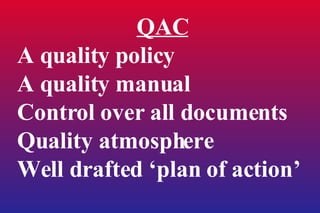
QAC A quality policy A quality manual Control over all documents Quality atmosphere Well drafted ‘plan of action’
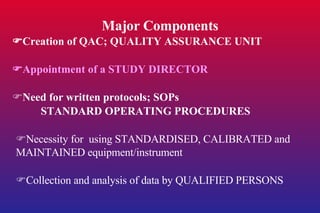
Major Components  Creation of QAC; QUALITY ASSURANCE UNIT  Appointment of a STUDY DIRECTOR  Need for written protocols; SOPs STANDARD OPERATING PROCEDURES  Necessity for  using STANDARDISED, CALIBRATED and MAINTAINED equipment/instrument  Collection and analysis of data by QUALIFIED PERSONS
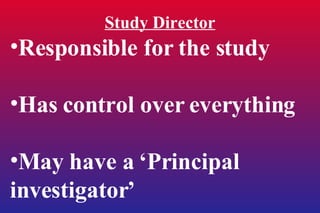
Study Director Responsible for the study Has control over everything May have a ‘Principal investigator’
Major Components  Creation of QAC; QUALITY ASSURANCE UNIT  Appointment of a STUDY DIRECTOR  Need for written protocols; SOPs STANDARD OPERATING PROCEDURES  Necessity for  using STANDARDISED, CALIBRATED and MAINTAINED equipment/instrument  Collection and analysis of data by QUALIFIED PERSONS
A written procedure for doing everything SOP Work instruction Work procedure work protocol
Major Components  Creation of QAC; QUALITY ASSURANCE UNIT  Appointment of a STUDY DIRECTOR  Need for written protocols; SOPs STANDARD OPERATING PROCEDURES  Necessity for  using STANDARDISED, CALIBRATED and MAINTAINED equipment/instrument  Collection and analysis of data by QUALIFIED PERSONS
Facility Equipment Environment Raw materials Maintenance
Major Components  Creation of QAC; QUALITY ASSURANCE UNIT  Appointment of a STUDY DIRECTOR  Need for written protocols; SOPs STANDARD OPERATING PROCEDURES  Necessity for  using STANDARDISED, CALIBRATED and MAINTAINED equipment/instrument  Collection and analysis of data by QUALIFIED PERSONS
People problems Unscientific Untrained Unaware Unhelpful
GLP in action-I    Availability of written documents A place for everything and everything has a place Assessing quality of raw materials Maintenance of equipment Purchase of raw materials Authorisation to do receive, handle test materials Environmental monitoring Disposal of waste
GLP in action-II    Availability of written documents Entry restrictions Ensuring safety Authorisation to do receive, handle test materials Describing qualification/training requirements of staff Training of new personnel
GLP in action-III    Availability of written procedures/SOPs/protocols Receiving test materials Identifying (unique) samples Handling test materials Storing test materials Conducting each test Disposing materials Reporting results
GLP in action-IV    Documentation in approved formats Log book for equipment Data sheets for recording data Records of receipt, test procedures Approved report formats Compilation of data
GLP in action-V    Regular quality checks Auditing by qualified auditors Regular reporting of NCs and/or NICs Preventive and corrective actions
GLP in action-VI    Management commitment For ensuring high professional standards For up dating procedures according to  changes in standards Participation in inter-laboratory comparisons Participation in proficiency testing
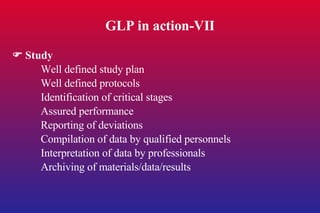
GLP in action-VII    Study Well defined study plan Well defined protocols Identification of critical stages Assured performance Reporting of deviations Compilation of data by qualified personnels Interpretation of data by professionals Archiving of materials/data/results
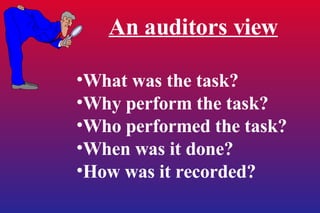
An auditors view What was the task? Why perform the task? Who performed the task? When was it done? How was it recorded?
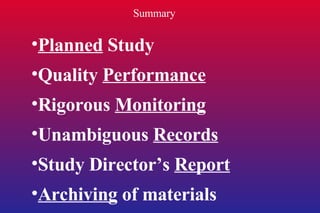
Planned  Study Quality  Performance Rigorous  Monitoring Unambiguous  Records Study Director’s  Report Archiving  of materials Summary
Are we ready for GLP? We are ready, when we write what we do and when we  do what we write, of course  in compliance with national/international standards.

Good Laboratory Practices (http://www.ubio.in)

  • 1.
    GOOD LABORATORY PRACTICE
  • 2.
    Do, what youwrite Write, what you do
  • 3.
    GLP goes hand-in-handwith QA (quality assurance) GLP without quality is useless
  • 4.
    USA: FEDERAL DRUG ADMINISTRATION  1906: Food, Drug and Cosmetic Act FDA has to prove the poor quality for withdrawing a drug from the market  1938: Manufacturer has to effectiveness of a drug  1962: Manufacturer has to prove safety and effectiveness of ‘New Drugs’
  • 5.
    USA FEDERAL DRUG ADMINISTRATION  1979: Good Laboratory Practice Regulations (Revised several times)  Other agencies had endorsed the concept Eg: Environmental Protection Agency (EPA)
  • 6.
    GLP is notan Act/Legislation/Statute GLP is a regulation/guideline
  • 7.
    Code of Federalregulations (Food and Drug Administration) Part 58 Good Laboratory practice for non-clinical Laboratory studies
  • 8.
    Organisation for EconomicCo-operation and Development (OECD) 1997 Principles of Good Laboratory Practice Objective To promote the quality and validity of test data used for determining the safety of chemicals and chemical products
  • 9.
    Scope  Industrial chemicals  Pharmaceuticals  Veterinary drugs  Pesticides, Cosmetics  Food additives preservatives  Basic Research  Any laboratory procedure
  • 10.
    What GLP isnot  Excellence of a laboratory  Quality of an organisation  Quality of a product  Professional competence
  • 11.
    Then, what isGLP ? GLP indicates quality of a study/procedure.
  • 12.
    Definition Good LaboratoryPractice is a quality system concerned with the organisational process and the conditions under which non-clinical health and environmental safety studies are planned, performed, monitored, recorded, archived and reported (OECD, 1997)
  • 13.
  • 14.
    Do not assumeanything Good science = Compliance
  • 15.
    Do not inventgood practice Compliance with national legislation Compliance with national standards Compliance with international standards Validation of own standards
  • 16.
    Terminology  QualitySystem  Quality and Requirement  Calibration and Traceability  Standard  Reference Material  Standardisation/validation  Accreditation  Inter-laboratory Comparison  Proficiency Testing  Auditing
  • 17.
    Major Components Creation of QAC; QUALITY ASSURANCE UNIT  Appointment of a STUDY DIRECTOR  Need for written protocols; SOPs STANDARD OPERATING PROCEDURES  Necessity for using STANDARDISED, CALIBRATED and MAINTAINED equipment/instrument  Collection and analysis of data by QUALIFIED PERSONS
  • 18.
    Major Components Creation of QAC; QUALITY ASSURANCE UNIT  Appointment of a STUDY DIRECTOR  Need for written protocols; SOPs STANDARD OPERATING PROCEDURES  Necessity for using STANDARDISED, CALIBRATED and MAINTAINED equipment/instrument  Collection and analysis of data by QUALIFIED PERSONS
  • 19.
    QAC A qualitypolicy A quality manual Control over all documents Quality atmosphere Well drafted ‘plan of action’
  • 20.
    Major Components Creation of QAC; QUALITY ASSURANCE UNIT  Appointment of a STUDY DIRECTOR  Need for written protocols; SOPs STANDARD OPERATING PROCEDURES  Necessity for using STANDARDISED, CALIBRATED and MAINTAINED equipment/instrument  Collection and analysis of data by QUALIFIED PERSONS
  • 21.
    Study Director Responsiblefor the study Has control over everything May have a ‘Principal investigator’
  • 22.
    Major Components Creation of QAC; QUALITY ASSURANCE UNIT  Appointment of a STUDY DIRECTOR  Need for written protocols; SOPs STANDARD OPERATING PROCEDURES  Necessity for using STANDARDISED, CALIBRATED and MAINTAINED equipment/instrument  Collection and analysis of data by QUALIFIED PERSONS
  • 23.
    A written procedurefor doing everything SOP Work instruction Work procedure work protocol
  • 24.
    Major Components Creation of QAC; QUALITY ASSURANCE UNIT  Appointment of a STUDY DIRECTOR  Need for written protocols; SOPs STANDARD OPERATING PROCEDURES  Necessity for using STANDARDISED, CALIBRATED and MAINTAINED equipment/instrument  Collection and analysis of data by QUALIFIED PERSONS
  • 25.
    Facility Equipment EnvironmentRaw materials Maintenance
  • 26.
    Major Components Creation of QAC; QUALITY ASSURANCE UNIT  Appointment of a STUDY DIRECTOR  Need for written protocols; SOPs STANDARD OPERATING PROCEDURES  Necessity for using STANDARDISED, CALIBRATED and MAINTAINED equipment/instrument  Collection and analysis of data by QUALIFIED PERSONS
  • 27.
    People problems UnscientificUntrained Unaware Unhelpful
  • 28.
    GLP in action-I Availability of written documents A place for everything and everything has a place Assessing quality of raw materials Maintenance of equipment Purchase of raw materials Authorisation to do receive, handle test materials Environmental monitoring Disposal of waste
  • 29.
    GLP in action-II Availability of written documents Entry restrictions Ensuring safety Authorisation to do receive, handle test materials Describing qualification/training requirements of staff Training of new personnel
  • 30.
    GLP in action-III Availability of written procedures/SOPs/protocols Receiving test materials Identifying (unique) samples Handling test materials Storing test materials Conducting each test Disposing materials Reporting results
  • 31.
    GLP in action-IV Documentation in approved formats Log book for equipment Data sheets for recording data Records of receipt, test procedures Approved report formats Compilation of data
  • 32.
    GLP in action-V Regular quality checks Auditing by qualified auditors Regular reporting of NCs and/or NICs Preventive and corrective actions
  • 33.
    GLP in action-VI Management commitment For ensuring high professional standards For up dating procedures according to changes in standards Participation in inter-laboratory comparisons Participation in proficiency testing
  • 34.
    GLP in action-VII Study Well defined study plan Well defined protocols Identification of critical stages Assured performance Reporting of deviations Compilation of data by qualified personnels Interpretation of data by professionals Archiving of materials/data/results
  • 35.
    An auditors viewWhat was the task? Why perform the task? Who performed the task? When was it done? How was it recorded?
  • 36.
    Planned StudyQuality Performance Rigorous Monitoring Unambiguous Records Study Director’s Report Archiving of materials Summary
  • 37.
    Are we readyfor GLP? We are ready, when we write what we do and when we do what we write, of course in compliance with national/international standards.