GOOD CLINICAL PRACTICES
DR. KARUN KUMAR
JUNIOR RESIDENT – I
DEPT. OF PHARMACOLOGY
What is Clinical Research ?
•Research conducted on
•Human subjects or
•Material of human origin
•Tissues,
•Specimens, and
•Cognitive phenomena
http://keck.usc.edu/Research/Clinical_Research/Definition.aspx
What is Clinical Trial ?
•Scientific studies
•Test the effectiveness of
•Treatment,
•Device, or
•Drug
•Find new & better ways
http://keck.usc.edu/en/Research/Clinical_Research/Clinical_Trials.aspx
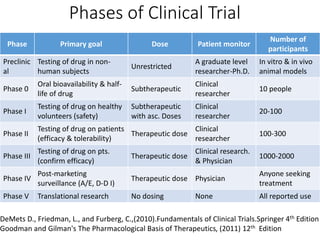
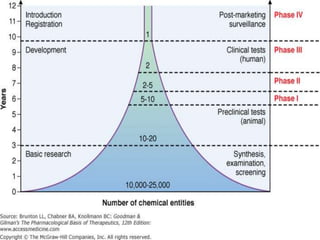
Phases of Clinical Trial
Phase Primary goal Dose Patient monitor
Number of
participants
Preclinic
al
Testing of drug in non-
human subjects
Unrestricted
A graduate level
researcher-Ph.D.
In vitro & in vivo
animal models
Phase 0
Oral bioavailability & half-
life of drug
Subtherapeutic
Clinical
researcher
10 people
Phase I
Testing of drug on healthy
volunteers (safety)
Subtherapeutic
with asc. Doses
Clinical
researcher
20-100
Phase II
Testing of drug on patients
(efficacy & tolerability)
Therapeutic dose
Clinical
researcher
100-300
Phase III
Testing of drug on pts.
(confirm efficacy)
Therapeutic dose
Clinical research.
& Physician
1000-2000
Phase IV
Post-marketing
surveillance (A/E, D-D I)
Therapeutic dose Physician
Anyone seeking
treatment
Phase V Translational research No dosing None All reported use
DeMets D., Friedman, L., and Furberg, C.,(2010).Fundamentals of Clinical Trials.Springer 4th Edition
Goodman and Gilman's The Pharmacological Basis of Therapeutics, (2011) 12th Edition
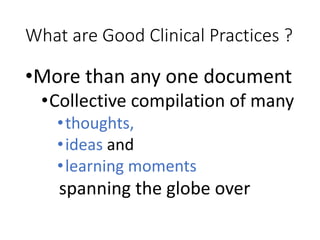
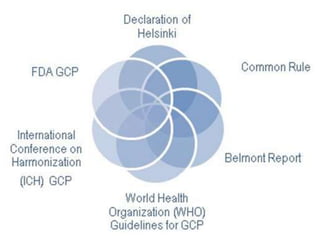
What are Good Clinical Practices ?
•More than any one document
•Collective compilation of many
•thoughts,
•ideas and
•learning moments
spanning the globe over
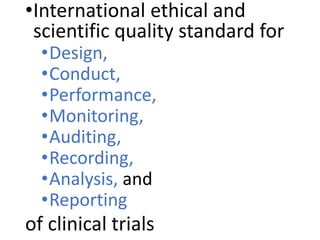
•International ethical and
scientific quality standard for
•Design,
•Conduct,
•Performance,
•Monitoring,
•Auditing,
•Recording,
•Analysis, and
•Reporting
of clinical trials
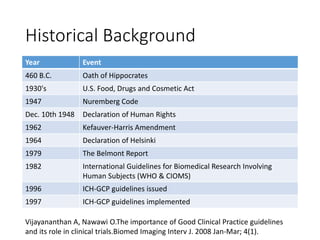
Historical Background
Year Event
460 B.C. Oath of Hippocrates
1930's U.S. Food, Drugs and Cosmetic Act
1947 Nuremberg Code
Dec. 10th 1948 Declaration of Human Rights
1962 Kefauver-Harris Amendment
1964 Declaration of Helsinki
1979 The Belmont Report
1982 International Guidelines for Biomedical Research Involving
Human Subjects (WHO & CIOMS)
1996 ICH-GCP guidelines issued
1997 ICH-GCP guidelines implemented
Vijayananthan A, Nawawi O.The importance of Good Clinical Practice guidelines
and its role in clinical trials.Biomed Imaging Interv J. 2008 Jan-Mar; 4(1).
The death sentences imposed in
October 1946 were carried out by
Master Sergeant John C. Woods
(1903-50), who told a reporter from
Time magazine that he was proud of
his work. "The way I look at this
hanging job, somebody has to do it .
. . ten men in 103 minutes. That's
fast work."
http://www.history.com/topics/world-war-ii/nuremberg-trials
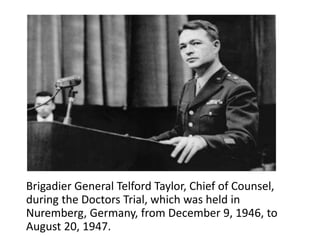
Brigadier General Telford Taylor, Chief of Counsel,
during the Doctors Trial, which was held in
Nuremberg, Germany, from December 9, 1946, to
August 20, 1947.
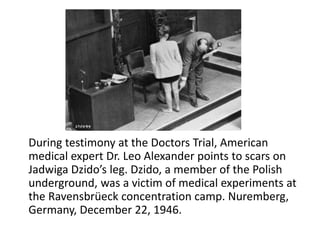
During testimony at the Doctors Trial, American
medical expert Dr. Leo Alexander points to scars on
Jadwiga Dzido’s leg. Dzido, a member of the Polish
underground, was a victim of medical experiments at
the Ravensbrüeck concentration camp. Nuremberg,
Germany, December 22, 1946.
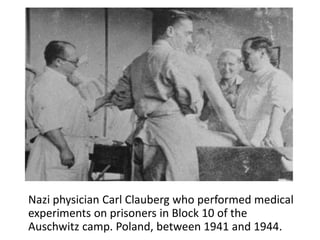
Nazi physician Carl Clauberg who performed medical
experiments on prisoners in Block 10 of the
Auschwitz camp. Poland, between 1941 and 1944.
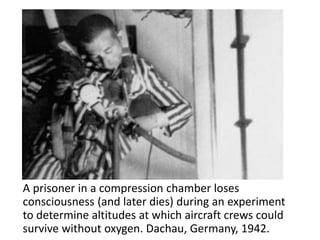
A prisoner in a compression chamber loses
consciousness (and later dies) during an experiment
to determine altitudes at which aircraft crews could
survive without oxygen. Dachau, Germany, 1942.
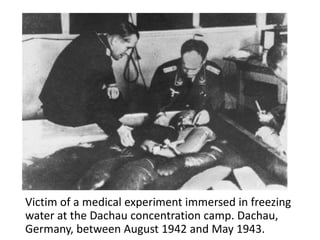
Victim of a medical experiment immersed in freezing
water at the Dachau concentration camp. Dachau,
Germany, between August 1942 and May 1943.
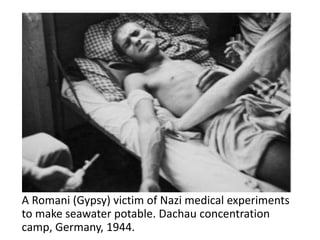
A Romani (Gypsy) victim of Nazi medical experiments
to make seawater potable. Dachau concentration
camp, Germany, 1944.
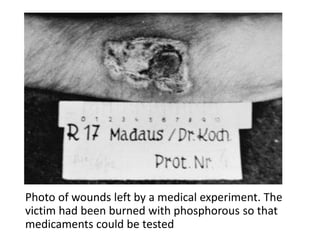
Photo of wounds left by a medical experiment. The
victim had been burned with phosphorous so that
medicaments could be tested
Nuremberg Code (1947)
•Voluntary consent of the
human subject is absolutely
essential
•Favorable risk/benefit ratio
•Research must help society
•Research should be based on
previous knowledge
•Participant must be free to
stop at any time
•Research should not cause
mental & physical suffering
•Research should avoid risk of
injury & death
Declaration of Helsinki (1964)
•Well being of subject >
interest of science & society
•Consent should be in writing
•Limited use of placebo
•Greater access to benefit
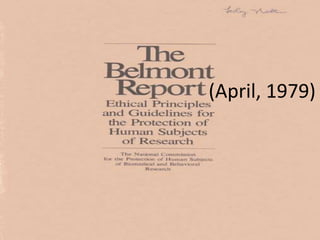
(April, 1979)
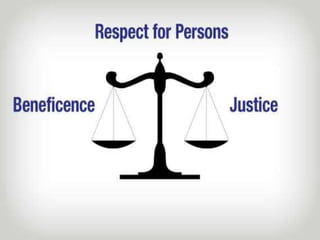
Respect for persons
•Protecting autonomy of
subjects
•Treating subjects with
courtesy and respect
•Allowing for informed
consent
Beneficence
•The philosophy of "Do no
harm”
•Maximize benefits for the
research project
•Minimize risks to the research
subjects
Justice
•Ensure considered
procedures are administered
fairly
•Fair distribution between
•Burden of research (Costs)
•Benefit of research
Common Rule (1981)
•Describes the types of
research subject(s)
•Defines key terms such as
•Research,
•Human subject, and
•Minimal risk
•Sets forth requirements for
•IRB membership
•Review procedures
•Criteria for approval
•Lists requirements for
informed consent
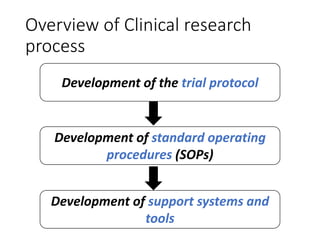
Overview of Clinical research
process
Development of the trial protocol
Development of standard operating
procedures (SOPs)
Development of support systems and
tools
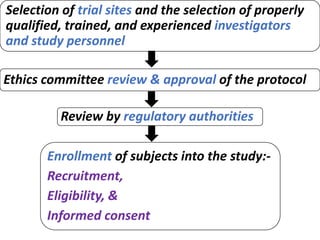
Selection of trial sites and the selection of properly
qualified, trained, and experienced investigators
and study personnel
Ethics committee review & approval of the protocol
Enrollment of subjects into the study:-
Recruitment,
Eligibility, &
Informed consent
Review by regulatory authorities
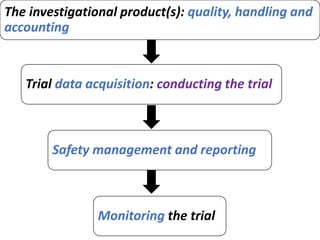
Safety management and reporting
Trial data acquisition: conducting the trial
The investigational product(s): quality, handling and
accounting
Monitoring the trial
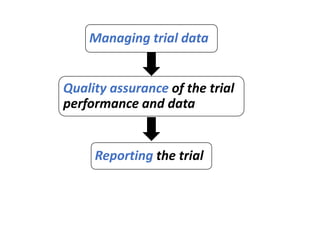
Quality assurance of the trial
performance and data
Managing trial data
Reporting the trial
WHO principles for GCP
Principle 1 – Ethical Conduct
•Research involving humans
 Scientifically sound
 In accordance with
Declaration of Helsinki
Principle 2: Protocol
•Research
 To be described in a
•Clear,
•Detailed, and
•“Scientifically justified”
protocol
Principle 3: Risk Identification
•Foreseeable risks and
discomforts and any
anticipated benefit(s)
 To be identified
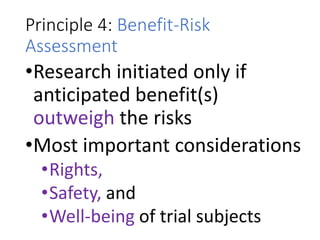
Principle 4: Benefit-Risk
Assessment
•Research initiated only if
anticipated benefit(s)
outweigh the risks
•Most important considerations
•Rights,
•Safety, and
•Well-being of trial subjects
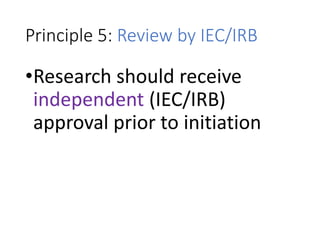
Principle 5: Review by IEC/IRB
•Research should receive
independent (IEC/IRB)
approval prior to initiation
Principle 6: Protocol Compliance
•Research  Conducted in
compliance with the
approved protocol
Principle 7: Informed Consent
•To be obtained
•From every subject
•Prior to research participation
•In accordance with national
culture(s) and requirements
Principle 8: Continuing review /
ongoing benefit-risk assessment
•Research  Continued only if
the benefit-risk profile
remains favorable
Principle 9: Investigator
Qualifications
•Qualified and duly licensed
medical personnel
 Responsible for the
medical care of trial
subjects
Principle 10: Staff Qualifications
•Each individual involved
should be qualified by
•Education,
•Training, and
•Experience
Principle 11: Records
•Clinical trial information
should be
•Recorded,
•Handled, and
•Stored
•In a way that allows its
accurate
•Reporting,
•Interpretation, and
•Verification
Principle 12: Confidentiality /
Privacy
•Confidentiality of records
should be protected
•In accordance with the
applicable regulatory
requirement(s)
Principle 13: Good Manufacturing
Practice(s)
•Investigational products
should be
•Manufactured,
•Handled, and
•Stored
in accordance with applicable
GMP
Principle 14: Quality Systems
•Systems with procedures that
assure the quality of every
aspect of the trial should be
implemented
•Quality control (QC)
•Quality assurance (QA)
•Quality improvement (QI)
Code of Federal Regulations, Title
21
21 CFR 11: Electronic records
and signatures
21 CFR 50: Protection of
human subjects
21 CFR 54: Financial disclosure
by clinical investigators
21 CFR 56: IRB that oversee
clinical trials
21 CFR 312: Investigational
New Drug Application
21 CFR 812: Investigational
Device Exemptions
ICH-GCP guidelines
•“Bible” of clinical trials
•Global law which safeguards
humanity
•13 core principles
Who is responsible for GCP ?
•Each & every person involved
in the research process.
•This includes
1.Sponsors
2.Investigators and research
staff
3. Contract Research
Organizations
4. IRB/EC
5. FDA
6. Research Subject
Never ending debate
•Whether the "greater good"
trumps the rights of the
individual?
•Are individual’s rights what
make up the greater good?
•Is it the greater good that
allows for individual’s rights?
Take Home Message
•"If it wasn't documented, it
wasn't done.”
•GCP is more than a piece of
paper or a set of rules
•A mind-set of dedication that
ensures a high level of ethics
& quality in research
THANK YOU

Good Clinical Practices

  • 1.
    GOOD CLINICAL PRACTICES DR.KARUN KUMAR JUNIOR RESIDENT – I DEPT. OF PHARMACOLOGY
  • 2.
    What is ClinicalResearch ? •Research conducted on •Human subjects or •Material of human origin •Tissues, •Specimens, and •Cognitive phenomena http://keck.usc.edu/Research/Clinical_Research/Definition.aspx
  • 3.
    What is ClinicalTrial ? •Scientific studies •Test the effectiveness of •Treatment, •Device, or •Drug •Find new & better ways http://keck.usc.edu/en/Research/Clinical_Research/Clinical_Trials.aspx
  • 4.
    Phases of ClinicalTrial Phase Primary goal Dose Patient monitor Number of participants Preclinic al Testing of drug in non- human subjects Unrestricted A graduate level researcher-Ph.D. In vitro & in vivo animal models Phase 0 Oral bioavailability & half- life of drug Subtherapeutic Clinical researcher 10 people Phase I Testing of drug on healthy volunteers (safety) Subtherapeutic with asc. Doses Clinical researcher 20-100 Phase II Testing of drug on patients (efficacy & tolerability) Therapeutic dose Clinical researcher 100-300 Phase III Testing of drug on pts. (confirm efficacy) Therapeutic dose Clinical research. & Physician 1000-2000 Phase IV Post-marketing surveillance (A/E, D-D I) Therapeutic dose Physician Anyone seeking treatment Phase V Translational research No dosing None All reported use DeMets D., Friedman, L., and Furberg, C.,(2010).Fundamentals of Clinical Trials.Springer 4th Edition Goodman and Gilman's The Pharmacological Basis of Therapeutics, (2011) 12th Edition
  • 6.
    What are GoodClinical Practices ? •More than any one document •Collective compilation of many •thoughts, •ideas and •learning moments spanning the globe over
  • 7.
    •International ethical and scientificquality standard for •Design, •Conduct, •Performance, •Monitoring, •Auditing, •Recording, •Analysis, and •Reporting of clinical trials
  • 8.
    Historical Background Year Event 460B.C. Oath of Hippocrates 1930's U.S. Food, Drugs and Cosmetic Act 1947 Nuremberg Code Dec. 10th 1948 Declaration of Human Rights 1962 Kefauver-Harris Amendment 1964 Declaration of Helsinki 1979 The Belmont Report 1982 International Guidelines for Biomedical Research Involving Human Subjects (WHO & CIOMS) 1996 ICH-GCP guidelines issued 1997 ICH-GCP guidelines implemented Vijayananthan A, Nawawi O.The importance of Good Clinical Practice guidelines and its role in clinical trials.Biomed Imaging Interv J. 2008 Jan-Mar; 4(1).
  • 12.
    The death sentencesimposed in October 1946 were carried out by Master Sergeant John C. Woods (1903-50), who told a reporter from Time magazine that he was proud of his work. "The way I look at this hanging job, somebody has to do it . . . ten men in 103 minutes. That's fast work." http://www.history.com/topics/world-war-ii/nuremberg-trials
  • 13.
    Brigadier General TelfordTaylor, Chief of Counsel, during the Doctors Trial, which was held in Nuremberg, Germany, from December 9, 1946, to August 20, 1947.
  • 14.
    During testimony atthe Doctors Trial, American medical expert Dr. Leo Alexander points to scars on Jadwiga Dzido’s leg. Dzido, a member of the Polish underground, was a victim of medical experiments at the Ravensbrüeck concentration camp. Nuremberg, Germany, December 22, 1946.
  • 15.
    Nazi physician CarlClauberg who performed medical experiments on prisoners in Block 10 of the Auschwitz camp. Poland, between 1941 and 1944.
  • 16.
    A prisoner ina compression chamber loses consciousness (and later dies) during an experiment to determine altitudes at which aircraft crews could survive without oxygen. Dachau, Germany, 1942.
  • 17.
    Victim of amedical experiment immersed in freezing water at the Dachau concentration camp. Dachau, Germany, between August 1942 and May 1943.
  • 18.
    A Romani (Gypsy)victim of Nazi medical experiments to make seawater potable. Dachau concentration camp, Germany, 1944.
  • 19.
    Photo of woundsleft by a medical experiment. The victim had been burned with phosphorous so that medicaments could be tested
  • 20.
    Nuremberg Code (1947) •Voluntaryconsent of the human subject is absolutely essential •Favorable risk/benefit ratio •Research must help society •Research should be based on previous knowledge
  • 21.
    •Participant must befree to stop at any time •Research should not cause mental & physical suffering •Research should avoid risk of injury & death
  • 23.
    Declaration of Helsinki(1964) •Well being of subject > interest of science & society •Consent should be in writing •Limited use of placebo •Greater access to benefit
  • 24.
  • 26.
    Respect for persons •Protectingautonomy of subjects •Treating subjects with courtesy and respect •Allowing for informed consent
  • 27.
    Beneficence •The philosophy of"Do no harm” •Maximize benefits for the research project •Minimize risks to the research subjects
  • 28.
    Justice •Ensure considered procedures areadministered fairly •Fair distribution between •Burden of research (Costs) •Benefit of research
  • 29.
    Common Rule (1981) •Describesthe types of research subject(s) •Defines key terms such as •Research, •Human subject, and •Minimal risk
  • 30.
    •Sets forth requirementsfor •IRB membership •Review procedures •Criteria for approval •Lists requirements for informed consent
  • 31.
    Overview of Clinicalresearch process Development of the trial protocol Development of standard operating procedures (SOPs) Development of support systems and tools
  • 32.
    Selection of trialsites and the selection of properly qualified, trained, and experienced investigators and study personnel Ethics committee review & approval of the protocol Enrollment of subjects into the study:- Recruitment, Eligibility, & Informed consent Review by regulatory authorities
  • 33.
    Safety management andreporting Trial data acquisition: conducting the trial The investigational product(s): quality, handling and accounting Monitoring the trial
  • 34.
    Quality assurance ofthe trial performance and data Managing trial data Reporting the trial
  • 35.
    WHO principles forGCP Principle 1 – Ethical Conduct •Research involving humans  Scientifically sound  In accordance with Declaration of Helsinki
  • 36.
    Principle 2: Protocol •Research To be described in a •Clear, •Detailed, and •“Scientifically justified” protocol
  • 37.
    Principle 3: RiskIdentification •Foreseeable risks and discomforts and any anticipated benefit(s)  To be identified
  • 38.
    Principle 4: Benefit-Risk Assessment •Researchinitiated only if anticipated benefit(s) outweigh the risks •Most important considerations •Rights, •Safety, and •Well-being of trial subjects
  • 39.
    Principle 5: Reviewby IEC/IRB •Research should receive independent (IEC/IRB) approval prior to initiation
  • 40.
    Principle 6: ProtocolCompliance •Research  Conducted in compliance with the approved protocol
  • 41.
    Principle 7: InformedConsent •To be obtained •From every subject •Prior to research participation •In accordance with national culture(s) and requirements
  • 42.
    Principle 8: Continuingreview / ongoing benefit-risk assessment •Research  Continued only if the benefit-risk profile remains favorable
  • 43.
    Principle 9: Investigator Qualifications •Qualifiedand duly licensed medical personnel  Responsible for the medical care of trial subjects
  • 44.
    Principle 10: StaffQualifications •Each individual involved should be qualified by •Education, •Training, and •Experience
  • 45.
    Principle 11: Records •Clinicaltrial information should be •Recorded, •Handled, and •Stored
  • 46.
    •In a waythat allows its accurate •Reporting, •Interpretation, and •Verification
  • 47.
    Principle 12: Confidentiality/ Privacy •Confidentiality of records should be protected •In accordance with the applicable regulatory requirement(s)
  • 48.
    Principle 13: GoodManufacturing Practice(s) •Investigational products should be •Manufactured, •Handled, and •Stored in accordance with applicable GMP
  • 49.
    Principle 14: QualitySystems •Systems with procedures that assure the quality of every aspect of the trial should be implemented •Quality control (QC) •Quality assurance (QA) •Quality improvement (QI)
  • 50.
    Code of FederalRegulations, Title 21 21 CFR 11: Electronic records and signatures 21 CFR 50: Protection of human subjects 21 CFR 54: Financial disclosure by clinical investigators
  • 51.
    21 CFR 56:IRB that oversee clinical trials 21 CFR 312: Investigational New Drug Application 21 CFR 812: Investigational Device Exemptions
  • 53.
    ICH-GCP guidelines •“Bible” ofclinical trials •Global law which safeguards humanity •13 core principles
  • 54.
    Who is responsiblefor GCP ? •Each & every person involved in the research process. •This includes 1.Sponsors 2.Investigators and research staff
  • 55.
    3. Contract Research Organizations 4.IRB/EC 5. FDA 6. Research Subject
  • 56.
    Never ending debate •Whetherthe "greater good" trumps the rights of the individual? •Are individual’s rights what make up the greater good? •Is it the greater good that allows for individual’s rights?
  • 57.
    Take Home Message •"Ifit wasn't documented, it wasn't done.” •GCP is more than a piece of paper or a set of rules •A mind-set of dedication that ensures a high level of ethics & quality in research
  • 60.