This document discusses the importance of documentation in Good Laboratory Practice (GLP). It emphasizes that documentation provides an audit trail and shows what actually occurred during a study, which is critical for validating study results. Poor or missing documentation can invalidate a study and lead to regulatory issues. The key requirements for GLP documentation are that it must be identifiable, prompt, accurate, legible, and signed/dated. Corrections to documentation must also be explained, signed, and dated. Proper documentation practice is paramount to demonstrating compliance with GLP standards.
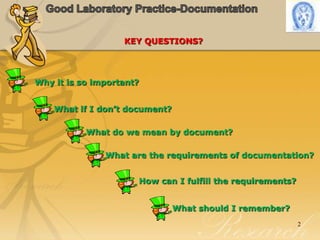
Good Laboratory Practice-DocumentationKEYQUESTIONS?Why it is so important?What if I don’t document?What do we mean by document? What are the requirements of documentation?How can I fulfill the requirements? What should I remember?2
3.
Good Laboratory Practice-DocumentationWHYIT IS SO IMPORTANT???Documents are the Life-blood of the Organization! Demonstrate what actually went on at the time… Critical for complete reconstruction of the study…Authentication that all the required procedures were correctly carried out at the correct time…Regulatory requirement…3
4.
Good Laboratory Practice-DocumentationWHATIF I DON’T DOCUMENT???Experimental data are lost… Complete record is not made… Lost/ Incomplete documentmay invalidate study… Impossible to justify as the usual believe is…Regulatory action…No record means procedure not done...4
5.
Good Laboratory Practice-DocumentationWHATDO WE MEAN BY DOCUMENT?Descriptive document… Results of original measurements, observations, and activities associated with the study which may be needed to verify and evaluate the study… Which will provide a picture of what actually happened during the course of an activity… Examples are: Raw Data in Laboratory Notebook, Logbook, Forms, Project Binder/File, Paper Printout, Electronic Format, All type of records… 5
Good Laboratory Practice-DocumentationWHATARE THE REQUIREMENTS OF DOCUMENTATION?Therefore the document should show: “What was done”… “How it was done”… “When the work was performed”… “Who performed the work”…8
9.
Good Laboratory Practice-DocumentationHOWCAN I FULFILL THE REQUIREMENTS?Record data Directly into the required format and not transcribed from a rough copy… Promptly… Accurately… Legibly…Then…Sign and date…Note: Sign indicates who has performed the work and date identifies when the work was performed…9
10.
Good Laboratory Practice-DocumentationWHATARE THE REQUIREMENTS OF DOCUMENTATION?Any correction made during and or latter recording should be explained for… Reason for correction… The signature of the individual making the correction… The date the correction was made…10
11.
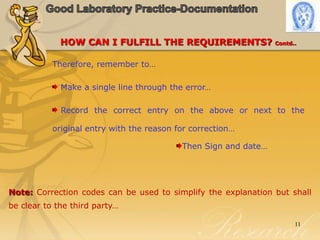
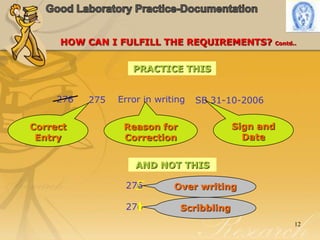
Good Laboratory Practice-DocumentationHOWCAN I FULFILL THE REQUIREMENTS? Contd..Therefore, remember to… Make a single line through the error… Record the correct entry on the above or next to the original entry with the reason for correction…Then Sign and date…Note: Correction codes can be used to simplify the explanation but shall be clear to the third party…11
12.
Good Laboratory Practice-DocumentationHOWCAN I FULFILL THE REQUIREMENTS? Contd..PRACTICE THIS276Error in writing275SB 31-10-2006Sign and DateCorrect EntryReason for CorrectionAND NOT THISOver writing276Scribbling27612
13.
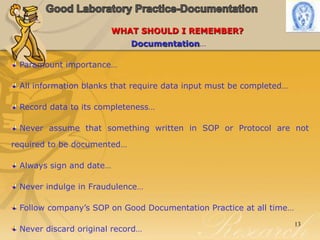
Good Laboratory Practice-DocumentationWHATSHOULD I REMEMBER? Documentation… Paramount importance… All information blanks that require data input must be completed… Record data to its completeness… Never assume that something written in SOP or Protocol are not required to be documented… Always sign and date… Never indulge in Fraudulence… Follow company’s SOP on Good Documentation Practice at all time… Never discard original record…13