



Good Clinical Practice


         Presented by:-

      Mr. Swapnil L.      1
Good Clinical Practices

                Presented by:-

     Mr. Swapnil L. Patil
                 M.Pharm
         Department of Pharmaceutics


   Pad. Dr. D. Y. Patil College of Pharmacy,

  Akurdi, Pune, Maharashtra, India, 411018   .
            Mob.09730306520
                          2
Contents

   Glossary
   Principles of GCP
   IEC/IRB Responsibilities
   Investigator Responsibilities
   Sponsor Responsibilities
   Protocols and Amendments
   Investigator’s Brochure
   Essential Documents             3
Glossary
Adverse drug reaction (ADR)
Serious Adverse Event (SAE)
 Audit
Blinding/masking
Investigator
Protocol
Sponsor
                              4
History of Good Clinical Practice
   Prior to an actual set of guidelines to follow for good clinical
    practice, clinical studies were dangerous and could result in
    serous disease, or possibly death.

   The Nuremburg Code of 1947
     Experiments performed in Germany during WWII opened the eyes of
      the world for guidance for clinical testing on humans.
     The code did set ethical guidelines, but it lacked legislation to back it
      up.
   Declaration of Helsinki
       ▪ In 1964, the World Medical Association established
         recommendations guiding medical doctors in biomedical research
         involving human subjects. These guidelines influenced national
         legislation, but there was no set standard between nations.    5
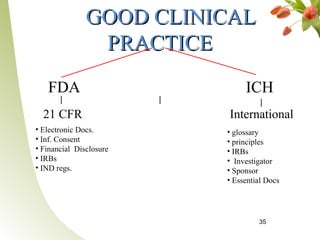
GOOD CLINICAL
                PRACTICE
   FDA                        ICH
  21 CFR                 International
• Electronic Docs.       • glossary
• Inf. Consent           • principles
• Financial Disclosure   • IRBs
• IRBs                   • Investigator
• IND regs.              • Sponsor
                         • Essential Docs


                                  35
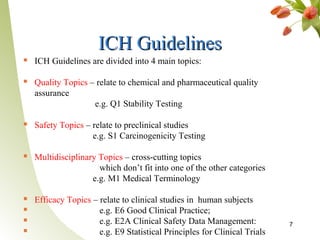
ICH Guidelines
   ICH Guidelines are divided into 4 main topics:

   Quality Topics – relate to chemical and pharmaceutical quality
    assurance
                    e.g. Q1 Stability Testing

   Safety Topics – relate to preclinical studies
                    e.g. S1 Carcinogenicity Testing

   Multidisciplinary Topics – cross-cutting topics
                      which don’t fit into one of the other categories
                    e.g. M1 Medical Terminology

   Efficacy Topics – relate to clinical studies in human subjects
                     e.g. E6 Good Clinical Practice;
                     e.g. E2A Clinical Safety Data Management:            7
                     e.g. E9 Statistical Principles for Clinical Trials
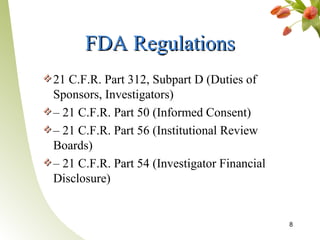
FDA Regulations
21 C.F.R. Part 312, Subpart D (Duties of
Sponsors, Investigators)
– 21 C.F.R. Part 50 (Informed Consent)
– 21 C.F.R. Part 56 (Institutional Review
Boards)
– 21 C.F.R. Part 54 (Investigator Financial
Disclosure)


                                              8
Good Clinical Practice (GCP) is defined as a
 ‘standard for the design, conduct,
 performance,       monitoring,      auditing,
 recording, analyses and reporting of clinical
 trials that provides assurance that the data
 and reported results are credible and
 accurate, and that the rights, integrity and
 confidentiality of trial subjects are
 protected’
                                             9
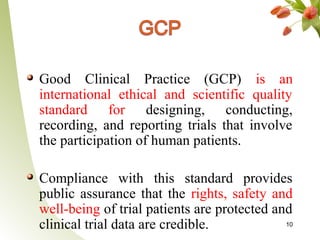
Good Clinical Practice (GCP) is an
international ethical and scientific quality
standard for designing, conducting,
recording, and reporting trials that involve
the participation of human patients.

Compliance with this standard provides
public assurance that the rights, safety and
well-being of trial patients are protected and
clinical trial data are credible.            10
   Are mainly focused on the protection of human rights
    in clinical trial.
   Provide assurance of the safety of the newly
    developed compounds.
   Provide standards on how clinical trials should be
    conducted.
    Define the roles and responsibilities of -
                  Clinical Sponsors,
                  Clinical Research Investigators,
                  Clinical Research Associates, And
                  Monitors.

                                                      11
Principles of ICH GCP
1.   Clinical trials should be conducted in accordance with the ethical
     principles that have their origin in the Declaration of Helsinki, and
     that are consistent with GCP and the applicable regulatory
     requirements.

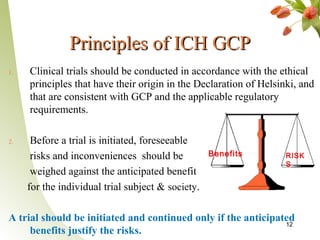
2.    Before a trial is initiated, foreseeable
      risks and inconveniences should be           Benefits        RISK
                                                                   S
      weighed against the anticipated benefit
     for the individual trial subject & society.

A trial should be initiated and continued only if the anticipated
                                                               12
     benefits justify the risks.
Principles of ICH GCP Continued
3.    The rights, safety, and well-being of the trial subjects are
      the most important considerations and should prevail
      over interests of science & society.

4.    The available non-clinical & clinical information on an
      investigational product should be adequate to support the
      proposed clinical trial.

5.    Clinical trials should be scientifically sound, and
      describe in a clear, detailed protocol.

6.    A trial should be conducted in compliance with the      13
      protocol that has received prior IRB (or IEC) approval.
Principles of ICH GCP Continued
7.    The medical care given to, and medical decisions made
      on behalf of, subjects should always be the
      responsibility of a qualified physician or, when
      appropriate, of a qualified dentist.

8.    Each individual involved in conducting a trial should be
      qualified by education, training and experience to
      perform his or her respective tasks.

9.    Freely given informed consent should be obtained from
      every subject prior to clinical trial participation.
                                                              14
Principles of ICH GCP Continued
10.   All clinical trial information should be recorded, handled,
      and stored in a way that allows its accurate reporting,
      interpretation, and verification.

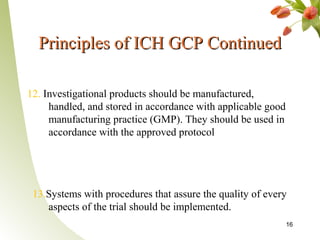
11.   The confidentiality of records that
      could identify subjects should be
      protected, respecting the privacy
      and confidentiality rules in accordance
      with the applicable regulatory
      compliance.
                                                                15
Principles of ICH GCP Continued

12. Investigational products should be manufactured,
     handled, and stored in accordance with applicable good
     manufacturing practice (GMP). They should be used in
     accordance with the approved protocol


 13.Systems with procedures that assure the quality of every
    aspects of the trial should be implemented.
                                                              16
Institutional Review Board (IRB),
       Independent Ethics Committee (IEC)

   A formally designated group that oversees research

    involving human subjects.

   Approves and disapproves human subject research.

   According to the standards of the community or the
    institution, the IRB/IEC may require modifications to a
    protocol to ensure patient safety.

                                                              17
IRB Function


•The primary function of an IRB/IEC is to safe guard the
rights ,safety ,and well being of all trial subjects. This is
accomplished by initial, continuing and annual review.

•An IRB should consist of members who collectively have
the qualifications and experience to review and evaluate
the science , medical aspects, and ethics of the proposed
trial.

                                                                18
IRB Members

 1.A minimum of five (5) members.
 2.One member whose concern is not scientific.
 3.One member who has no personal or familial
relationship to the institution or trial site.
4.Any member with a conflict of interest may not
participate in any part of the review or vote (except to
provide requested information).
5.Individuals with special expertise may be invited to assist
with areas of unique or complex nature. These will not be
voting members.
6.A list of IRB/IEC members and their qualifications       19
should be maintained.
IRB/Ethics Committee

All studies must be approved prior to recruiting
participants

IRB must review all documents given to participants

Reporting AEs and Deviations from protocol to the IRB

Maintenance of Records

                                                        20
Investigator Responsibilities
Adequate Resources
  Recruitment
  Time
  Qualified Staff
  Facilities
  Training


                                21
Investigator Responsibilities
Medical Care
  A qualified MD (or dentist) responsible for
  trial-related medical decisions
  Provide adequate medical care for AEs or other
  significant medical condition
  Inform PCP about participation in trial
  Make a reasonable effort to ascertain why
  participant withdrawals from study
                                               22
Investigator Responsibilities
Compliance with Protocol
  Investigator should sign off on protocol
  Investigator should not implement deviations
  from protocol
  If deviations occur, they should be documented
  and reported at once to the sponsor, the IRB
  and other regulatory authorities


                                               23
Investigator Responsibilities
Progress Reports             Safety Monitoring
  Written summary of trial     SAEs should be reported
  status to the IRB            immediately
  Written reports to the       AEs should be reported
  sponsor or regulatory        according to sponsor
  authority of any changes     guidelines
  affecting the trial          Supply sponsor & IRB
                               with requested materials
                               on participant deaths


                                                    24
Investigator Responsibilities
Premature Termination        Final Reporting
or Suspension                  Inform IRB of study
  Promptly inform trial        completion & a summary
  subjects                     of the trial’s outcome
  Assure appropriate           Provide sponsor &
  therapy & follow-up          regulatory authorities
  Inform sponsor,              with all required reports
  regulatory authorities &
  IRB


                                                    25
Investigator’s Brochure

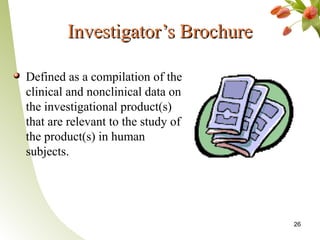
Defined as a compilation of the
clinical and nonclinical data on
the investigational product(s)
that are relevant to the study of
the product(s) in human
subjects.


                                    26
Clinical Trial Protocol
General Information
Background Information
Trial Objectives & Purpose
Trial Design
Selection & Withdrawal of Participants
Treatment of Subjects
Assessment of Efficacy
Assessment of Safety
                                         27
Sponsor Responsibilities
Quality Assurance & Quality Control
  Provide written SOPs
  Secures agreement between all parties
  Data handling
Contract Research Organization (CRO)
  Hired by the sponsor to implement trial-related duties
Medical Expertise
  Designated medical personnel to advise on trial-related
  medical questions and problems
                                                           28
Sponsor Responsibilities
Trial Design
  Designs CRFs
  Planning analyses
Trial Management, Data Handling,
Recordkeeping, & Independent Data Monitoring
Committee (DMC)
  Qualified personnel to supervise overall conduct of the
  study
  DMC assesses the progress of the clinical trial
  Maintain SOPs for electronic data processing
  Inform Investigator of guidelines for record retention 29
Essential Documents for the Conduct of a
             Clinical Trial
Preclinical trial
commencement

During clinical conduct
of trial

After completion or
termination of trial
                                       30
Storage of Essential Documents

Sponsor Rule: refer to study
  protocol

  FDA Rule: 2 options
    2 years following marketing of
    the drug or,
    2 years after IND application
    is withdrawn if drug was not
    marketed


                                     31
References


             32
References
http://www.fda.gov/oc/gcp/guidance.htm
http://www.clinicaltrials.gov/
http://www.fda.gov/oc/ohrt/irbs/websites.html
http://ohrp.osophs.dhhs.gov/
http://privacyruleandresearch.nih.gov/
http://en.wikipedia.org/wiki/ICH-GCP
Handbook: good laboratory practice (GLP): quality
practices for regulated non-clinical research and
development -2nd ed., WHO Library Cataloguing-in- 33
Publication Data, 2nd ed., 7,15-20.
References

OECD Principles of Good Laboratory Practice (as
revised in 1997)". OECD Environmental Health
and Safety Publications (OECD) 1. 1998.
http://www.oecd.org/document/63/0,2340,en_264
9_34381_2346175_1_1_1_37465,00.html.
Schneider, K (1983(Spring)). "Faking it: The case
against Industrial Bio-Test Laboratories". Amicus
Journal (Natural Resources Defence Council): 14-
26.
http://planetwaves.net/contents/faking_it.html. 34
References
Tweedale, AC (2011). "Uses of ‘Good Laboratory
Practices’ by regulated industry and agencies, and
the safety of bisphenol A". J Epidemiol
Community Health (BMJ Group) Online First: 15
February 2011. doi:10.1136/jech.2010.127761.
Webster, Gregory K. et al. (2005). "JALA
Tutorial: Considerations When Implementing
Automated Methods into GcP". Journal of the
Association for Laboratory Automation (Elsevier)
10 (3): 182–191. doi:10.1016/j.jala.2005.03.003 35
Thank you……….


                36

Good Clinical Practice By: Swapnil L. patil

  • 1.
    Good Clinical Practice Presented by:- Mr. Swapnil L. 1
  • 2.
    Good Clinical Practices Presented by:- Mr. Swapnil L. Patil M.Pharm Department of Pharmaceutics Pad. Dr. D. Y. Patil College of Pharmacy, Akurdi, Pune, Maharashtra, India, 411018 . Mob.09730306520 2
  • 3.
    Contents  Glossary  Principles of GCP  IEC/IRB Responsibilities  Investigator Responsibilities  Sponsor Responsibilities  Protocols and Amendments  Investigator’s Brochure  Essential Documents 3
  • 4.
    Glossary Adverse drug reaction(ADR) Serious Adverse Event (SAE) Audit Blinding/masking Investigator Protocol Sponsor 4
  • 5.
    History of GoodClinical Practice  Prior to an actual set of guidelines to follow for good clinical practice, clinical studies were dangerous and could result in serous disease, or possibly death.  The Nuremburg Code of 1947  Experiments performed in Germany during WWII opened the eyes of the world for guidance for clinical testing on humans.  The code did set ethical guidelines, but it lacked legislation to back it up.  Declaration of Helsinki ▪ In 1964, the World Medical Association established recommendations guiding medical doctors in biomedical research involving human subjects. These guidelines influenced national legislation, but there was no set standard between nations. 5
  • 6.
    GOOD CLINICAL PRACTICE FDA ICH 21 CFR International • Electronic Docs. • glossary • Inf. Consent • principles • Financial Disclosure • IRBs • IRBs • Investigator • IND regs. • Sponsor • Essential Docs 35
  • 7.
    ICH Guidelines  ICH Guidelines are divided into 4 main topics:  Quality Topics – relate to chemical and pharmaceutical quality assurance e.g. Q1 Stability Testing  Safety Topics – relate to preclinical studies e.g. S1 Carcinogenicity Testing  Multidisciplinary Topics – cross-cutting topics which don’t fit into one of the other categories e.g. M1 Medical Terminology  Efficacy Topics – relate to clinical studies in human subjects  e.g. E6 Good Clinical Practice;  e.g. E2A Clinical Safety Data Management: 7  e.g. E9 Statistical Principles for Clinical Trials
  • 8.
    FDA Regulations 21 C.F.R.Part 312, Subpart D (Duties of Sponsors, Investigators) – 21 C.F.R. Part 50 (Informed Consent) – 21 C.F.R. Part 56 (Institutional Review Boards) – 21 C.F.R. Part 54 (Investigator Financial Disclosure) 8
  • 9.
    Good Clinical Practice(GCP) is defined as a ‘standard for the design, conduct, performance, monitoring, auditing, recording, analyses and reporting of clinical trials that provides assurance that the data and reported results are credible and accurate, and that the rights, integrity and confidentiality of trial subjects are protected’ 9
  • 10.
    Good Clinical Practice(GCP) is an international ethical and scientific quality standard for designing, conducting, recording, and reporting trials that involve the participation of human patients. Compliance with this standard provides public assurance that the rights, safety and well-being of trial patients are protected and clinical trial data are credible. 10
  • 11.
    Are mainly focused on the protection of human rights in clinical trial.  Provide assurance of the safety of the newly developed compounds.  Provide standards on how clinical trials should be conducted.  Define the roles and responsibilities of -  Clinical Sponsors,  Clinical Research Investigators,  Clinical Research Associates, And  Monitors. 11
  • 12.
    Principles of ICHGCP 1. Clinical trials should be conducted in accordance with the ethical principles that have their origin in the Declaration of Helsinki, and that are consistent with GCP and the applicable regulatory requirements. 2. Before a trial is initiated, foreseeable risks and inconveniences should be Benefits RISK S weighed against the anticipated benefit for the individual trial subject & society. A trial should be initiated and continued only if the anticipated 12 benefits justify the risks.
  • 13.
    Principles of ICHGCP Continued 3. The rights, safety, and well-being of the trial subjects are the most important considerations and should prevail over interests of science & society. 4. The available non-clinical & clinical information on an investigational product should be adequate to support the proposed clinical trial. 5. Clinical trials should be scientifically sound, and describe in a clear, detailed protocol. 6. A trial should be conducted in compliance with the 13 protocol that has received prior IRB (or IEC) approval.
  • 14.
    Principles of ICHGCP Continued 7. The medical care given to, and medical decisions made on behalf of, subjects should always be the responsibility of a qualified physician or, when appropriate, of a qualified dentist. 8. Each individual involved in conducting a trial should be qualified by education, training and experience to perform his or her respective tasks. 9. Freely given informed consent should be obtained from every subject prior to clinical trial participation. 14
  • 15.
    Principles of ICHGCP Continued 10. All clinical trial information should be recorded, handled, and stored in a way that allows its accurate reporting, interpretation, and verification. 11. The confidentiality of records that could identify subjects should be protected, respecting the privacy and confidentiality rules in accordance with the applicable regulatory compliance. 15
  • 16.
    Principles of ICHGCP Continued 12. Investigational products should be manufactured, handled, and stored in accordance with applicable good manufacturing practice (GMP). They should be used in accordance with the approved protocol 13.Systems with procedures that assure the quality of every aspects of the trial should be implemented. 16
  • 17.
    Institutional Review Board(IRB), Independent Ethics Committee (IEC)  A formally designated group that oversees research involving human subjects.  Approves and disapproves human subject research.  According to the standards of the community or the institution, the IRB/IEC may require modifications to a protocol to ensure patient safety. 17
  • 18.
    IRB Function •The primaryfunction of an IRB/IEC is to safe guard the rights ,safety ,and well being of all trial subjects. This is accomplished by initial, continuing and annual review. •An IRB should consist of members who collectively have the qualifications and experience to review and evaluate the science , medical aspects, and ethics of the proposed trial. 18
  • 19.
    IRB Members 1.Aminimum of five (5) members. 2.One member whose concern is not scientific. 3.One member who has no personal or familial relationship to the institution or trial site. 4.Any member with a conflict of interest may not participate in any part of the review or vote (except to provide requested information). 5.Individuals with special expertise may be invited to assist with areas of unique or complex nature. These will not be voting members. 6.A list of IRB/IEC members and their qualifications 19 should be maintained.
  • 20.
    IRB/Ethics Committee All studiesmust be approved prior to recruiting participants IRB must review all documents given to participants Reporting AEs and Deviations from protocol to the IRB Maintenance of Records 20
  • 21.
    Investigator Responsibilities Adequate Resources Recruitment Time Qualified Staff Facilities Training 21
  • 22.
    Investigator Responsibilities Medical Care A qualified MD (or dentist) responsible for trial-related medical decisions Provide adequate medical care for AEs or other significant medical condition Inform PCP about participation in trial Make a reasonable effort to ascertain why participant withdrawals from study 22
  • 23.
    Investigator Responsibilities Compliance withProtocol Investigator should sign off on protocol Investigator should not implement deviations from protocol If deviations occur, they should be documented and reported at once to the sponsor, the IRB and other regulatory authorities 23
  • 24.
    Investigator Responsibilities Progress Reports Safety Monitoring Written summary of trial SAEs should be reported status to the IRB immediately Written reports to the AEs should be reported sponsor or regulatory according to sponsor authority of any changes guidelines affecting the trial Supply sponsor & IRB with requested materials on participant deaths 24
  • 25.
    Investigator Responsibilities Premature Termination Final Reporting or Suspension Inform IRB of study Promptly inform trial completion & a summary subjects of the trial’s outcome Assure appropriate Provide sponsor & therapy & follow-up regulatory authorities Inform sponsor, with all required reports regulatory authorities & IRB 25
  • 26.
    Investigator’s Brochure Defined asa compilation of the clinical and nonclinical data on the investigational product(s) that are relevant to the study of the product(s) in human subjects. 26
  • 27.
    Clinical Trial Protocol GeneralInformation Background Information Trial Objectives & Purpose Trial Design Selection & Withdrawal of Participants Treatment of Subjects Assessment of Efficacy Assessment of Safety 27
  • 28.
    Sponsor Responsibilities Quality Assurance& Quality Control Provide written SOPs Secures agreement between all parties Data handling Contract Research Organization (CRO) Hired by the sponsor to implement trial-related duties Medical Expertise Designated medical personnel to advise on trial-related medical questions and problems 28
  • 29.
    Sponsor Responsibilities Trial Design Designs CRFs Planning analyses Trial Management, Data Handling, Recordkeeping, & Independent Data Monitoring Committee (DMC) Qualified personnel to supervise overall conduct of the study DMC assesses the progress of the clinical trial Maintain SOPs for electronic data processing Inform Investigator of guidelines for record retention 29
  • 30.
    Essential Documents forthe Conduct of a Clinical Trial Preclinical trial commencement During clinical conduct of trial After completion or termination of trial 30
  • 31.
    Storage of EssentialDocuments Sponsor Rule: refer to study protocol FDA Rule: 2 options 2 years following marketing of the drug or, 2 years after IND application is withdrawn if drug was not marketed 31
  • 32.
  • 33.
  • 34.
    References OECD Principles ofGood Laboratory Practice (as revised in 1997)". OECD Environmental Health and Safety Publications (OECD) 1. 1998. http://www.oecd.org/document/63/0,2340,en_264 9_34381_2346175_1_1_1_37465,00.html. Schneider, K (1983(Spring)). "Faking it: The case against Industrial Bio-Test Laboratories". Amicus Journal (Natural Resources Defence Council): 14- 26. http://planetwaves.net/contents/faking_it.html. 34
  • 35.
    References Tweedale, AC (2011)."Uses of ‘Good Laboratory Practices’ by regulated industry and agencies, and the safety of bisphenol A". J Epidemiol Community Health (BMJ Group) Online First: 15 February 2011. doi:10.1136/jech.2010.127761. Webster, Gregory K. et al. (2005). "JALA Tutorial: Considerations When Implementing Automated Methods into GcP". Journal of the Association for Laboratory Automation (Elsevier) 10 (3): 182–191. doi:10.1016/j.jala.2005.03.003 35
  • 36.

Editor's Notes

  • #21 Maintain records for 3 years after the completion of the trial