PRESENTED BY
ANUSHA .B
Y15MPH431
DEPT . OF PHARMACETICAL
ANALYSIS
 INTRODUCTION
 WHAT IS GLP ?
 WHY IS GLP NEDDED?
 OBJECTIVES OF GLP
 ELEMENTS OF GLP
 IMPORTANCE AND FUNCTION
 CONCLUSION
 REFERENCE
• The term GLP was first used in New Zealand in 1972.
• In 1981 an organization named OECD (organization for
economic co-operation and development ) produced GLP
principles that are international standard.
Good laboratory practice or GLP specifically refers to a
quality system of management controls for research
laboratories and organizations to try to ensure the
uniformity, consistency, reliability, reproducibility, quality
Good Laboratory Practices(GLP) is
a quality system concerned with
the organizational process and the
conditions under which non-clinical
health and environmental safety
studies are planned, performed,
monitored, recorded, archived and
reported.
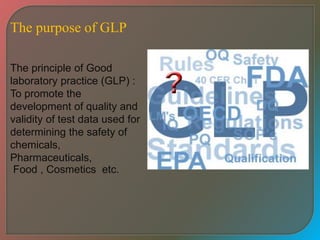
The purpose of GLP
The principle of Good
laboratory practice (GLP) :
To promote the
development of quality and
validity of test data used for
determining the safety of
chemicals,
Pharmaceuticals,
Food , Cosmetics etc.
Reason behind GLP creation
In the 1970s because of concerns about the validity of non-
clinical safety data submitted to the Food and Drug
Administration (FDA) in the context of New Drug Applications
(NDA).
The inspection of studies and test facilities revealed
instances of inadequate planning and incompetent execution
of studies, insufficient documentation of methods and results,
and even cases of fraud.
These deficiencies were made public in the Kennedy-
Hearings of the US Congress, and the political outcome of
these hearings led to the FDA’s publication of Proposed
Regulations on GLP in 1976, with establishment of the Final
Rule in June 1979 (21 CFR 58.
For example, replacing animals which had died during a study
with new ones (without documenting this fact).
Deleting gross necropsy observations changing raw data in
order to “fit the result tables” in the final report.
FAMOUS EXAMPLE
 The name of the Lab was Industrial
Bio Test. This was a big lab that ran
tests for big companies such as Procter
and Gamble.
 One of the labs that went under such an
investigation made headline news.
 It was discovered that mice that they
had used to test lotion and deodorants had
developed cancer and died
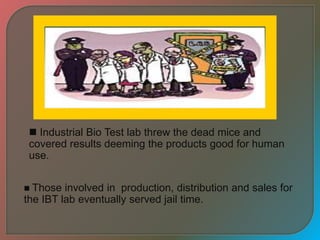
 Industrial Bio Test lab threw the dead mice and
covered results deeming the products good for human
use.
 Those involved in production, distribution and sales for
the IBT lab eventually served jail time.
 GLP makes sure that the data submitted are a true reflection
of the results that are obtained during the study.
 GLP also makes sure that data is traceable.
 Promotes international acceptance
OBJECTIVES OF GLP
GMP vs. GLP
Samples Laboratory Processes Results of
Analysis
Good Laboratory Practices
Raw Materials Packaging
Materials
Manufacturing Processes
Finished
Product of
Standard
Quality
Good Manufacturing
Practices
MANAGEMENT
QUALITY
ASSURANCE
UNIT
INSPECTION &
TEST UNIT
HEAD TESTING
LABORTATORY
SIMPLEST ORGANIZATION IN AN
APPROVED TESTING LABORATORY
GLP stresses the importance of the following main points:
1. Resources: Organisation, personnel, facilities and equipment;
2. Characterisation: Test items and test systems;
3. Rules: Protocols, standard operating procedures (SOPs);
4. Results: Raw data, final report and archives;
5. Quality Assurance: Independent monitoring of research processes
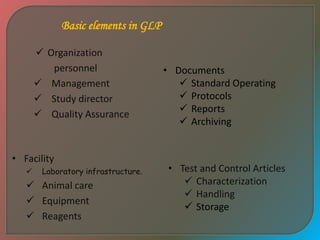
Basic elements in GLP
• Documents
 Standard Operating
 Protocols
 Reports
 Archiving
• Test and Control Articles
 Characterization
 Handling
 Storage
• Facility
 Laboratory infrastructure.
 Animal care
 Equipment
 Reagents
 Organization
personnel
 Management
 Study director
 Quality Assurance
ORGANISATION
GLP regulations require clear definitions of the structure of the
research organisation and the responsibilities of the research
personnel.
This means that the organisational chart should reflect the
reality of the institution and should be kept up to date.
Organisational charts and job descriptions give an immediate
idea of the way in which the laboratory functions and the
relationships between the different departments and posts.
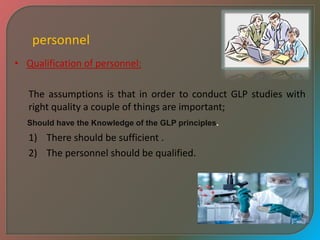
personnel
• Qualification of personnel:
The assumptions is that in order to conduct GLP studies with
right quality a couple of things are important;
1) There should be sufficient .
2) The personnel should be qualified.
Should have the Knowledge of the GLP principles.
• Facility management:
Responsibilities of facility management is well defined. They
designate a study director, as well as assure quality assurance
unit is available, test and control articles are characterized.
• Study director:
He has overall responsibilities for technical conduct safety
studies, as well as interpretation, analysis, documentation and
reporting of results.
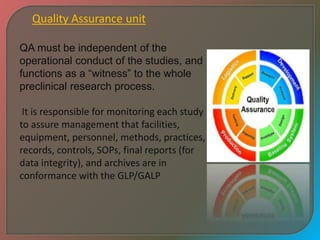
Quality Assurance unit
QA must be independent of the
operational conduct of the studies, and
functions as a “witness” to the whole
preclinical research process.
It is responsible for monitoring each study
to assure management that facilities,
equipment, personnel, methods, practices,
records, controls, SOPs, final reports (for
data integrity), and archives are in
conformance with the GLP/GALP
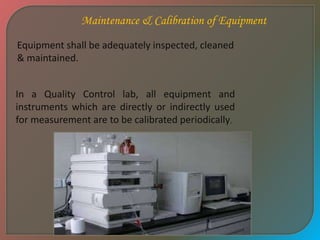
Maintenance & Calibration of Equipment
Equipment shall be adequately inspected, cleaned
& maintained.
In a Quality Control lab, all equipment and
instruments which are directly or indirectly used
for measurement are to be calibrated periodically.
Facility
The facilities should be spacious enough to avoid problems
such as overcrowding, cross contamination or confusion between projects.
Utilities (water, electricity etc.) must be adequate and stable.
Laboratory infrastructure.
General Chemical Laboratory
The specific requirements are:
Well ventilated, lighted and preferably air conditioned to
maintain a temperature of 27 ± 10C.
Instrument Room:
The specific requirements are:
 Temperature : 25 ± 10C
 Relative humidity : 45 ± 5%.
 Constant supply of Electricity
 No vibrational disturbances.
 Separate room for housing semi-micro & microbalances.
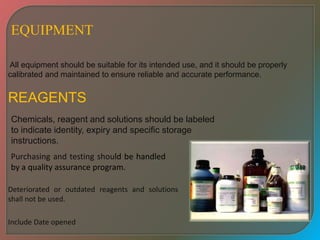
All equipment should be suitable for its intended use, and it should be properly
calibrated and maintained to ensure reliable and accurate performance.
REAGENTS
EQUIPMENT
Purchasing and testing should be handled
by a quality assurance program.
Chemicals, reagent and solutions should be labeled
to indicate identity, expiry and specific storage
instructions.
Deteriorated or outdated reagents and solutions
shall not be used.
Include Date opened
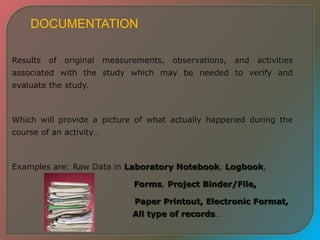
DOCUMENTATION
Results of original measurements, observations, and activities
associated with the study which may be needed to verify and
evaluate the study.
Which will provide a picture of what actually happened during the
course of an activity…
Examples are: Raw Data in Laboratory Notebook, Logbook,
Forms, Project Binder/File,
Paper Printout, Electronic Format,
All type of records…
WHAT ARE THE REQUIREMENTS OF DOCUMENTATION?
Therefore the document should show:
What was done…
How it was done…
When the work was performed…
Who performed the work…
DOCUMENTATION TYPE…
Handwritten Documentation
Entry Into Electronic System
Copying Raw Data
Electronic Data Capture
Standard Operating Procedures
(SOP)
 Written procedures for a laboratories program.
 They define how to carry out protocol-specified activities.
 Most often written in a chronological listing of action steps.
 They are written to explain how the procedures are suppose to
work
 Routine inspection, cleaning, maintenance, testing and
calibration.
 Actions to be taken in response to equipment failure.
 Keeping records, reporting, storage, mixing, and retrieval of
data
TRAINING AND
ANALYST CERTIFICATION
All laboratory personnel (managers, supervisory staffs, analysts,
technicians, helpers and others) should have regular training and
updated
Some acceptable proof of satisfactory training and/or competence
with specific laboratory procedures must be established for each
analyst.
Qualification can come from education, experience or additional
trainings, but it should be documented
Safety
In the Quality Control Laboratory, one has to handle a no of
hazardous, poisonous and inflammable chemicals and also pathogenic
organisms.
Hence the adoption of proper safety measure and use of safety
devices are of paramount importance.
The use of mask, gloves, face shields, aprons, gumboots etc. should be
made compulsory in the handling of corrosive chemicals.
There should be adequate fire fighting arrangements in the
laboratory and personnel should be given proper training for fire
fighting.
Benefits of good laboratory practices.
It will give better image of company as a Quality producer in
Global market.
Provide guideline for doing testing and measurement in detail.
Studies done under GLP are definitely more acceptable to Regulatory
bodies.
1)Good house-keeping,
(2) Quality Manual/Documentation,
(3) Quality Policy,
(4) Method Validation,
(5) Instrumental Validation,
(6) System Suitability Tests,
(7) Calibration of Equipment/Instruments/
Calibration Schedules/Traceability,
A General Checklist for GLP Implementation
8) Equipment Log Books,
(9) Standard Analytical Reference Samples and
their Traceability(All related
Certificates/Documentation),
(10) Archives for Samples and Documents,
(11) Specifications for the products investigated
12) Good Vendor Development,
(13) Study Director for Projects,
(14) Statistical Evaluations,
15) Staff proficiency, Health and Safety,
(16) Procedures for Receiving, Dealing and
Disposing Samples,
(17) Environmental monitoring in working
18) Effluent Treatment Monitoring and
Control,
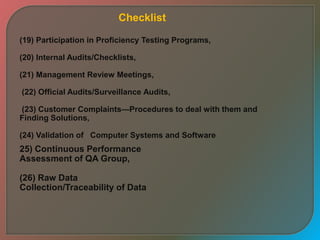
Checklist
(19) Participation in Proficiency Testing Programs,
(20) Internal Audits/Checklists,
(21) Management Review Meetings,
(22) Official Audits/Surveillance Audits,
(23) Customer Complaints—Procedures to deal with them and
Finding Solutions,
(24) Validation of Computer Systems and Software
25) Continuous Performance
Assessment of QA Group,
(26) Raw Data
Collection/Traceability of Data
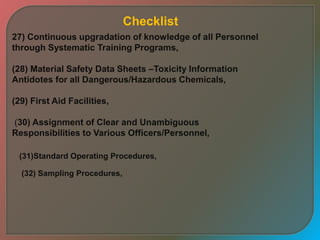
Checklist
27) Continuous upgradation of knowledge of all Personnel
through Systematic Training Programs,
(28) Material Safety Data Sheets –Toxicity Information
Antidotes for all Dangerous/Hazardous Chemicals,
(29) First Aid Facilities,
(30) Assignment of Clear and Unambiguous
Responsibilities to Various Officers/Personnel,
(31)Standard Operating Procedures,
(32) Sampling Procedures,
Checklist
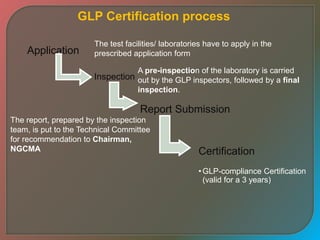
GLP Certification process
Application
Inspection
Report Submission
Certification
The test facilities/ laboratories have to apply in the
prescribed application form
A pre-inspection of the laboratory is carried
out by the GLP inspectors, followed by a final
inspection.
The report, prepared by the inspection
team, is put to the Technical Committee
for recommendation to Chairman,
NGCMA
•GLP-compliance Certification
(valid for a 3 years)
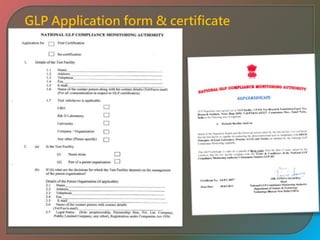
GLP Application form & certificate
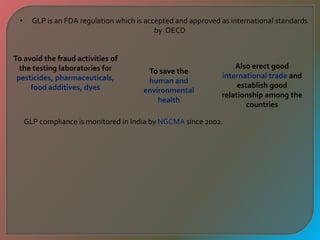
• GLP is an FDA regulation which is accepted and approved as international standards
by OECD
To avoid the fraud activities of
the testing laboratories for
pesticides, pharmaceuticals,
food additives, dyes
To save the
human and
environmental
health
Also erect good
international trade and
establish good
relationship among the
countries
GLP compliance is monitored in India by NGCMA since 2002.
CONCLUSION
In conclusion one must realize that
in the pharmaceutical industry
there is no margin for error and
one must follow good practices in
the laboratory to generate
accurate, precise and reliable data.
BIBLOGRAPHY:
 Pharmaceutical Quality Assurance And Management by
K.P.Bhusari p.g.no:105-112
 Drug Regulatory Affairs by Sai Kishore p.g.no:292-301
 Hand book of good laboratory practices by WHO
SO START
GLP

Glp guidelines in_qc_laboratory_as_per_ich

  • 1.
    PRESENTED BY ANUSHA .B Y15MPH431 DEPT. OF PHARMACETICAL ANALYSIS
  • 2.
     INTRODUCTION  WHATIS GLP ?  WHY IS GLP NEDDED?  OBJECTIVES OF GLP  ELEMENTS OF GLP  IMPORTANCE AND FUNCTION  CONCLUSION  REFERENCE
  • 3.
    • The termGLP was first used in New Zealand in 1972. • In 1981 an organization named OECD (organization for economic co-operation and development ) produced GLP principles that are international standard. Good laboratory practice or GLP specifically refers to a quality system of management controls for research laboratories and organizations to try to ensure the uniformity, consistency, reliability, reproducibility, quality
  • 4.
    Good Laboratory Practices(GLP)is a quality system concerned with the organizational process and the conditions under which non-clinical health and environmental safety studies are planned, performed, monitored, recorded, archived and reported.
  • 5.
    The purpose ofGLP The principle of Good laboratory practice (GLP) : To promote the development of quality and validity of test data used for determining the safety of chemicals, Pharmaceuticals, Food , Cosmetics etc.
  • 6.
    Reason behind GLPcreation In the 1970s because of concerns about the validity of non- clinical safety data submitted to the Food and Drug Administration (FDA) in the context of New Drug Applications (NDA). The inspection of studies and test facilities revealed instances of inadequate planning and incompetent execution of studies, insufficient documentation of methods and results, and even cases of fraud.
  • 7.
    These deficiencies weremade public in the Kennedy- Hearings of the US Congress, and the political outcome of these hearings led to the FDA’s publication of Proposed Regulations on GLP in 1976, with establishment of the Final Rule in June 1979 (21 CFR 58. For example, replacing animals which had died during a study with new ones (without documenting this fact). Deleting gross necropsy observations changing raw data in order to “fit the result tables” in the final report.
  • 8.
    FAMOUS EXAMPLE  Thename of the Lab was Industrial Bio Test. This was a big lab that ran tests for big companies such as Procter and Gamble.  One of the labs that went under such an investigation made headline news.  It was discovered that mice that they had used to test lotion and deodorants had developed cancer and died
  • 9.
     Industrial BioTest lab threw the dead mice and covered results deeming the products good for human use.  Those involved in production, distribution and sales for the IBT lab eventually served jail time.
  • 10.
     GLP makessure that the data submitted are a true reflection of the results that are obtained during the study.  GLP also makes sure that data is traceable.  Promotes international acceptance OBJECTIVES OF GLP
  • 11.
    GMP vs. GLP SamplesLaboratory Processes Results of Analysis Good Laboratory Practices Raw Materials Packaging Materials Manufacturing Processes Finished Product of Standard Quality Good Manufacturing Practices
  • 12.
    MANAGEMENT QUALITY ASSURANCE UNIT INSPECTION & TEST UNIT HEADTESTING LABORTATORY SIMPLEST ORGANIZATION IN AN APPROVED TESTING LABORATORY
  • 13.
    GLP stresses theimportance of the following main points: 1. Resources: Organisation, personnel, facilities and equipment; 2. Characterisation: Test items and test systems; 3. Rules: Protocols, standard operating procedures (SOPs); 4. Results: Raw data, final report and archives; 5. Quality Assurance: Independent monitoring of research processes
  • 14.
    Basic elements inGLP • Documents  Standard Operating  Protocols  Reports  Archiving • Test and Control Articles  Characterization  Handling  Storage • Facility  Laboratory infrastructure.  Animal care  Equipment  Reagents  Organization personnel  Management  Study director  Quality Assurance
  • 15.
    ORGANISATION GLP regulations requireclear definitions of the structure of the research organisation and the responsibilities of the research personnel. This means that the organisational chart should reflect the reality of the institution and should be kept up to date. Organisational charts and job descriptions give an immediate idea of the way in which the laboratory functions and the relationships between the different departments and posts.
  • 16.
    personnel • Qualification ofpersonnel: The assumptions is that in order to conduct GLP studies with right quality a couple of things are important; 1) There should be sufficient . 2) The personnel should be qualified. Should have the Knowledge of the GLP principles.
  • 17.
    • Facility management: Responsibilitiesof facility management is well defined. They designate a study director, as well as assure quality assurance unit is available, test and control articles are characterized. • Study director: He has overall responsibilities for technical conduct safety studies, as well as interpretation, analysis, documentation and reporting of results.
  • 18.
    Quality Assurance unit QAmust be independent of the operational conduct of the studies, and functions as a “witness” to the whole preclinical research process. It is responsible for monitoring each study to assure management that facilities, equipment, personnel, methods, practices, records, controls, SOPs, final reports (for data integrity), and archives are in conformance with the GLP/GALP
  • 19.
    Maintenance & Calibrationof Equipment Equipment shall be adequately inspected, cleaned & maintained. In a Quality Control lab, all equipment and instruments which are directly or indirectly used for measurement are to be calibrated periodically.
  • 20.
    Facility The facilities shouldbe spacious enough to avoid problems such as overcrowding, cross contamination or confusion between projects. Utilities (water, electricity etc.) must be adequate and stable. Laboratory infrastructure. General Chemical Laboratory The specific requirements are: Well ventilated, lighted and preferably air conditioned to maintain a temperature of 27 ± 10C.
  • 21.
    Instrument Room: The specificrequirements are:  Temperature : 25 ± 10C  Relative humidity : 45 ± 5%.  Constant supply of Electricity  No vibrational disturbances.  Separate room for housing semi-micro & microbalances.
  • 22.
    All equipment shouldbe suitable for its intended use, and it should be properly calibrated and maintained to ensure reliable and accurate performance. REAGENTS EQUIPMENT Purchasing and testing should be handled by a quality assurance program. Chemicals, reagent and solutions should be labeled to indicate identity, expiry and specific storage instructions. Deteriorated or outdated reagents and solutions shall not be used. Include Date opened
  • 23.
    DOCUMENTATION Results of originalmeasurements, observations, and activities associated with the study which may be needed to verify and evaluate the study. Which will provide a picture of what actually happened during the course of an activity… Examples are: Raw Data in Laboratory Notebook, Logbook, Forms, Project Binder/File, Paper Printout, Electronic Format, All type of records…
  • 24.
    WHAT ARE THEREQUIREMENTS OF DOCUMENTATION? Therefore the document should show: What was done… How it was done… When the work was performed… Who performed the work…
  • 25.
    DOCUMENTATION TYPE… Handwritten Documentation EntryInto Electronic System Copying Raw Data Electronic Data Capture
  • 26.
    Standard Operating Procedures (SOP) Written procedures for a laboratories program.  They define how to carry out protocol-specified activities.  Most often written in a chronological listing of action steps.  They are written to explain how the procedures are suppose to work  Routine inspection, cleaning, maintenance, testing and calibration.  Actions to be taken in response to equipment failure.  Keeping records, reporting, storage, mixing, and retrieval of data
  • 27.
    TRAINING AND ANALYST CERTIFICATION Alllaboratory personnel (managers, supervisory staffs, analysts, technicians, helpers and others) should have regular training and updated Some acceptable proof of satisfactory training and/or competence with specific laboratory procedures must be established for each analyst. Qualification can come from education, experience or additional trainings, but it should be documented
  • 28.
    Safety In the QualityControl Laboratory, one has to handle a no of hazardous, poisonous and inflammable chemicals and also pathogenic organisms. Hence the adoption of proper safety measure and use of safety devices are of paramount importance. The use of mask, gloves, face shields, aprons, gumboots etc. should be made compulsory in the handling of corrosive chemicals. There should be adequate fire fighting arrangements in the laboratory and personnel should be given proper training for fire fighting.
  • 29.
    Benefits of goodlaboratory practices. It will give better image of company as a Quality producer in Global market. Provide guideline for doing testing and measurement in detail. Studies done under GLP are definitely more acceptable to Regulatory bodies.
  • 30.
    1)Good house-keeping, (2) QualityManual/Documentation, (3) Quality Policy, (4) Method Validation, (5) Instrumental Validation, (6) System Suitability Tests, (7) Calibration of Equipment/Instruments/ Calibration Schedules/Traceability, A General Checklist for GLP Implementation 8) Equipment Log Books, (9) Standard Analytical Reference Samples and their Traceability(All related Certificates/Documentation), (10) Archives for Samples and Documents, (11) Specifications for the products investigated
  • 31.
    12) Good VendorDevelopment, (13) Study Director for Projects, (14) Statistical Evaluations, 15) Staff proficiency, Health and Safety, (16) Procedures for Receiving, Dealing and Disposing Samples, (17) Environmental monitoring in working 18) Effluent Treatment Monitoring and Control, Checklist
  • 32.
    (19) Participation inProficiency Testing Programs, (20) Internal Audits/Checklists, (21) Management Review Meetings, (22) Official Audits/Surveillance Audits, (23) Customer Complaints—Procedures to deal with them and Finding Solutions, (24) Validation of Computer Systems and Software 25) Continuous Performance Assessment of QA Group, (26) Raw Data Collection/Traceability of Data Checklist
  • 33.
    27) Continuous upgradationof knowledge of all Personnel through Systematic Training Programs, (28) Material Safety Data Sheets –Toxicity Information Antidotes for all Dangerous/Hazardous Chemicals, (29) First Aid Facilities, (30) Assignment of Clear and Unambiguous Responsibilities to Various Officers/Personnel, (31)Standard Operating Procedures, (32) Sampling Procedures, Checklist
  • 34.
    GLP Certification process Application Inspection ReportSubmission Certification The test facilities/ laboratories have to apply in the prescribed application form A pre-inspection of the laboratory is carried out by the GLP inspectors, followed by a final inspection. The report, prepared by the inspection team, is put to the Technical Committee for recommendation to Chairman, NGCMA •GLP-compliance Certification (valid for a 3 years)
  • 35.
    GLP Application form& certificate
  • 36.
    • GLP isan FDA regulation which is accepted and approved as international standards by OECD To avoid the fraud activities of the testing laboratories for pesticides, pharmaceuticals, food additives, dyes To save the human and environmental health Also erect good international trade and establish good relationship among the countries GLP compliance is monitored in India by NGCMA since 2002.
  • 37.
    CONCLUSION In conclusion onemust realize that in the pharmaceutical industry there is no margin for error and one must follow good practices in the laboratory to generate accurate, precise and reliable data.
  • 38.
    BIBLOGRAPHY:  Pharmaceutical QualityAssurance And Management by K.P.Bhusari p.g.no:105-112  Drug Regulatory Affairs by Sai Kishore p.g.no:292-301  Hand book of good laboratory practices by WHO
  • 39.