Good Manufacturing
Practice
K.GURU MOHAN REDDY
TVM/2016-13
DEPARTMENT OF ANIMAL NUTRTION
COLLEGE OF VETERINARY SCIENCE, TIRUPATI
SRI VENKATESWARA VETERINARY UNIVERSITY
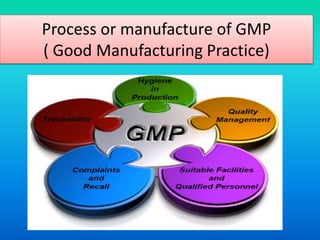
Process or manufacture of GMP
( Good Manufacturing Practice)
Each segment of the manufacturing
process affects product quality
Storage:- Dry ingredients and liquid
Particle reduction:-testing
Batching, Soaking, and Testing
Liquid handling
Mixing, Sampling and testing
Bagging and Storage
Bulk storage
Housekeeping
Maintenance
Safety
1) Storage
 Mark to prevent cross mixing
Clean out top to bottom
Seal between bins, check turnheads
Repair broken diverter gates
No water leaks
Practice yo-yoing
Fresh ingredients
Empty solids that settled
Keep manholes tight
Tests for strength and contamination
Good potency
2)Particle reduction
•Purpose:-Mixing ingredients
Further processing
Digestion
Appearance
a. Remove foreign material
Use 2×2” grill
Heavy duty magnets remove most ferrous materials.
These magnets may be operated manually or automatically.
A second magnet at the roller mill or hammer mill is needed.
Damage to the rolls and hammer breakage affects quality and cost.
b. Hammer mill - The hammer pattern and position will affect the capacity
of the hammer mill and the quality of the ground products.
• Follow the equipment manufacturer's recommendations.
• Monitor hammer wear.
• Monitor screens for wear and holes.
• Screen hole size is very important throughout.
• Check rolls  wear and damage.
• Recorrigation is necessary after wear.
• Keep quality grinds up to standard.
• Feeding roller mills and hammer mills is important  operating and quality
job.
• A rotary pocket feeder works best automating the grinding system.
c. Air Relief/Assist System :-
Objectives:
1.Increased productivity per Kilowatt hour reduce operating costs
and increasing profits.
2.To keep the temperature of the product being ground 7°F or less
above ambient temperature.
3.Better housekeeping, less labor, less dust hence, reduce risk for fire
and explosion.
To ensure an effective system the following must be considered:
1. Ventilated grinding room
2. Air - 1800 RPM - 1.25 CFM per square inch of screen area
3600 RPM 1.5 CFM per square inch of screen area.
3. You must have 1.5 WC Inches of Vacuum at mill inlet.
4. Minimum Air Requirements For Air Relief/Assist Systems
Plenum Chamber - This chamber below the mill to fan duct cannot be too large.
You must keep air velocity down to match your product.
Factors or quality involved:
a) Accuracy of System - modify and correct.
 System Weighing - accurately - test with certified weights
monthly. Test micro
scales weekly with certified weights.
 Batching - set parameters
 Time involved in weighing
 Cleaning and inspecting of scales.
 Liquid scales - check with certified weights weekly - clean
weekly.
3. Batching – Automated
b) Sequencing –
 Refers to order of weighing and order for dumping in mixer.
 Major Scales: weigh high volume ingredients first.
 Micro Scales: Accuracy should be within .02 pounds.
 Liquid Scale: weigh those that do not react with one another.
combining those
that don't give trouble
 Mixing: Correct timing sequence is important.
Major or large ingredients first followed by lesser.
After filling 1/2 to 3/4 in mixer start liquid spraying.
Start Mixing.
c) Sampling Mixer:-
 Done with probes or with a commercial sampler or make a 1"
hole about 1/3 from bottom of auger trough in the conveying
stream of material.
 Take sample by opening gate over the 1" hole and catch a
continuous stream of feed in a container.
 Mix and take a quart sample.
 To reduce sample size you open this gate every 10 seconds for
5 seconds.
d). Testing Mixer
a. Microscope
b. Chemical Analysis:-
Protein Minerals
Fats
Drug Additives
c. Microtracers
d. Fiber or finished feed
e. Molds or finished feed
f. Pelleting :
Factors affecting Quality of Pellets:
• Mixed Feeds
• Pellet Binders Equipment and conditions
• Selections of dies and rolls
• Quality of steam – regulation
• % of fat in mixer - adding fat to die
• Moisture
• Cooling
• Addition of liquids downstream
• Maintenance
• Production rate
g. Storage
1) Moisture
2) Regular Cleaning of Bins
3) Bagging Operation
Scales
Pellet
Rotating Inventory
Insect and rodent control
h. Housekeeping, Maintenance and Safety
Program:
1) Orderly cleaning
2) Controls molds, bacteria, insects, and rodents
3) Regular and scheduled maintenance will insure
Quality Production.
4)Safety – program
5)Results - interrupted in Quality product.
GMP (Good Manufacturing Practice)

GMP (Good Manufacturing Practice)

  • 1.
    Good Manufacturing Practice K.GURU MOHANREDDY TVM/2016-13 DEPARTMENT OF ANIMAL NUTRTION COLLEGE OF VETERINARY SCIENCE, TIRUPATI SRI VENKATESWARA VETERINARY UNIVERSITY
  • 2.
    Process or manufactureof GMP ( Good Manufacturing Practice)
  • 3.
    Each segment ofthe manufacturing process affects product quality Storage:- Dry ingredients and liquid Particle reduction:-testing Batching, Soaking, and Testing Liquid handling Mixing, Sampling and testing Bagging and Storage Bulk storage Housekeeping Maintenance Safety
  • 4.
    1) Storage  Markto prevent cross mixing Clean out top to bottom Seal between bins, check turnheads Repair broken diverter gates No water leaks Practice yo-yoing Fresh ingredients Empty solids that settled Keep manholes tight Tests for strength and contamination Good potency
  • 5.
    2)Particle reduction •Purpose:-Mixing ingredients Furtherprocessing Digestion Appearance a. Remove foreign material Use 2×2” grill Heavy duty magnets remove most ferrous materials. These magnets may be operated manually or automatically. A second magnet at the roller mill or hammer mill is needed. Damage to the rolls and hammer breakage affects quality and cost.
  • 6.
    b. Hammer mill- The hammer pattern and position will affect the capacity of the hammer mill and the quality of the ground products. • Follow the equipment manufacturer's recommendations. • Monitor hammer wear. • Monitor screens for wear and holes. • Screen hole size is very important throughout. • Check rolls  wear and damage. • Recorrigation is necessary after wear. • Keep quality grinds up to standard. • Feeding roller mills and hammer mills is important  operating and quality job. • A rotary pocket feeder works best automating the grinding system.
  • 7.
    c. Air Relief/AssistSystem :- Objectives: 1.Increased productivity per Kilowatt hour reduce operating costs and increasing profits. 2.To keep the temperature of the product being ground 7°F or less above ambient temperature. 3.Better housekeeping, less labor, less dust hence, reduce risk for fire and explosion.
  • 8.
    To ensure aneffective system the following must be considered: 1. Ventilated grinding room 2. Air - 1800 RPM - 1.25 CFM per square inch of screen area 3600 RPM 1.5 CFM per square inch of screen area. 3. You must have 1.5 WC Inches of Vacuum at mill inlet. 4. Minimum Air Requirements For Air Relief/Assist Systems Plenum Chamber - This chamber below the mill to fan duct cannot be too large. You must keep air velocity down to match your product.
  • 9.
    Factors or qualityinvolved: a) Accuracy of System - modify and correct.  System Weighing - accurately - test with certified weights monthly. Test micro scales weekly with certified weights.  Batching - set parameters  Time involved in weighing  Cleaning and inspecting of scales.  Liquid scales - check with certified weights weekly - clean weekly. 3. Batching – Automated
  • 10.
    b) Sequencing – Refers to order of weighing and order for dumping in mixer.  Major Scales: weigh high volume ingredients first.  Micro Scales: Accuracy should be within .02 pounds.  Liquid Scale: weigh those that do not react with one another. combining those that don't give trouble  Mixing: Correct timing sequence is important. Major or large ingredients first followed by lesser. After filling 1/2 to 3/4 in mixer start liquid spraying. Start Mixing.
  • 11.
    c) Sampling Mixer:- Done with probes or with a commercial sampler or make a 1" hole about 1/3 from bottom of auger trough in the conveying stream of material.  Take sample by opening gate over the 1" hole and catch a continuous stream of feed in a container.  Mix and take a quart sample.  To reduce sample size you open this gate every 10 seconds for 5 seconds.
  • 12.
    d). Testing Mixer a.Microscope b. Chemical Analysis:- Protein Minerals Fats Drug Additives c. Microtracers d. Fiber or finished feed e. Molds or finished feed f. Pelleting :
  • 13.
    Factors affecting Qualityof Pellets: • Mixed Feeds • Pellet Binders Equipment and conditions • Selections of dies and rolls • Quality of steam – regulation • % of fat in mixer - adding fat to die • Moisture • Cooling • Addition of liquids downstream • Maintenance • Production rate
  • 14.
    g. Storage 1) Moisture 2)Regular Cleaning of Bins 3) Bagging Operation Scales Pellet Rotating Inventory Insect and rodent control
  • 15.
    h. Housekeeping, Maintenanceand Safety Program: 1) Orderly cleaning 2) Controls molds, bacteria, insects, and rodents 3) Regular and scheduled maintenance will insure Quality Production. 4)Safety – program 5)Results - interrupted in Quality product.