Partitioning of feed energy
K.GURU MOHAN REDDY
TVM/2016-13
DEPARTMENT OF ANIMAL NUTRTION
COLLEGE OF VETERINARY SCIENCE, TIRUPATI
SRI VENKATESWARA VETERINARY UNIVERSITY
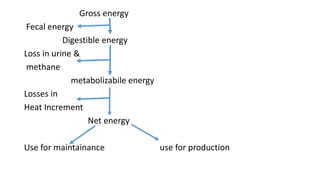
Gross energy
Fecal energy
Digestible energy
Loss in urine &
methane
metabolizabile energy
Losses in
Heat Increment
Net energy
Use for maintainance use for production
• GROSS ENERGY
• Animal food is composed of proteins, fats and carbohydrates besides
mineral, vitamins etc.
• In considering the energy requirement body purposes, the proteins,
fats and carbohydrates are grouped together.
• Gross energy is the total heat of combustion of a material as
determined with a bomb calorimeter-ordinarily expressed as
kilocalories per kilogram of feed or mega joule/kg dry matter.
• The gross energy value of a feed has no relationship to the feeds
digestible, metabolizable or net energy values, except that the latter can
never exceeded the GE.
• Certain products such as coal, mineral oil and lignin have high gross energy
values but, because of their indigestibility are of no energy value to the
animal.
• Roughages have gross energy values comparable concentrates, but the two
differ greatly in digestible, metabolizableand net energy values.
• Fat, because of their greater proportion of carbon and hydrogen,
yield 2.25 times more gross energy per kg than carbohydrates and
protein
• Energy supplied by the food in excess of that needed for maintenance
is used for the various forms of production.
• A young growing animal will store energy principally in the protein of
its new tissues, a fattening animal stores energy in fat, and a lactating
animal will transfer food energy into milk.
• DIGESTIBLE ENERGY
• This is that portion of the gross energy of a feed which does not appear in
the faeces.
• It include metabolizable energy as well as the energy of the urine and
methane.
• The undigested food nutrient present in faeces can burnt in bomb
calorimeter produced enough heat.
• This means that considerable quantity of heat of the digested food is
eliminated in the faeces.
• METABOLIZABLE ENERGY (ME)
• It is that portion of gross energy not appearing in the faeces, urine
and gases of fermentation (Principally methane).
• It is digestible energy minus energy of the urine and methane.
• It is comparable energy of TDN minus the energy of the fermentation
gases.
• Metabolizable energy = Energy in the food - (Energy lost in faeces +
energy lost in combustible gases + energy lost in urine).
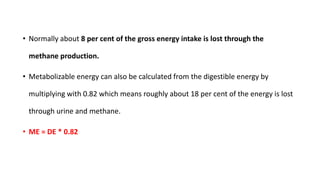
• Normally about 8 per cent of the gross energy intake is lost through the
methane production.
• Metabolizable energy can also be calculated from the digestible energy by
multiplying with 0.82 which means roughly about 18 per cent of the energy is lost
through urine and methane.
• ME = DE * 0.82
• Factors Affecting the Metabolizable Energy Values of Foods
• Species of animals
• Composition of feed
• Processing of food
• Level of feeding
• 1. Species of animals.
• The metabolizable energy of feeding stuffs varies according to the
species to which it is being fed.
• In the ruminants about 8-10 per cent losses of energy are in the
methane production while in the non-ruminants there are no such
losses.
• Therefore, the ME values are higher in non-ruminants than for the
ruminants. This gap is more in the feeding stuffs rich in the crude
fibre.
• 2. Composition of feed.
• If the crude protein present in the food is unbalanced then
• the majority of the amino acids will be determined
• and greater proportion of the amino acids will be deaminated
• and greater proportion of nitrogen will be excreted as urea.
• One gram of urea excreted will be equivalent to 23.00 KJ of energy
• Therefore, generally the ME values are frequently corrected to zero
nitrogen balance.
• For ruminant a factor of 31.17 KJ per gram of nitrogen has been used
• For poultry the factor is 34.39 KJ per gram
• 3.Processing of food.
• Processing of food also affect the ME values since it affects the losses
of nutrients in faeces and methane production.
• 4.Level of feeding.
• The level at which feed is being fed affect the ME value of the feed.
• At high level of intake ME values are reduced.
• NET ENERGY (NE)
• This is that portion of metabolizable energy which may be used as
needed by the animals for work, growth, fattening, fetal
development, milk production, and/or heat production.
• It differs from metabolizable energy in that net energy does not
include the heat of fermentation and nutrient metabolism or the
heat increment.
• Net energy is not used for heat production unless however and above
that from other sources is required to keep the animal warm.
• It is important to understand that of the heat lost by the animal only
a part, the heat increment of the food, is truly waste energy which
can be regarded as a direct tax on the food energy.
• The heat increment or the expenditure of energy during the
assimilation of feed was accounted for the Armsby in the following
manner.
• He measured the heat resulting from ingestion of a feed at a given
level of food intake in animal calorimeter .
• He then increased the intake of food
• And by a second measurement he found out the differences, which he
called the heat increment or specific dynamic effect of food.
• This heat is useful only for keeping an animal warm during very cold
weather.
• At other times the energy represented by this heat is not only a complete
loss but also may actually interfere with production by causing the animals
to be too warm.
Evaluation of Energy Value of
Feed
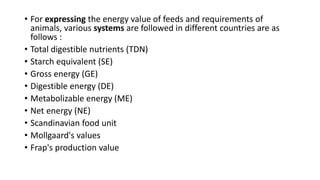
• For expressing the energy value of feeds and requirements of
animals, various systems are followed in different countries are as
follows :
• Total digestible nutrients (TDN)
• Starch equivalent (SE)
• Gross energy (GE)
• Digestible energy (DE)
• Metabolizable energy (ME)
• Net energy (NE)
• Scandinavian food unit
• Mollgaard's values
• Frap's production value
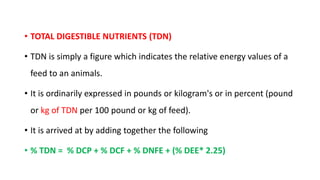
• TOTAL DIGESTIBLE NUTRIENTS (TDN)
• TDN is simply a figure which indicates the relative energy values of a
feed to an animals.
• It is ordinarily expressed in pounds or kilogram's or in percent (pound
or kg of TDN per 100 pound or kg of feed).
• It is arrived at by adding together the following
• % TDN = % DCP + % DCF + % DNFE + (% DEE* 2.25)
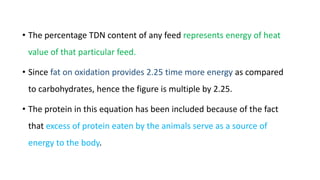
• The percentage TDN content of any feed represents energy of heat
value of that particular feed.
• Since fat on oxidation provides 2.25 time more energy as compared
to carbohydrates, hence the figure is multiple by 2.25.
• The protein in this equation has been included because of the fact
that excess of protein eaten by the animals serve as a source of
energy to the body.
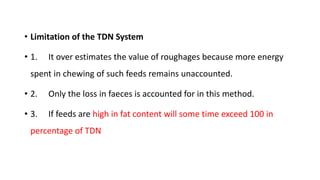
• Limitation of the TDN System
• 1. It over estimates the value of roughages because more energy
spent in chewing of such feeds remains unaccounted.
• 2. Only the loss in faeces is accounted for in this method.
• 3. If feeds are high in fat content will some time exceed 100 in
percentage of TDN
• Factors Affecting the TDN Value of a Feed
• The percentage of the dry matter
• The digestibility of the dry matter
• The amount of mineral matter in the digestible dry matter.
• The amount of fat in the digestible dry matter
The percentage of the dry matter.
• The more water present in feed, the less there is of other
nutrients, and, other things being equal, the lower the TDN
value.
The digestibility of the dry matter.
• Unless the dry matter of a feed is digestible, it can have no TDN
value.
• Only digestible dry matter can contribute TDN.
• Lignin has a high energy value but it can not be digested by the
animals so has no digestible energy or TDN values.
• The amount of mineral matter in the digestible dry matter.
• Mineral contribute no energy to the animal though mineral compounds
are digestible but have no TDN value.
• The more mineral matter a feed contains, other things being equals, the
lower will be its TDN values.
• The amount of fat in the digestible dry matter.
• The feeds high in digestible fat some time TDN value exceed 100%.
• In fact, a pure fat which had a coefficient of digestibility of 100% would
theoretically have a TDN value of 225% (100 x 2.25 1 225).
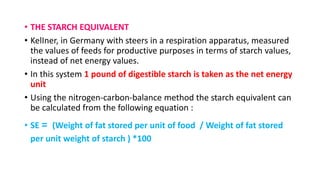
• THE STARCH EQUIVALENT
• KelIner, in Germany with steers in a respiration apparatus, measured
the values of feeds for productive purposes in terms of starch values,
instead of net energy values.
• In this system 1 pound of digestible starch is taken as the net energy
unit
• Using the nitrogen-carbon-balance method the starch equivalent can
be calculated from the following equation :
• SE = (Weight of fat stored per unit of food / Weight of fat stored
per unit weight of starch ) *100
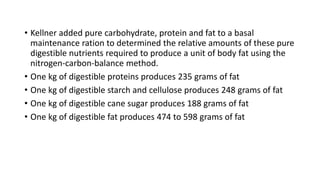
• Kellner added pure carbohydrate, protein and fat to a basal
maintenance ration to determined the relative amounts of these pure
digestible nutrients required to produce a unit of body fat using the
nitrogen-carbon-balance method.
• One kg of digestible proteins produces 235 grams of fat
• One kg of digestible starch and cellulose produces 248 grams of fat
• One kg of digestible cane sugar produces 188 grams of fat
• One kg of digestible fat produces 474 to 598 grams of fat
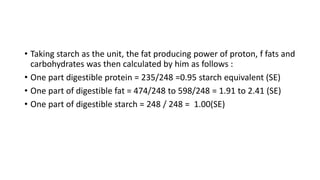
• Taking starch as the unit, the fat producing power of proton, f fats and
carbohydrates was then calculated by him as follows :
• One part digestible protein = 235/248 =0.95 starch equivalent (SE)
• One part of digestible fat = 474/248 to 598/248 = 1.91 to 2.41 (SE)
• One part of digestible starch = 248 / 248 = 1.00(SE)
• SCANDINAVIAN FEED UNIT SYSTEM
• The Scandinavian feed unit system of valuing feed is widely used in the
Scandinavian countries for measuring the relative values of different feeds.
• In this ,the value of 1 pound of barley grain is taken as the standard.
• The feed unit value for any other feed is the amount of that feed which is
estimated to have same Productive value as 1.00 pound barley.
• For example, the feed unit values of soybean oil meal and cotton seed
meal for dairy cows are 0.85 pound and the value for corn grain is
0.95.
• This system has the merit of comparing the values of food on the
basis of actual result when applied in practice.
• Consequently any specific value that the food may possess in
addition to its protein and energy values receives proper recognition
• MOLLGAARD’S VALUE
• Mollgaard, who has conducted extensive respiration studies with dairy cow
in Denmark, has published feed units for milk production or production
units, of a somewhat different kind.
• For feeds which values has not been determined experimentally, values
were computed from Kellner’s starch value, or from the content of
digestible nutrients.
• In his value recognition is given to the fact that the net energy values of
feed are higher for milk production than for fattening animals
• FRAP’S PRODUCTIVE VALUES
• From extensive studies of the results of feeding experiments in which
various feeds have been compared.
• Fraps of the Taxas station computed net energy values expressed in therm.
He called these values as productive energy values.
• He also derives production coefficients for a considerable list of feed by
means of which approximate net energy values can be computed from the
chemical composition.

Partitioning of feed energy

  • 1.
    Partitioning of feedenergy K.GURU MOHAN REDDY TVM/2016-13 DEPARTMENT OF ANIMAL NUTRTION COLLEGE OF VETERINARY SCIENCE, TIRUPATI SRI VENKATESWARA VETERINARY UNIVERSITY
  • 2.
    Gross energy Fecal energy Digestibleenergy Loss in urine & methane metabolizabile energy Losses in Heat Increment Net energy Use for maintainance use for production
  • 3.
    • GROSS ENERGY •Animal food is composed of proteins, fats and carbohydrates besides mineral, vitamins etc. • In considering the energy requirement body purposes, the proteins, fats and carbohydrates are grouped together. • Gross energy is the total heat of combustion of a material as determined with a bomb calorimeter-ordinarily expressed as kilocalories per kilogram of feed or mega joule/kg dry matter.
  • 4.
    • The grossenergy value of a feed has no relationship to the feeds digestible, metabolizable or net energy values, except that the latter can never exceeded the GE. • Certain products such as coal, mineral oil and lignin have high gross energy values but, because of their indigestibility are of no energy value to the animal. • Roughages have gross energy values comparable concentrates, but the two differ greatly in digestible, metabolizableand net energy values.
  • 5.
    • Fat, becauseof their greater proportion of carbon and hydrogen, yield 2.25 times more gross energy per kg than carbohydrates and protein • Energy supplied by the food in excess of that needed for maintenance is used for the various forms of production. • A young growing animal will store energy principally in the protein of its new tissues, a fattening animal stores energy in fat, and a lactating animal will transfer food energy into milk.
  • 6.
    • DIGESTIBLE ENERGY •This is that portion of the gross energy of a feed which does not appear in the faeces. • It include metabolizable energy as well as the energy of the urine and methane. • The undigested food nutrient present in faeces can burnt in bomb calorimeter produced enough heat. • This means that considerable quantity of heat of the digested food is eliminated in the faeces.
  • 7.
    • METABOLIZABLE ENERGY(ME) • It is that portion of gross energy not appearing in the faeces, urine and gases of fermentation (Principally methane). • It is digestible energy minus energy of the urine and methane. • It is comparable energy of TDN minus the energy of the fermentation gases. • Metabolizable energy = Energy in the food - (Energy lost in faeces + energy lost in combustible gases + energy lost in urine).
  • 8.
    • Normally about8 per cent of the gross energy intake is lost through the methane production. • Metabolizable energy can also be calculated from the digestible energy by multiplying with 0.82 which means roughly about 18 per cent of the energy is lost through urine and methane. • ME = DE * 0.82
  • 9.
    • Factors Affectingthe Metabolizable Energy Values of Foods • Species of animals • Composition of feed • Processing of food • Level of feeding
  • 10.
    • 1. Speciesof animals. • The metabolizable energy of feeding stuffs varies according to the species to which it is being fed. • In the ruminants about 8-10 per cent losses of energy are in the methane production while in the non-ruminants there are no such losses. • Therefore, the ME values are higher in non-ruminants than for the ruminants. This gap is more in the feeding stuffs rich in the crude fibre.
  • 11.
    • 2. Compositionof feed. • If the crude protein present in the food is unbalanced then • the majority of the amino acids will be determined • and greater proportion of the amino acids will be deaminated • and greater proportion of nitrogen will be excreted as urea. • One gram of urea excreted will be equivalent to 23.00 KJ of energy
  • 12.
    • Therefore, generallythe ME values are frequently corrected to zero nitrogen balance. • For ruminant a factor of 31.17 KJ per gram of nitrogen has been used • For poultry the factor is 34.39 KJ per gram
  • 13.
    • 3.Processing offood. • Processing of food also affect the ME values since it affects the losses of nutrients in faeces and methane production. • 4.Level of feeding. • The level at which feed is being fed affect the ME value of the feed. • At high level of intake ME values are reduced.
  • 14.
    • NET ENERGY(NE) • This is that portion of metabolizable energy which may be used as needed by the animals for work, growth, fattening, fetal development, milk production, and/or heat production. • It differs from metabolizable energy in that net energy does not include the heat of fermentation and nutrient metabolism or the heat increment. • Net energy is not used for heat production unless however and above that from other sources is required to keep the animal warm.
  • 15.
    • It isimportant to understand that of the heat lost by the animal only a part, the heat increment of the food, is truly waste energy which can be regarded as a direct tax on the food energy. • The heat increment or the expenditure of energy during the assimilation of feed was accounted for the Armsby in the following manner. • He measured the heat resulting from ingestion of a feed at a given level of food intake in animal calorimeter .
  • 16.
    • He thenincreased the intake of food • And by a second measurement he found out the differences, which he called the heat increment or specific dynamic effect of food. • This heat is useful only for keeping an animal warm during very cold weather. • At other times the energy represented by this heat is not only a complete loss but also may actually interfere with production by causing the animals to be too warm.
  • 17.
    Evaluation of EnergyValue of Feed
  • 18.
    • For expressingthe energy value of feeds and requirements of animals, various systems are followed in different countries are as follows : • Total digestible nutrients (TDN) • Starch equivalent (SE) • Gross energy (GE) • Digestible energy (DE) • Metabolizable energy (ME) • Net energy (NE) • Scandinavian food unit • Mollgaard's values • Frap's production value
  • 19.
    • TOTAL DIGESTIBLENUTRIENTS (TDN) • TDN is simply a figure which indicates the relative energy values of a feed to an animals. • It is ordinarily expressed in pounds or kilogram's or in percent (pound or kg of TDN per 100 pound or kg of feed). • It is arrived at by adding together the following • % TDN = % DCP + % DCF + % DNFE + (% DEE* 2.25)
  • 20.
    • The percentageTDN content of any feed represents energy of heat value of that particular feed. • Since fat on oxidation provides 2.25 time more energy as compared to carbohydrates, hence the figure is multiple by 2.25. • The protein in this equation has been included because of the fact that excess of protein eaten by the animals serve as a source of energy to the body.
  • 21.
    • Limitation ofthe TDN System • 1. It over estimates the value of roughages because more energy spent in chewing of such feeds remains unaccounted. • 2. Only the loss in faeces is accounted for in this method. • 3. If feeds are high in fat content will some time exceed 100 in percentage of TDN
  • 22.
    • Factors Affectingthe TDN Value of a Feed • The percentage of the dry matter • The digestibility of the dry matter • The amount of mineral matter in the digestible dry matter. • The amount of fat in the digestible dry matter
  • 23.
    The percentage ofthe dry matter. • The more water present in feed, the less there is of other nutrients, and, other things being equal, the lower the TDN value. The digestibility of the dry matter. • Unless the dry matter of a feed is digestible, it can have no TDN value. • Only digestible dry matter can contribute TDN. • Lignin has a high energy value but it can not be digested by the animals so has no digestible energy or TDN values.
  • 24.
    • The amountof mineral matter in the digestible dry matter. • Mineral contribute no energy to the animal though mineral compounds are digestible but have no TDN value. • The more mineral matter a feed contains, other things being equals, the lower will be its TDN values. • The amount of fat in the digestible dry matter. • The feeds high in digestible fat some time TDN value exceed 100%. • In fact, a pure fat which had a coefficient of digestibility of 100% would theoretically have a TDN value of 225% (100 x 2.25 1 225).
  • 25.
    • THE STARCHEQUIVALENT • KelIner, in Germany with steers in a respiration apparatus, measured the values of feeds for productive purposes in terms of starch values, instead of net energy values. • In this system 1 pound of digestible starch is taken as the net energy unit • Using the nitrogen-carbon-balance method the starch equivalent can be calculated from the following equation : • SE = (Weight of fat stored per unit of food / Weight of fat stored per unit weight of starch ) *100
  • 26.
    • Kellner addedpure carbohydrate, protein and fat to a basal maintenance ration to determined the relative amounts of these pure digestible nutrients required to produce a unit of body fat using the nitrogen-carbon-balance method. • One kg of digestible proteins produces 235 grams of fat • One kg of digestible starch and cellulose produces 248 grams of fat • One kg of digestible cane sugar produces 188 grams of fat • One kg of digestible fat produces 474 to 598 grams of fat
  • 27.
    • Taking starchas the unit, the fat producing power of proton, f fats and carbohydrates was then calculated by him as follows : • One part digestible protein = 235/248 =0.95 starch equivalent (SE) • One part of digestible fat = 474/248 to 598/248 = 1.91 to 2.41 (SE) • One part of digestible starch = 248 / 248 = 1.00(SE)
  • 28.
    • SCANDINAVIAN FEEDUNIT SYSTEM • The Scandinavian feed unit system of valuing feed is widely used in the Scandinavian countries for measuring the relative values of different feeds. • In this ,the value of 1 pound of barley grain is taken as the standard. • The feed unit value for any other feed is the amount of that feed which is estimated to have same Productive value as 1.00 pound barley.
  • 29.
    • For example,the feed unit values of soybean oil meal and cotton seed meal for dairy cows are 0.85 pound and the value for corn grain is 0.95. • This system has the merit of comparing the values of food on the basis of actual result when applied in practice. • Consequently any specific value that the food may possess in addition to its protein and energy values receives proper recognition
  • 30.
    • MOLLGAARD’S VALUE •Mollgaard, who has conducted extensive respiration studies with dairy cow in Denmark, has published feed units for milk production or production units, of a somewhat different kind. • For feeds which values has not been determined experimentally, values were computed from Kellner’s starch value, or from the content of digestible nutrients. • In his value recognition is given to the fact that the net energy values of feed are higher for milk production than for fattening animals
  • 31.
    • FRAP’S PRODUCTIVEVALUES • From extensive studies of the results of feeding experiments in which various feeds have been compared. • Fraps of the Taxas station computed net energy values expressed in therm. He called these values as productive energy values. • He also derives production coefficients for a considerable list of feed by means of which approximate net energy values can be computed from the chemical composition.