Application of Digestibility Values in Poultry
And
Bioassay and analytical procedures
Vishnu Vardhan Reddy.P
TVM/2015-029
Department of Animal nutrition
College of Veterinary Science, Tirupati
Sri Venkateswara Veterinary University
Low quality protein meals
• Using digestible amino acids in diet formulation is that it makes it
possible to increase the inclusion levels of alternate ingredients (in
particular, low quality protein sources) in poultry diets.
• In effect, it will increase the range of ingredients that can be
incorporated, improve the precision of formulation and ensure more
predictable bird performance.
Canola meal (Ravindran et al., 1998; Li et al., 2002a)
Cottonseed meal (Ravindran and Bryden, l999; Li et al., 2002b)
Meat and bone meal (Ravindran and Bryden, 1999; Ravindran et al., 2002)
According to these studies increasing dietary levels of canola meal, cottonseed
meal and meat and bone meal on a total amino acid basis significantly lowered
weight gains and feed efficiency of broilers.
The observed depressions were, overcome when the diets were balanced on a
digestible amino acid basis (Fernandez et al., 1995) and (Rostagno et al., 1995;
Douglas and Parsons, 1999).
Age and physiological state
• The ability of poultry to digest and absorb dietary protein is known to
be influenced by age and physiological state.
• In general, the digestibility coefficients of amino acids increased with
age and varied with feedstuff.
• The differences may in part, reflect differences in endogenous amino
acid flows (Ravindran and Hendriks, 2004).
Additivity of values
• Additivity of digestible amino acids, determined in single feedstuffs, is
a crucial consideration in the formulation of complete diets.
• Studies by Angkanaporn et al. (1996) and Bryden and Li (2003) found
that digestible amino acid supply in a complete diet can be predicted
from apparent amino acid digestibilities determined for individual
feed ingredients.
Feed enzymes
• Enzymes are added to diets to enable the bird to degrade anti-nutrient
feed components in particular, non-starch polysaccharides and
phytate.
• It has also been demonstrated that addition of feed enzymes improves
amino acid digestibility and the metabolisable energy value of the diet.
• The response to feed enzymes is dependent on diet composition,
source and level of enzyme addition.
Apparent or true digestibility values
• Apparent digestibility measures the digestibility of amino acids of both dietary
and endogenous origins. True digestibility, on the other hand, includes a
correction for endogenous amino acid secretions.
• The choice of the appropriate system of digestible amino acids may depend on
the method of formulating diets.
• If diets are being formulated to least-cost using linear programming, then
apparent ileal digestibility values are the most appropriate as they take
into account the endogenous cost of digestion.
• On the other hand, if diets are being formulated with computer
simulation models, then true digestibility values will be relevant if
the model corrects for the endogenous cost of digestion.
• It should be appreciated, however, that both digestible amino
systems are superior to the total amino acid system currently
employed in practical feed formulations.
Standardised ileal digestibility values
• Correcting apparent digestibility for endogenous losses can introduce
artefacts and mask important differences between feed ingredients.
• If a feed ingredient increases endogenous amino acid flow out of the
small intestine, then we must realistically ‘charge’ against the feed
ingredient as lowered amino acid digestibility.
• Endogenous amino acid losses are influenced primarily by dry matter
intake and secondarily by the inherent composition of the feed ingredient
or diet (ie. fibre level, presence of anti-nutritional factors etc).
• These two fractions are referred to as basal (or non-specific) and specific
endogenous amino acid losses, respectively.
• The limitations of apparent ileal digestibility values could be overcome by
standardizing these estimates through corrections for basal endogenous
losses, as suggested by Boisen (1998) and Rademacher et al. (1999).
• Databases on standardised ileal digestibility values of amino acids in
feed ingredients are now available, wherein published apparent
digestibility values have been transformed to standardised values
using existing literature data on endogenous amino acid recovery in
ileal digesta (see Lemme et al., 2004).
Bioassay and analytical procedures
Diets
• Different assay diets were used for cereal grains and protein meals.
• In the case of cereals, assay diets contained per kg: 918 g of test cereal, 20 g
of vegetable oil and, 42 g of mineral and vitamin supplements.
• For protein meals, assay diets were based on dextrose and contained the
test feedstuff as the only source of protein.
• The proportions of dextrose and the test feedstuff were varied in
each diet to obtain 200 g crude protein/kg.
• Solkafloc (30 g/kg) was added as a source of fibre in diets containing
animal protein meals.
• Celite (20 g/kg) was added to all diets as a source of acid-insoluble
ash (AIA) which was used as an indigestible marker in the calculation
of digestibility coefficients.
Birds
• Each assay diet was offered ad libitum to three pens (four birds/pen)
of male broilers from 35 to 42 days of age.
• Ileal digesta of birds within a pen were pooled, frozen immediately
after collection and subsequently freeze-dried.
• Dried ileal digesta samples were ground to pass through a 0.5 mm
sieve and stored in airtight containers at - 20 °C for chemical analyses.
Chemical analysis
• Amino acid concentrations in the diet and ileal digesta samples were
determined using cation exchange column chromatographic
procedures with post-column derivatisation and fluorimetric
detection of amino acids using 0-phthaldialdehyde as described by
Siriwan et al. (1993) and Li et al. (2006).
• Tryptophan was determined separately after alkaline hydrolysis with NaOH
followed by isocratic ion-exchange chromatography with O-phthalaldehyde
derivatisation followed by fluorescence detection using the method of
Ravindran and Bryden (2005).
• Nitrogen (N) content was determined by the method of Sweeney (1989) using
a nitrogen determinator (LECO® Corporation, St. Joseph, Michigan, USA).
• The AIA contents of the diet and ileal digesta samples were measured after
ashing the samples and treating the ash with boiling 4 M hydrochloric acid
(Mollah et al., 1983).
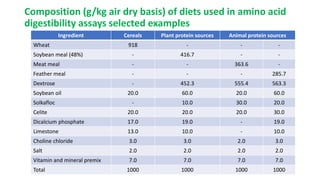
Composition (g/kg air dry basis) of diets used in amino acid
digestibility assays selected examples
Ingredient Cereals Plant protein sources Animal protein sources
Wheat 918 - - -
Soybean meal (48%) - 416.7 - -
Meat meal - - 363.6 -
Feather meal - - - 285.7
Dextrose - 452.3 555.4 563.3
Soybean oil 20.0 60.0 20.0 60.0
Solkafloc - 10.0 30.0 20.0
Celite 20.0 20.0 20.0 30.0
Dicalcium phosphate 17.0 19.0 - 19.0
Limestone 13.0 10.0 - 10.0
Choline chloride 3.0 3.0 2.0 3.0
Salt 2.0 2.0 2.0 2.0
Vitamin and mineral premix 7.0 7.0 7.0 7.0
Total 1000 1000 1000 1000
Digestibility calculations
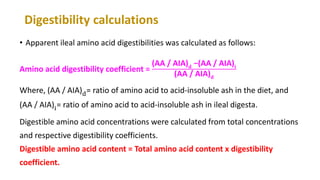
• Apparent ileal amino acid digestibilities was calculated as follows:
Amino acid digestibility coefficient =
(AA / AIA) 𝐝 −(AA / AIA)𝐢
(AA / AIA) 𝐝
Where, (AA / AIA)d= ratio of amino acid to acid-insoluble ash in the diet, and
(AA / AIA)i= ratio of amino acid to acid-insoluble ash in ileal digesta.
Digestible amino acid concentrations were calculated from total concentrations
and respective digestibility coefficients.
Digestible amino acid content = Total amino acid content x digestibility
coefficient.
THANK YOU
Vishnu Vardhan Reddy.P
TVM/2015-029

Application of digestibility values in poultry

  • 1.
    Application of DigestibilityValues in Poultry And Bioassay and analytical procedures Vishnu Vardhan Reddy.P TVM/2015-029 Department of Animal nutrition College of Veterinary Science, Tirupati Sri Venkateswara Veterinary University
  • 2.
    Low quality proteinmeals • Using digestible amino acids in diet formulation is that it makes it possible to increase the inclusion levels of alternate ingredients (in particular, low quality protein sources) in poultry diets. • In effect, it will increase the range of ingredients that can be incorporated, improve the precision of formulation and ensure more predictable bird performance.
  • 3.
    Canola meal (Ravindranet al., 1998; Li et al., 2002a) Cottonseed meal (Ravindran and Bryden, l999; Li et al., 2002b) Meat and bone meal (Ravindran and Bryden, 1999; Ravindran et al., 2002) According to these studies increasing dietary levels of canola meal, cottonseed meal and meat and bone meal on a total amino acid basis significantly lowered weight gains and feed efficiency of broilers. The observed depressions were, overcome when the diets were balanced on a digestible amino acid basis (Fernandez et al., 1995) and (Rostagno et al., 1995; Douglas and Parsons, 1999).
  • 4.
    Age and physiologicalstate • The ability of poultry to digest and absorb dietary protein is known to be influenced by age and physiological state. • In general, the digestibility coefficients of amino acids increased with age and varied with feedstuff. • The differences may in part, reflect differences in endogenous amino acid flows (Ravindran and Hendriks, 2004).
  • 5.
    Additivity of values •Additivity of digestible amino acids, determined in single feedstuffs, is a crucial consideration in the formulation of complete diets. • Studies by Angkanaporn et al. (1996) and Bryden and Li (2003) found that digestible amino acid supply in a complete diet can be predicted from apparent amino acid digestibilities determined for individual feed ingredients.
  • 6.
    Feed enzymes • Enzymesare added to diets to enable the bird to degrade anti-nutrient feed components in particular, non-starch polysaccharides and phytate. • It has also been demonstrated that addition of feed enzymes improves amino acid digestibility and the metabolisable energy value of the diet. • The response to feed enzymes is dependent on diet composition, source and level of enzyme addition.
  • 7.
    Apparent or truedigestibility values • Apparent digestibility measures the digestibility of amino acids of both dietary and endogenous origins. True digestibility, on the other hand, includes a correction for endogenous amino acid secretions. • The choice of the appropriate system of digestible amino acids may depend on the method of formulating diets. • If diets are being formulated to least-cost using linear programming, then apparent ileal digestibility values are the most appropriate as they take into account the endogenous cost of digestion.
  • 8.
    • On theother hand, if diets are being formulated with computer simulation models, then true digestibility values will be relevant if the model corrects for the endogenous cost of digestion. • It should be appreciated, however, that both digestible amino systems are superior to the total amino acid system currently employed in practical feed formulations.
  • 9.
    Standardised ileal digestibilityvalues • Correcting apparent digestibility for endogenous losses can introduce artefacts and mask important differences between feed ingredients. • If a feed ingredient increases endogenous amino acid flow out of the small intestine, then we must realistically ‘charge’ against the feed ingredient as lowered amino acid digestibility.
  • 10.
    • Endogenous aminoacid losses are influenced primarily by dry matter intake and secondarily by the inherent composition of the feed ingredient or diet (ie. fibre level, presence of anti-nutritional factors etc). • These two fractions are referred to as basal (or non-specific) and specific endogenous amino acid losses, respectively. • The limitations of apparent ileal digestibility values could be overcome by standardizing these estimates through corrections for basal endogenous losses, as suggested by Boisen (1998) and Rademacher et al. (1999).
  • 11.
    • Databases onstandardised ileal digestibility values of amino acids in feed ingredients are now available, wherein published apparent digestibility values have been transformed to standardised values using existing literature data on endogenous amino acid recovery in ileal digesta (see Lemme et al., 2004).
  • 12.
    Bioassay and analyticalprocedures Diets • Different assay diets were used for cereal grains and protein meals. • In the case of cereals, assay diets contained per kg: 918 g of test cereal, 20 g of vegetable oil and, 42 g of mineral and vitamin supplements. • For protein meals, assay diets were based on dextrose and contained the test feedstuff as the only source of protein.
  • 13.
    • The proportionsof dextrose and the test feedstuff were varied in each diet to obtain 200 g crude protein/kg. • Solkafloc (30 g/kg) was added as a source of fibre in diets containing animal protein meals. • Celite (20 g/kg) was added to all diets as a source of acid-insoluble ash (AIA) which was used as an indigestible marker in the calculation of digestibility coefficients.
  • 14.
    Birds • Each assaydiet was offered ad libitum to three pens (four birds/pen) of male broilers from 35 to 42 days of age. • Ileal digesta of birds within a pen were pooled, frozen immediately after collection and subsequently freeze-dried. • Dried ileal digesta samples were ground to pass through a 0.5 mm sieve and stored in airtight containers at - 20 °C for chemical analyses.
  • 15.
    Chemical analysis • Aminoacid concentrations in the diet and ileal digesta samples were determined using cation exchange column chromatographic procedures with post-column derivatisation and fluorimetric detection of amino acids using 0-phthaldialdehyde as described by Siriwan et al. (1993) and Li et al. (2006).
  • 16.
    • Tryptophan wasdetermined separately after alkaline hydrolysis with NaOH followed by isocratic ion-exchange chromatography with O-phthalaldehyde derivatisation followed by fluorescence detection using the method of Ravindran and Bryden (2005). • Nitrogen (N) content was determined by the method of Sweeney (1989) using a nitrogen determinator (LECO® Corporation, St. Joseph, Michigan, USA). • The AIA contents of the diet and ileal digesta samples were measured after ashing the samples and treating the ash with boiling 4 M hydrochloric acid (Mollah et al., 1983).
  • 17.
    Composition (g/kg airdry basis) of diets used in amino acid digestibility assays selected examples Ingredient Cereals Plant protein sources Animal protein sources Wheat 918 - - - Soybean meal (48%) - 416.7 - - Meat meal - - 363.6 - Feather meal - - - 285.7 Dextrose - 452.3 555.4 563.3 Soybean oil 20.0 60.0 20.0 60.0 Solkafloc - 10.0 30.0 20.0 Celite 20.0 20.0 20.0 30.0 Dicalcium phosphate 17.0 19.0 - 19.0 Limestone 13.0 10.0 - 10.0 Choline chloride 3.0 3.0 2.0 3.0 Salt 2.0 2.0 2.0 2.0 Vitamin and mineral premix 7.0 7.0 7.0 7.0 Total 1000 1000 1000 1000
  • 18.
    Digestibility calculations • Apparentileal amino acid digestibilities was calculated as follows: Amino acid digestibility coefficient = (AA / AIA) 𝐝 −(AA / AIA)𝐢 (AA / AIA) 𝐝 Where, (AA / AIA)d= ratio of amino acid to acid-insoluble ash in the diet, and (AA / AIA)i= ratio of amino acid to acid-insoluble ash in ileal digesta. Digestible amino acid concentrations were calculated from total concentrations and respective digestibility coefficients. Digestible amino acid content = Total amino acid content x digestibility coefficient.
  • 19.
    THANK YOU Vishnu VardhanReddy.P TVM/2015-029