Commonly used conveying
systems in feed mills
Vishnu Vardhan Reddy.P
TVM/2015-029
Department of Animal nutrition
College of Veterinary Science, Tirupati
Sri Venkateswara Veterinary University
Conveying systems
• A conveyor system is a common piece of mechanical handling
equipment that moves materials from one location to another.
• Conveyors are used to transport the material generally in horizontal
direction, but with some modification in vertical direction.
• Conveyors move materials over a fixed path.
Classification of conveying systems
Conveyors can be classified in different ways:
• Type of product being handled: unit load or bulk load
• Location of the conveyor: overhead, on-floor, or in-floor
• Whether or not loads can accumulate on the conveyor
Different types of conveying systems
1. Chute conveyor
2. Wheel conveyor
3. Roller conveyor
A. Gravity roller conveyor
B. Live (powered) roller conveyor
4. Chain conveyor
5. Slat conveyor
6. Flat belt conveyor
7. Magnetic belt conveyor
8. Troughed belt conveyor
9. Bucket conveyor
10. Oscillating conveyors or
Vibrating conveyor
11. Screw conveyor
12. Pneumatic conveyor
A. Dilute-phase pneumatic conveyor
B. Carrier-system pneumatic conveyor
13. Vertical conveyor
A. Vertical lift conveyor
B. Reciprocating vertical conveyor
14. Cart-on-track conveyor
15. Tow conveyor
16. Trolley conveyor
17. Power-and-free conveyor
18. Monorail
19. Sortation conveyor
A. Diverter
B. Pop-up device
C. Sliding shoe device
D. Tilting device
E. Cross-belt transfer device
20. Drag conveyors
A. Peddle type
B. Bar type
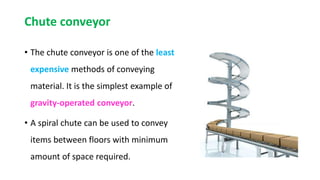
Chute conveyor
• The chute conveyor is one of the least
expensive methods of conveying
material. It is the simplest example of
gravity-operated conveyor.
• A spiral chute can be used to convey
items between floors with minimum
amount of space required.
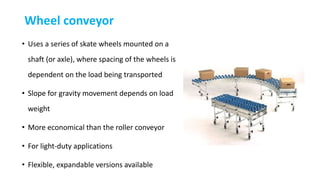
Wheel conveyor
• Uses a series of skate wheels mounted on a
shaft (or axle), where spacing of the wheels is
dependent on the load being transported
• Slope for gravity movement depends on load
weight
• More economical than the roller conveyor
• For light-duty applications
• Flexible, expandable versions available
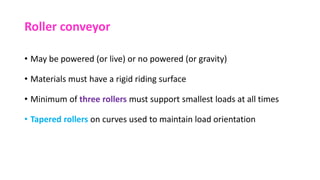
Roller conveyor
• May be powered (or live) or no powered (or gravity)
• Materials must have a rigid riding surface
• Minimum of three rollers must support smallest loads at all times
• Tapered rollers on curves used to maintain load orientation
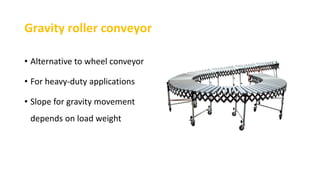
Gravity roller conveyor
• Alternative to wheel conveyor
• For heavy-duty applications
• Slope for gravity movement
depends on load weight
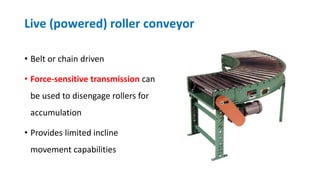
Live (powered) roller conveyor
• Belt or chain driven
• Force-sensitive transmission can
be used to disengage rollers for
accumulation
• Provides limited incline
movement capabilities
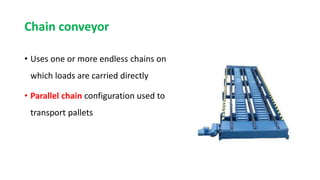
Chain conveyor
• Uses one or more endless chains on
which loads are carried directly
• Parallel chain configuration used to
transport pallets
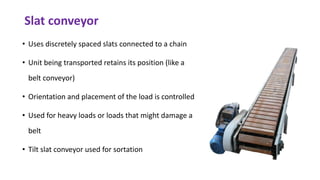
Slat conveyor
• Uses discretely spaced slats connected to a chain
• Unit being transported retains its position (like a
belt conveyor)
• Orientation and placement of the load is controlled
• Used for heavy loads or loads that might damage a
belt
• Tilt slat conveyor used for sortation
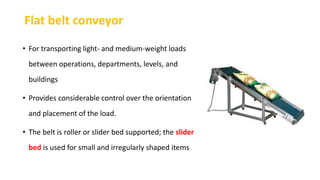
Flat belt conveyor
• For transporting light- and medium-weight loads
between operations, departments, levels, and
buildings
• Provides considerable control over the orientation
and placement of the load.
• The belt is roller or slider bed supported; the slider
bed is used for small and irregularly shaped items
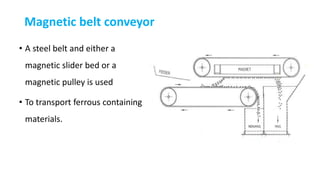
Magnetic belt conveyor
• A steel belt and either a
magnetic slider bed or a
magnetic pulley is used
• To transport ferrous containing
materials.
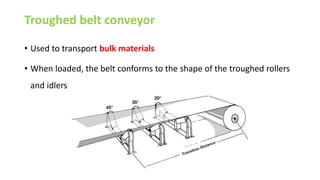
Troughed belt conveyor
• Used to transport bulk materials
• When loaded, the belt conforms to the shape of the troughed rollers
and idlers
Bucket conveyor
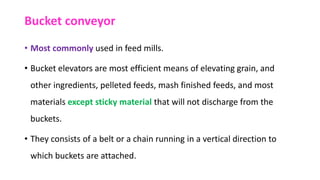
• Most commonly used in feed mills.
• Bucket elevators are most efficient means of elevating grain, and
other ingredients, pelleted feeds, mash finished feeds, and most
materials except sticky material that will not discharge from the
buckets.
• They consists of a belt or a chain running in a vertical direction to
which buckets are attached.
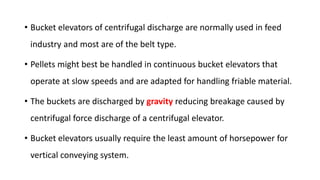
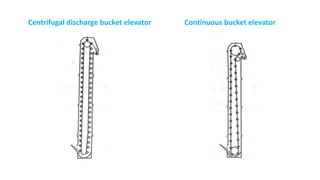
• Bucket elevators of centrifugal discharge are normally used in feed
industry and most are of the belt type.
• Pellets might best be handled in continuous bucket elevators that
operate at slow speeds and are adapted for handling friable material.
• The buckets are discharged by gravity reducing breakage caused by
centrifugal force discharge of a centrifugal elevator.
• Bucket elevators usually require the least amount of horsepower for
vertical conveying system.
Centrifugal discharge bucket elevator Continuous bucket elevator
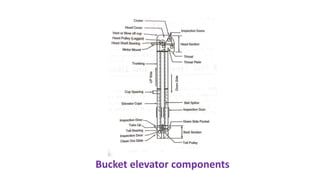
Bucket elevator components
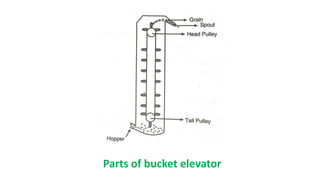
• The buckets and belt are normally enclosed in a housing consisting of
three major parts:
1. The boot (product loading)
2. Trunking (product elevating)
3. And head (product discharge)
• This enclosure keeps the conveyed material inside the enclosure,
contains the dust, and can be weather tight for outside installation.
Parts of bucket elevator
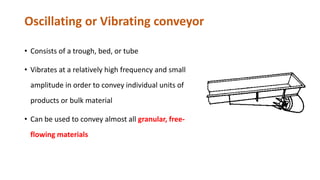
Oscillating or Vibrating conveyor
• Consists of a trough, bed, or tube
• Vibrates at a relatively high frequency and small
amplitude in order to convey individual units of
products or bulk material
• Can be used to convey almost all granular, free-
flowing materials
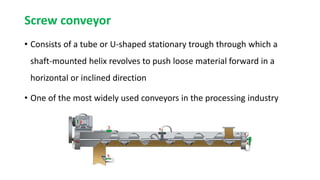
Screw conveyor
• Consists of a tube or U-shaped stationary trough through which a
shaft-mounted helix revolves to push loose material forward in a
horizontal or inclined direction
• One of the most widely used conveyors in the processing industry
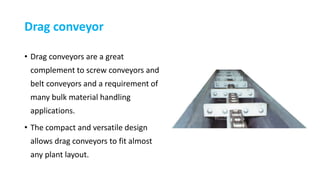
Drag conveyor
• Drag conveyors are a great
complement to screw conveyors and
belt conveyors and a requirement of
many bulk material handling
applications.
• The compact and versatile design
allows drag conveyors to fit almost
any plant layout.
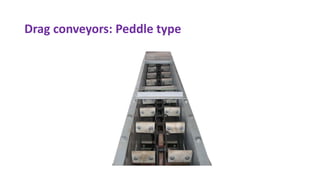
Drag conveyors: Peddle type
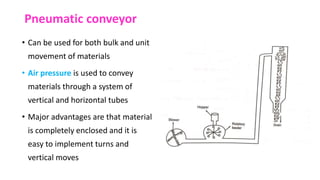
Pneumatic conveyor
• Can be used for both bulk and unit
movement of materials
• Air pressure is used to convey
materials through a system of
vertical and horizontal tubes
• Major advantages are that material
is completely enclosed and it is
easy to implement turns and
vertical moves
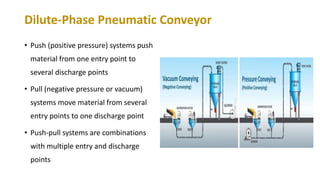
Dilute-Phase Pneumatic Conveyor
• Push (positive pressure) systems push
material from one entry point to
several discharge points
• Pull (negative pressure or vacuum)
systems move material from several
entry points to one discharge point
• Push-pull systems are combinations
with multiple entry and discharge
points
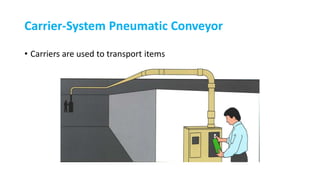
Carrier-System Pneumatic Conveyor
• Carriers are used to transport items
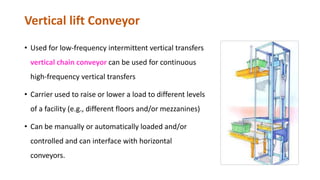
Vertical lift Conveyor
• Used for low-frequency intermittent vertical transfers
vertical chain conveyor can be used for continuous
high-frequency vertical transfers
• Carrier used to raise or lower a load to different levels
of a facility (e.g., different floors and/or mezzanines)
• Can be manually or automatically loaded and/or
controlled and can interface with horizontal
conveyors.
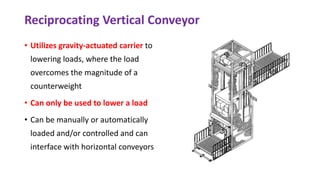
Reciprocating Vertical Conveyor
• Utilizes gravity-actuated carrier to
lowering loads, where the load
overcomes the magnitude of a
counterweight
• Can only be used to lower a load
• Can be manually or automatically
loaded and/or controlled and can
interface with horizontal conveyors
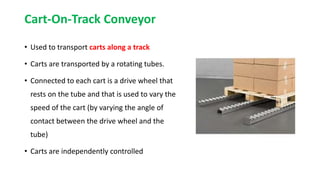
Cart-On-Track Conveyor
• Used to transport carts along a track
• Carts are transported by a rotating tubes.
• Connected to each cart is a drive wheel that
rests on the tube and that is used to vary the
speed of the cart (by varying the angle of
contact between the drive wheel and the
tube)
• Carts are independently controlled
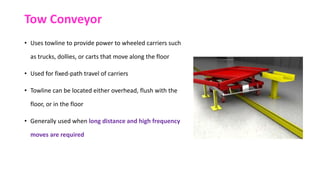
Tow Conveyor
• Uses towline to provide power to wheeled carriers such
as trucks, dollies, or carts that move along the floor
• Used for fixed-path travel of carriers
• Towline can be located either overhead, flush with the
floor, or in the floor
• Generally used when long distance and high frequency
moves are required
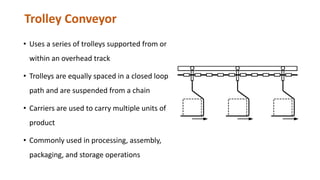
Trolley Conveyor
• Uses a series of trolleys supported from or
within an overhead track
• Trolleys are equally spaced in a closed loop
path and are suspended from a chain
• Carriers are used to carry multiple units of
product
• Commonly used in processing, assembly,
packaging, and storage operations
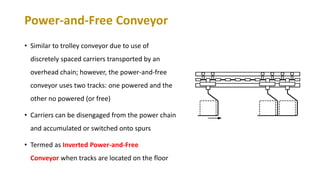
Power-and-Free Conveyor
• Similar to trolley conveyor due to use of
discretely spaced carriers transported by an
overhead chain; however, the power-and-free
conveyor uses two tracks: one powered and the
other no powered (or free)
• Carriers can be disengaged from the power chain
and accumulated or switched onto spurs
• Termed as Inverted Power-and-Free
Conveyor when tracks are located on the floor
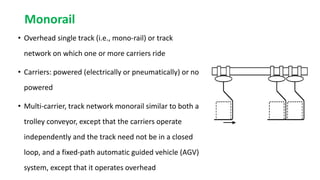
Monorail
• Overhead single track (i.e., mono-rail) or track
network on which one or more carriers ride
• Carriers: powered (electrically or pneumatically) or no
powered
• Multi-carrier, track network monorail similar to both a
trolley conveyor, except that the carriers operate
independently and the track need not be in a closed
loop, and a fixed-path automatic guided vehicle (AGV)
system, except that it operates overhead
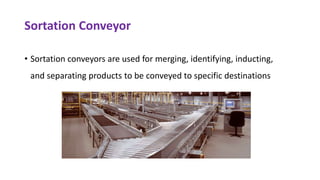
Sortation Conveyor
• Sortation conveyors are used for merging, identifying, inducting,
and separating products to be conveyed to specific destinations
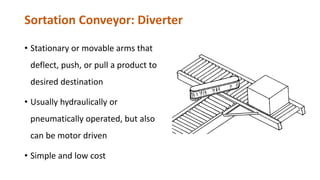
Sortation Conveyor: Diverter
• Stationary or movable arms that
deflect, push, or pull a product to
desired destination
• Usually hydraulically or
pneumatically operated, but also
can be motor driven
• Simple and low cost
Sortation Conveyor: Pop-Up Device
• One or more rows of powered rollers
or wheels or chains that pop up
above surface of conveyor to lift
product and guide it off conveyor at
an angle; wheels are lowered when
products not required to be diverted
• Only capable of sorting flat-bottomed
items
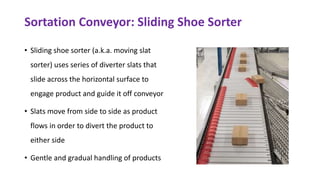
Sortation Conveyor: Sliding Shoe Sorter
• Sliding shoe sorter (a.k.a. moving slat
sorter) uses series of diverter slats that
slide across the horizontal surface to
engage product and guide it off conveyor
• Slats move from side to side as product
flows in order to divert the product to
either side
• Gentle and gradual handling of products
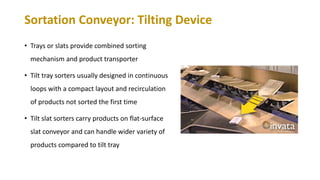
Sortation Conveyor: Tilting Device
• Trays or slats provide combined sorting
mechanism and product transporter
• Tilt tray sorters usually designed in continuous
loops with a compact layout and recirculation
of products not sorted the first time
• Tilt slat sorters carry products on flat-surface
slat conveyor and can handle wider variety of
products compared to tilt tray
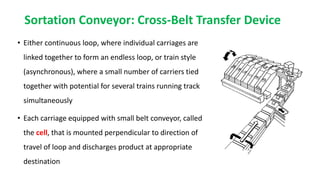
Sortation Conveyor: Cross-Belt Transfer Device
• Either continuous loop, where individual carriages are
linked together to form an endless loop, or train style
(asynchronous), where a small number of carriers tied
together with potential for several trains running track
simultaneously
• Each carriage equipped with small belt conveyor, called
the cell, that is mounted perpendicular to direction of
travel of loop and discharges product at appropriate
destination
THANK YOU
Vishnu Vardhan Reddy.P
TVM/2015-029

Commonly used conveying systems in feed mills

  • 1.
    Commonly used conveying systemsin feed mills Vishnu Vardhan Reddy.P TVM/2015-029 Department of Animal nutrition College of Veterinary Science, Tirupati Sri Venkateswara Veterinary University
  • 2.
    Conveying systems • Aconveyor system is a common piece of mechanical handling equipment that moves materials from one location to another. • Conveyors are used to transport the material generally in horizontal direction, but with some modification in vertical direction. • Conveyors move materials over a fixed path.
  • 3.
    Classification of conveyingsystems Conveyors can be classified in different ways: • Type of product being handled: unit load or bulk load • Location of the conveyor: overhead, on-floor, or in-floor • Whether or not loads can accumulate on the conveyor
  • 4.
    Different types ofconveying systems 1. Chute conveyor 2. Wheel conveyor 3. Roller conveyor A. Gravity roller conveyor B. Live (powered) roller conveyor 4. Chain conveyor 5. Slat conveyor 6. Flat belt conveyor 7. Magnetic belt conveyor 8. Troughed belt conveyor 9. Bucket conveyor 10. Oscillating conveyors or Vibrating conveyor 11. Screw conveyor
  • 5.
    12. Pneumatic conveyor A.Dilute-phase pneumatic conveyor B. Carrier-system pneumatic conveyor 13. Vertical conveyor A. Vertical lift conveyor B. Reciprocating vertical conveyor 14. Cart-on-track conveyor 15. Tow conveyor 16. Trolley conveyor 17. Power-and-free conveyor 18. Monorail 19. Sortation conveyor A. Diverter B. Pop-up device C. Sliding shoe device D. Tilting device E. Cross-belt transfer device 20. Drag conveyors A. Peddle type B. Bar type
  • 6.
    Chute conveyor • Thechute conveyor is one of the least expensive methods of conveying material. It is the simplest example of gravity-operated conveyor. • A spiral chute can be used to convey items between floors with minimum amount of space required.
  • 7.
    Wheel conveyor • Usesa series of skate wheels mounted on a shaft (or axle), where spacing of the wheels is dependent on the load being transported • Slope for gravity movement depends on load weight • More economical than the roller conveyor • For light-duty applications • Flexible, expandable versions available
  • 8.
    Roller conveyor • Maybe powered (or live) or no powered (or gravity) • Materials must have a rigid riding surface • Minimum of three rollers must support smallest loads at all times • Tapered rollers on curves used to maintain load orientation
  • 9.
    Gravity roller conveyor •Alternative to wheel conveyor • For heavy-duty applications • Slope for gravity movement depends on load weight
  • 10.
    Live (powered) rollerconveyor • Belt or chain driven • Force-sensitive transmission can be used to disengage rollers for accumulation • Provides limited incline movement capabilities
  • 11.
    Chain conveyor • Usesone or more endless chains on which loads are carried directly • Parallel chain configuration used to transport pallets
  • 12.
    Slat conveyor • Usesdiscretely spaced slats connected to a chain • Unit being transported retains its position (like a belt conveyor) • Orientation and placement of the load is controlled • Used for heavy loads or loads that might damage a belt • Tilt slat conveyor used for sortation
  • 13.
    Flat belt conveyor •For transporting light- and medium-weight loads between operations, departments, levels, and buildings • Provides considerable control over the orientation and placement of the load. • The belt is roller or slider bed supported; the slider bed is used for small and irregularly shaped items
  • 14.
    Magnetic belt conveyor •A steel belt and either a magnetic slider bed or a magnetic pulley is used • To transport ferrous containing materials.
  • 15.
    Troughed belt conveyor •Used to transport bulk materials • When loaded, the belt conforms to the shape of the troughed rollers and idlers
  • 16.
    Bucket conveyor • Mostcommonly used in feed mills. • Bucket elevators are most efficient means of elevating grain, and other ingredients, pelleted feeds, mash finished feeds, and most materials except sticky material that will not discharge from the buckets. • They consists of a belt or a chain running in a vertical direction to which buckets are attached.
  • 17.
    • Bucket elevatorsof centrifugal discharge are normally used in feed industry and most are of the belt type. • Pellets might best be handled in continuous bucket elevators that operate at slow speeds and are adapted for handling friable material. • The buckets are discharged by gravity reducing breakage caused by centrifugal force discharge of a centrifugal elevator. • Bucket elevators usually require the least amount of horsepower for vertical conveying system.
  • 18.
    Centrifugal discharge bucketelevator Continuous bucket elevator
  • 19.
  • 20.
    • The bucketsand belt are normally enclosed in a housing consisting of three major parts: 1. The boot (product loading) 2. Trunking (product elevating) 3. And head (product discharge) • This enclosure keeps the conveyed material inside the enclosure, contains the dust, and can be weather tight for outside installation.
  • 21.
  • 22.
    Oscillating or Vibratingconveyor • Consists of a trough, bed, or tube • Vibrates at a relatively high frequency and small amplitude in order to convey individual units of products or bulk material • Can be used to convey almost all granular, free- flowing materials
  • 23.
    Screw conveyor • Consistsof a tube or U-shaped stationary trough through which a shaft-mounted helix revolves to push loose material forward in a horizontal or inclined direction • One of the most widely used conveyors in the processing industry
  • 24.
    Drag conveyor • Dragconveyors are a great complement to screw conveyors and belt conveyors and a requirement of many bulk material handling applications. • The compact and versatile design allows drag conveyors to fit almost any plant layout.
  • 25.
  • 26.
    Pneumatic conveyor • Canbe used for both bulk and unit movement of materials • Air pressure is used to convey materials through a system of vertical and horizontal tubes • Major advantages are that material is completely enclosed and it is easy to implement turns and vertical moves
  • 27.
    Dilute-Phase Pneumatic Conveyor •Push (positive pressure) systems push material from one entry point to several discharge points • Pull (negative pressure or vacuum) systems move material from several entry points to one discharge point • Push-pull systems are combinations with multiple entry and discharge points
  • 28.
    Carrier-System Pneumatic Conveyor •Carriers are used to transport items
  • 29.
    Vertical lift Conveyor •Used for low-frequency intermittent vertical transfers vertical chain conveyor can be used for continuous high-frequency vertical transfers • Carrier used to raise or lower a load to different levels of a facility (e.g., different floors and/or mezzanines) • Can be manually or automatically loaded and/or controlled and can interface with horizontal conveyors.
  • 30.
    Reciprocating Vertical Conveyor •Utilizes gravity-actuated carrier to lowering loads, where the load overcomes the magnitude of a counterweight • Can only be used to lower a load • Can be manually or automatically loaded and/or controlled and can interface with horizontal conveyors
  • 31.
    Cart-On-Track Conveyor • Usedto transport carts along a track • Carts are transported by a rotating tubes. • Connected to each cart is a drive wheel that rests on the tube and that is used to vary the speed of the cart (by varying the angle of contact between the drive wheel and the tube) • Carts are independently controlled
  • 32.
    Tow Conveyor • Usestowline to provide power to wheeled carriers such as trucks, dollies, or carts that move along the floor • Used for fixed-path travel of carriers • Towline can be located either overhead, flush with the floor, or in the floor • Generally used when long distance and high frequency moves are required
  • 33.
    Trolley Conveyor • Usesa series of trolleys supported from or within an overhead track • Trolleys are equally spaced in a closed loop path and are suspended from a chain • Carriers are used to carry multiple units of product • Commonly used in processing, assembly, packaging, and storage operations
  • 34.
    Power-and-Free Conveyor • Similarto trolley conveyor due to use of discretely spaced carriers transported by an overhead chain; however, the power-and-free conveyor uses two tracks: one powered and the other no powered (or free) • Carriers can be disengaged from the power chain and accumulated or switched onto spurs • Termed as Inverted Power-and-Free Conveyor when tracks are located on the floor
  • 35.
    Monorail • Overhead singletrack (i.e., mono-rail) or track network on which one or more carriers ride • Carriers: powered (electrically or pneumatically) or no powered • Multi-carrier, track network monorail similar to both a trolley conveyor, except that the carriers operate independently and the track need not be in a closed loop, and a fixed-path automatic guided vehicle (AGV) system, except that it operates overhead
  • 36.
    Sortation Conveyor • Sortationconveyors are used for merging, identifying, inducting, and separating products to be conveyed to specific destinations
  • 37.
    Sortation Conveyor: Diverter •Stationary or movable arms that deflect, push, or pull a product to desired destination • Usually hydraulically or pneumatically operated, but also can be motor driven • Simple and low cost
  • 38.
    Sortation Conveyor: Pop-UpDevice • One or more rows of powered rollers or wheels or chains that pop up above surface of conveyor to lift product and guide it off conveyor at an angle; wheels are lowered when products not required to be diverted • Only capable of sorting flat-bottomed items
  • 39.
    Sortation Conveyor: SlidingShoe Sorter • Sliding shoe sorter (a.k.a. moving slat sorter) uses series of diverter slats that slide across the horizontal surface to engage product and guide it off conveyor • Slats move from side to side as product flows in order to divert the product to either side • Gentle and gradual handling of products
  • 40.
    Sortation Conveyor: TiltingDevice • Trays or slats provide combined sorting mechanism and product transporter • Tilt tray sorters usually designed in continuous loops with a compact layout and recirculation of products not sorted the first time • Tilt slat sorters carry products on flat-surface slat conveyor and can handle wider variety of products compared to tilt tray
  • 41.
    Sortation Conveyor: Cross-BeltTransfer Device • Either continuous loop, where individual carriages are linked together to form an endless loop, or train style (asynchronous), where a small number of carriers tied together with potential for several trains running track simultaneously • Each carriage equipped with small belt conveyor, called the cell, that is mounted perpendicular to direction of travel of loop and discharges product at appropriate destination
  • 42.
    THANK YOU Vishnu VardhanReddy.P TVM/2015-029