1
PMG Engineering Private Limited
The End-to-End Engineering Company in Food Industry
info@pmg.engineering | www.pmg.engineering
Competent People. Smarter Work Systems. Exceptional Customer Interactions.
Good Manufacturing Practices
Good Manufacturing Practices (GMP) is a whole system in itself which enlist practices that is to
be followed for getting consistent quality product, processed under controlled environment to meet
with guidelines recommended by agencies that control the authorization and licensing of the
manufacture and sale. It enlists set of guidelines and procedures that is to be practiced by
manufacturers to ascertain the minimum required quality so that the end consumer is not harmed.
Good Manufacturing Practices: Objective and Need
GMP apart from providing minimum quality, it is to achieve following aims
1. To manufacture products of pre-determined specifications
2. To get consistent quality end product
3. To package product as intended and to correctly label
4. To minimize any sort of contamination possible in the delivering product.
5. To eliminate any chance of error during processing of product
6. To increase the efficiency and reduce the doing business
7. To reduce the risk of mislabelling and adulteration
Risk of product contamination are very high. Few factors contributing to the same are from people,
other food materials like allergens, packaging materials, hazardous material, equipment’s, building
and miscellaneous material.
2
PMG Engineering Private Limited
The End-to-End Engineering Company in Food Industry
info@pmg.engineering | www.pmg.engineering
Competent People. Smarter Work Systems. Exceptional Customer Interactions.
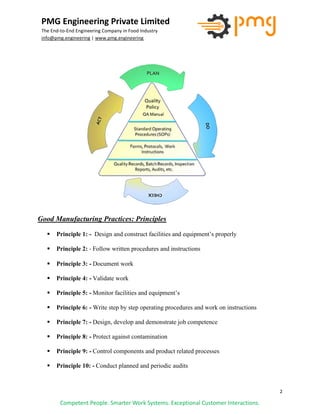
Good Manufacturing Practices: Principles
▪ Principle 1: - Design and construct facilities and equipment’s properly
▪ Principle 2: - Follow written procedures and instructions
▪ Principle 3: - Document work
▪ Principle 4: - Validate work
▪ Principle 5: - Monitor facilities and equipment’s
▪ Principle 6: - Write step by step operating procedures and work on instructions
▪ Principle 7: - Design, develop and demonstrate job competence
▪ Principle 8: - Protect against contamination
▪ Principle 9: - Control components and product related processes
▪ Principle 10: - Conduct planned and periodic audits
3
PMG Engineering Private Limited
The End-to-End Engineering Company in Food Industry
info@pmg.engineering | www.pmg.engineering
Competent People. Smarter Work Systems. Exceptional Customer Interactions.
Good Manufacturing Practices: Implementation
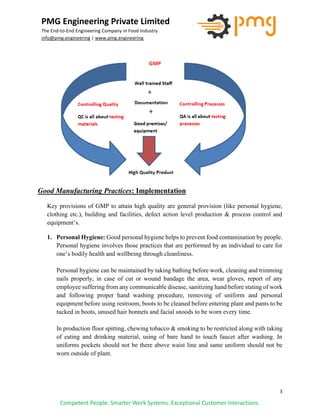
Key provisions of GMP to attain high quality are general provision (like personal hygiene,
clothing etc.), building and facilities, defect action level production & process control and
equipment’s.
1. Personal Hygiene: Good personal hygiene helps to prevent food contamination by people.
Personal hygiene involves those practices that are performed by an individual to care for
one’s bodily health and wellbeing through cleanliness.
Personal hygiene can be maintained by taking bathing before work, cleaning and trimming
nails properly, in case of cut or wound bandage the area, wear gloves, report of any
employee suffering from any communicable disease, sanitizing hand before stating of work
and following proper hand washing procedure, removing of uniform and personal
equipment before using restroom, boots to be cleaned before entering plant and pants to be
tucked in boots, unused hair bonnets and facial snoods to be worn every time.
In production floor spitting, chewing tobacco & smoking to be restricted along with taking
of eating and drinking material, using of bare hand to touch faucet after washing. In
uniforms pockets should not be there above waist line and same uniform should not be
worn outside of plant.
4
PMG Engineering Private Limited
The End-to-End Engineering Company in Food Industry
info@pmg.engineering | www.pmg.engineering
Competent People. Smarter Work Systems. Exceptional Customer Interactions.
2. Plant and plant grounds: Grass and weeds around the vicinity of the plant should be kept
eliminated as they can harborage for unwanted pests. Plant should be free from trash and
refuse. Roads and parking lots associated with facility should be paved and there should be
adequate ground drainage facility.
3. Plant construction and design: Plant construction and design for new construction,
expansion and reconstruction work should be designed and executed for
1. Easy cleaning and sanitization of plant and sufficient room space for same
2. Internal roofs and top angle’s in processing area to be designed that minimize the dirt
buildup and condensation and should be easily cleanable.
3. Floors to be properly sloped to avoid water accumulation and proper drainage in areas
where water usage is more and all drains should have cover and pest traps.
4. Material for wall construction should be of anti-corrosive materials. Selection of paint
should be on basis of non-toxic, odorless, smooth, water prof, easy to clean and light
colored.
5. Smooth and anti-absorbent materials should be used for floors, doors and windows for
easy cleaning and disinfection purposes.
6. Lighting and ventilation to be adequately designed with safety fixtures.
5
PMG Engineering Private Limited
The End-to-End Engineering Company in Food Industry
info@pmg.engineering | www.pmg.engineering
Competent People. Smarter Work Systems. Exceptional Customer Interactions.
4. Equipment: Equipment’s can be source of contamination to the product either by coming
into direct contact or can be indirectly spreading contamination. For prevention from both
cases it is important to have preferable design of equipment which provides better cleanable
contact surface. Other parameters that should be considered are:
1. Food contact surfaces to be inert, smooth & non porous (SS preferred).
2. Equipment installation to have 3 feet around clearance & to be 6 inches off the floor.
3. Production equipment’s to be arranged as per technical procedure to avoid cross
contamination.
4. Equipment assembly parts like bolts, nuts, gaskets etc. not to be kept near equipment during
operation.
5. Mobile equipment cleaning and storage not to be done in processing area.
6. Nonfood grade lubricants for equipment’s not to be used.
7. To follow maintenance and service schedule for equipment.
5. Production and Process Control: For production & process control one should follow
sanitary principles during operations like receiving, production, transportation, processing
and storage. Inspection can solve lot of problems in this section.
1. Raw materials to be inspected and separated from processed products, raw material
containers need to be inspected
2. Regular inspection & cleaning of food processing equipment.
3. Documentation of various processing factors such as time, temperature, humidity, pressure
& other relevant variables to be properly controlled & documented.
4. To ensure traceability finished goods should be coded.
5. Production records should be properly maintained.
6. Testing procedures to be in place for checking finished product quality & safety.
7. Packaging materials to be approved & provide appropriate protection
Making poor quality product doesn’t save money in long run as they can cause recalls and affecting
the brand name. GMP always is a good investment in good quality product and is best way to
conduct business as it is designed to ensure that mistakes do not occur. One important flexibility
GMP guidelines provide are that manufacturer can determine the effective method for efficiently
setting up quality program at their end that shall be meeting business and regulatory control.

Good Manufacturing Practices - Objective and Need, Principles, Implementation

  • 1.
    1 PMG Engineering PrivateLimited The End-to-End Engineering Company in Food Industry info@pmg.engineering | www.pmg.engineering Competent People. Smarter Work Systems. Exceptional Customer Interactions. Good Manufacturing Practices Good Manufacturing Practices (GMP) is a whole system in itself which enlist practices that is to be followed for getting consistent quality product, processed under controlled environment to meet with guidelines recommended by agencies that control the authorization and licensing of the manufacture and sale. It enlists set of guidelines and procedures that is to be practiced by manufacturers to ascertain the minimum required quality so that the end consumer is not harmed. Good Manufacturing Practices: Objective and Need GMP apart from providing minimum quality, it is to achieve following aims 1. To manufacture products of pre-determined specifications 2. To get consistent quality end product 3. To package product as intended and to correctly label 4. To minimize any sort of contamination possible in the delivering product. 5. To eliminate any chance of error during processing of product 6. To increase the efficiency and reduce the doing business 7. To reduce the risk of mislabelling and adulteration Risk of product contamination are very high. Few factors contributing to the same are from people, other food materials like allergens, packaging materials, hazardous material, equipment’s, building and miscellaneous material.
  • 2.
    2 PMG Engineering PrivateLimited The End-to-End Engineering Company in Food Industry info@pmg.engineering | www.pmg.engineering Competent People. Smarter Work Systems. Exceptional Customer Interactions. Good Manufacturing Practices: Principles ▪ Principle 1: - Design and construct facilities and equipment’s properly ▪ Principle 2: - Follow written procedures and instructions ▪ Principle 3: - Document work ▪ Principle 4: - Validate work ▪ Principle 5: - Monitor facilities and equipment’s ▪ Principle 6: - Write step by step operating procedures and work on instructions ▪ Principle 7: - Design, develop and demonstrate job competence ▪ Principle 8: - Protect against contamination ▪ Principle 9: - Control components and product related processes ▪ Principle 10: - Conduct planned and periodic audits
  • 3.
    3 PMG Engineering PrivateLimited The End-to-End Engineering Company in Food Industry info@pmg.engineering | www.pmg.engineering Competent People. Smarter Work Systems. Exceptional Customer Interactions. Good Manufacturing Practices: Implementation Key provisions of GMP to attain high quality are general provision (like personal hygiene, clothing etc.), building and facilities, defect action level production & process control and equipment’s. 1. Personal Hygiene: Good personal hygiene helps to prevent food contamination by people. Personal hygiene involves those practices that are performed by an individual to care for one’s bodily health and wellbeing through cleanliness. Personal hygiene can be maintained by taking bathing before work, cleaning and trimming nails properly, in case of cut or wound bandage the area, wear gloves, report of any employee suffering from any communicable disease, sanitizing hand before stating of work and following proper hand washing procedure, removing of uniform and personal equipment before using restroom, boots to be cleaned before entering plant and pants to be tucked in boots, unused hair bonnets and facial snoods to be worn every time. In production floor spitting, chewing tobacco & smoking to be restricted along with taking of eating and drinking material, using of bare hand to touch faucet after washing. In uniforms pockets should not be there above waist line and same uniform should not be worn outside of plant.
  • 4.
    4 PMG Engineering PrivateLimited The End-to-End Engineering Company in Food Industry info@pmg.engineering | www.pmg.engineering Competent People. Smarter Work Systems. Exceptional Customer Interactions. 2. Plant and plant grounds: Grass and weeds around the vicinity of the plant should be kept eliminated as they can harborage for unwanted pests. Plant should be free from trash and refuse. Roads and parking lots associated with facility should be paved and there should be adequate ground drainage facility. 3. Plant construction and design: Plant construction and design for new construction, expansion and reconstruction work should be designed and executed for 1. Easy cleaning and sanitization of plant and sufficient room space for same 2. Internal roofs and top angle’s in processing area to be designed that minimize the dirt buildup and condensation and should be easily cleanable. 3. Floors to be properly sloped to avoid water accumulation and proper drainage in areas where water usage is more and all drains should have cover and pest traps. 4. Material for wall construction should be of anti-corrosive materials. Selection of paint should be on basis of non-toxic, odorless, smooth, water prof, easy to clean and light colored. 5. Smooth and anti-absorbent materials should be used for floors, doors and windows for easy cleaning and disinfection purposes. 6. Lighting and ventilation to be adequately designed with safety fixtures.
  • 5.
    5 PMG Engineering PrivateLimited The End-to-End Engineering Company in Food Industry info@pmg.engineering | www.pmg.engineering Competent People. Smarter Work Systems. Exceptional Customer Interactions. 4. Equipment: Equipment’s can be source of contamination to the product either by coming into direct contact or can be indirectly spreading contamination. For prevention from both cases it is important to have preferable design of equipment which provides better cleanable contact surface. Other parameters that should be considered are: 1. Food contact surfaces to be inert, smooth & non porous (SS preferred). 2. Equipment installation to have 3 feet around clearance & to be 6 inches off the floor. 3. Production equipment’s to be arranged as per technical procedure to avoid cross contamination. 4. Equipment assembly parts like bolts, nuts, gaskets etc. not to be kept near equipment during operation. 5. Mobile equipment cleaning and storage not to be done in processing area. 6. Nonfood grade lubricants for equipment’s not to be used. 7. To follow maintenance and service schedule for equipment. 5. Production and Process Control: For production & process control one should follow sanitary principles during operations like receiving, production, transportation, processing and storage. Inspection can solve lot of problems in this section. 1. Raw materials to be inspected and separated from processed products, raw material containers need to be inspected 2. Regular inspection & cleaning of food processing equipment. 3. Documentation of various processing factors such as time, temperature, humidity, pressure & other relevant variables to be properly controlled & documented. 4. To ensure traceability finished goods should be coded. 5. Production records should be properly maintained. 6. Testing procedures to be in place for checking finished product quality & safety. 7. Packaging materials to be approved & provide appropriate protection Making poor quality product doesn’t save money in long run as they can cause recalls and affecting the brand name. GMP always is a good investment in good quality product and is best way to conduct business as it is designed to ensure that mistakes do not occur. One important flexibility GMP guidelines provide are that manufacturer can determine the effective method for efficiently setting up quality program at their end that shall be meeting business and regulatory control.