COURSE CODE: 213FTE2102
COURSE TITLE: MEAT, POULTRY AND FISH PROCESSING
TECHNOLOGY
1
Course Coordinator: Dr. R Rajam
Associate Professor and Head
Department of Food Technology
School of Bio, Chemical and Processing Engineering
KALASALINGAM ACADEMY OF RESEARCH AND EDUCATION
Students Name & Reg No: :
B. PANDIYAN & 9921011019
Year/Sem: IV / VII
Meat plant hygiene – GMP and HACCP
MEAT INDUSTRY
• Meat processing is a means of extending shelf-life (preserving) and producing a
convenient item for use later and elsewhere. Processing is aimed at reducing the
enzyme activity in the meat, retarding oxidation of the fat, and preventing spoilage
by microorganisms. These aims have been achieved through drying, curing with
salts, or smoking meat. Sausage manufacturing, for which meat is ground to varying
degrees, is another form of processing, in principle for the same purpose. Either one
or a combination of these procedures in various regions of the world has preserved
goats' meat.
• In modern times, meat is processed not only as a means of preserving, but also for
producing consumer-acceptable products compatible with modern lifestyles and
philosophy of a health-related quality of life. In order to achieve this the processor
has to define clearly the image and commercial appeal of the envisaged product.
The decision-making process of the consumer needs to be defined in terms of real
and perceived value, the convenience the product offers, and its palatability.
2
WHAT IS GMP?
GMP is a set of guidelines designed to ensure that food products are
consistently produced and controlled according to quality standards. It covers
various aspects of production, such as personnel hygiene, facility maintenance,
equipment cleanliness, and product handling. Adhering to GMP principles helps
prevent contamination, cross-contamination, and microbial growth during meat
processing. By following GMP guidelines, meat industries can ensure the
consistent production of safe and high-quality meat products for consumers.
3
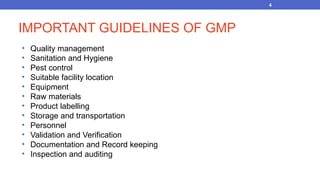
IMPORTANT GUIDELINES OF GMP
• Quality management
• Sanitation and Hygiene
• Pest control
• Suitable facility location
• Equipment
• Raw materials
• Product labelling
• Storage and transportation
• Personnel
• Validation and Verification
• Documentation and Record keeping
• Inspection and auditing
4
WHAT IS HACCP?
HACCP is a systematic approach to identify, evaluate, and control food safety
hazards throughout the production process. It involves seven principles that
include hazard analysis, critical control points identification, monitoring,
corrective actions, verification, and record-keeping. Implementing a HACCP
system in meat processing facilities helps to prevent, eliminate, or reduce
hazards that could pose a risk to food safety. By identifying critical control points
and monitoring them regularly, meat industries can effectively control potential
hazards and ensure the safety of meat products.
5
PRINCIPLES OF HACCP
• Conduct a hazard analysis.
• Determine the critical control points (CCPs).
• Establish critical limits.
• Establish monitoring procedures.
• Establish corrective actions.
• Establish verification procedures.
• Establish record-keeping and documentation procedures.
6
COMBINATION OF GMP AND HACCP
The integration of GMP and HACCP systems in meat industries is essential to
maintain the highest standards of food safety and quality. GMP helps establish
a foundation of good practices in production facilities, while HACCP provides a
systematic approach to identify and control food safety hazards. Together, these
systems enable meat industries to produce safe and high-quality products that
meet regulatory requirements and consumer expectations.
7
IMPORTANCE OF TRAINING OF EMPLOYEES
In meat processing facilities, employees must undergo comprehensive training
on GMP and HACCP principles to ensure adherence to established guidelines.
Proper training helps employees understand the importance of following GMP
practices, maintaining hygiene standards, and identifying critical control points
in the production process. By investing in training programs, meat industries
can enhance the knowledge and skills of their workforce, leading to improved
food safety practices and product quality.
8
MONITORING AND AUDITING
Regular monitoring and auditing of GMP and HACCP systems are essential to
ensure compliance with established standards and regulations. Audits help
identify potential areas for improvement, correct deviations from the established
guidelines, and verify the effectiveness of control measures. By conducting
regular audits, meat industries can proactively address food safety issues,
prevent potential hazards, and maintain the integrity of their GMP and HACCP
systems.
9
IMPLEMENTATION OF GMP AND HACCP
The implementation of GMP and HACCP systems in meat industries requires a
coordinated effort from all stakeholders, including management, employees,
and government regulatory agencies. Collaboration between these parties is
essential to ensure the successful implementation and maintenance of food
safety practices in meat processing facilities. By working together, stakeholders
can address challenges, share best practices, and uphold the highest standards
of food safety in the meat industry.
10
CONCLUSION
In conclusion, GMP and HACCP systems play a critical role in enhancing food
safety and quality in the meat industry. By following GMP guidelines and
implementing a HACCP system, meat processing facilities can prevent
foodborne illnesses, maintain product integrity, and meet regulatory
requirements. Training employees, conducting regular audits, and fostering
collaboration among stakeholders are essential components of successful GMP
and HACCP implementation. Going forward, continued commitment to food
safety practices and the adoption of new technologies will further improve the
safety and quality of meat products for consumers worldwide
11
THANK YOU
12

GMP AND HACCP in meat processing industry

  • 1.
    COURSE CODE: 213FTE2102 COURSETITLE: MEAT, POULTRY AND FISH PROCESSING TECHNOLOGY 1 Course Coordinator: Dr. R Rajam Associate Professor and Head Department of Food Technology School of Bio, Chemical and Processing Engineering KALASALINGAM ACADEMY OF RESEARCH AND EDUCATION Students Name & Reg No: : B. PANDIYAN & 9921011019 Year/Sem: IV / VII Meat plant hygiene – GMP and HACCP
  • 2.
    MEAT INDUSTRY • Meatprocessing is a means of extending shelf-life (preserving) and producing a convenient item for use later and elsewhere. Processing is aimed at reducing the enzyme activity in the meat, retarding oxidation of the fat, and preventing spoilage by microorganisms. These aims have been achieved through drying, curing with salts, or smoking meat. Sausage manufacturing, for which meat is ground to varying degrees, is another form of processing, in principle for the same purpose. Either one or a combination of these procedures in various regions of the world has preserved goats' meat. • In modern times, meat is processed not only as a means of preserving, but also for producing consumer-acceptable products compatible with modern lifestyles and philosophy of a health-related quality of life. In order to achieve this the processor has to define clearly the image and commercial appeal of the envisaged product. The decision-making process of the consumer needs to be defined in terms of real and perceived value, the convenience the product offers, and its palatability. 2
  • 3.
    WHAT IS GMP? GMPis a set of guidelines designed to ensure that food products are consistently produced and controlled according to quality standards. It covers various aspects of production, such as personnel hygiene, facility maintenance, equipment cleanliness, and product handling. Adhering to GMP principles helps prevent contamination, cross-contamination, and microbial growth during meat processing. By following GMP guidelines, meat industries can ensure the consistent production of safe and high-quality meat products for consumers. 3
  • 4.
    IMPORTANT GUIDELINES OFGMP • Quality management • Sanitation and Hygiene • Pest control • Suitable facility location • Equipment • Raw materials • Product labelling • Storage and transportation • Personnel • Validation and Verification • Documentation and Record keeping • Inspection and auditing 4
  • 5.
    WHAT IS HACCP? HACCPis a systematic approach to identify, evaluate, and control food safety hazards throughout the production process. It involves seven principles that include hazard analysis, critical control points identification, monitoring, corrective actions, verification, and record-keeping. Implementing a HACCP system in meat processing facilities helps to prevent, eliminate, or reduce hazards that could pose a risk to food safety. By identifying critical control points and monitoring them regularly, meat industries can effectively control potential hazards and ensure the safety of meat products. 5
  • 6.
    PRINCIPLES OF HACCP •Conduct a hazard analysis. • Determine the critical control points (CCPs). • Establish critical limits. • Establish monitoring procedures. • Establish corrective actions. • Establish verification procedures. • Establish record-keeping and documentation procedures. 6
  • 7.
    COMBINATION OF GMPAND HACCP The integration of GMP and HACCP systems in meat industries is essential to maintain the highest standards of food safety and quality. GMP helps establish a foundation of good practices in production facilities, while HACCP provides a systematic approach to identify and control food safety hazards. Together, these systems enable meat industries to produce safe and high-quality products that meet regulatory requirements and consumer expectations. 7
  • 8.
    IMPORTANCE OF TRAININGOF EMPLOYEES In meat processing facilities, employees must undergo comprehensive training on GMP and HACCP principles to ensure adherence to established guidelines. Proper training helps employees understand the importance of following GMP practices, maintaining hygiene standards, and identifying critical control points in the production process. By investing in training programs, meat industries can enhance the knowledge and skills of their workforce, leading to improved food safety practices and product quality. 8
  • 9.
    MONITORING AND AUDITING Regularmonitoring and auditing of GMP and HACCP systems are essential to ensure compliance with established standards and regulations. Audits help identify potential areas for improvement, correct deviations from the established guidelines, and verify the effectiveness of control measures. By conducting regular audits, meat industries can proactively address food safety issues, prevent potential hazards, and maintain the integrity of their GMP and HACCP systems. 9
  • 10.
    IMPLEMENTATION OF GMPAND HACCP The implementation of GMP and HACCP systems in meat industries requires a coordinated effort from all stakeholders, including management, employees, and government regulatory agencies. Collaboration between these parties is essential to ensure the successful implementation and maintenance of food safety practices in meat processing facilities. By working together, stakeholders can address challenges, share best practices, and uphold the highest standards of food safety in the meat industry. 10
  • 11.
    CONCLUSION In conclusion, GMPand HACCP systems play a critical role in enhancing food safety and quality in the meat industry. By following GMP guidelines and implementing a HACCP system, meat processing facilities can prevent foodborne illnesses, maintain product integrity, and meet regulatory requirements. Training employees, conducting regular audits, and fostering collaboration among stakeholders are essential components of successful GMP and HACCP implementation. Going forward, continued commitment to food safety practices and the adoption of new technologies will further improve the safety and quality of meat products for consumers worldwide 11
  • 12.