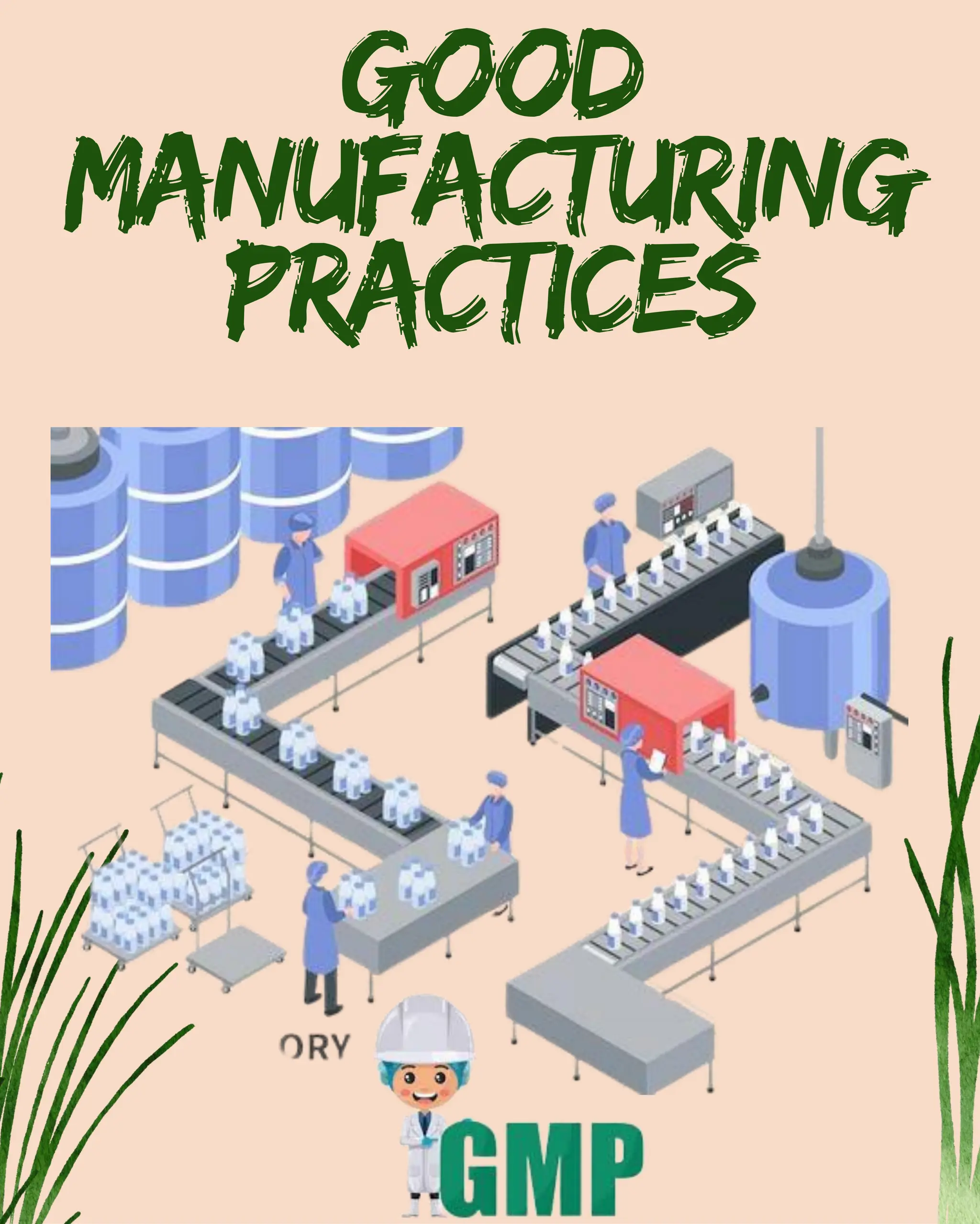
Good
Manufacturing
Practices
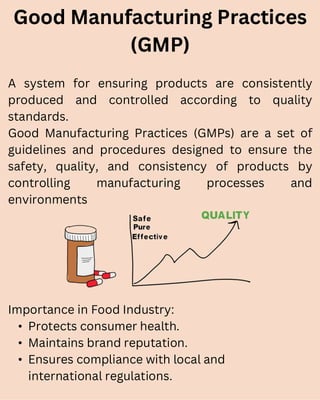
A system for ensuring products are consistently
produced and controlled according to quality
standards.
Good Manufacturing Practices (GMPs) are a set of
guidelines and procedures designed to ensure the
safety, quality, and consistency of products by
controlling manufacturing processes and
environments
Good Manufacturing Practices
(GMP)
Importance in Food Industry:
• Protects consumer health.
• Maintains brand reputation.
• Ensures compliance with local and
international regulations.
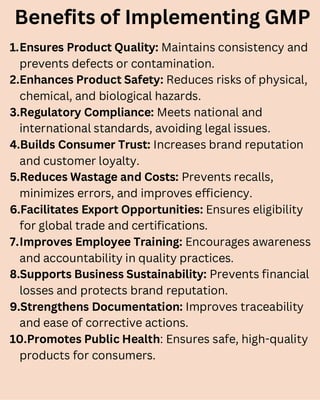
Benefits of Implementing GMP
1.Ensures Product Quality: Maintains consistency and
prevents defects or contamination.
2.Enhances Product Safety: Reduces risks of physical,
chemical, and biological hazards.
3.Regulatory Compliance: Meets national and
international standards, avoiding legal issues.
4.Builds Consumer Trust: Increases brand reputation
and customer loyalty.
5.Reduces Wastage and Costs: Prevents recalls,
minimizes errors, and improves efficiency.
6.Facilitates Export Opportunities: Ensures eligibility
for global trade and certifications.
7.Improves Employee Training: Encourages awareness
and accountability in quality practices.
8.Supports Business Sustainability: Prevents financial
losses and protects brand reputation.
9.Strengthens Documentation: Improves traceability
and ease of corrective actions.
10.Promotes Public Health: Ensures safe, high-quality
products for consumers.
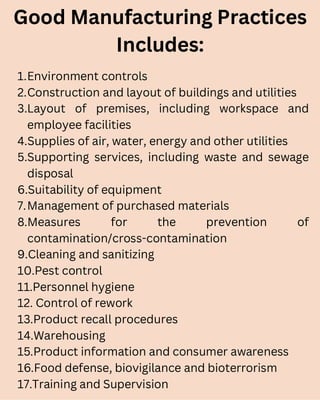
Good Manufacturing Practices
Includes:
1.Environment controls
2.Construction and layout of buildings and utilities
3.Layout of premises, including workspace and
employee facilities
4.Supplies of air, water, energy and other utilities
5.Supporting services, including waste and sewage
disposal
6.Suitability of equipment
7.Management of purchased materials
8.Measures for the prevention of
contamination/cross-contamination
9.Cleaning and sanitizing
10.Pest control
11.Personnel hygiene
12. Control of rework
13.Product recall procedures
14.Warehousing
15.Product information and consumer awareness
16.Food defense, biovigilance and bioterrorism
17.Training and Supervision
Consider the following points during site selection for
food facility
• Location and Surroundings
• Environmental Pollution (air, water, noise, waste)
• Climate and Weather Conditions
• Pest and Animal Control
• Waste Management in Nearby Areas
• Water and Energy Availability
• Regulatory Compliance and Zoning Laws
• Infrastructure and Transportation
• Community and Social Impact
• Security
Environment Controls
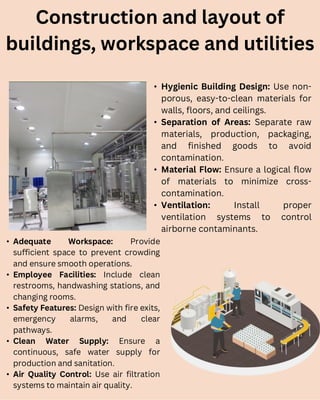
Construction and layout of
buildings, workspace and utilities
• Hygienic Building Design: Use non-
porous, easy-to-clean materials for
walls, floors, and ceilings.
• Separation of Areas: Separate raw
materials, production, packaging,
and finished goods to avoid
contamination.
• Material Flow: Ensure a logical flow
of materials to minimize cross-
contamination.
• Ventilation: Install proper
ventilation systems to control
airborne contaminants.
• Adequate Workspace: Provide
sufficient space to prevent crowding
and ensure smooth operations.
• Employee Facilities: Include clean
restrooms, handwashing stations, and
changing rooms.
• Safety Features: Design with fire exits,
emergency alarms, and clear
pathways.
• Clean Water Supply: Ensure a
continuous, safe water supply for
production and sanitation.
• Air Quality Control: Use air filtration
systems to maintain air quality.
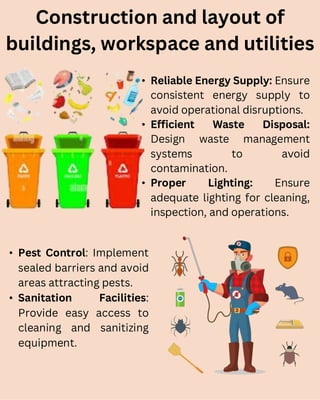
• Reliable Energy Supply: Ensure
consistent energy supply to
avoid operational disruptions.
• Efficient Waste Disposal:
Design waste management
systems to avoid
contamination.
• Proper Lighting: Ensure
adequate lighting for cleaning,
inspection, and operations.
Construction and layout of
buildings, workspace and utilities
• Pest Control: Implement
sealed barriers and avoid
areas attracting pests.
• Sanitation Facilities:
Provide easy access to
cleaning and sanitizing
equipment.
Personnel
Facilities
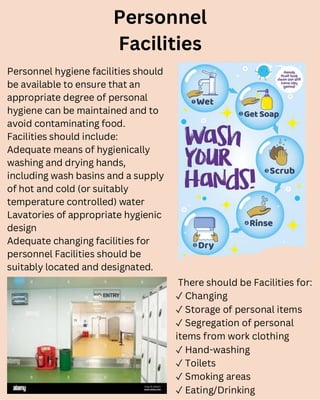
Personnel hygiene facilities should
be available to ensure that an
appropriate degree of personal
hygiene can be maintained and to
avoid contaminating food.
Facilities should include:
Adequate means of hygienically
washing and drying hands,
including wash basins and a supply
of hot and cold (or suitably
temperature controlled) water
Lavatories of appropriate hygienic
design
Adequate changing facilities for
personnel Facilities should be
suitably located and designated.
There should be Facilities for:
✓ Changing
✓ Storage of personal items
✓ Segregation of personal
items from work clothing
✓ Hand-washing
✓ Toilets
✓ Smoking areas
✓ Eating/Drinking
Water
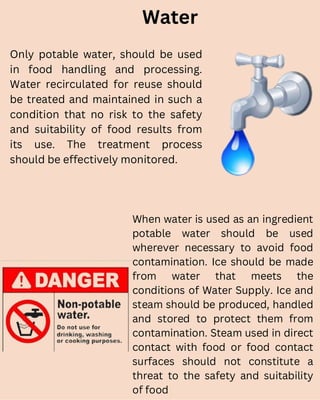
Only potable water, should be used
in food handling and processing.
Water recirculated for reuse should
be treated and maintained in such a
condition that no risk to the safety
and suitability of food results from
its use. The treatment process
should be effectively monitored.
When water is used as an ingredient
potable water should be used
wherever necessary to avoid food
contamination. Ice should be made
from water that meets the
conditions of Water Supply. Ice and
steam should be produced, handled
and stored to protect them from
contamination. Steam used in direct
contact with food or food contact
surfaces should not constitute a
threat to the safety and suitability
of food
Air Quality and Ventilation
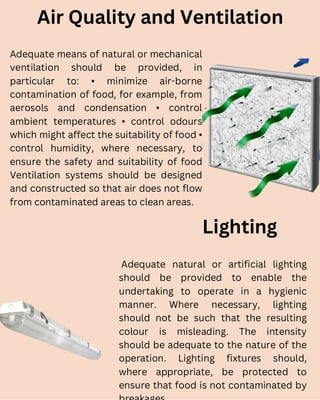
Adequate means of natural or mechanical
ventilation should be provided, in
particular to: • minimize air-borne
contamination of food, for example, from
aerosols and condensation • control
ambient temperatures • control odours
which might affect the suitability of food •
control humidity, where necessary, to
ensure the safety and suitability of food
Ventilation systems should be designed
and constructed so that air does not flow
from contaminated areas to clean areas.
Lighting
Adequate natural or artificial lighting
should be provided to enable the
undertaking to operate in a hygienic
manner. Where necessary, lighting
should not be such that the resulting
colour is misleading. The intensity
should be adequate to the nature of the
operation. Lighting fixtures should,
where appropriate, be protected to
ensure that food is not contaminated by
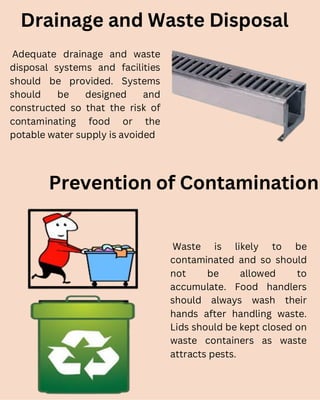
Drainage and Waste Disposal
Adequate drainage and waste
disposal systems and facilities
should be provided. Systems
should be designed and
constructed so that the risk of
contaminating food or the
potable water supply is avoided
Prevention of Contamination
Waste is likely to be
contaminated and so should
not be allowed to
accumulate. Food handlers
should always wash their
hands after handling waste.
Lids should be kept closed on
waste containers as waste
attracts pests.
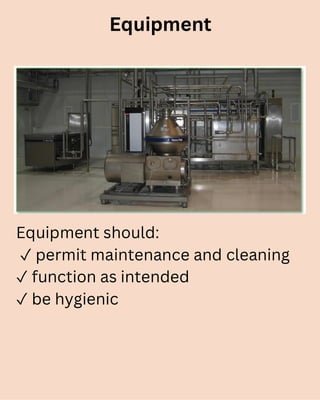
Equipment
Equipment should:
✓ permit maintenance and cleaning
✓ function as intended
✓ be hygienic
Approved Suppliers:
• Source raw materials only from certified and
reliable suppliers.
• Require Certificates of Analysis (CoA) for raw
materials.
Inspection and Testing:
• Inspect raw materials upon arrival for quality and
safety.
• Test ingredients for contaminants like pesticides,
heavy metals, and pathogens.
Storage:
• Store ingredients at appropriate temperatures
and conditions to prevent spoilage.
Raw Material and Supplier
Control
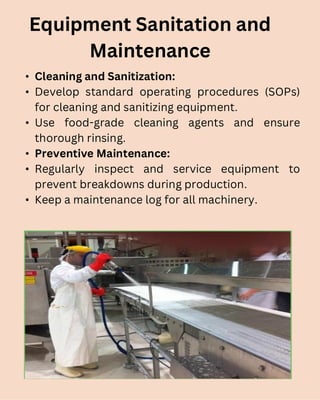
• Cleaning and Sanitization:
• Develop standard operating procedures (SOPs)
for cleaning and sanitizing equipment.
• Use food-grade cleaning agents and ensure
thorough rinsing.
• Preventive Maintenance:
• Regularly inspect and service equipment to
prevent breakdowns during production.
• Keep a maintenance log for all machinery.
Equipment Sanitation and
Maintenance
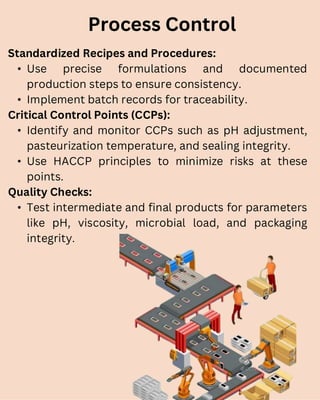
Standardized Recipes and Procedures:
• Use precise formulations and documented
production steps to ensure consistency.
• Implement batch records for traceability.
Critical Control Points (CCPs):
• Identify and monitor CCPs such as pH adjustment,
pasteurization temperature, and sealing integrity.
• Use HACCP principles to minimize risks at these
points.
Quality Checks:
• Test intermediate and final products for parameters
like pH, viscosity, microbial load, and packaging
integrity.
Process Control
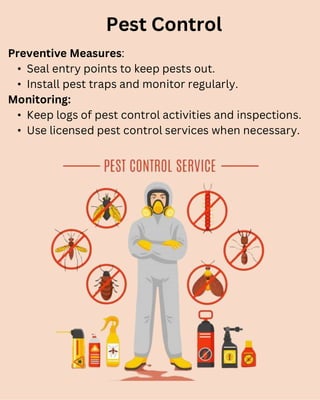
Preventive Measures:
• Seal entry points to keep pests out.
• Install pest traps and monitor regularly.
Monitoring:
• Keep logs of pest control activities and inspections.
• Use licensed pest control services when necessary.
Pest Control
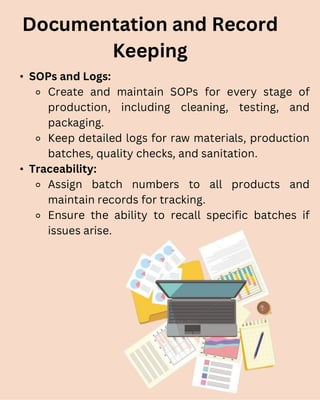
• SOPs and Logs:
⚬ Create and maintain SOPs for every stage of
production, including cleaning, testing, and
packaging.
⚬ Keep detailed logs for raw materials, production
batches, quality checks, and sanitation.
• Traceability:
⚬ Assign batch numbers to all products and
maintain records for tracking.
⚬ Ensure the ability to recall specific batches if
issues arise.
Documentation and Record
Keeping
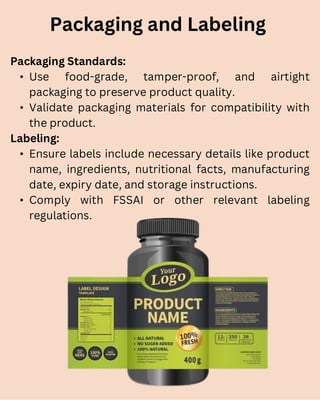
Packaging Standards:
• Use food-grade, tamper-proof, and airtight
packaging to preserve product quality.
• Validate packaging materials for compatibility with
the product.
Labeling:
• Ensure labels include necessary details like product
name, ingredients, nutritional facts, manufacturing
date, expiry date, and storage instructions.
• Comply with FSSAI or other relevant labeling
regulations.
Packaging and Labeling
• Adherence to Standards:
⚬ Follow FSSAI (India), FDA (USA), or Codex
Alimentarius guidelines as applicable.
⚬ Obtain necessary certifications like HACCP, ISO
22000, or BRCGS.
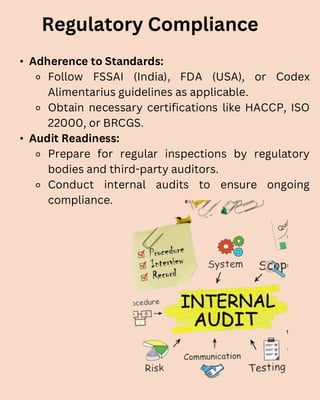
• Audit Readiness:
⚬ Prepare for regular inspections by regulatory
bodies and third-party auditors.
⚬ Conduct internal audits to ensure ongoing
compliance.
Regulatory Compliance
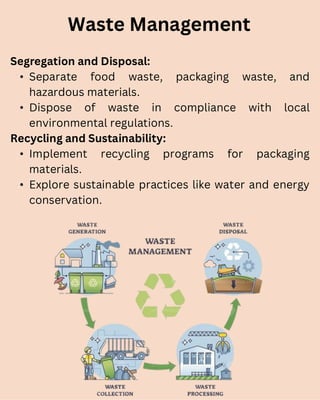
Segregation and Disposal:
• Separate food waste, packaging waste, and
hazardous materials.
• Dispose of waste in compliance with local
environmental regulations.
Recycling and Sustainability:
• Implement recycling programs for packaging
materials.
• Explore sustainable practices like water and energy
conservation.
Waste Management
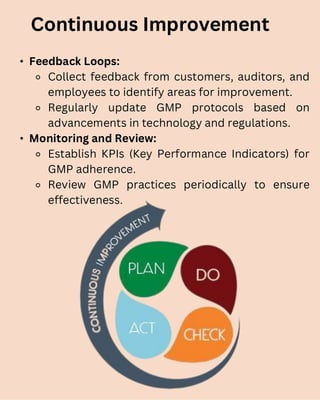
• Feedback Loops:
⚬ Collect feedback from customers, auditors, and
employees to identify areas for improvement.
⚬ Regularly update GMP protocols based on
advancements in technology and regulations.
• Monitoring and Review:
⚬ Establish KPIs (Key Performance Indicators) for
GMP adherence.
⚬ Review GMP practices periodically to ensure
effectiveness.
Continuous Improvement
• Good Manufacturing Practices (GMPs) are essential
guidelines that ensure food safety, quality, and
consistency in food manufacturing industries. By
implementing GMPs, manufacturers can prevent
contamination, maintain hygiene, and adhere to
regulatory standards. Key focus areas include
proper facility design, efficient workflow, personnel
hygiene, equipment suitability, waste management,
and environmental controls.
• GMPs not only protect consumers by ensuring safe
and high-quality products but also enhance
operational efficiency, reduce risks of product
recalls, and build trust in the brand. For food
industries, especially sauce manufacturing, strict
adherence to GMPs is critical to meet global food
safety requirements and remain competitive in the
market.
Conclusion
what is GMP ( Good Manufacturing Practices)

  • 1.
  • 2.
    A system forensuring products are consistently produced and controlled according to quality standards. Good Manufacturing Practices (GMPs) are a set of guidelines and procedures designed to ensure the safety, quality, and consistency of products by controlling manufacturing processes and environments Good Manufacturing Practices (GMP) Importance in Food Industry: • Protects consumer health. • Maintains brand reputation. • Ensures compliance with local and international regulations.
  • 3.
    Benefits of ImplementingGMP 1.Ensures Product Quality: Maintains consistency and prevents defects or contamination. 2.Enhances Product Safety: Reduces risks of physical, chemical, and biological hazards. 3.Regulatory Compliance: Meets national and international standards, avoiding legal issues. 4.Builds Consumer Trust: Increases brand reputation and customer loyalty. 5.Reduces Wastage and Costs: Prevents recalls, minimizes errors, and improves efficiency. 6.Facilitates Export Opportunities: Ensures eligibility for global trade and certifications. 7.Improves Employee Training: Encourages awareness and accountability in quality practices. 8.Supports Business Sustainability: Prevents financial losses and protects brand reputation. 9.Strengthens Documentation: Improves traceability and ease of corrective actions. 10.Promotes Public Health: Ensures safe, high-quality products for consumers.
  • 4.
    Good Manufacturing Practices Includes: 1.Environmentcontrols 2.Construction and layout of buildings and utilities 3.Layout of premises, including workspace and employee facilities 4.Supplies of air, water, energy and other utilities 5.Supporting services, including waste and sewage disposal 6.Suitability of equipment 7.Management of purchased materials 8.Measures for the prevention of contamination/cross-contamination 9.Cleaning and sanitizing 10.Pest control 11.Personnel hygiene 12. Control of rework 13.Product recall procedures 14.Warehousing 15.Product information and consumer awareness 16.Food defense, biovigilance and bioterrorism 17.Training and Supervision
  • 5.
    Consider the followingpoints during site selection for food facility • Location and Surroundings • Environmental Pollution (air, water, noise, waste) • Climate and Weather Conditions • Pest and Animal Control • Waste Management in Nearby Areas • Water and Energy Availability • Regulatory Compliance and Zoning Laws • Infrastructure and Transportation • Community and Social Impact • Security Environment Controls
  • 6.
    Construction and layoutof buildings, workspace and utilities • Hygienic Building Design: Use non- porous, easy-to-clean materials for walls, floors, and ceilings. • Separation of Areas: Separate raw materials, production, packaging, and finished goods to avoid contamination. • Material Flow: Ensure a logical flow of materials to minimize cross- contamination. • Ventilation: Install proper ventilation systems to control airborne contaminants. • Adequate Workspace: Provide sufficient space to prevent crowding and ensure smooth operations. • Employee Facilities: Include clean restrooms, handwashing stations, and changing rooms. • Safety Features: Design with fire exits, emergency alarms, and clear pathways. • Clean Water Supply: Ensure a continuous, safe water supply for production and sanitation. • Air Quality Control: Use air filtration systems to maintain air quality.
  • 7.
    • Reliable EnergySupply: Ensure consistent energy supply to avoid operational disruptions. • Efficient Waste Disposal: Design waste management systems to avoid contamination. • Proper Lighting: Ensure adequate lighting for cleaning, inspection, and operations. Construction and layout of buildings, workspace and utilities • Pest Control: Implement sealed barriers and avoid areas attracting pests. • Sanitation Facilities: Provide easy access to cleaning and sanitizing equipment.
  • 8.
    Personnel Facilities Personnel hygiene facilitiesshould be available to ensure that an appropriate degree of personal hygiene can be maintained and to avoid contaminating food. Facilities should include: Adequate means of hygienically washing and drying hands, including wash basins and a supply of hot and cold (or suitably temperature controlled) water Lavatories of appropriate hygienic design Adequate changing facilities for personnel Facilities should be suitably located and designated. There should be Facilities for: ✓ Changing ✓ Storage of personal items ✓ Segregation of personal items from work clothing ✓ Hand-washing ✓ Toilets ✓ Smoking areas ✓ Eating/Drinking
  • 9.
    Water Only potable water,should be used in food handling and processing. Water recirculated for reuse should be treated and maintained in such a condition that no risk to the safety and suitability of food results from its use. The treatment process should be effectively monitored. When water is used as an ingredient potable water should be used wherever necessary to avoid food contamination. Ice should be made from water that meets the conditions of Water Supply. Ice and steam should be produced, handled and stored to protect them from contamination. Steam used in direct contact with food or food contact surfaces should not constitute a threat to the safety and suitability of food
  • 10.
    Air Quality andVentilation Adequate means of natural or mechanical ventilation should be provided, in particular to: • minimize air-borne contamination of food, for example, from aerosols and condensation • control ambient temperatures • control odours which might affect the suitability of food • control humidity, where necessary, to ensure the safety and suitability of food Ventilation systems should be designed and constructed so that air does not flow from contaminated areas to clean areas. Lighting Adequate natural or artificial lighting should be provided to enable the undertaking to operate in a hygienic manner. Where necessary, lighting should not be such that the resulting colour is misleading. The intensity should be adequate to the nature of the operation. Lighting fixtures should, where appropriate, be protected to ensure that food is not contaminated by
  • 11.
    Drainage and WasteDisposal Adequate drainage and waste disposal systems and facilities should be provided. Systems should be designed and constructed so that the risk of contaminating food or the potable water supply is avoided Prevention of Contamination Waste is likely to be contaminated and so should not be allowed to accumulate. Food handlers should always wash their hands after handling waste. Lids should be kept closed on waste containers as waste attracts pests.
  • 12.
    Equipment Equipment should: ✓ permitmaintenance and cleaning ✓ function as intended ✓ be hygienic
  • 13.
    Approved Suppliers: • Sourceraw materials only from certified and reliable suppliers. • Require Certificates of Analysis (CoA) for raw materials. Inspection and Testing: • Inspect raw materials upon arrival for quality and safety. • Test ingredients for contaminants like pesticides, heavy metals, and pathogens. Storage: • Store ingredients at appropriate temperatures and conditions to prevent spoilage. Raw Material and Supplier Control
  • 14.
    • Cleaning andSanitization: • Develop standard operating procedures (SOPs) for cleaning and sanitizing equipment. • Use food-grade cleaning agents and ensure thorough rinsing. • Preventive Maintenance: • Regularly inspect and service equipment to prevent breakdowns during production. • Keep a maintenance log for all machinery. Equipment Sanitation and Maintenance
  • 15.
    Standardized Recipes andProcedures: • Use precise formulations and documented production steps to ensure consistency. • Implement batch records for traceability. Critical Control Points (CCPs): • Identify and monitor CCPs such as pH adjustment, pasteurization temperature, and sealing integrity. • Use HACCP principles to minimize risks at these points. Quality Checks: • Test intermediate and final products for parameters like pH, viscosity, microbial load, and packaging integrity. Process Control
  • 16.
    Preventive Measures: • Sealentry points to keep pests out. • Install pest traps and monitor regularly. Monitoring: • Keep logs of pest control activities and inspections. • Use licensed pest control services when necessary. Pest Control
  • 17.
    • SOPs andLogs: ⚬ Create and maintain SOPs for every stage of production, including cleaning, testing, and packaging. ⚬ Keep detailed logs for raw materials, production batches, quality checks, and sanitation. • Traceability: ⚬ Assign batch numbers to all products and maintain records for tracking. ⚬ Ensure the ability to recall specific batches if issues arise. Documentation and Record Keeping
  • 18.
    Packaging Standards: • Usefood-grade, tamper-proof, and airtight packaging to preserve product quality. • Validate packaging materials for compatibility with the product. Labeling: • Ensure labels include necessary details like product name, ingredients, nutritional facts, manufacturing date, expiry date, and storage instructions. • Comply with FSSAI or other relevant labeling regulations. Packaging and Labeling
  • 19.
    • Adherence toStandards: ⚬ Follow FSSAI (India), FDA (USA), or Codex Alimentarius guidelines as applicable. ⚬ Obtain necessary certifications like HACCP, ISO 22000, or BRCGS. • Audit Readiness: ⚬ Prepare for regular inspections by regulatory bodies and third-party auditors. ⚬ Conduct internal audits to ensure ongoing compliance. Regulatory Compliance
  • 20.
    Segregation and Disposal: •Separate food waste, packaging waste, and hazardous materials. • Dispose of waste in compliance with local environmental regulations. Recycling and Sustainability: • Implement recycling programs for packaging materials. • Explore sustainable practices like water and energy conservation. Waste Management
  • 21.
    • Feedback Loops: ⚬Collect feedback from customers, auditors, and employees to identify areas for improvement. ⚬ Regularly update GMP protocols based on advancements in technology and regulations. • Monitoring and Review: ⚬ Establish KPIs (Key Performance Indicators) for GMP adherence. ⚬ Review GMP practices periodically to ensure effectiveness. Continuous Improvement
  • 22.
    • Good ManufacturingPractices (GMPs) are essential guidelines that ensure food safety, quality, and consistency in food manufacturing industries. By implementing GMPs, manufacturers can prevent contamination, maintain hygiene, and adhere to regulatory standards. Key focus areas include proper facility design, efficient workflow, personnel hygiene, equipment suitability, waste management, and environmental controls. • GMPs not only protect consumers by ensuring safe and high-quality products but also enhance operational efficiency, reduce risks of product recalls, and build trust in the brand. For food industries, especially sauce manufacturing, strict adherence to GMPs is critical to meet global food safety requirements and remain competitive in the market. Conclusion