
SIEVE ANALYSIS
Presented By:
Zeeshan Jutt (591-E)
Rao Altaf (592-E)
Waseem (593-E)
Farooq e Azam (594-E)
Imran (595-E)
Diameter of Particle
diameter maybe calculated from the
1. Length of particle (mean diameter)… when shape is regular
2. volume of particle (mean volume diameter)
3. surface area of particle (mean surface diameter,
also called Sauter mean diameter)
The choice of method?
• If packing or flow rate are under consideration
Use “mean volume diameter”
• If Dissolution or Adsorption..
Use “mean surface diameter”
SIEVING
• Sieve analysis is performed using a nest or stack of sieves where
each lower sieve has a smaller aperture size than that of the sieve
above it.
• Sieves can be referred to either by their aperture size or by their
mesh size (or sieve number).
• The mesh size is the number of wires per linear inch.
• Approx. size range : 5µm - ~3mm
– Standard woven wire sieves
– Punch plate sieves
– Electroformed micromesh sieves at the lower end or range (< 20µm)
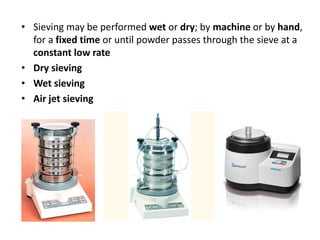
• Sieving may be performed wet or dry; by machine or by hand,
for a fixed time or until powder passes through the sieve at a
constant low rate
• Dry sieving
• Wet sieving
• Air jet sieving
Representation of Data
The data is usually represented in the form of
graph, which can be:
1. Size-Frequency Distribution plot
2. Cumulative Distribution Plot
Size-Frequency Distribution plot
In the given plot, the data is
normally distributed (symmetrical
about the vertical axis).
The data for ground materials is usually
skewed (Because the number of particles
Increase with decreasing size).
In that case, we use logarithm of sizes,
Thus making it symmetrical.
Cumulative Distribution Plot
1. “Cumulative plots” are those in which the percentage of
particles less than or greater than a given particle size is
plotted against size.
• The “Median Diameter “ is the diameter for which 50% of the
particles measured are less than the stated size
• Median diameter is read from
50% value of the curve.
References:
• The Theory and practice of industrial pharmacy
by Leon Lachman, Herbert A. Lieberman, Joseph L. Kanig
• USP 2009
• Remington: The Science and practice of pharmacy
• Images of instruments from web.

Sieve analysis-----(Pharmaceutics)

  • 1.
    SIEVE ANALYSIS Presented By: ZeeshanJutt (591-E) Rao Altaf (592-E) Waseem (593-E) Farooq e Azam (594-E) Imran (595-E)
  • 2.
    Diameter of Particle diametermaybe calculated from the 1. Length of particle (mean diameter)… when shape is regular 2. volume of particle (mean volume diameter) 3. surface area of particle (mean surface diameter, also called Sauter mean diameter) The choice of method? • If packing or flow rate are under consideration Use “mean volume diameter” • If Dissolution or Adsorption.. Use “mean surface diameter”
  • 3.
    SIEVING • Sieve analysisis performed using a nest or stack of sieves where each lower sieve has a smaller aperture size than that of the sieve above it. • Sieves can be referred to either by their aperture size or by their mesh size (or sieve number). • The mesh size is the number of wires per linear inch. • Approx. size range : 5µm - ~3mm – Standard woven wire sieves – Punch plate sieves – Electroformed micromesh sieves at the lower end or range (< 20µm)
  • 4.
    • Sieving maybe performed wet or dry; by machine or by hand, for a fixed time or until powder passes through the sieve at a constant low rate • Dry sieving • Wet sieving • Air jet sieving
  • 5.
    Representation of Data Thedata is usually represented in the form of graph, which can be: 1. Size-Frequency Distribution plot 2. Cumulative Distribution Plot
  • 6.
    Size-Frequency Distribution plot Inthe given plot, the data is normally distributed (symmetrical about the vertical axis). The data for ground materials is usually skewed (Because the number of particles Increase with decreasing size). In that case, we use logarithm of sizes, Thus making it symmetrical.
  • 7.
    Cumulative Distribution Plot 1.“Cumulative plots” are those in which the percentage of particles less than or greater than a given particle size is plotted against size. • The “Median Diameter “ is the diameter for which 50% of the particles measured are less than the stated size • Median diameter is read from 50% value of the curve.
  • 10.
    References: • The Theoryand practice of industrial pharmacy by Leon Lachman, Herbert A. Lieberman, Joseph L. Kanig • USP 2009 • Remington: The Science and practice of pharmacy • Images of instruments from web.