GOOD LABORATORY
PRACTICES
Dr. Nasir Jamal Khan
(QAM HOOVER
PHARMACEUTICALS)
4/5/2022
INTRODUCTION
• Number Of Countries Require The Manufacturers To Perform
Laboratory Studies On Such Products For Their Properties And
Safety And To Submit The Results Of These Studies To
Government Authority/Regulatory Authorities For The
Assessment Of Potential Hazards To Human Health And The
Environment And Have Passed Legislation To That Effect .
4/5/2022
Definition of GLP
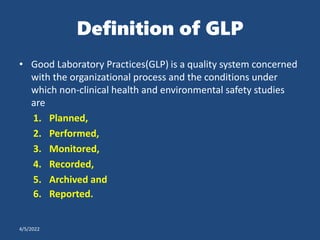
• Good Laboratory Practices(GLP) is a quality system concerned
with the organizational process and the conditions under
which non-clinical health and environmental safety studies
are
1. Planned,
2. Performed,
3. Monitored,
4. Recorded,
5. Archived and
6. Reported.
4/5/2022
THE PURPOSE OF GLP
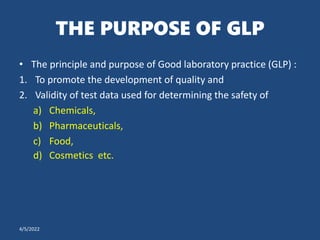
• The principle and purpose of Good laboratory practice (GLP) :
1. To promote the development of quality and
2. Validity of test data used for determining the safety of
a) Chemicals,
b) Pharmaceuticals,
c) Food,
d) Cosmetics etc.
4/5/2022
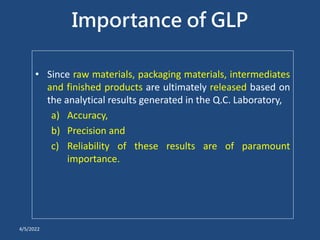
Importance of GLP
• Since raw materials, packaging materials, intermediates
and finished products are ultimately released based on
the analytical results generated in the Q.C. Laboratory,
a) Accuracy,
b) Precision and
c) Reliability of these results are of paramount
importance.
4/5/2022
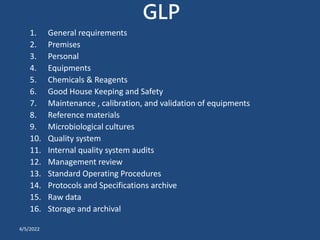
GLP
1. General requirements
2. Premises
3. Personal
4. Equipments
5. Chemicals & Reagents
6. Good House Keeping and Safety
7. Maintenance , calibration, and validation of equipments
8. Reference materials
9. Microbiological cultures
10. Quality system
11. Internal quality system audits
12. Management review
13. Standard Operating Procedures
14. Protocols and Specifications archive
15. Raw data
16. Storage and archival
4/5/2022
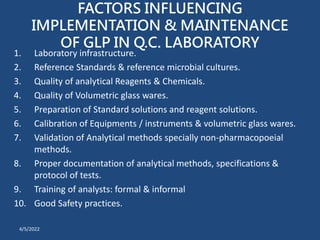
FACTORS INFLUENCING
IMPLEMENTATION & MAINTENANCE
OF GLP IN Q.C. LABORATORY
1. Laboratory infrastructure.
2. Reference Standards & reference microbial cultures.
3. Quality of analytical Reagents & Chemicals.
4. Quality of Volumetric glass wares.
5. Preparation of Standard solutions and reagent solutions.
6. Calibration of Equipments / instruments & volumetric glass wares.
7. Validation of Analytical methods specially non-pharmacopoeial
methods.
8. Proper documentation of analytical methods, specifications &
protocol of tests.
9. Training of analysts: formal & informal
10. Good Safety practices.
4/5/2022
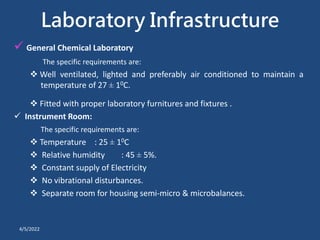
Laboratory Infrastructure
 General Chemical Laboratory
The specific requirements are:
 Well ventilated, lighted and preferably air conditioned to maintain a
temperature of 27 ± 10C.
 Fitted with proper laboratory furnitures and fixtures .
 Instrument Room:
The specific requirements are:
 Temperature : 25 ± 10C
 Relative humidity : 45 ± 5%.
 Constant supply of Electricity
 No vibrational disturbances.
 Separate room for housing semi-micro & microbalances.
4/5/2022
LABORATORY
INFRASTRUCTURE
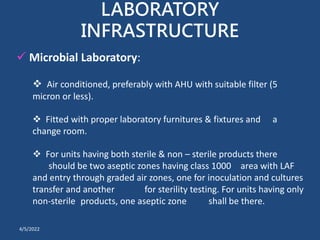
 Microbial Laboratory:
 Air conditioned, preferably with AHU with suitable filter (5
micron or less).
 Fitted with proper laboratory furnitures & fixtures and a
change room.
 For units having both sterile & non – sterile products there
should be two aseptic zones having class 1000 area with LAF
and entry through graded air zones, one for inoculation and cultures
transfer and another for sterility testing. For units having only
non-sterile products, one aseptic zone shall be there.
4/5/2022
LABORATORY
INFRASTRUCTURE
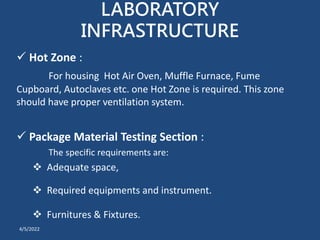
 Hot Zone :
For housing Hot Air Oven, Muffle Furnace, Fume
Cupboard, Autoclaves etc. one Hot Zone is required. This zone
should have proper ventilation system.
 Package Material Testing Section :
The specific requirements are:
 Adequate space,
 Required equipments and instrument.
 Furnitures & Fixtures.
4/5/2022
Laboratory Infrastructure
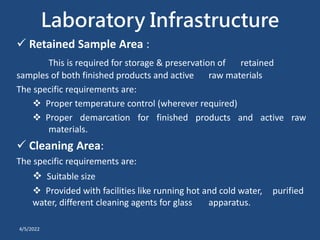
 Retained Sample Area :
This is required for storage & preservation of retained
samples of both finished products and active raw materials
The specific requirements are:
 Proper temperature control (wherever required)
 Proper demarcation for finished products and active raw
materials.
 Cleaning Area:
The specific requirements are:
 Suitable size
 Provided with facilities like running hot and cold water, purified
water, different cleaning agents for glass apparatus.
4/5/2022
LABORATORY
INFRASTRUCTURE
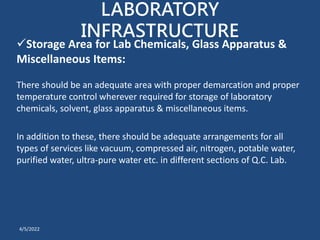
Storage Area for Lab Chemicals, Glass Apparatus &
Miscellaneous Items:
There should be an adequate area with proper demarcation and proper
temperature control wherever required for storage of laboratory
chemicals, solvent, glass apparatus & miscellaneous items.
In addition to these, there should be adequate arrangements for all
types of services like vacuum, compressed air, nitrogen, potable water,
purified water, ultra-pure water etc. in different sections of Q.C. Lab.
4/5/2022
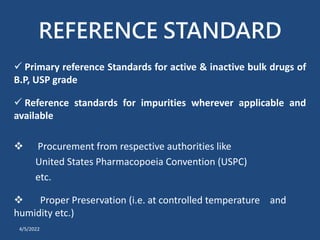
REFERENCE STANDARD
 Primary reference Standards for active & inactive bulk drugs of
B.P, USP grade
 Reference standards for impurities wherever applicable and
available
 Procurement from respective authorities like
United States Pharmacopoeia Convention (USPC)
etc.
 Proper Preservation (i.e. at controlled temperature and
humidity etc.)
4/5/2022
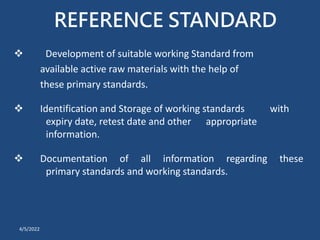
REFERENCE STANDARD
 Development of suitable working Standard from
available active raw materials with the help of
these primary standards.
 Identification and Storage of working standards with
expiry date, retest date and other appropriate
information.
 Documentation of all information regarding these
primary standards and working standards.
4/5/2022
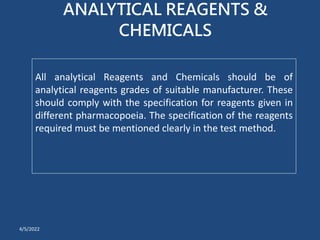
ANALYTICAL REAGENTS &
CHEMICALS
All analytical Reagents and Chemicals should be of
analytical reagents grades of suitable manufacturer. These
should comply with the specification for reagents given in
different pharmacopoeia. The specification of the reagents
required must be mentioned clearly in the test method.
4/5/2022
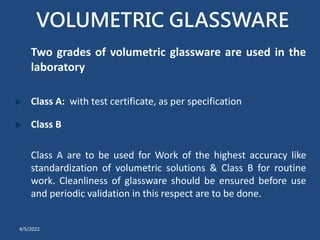
VOLUMETRIC GLASSWARE
Two grades of volumetric glassware are used in the
laboratory
Class A: with test certificate, as per specification
Class B
Class A are to be used for Work of the highest accuracy like
standardization of volumetric solutions & Class B for routine
work. Cleanliness of glassware should be ensured before use
and periodic validation in this respect are to be done.
4/5/2022
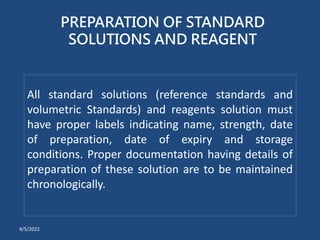
PREPARATION OF STANDARD
SOLUTIONS AND REAGENT
All standard solutions (reference standards and
volumetric Standards) and reagents solution must
have proper labels indicating name, strength, date
of preparation, date of expiry and storage
conditions. Proper documentation having details of
preparation of these solution are to be maintained
chronologically.
4/5/2022
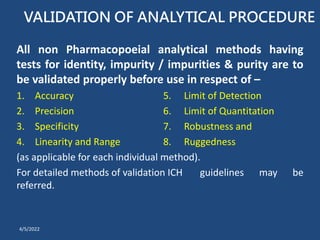
VALIDATION OF ANALYTICAL PROCEDURE
All non Pharmacopoeial analytical methods having
tests for identity, impurity / impurities & purity are to
be validated properly before use in respect of –
1. Accuracy 5. Limit of Detection
2. Precision 6. Limit of Quantitation
3. Specificity 7. Robustness and
4. Linearity and Range 8. Ruggedness
(as applicable for each individual method).
For detailed methods of validation ICH guidelines may be
referred.
4/5/2022
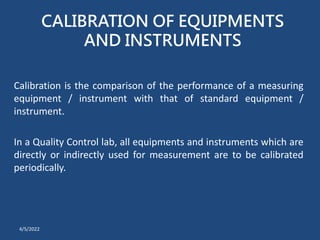
CALIBRATION OF EQUIPMENTS
AND INSTRUMENTS
Calibration is the comparison of the performance of a measuring
equipment / instrument with that of standard equipment /
instrument.
In a Quality Control lab, all equipments and instruments which are
directly or indirectly used for measurement are to be calibrated
periodically.
4/5/2022
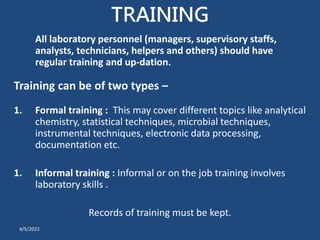
TRAINING
All laboratory personnel (managers, supervisory staffs,
analysts, technicians, helpers and others) should have
regular training and up-dation.
Training can be of two types –
1. Formal training : This may cover different topics like analytical
chemistry, statistical techniques, microbial techniques,
instrumental techniques, electronic data processing,
documentation etc.
1. Informal training : Informal or on the job training involves
laboratory skills .
Records of training must be kept.
4/5/2022
DOCUMENTATION & RECORDS
Usual Document and records with which Q C Laboratory has to deal with
are –
 Specification
 Test Procedure
 Standard Operating Procedures
 Certificate of Analysis with relevant Test Protocols
 Sample Register
 Register for Reference Standards & Reference Cultures
 Calibration Records
 Validation Records
 Training Records
 Records for Retained samples (Both finished products & active raw materials)
 Records pertaining to the preparation of solutions of reference standards,
volumetric solutions and other reagents.
 Log book for instruments & equipments.
All documents are to be reviewed periodically and updated whenever required.
Records should be maintained in such a manner that these are always traceable. If
required help of electronic data processing system may be taken.
4/5/2022
SAFETY
In the Quality Control Laboratory, one has to handle a no of hazardous,
poisonous and inflammable chemicals and also pathogenic organisms.
Hence the adoption of proper safety measure and use of safety devices
are of paramount importance.
The use of mask, gloves, face shields, aprons, gumboots etc. should be
made compulsory in the handling of corrosive chemicals. There should be
adequate fire fighting arrangements in the laboratory and personnel
should be given proper training for fire fighting.
Training for other safety measures should be imparted regularly and
records of these training should be maintained. Microbial residues should
be regularly destroyed by autoclaving and records maintained.
4/5/2022
A GENERAL CHECKLIST FOR GLP
IMPLEMENTATION
1. Good house-keeping,
2. Quality Manual/Documentation,
3. Quality Policy,
4. Method Validation,
5. Instrumental Validation,
6. System Suitability Tests,
7. Calibration of Equipments/Instruments/ Calibration
Schedules/Traceability,
4/5/2022
CHECKLIST FOR GLP
8. Equipment Log Books,
9. Standard Analytical Reference Samples and their
Traceability(All related Certificates/Documentation),
10. Archives for Samples and Documents,
11. Specifications for the products investigated,
12. Good Vendor Development,
13. Study Director for Projects,
14. Statistical Evaluations,
4/5/2022
CHECKLIST
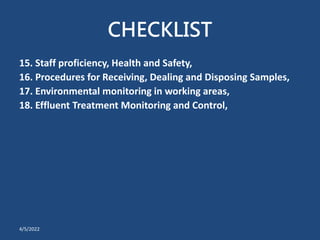
15. Staff proficiency, Health and Safety,
16. Procedures for Receiving, Dealing and Disposing Samples,
17. Environmental monitoring in working areas,
18. Effluent Treatment Monitoring and Control,
4/5/2022
CHECKLIST
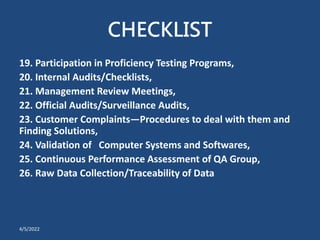
19. Participation in Proficiency Testing Programs,
20. Internal Audits/Checklists,
21. Management Review Meetings,
22. Official Audits/Surveillance Audits,
23. Customer Complaints—Procedures to deal with them and
Finding Solutions,
24. Validation of Computer Systems and Softwares,
25. Continuous Performance Assessment of QA Group,
26. Raw Data Collection/Traceability of Data
4/5/2022
CHECKLIST
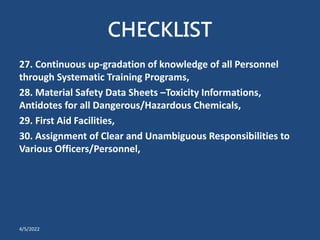
27. Continuous up-gradation of knowledge of all Personnel
through Systematic Training Programs,
28. Material Safety Data Sheets –Toxicity Informations,
Antidotes for all Dangerous/Hazardous Chemicals,
29. First Aid Facilities,
30. Assignment of Clear and Unambiguous Responsibilities to
Various Officers/Personnel,
4/5/2022
CHECKLIST
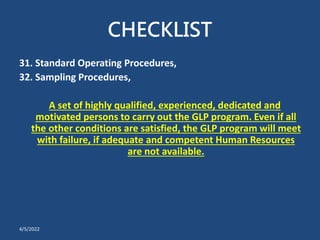
31. Standard Operating Procedures,
32. Sampling Procedures,
A set of highly qualified, experienced, dedicated and
motivated persons to carry out the GLP program. Even if all
the other conditions are satisfied, the GLP program will meet
with failure, if adequate and competent Human Resources
are not available.
4/5/2022
In conclusion one must realize that in the pharmaceutical
industry there is no margin for error and one must follow
good practices in the laboratory to generate accurate, precise
and reliable data.
CONCLUSION
4/5/2022
Thank You
4/5/2022

Glp

  • 1.
    GOOD LABORATORY PRACTICES Dr. NasirJamal Khan (QAM HOOVER PHARMACEUTICALS) 4/5/2022
  • 2.
    INTRODUCTION • Number OfCountries Require The Manufacturers To Perform Laboratory Studies On Such Products For Their Properties And Safety And To Submit The Results Of These Studies To Government Authority/Regulatory Authorities For The Assessment Of Potential Hazards To Human Health And The Environment And Have Passed Legislation To That Effect . 4/5/2022
  • 3.
    Definition of GLP •Good Laboratory Practices(GLP) is a quality system concerned with the organizational process and the conditions under which non-clinical health and environmental safety studies are 1. Planned, 2. Performed, 3. Monitored, 4. Recorded, 5. Archived and 6. Reported. 4/5/2022
  • 4.
    THE PURPOSE OFGLP • The principle and purpose of Good laboratory practice (GLP) : 1. To promote the development of quality and 2. Validity of test data used for determining the safety of a) Chemicals, b) Pharmaceuticals, c) Food, d) Cosmetics etc. 4/5/2022
  • 5.
    Importance of GLP •Since raw materials, packaging materials, intermediates and finished products are ultimately released based on the analytical results generated in the Q.C. Laboratory, a) Accuracy, b) Precision and c) Reliability of these results are of paramount importance. 4/5/2022
  • 6.
    GLP 1. General requirements 2.Premises 3. Personal 4. Equipments 5. Chemicals & Reagents 6. Good House Keeping and Safety 7. Maintenance , calibration, and validation of equipments 8. Reference materials 9. Microbiological cultures 10. Quality system 11. Internal quality system audits 12. Management review 13. Standard Operating Procedures 14. Protocols and Specifications archive 15. Raw data 16. Storage and archival 4/5/2022
  • 7.
    FACTORS INFLUENCING IMPLEMENTATION &MAINTENANCE OF GLP IN Q.C. LABORATORY 1. Laboratory infrastructure. 2. Reference Standards & reference microbial cultures. 3. Quality of analytical Reagents & Chemicals. 4. Quality of Volumetric glass wares. 5. Preparation of Standard solutions and reagent solutions. 6. Calibration of Equipments / instruments & volumetric glass wares. 7. Validation of Analytical methods specially non-pharmacopoeial methods. 8. Proper documentation of analytical methods, specifications & protocol of tests. 9. Training of analysts: formal & informal 10. Good Safety practices. 4/5/2022
  • 8.
    Laboratory Infrastructure  GeneralChemical Laboratory The specific requirements are:  Well ventilated, lighted and preferably air conditioned to maintain a temperature of 27 ± 10C.  Fitted with proper laboratory furnitures and fixtures .  Instrument Room: The specific requirements are:  Temperature : 25 ± 10C  Relative humidity : 45 ± 5%.  Constant supply of Electricity  No vibrational disturbances.  Separate room for housing semi-micro & microbalances. 4/5/2022
  • 9.
    LABORATORY INFRASTRUCTURE  Microbial Laboratory: Air conditioned, preferably with AHU with suitable filter (5 micron or less).  Fitted with proper laboratory furnitures & fixtures and a change room.  For units having both sterile & non – sterile products there should be two aseptic zones having class 1000 area with LAF and entry through graded air zones, one for inoculation and cultures transfer and another for sterility testing. For units having only non-sterile products, one aseptic zone shall be there. 4/5/2022
  • 10.
    LABORATORY INFRASTRUCTURE  Hot Zone: For housing Hot Air Oven, Muffle Furnace, Fume Cupboard, Autoclaves etc. one Hot Zone is required. This zone should have proper ventilation system.  Package Material Testing Section : The specific requirements are:  Adequate space,  Required equipments and instrument.  Furnitures & Fixtures. 4/5/2022
  • 11.
    Laboratory Infrastructure  RetainedSample Area : This is required for storage & preservation of retained samples of both finished products and active raw materials The specific requirements are:  Proper temperature control (wherever required)  Proper demarcation for finished products and active raw materials.  Cleaning Area: The specific requirements are:  Suitable size  Provided with facilities like running hot and cold water, purified water, different cleaning agents for glass apparatus. 4/5/2022
  • 12.
    LABORATORY INFRASTRUCTURE Storage Area forLab Chemicals, Glass Apparatus & Miscellaneous Items: There should be an adequate area with proper demarcation and proper temperature control wherever required for storage of laboratory chemicals, solvent, glass apparatus & miscellaneous items. In addition to these, there should be adequate arrangements for all types of services like vacuum, compressed air, nitrogen, potable water, purified water, ultra-pure water etc. in different sections of Q.C. Lab. 4/5/2022
  • 13.
    REFERENCE STANDARD  Primaryreference Standards for active & inactive bulk drugs of B.P, USP grade  Reference standards for impurities wherever applicable and available  Procurement from respective authorities like United States Pharmacopoeia Convention (USPC) etc.  Proper Preservation (i.e. at controlled temperature and humidity etc.) 4/5/2022
  • 14.
    REFERENCE STANDARD  Developmentof suitable working Standard from available active raw materials with the help of these primary standards.  Identification and Storage of working standards with expiry date, retest date and other appropriate information.  Documentation of all information regarding these primary standards and working standards. 4/5/2022
  • 15.
    ANALYTICAL REAGENTS & CHEMICALS Allanalytical Reagents and Chemicals should be of analytical reagents grades of suitable manufacturer. These should comply with the specification for reagents given in different pharmacopoeia. The specification of the reagents required must be mentioned clearly in the test method. 4/5/2022
  • 16.
    VOLUMETRIC GLASSWARE Two gradesof volumetric glassware are used in the laboratory Class A: with test certificate, as per specification Class B Class A are to be used for Work of the highest accuracy like standardization of volumetric solutions & Class B for routine work. Cleanliness of glassware should be ensured before use and periodic validation in this respect are to be done. 4/5/2022
  • 17.
    PREPARATION OF STANDARD SOLUTIONSAND REAGENT All standard solutions (reference standards and volumetric Standards) and reagents solution must have proper labels indicating name, strength, date of preparation, date of expiry and storage conditions. Proper documentation having details of preparation of these solution are to be maintained chronologically. 4/5/2022
  • 18.
    VALIDATION OF ANALYTICALPROCEDURE All non Pharmacopoeial analytical methods having tests for identity, impurity / impurities & purity are to be validated properly before use in respect of – 1. Accuracy 5. Limit of Detection 2. Precision 6. Limit of Quantitation 3. Specificity 7. Robustness and 4. Linearity and Range 8. Ruggedness (as applicable for each individual method). For detailed methods of validation ICH guidelines may be referred. 4/5/2022
  • 19.
    CALIBRATION OF EQUIPMENTS ANDINSTRUMENTS Calibration is the comparison of the performance of a measuring equipment / instrument with that of standard equipment / instrument. In a Quality Control lab, all equipments and instruments which are directly or indirectly used for measurement are to be calibrated periodically. 4/5/2022
  • 20.
    TRAINING All laboratory personnel(managers, supervisory staffs, analysts, technicians, helpers and others) should have regular training and up-dation. Training can be of two types – 1. Formal training : This may cover different topics like analytical chemistry, statistical techniques, microbial techniques, instrumental techniques, electronic data processing, documentation etc. 1. Informal training : Informal or on the job training involves laboratory skills . Records of training must be kept. 4/5/2022
  • 21.
    DOCUMENTATION & RECORDS UsualDocument and records with which Q C Laboratory has to deal with are –  Specification  Test Procedure  Standard Operating Procedures  Certificate of Analysis with relevant Test Protocols  Sample Register  Register for Reference Standards & Reference Cultures  Calibration Records  Validation Records  Training Records  Records for Retained samples (Both finished products & active raw materials)  Records pertaining to the preparation of solutions of reference standards, volumetric solutions and other reagents.  Log book for instruments & equipments. All documents are to be reviewed periodically and updated whenever required. Records should be maintained in such a manner that these are always traceable. If required help of electronic data processing system may be taken. 4/5/2022
  • 22.
    SAFETY In the QualityControl Laboratory, one has to handle a no of hazardous, poisonous and inflammable chemicals and also pathogenic organisms. Hence the adoption of proper safety measure and use of safety devices are of paramount importance. The use of mask, gloves, face shields, aprons, gumboots etc. should be made compulsory in the handling of corrosive chemicals. There should be adequate fire fighting arrangements in the laboratory and personnel should be given proper training for fire fighting. Training for other safety measures should be imparted regularly and records of these training should be maintained. Microbial residues should be regularly destroyed by autoclaving and records maintained. 4/5/2022
  • 23.
    A GENERAL CHECKLISTFOR GLP IMPLEMENTATION 1. Good house-keeping, 2. Quality Manual/Documentation, 3. Quality Policy, 4. Method Validation, 5. Instrumental Validation, 6. System Suitability Tests, 7. Calibration of Equipments/Instruments/ Calibration Schedules/Traceability, 4/5/2022
  • 24.
    CHECKLIST FOR GLP 8.Equipment Log Books, 9. Standard Analytical Reference Samples and their Traceability(All related Certificates/Documentation), 10. Archives for Samples and Documents, 11. Specifications for the products investigated, 12. Good Vendor Development, 13. Study Director for Projects, 14. Statistical Evaluations, 4/5/2022
  • 25.
    CHECKLIST 15. Staff proficiency,Health and Safety, 16. Procedures for Receiving, Dealing and Disposing Samples, 17. Environmental monitoring in working areas, 18. Effluent Treatment Monitoring and Control, 4/5/2022
  • 26.
    CHECKLIST 19. Participation inProficiency Testing Programs, 20. Internal Audits/Checklists, 21. Management Review Meetings, 22. Official Audits/Surveillance Audits, 23. Customer Complaints—Procedures to deal with them and Finding Solutions, 24. Validation of Computer Systems and Softwares, 25. Continuous Performance Assessment of QA Group, 26. Raw Data Collection/Traceability of Data 4/5/2022
  • 27.
    CHECKLIST 27. Continuous up-gradationof knowledge of all Personnel through Systematic Training Programs, 28. Material Safety Data Sheets –Toxicity Informations, Antidotes for all Dangerous/Hazardous Chemicals, 29. First Aid Facilities, 30. Assignment of Clear and Unambiguous Responsibilities to Various Officers/Personnel, 4/5/2022
  • 28.
    CHECKLIST 31. Standard OperatingProcedures, 32. Sampling Procedures, A set of highly qualified, experienced, dedicated and motivated persons to carry out the GLP program. Even if all the other conditions are satisfied, the GLP program will meet with failure, if adequate and competent Human Resources are not available. 4/5/2022
  • 29.
    In conclusion onemust realize that in the pharmaceutical industry there is no margin for error and one must follow good practices in the laboratory to generate accurate, precise and reliable data. CONCLUSION 4/5/2022
  • 30.