
B Y : K I R A N K U M A R S O L A N K I
GOOD LABORATORY
PRACTICE
GLP: INTRODUCTION
 Definition: It is a set of principles that provides a
framework within which laboratory studies are
planned,performed,monitored, reported and
archived.
 GLP is an FDA regulation.
 GLP applies to nonclinical studies conducted for
the assessment of the safety or efficacy of
chemicals (including pharmaceuticals).
 GLP helps assure regulatory authorities that the data
submitted are a true.
GLP: INTRODUCTION
 The FDA’s (United states food and drug
administration) publication of Proposed Regulations
on GLP in 1976,with establishment of the Final Rule
in June 1979 (21 CFR part 58).
 It was followed a few years later by the
Organization for Economic Co-operation and
Development (OECD) Principles of GLP in 1992;
the OECD has since helped promulgate GLP to many
countries.
WHY WAS GLP CAME TO EXISTENCE?
 In the early 70’s FDA became aware of cases of poor
laboratory practice all over the United States.
 They discovered a lot fraudulent activities and a lot of
poor lab practices.
 Examples of some of these poor lab practices found were
1. Equipment not been calibrated to standard form,
therefore giving wrong measurements.
2. Incorrect/inaccurate accounts of the actual lab study.
3. Inadequate test systems.
4. Data generation without conduct of the study.
5. Replacement of dead animals and fabrication of test
results etc
GLP applies to the studies which…..
 are non-clinical, i. e. Mostly studies on animals or in
vitro, including the analytical aspects of such studies.
 are designed to obtain data on the properties and/or
the safety of items with respect to human health
and/or the environment
 are intended to be submitted to a national
registration authority with the purpose of registering
or licensing the tested substance or any product
derived from it.
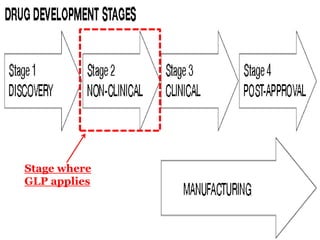
Stage where
GLP applies
Advantages of GLP
 1. Adherence to GLP will remove many sources of
error and uncertainty, adding to the overall
credibility of the study.
 2. Through the application of technically valid and
approved Standard Operating procedures (SOPs)
many sources of systematic error may be avoided.
 3. The requirement to formulate a study plan with a
defined scientific purpose tor the study provides a
more systematic approach preventing false starts
and diminishes the incidence of incomplete or
inconclusive studies.
GLP FOCUSES ON…
1. Resources: Organization, personnel, facilities and
equipment.
2. Characterization: Test items and test systems.
3. Rules: Protocols, standard operating procedures
(SOPs).
4. Results: Raw data, final report, and archives.
5. Quality Assurance: Independent monitoring of
research processes.
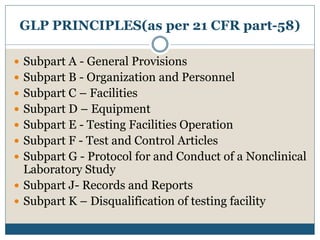
GLP PRINCIPLES(as per 21 CFR part-58)
 Subpart A - General Provisions
 Subpart B - Organization and Personnel
 Subpart C – Facilities
 Subpart D – Equipment
 Subpart E - Testing Facilities Operation
 Subpart F - Test and Control Articles
 Subpart G - Protocol for and Conduct of a Nonclinical
Laboratory Study
 Subpart J- Records and Reports
 Subpart K – Disqualification of testing facility
Subpart A - General Provisions
 Scope
 This part prescribes good laboratory practices for
conducting non-clinical laboratory studies that
support or are intended to support applications for
research or marketing permits for products regulated
by the FDA.
 It includes food and color additives, animal food
additives, human and animal drugs, medical devices
for human use, biological products, and electronic
products.
Subpart A - General Provisions
 Inspection of a testing facility
 A testing facility shall permit an authorized
employee of the FDA, at reasonable times and in a
reasonable manner, to inspect the facility all records
and specimens required to be maintained regarding
studies.
 If the testing facility refuses to permit inspection the
Food and Drug administration will not consider a
non-clinical laboratory study in support of an
application for a research or marketing permit.
Subpart A - General Provisions
 1. Test facility means the persons, premises, and operational
unit(s) that are necessary for conducting the study.
 2. Study Director means the individual responsible for the
overall conduct of the study.
 3. Quality Assurance Program means an internal control
system designed to ascertain that the study is in compliance
with these Principles of Good Laboratory Practice.
 4. Standard Operating Procedures (SOPs) means
written procedures which describe how to perform certain
routine laboratory tests or activities normally not specified in
detail in study plans or test guidelines.
 5. Sponsor means a person(s) or entity who commissions
and/or supports a study.
Subpart A - General Provisions
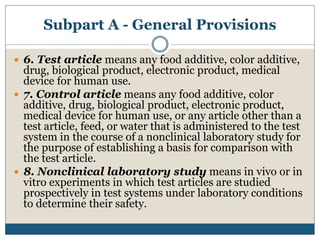
 6. Test article means any food additive, color additive,
drug, biological product, electronic product, medical
device for human use.
 7. Control article means any food additive, color
additive, drug, biological product, electronic product,
medical device for human use, or any article other than a
test article, feed, or water that is administered to the test
system in the course of a nonclinical laboratory study for
the purpose of establishing a basis for comparison with
the test article.
 8. Nonclinical laboratory study means in vivo or in
vitro experiments in which test articles are studied
prospectively in test systems under laboratory conditions
to determine their safety.
Subpart B - Organization and Personnel
 Each individual engaged or involved in the
conduct or supervision of study shall have
education, training and experience that allow
them to perform the assigned function.
 The testing facility shall maintain the records of
each individual including the summary of their
qualifications, trainings and experience.
 For the timely and proper conduct of study, there
shall be adequate number of personnel.
Subpart B - Organization and Personnel
 In order to avoid contamination of test and control
articles, proper sanitation procedure should be
in place.
 Personnel shall wear clothing appropriate for
their duties and shall be changed often to prevent
microbial, radiological or chemical contamination of
test systems and articles.
 The person suffering from illness must be excluded
from the study.
Subpart B - Organization and Personnel
 Various Responsibilities are assigned to particular
persons as following:
A. Test Facility Management’s Responsibilities
B. Study Director’s Responsibilities
C. Principal Investigator’s Responsibilities
D. Study Personnel’s Responsibilities
Test Facility Management’s Responsibilities
 Sufficient number of qualified personnel,
appropriate facilities, equipment, and materials
are available for the timely and proper conduct of
the study
 Ensure the maintenance of a record of the
qualifications, training, experience.
 Job description for each professional and technical
individual.
Test Facility Management’s Responsibilities
 Documented approval of the study plan by the
study director.
 Proper training of personnel to assigned functions.
 Job description for each professional and technical
individual.
 To establish and follow SOP.
 To establish quality assurance program with
designated personnel.
Study Director’s Responsibilities
 Preparation of study plan.
 Any amendments to the study plan by dated Signature.
 Availability of SOPs to the personnel & follow up of SOPs
periodically and take appropriate corrective action
 Raw data generated are fully documented and recorded.
 Computerized systems used in the study have been
validated.
 Sign and date the final report to indicate acceptance of
responsibility for the validity of the data.
 Ensure that after completion (including termination) of
the study, the study plan, the final report, raw data and
supporting material are archived.
Principal Investigator’s Responsibilities
 The Principal Investigator will ensure that the
delegated phases of the study are conducted in
accordance with the applicable Principles of Good
Laboratory Practice.
 Principal Investigator acts on behalf of the Study
Director for a multi-site study.
 Principal Investigator can not give approval of the
study plan and its amendments & approval of the
final report.
Study Personnel’s Responsibilities
 Should have the Knowledge of the GLP principles.
 Access to the study plan and appropriate SOP’s.
 His work should comply with the instructions of the
SOP’s.
 Study personnel are responsible for the quality of their
data.
 Recording of all raw data in compliance with the
principles of GLP.
 Deviations from the instructions to be reported the PI or
SD.
 Takes health precautions and personal safety.
Quality assurance unit.
 An individual or a group is designated by management to
assure that studies are in compliance with GLP
Principles.
Responsibilities Of The quality assurance unit
 Monitoring each study to assure management that the
facilities, equipment, personnel, methods, practice,
records, and controls are in conformance with the
regulations.
 For any given study, the quality assurance unit shall be
entirely separate from and independent of the personnel
engaged in the direction and conduct of that study.
Responsibilities of the QA Personnel
Continue…
 Documented verification of the compliance of study
plan to the GLP principles.
 Inspections to determine compliance of the study
with GLP principles.
 To maintain copies of protocols & SOPs.
Responsibilities of the QA Personnel
Continue…
 There are Three types of inspection performed by QA
– Study-based inspections.
– Facility-based inspections.
– Process-based inspections.
 To determines any deviation from approved
protocol and report to SD, PI & management.
 To prepare a statements to be included in final
report containing dates & types of inspection.
Subpart C – Facilities
 General
 Each testing facility shall be of suitable size and
construction to facilitate the proper conduct of non-
clinical laboratory studies.
 It shall be designed so that there is a degree of
separation that will prevent any further function or
activity from having an adverse effect on the study.
Subpart C – Facilities
 Animal care facilities
 A testing facility shall have sufficient number of
animal rooms or areas.
 Separate areas shall be provided for the diagnosis,
treatment, and control of laboratory animal disease.
 When animals are housed, facilities shall exist for the
collection and disposal of all animal waste.
Subpart C – Facilities
 Facilities for handling test and control articles
 There shall be separate areas for :
 Receipt and storage of the test and control articles,
 Mixing of the test and control articles with a carrier
 Storage of the test and control article to prevent
contamination or mix-ups.
 Storage areas for the test and control article shall be
separate from areas housing the test systems.
 Storage areas shall be adequate to preserve the
identity, strength, purity, and stability of the articles
and mixtures.
Subpart C – Facilities
 Laboratory operation areas
 Separate laboratory space shall be provided, as
needed, for performance of the routine and
specialized procedures required by nonclinical
laboratory studies.
Subpart C – Facilities
 Specimen and data storage facilities
 Space shall be provided for archives, limited access
by authorized personnel only, for the storage and
retrieval of all raw data and specimens from
completed studies.
Subpart D – Equipment
 Equipment design
 Equipment used in the generation, measurement, or
assessment of data and equipment used for facility
environmental control shall be of appropriate design.
 It shall have adequate capacity to function according
to the protocol and shall be suitability located for
operation, inspection, cleaning and maintenance.
Subpart D – Equipment
 Maintenance and calibration of equipment
 Equipment shall be adequately inspected, cleaned,
and maintained.
 Equipment used for the generation, measurement, or
assessment of data shall be adequately tested,
calibrated.
 Written records shall be maintained of all inspection,
maintenance, testing & calibration operations.
Subpart E - Testing Facilities Operation
 Standard operating procedures
 Current version of relevant SOP’s should be
immediately available for the activities being
performed.
 Deviations from SOP’s to be acknowledged by the
study director.
Subpart E - Testing Facilities Operation
 SOPs shall be established for :
 Animal room preparation.
 Animal care.
 Receipt, identification, storage, handling, mixing,
and method of sampling of the test and control
articles.
 Test system observations.
 Laboratory tests.
 Handling of animals found moribund or dead during
study.
Subpart E - Testing Facilities Operation
 SOPs shall be established for :
 Necropsy of animals or post mortem examination of
animals.
 Collection and identification of specimens.
 Histopathology.
 Data handling, storage, and retrieval.
 Maintenance and calibration of equipment.
 Transfer, proper placement, and identification of
animals.
Subpart E - Testing Facilities Operation
 Reagents and solutions
 All reagents and solutions in the laboratory areas
shall be labeled to indicate identity, concentration,
storage requirements, and expiration date.
 Deteriorated or outdated reagents and solutions
shall not be used.
Subpart E - Testing Facilities Operation
 Animal care
 There shall be standard operating procedures for the
housing, feeding, handling, and care of animals.
 All newly received animals from outside sources
shall be isolated and their health status shall be
evaluated
 At the initiation of a non-clinical laboratory study,
animals shall be free of any.
Subpart E - Testing Facilities Operation
 Animal care
 If, during the course of the study, the animals shows a
disease the diseased animals shall be isolated.
 If necessary these animals may be treated for disease or
signs of disease provided that such treatment does not
interfere with the study.
 The diagnosis, authorization of treatment, description of
treatment, and each date of treatment shall be
documented and shall be retained.
 Animals of different species shall be housed in separate
rooms when necessary.
Subpart E - Testing Facilities Operation
 Animal care
 Animal cages, racks and accessory equipment shall be
cleaned and sanitized at appropriate intervals.
 Feed and water used for the animals shall be analyzed
periodically to ensure that contaminants known to be
capable of interfering with study and reasonably
expected to be present in such feed or water are not
present in levels above those specified in the protocol.
 Documentation of such analyses shall be maintained as
raw data.
 If any pest control materials are used, the use shall be
documented.
 Cleaning and pest control materials that interfere with
the study shall not be used.
Subpart F - Test and Control Articles
 Characterization
 The identity, strength, purity, and composition or
other characteristics which will appropriately define
the test or control article shall be determined for
each batch and shall be documented.
 Methods of synthesis, fabrication, or derivation of
the test and control articles shall be documented by
the sponsor or the testing facility.
Subpart F - Test and Control Articles
 Characterization
 Each storage container for a test or control article
shall be labeled by name, chemical abstract number,
or code number, batch number, expiration date &
storage conditions.
 Storage containers shall be assigned to a particular
test article for the duration of the study.
Subpart F - Test and Control Articles
 Procedures shall be established for a system for the
handling of the test and control articles to ensure that:
 There is proper storage.
 Distribution is made in a manner that reduce the
possibility of contamination, deterioration, or damage.
 Proper identification is maintained throughout the
distribution process.
 The receipt and distribution of each batch is documented.
 Such documentation shall include the date and quantity
of each batch distributed or returned.
Subpart G - Protocol for and Conduct of a Nonclinical
Laboratory Study
 Protocol
 Each study shall have an approved written protocol that
clearly indicates the objectives and all methods for the
conduct of the study.
 The protocol shall contain:
 A descriptive title and statement of the purpose of the
study.
 Identification of the test and control articles by name,
chemical abstract number, or code number.
 The name of the sponsor and address of the testing
facility.
Subpart G - Protocol for and Conduct of a Nonclinical
Laboratory Study
 The number, body weight range, sex, source of
supply, species, strain, sub strain, and age of the test
system.
 The procedure for the identification of the system.
 A description of the experimental design, including
the methods for the control bias.
 Each dosage level to be administered and the method
and frequency of administration.
 The records to be maintained.
Subpart G - Protocol for and Conduct of a Nonclinical
Laboratory Study
 Conduct of nonclinical laboratory study
 The non-clinical laboratory study shall be conducted
in accordance with the protocol.
 The systems shall be monitored in conformity with
the protocol.
 Specimens shall be identified by test system, study,
nature, and date of collection.
Subpart G - Protocol for and Conduct of a Nonclinical
Laboratory Study
 Records of gross findings for a specimen from post-
mortem observations should be available to a
pathologist when examining that specimen
histopathologically.
 Any change in these entries shall be made so as not
to obscure the original entry, shall indicate the
reason for such change, and shall be dated and
signed or identified at the time of the change.
Subpart J- Records and Reports
 Reporting of non-clinical laboratory study
results.
 A final report shall be prepared for each nonclinical
laboratory study and shall include :
 Name and address of the facility performing the
study with the dates.
 Statistical methods employed for analyzing data.
 The test and control articles identified by name,
code number, strength, purity, and composition or
other characteristics.
Subpart J- Records and Reports
(report contents continue…)
 Stability of the test and control articles under the
conditions of administration.
 A description of the methods used.
 A description of the test system used.
 A description of the dosage, dosage regimen,
route of administration, and duration.
 The name of the study director, other scientists,
supervisory personnel involved in the study.
Subpart J- Records and Reports
(report contents continue…)
 A description of the transformations,
calculations, or operations performed on the
data, a summary and analysis of the data, and a
statement of the conclusions drawn from the
analysis.
 The locations where all specimens, raw data, and
the final report are to be stored.
 The statement prepared and signed by the quality
assurance Unit.
Subpart J- Records and Reports
 The final report shall be signed and dated by the
study director.
 Corrections or additions to a final report shall be in
the form of an amendment by the study director.
 The amendment shall clearly identify that part of the
report that is being added to or corrected and the
reasons for the correction or addition, and shall be
signed and dated by the person responsible.
Subpart J- Records and Reports
 Storage and retrieval of records and data.
 All raw data, documentation, protocols, final reports,
and generated as a result of a nonclinical laboratory
study shall be retained.
 There shall be archives for orderly storage and
expedient retrieval of all raw data, documentation,
protocols, specimens, and interim and final reports.
 An individual shall be identified as being responsible
for the archives.
Subpart J- Records and Reports
 Only authorized personnel shall enter the archives.
 Material retained or referred to in the archives shall
be indexed to permit expedient retrieval.
Subpart K: Disqualification Of A testing
Facility
 Purpose of disqualification:
 The FDA states the purpose of disqualification as the
exclusion of a testing facility from completing
laboratory studies or starting any new studies due to
not following the standards of compliance set by the
Good Laboratory Practice manual.
 Before a workplace can experience the consequences
of noncompliance, an explanation of disqualification
is needed.
Subpart K: Disqualification Of A testing
Facility
 Possible Violations
 Falsifying information for permit, registration or any
required records.
 Falsifying information related to testing ~ protocols,
ingredients, observations, data equipment etc.
 Failure to prepare, retain, or submit written records
required by law.
Subpart K: Disqualification Of A testing
Facility
 Grounds For Disqualification
 The testing facility failed to comply with one or more
regulations implemented by the GLP manual.
 Compliance failure which led to adverse outcomes in
the data; in other words, it affected the validity of the
study.
 Warnings or rejection of previous studies have not
been adequate to improve the facility’s compliance.
Subpart K: Disqualification Of A testing
Facility
 Consequences of Noncompliance
 The FDA states the following consequences of
noncompliance:
 The commissioner will send a written proposal of
disqualification to the testing facility.
 A regulatory hearing on the disqualification will be
scheduled.
 If the commissioner finds that after the hearing, the
facility has complied, then a written statement with an
explanation of termination of disqualification will be sent
to the facility.
Subpart K: Disqualification Of A testing
Facility
 Thus, if it can be shown that such disqualifications
did not affect the integrity and outcome of the study
itself, or did not occur at all, then the study may be
reinstated at the will of the commissioner.
 If the commissioner finds that the facility was
noncompliant on any of the grounds after the
hearing, then a final order of non-compliance will be
sent to the facility with explanations.
Subpart K: Disqualification Of A testing
Facility
 Upon Disqualification…
 If a testing facility has been disqualified, any studies
done before of after the disqualification will need to
be determined as essential to a decision (acceptable
or not)
 If the study is determined unacceptable, then the
facility itself may need to show that the study was
not affected by the non-compliance that led to the
disqualification.
 Once finally disqualified, the facility may not receive
or be considered for a research or marketing permit
and the study is rejected.
Subpart K: Disqualification Of A testing
Facility
 The commissioner may notify the public and all
interested persons, including other federal agencies the
facility may have contacted.
 The FDA may ask the other agencies to consider whether
to support the facility or not under the disqualification.
 Civil or criminal proceedings may occur at the discretion
of the commissioner.
 The facility’s sponsor may terminate or suspend the
facility from doing any non- clinical study for a permit.
 The sponsor is required to notify the FDA in writing
within 15 working days that the facility is to be
suspended or terminated with reason.
Subpart K: Disqualification Of A testing
Facility
 Reinstatement of a Disqualified Facility.
 The disqualified facility will be required to put in writing
to the commissioner reasons why it should be reinstated
and any actions the facility will take or have taken to
assure any disqualification problems will not happen
again.
 The testing facility may be reinstated as acceptable non-
clinical study to be turned into the FDA if the
commissioner can be certain that future studies will be
conducted in compliance with the Good Laboratory
Practice standards and that any current studies integrity
have not been severely harmed by the disqualification.
Subpart K: Disqualification Of A testing
Facility
 The commissioner will inspect the facility and
determine if it shall be reinstated
 If it is reinstated, the commissioner is required to
notify all persons that were notified of the
disqualification including the facility itself.
Good laboratory practice

Good laboratory practice

  • 1.
    B Y :K I R A N K U M A R S O L A N K I GOOD LABORATORY PRACTICE
  • 2.
    GLP: INTRODUCTION  Definition:It is a set of principles that provides a framework within which laboratory studies are planned,performed,monitored, reported and archived.  GLP is an FDA regulation.  GLP applies to nonclinical studies conducted for the assessment of the safety or efficacy of chemicals (including pharmaceuticals).  GLP helps assure regulatory authorities that the data submitted are a true.
  • 3.
    GLP: INTRODUCTION  TheFDA’s (United states food and drug administration) publication of Proposed Regulations on GLP in 1976,with establishment of the Final Rule in June 1979 (21 CFR part 58).  It was followed a few years later by the Organization for Economic Co-operation and Development (OECD) Principles of GLP in 1992; the OECD has since helped promulgate GLP to many countries.
  • 4.
    WHY WAS GLPCAME TO EXISTENCE?  In the early 70’s FDA became aware of cases of poor laboratory practice all over the United States.  They discovered a lot fraudulent activities and a lot of poor lab practices.  Examples of some of these poor lab practices found were 1. Equipment not been calibrated to standard form, therefore giving wrong measurements. 2. Incorrect/inaccurate accounts of the actual lab study. 3. Inadequate test systems. 4. Data generation without conduct of the study. 5. Replacement of dead animals and fabrication of test results etc
  • 5.
    GLP applies tothe studies which…..  are non-clinical, i. e. Mostly studies on animals or in vitro, including the analytical aspects of such studies.  are designed to obtain data on the properties and/or the safety of items with respect to human health and/or the environment  are intended to be submitted to a national registration authority with the purpose of registering or licensing the tested substance or any product derived from it.
  • 6.
  • 7.
    Advantages of GLP 1. Adherence to GLP will remove many sources of error and uncertainty, adding to the overall credibility of the study.  2. Through the application of technically valid and approved Standard Operating procedures (SOPs) many sources of systematic error may be avoided.  3. The requirement to formulate a study plan with a defined scientific purpose tor the study provides a more systematic approach preventing false starts and diminishes the incidence of incomplete or inconclusive studies.
  • 8.
    GLP FOCUSES ON… 1.Resources: Organization, personnel, facilities and equipment. 2. Characterization: Test items and test systems. 3. Rules: Protocols, standard operating procedures (SOPs). 4. Results: Raw data, final report, and archives. 5. Quality Assurance: Independent monitoring of research processes.
  • 9.
    GLP PRINCIPLES(as per21 CFR part-58)  Subpart A - General Provisions  Subpart B - Organization and Personnel  Subpart C – Facilities  Subpart D – Equipment  Subpart E - Testing Facilities Operation  Subpart F - Test and Control Articles  Subpart G - Protocol for and Conduct of a Nonclinical Laboratory Study  Subpart J- Records and Reports  Subpart K – Disqualification of testing facility
  • 10.
    Subpart A -General Provisions  Scope  This part prescribes good laboratory practices for conducting non-clinical laboratory studies that support or are intended to support applications for research or marketing permits for products regulated by the FDA.  It includes food and color additives, animal food additives, human and animal drugs, medical devices for human use, biological products, and electronic products.
  • 11.
    Subpart A -General Provisions  Inspection of a testing facility  A testing facility shall permit an authorized employee of the FDA, at reasonable times and in a reasonable manner, to inspect the facility all records and specimens required to be maintained regarding studies.  If the testing facility refuses to permit inspection the Food and Drug administration will not consider a non-clinical laboratory study in support of an application for a research or marketing permit.
  • 12.
    Subpart A -General Provisions  1. Test facility means the persons, premises, and operational unit(s) that are necessary for conducting the study.  2. Study Director means the individual responsible for the overall conduct of the study.  3. Quality Assurance Program means an internal control system designed to ascertain that the study is in compliance with these Principles of Good Laboratory Practice.  4. Standard Operating Procedures (SOPs) means written procedures which describe how to perform certain routine laboratory tests or activities normally not specified in detail in study plans or test guidelines.  5. Sponsor means a person(s) or entity who commissions and/or supports a study.
  • 13.
    Subpart A -General Provisions  6. Test article means any food additive, color additive, drug, biological product, electronic product, medical device for human use.  7. Control article means any food additive, color additive, drug, biological product, electronic product, medical device for human use, or any article other than a test article, feed, or water that is administered to the test system in the course of a nonclinical laboratory study for the purpose of establishing a basis for comparison with the test article.  8. Nonclinical laboratory study means in vivo or in vitro experiments in which test articles are studied prospectively in test systems under laboratory conditions to determine their safety.
  • 14.
    Subpart B -Organization and Personnel  Each individual engaged or involved in the conduct or supervision of study shall have education, training and experience that allow them to perform the assigned function.  The testing facility shall maintain the records of each individual including the summary of their qualifications, trainings and experience.  For the timely and proper conduct of study, there shall be adequate number of personnel.
  • 15.
    Subpart B -Organization and Personnel  In order to avoid contamination of test and control articles, proper sanitation procedure should be in place.  Personnel shall wear clothing appropriate for their duties and shall be changed often to prevent microbial, radiological or chemical contamination of test systems and articles.  The person suffering from illness must be excluded from the study.
  • 16.
    Subpart B -Organization and Personnel  Various Responsibilities are assigned to particular persons as following: A. Test Facility Management’s Responsibilities B. Study Director’s Responsibilities C. Principal Investigator’s Responsibilities D. Study Personnel’s Responsibilities
  • 17.
    Test Facility Management’sResponsibilities  Sufficient number of qualified personnel, appropriate facilities, equipment, and materials are available for the timely and proper conduct of the study  Ensure the maintenance of a record of the qualifications, training, experience.  Job description for each professional and technical individual.
  • 18.
    Test Facility Management’sResponsibilities  Documented approval of the study plan by the study director.  Proper training of personnel to assigned functions.  Job description for each professional and technical individual.  To establish and follow SOP.  To establish quality assurance program with designated personnel.
  • 19.
    Study Director’s Responsibilities Preparation of study plan.  Any amendments to the study plan by dated Signature.  Availability of SOPs to the personnel & follow up of SOPs periodically and take appropriate corrective action  Raw data generated are fully documented and recorded.  Computerized systems used in the study have been validated.  Sign and date the final report to indicate acceptance of responsibility for the validity of the data.  Ensure that after completion (including termination) of the study, the study plan, the final report, raw data and supporting material are archived.
  • 20.
    Principal Investigator’s Responsibilities The Principal Investigator will ensure that the delegated phases of the study are conducted in accordance with the applicable Principles of Good Laboratory Practice.  Principal Investigator acts on behalf of the Study Director for a multi-site study.  Principal Investigator can not give approval of the study plan and its amendments & approval of the final report.
  • 21.
    Study Personnel’s Responsibilities Should have the Knowledge of the GLP principles.  Access to the study plan and appropriate SOP’s.  His work should comply with the instructions of the SOP’s.  Study personnel are responsible for the quality of their data.  Recording of all raw data in compliance with the principles of GLP.  Deviations from the instructions to be reported the PI or SD.  Takes health precautions and personal safety.
  • 22.
    Quality assurance unit. An individual or a group is designated by management to assure that studies are in compliance with GLP Principles. Responsibilities Of The quality assurance unit  Monitoring each study to assure management that the facilities, equipment, personnel, methods, practice, records, and controls are in conformance with the regulations.  For any given study, the quality assurance unit shall be entirely separate from and independent of the personnel engaged in the direction and conduct of that study.
  • 23.
    Responsibilities of theQA Personnel Continue…  Documented verification of the compliance of study plan to the GLP principles.  Inspections to determine compliance of the study with GLP principles.  To maintain copies of protocols & SOPs.
  • 24.
    Responsibilities of theQA Personnel Continue…  There are Three types of inspection performed by QA – Study-based inspections. – Facility-based inspections. – Process-based inspections.  To determines any deviation from approved protocol and report to SD, PI & management.  To prepare a statements to be included in final report containing dates & types of inspection.
  • 25.
    Subpart C –Facilities  General  Each testing facility shall be of suitable size and construction to facilitate the proper conduct of non- clinical laboratory studies.  It shall be designed so that there is a degree of separation that will prevent any further function or activity from having an adverse effect on the study.
  • 26.
    Subpart C –Facilities  Animal care facilities  A testing facility shall have sufficient number of animal rooms or areas.  Separate areas shall be provided for the diagnosis, treatment, and control of laboratory animal disease.  When animals are housed, facilities shall exist for the collection and disposal of all animal waste.
  • 27.
    Subpart C –Facilities  Facilities for handling test and control articles  There shall be separate areas for :  Receipt and storage of the test and control articles,  Mixing of the test and control articles with a carrier  Storage of the test and control article to prevent contamination or mix-ups.  Storage areas for the test and control article shall be separate from areas housing the test systems.  Storage areas shall be adequate to preserve the identity, strength, purity, and stability of the articles and mixtures.
  • 28.
    Subpart C –Facilities  Laboratory operation areas  Separate laboratory space shall be provided, as needed, for performance of the routine and specialized procedures required by nonclinical laboratory studies.
  • 29.
    Subpart C –Facilities  Specimen and data storage facilities  Space shall be provided for archives, limited access by authorized personnel only, for the storage and retrieval of all raw data and specimens from completed studies.
  • 30.
    Subpart D –Equipment  Equipment design  Equipment used in the generation, measurement, or assessment of data and equipment used for facility environmental control shall be of appropriate design.  It shall have adequate capacity to function according to the protocol and shall be suitability located for operation, inspection, cleaning and maintenance.
  • 31.
    Subpart D –Equipment  Maintenance and calibration of equipment  Equipment shall be adequately inspected, cleaned, and maintained.  Equipment used for the generation, measurement, or assessment of data shall be adequately tested, calibrated.  Written records shall be maintained of all inspection, maintenance, testing & calibration operations.
  • 32.
    Subpart E -Testing Facilities Operation  Standard operating procedures  Current version of relevant SOP’s should be immediately available for the activities being performed.  Deviations from SOP’s to be acknowledged by the study director.
  • 33.
    Subpart E -Testing Facilities Operation  SOPs shall be established for :  Animal room preparation.  Animal care.  Receipt, identification, storage, handling, mixing, and method of sampling of the test and control articles.  Test system observations.  Laboratory tests.  Handling of animals found moribund or dead during study.
  • 34.
    Subpart E -Testing Facilities Operation  SOPs shall be established for :  Necropsy of animals or post mortem examination of animals.  Collection and identification of specimens.  Histopathology.  Data handling, storage, and retrieval.  Maintenance and calibration of equipment.  Transfer, proper placement, and identification of animals.
  • 35.
    Subpart E -Testing Facilities Operation  Reagents and solutions  All reagents and solutions in the laboratory areas shall be labeled to indicate identity, concentration, storage requirements, and expiration date.  Deteriorated or outdated reagents and solutions shall not be used.
  • 36.
    Subpart E -Testing Facilities Operation  Animal care  There shall be standard operating procedures for the housing, feeding, handling, and care of animals.  All newly received animals from outside sources shall be isolated and their health status shall be evaluated  At the initiation of a non-clinical laboratory study, animals shall be free of any.
  • 37.
    Subpart E -Testing Facilities Operation  Animal care  If, during the course of the study, the animals shows a disease the diseased animals shall be isolated.  If necessary these animals may be treated for disease or signs of disease provided that such treatment does not interfere with the study.  The diagnosis, authorization of treatment, description of treatment, and each date of treatment shall be documented and shall be retained.  Animals of different species shall be housed in separate rooms when necessary.
  • 38.
    Subpart E -Testing Facilities Operation  Animal care  Animal cages, racks and accessory equipment shall be cleaned and sanitized at appropriate intervals.  Feed and water used for the animals shall be analyzed periodically to ensure that contaminants known to be capable of interfering with study and reasonably expected to be present in such feed or water are not present in levels above those specified in the protocol.  Documentation of such analyses shall be maintained as raw data.  If any pest control materials are used, the use shall be documented.  Cleaning and pest control materials that interfere with the study shall not be used.
  • 39.
    Subpart F -Test and Control Articles  Characterization  The identity, strength, purity, and composition or other characteristics which will appropriately define the test or control article shall be determined for each batch and shall be documented.  Methods of synthesis, fabrication, or derivation of the test and control articles shall be documented by the sponsor or the testing facility.
  • 40.
    Subpart F -Test and Control Articles  Characterization  Each storage container for a test or control article shall be labeled by name, chemical abstract number, or code number, batch number, expiration date & storage conditions.  Storage containers shall be assigned to a particular test article for the duration of the study.
  • 41.
    Subpart F -Test and Control Articles  Procedures shall be established for a system for the handling of the test and control articles to ensure that:  There is proper storage.  Distribution is made in a manner that reduce the possibility of contamination, deterioration, or damage.  Proper identification is maintained throughout the distribution process.  The receipt and distribution of each batch is documented.  Such documentation shall include the date and quantity of each batch distributed or returned.
  • 42.
    Subpart G -Protocol for and Conduct of a Nonclinical Laboratory Study  Protocol  Each study shall have an approved written protocol that clearly indicates the objectives and all methods for the conduct of the study.  The protocol shall contain:  A descriptive title and statement of the purpose of the study.  Identification of the test and control articles by name, chemical abstract number, or code number.  The name of the sponsor and address of the testing facility.
  • 43.
    Subpart G -Protocol for and Conduct of a Nonclinical Laboratory Study  The number, body weight range, sex, source of supply, species, strain, sub strain, and age of the test system.  The procedure for the identification of the system.  A description of the experimental design, including the methods for the control bias.  Each dosage level to be administered and the method and frequency of administration.  The records to be maintained.
  • 44.
    Subpart G -Protocol for and Conduct of a Nonclinical Laboratory Study  Conduct of nonclinical laboratory study  The non-clinical laboratory study shall be conducted in accordance with the protocol.  The systems shall be monitored in conformity with the protocol.  Specimens shall be identified by test system, study, nature, and date of collection.
  • 45.
    Subpart G -Protocol for and Conduct of a Nonclinical Laboratory Study  Records of gross findings for a specimen from post- mortem observations should be available to a pathologist when examining that specimen histopathologically.  Any change in these entries shall be made so as not to obscure the original entry, shall indicate the reason for such change, and shall be dated and signed or identified at the time of the change.
  • 46.
    Subpart J- Recordsand Reports  Reporting of non-clinical laboratory study results.  A final report shall be prepared for each nonclinical laboratory study and shall include :  Name and address of the facility performing the study with the dates.  Statistical methods employed for analyzing data.  The test and control articles identified by name, code number, strength, purity, and composition or other characteristics.
  • 47.
    Subpart J- Recordsand Reports (report contents continue…)  Stability of the test and control articles under the conditions of administration.  A description of the methods used.  A description of the test system used.  A description of the dosage, dosage regimen, route of administration, and duration.  The name of the study director, other scientists, supervisory personnel involved in the study.
  • 48.
    Subpart J- Recordsand Reports (report contents continue…)  A description of the transformations, calculations, or operations performed on the data, a summary and analysis of the data, and a statement of the conclusions drawn from the analysis.  The locations where all specimens, raw data, and the final report are to be stored.  The statement prepared and signed by the quality assurance Unit.
  • 49.
    Subpart J- Recordsand Reports  The final report shall be signed and dated by the study director.  Corrections or additions to a final report shall be in the form of an amendment by the study director.  The amendment shall clearly identify that part of the report that is being added to or corrected and the reasons for the correction or addition, and shall be signed and dated by the person responsible.
  • 50.
    Subpart J- Recordsand Reports  Storage and retrieval of records and data.  All raw data, documentation, protocols, final reports, and generated as a result of a nonclinical laboratory study shall be retained.  There shall be archives for orderly storage and expedient retrieval of all raw data, documentation, protocols, specimens, and interim and final reports.  An individual shall be identified as being responsible for the archives.
  • 51.
    Subpart J- Recordsand Reports  Only authorized personnel shall enter the archives.  Material retained or referred to in the archives shall be indexed to permit expedient retrieval.
  • 52.
    Subpart K: DisqualificationOf A testing Facility  Purpose of disqualification:  The FDA states the purpose of disqualification as the exclusion of a testing facility from completing laboratory studies or starting any new studies due to not following the standards of compliance set by the Good Laboratory Practice manual.  Before a workplace can experience the consequences of noncompliance, an explanation of disqualification is needed.
  • 53.
    Subpart K: DisqualificationOf A testing Facility  Possible Violations  Falsifying information for permit, registration or any required records.  Falsifying information related to testing ~ protocols, ingredients, observations, data equipment etc.  Failure to prepare, retain, or submit written records required by law.
  • 54.
    Subpart K: DisqualificationOf A testing Facility  Grounds For Disqualification  The testing facility failed to comply with one or more regulations implemented by the GLP manual.  Compliance failure which led to adverse outcomes in the data; in other words, it affected the validity of the study.  Warnings or rejection of previous studies have not been adequate to improve the facility’s compliance.
  • 55.
    Subpart K: DisqualificationOf A testing Facility  Consequences of Noncompliance  The FDA states the following consequences of noncompliance:  The commissioner will send a written proposal of disqualification to the testing facility.  A regulatory hearing on the disqualification will be scheduled.  If the commissioner finds that after the hearing, the facility has complied, then a written statement with an explanation of termination of disqualification will be sent to the facility.
  • 56.
    Subpart K: DisqualificationOf A testing Facility  Thus, if it can be shown that such disqualifications did not affect the integrity and outcome of the study itself, or did not occur at all, then the study may be reinstated at the will of the commissioner.  If the commissioner finds that the facility was noncompliant on any of the grounds after the hearing, then a final order of non-compliance will be sent to the facility with explanations.
  • 57.
    Subpart K: DisqualificationOf A testing Facility  Upon Disqualification…  If a testing facility has been disqualified, any studies done before of after the disqualification will need to be determined as essential to a decision (acceptable or not)  If the study is determined unacceptable, then the facility itself may need to show that the study was not affected by the non-compliance that led to the disqualification.  Once finally disqualified, the facility may not receive or be considered for a research or marketing permit and the study is rejected.
  • 58.
    Subpart K: DisqualificationOf A testing Facility  The commissioner may notify the public and all interested persons, including other federal agencies the facility may have contacted.  The FDA may ask the other agencies to consider whether to support the facility or not under the disqualification.  Civil or criminal proceedings may occur at the discretion of the commissioner.  The facility’s sponsor may terminate or suspend the facility from doing any non- clinical study for a permit.  The sponsor is required to notify the FDA in writing within 15 working days that the facility is to be suspended or terminated with reason.
  • 59.
    Subpart K: DisqualificationOf A testing Facility  Reinstatement of a Disqualified Facility.  The disqualified facility will be required to put in writing to the commissioner reasons why it should be reinstated and any actions the facility will take or have taken to assure any disqualification problems will not happen again.  The testing facility may be reinstated as acceptable non- clinical study to be turned into the FDA if the commissioner can be certain that future studies will be conducted in compliance with the Good Laboratory Practice standards and that any current studies integrity have not been severely harmed by the disqualification.
  • 60.
    Subpart K: DisqualificationOf A testing Facility  The commissioner will inspect the facility and determine if it shall be reinstated  If it is reinstated, the commissioner is required to notify all persons that were notified of the disqualification including the facility itself.