 In the early 70’s FDA became aware of cases
of poor laboratory practice all over the
United States.
 They discovered a lot fraudulent activities and
a lot of poor lab practices.
 Examples of some of these poor lab practices
found were :
1. Equipment not been calibrated to
standard form , therefore giving wrong
measurements. 2.
Incorrect/inaccurate accounts of the actual
lab study.
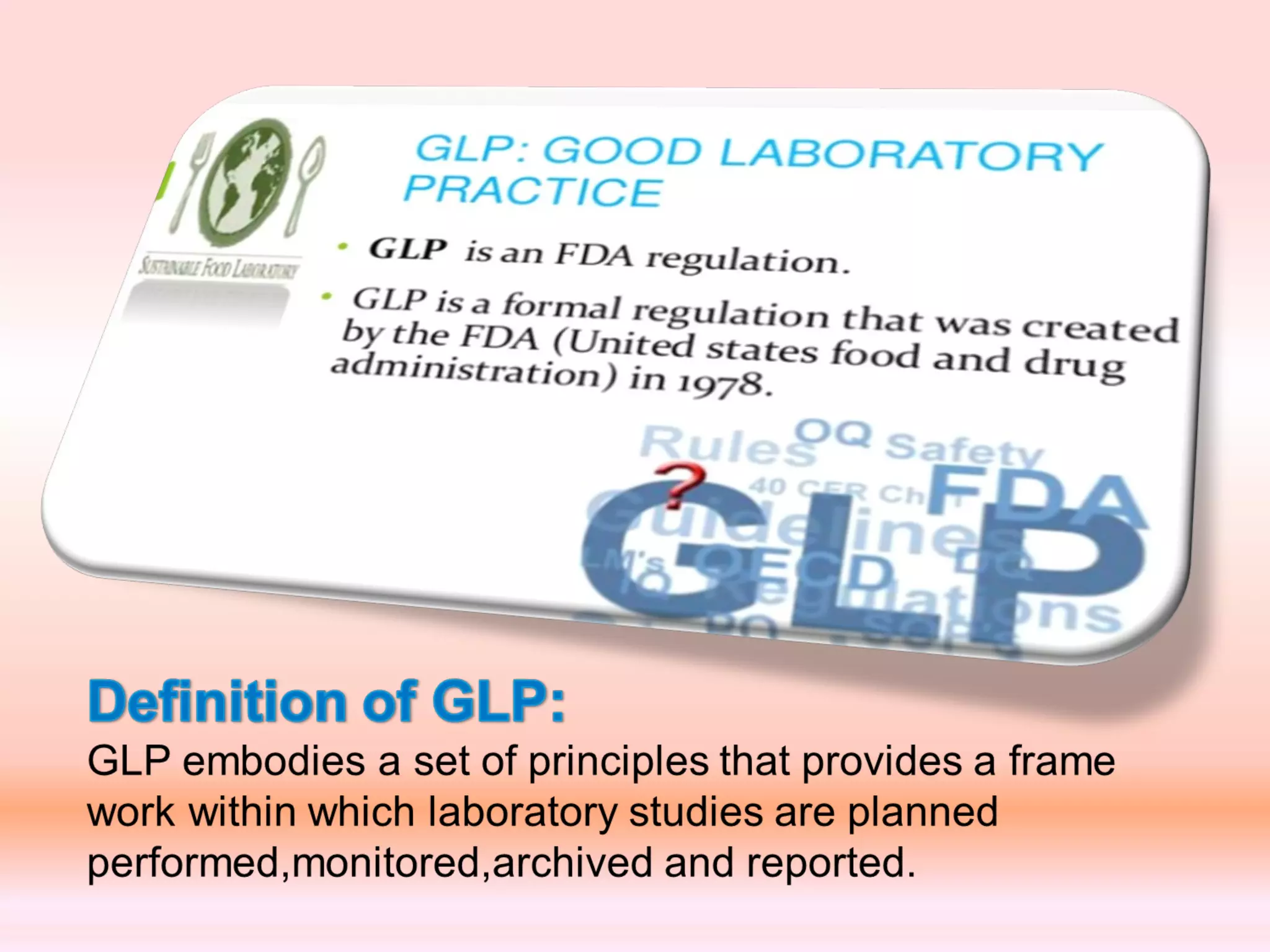
GLP was first introduced in New Zealand and
Denmark in 1972, and later in the US in 1978 in
response to the Industrial Bio Test Labs scandal.
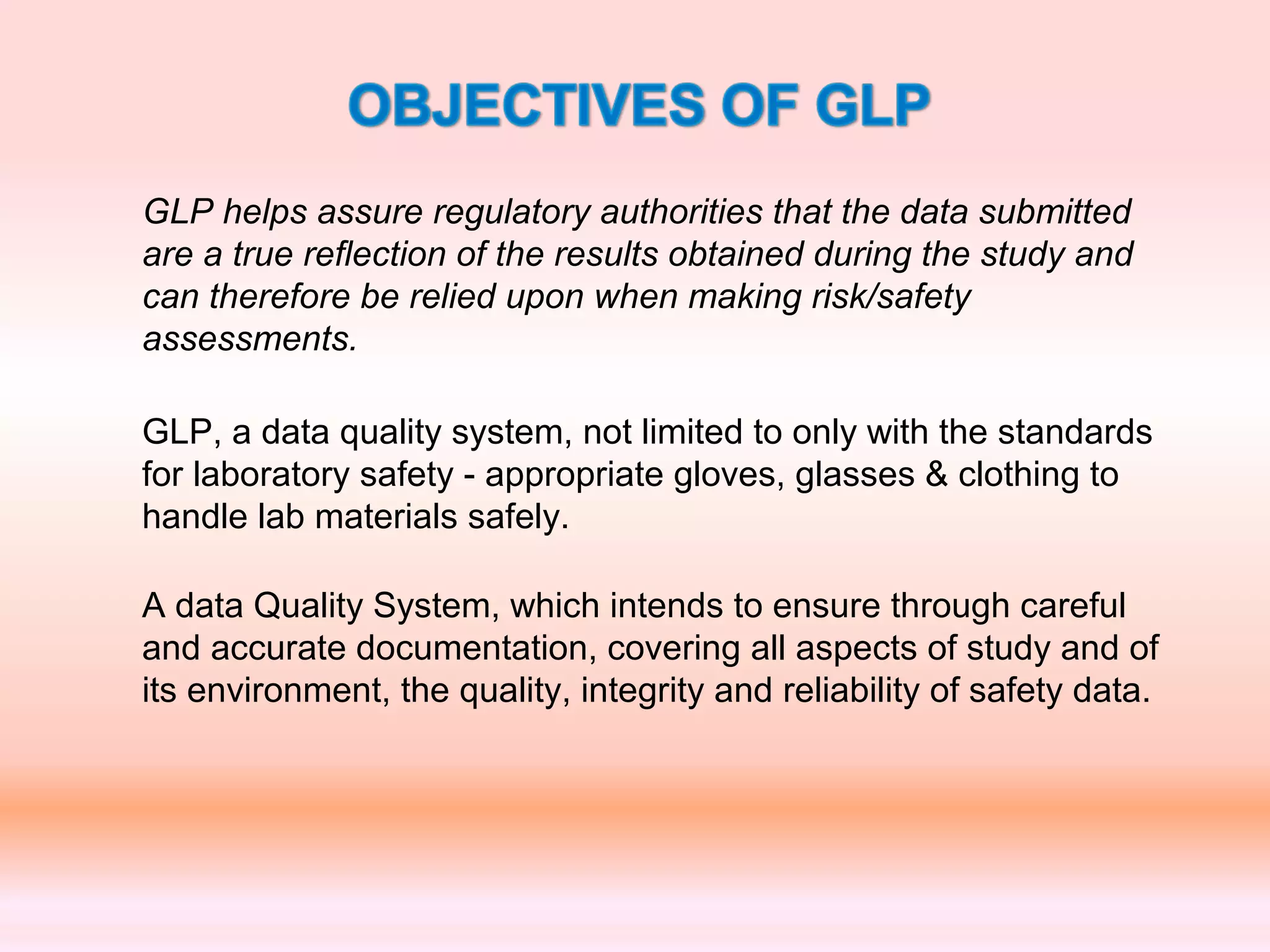
GLP helps assure regulatory authorities that the data submitted
are a true reflection of the results obtained during the study and
can therefore be relied upon when making risk/safety
assessments.
GLP, a data quality system, not limited to only with the standards
for laboratory safety - appropriate gloves, glasses & clothing to
handle lab materials safely.
A data Quality System, which intends to ensure through careful
and accurate documentation, covering all aspects of study and of
its environment, the quality, integrity and reliability of safety data.
LABORATORY
COMPLIANCE
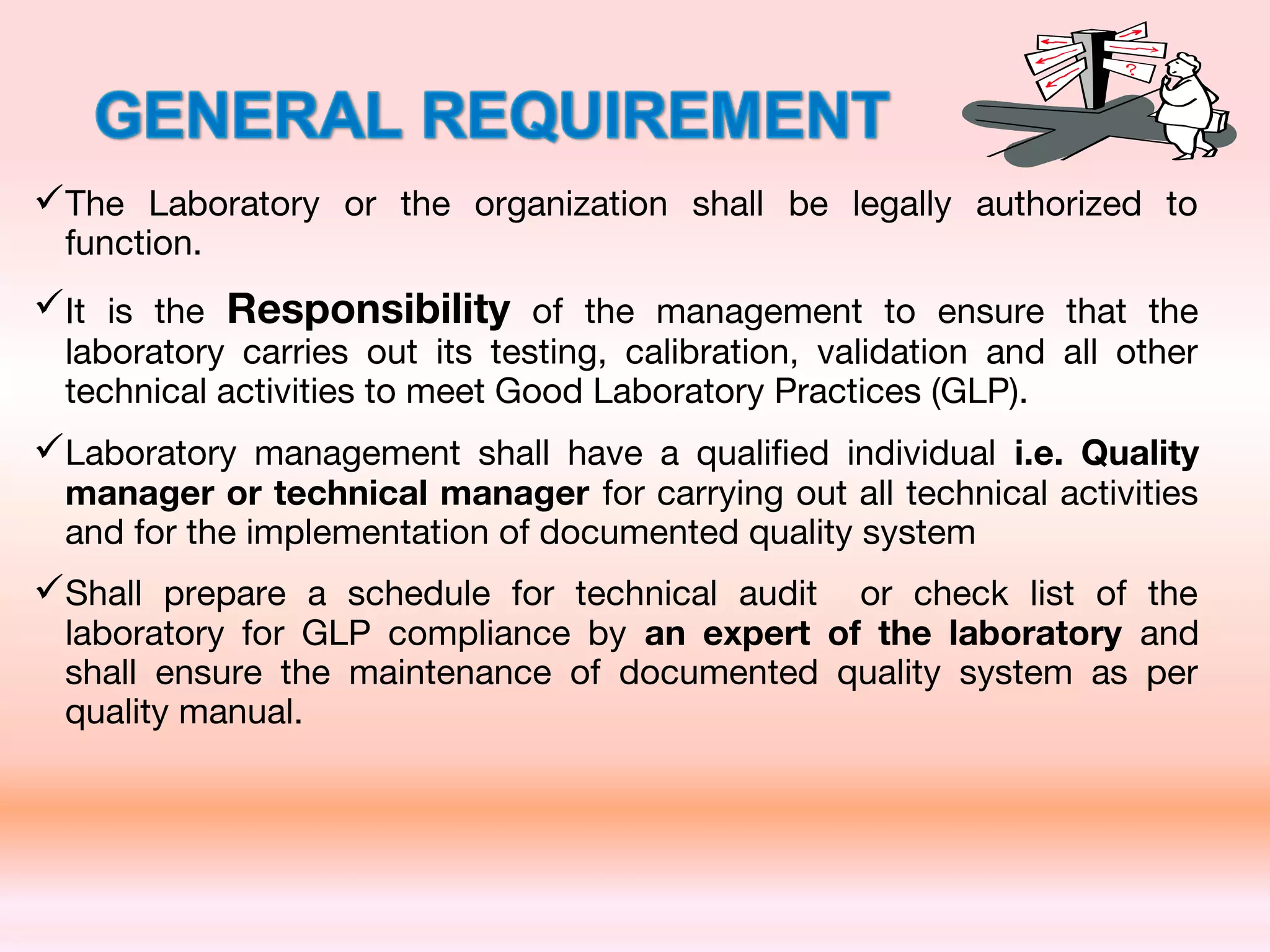
The Laboratory or the organization shall be legally authorized to
function.
It is the Responsibility of the management to ensure that the
laboratory carries out its testing, calibration, validation and all other
technical activities to meet Good Laboratory Practices (GLP).
Laboratory management shall have a qualified individual i.e. Quality
manager or technical manager for carrying out all technical activities
and for the implementation of documented quality system
Shall prepare a schedule for technical audit or check list of the
laboratory for GLP compliance by an expert of the laboratory and
shall ensure the maintenance of documented quality system as per
quality manual.
The laboratory shall be designed , constructed and maintained so as
to prevent entry of insects and rodents besides cross
contamination.
Interior surface (Wall, floor and ceiling) shall be smooth and free from
cracks, and permit easy cleaning and disinfection.
Adequate provision/space is made not only for equipment for
carrying out necessary test but also for utility like water, power and
gas.
Laboratory shall be provided with adequate lighting and Air
ventilation System
The drainage system facilities shall be such as to facilitate proper
maintenance and prevent water logging in the laboratory.
Tabletops shall be constructed with acid, alkali and solvent resistant
material
Adequate space with proper storage condition in the laboratory shall be
provided for keeping reference and working standard.
The air circulation is maintained in the area where sterility test is
carried out as per Schedule “M”.
All bio-medical laboratory waste shall be destroyed as per the provision
of the bio medical waste rules 1998.
• Lab. People should undergo periodic health check-ups.
• Lab Persons shall possess necessary qualification, proper training and
shall have adequate experience for the assigned duties.
• A training records of all personal shall be maintained
• Head of the laboratory must be Skilled in Technical and laboratory
management who is responsible for :
a)Control and maintenance of documents (Quality manual, SOP , STP,
protocol and training charts).
b)Planning and organizing the audit of the quality system.
c)Investigation of the technical complained.
d)Taking final responsibilities for recommending any regulatory action in
the event of non-compliance of tested samples.
The laboratory shall be furnished with all types of equipments as
per requirement.
The analytical instrument shall be placed in dust free environment,
Controlled Temp and Humidity Area. and same shall be documented.
All the critical instruments (new & modified) must be Validated
(IQ/OQ/PQ) and Calibrated.
Maintain schedules for Preventive maintenance & Calibration activities of
instruments on basis of usage.
Instrument giving anomalous results or defective must be labeled as
“Out-of-order” till they are repaired . After repair , instrument should be
calibrated before use.
Written procedures must be established to operate / Calibrate the
instruments.
Equipment calibrations should be performed using standards traceable
to certified standards, if existing and Records should be maintained
Storage and handling of the chemicals and reagents shall be
according to physiochemical properties of the substances and
hazardous behavior – (Refer MSDS) Material Safety Data Sheet.
All reagent and solution shall be properly identified with a label to
indicate concentration, storage requirements, and expiration date
The transfer of hazardous chemicals and reagents from one container
to another container shall be carried out with suitable equipment by
taking the care of the safety aspects.
General and specific written procedure for safety shall be circulated to
each staff member and the instruction be revised periodically as
appropriated (e.g. poster display, audio-visual material or seminars.)
Material safety data sheet (MSDS) must be available to staff before
testing is carried out.
Staff must wear laboratory coat PPE’s (Personal Protective
Equipments).
The laboratory shall have adequate first aid kit and fire fighting
equipments and the staff must be familiar and trained with the location
and uses.
The staff must be educated in the first aid techniques, emergency care
and uses of antidote.
Safety rules in handling cylinders of compressed gases must be
observed and staff must be familiar with relevant color identification
codes.
Water showers shall be installed at appropriate place in the laboratory.
Rubber suction bulbs must be used on manual pipettes .
Written procedures for use of suitable rodenticides, insecticides,
fungicides, fumigating agents, and cleaning and sanitizing agents. Such
written procedures shall be designed to prevent the contamination of
equipment, components, drug product containers, closures, packaging,
• Appropriate facilities for the collection , storage , and disposal of
corrosive or dangerous products.
• A standard operating procedure for handling, collection , disposal of
chemicals and biological waste be prepared.
• Work involving the evolution of harmful and obnoxious vapors shall be
carried out in a fume cupboard.
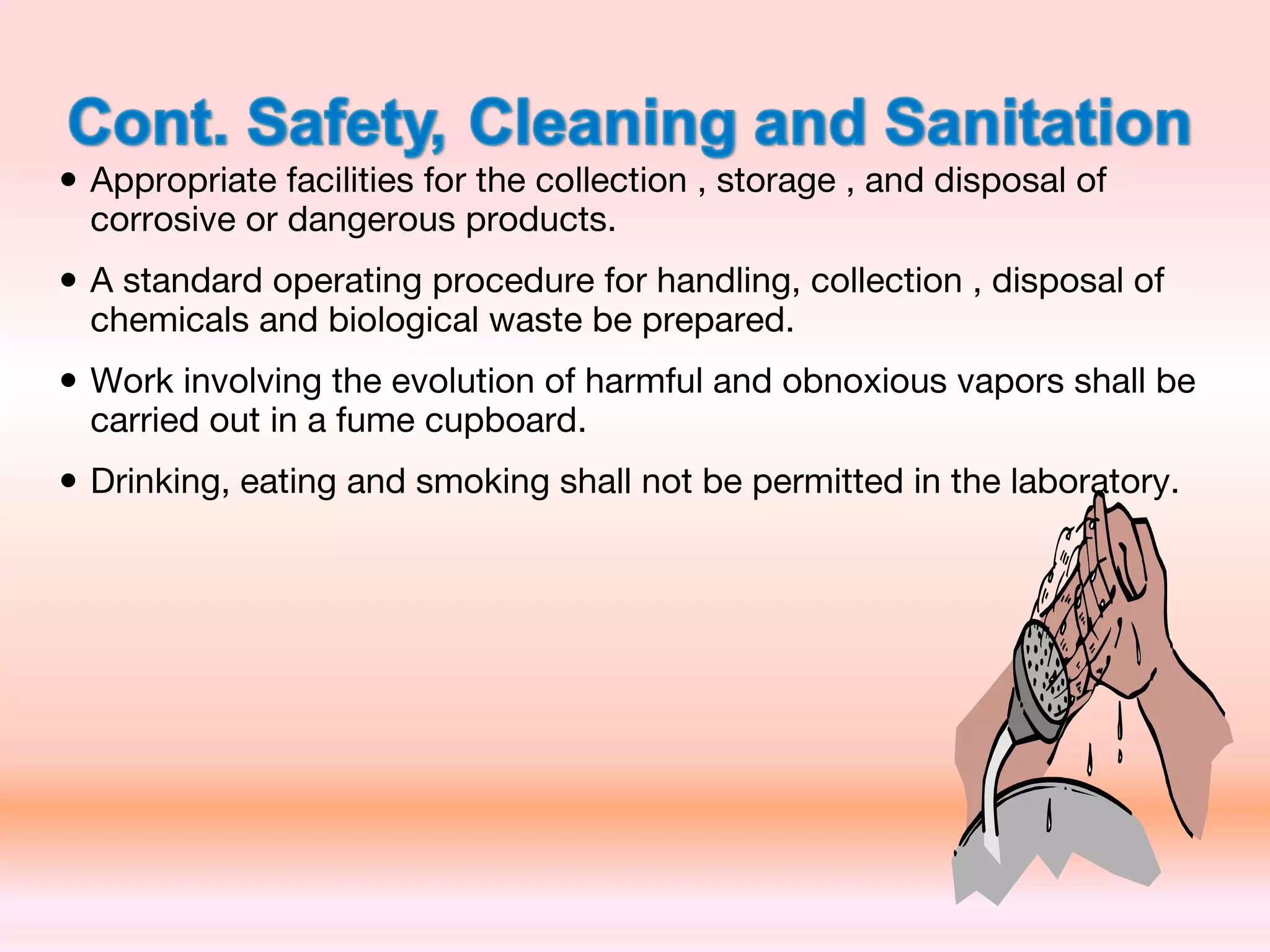
• Drinking, eating and smoking shall not be permitted in the laboratory.
• Definition :
“Reference standards are highly characterized
specimens of drug substances, excipients, reportable
impurities, degradation products, compendia reagents
and performance calibrators.”
Reference material are necessary for the testing and, or calibration,
validation or verification of a sample or of equipment , instrument or
other devices and all such material shall be traceable to agency
authorized by Government of India or other agencies like USP/BP/EP.
The laboratory shall prepared working standard by comparing with the
reference standard ( due to high cost of RS) and All working standard
shall be checked at appropriate interval, or before use to ensure that it
has not deteriorated during storage.
Do not put back any excess quantity of the dispensed standard back
into the stock bottles.
Standards should be stored in their original stoppered container away
from heat and humidity and protected from light .
Store up to the validity of current lot
All working standard prepared shall be stored at appropriate storage
condition as of Reference Standard.
Safety first.
The Micro Lab should practice aseptic techniques during testing
in general, to avoid microbial contamination and false positives.
In the Micro Lab, areas where water, or product samples are
handled/incubated must be adequately separated from areas
where there are tests that involve live cultures or sub-culturing,
microbial ID or investigations.
Housekeeping must be properly maintained to prevent use of
expired or contaminated testing mat’s.
Verify cleanliness of work stations, cleared of extraneous or
previous test residue, prompt removal of refuse, and clean
utensils and equipment
Standard operating procedure are written procedures for different
activities being conducted in a laboratory and shall include the following
characteristic:
a) They shall be written in chronological order listing different steps.
b) Testing laboratory shall have standard operating procedure manuals.
c) It shall be user friendly documents and shall include designation of
the person responsible for intended activities.
Raw data refers to the laboratory work sheet, note book or analysis
sheet , records , memorandum, notes that may be the results of general
observation and other.
A single line shall strike through the data being changed, the correct
information shall be recorded along with the old data and the reason of
changes.
In case of automated data collection system, the person responsible
shall be identified at the time of data output. The original entry must be
saved and the system shall have audit trial for all the data.
Data integrity and security shall be maintained and the data shall not be
accessible to any unauthorized person.
In Laboratory analyst must follow the specification/STP and current
versions of all necessary specifications/STP shall kept as per the
requirements for work.
All updates and corrections must be noted .
List of All pharmacopeia.
A file on patent and proprietary medicines test methods to
specification prepared and validated by the manufacturer or by the
laboratory itself.
The laboratory must be establish and maintain
procedure for the identification collection, indexing, retrieval,
storage, maintenance and disposal of all quality documents (follow 5S ).
All the raw data , documentation , SOP and protocol and final report are
to be retained. The archive shall provide a suitable environment that will
prevent modification, damage, or deterioration and/or loss.
The condition under which the original document are stored must
ensure their security and confidentiality.
Paper documents shall not be kept for long period under high humidity
and raw data in the form of tapes and discs are to be preserved with
care.
Raw data on thermal paper might fade away with time, therefore, a
photocopy of the thermal paper shall also be retained in the archive.
Time for which records are retained shall be prescribed in the
documents.
The quality system shall be designed to ensure the following objectives.
a)The measurement and the calibration shall fully conform to the
compendial requirements and the method demonstrably based on
validation protocol.
b)If shall be effective in providing necessary assurance that the activities
or process or techniques or practices comply with planned
arrangements.
c)It helps in early detection and correction of non- conformities.
d)Remedial action on the observations by internal and external audits are
taken appropriately.
e)It shall have a documented quality policy for the organization.
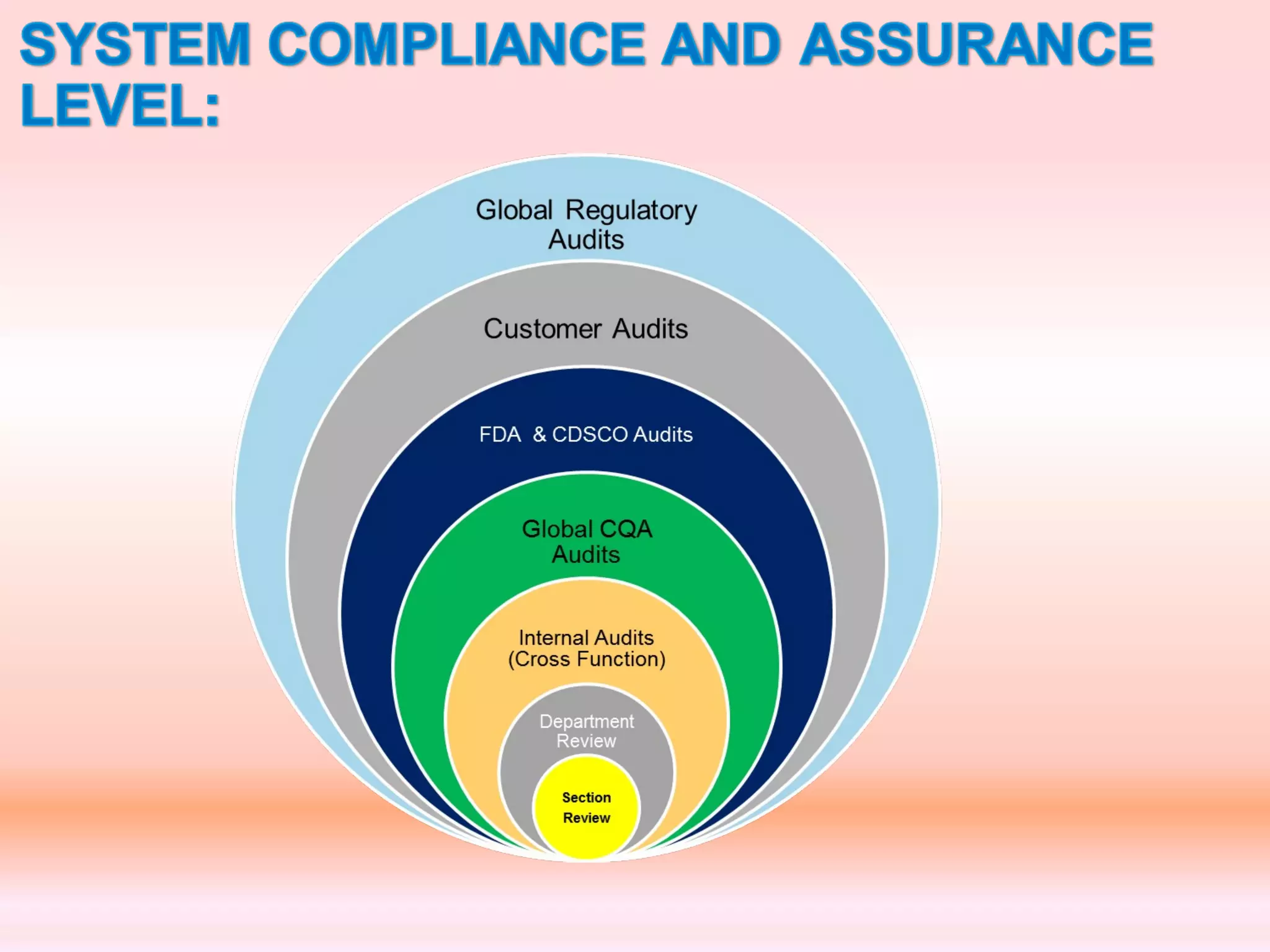
Internal audits are done to assure the integrity of the analysis and such
audits shall be appropriated with a predetermined schedule .
The periodicity of quality audits shall be fixed by the head of the
laboratory so that each activity is audited at least one in a year.
Head of the laboratory will be responsible for initiation of the corrective
action arising from audits and verification of correction action.
Whenever any non- compliance or any diversion is noticed by the team
in implementation quality policy or quality system , protocol , the same
will be attended by the quality manager. The problem will be analyzed
and necessary action will be taken with proper documentation. in form
of OOS/OOT/INCIDENT.
The quality manager shall maintain all the records of the analysis being
conducted which include test system , the type of analysis, date on
which analysis done etc.
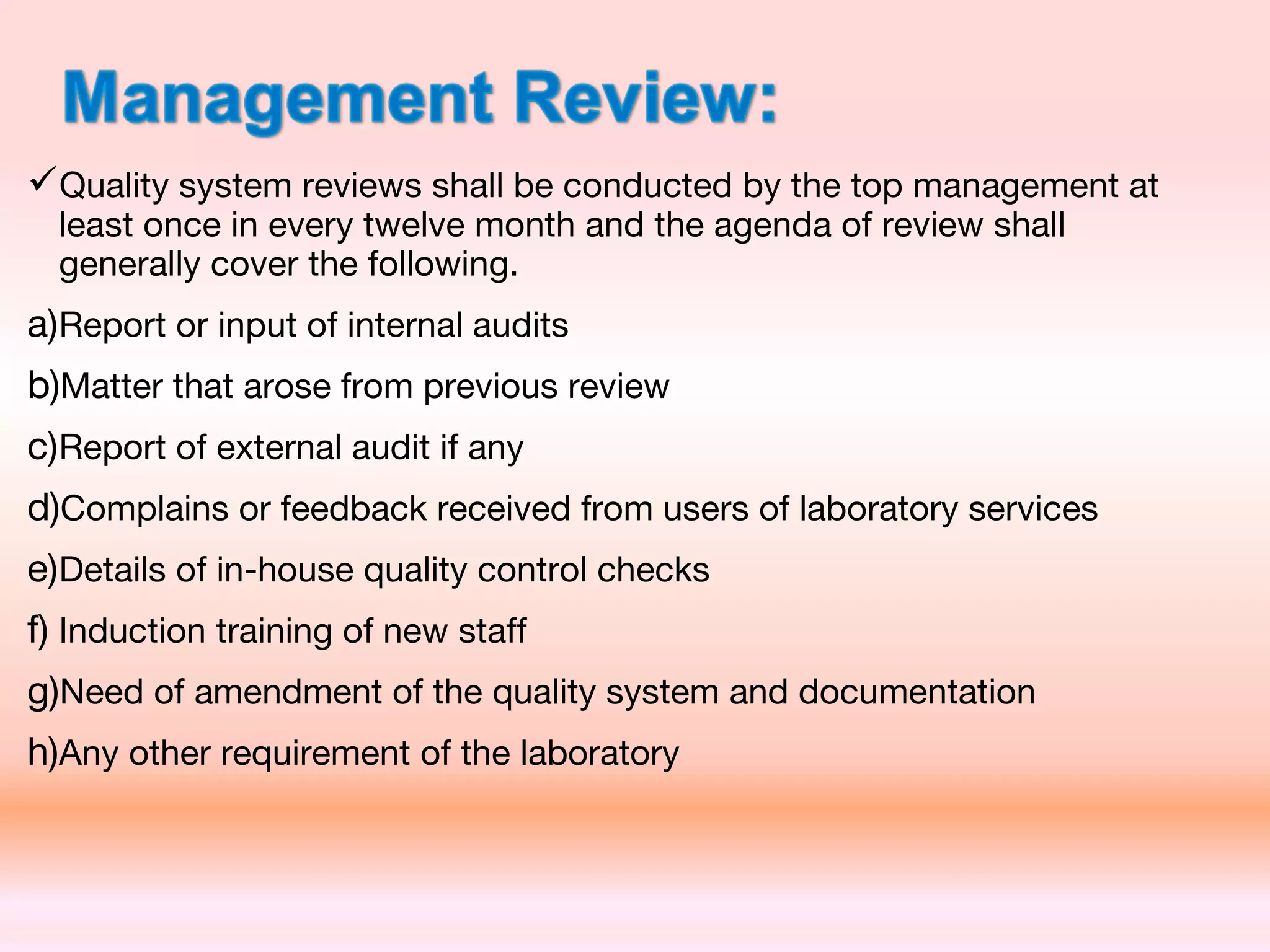
Quality system reviews shall be conducted by the top management at
least once in every twelve month and the agenda of review shall
generally cover the following.
a)Report or input of internal audits
b)Matter that arose from previous review
c)Report of external audit if any
d)Complains or feedback received from users of laboratory services
e)Details of in-house quality control checks
f) Induction training of new staff
g)Need of amendment of the quality system and documentation
h)Any other requirement of the laboratory
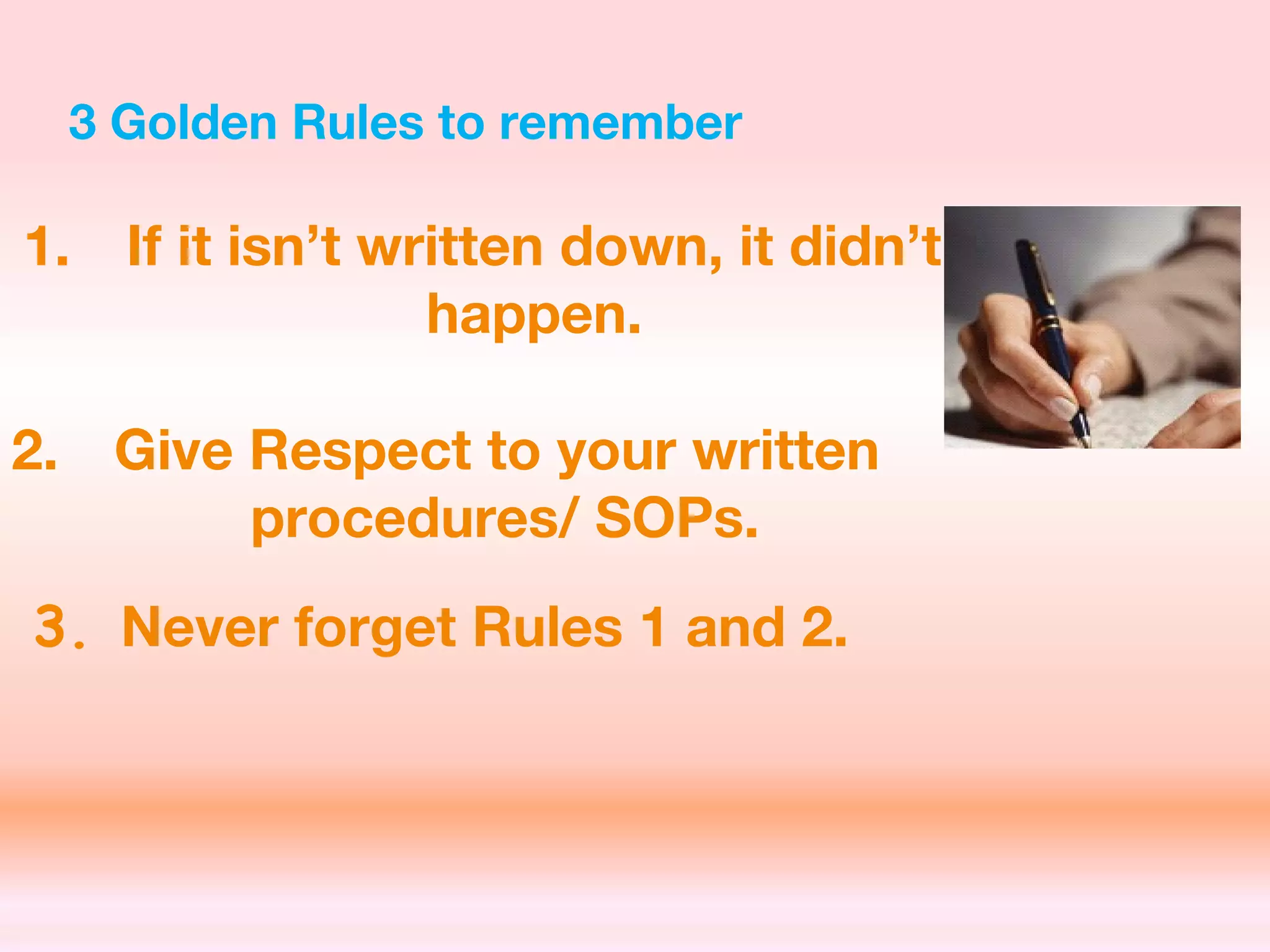
3 Golden Rules to remember
1. If it isn’t written down, it didn’t
happen.
2. Give Respect to your written
procedures/ SOPs.
3. Never forget Rules 1 and 2.
Further questions ??????
THANK YOU
Prepared By: Madhvi Bajaj

Good laboratory practices

  • 4.
     In theearly 70’s FDA became aware of cases of poor laboratory practice all over the United States.  They discovered a lot fraudulent activities and a lot of poor lab practices.  Examples of some of these poor lab practices found were : 1. Equipment not been calibrated to standard form , therefore giving wrong measurements. 2. Incorrect/inaccurate accounts of the actual lab study. GLP was first introduced in New Zealand and Denmark in 1972, and later in the US in 1978 in response to the Industrial Bio Test Labs scandal.
  • 6.
    GLP helps assureregulatory authorities that the data submitted are a true reflection of the results obtained during the study and can therefore be relied upon when making risk/safety assessments. GLP, a data quality system, not limited to only with the standards for laboratory safety - appropriate gloves, glasses & clothing to handle lab materials safely. A data Quality System, which intends to ensure through careful and accurate documentation, covering all aspects of study and of its environment, the quality, integrity and reliability of safety data.
  • 8.
  • 9.
    The Laboratory orthe organization shall be legally authorized to function. It is the Responsibility of the management to ensure that the laboratory carries out its testing, calibration, validation and all other technical activities to meet Good Laboratory Practices (GLP). Laboratory management shall have a qualified individual i.e. Quality manager or technical manager for carrying out all technical activities and for the implementation of documented quality system Shall prepare a schedule for technical audit or check list of the laboratory for GLP compliance by an expert of the laboratory and shall ensure the maintenance of documented quality system as per quality manual.
  • 10.
    The laboratory shallbe designed , constructed and maintained so as to prevent entry of insects and rodents besides cross contamination. Interior surface (Wall, floor and ceiling) shall be smooth and free from cracks, and permit easy cleaning and disinfection. Adequate provision/space is made not only for equipment for carrying out necessary test but also for utility like water, power and gas. Laboratory shall be provided with adequate lighting and Air ventilation System
  • 11.
    The drainage systemfacilities shall be such as to facilitate proper maintenance and prevent water logging in the laboratory. Tabletops shall be constructed with acid, alkali and solvent resistant material Adequate space with proper storage condition in the laboratory shall be provided for keeping reference and working standard. The air circulation is maintained in the area where sterility test is carried out as per Schedule “M”. All bio-medical laboratory waste shall be destroyed as per the provision of the bio medical waste rules 1998.
  • 12.
    • Lab. Peopleshould undergo periodic health check-ups. • Lab Persons shall possess necessary qualification, proper training and shall have adequate experience for the assigned duties. • A training records of all personal shall be maintained • Head of the laboratory must be Skilled in Technical and laboratory management who is responsible for : a)Control and maintenance of documents (Quality manual, SOP , STP, protocol and training charts). b)Planning and organizing the audit of the quality system. c)Investigation of the technical complained. d)Taking final responsibilities for recommending any regulatory action in the event of non-compliance of tested samples.
  • 13.
    The laboratory shallbe furnished with all types of equipments as per requirement. The analytical instrument shall be placed in dust free environment, Controlled Temp and Humidity Area. and same shall be documented. All the critical instruments (new & modified) must be Validated (IQ/OQ/PQ) and Calibrated. Maintain schedules for Preventive maintenance & Calibration activities of instruments on basis of usage. Instrument giving anomalous results or defective must be labeled as “Out-of-order” till they are repaired . After repair , instrument should be calibrated before use. Written procedures must be established to operate / Calibrate the instruments. Equipment calibrations should be performed using standards traceable to certified standards, if existing and Records should be maintained
  • 14.
    Storage and handlingof the chemicals and reagents shall be according to physiochemical properties of the substances and hazardous behavior – (Refer MSDS) Material Safety Data Sheet. All reagent and solution shall be properly identified with a label to indicate concentration, storage requirements, and expiration date The transfer of hazardous chemicals and reagents from one container to another container shall be carried out with suitable equipment by taking the care of the safety aspects. General and specific written procedure for safety shall be circulated to each staff member and the instruction be revised periodically as appropriated (e.g. poster display, audio-visual material or seminars.) Material safety data sheet (MSDS) must be available to staff before testing is carried out.
  • 15.
    Staff must wearlaboratory coat PPE’s (Personal Protective Equipments). The laboratory shall have adequate first aid kit and fire fighting equipments and the staff must be familiar and trained with the location and uses. The staff must be educated in the first aid techniques, emergency care and uses of antidote. Safety rules in handling cylinders of compressed gases must be observed and staff must be familiar with relevant color identification codes. Water showers shall be installed at appropriate place in the laboratory. Rubber suction bulbs must be used on manual pipettes . Written procedures for use of suitable rodenticides, insecticides, fungicides, fumigating agents, and cleaning and sanitizing agents. Such written procedures shall be designed to prevent the contamination of equipment, components, drug product containers, closures, packaging,
  • 16.
    • Appropriate facilitiesfor the collection , storage , and disposal of corrosive or dangerous products. • A standard operating procedure for handling, collection , disposal of chemicals and biological waste be prepared. • Work involving the evolution of harmful and obnoxious vapors shall be carried out in a fume cupboard. • Drinking, eating and smoking shall not be permitted in the laboratory.
  • 17.
    • Definition : “Referencestandards are highly characterized specimens of drug substances, excipients, reportable impurities, degradation products, compendia reagents and performance calibrators.” Reference material are necessary for the testing and, or calibration, validation or verification of a sample or of equipment , instrument or other devices and all such material shall be traceable to agency authorized by Government of India or other agencies like USP/BP/EP. The laboratory shall prepared working standard by comparing with the reference standard ( due to high cost of RS) and All working standard shall be checked at appropriate interval, or before use to ensure that it has not deteriorated during storage. Do not put back any excess quantity of the dispensed standard back into the stock bottles.
  • 18.
    Standards should bestored in their original stoppered container away from heat and humidity and protected from light . Store up to the validity of current lot All working standard prepared shall be stored at appropriate storage condition as of Reference Standard.
  • 19.
    Safety first. The MicroLab should practice aseptic techniques during testing in general, to avoid microbial contamination and false positives. In the Micro Lab, areas where water, or product samples are handled/incubated must be adequately separated from areas where there are tests that involve live cultures or sub-culturing, microbial ID or investigations. Housekeeping must be properly maintained to prevent use of expired or contaminated testing mat’s. Verify cleanliness of work stations, cleared of extraneous or previous test residue, prompt removal of refuse, and clean utensils and equipment
  • 20.
    Standard operating procedureare written procedures for different activities being conducted in a laboratory and shall include the following characteristic: a) They shall be written in chronological order listing different steps. b) Testing laboratory shall have standard operating procedure manuals. c) It shall be user friendly documents and shall include designation of the person responsible for intended activities. Raw data refers to the laboratory work sheet, note book or analysis sheet , records , memorandum, notes that may be the results of general observation and other. A single line shall strike through the data being changed, the correct information shall be recorded along with the old data and the reason of changes.
  • 21.
    In case ofautomated data collection system, the person responsible shall be identified at the time of data output. The original entry must be saved and the system shall have audit trial for all the data. Data integrity and security shall be maintained and the data shall not be accessible to any unauthorized person.
  • 22.
    In Laboratory analystmust follow the specification/STP and current versions of all necessary specifications/STP shall kept as per the requirements for work. All updates and corrections must be noted . List of All pharmacopeia. A file on patent and proprietary medicines test methods to specification prepared and validated by the manufacturer or by the laboratory itself.
  • 23.
    The laboratory mustbe establish and maintain procedure for the identification collection, indexing, retrieval, storage, maintenance and disposal of all quality documents (follow 5S ). All the raw data , documentation , SOP and protocol and final report are to be retained. The archive shall provide a suitable environment that will prevent modification, damage, or deterioration and/or loss. The condition under which the original document are stored must ensure their security and confidentiality. Paper documents shall not be kept for long period under high humidity and raw data in the form of tapes and discs are to be preserved with care. Raw data on thermal paper might fade away with time, therefore, a photocopy of the thermal paper shall also be retained in the archive. Time for which records are retained shall be prescribed in the documents.
  • 24.
    The quality systemshall be designed to ensure the following objectives. a)The measurement and the calibration shall fully conform to the compendial requirements and the method demonstrably based on validation protocol. b)If shall be effective in providing necessary assurance that the activities or process or techniques or practices comply with planned arrangements. c)It helps in early detection and correction of non- conformities. d)Remedial action on the observations by internal and external audits are taken appropriately. e)It shall have a documented quality policy for the organization.
  • 25.
    Internal audits aredone to assure the integrity of the analysis and such audits shall be appropriated with a predetermined schedule . The periodicity of quality audits shall be fixed by the head of the laboratory so that each activity is audited at least one in a year. Head of the laboratory will be responsible for initiation of the corrective action arising from audits and verification of correction action. Whenever any non- compliance or any diversion is noticed by the team in implementation quality policy or quality system , protocol , the same will be attended by the quality manager. The problem will be analyzed and necessary action will be taken with proper documentation. in form of OOS/OOT/INCIDENT. The quality manager shall maintain all the records of the analysis being conducted which include test system , the type of analysis, date on which analysis done etc.
  • 26.
    Quality system reviewsshall be conducted by the top management at least once in every twelve month and the agenda of review shall generally cover the following. a)Report or input of internal audits b)Matter that arose from previous review c)Report of external audit if any d)Complains or feedback received from users of laboratory services e)Details of in-house quality control checks f) Induction training of new staff g)Need of amendment of the quality system and documentation h)Any other requirement of the laboratory
  • 28.
    3 Golden Rulesto remember 1. If it isn’t written down, it didn’t happen. 2. Give Respect to your written procedures/ SOPs. 3. Never forget Rules 1 and 2.
  • 29.
  • 30.

Editor's Notes

  • #12 (1) Bio-medical waste shall be treated and disposed of in accordance with Schedule I, and in compliance with the standards prescribed in Schedule V. (2) Every occupier, where required, shall set up in accordance with the time-schedule in Schedule VI, requisite bio-medical waste treatment facilities like incinerator, autoclave, microwave system for the treatment of waste, or, ensure requisite treatment of waste at a common waste treatment facility or any other waste treatment facility.