GOOD LABORATORY
PRACTICE
(GLP)
1
Department of Pharmacology BVVS COP BGK
 GLP : GOOD LABORATORY PRACTICE
GLP was first introduced in NEW ZEALAND and DENMARK in 1972.
In the US in 1978 in response to the Industrial Bio Test Labs scandal.
 GLP is an FDA regulation.
 GLP is a formal regulation that was created by the FDA (United states food
and drug administration ) in 1978.
2
Department of Pharmacology BVVS COP BGK
Definition of GLP
 Good laboratory practices or GLP is a set of principles intended to
assure the quality and integrity of non-clinical laboratory studies
that are intended to support research or marketing permits for
products regulated by government agencies.
3
Department of Pharmacology BVVS COP BGK
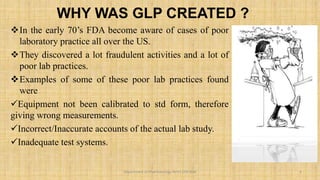
WHY WAS GLP CREATED ?
In the early 70’s FDA become aware of cases of poor
laboratory practice all over the US.
They discovered a lot fraudulent activities and a lot of
poor lab practices.
Examples of some of these poor lab practices found
were
Equipment not been calibrated to std form, therefore
giving wrong measurements.
Incorrect/Inaccurate accounts of the actual lab study.
Inadequate test systems.
4
Department of Pharmacology BVVS COP BGK
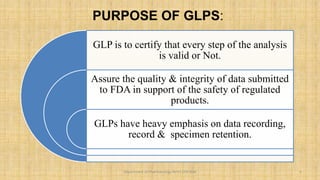
PURPOSE OF GLPS:
GLP is to certify that every step of the analysis
is valid or Not.
Assure the quality & integrity of data submitted
to FDA in support of the safety of regulated
products.
GLPs have heavy emphasis on data recording,
record & specimen retention.
5
Department of Pharmacology BVVS COP BGK
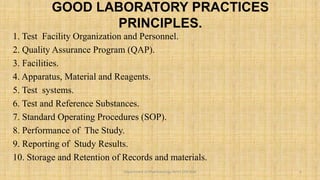
GOOD LABORATORY PRACTICES
PRINCIPLES.
1. Test Facility Organization and Personnel.
2. Quality Assurance Program (QAP).
3. Facilities.
4. Apparatus, Material and Reagents.
5. Test systems.
6. Test and Reference Substances.
7. Standard Operating Procedures (SOP).
8. Performance of The Study.
9. Reporting of Study Results.
10. Storage and Retention of Records and materials.
6
Department of Pharmacology BVVS COP BGK
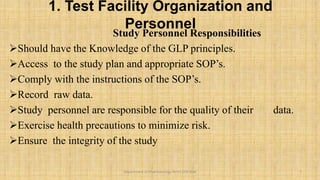
1. Test Facility Organization and
Personnel
Study Personnel Responsibilities
Should have the Knowledge of the GLP principles.
Access to the study plan and appropriate SOP’s.
Comply with the instructions of the SOP’s.
Record raw data.
Study personnel are responsible for the quality of their data.
Exercise health precautions to minimize risk.
Ensure the integrity of the study
7
Department of Pharmacology BVVS COP BGK
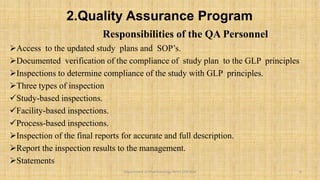
2.Quality Assurance Program
Responsibilities of the QA Personnel
Access to the updated study plans and SOP’s.
Documented verification of the compliance of study plan to the GLP principles
Inspections to determine compliance of the study with GLP principles.
Three types of inspection
Study-based inspections.
Facility-based inspections.
Process-based inspections.
Inspection of the final reports for accurate and full description.
Report the inspection results to the management.
Statements
8
Department of Pharmacology BVVS COP BGK
3. Facilities
Suitable size, construction and location.
Adequate degree of separation of the different activities.
 Isolation of test systems and individual projects to protect from biological
hazards.
 Suitable rooms for the diagnosis, treatment and control of diseases.
 Storage rooms.
9
Department of Pharmacology BVVS COP BGK
4. Apparatus, Materials and Reagents
Apparatus of appropriate design and adequate capacity.
Documented Inspection, cleaning, maintenance and calibration of
apparatus.
Apparatus and materials not to interfere with the test systems.
Chemicals, reagent and solutions should be labeled to indicate
identity, expiry and specific storage instructions.
10
Department of Pharmacology BVVS COP BGK
5. Test Systems
Physical and chemical test systems.
Biological test systems.
 Records of source, date of arrival, and arrival conditions of test systems.
Proper identification of test systems in their container or when removed.
Cleaning and sanitization of containers.
Pest control agents to be documented.
11
Department of Pharmacology BVVS COP BGK
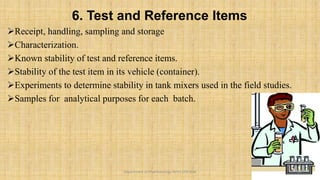
6. Test and Reference Items
Receipt, handling, sampling and storage
Characterization.
Known stability of test and reference items.
Stability of the test item in its vehicle (container).
Experiments to determine stability in tank mixers used in the field studies.
Samples for analytical purposes for each batch.
12
Department of Pharmacology BVVS COP BGK
7. Standard Operating Procedures (SOP)
 Written procedures for a laboratories program.
 They define how to carry out protocol specified activities
 Most often written in a chronological listing of action steps.
 They are written to explain how the procedures are suppose to work.
 Routine inspection, cleaning, maintenance, testing and calibration.
 Actions to be taken in response to equipment failure.
 Keeping records, reporting, storage, mixing, and retrieval of data.
 Definition of raw data.
 Analytical methods.
13
Department of Pharmacology BVVS COP BGK
8. Performance of the Study
Prepare the Study plan.
 Content of the study plan.
› Identification of the study.
› Records.
› Dates.
› Reference to test methods.
› Information concerning the sponsor and facility.
Conduct of the study.
14
Department of Pharmacology BVVS COP BGK
9. Reporting of Study Results
Information on sponsor and test facility
Experimental starting and completion dates.
A Quality Assurance Program Statement.
Description of materials and test methods.
Results.
Storage (samples, reference items, raw data, final reports) etc.
15
Department of Pharmacology BVVS COP BGK
10. Storage and Retention of Records and
Materials
The study plan, raw data, samples.
Inspection data and master schedules.
SOPs.
Maintenance and calibration data.
If any study material is disposed of before expiry the reason to be justified
and documented.
Index of materials retained.
16
Department of Pharmacology BVVS COP BGK
What Good Laboratory Must Contain.?
Area should be free from smoke, smell, dust etc.
Ensure good ventilation, proper illumination and prefer natural light.
Air conditioned the lab with humidity control.
Enough space for measuring and testing instrument.
Proper arrangement of testing.
Take care of all safety points including proper earthing as well as fire safety.
Avoid uncleanable spots in floors, walls, ceiling.
Establish proper areas for storage of incoming samples as well as test–
completed samples.
Also provide sample collection place as well as packing and disposal of tested
samples.
17
Department of Pharmacology BVVS COP BGK
Do this for GLP
Keep the things at its location after use.
Store heavy things at bottom & if possible on Trollies.
Give name of location to everything.
Follow “Everything has the place & Everything at its place” principle.
Prepare location list & display it.
Put ladders for things stored on top.
Identify everything with its name/ purpose.
Follow “FIFO” to prevent old accumulation for laboratory chemicals.
18
Department of Pharmacology BVVS COP BGK
Benefits of good laboratory practices.
It will give better image of company as a Quality producer in Global
market.
Provide hot tips on analysis of data as well as measure uncertainty and
perfect record keeping.
Provide guideline for doing testing and measurement in detail.
Provide guidelines and better control for maintenance of instruments,
environment control, preservation of test records etc…
19
Department of Pharmacology BVVS COP BGK
CONCLUSION
Gives better image of company as a Quality producer in Global market
Provide hot tips on analysis of data as well as measure uncertainty and perfect
record keeping & guideline for doing testing and measurement in detail.
Finally GLP Provide guidelines and better control for maintenance of
instruments, environment control, preservation of test records etc.
20
Department of Pharmacology BVVS COP BGK
THANK YOU
21
Department of Pharmacology BVVS COP BGK

Good laboratory practice

  • 1.
  • 2.
     GLP :GOOD LABORATORY PRACTICE GLP was first introduced in NEW ZEALAND and DENMARK in 1972. In the US in 1978 in response to the Industrial Bio Test Labs scandal.  GLP is an FDA regulation.  GLP is a formal regulation that was created by the FDA (United states food and drug administration ) in 1978. 2 Department of Pharmacology BVVS COP BGK
  • 3.
    Definition of GLP Good laboratory practices or GLP is a set of principles intended to assure the quality and integrity of non-clinical laboratory studies that are intended to support research or marketing permits for products regulated by government agencies. 3 Department of Pharmacology BVVS COP BGK
  • 4.
    WHY WAS GLPCREATED ? In the early 70’s FDA become aware of cases of poor laboratory practice all over the US. They discovered a lot fraudulent activities and a lot of poor lab practices. Examples of some of these poor lab practices found were Equipment not been calibrated to std form, therefore giving wrong measurements. Incorrect/Inaccurate accounts of the actual lab study. Inadequate test systems. 4 Department of Pharmacology BVVS COP BGK
  • 5.
    PURPOSE OF GLPS: GLPis to certify that every step of the analysis is valid or Not. Assure the quality & integrity of data submitted to FDA in support of the safety of regulated products. GLPs have heavy emphasis on data recording, record & specimen retention. 5 Department of Pharmacology BVVS COP BGK
  • 6.
    GOOD LABORATORY PRACTICES PRINCIPLES. 1.Test Facility Organization and Personnel. 2. Quality Assurance Program (QAP). 3. Facilities. 4. Apparatus, Material and Reagents. 5. Test systems. 6. Test and Reference Substances. 7. Standard Operating Procedures (SOP). 8. Performance of The Study. 9. Reporting of Study Results. 10. Storage and Retention of Records and materials. 6 Department of Pharmacology BVVS COP BGK
  • 7.
    1. Test FacilityOrganization and Personnel Study Personnel Responsibilities Should have the Knowledge of the GLP principles. Access to the study plan and appropriate SOP’s. Comply with the instructions of the SOP’s. Record raw data. Study personnel are responsible for the quality of their data. Exercise health precautions to minimize risk. Ensure the integrity of the study 7 Department of Pharmacology BVVS COP BGK
  • 8.
    2.Quality Assurance Program Responsibilitiesof the QA Personnel Access to the updated study plans and SOP’s. Documented verification of the compliance of study plan to the GLP principles Inspections to determine compliance of the study with GLP principles. Three types of inspection Study-based inspections. Facility-based inspections. Process-based inspections. Inspection of the final reports for accurate and full description. Report the inspection results to the management. Statements 8 Department of Pharmacology BVVS COP BGK
  • 9.
    3. Facilities Suitable size,construction and location. Adequate degree of separation of the different activities.  Isolation of test systems and individual projects to protect from biological hazards.  Suitable rooms for the diagnosis, treatment and control of diseases.  Storage rooms. 9 Department of Pharmacology BVVS COP BGK
  • 10.
    4. Apparatus, Materialsand Reagents Apparatus of appropriate design and adequate capacity. Documented Inspection, cleaning, maintenance and calibration of apparatus. Apparatus and materials not to interfere with the test systems. Chemicals, reagent and solutions should be labeled to indicate identity, expiry and specific storage instructions. 10 Department of Pharmacology BVVS COP BGK
  • 11.
    5. Test Systems Physicaland chemical test systems. Biological test systems.  Records of source, date of arrival, and arrival conditions of test systems. Proper identification of test systems in their container or when removed. Cleaning and sanitization of containers. Pest control agents to be documented. 11 Department of Pharmacology BVVS COP BGK
  • 12.
    6. Test andReference Items Receipt, handling, sampling and storage Characterization. Known stability of test and reference items. Stability of the test item in its vehicle (container). Experiments to determine stability in tank mixers used in the field studies. Samples for analytical purposes for each batch. 12 Department of Pharmacology BVVS COP BGK
  • 13.
    7. Standard OperatingProcedures (SOP)  Written procedures for a laboratories program.  They define how to carry out protocol specified activities  Most often written in a chronological listing of action steps.  They are written to explain how the procedures are suppose to work.  Routine inspection, cleaning, maintenance, testing and calibration.  Actions to be taken in response to equipment failure.  Keeping records, reporting, storage, mixing, and retrieval of data.  Definition of raw data.  Analytical methods. 13 Department of Pharmacology BVVS COP BGK
  • 14.
    8. Performance ofthe Study Prepare the Study plan.  Content of the study plan. › Identification of the study. › Records. › Dates. › Reference to test methods. › Information concerning the sponsor and facility. Conduct of the study. 14 Department of Pharmacology BVVS COP BGK
  • 15.
    9. Reporting ofStudy Results Information on sponsor and test facility Experimental starting and completion dates. A Quality Assurance Program Statement. Description of materials and test methods. Results. Storage (samples, reference items, raw data, final reports) etc. 15 Department of Pharmacology BVVS COP BGK
  • 16.
    10. Storage andRetention of Records and Materials The study plan, raw data, samples. Inspection data and master schedules. SOPs. Maintenance and calibration data. If any study material is disposed of before expiry the reason to be justified and documented. Index of materials retained. 16 Department of Pharmacology BVVS COP BGK
  • 17.
    What Good LaboratoryMust Contain.? Area should be free from smoke, smell, dust etc. Ensure good ventilation, proper illumination and prefer natural light. Air conditioned the lab with humidity control. Enough space for measuring and testing instrument. Proper arrangement of testing. Take care of all safety points including proper earthing as well as fire safety. Avoid uncleanable spots in floors, walls, ceiling. Establish proper areas for storage of incoming samples as well as test– completed samples. Also provide sample collection place as well as packing and disposal of tested samples. 17 Department of Pharmacology BVVS COP BGK
  • 18.
    Do this forGLP Keep the things at its location after use. Store heavy things at bottom & if possible on Trollies. Give name of location to everything. Follow “Everything has the place & Everything at its place” principle. Prepare location list & display it. Put ladders for things stored on top. Identify everything with its name/ purpose. Follow “FIFO” to prevent old accumulation for laboratory chemicals. 18 Department of Pharmacology BVVS COP BGK
  • 19.
    Benefits of goodlaboratory practices. It will give better image of company as a Quality producer in Global market. Provide hot tips on analysis of data as well as measure uncertainty and perfect record keeping. Provide guideline for doing testing and measurement in detail. Provide guidelines and better control for maintenance of instruments, environment control, preservation of test records etc… 19 Department of Pharmacology BVVS COP BGK
  • 20.
    CONCLUSION Gives better imageof company as a Quality producer in Global market Provide hot tips on analysis of data as well as measure uncertainty and perfect record keeping & guideline for doing testing and measurement in detail. Finally GLP Provide guidelines and better control for maintenance of instruments, environment control, preservation of test records etc. 20 Department of Pharmacology BVVS COP BGK
  • 21.
    THANK YOU 21 Department ofPharmacology BVVS COP BGK