Six-System Inspection Model:
A model that can help pharmaceutical manufacturers
comply with CGMP regulations. The six systems referred
to in this inspection model are: quality, production,
facilities and equipment, laboratory controls, materials,
and packaging and labeling
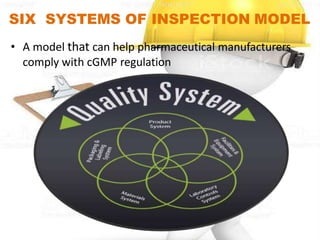
SIX SYSTEMS OF INSPECTION MODEL
• A model that can help pharmaceutical manufacturers
comply with cGMP regulation
QUALITY MANAGEMENT SYSTEM
• A QMS is a collection of business processes
focused on consistently meeting customer
requirements and enhancing their satisfaction.
• It is expressed as organizational goals and
aspirations, policies, processes, documented
information and resources needed to implement
and maintain it.
• Early QMS emphasized predictable outcomes of
an industrial product production line, using
simple statistics and random sampling.
Production System
According to the cGMP :
• Quality and manufacturing process and
procedures (and changes to them) must be
defined, approved and controlled.
• Batch numbering and maintaining proper
traceability is required/process validation is
required.
– Track batch, equipment use records and labeling used,
personnel, raw material controls are traceable
• Verification of all steps including sign-off are
required for critical process steps.
• Verification/ validation of computerized processes.
• All batch records must be reviewed and have QA
approval before the product is released.
Objectives of Inspection
1. Todetect and remove the faulty raw materials before it undergoes production.
2. Todetect the faulty products in production whenever it is detected.
3. Tobring facts to the notice of managers before they become serous to enable them
discover weaknesses and over the problem.
4. Toprevent the substandard reaching the customer and reducing complaints.
5. Topromote reputation for quality and reliability of product.
Purpose of Inspection
1. Todistinguish good lots from bad lots.
2. Todistinguish good pieces from bad pieces.
3. Todetermine if the process is changing.
4. Todetermine if the process is approaching the specification limits.
5. Torate quality of product.
6. Torate accuracy of inspectors.
7. Tomeasure the precision of the measuring instrument.
8. Tosecure products-design information.
9. Tomeasure process capability.
FACILITIES AND EQUIPMENT SYSTEM
According to cGMP :
• Areas are designated as clean and dirty,
– Physical separation, equipment and staff for each
operation
• Specify personnel protection equipment and to
prevent contamination by humans
• Areas must operate to a single standard - GMP
or non-GMP
• Need to have designed into areas
– Building materials, air handling, temperature,
microbiology
Facilities and building:
operations performed within separate areas are necessary to prevent contamination
including,
1. storage of in-process materials and other materials(containers ,closure, labelling).
2. Manufacturing and processing operations.
3. Storage of released components and drug products and quarantine storage
4. Control and laboratory operations.
5.aseptic processing-cleanable floors, wall ,ceiling and temperature and humidity
control
6.washing, toilet facilities ,sanitation, maintenance.
Equipment:
equipment used in the manufacture, processing, packaging or holding of the drug
product shall be of appropriate size ,design and suitably located to facilate operation
for its intended use and cleaning and maintenance.
1. IQ
2. OQ
3. PQ
4.Equipment construction, cleaning, maintenance, automatic, mechanical, electronic
equipment, filters.
Laboratory Controls Adequacy of
equipment for intended use
Enough space
Calibration and maintenance
Security of computer systems Change
control Procedures,
Testing,
Analytical methodology,
development and verification/validation
Lab documentation
Adherence to out-of-specification procedures
Packaging And Labelling
Controls of master copies
Issuance and restriction
Changes in labelling
Line clearance operations
Reconciliation procedures, if applicable
Vision system validation
Six system inspection model

Six system inspection model

  • 2.
    Six-System Inspection Model: Six-SystemInspection Model: A model that can help pharmaceutical manufacturers comply with CGMP regulations. The six systems referred to in this inspection model are: quality, production, facilities and equipment, laboratory controls, materials, and packaging and labeling
  • 3.
    SIX SYSTEMS OFINSPECTION MODEL • A model that can help pharmaceutical manufacturers comply with cGMP regulation
  • 4.
    QUALITY MANAGEMENT SYSTEM •A QMS is a collection of business processes focused on consistently meeting customer requirements and enhancing their satisfaction. • It is expressed as organizational goals and aspirations, policies, processes, documented information and resources needed to implement and maintain it. • Early QMS emphasized predictable outcomes of an industrial product production line, using simple statistics and random sampling.
  • 5.
    Production System According tothe cGMP : • Quality and manufacturing process and procedures (and changes to them) must be defined, approved and controlled. • Batch numbering and maintaining proper traceability is required/process validation is required. – Track batch, equipment use records and labeling used, personnel, raw material controls are traceable • Verification of all steps including sign-off are required for critical process steps. • Verification/ validation of computerized processes. • All batch records must be reviewed and have QA approval before the product is released.
  • 6.
    Objectives of Inspection 1.Todetect and remove the faulty raw materials before it undergoes production. 2. Todetect the faulty products in production whenever it is detected. 3. Tobring facts to the notice of managers before they become serous to enable them discover weaknesses and over the problem. 4. Toprevent the substandard reaching the customer and reducing complaints. 5. Topromote reputation for quality and reliability of product. Purpose of Inspection 1. Todistinguish good lots from bad lots. 2. Todistinguish good pieces from bad pieces. 3. Todetermine if the process is changing. 4. Todetermine if the process is approaching the specification limits. 5. Torate quality of product. 6. Torate accuracy of inspectors. 7. Tomeasure the precision of the measuring instrument. 8. Tosecure products-design information. 9. Tomeasure process capability.
  • 7.
    FACILITIES AND EQUIPMENTSYSTEM According to cGMP : • Areas are designated as clean and dirty, – Physical separation, equipment and staff for each operation • Specify personnel protection equipment and to prevent contamination by humans • Areas must operate to a single standard - GMP or non-GMP • Need to have designed into areas – Building materials, air handling, temperature, microbiology
  • 8.
    Facilities and building: operationsperformed within separate areas are necessary to prevent contamination including, 1. storage of in-process materials and other materials(containers ,closure, labelling). 2. Manufacturing and processing operations. 3. Storage of released components and drug products and quarantine storage 4. Control and laboratory operations. 5.aseptic processing-cleanable floors, wall ,ceiling and temperature and humidity control 6.washing, toilet facilities ,sanitation, maintenance. Equipment: equipment used in the manufacture, processing, packaging or holding of the drug product shall be of appropriate size ,design and suitably located to facilate operation for its intended use and cleaning and maintenance. 1. IQ 2. OQ 3. PQ 4.Equipment construction, cleaning, maintenance, automatic, mechanical, electronic equipment, filters.
  • 9.
    Laboratory Controls Adequacyof equipment for intended use Enough space Calibration and maintenance Security of computer systems Change control Procedures, Testing, Analytical methodology, development and verification/validation Lab documentation Adherence to out-of-specification procedures
  • 10.
    Packaging And Labelling Controlsof master copies Issuance and restriction Changes in labelling Line clearance operations Reconciliation procedures, if applicable Vision system validation