
Good
Laboratory
Practice
Edited & Prepared by
ADEL YOUNIS
Quality & BD Consultant
PHD in TQM
Awareness Course
Agenda
 GLP BOK.
 History of Standard Development
 GLP Essentials
-resources
-characterization
-Rules
-results
-QA
 Summary
Good Laboratory Practice - BOK
1) Fundamentals of GLP
2) Resources
2.1 Personnel
2.2 Facility “building & Equipment”
3) Rules
3.1 Protocols / Study plan
3.2 Procedures / SOPs
4) Characterization
4.1 test item
4.2 test system
GLP – BOK (II)
5) Documentation /Results
5.1 raw data & data collection
5.2 final reports
5.3 archives
5.4 indexing
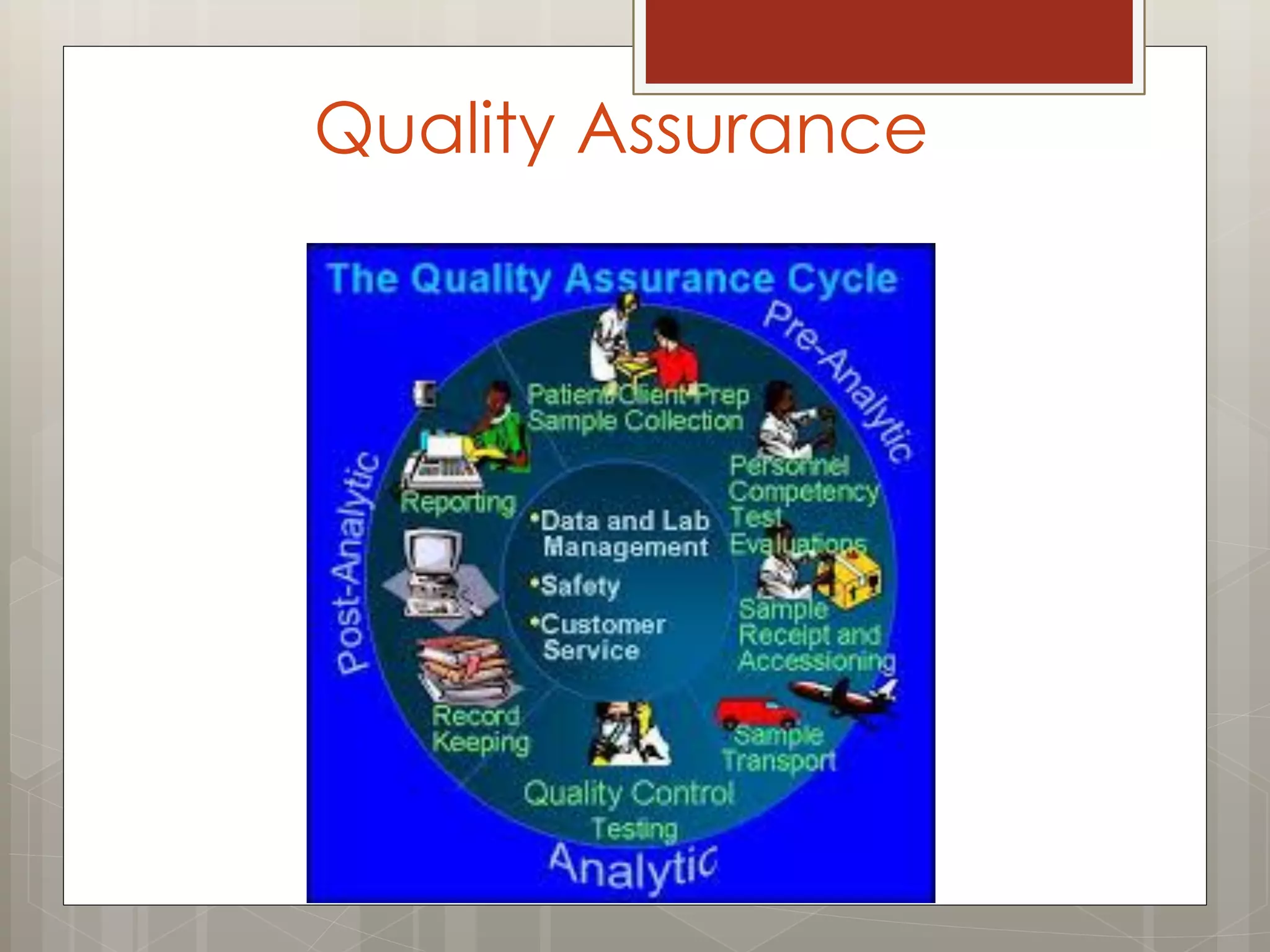
6) Quality Assurance
History of GLP
 GLP is a formal regulation that was created by
the FDA (United states food and drug
administration) in 1978.
 Although GLP originated in the United States , it
had a world wide impact.
 Non-US companies that wanted to do business
with the United states or register their
pharmacies in the United States had to comply
with the United States GLP regulations.
 They eventually started making GLP regulations
in their home countries.
 In 1981 an organization named OECD
(organization for economic co-operation and
development ) produced GLP principles that are
international standard.
Purpose for creating GLP standard
 In the early 70‟s FDA became aware of cases
of poor laboratory practice all over the United
States.
 FDA decided to do an in-depth investigation
on 40 toxicology labs.
 They discovered a lot fraudulent activities and
a lot of poor lab practices.
 Examples of some of these poor lab practices
found were
1. Equipment not been calibrated to standard
form , therefore giving wrong measurements.
2. Incorrect/inaccurate accounts of the actual
lab study
3. Inadequate test systems
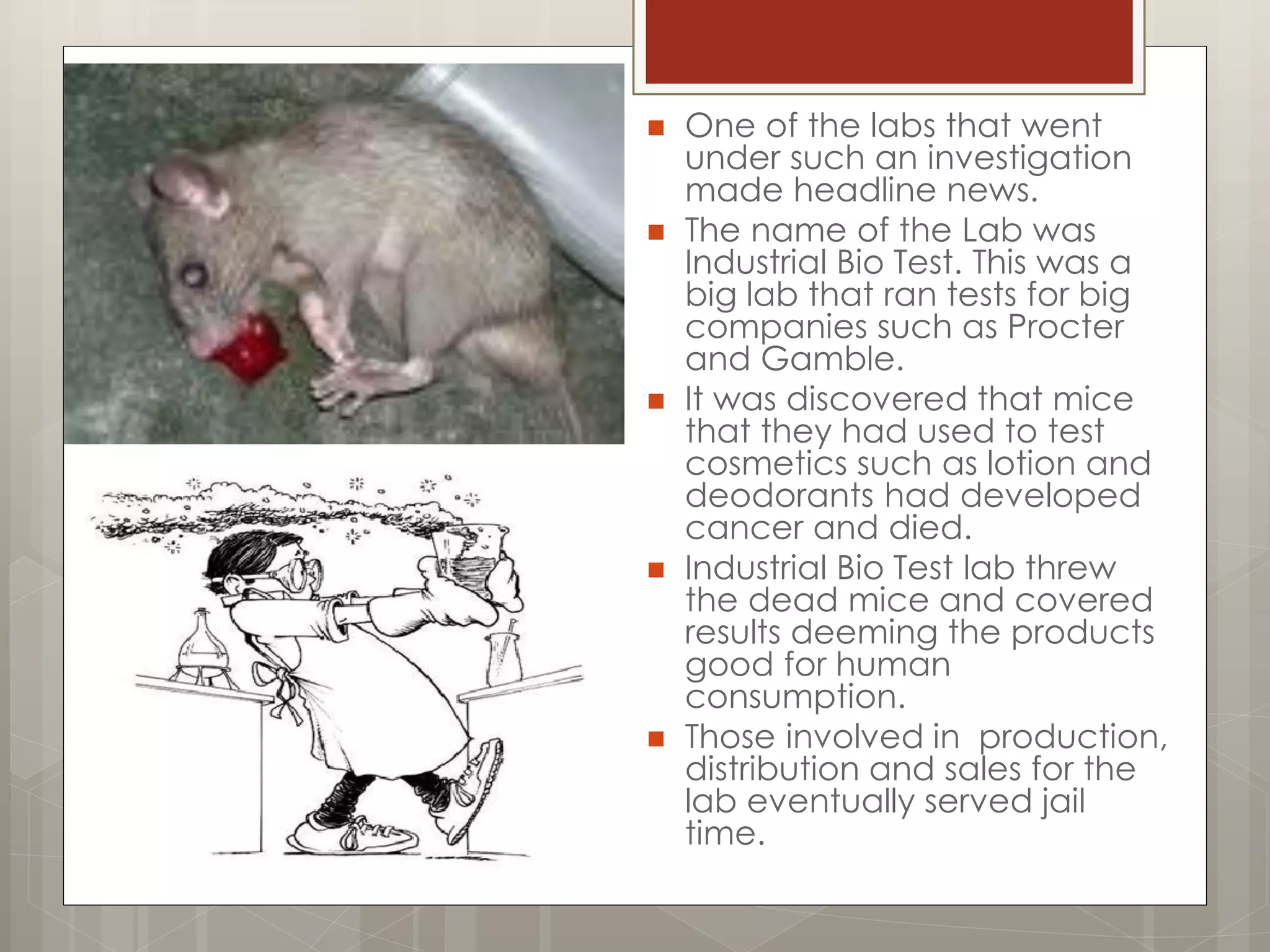
 One of the labs that went
under such an investigation
made headline news.
 The name of the Lab was
Industrial Bio Test. This was a
big lab that ran tests for big
companies such as Procter
and Gamble.
 It was discovered that mice
that they had used to test
cosmetics such as lotion and
deodorants had developed
cancer and died.
 Industrial Bio Test lab threw
the dead mice and covered
results deeming the products
good for human
consumption.
 Those involved in production,
distribution and sales for the
lab eventually served jail
time.
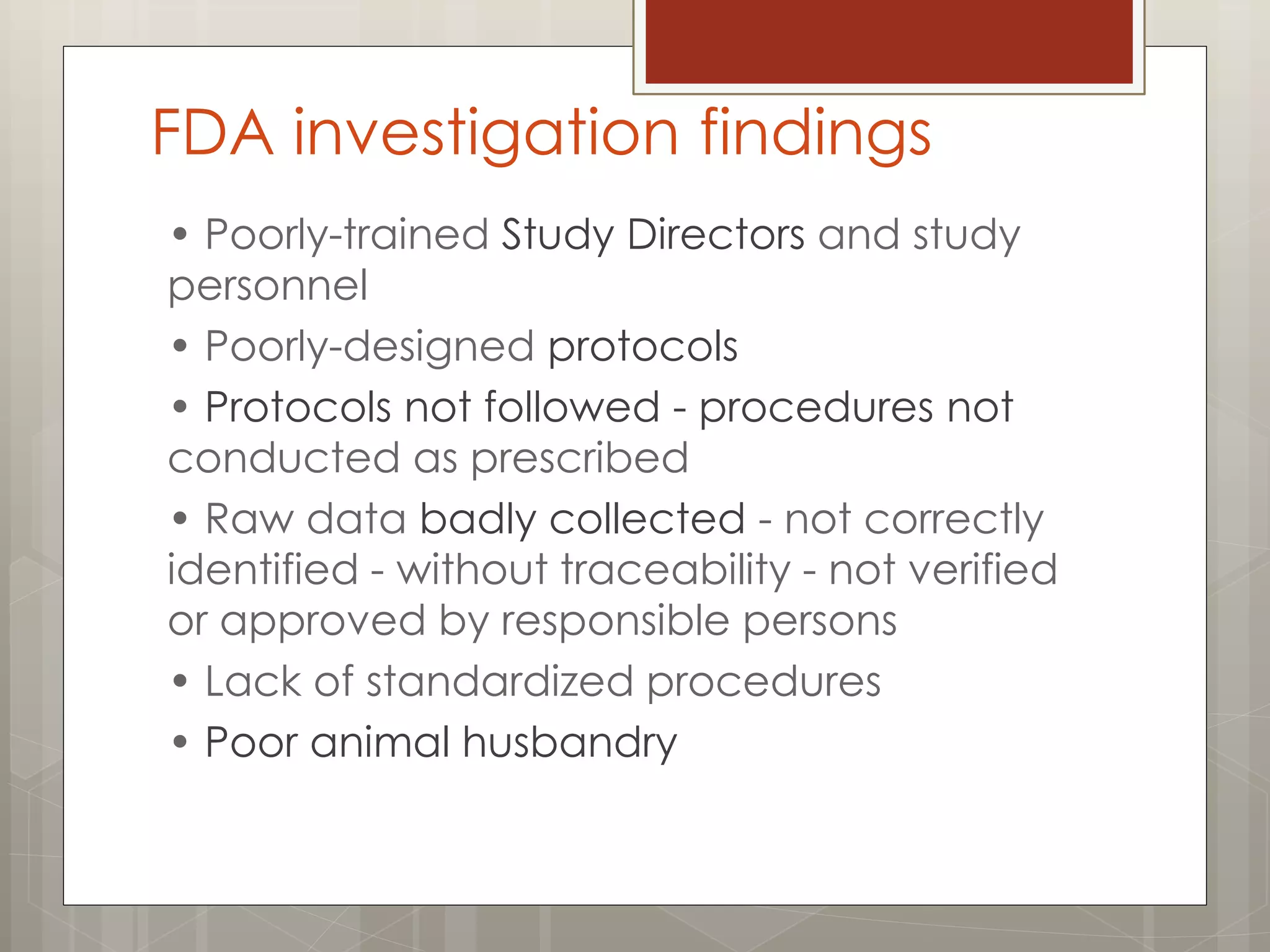
FDA investigation findings
• Poorly-trained Study Directors and study
personnel
• Poorly-designed protocols
• Protocols not followed - procedures not
conducted as prescribed
• Raw data badly collected - not correctly
identified - without traceability - not verified
or approved by responsible persons
• Lack of standardized procedures
• Poor animal husbandry
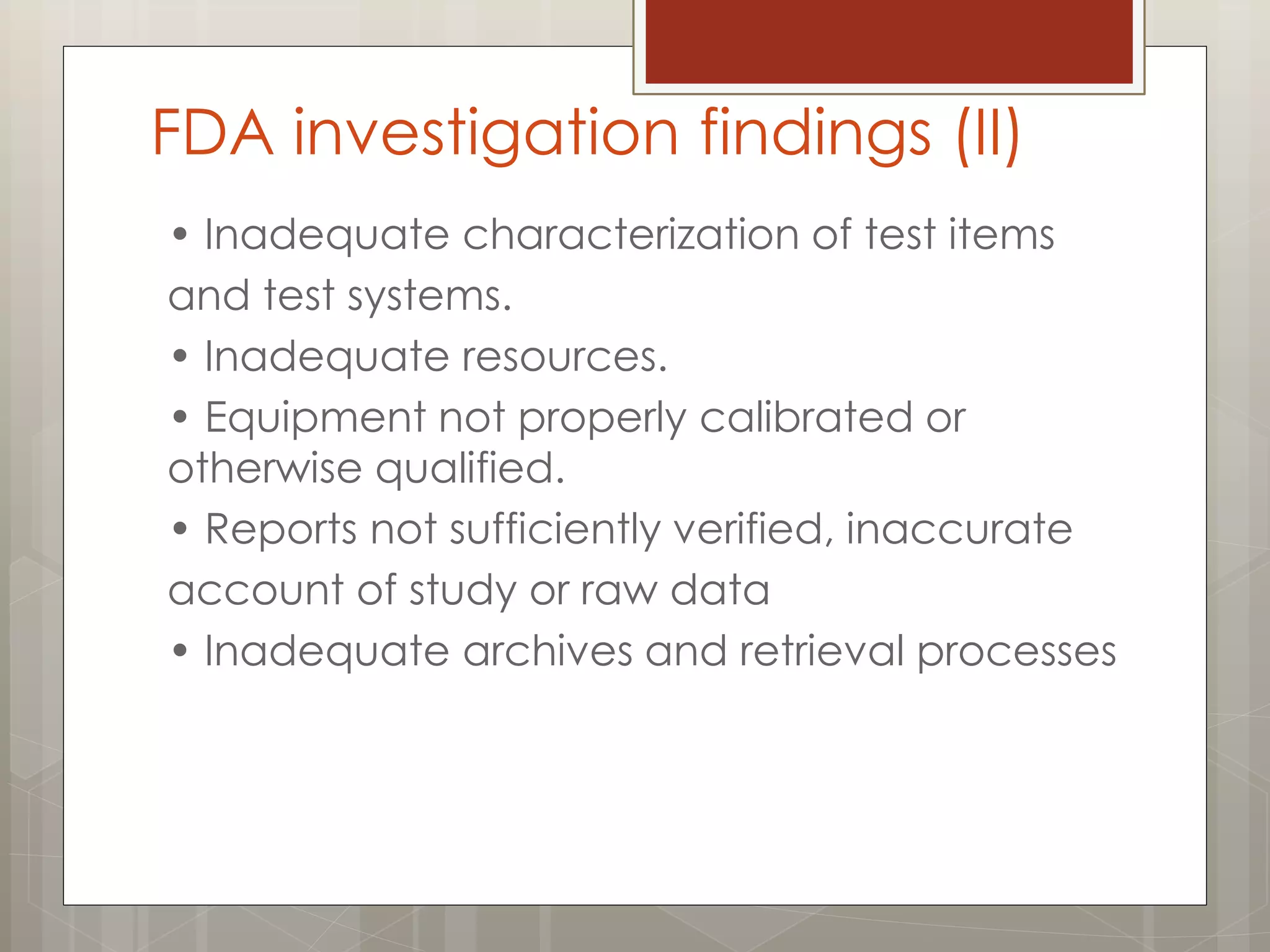
• Inadequate characterization of test items
and test systems.
• Inadequate resources.
• Equipment not properly calibrated or
otherwise qualified.
• Reports not sufficiently verified, inaccurate
account of study or raw data
• Inadequate archives and retrieval processes
FDA investigation findings (II)
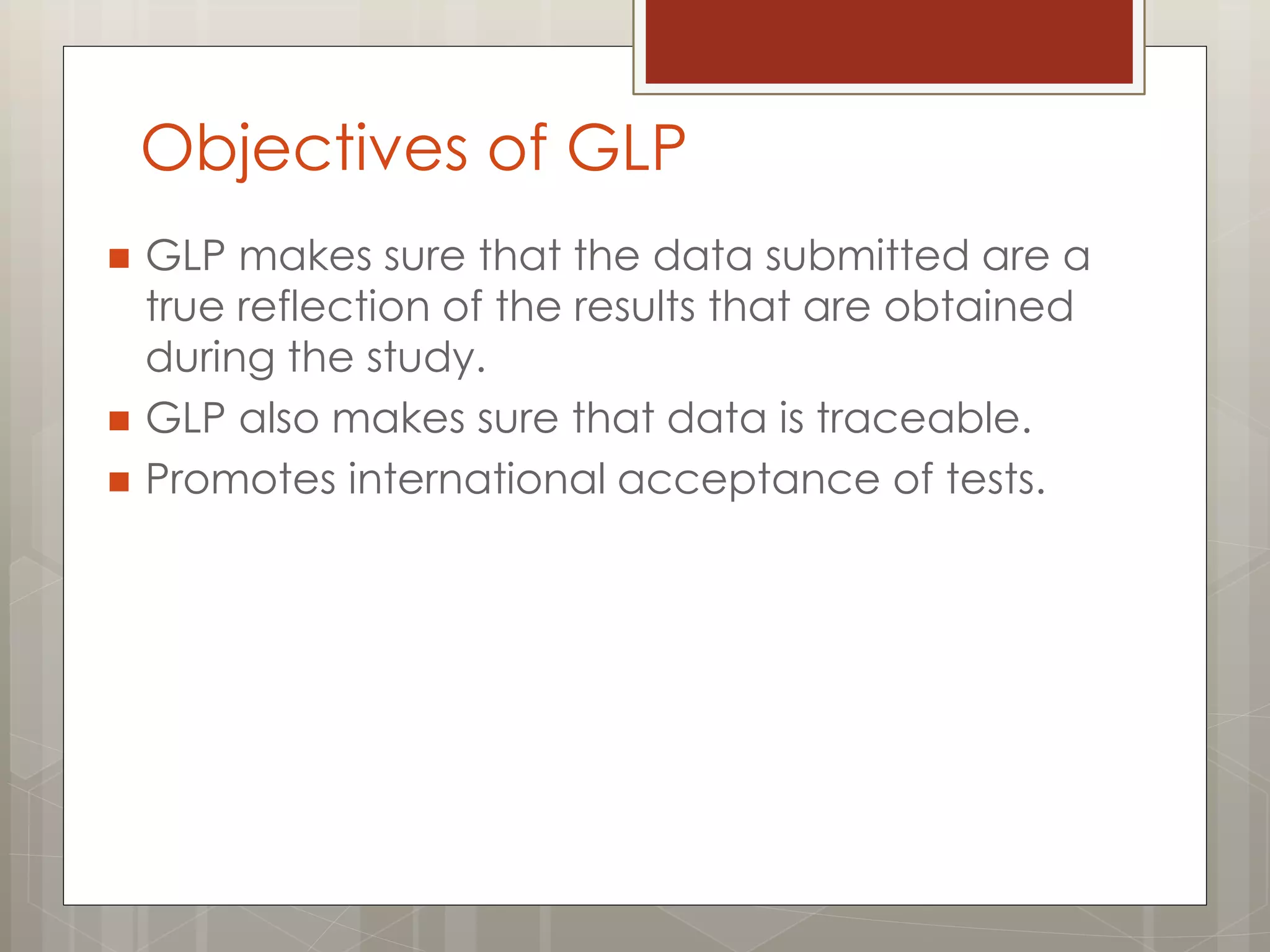
Objectives of GLP
 GLP makes sure that the data submitted are a
true reflection of the results that are obtained
during the study.
 GLP also makes sure that data is traceable.
 Promotes international acceptance of tests.
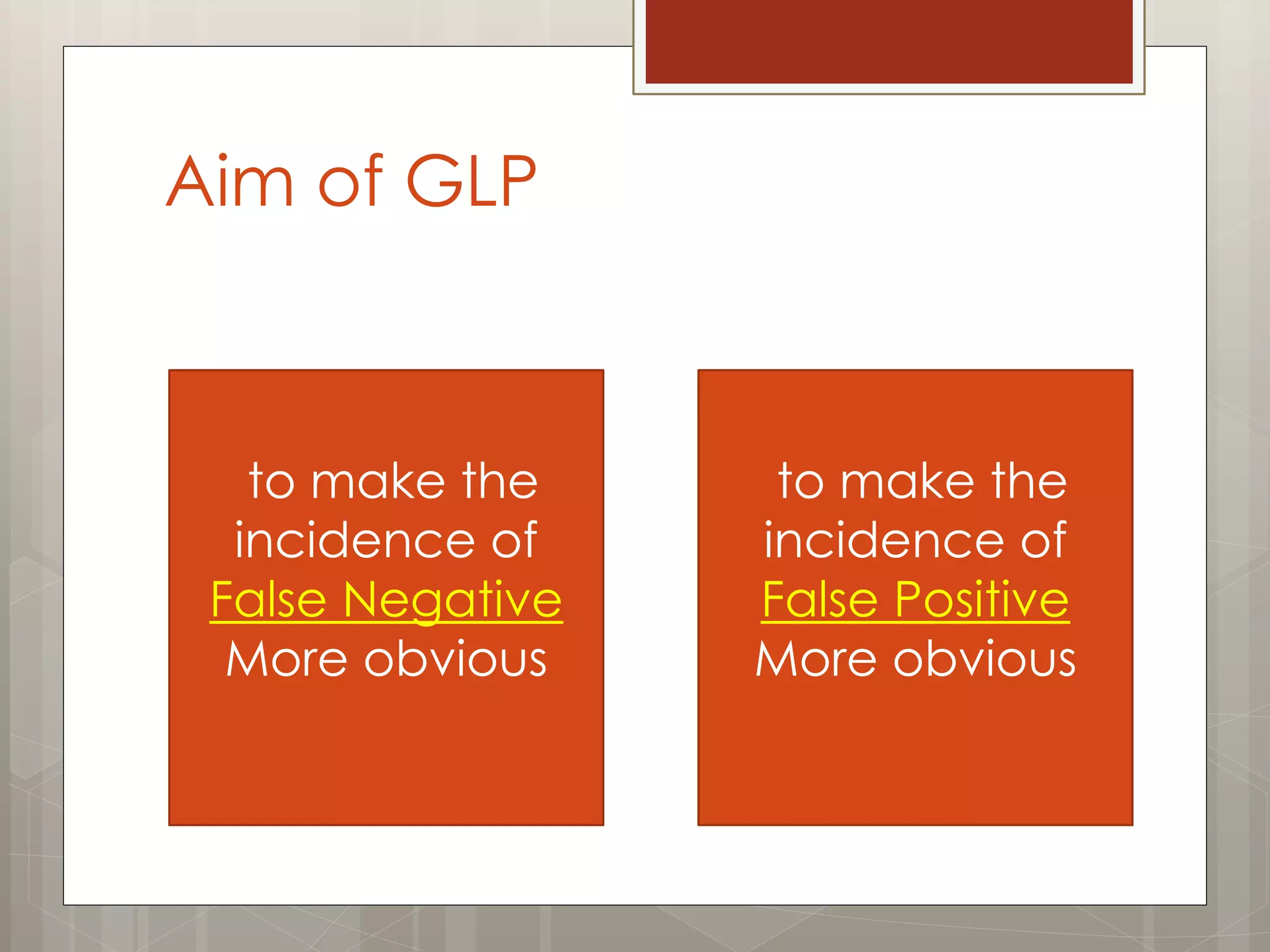
Aim of GLP
to make the
incidence of
False Negative
More obvious
to make the
incidence of
False Positive
More obvious
MISSION OF GLP
 Test systems
 Archiving of records and materials.
 Apparatus, material and reagent
facilities.
 Quality assurance programs.
 Performance of the study.
 Reporting of study results.
 Standard operating procedures (SOP)
 Personnel and test facility organization
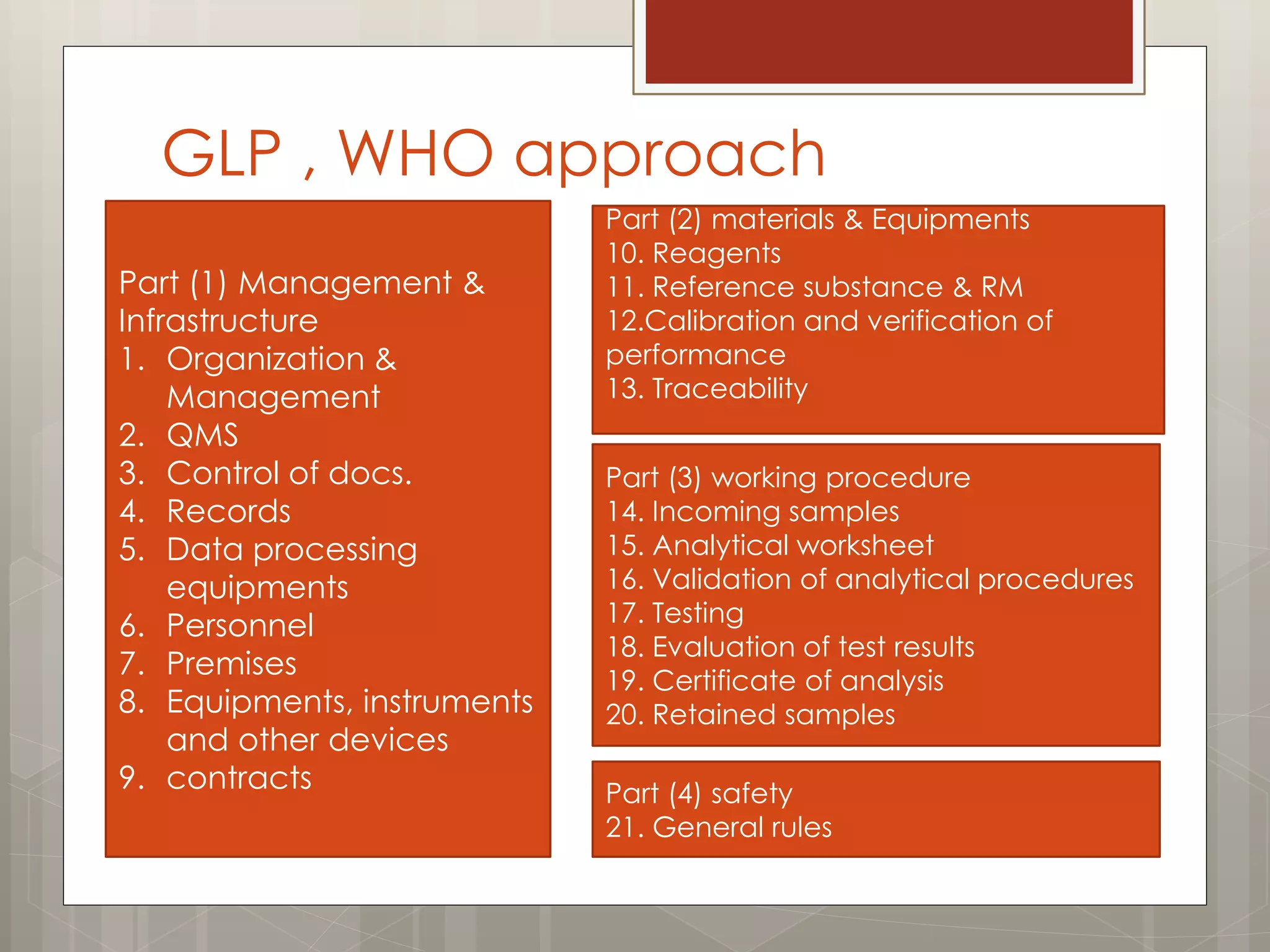
GLP , WHO approach
Part (1) Management &
Infrastructure
1. Organization &
Management
2. QMS
3. Control of docs.
4. Records
5. Data processing
equipments
6. Personnel
7. Premises
8. Equipments, instruments
and other devices
9. contracts
Part (3) working procedure
14. Incoming samples
15. Analytical worksheet
16. Validation of analytical procedures
17. Testing
18. Evaluation of test results
19. Certificate of analysis
20. Retained samples
Part (2) materials & Equipments
10. Reagents
11. Reference substance & RM
12.Calibration and verification of
performance
13. Traceability
Part (4) safety
21. General rules
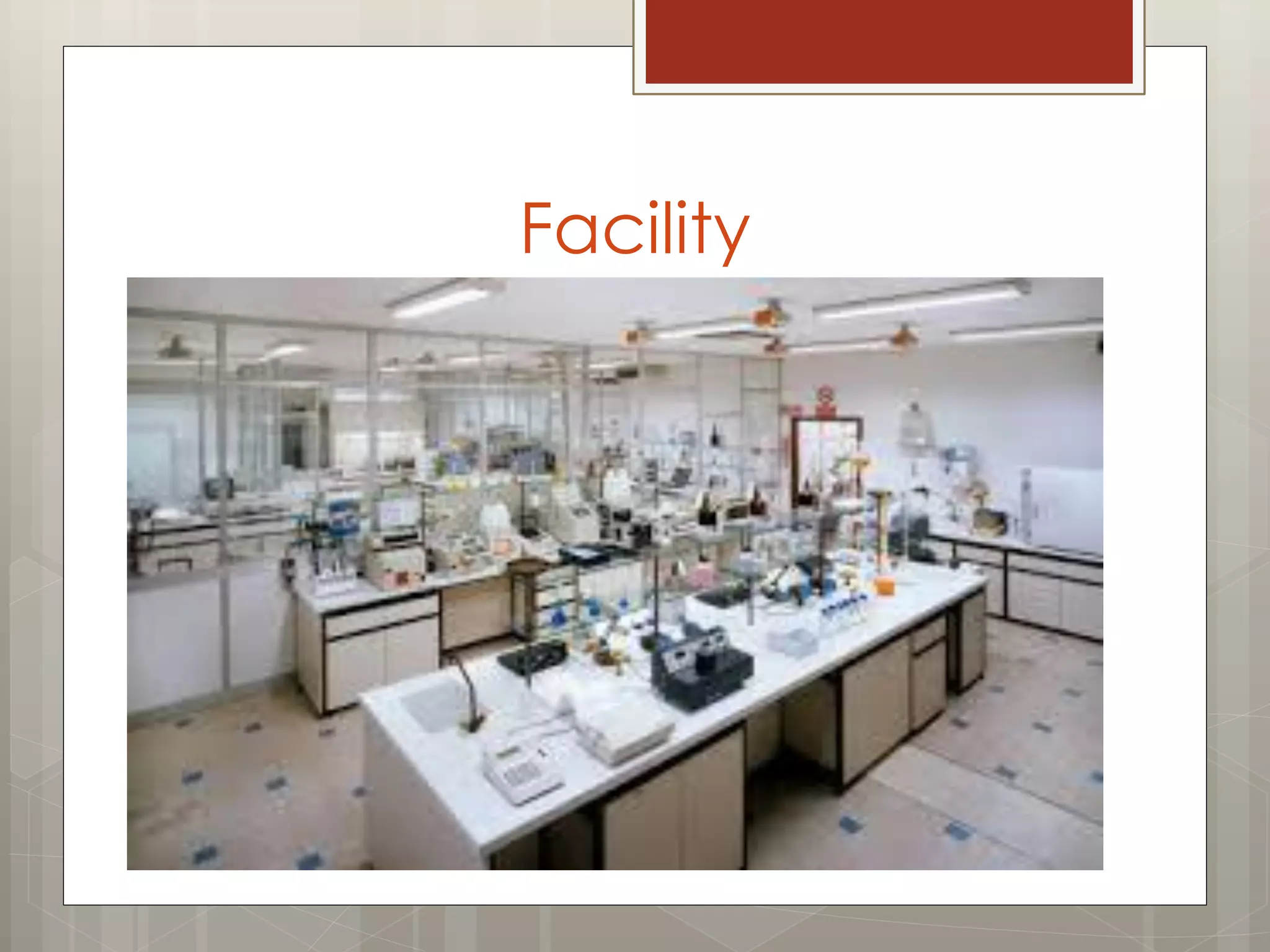
Facility
Cleanliness
 Control laboratories & equipment should
be kept clean., in accordance with
written cleaning schedules.
 All laboratory personnel should wear
clean protective clothing appropriate to
the duties being performed.
 The disposal of waste material should be
done carefully & responsibly in
accordance with procedures which
should be documented.
 Keep the work place clean &
uncluttered& do not get distracted at
work by other people.
Premises
 Located, designed, constructed or
adapted 7 maintained to suit the
performance of all quality control tests &
analysis required before, during & after
manufacture.
 Away from external & internal traffic.
Premises (II)
 Design & construction should prevent
entry of rodents & insects
 Interior surfaces of walls, floors& ceilings
should be smooth& free from cracks
 Temp. & relative humidity should be
appropriate for desired functions
 Bio-burden will be routinely maintained.
Premises (III)
 Separate facility for
 Instrumentation
 Chemical analysis/wet chemistry
 Micro lab/sterility/ pyrogen testing lab
 Hot room: fuming hood
 Stability room
 Reference sample/control samples room
Premises – animal facility
 To minimize the effects of environmental
variables on the animal, the facility should be
designed and operated to prevent the animal
coming into contact with disease, or with a test
item other than the one under investigation.
 Requirements will be different depending upon
the nature and duration of the studies being
performed in the facilities.
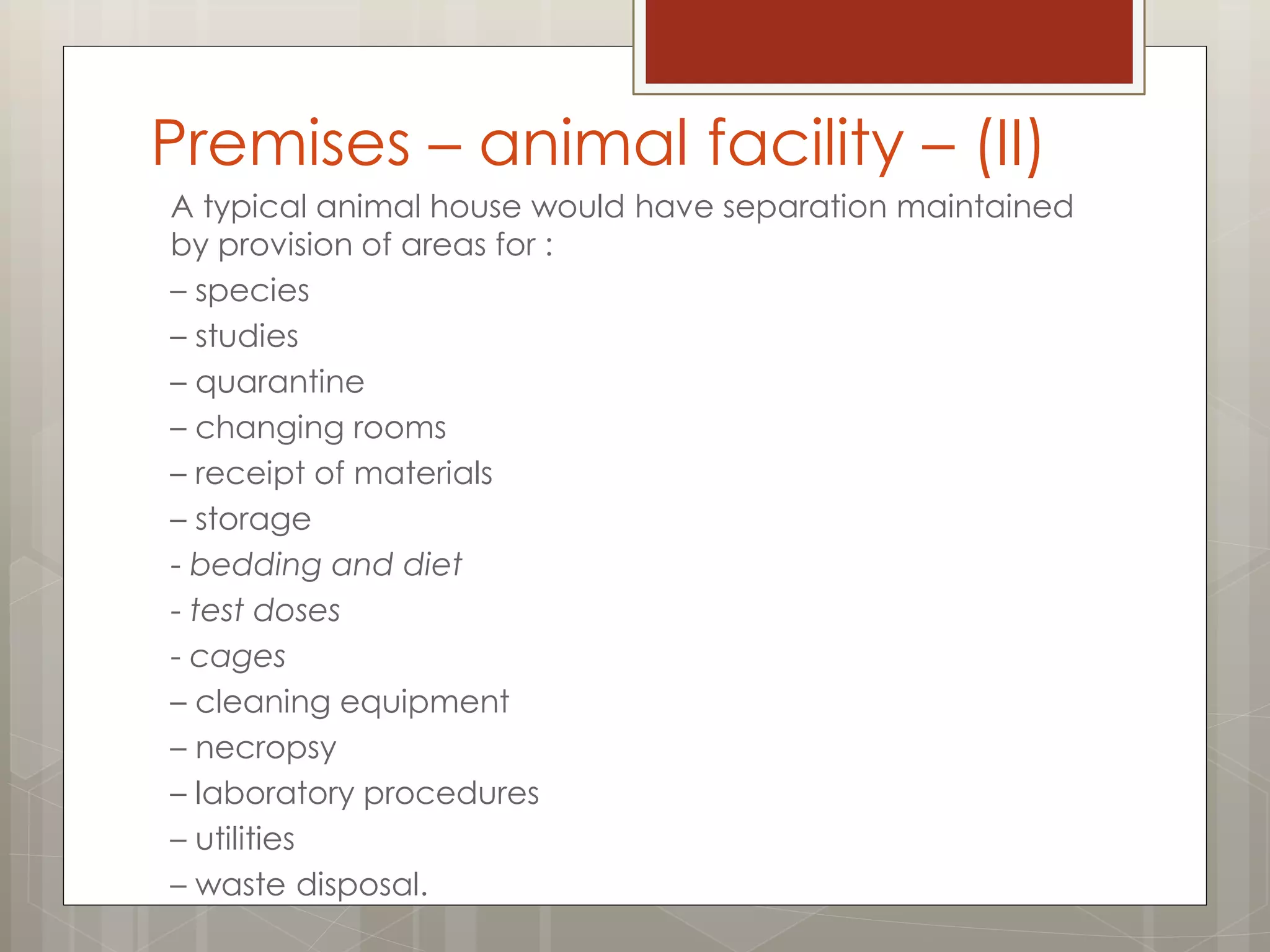
A typical animal house would have separation maintained
by provision of areas for :
– species
– studies
– quarantine
– changing rooms
– receipt of materials
– storage
- bedding and diet
- test doses
- cages
– cleaning equipment
– necropsy
– laboratory procedures
– utilities
– waste disposal.
Premises – animal facility – (II)
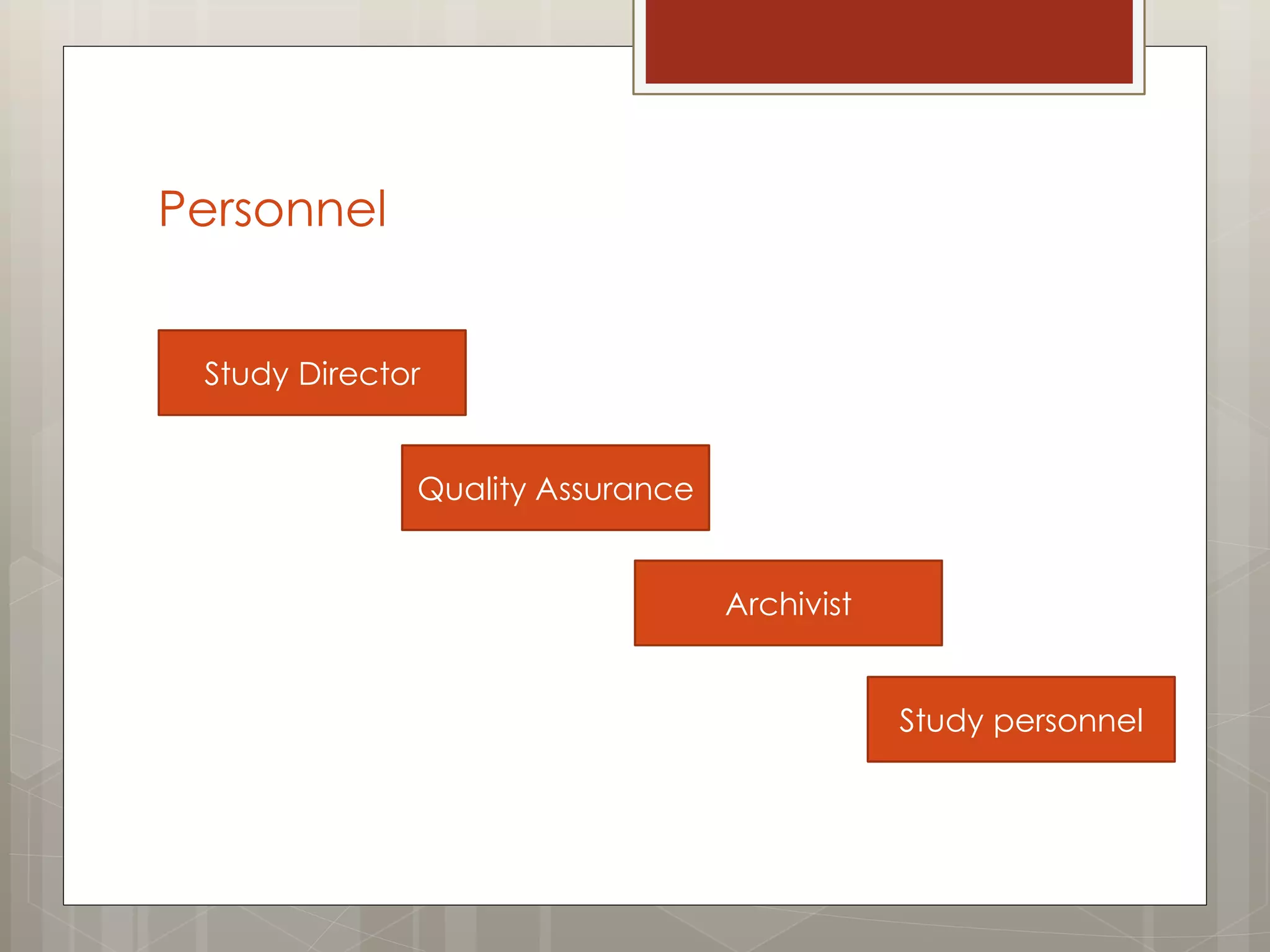
personnel
Personnel
Study Director
Quality Assurance
Archivist
Study personnel
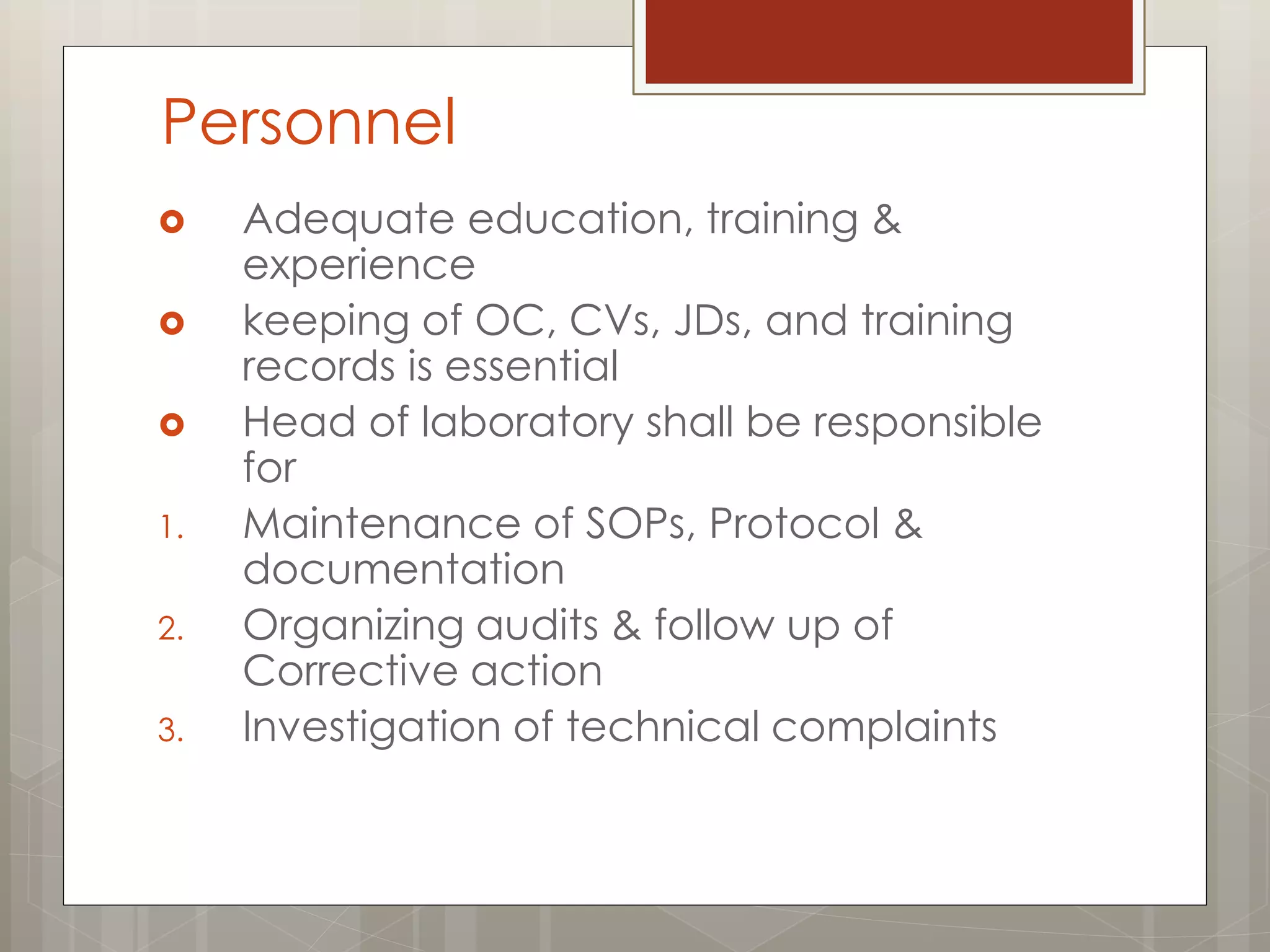
Personnel
 Adequate education, training &
experience
 keeping of OC, CVs, JDs, and training
records is essential
 Head of laboratory shall be responsible
for
1. Maintenance of SOPs, Protocol &
documentation
2. Organizing audits & follow up of
Corrective action
3. Investigation of technical complaints
Reagents
Reagents
 The reagents should be dated upon receipt or
preparation & labeled for identification.
 Reagents made up in the laboratory should be
prepared by competent persons according to
laid-down procedures.
 The labels on the reagent bottles should indicate
the concentration, standardization factor, shelf life
& storage conditions , date of preparation, date
of re-standardisation & signature of the chemist
who has prepared it.
 Reference standards & working standards should
be dated & stored at proper conditions. They
should be handled & used carefully in consultation
with senior chemist.
 MSDS of hazardous & poisonous chemicals
 Distilled /DM water- analysis
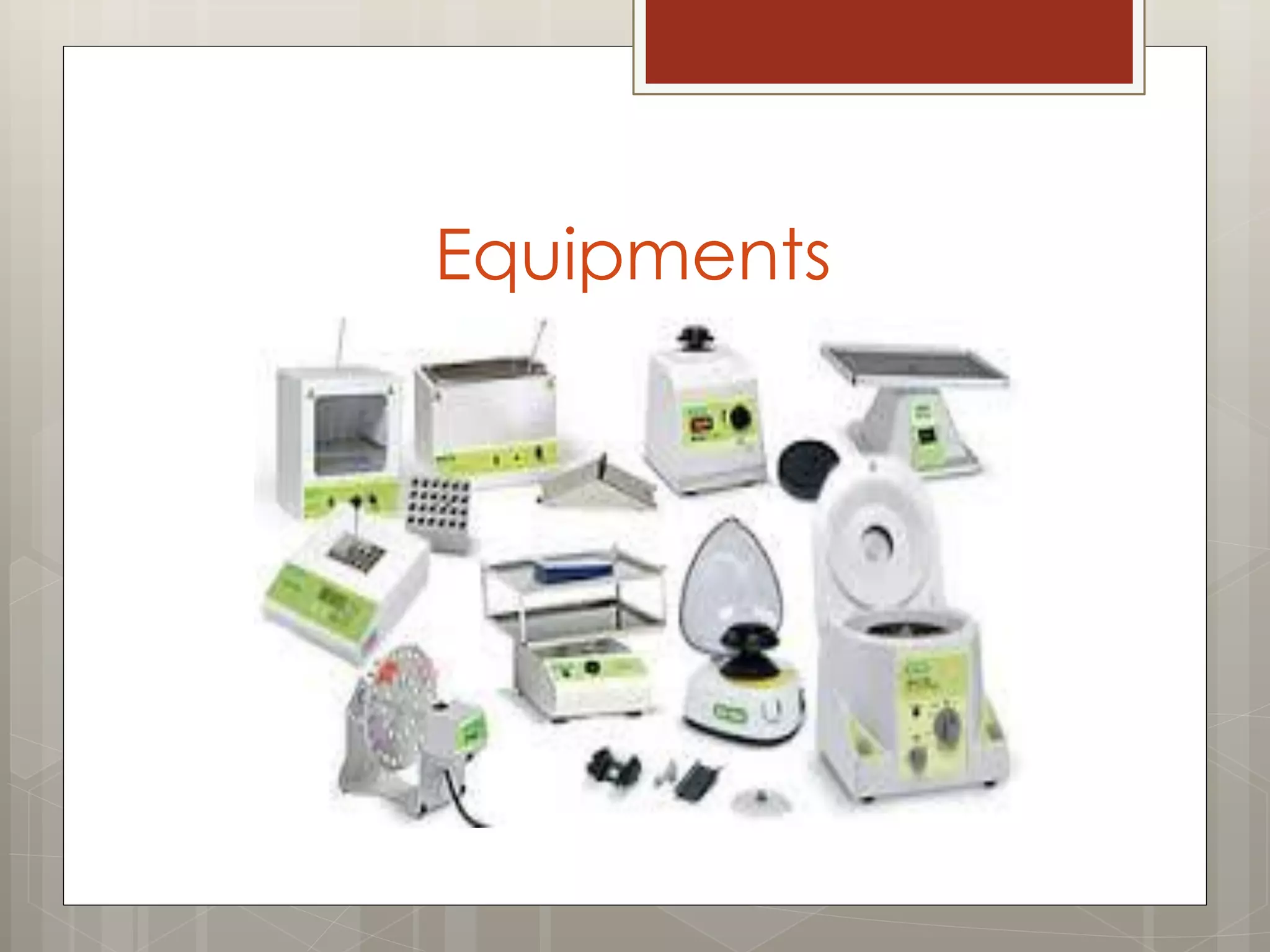
Equipments
Equipments
 Laboratory instruments & equipments
should be serviced & calibrated at
suitable intervals according to written
procedures by persons or a service
agency & validated. (SOP for
operation & calibration)
 Readily available records must be
maintained for each one of them.
 Next servicing or calibration due date
should also be mentioned on them.
 Separate room under control temp. &
humidity
Equipments (II)
 Written operating instructions should be readily
available or preferably be displayed for each
instrument.
 Records shall have Name of eqip., Mfg.‟s name &
instruction manual, model no., list of spares
&accessories, etc.
 Defective instrument should be withdrawn from
use until the fault has been rectified.
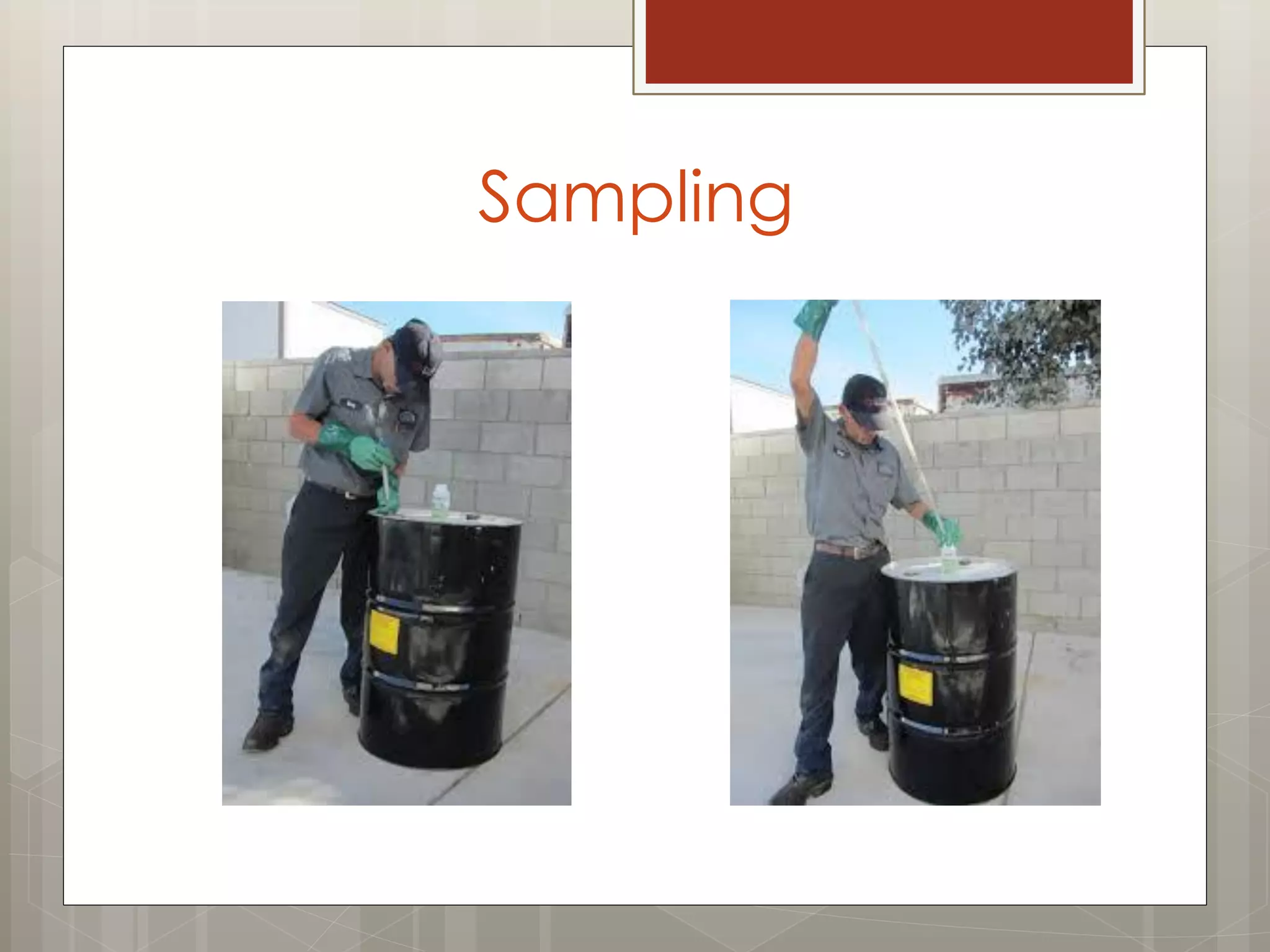
Sampling
Sampling
 Sample should be a proper representative
of bulk product.
 A trained & authorized sampler should
sample out using appropriate , clean
Sampling equipments , following safety
precautions & sampling norms.
Sampling (II)
 Written Sampling SOP should include
 Method of sampling
 Equipment to be used
 The amount of sample to be taken
 Instructions for any required sub division
of sample
 The type & condition of sample
container to be used
 Any special precaution to be observed
 Cleaning & storage of sampling
equipment.
Sampling (III)
 The Sample container should have
labels bearing details about Name
of material, Batch no., Mfg. Date,
expiry date , Name of
manufacturer,& quantity sampled.
 Those containers from which samples
are drawn, are marked with
„sampled‟ stamp with date &
signature of the chemist so that they
are identifiable from bulk containers.
 Sampling equipments should be
cleaned after each use & stored
separately from other laboratory
equipments.
Documents
Documents
 All the departmental systems &
procedures , specifications for all input
materials, intermediates & finished
products & all tests and methods of
analysis should be documented.
 All raw data, formats of analytical
reports , under test, approved &
rejected labels , various in-process
checks , calibration check records
should be documented & available.
 Archives for storage,& retrieval of
records. Retention time should be
maintained.
Procedure & documentation
 Method of analysis & specifications
 SOP for systems, instruments
 Reports- Analytical reports of batch,
stability report, working standards,
validation reports, Monitoring quality of
water, effluents discharged, RM, In-
process, FP.
Standard Operating Procedures (II)
 To store data in paper format, humidity
conditions shall be maintained.
 Data in the form of disc & tape should be
stored with care.
 For storage on optical disc, its life shall be
longer than storage time.
 Keep a photocopy of data on thermal
paper.
Documents
 Documents shall specify the title, nature &
purpose.
 They shall be laid out in an orderly fashion
& easy to check.
 Documents shall be approved, signed,
regularly reviewed, and dated by
appropriate & authorized person.
Records
Raw data refers to records of
original observations.
Make detailed records of the results
of the tests & analyses of all
materials, intermediates & finished
products & in process tests done,
environmental monitoring,
calibrations etc.
Changes or corrections in the entry
should be single line strike.
Authorized persons will have access
to data to maintain its integrity &
security.
Records
 Records should have following details.
 Analytical report no.
 Name of the sample
 Date of receipt of sample
 Batch/lot no.
 Protocols of tests applied
 Signature of the analyst
 Opinion & sign of approved analyst
 Any other relevant & extra information e.g.
date of expiry , date of release & in case of
drugs, requirements complying schedule U
 Records should also contain the basic data &
calculations from which test results were
derived.(e.g. weighings, readings, recorder
charts, instrument printouts etc.)
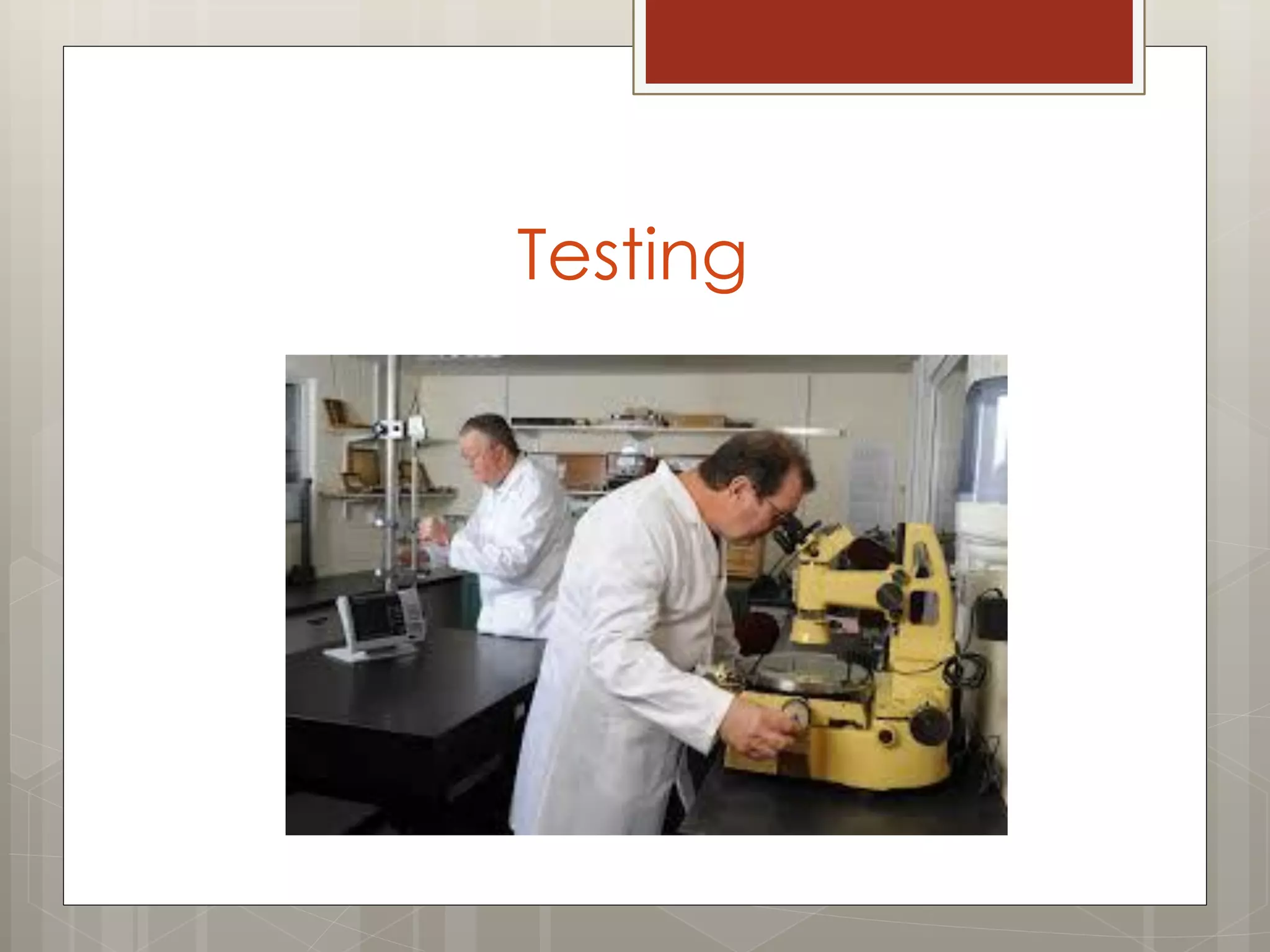
Testing
Testing
 Samples should be tested in
accordance with the written methods
& referred to in relevant specifications.
 In- process checks done by QC
personnel on the batches in
production should also be attached to
the analytical reports for the batch.
 Test methods should be validated.
 Where the results of testing appear
doubtful, repeat the test/s but do not
fabricate the results to cover up
mistakes or to avoid work.
Good house keeping & Safety
 People working in the laboratory should
look after safety aspects of their work for
themselves, their colleagues &the
organization.
 They should wear appropriate safety
gadgets while working with hazardous ,
corrosive chemicals & inflammable
solvents.
 Persons in the department should be
trained to operate fire fighting apparatus.
 Persons in the department should be
familiar to first-aid techniques in case of
emergency till medical help is available.
Good house keeping & Safety (II)
 Government of specifies SOPs as
 Circulation of safety data sheet
 Eating, drinking, smoking and keeping
food items in the lab is prohibited.
 Adequate facilities for storage & disposal
of animal waste
 Protective clothing to be provided.
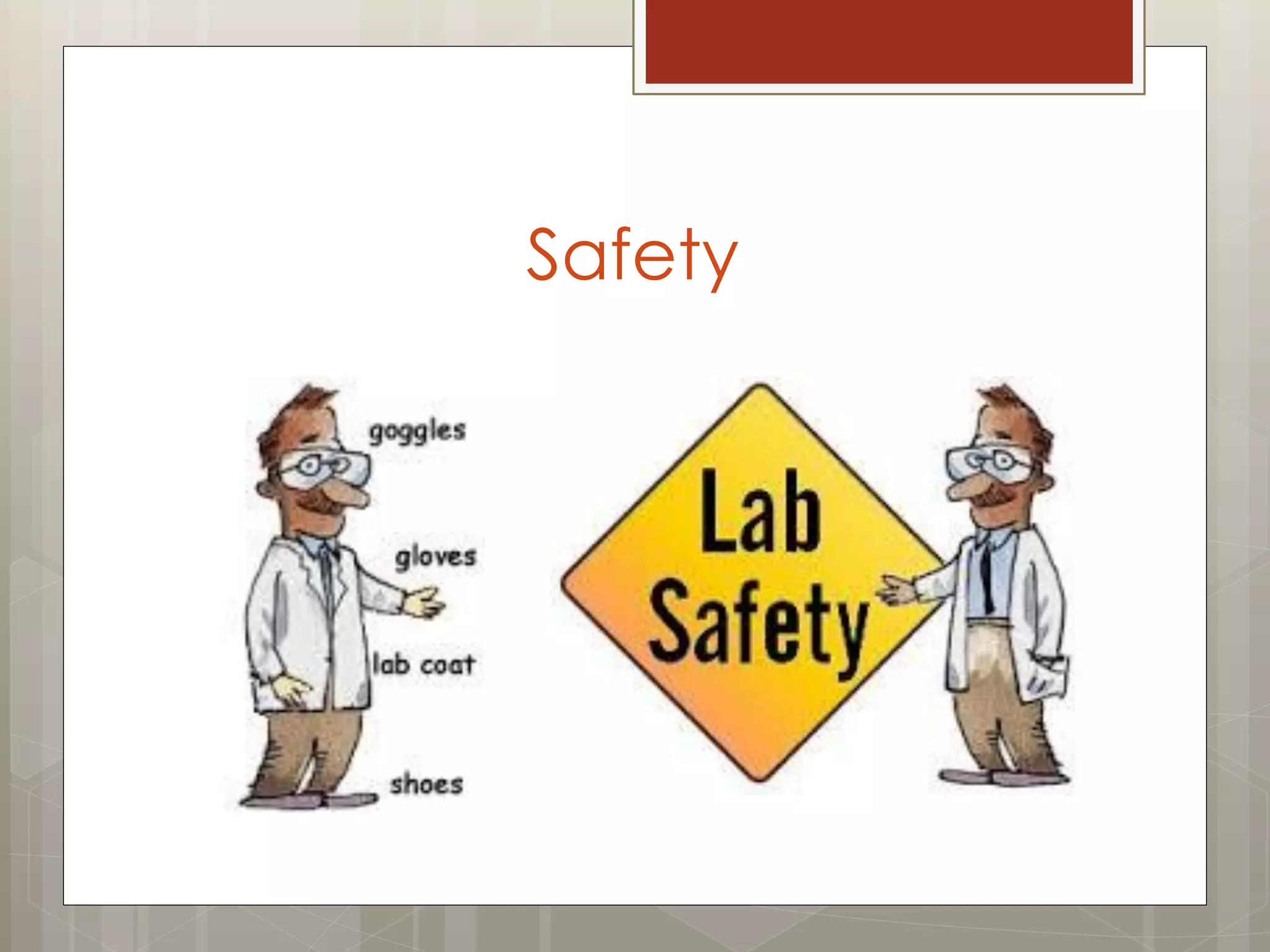
Safety
Safety
 Waste materials awaiting disposal should
be safely stored. Flammable &
halogenated solvents & other
contaminated waste liquids should not be
poured into the drains carrying the
factory effluent. They should be collected
separately & disposed off suitably . There
should be separate waste containers for
broken glass.
Training
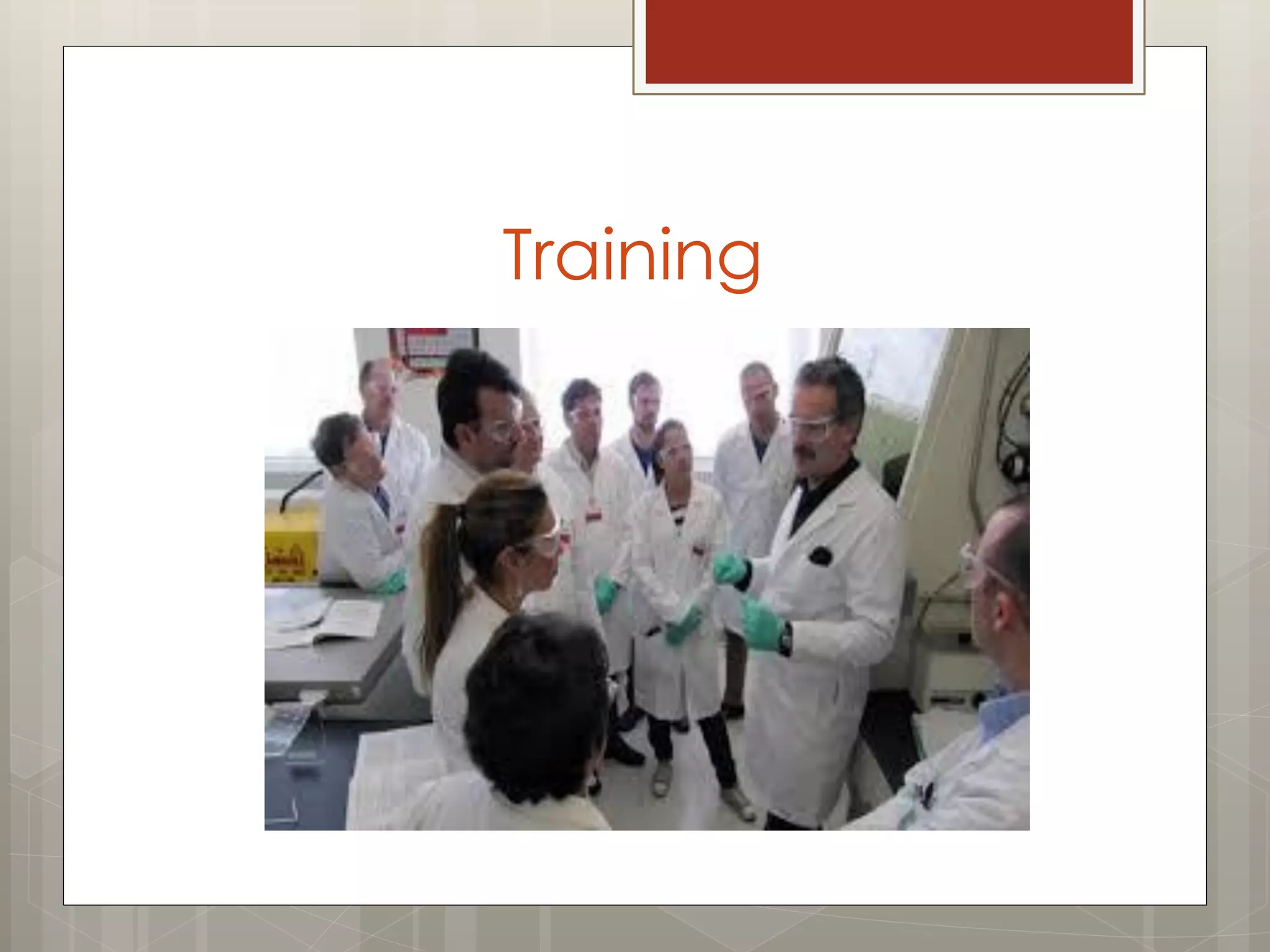
Training
 Persons in the department should be
adequately qualified & provided suitable
training to carry out their responsibilities in
a competent & reliable manner.
 Records of training should be maintained.
Reference materials
 Traceable to Government body Or
international agency.
 Working std. shall be prepared using ref.
std. & records of same will be maintained
 Maintain a register for ref. material
including source of supply, code no. ID
no., storage conditions, mfg. & expiry
date.
 Handled & stored properly.
Quality Assurance
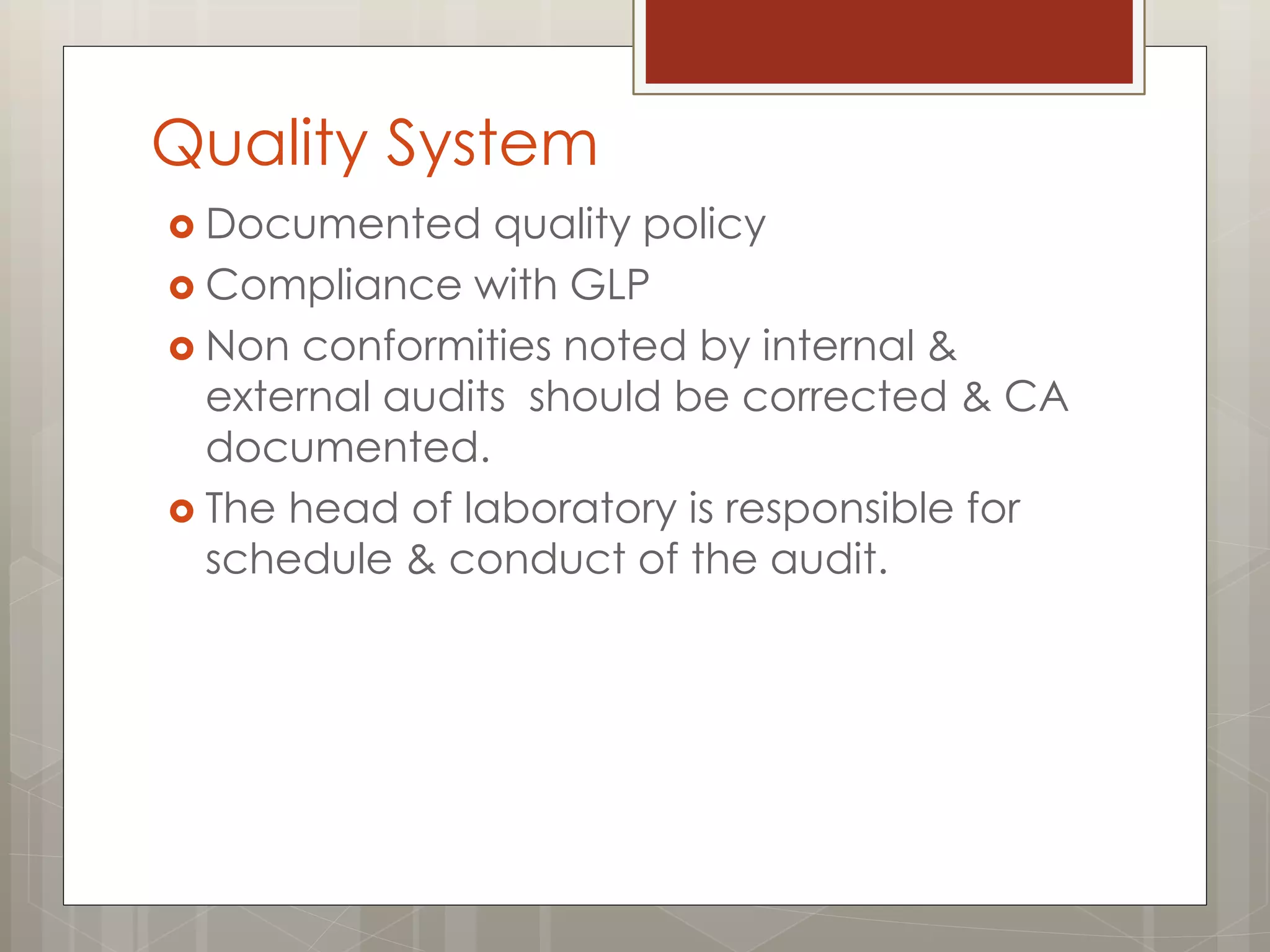
Quality System
 Documented quality policy
 Compliance with GLP
 Non conformities noted by internal &
external audits should be corrected & CA
documented.
 The head of laboratory is responsible for
schedule & conduct of the audit.
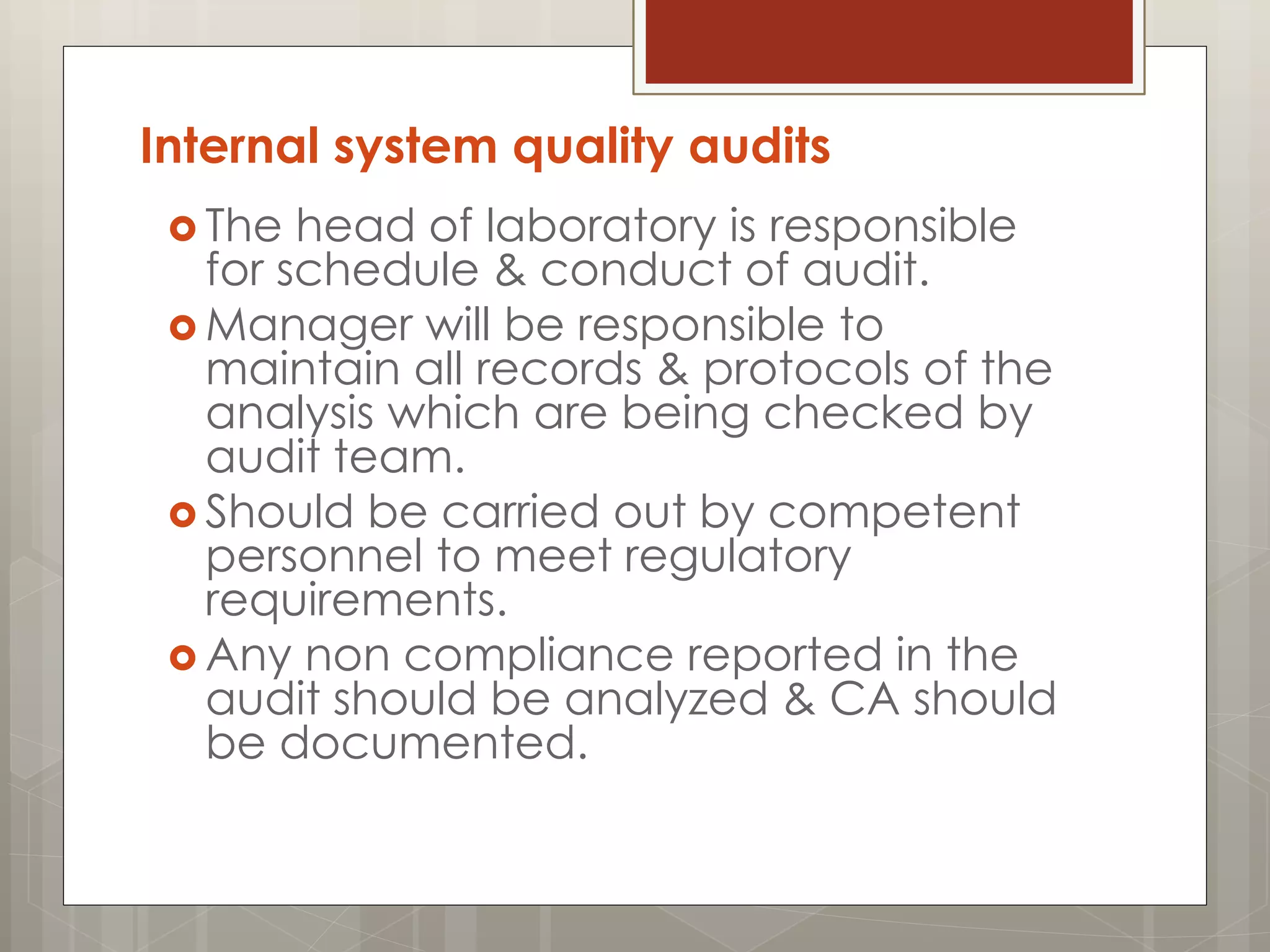
Internal system quality audits
 The head of laboratory is responsible
for schedule & conduct of audit.
 Manager will be responsible to
maintain all records & protocols of the
analysis which are being checked by
audit team.
 Should be carried out by competent
personnel to meet regulatory
requirements.
 Any non compliance reported in the
audit should be analyzed & CA should
be documented.
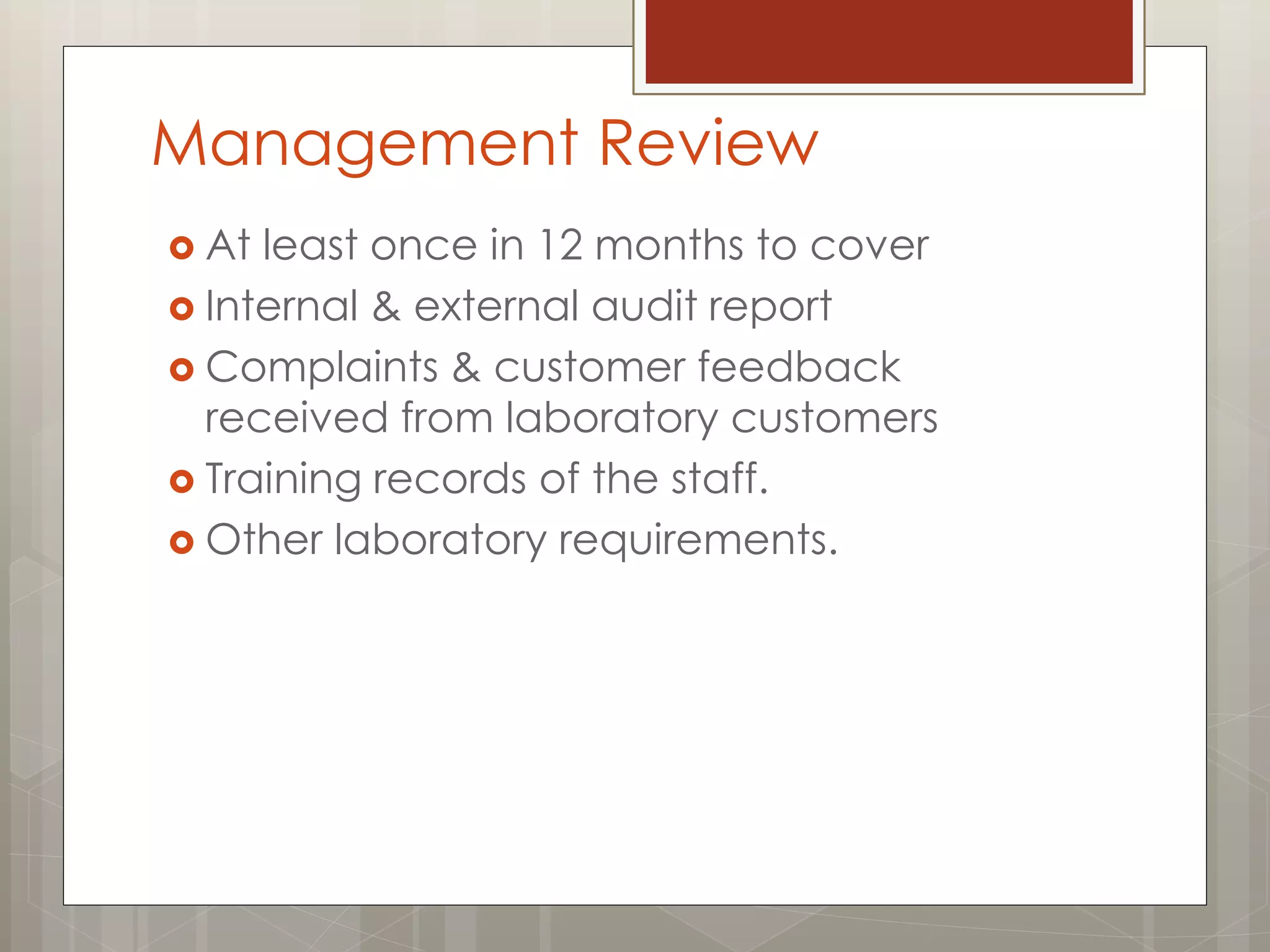
Management Review
 At least once in 12 months to cover
 Internal & external audit report
 Complaints & customer feedback
received from laboratory customers
 Training records of the staff.
 Other laboratory requirements.
Standard Operating
Procedures
 Sops required for
 Analysis of drugs
 Sample handling & accountability
 Receipt, identification, storage &
sampling of test & control articles.
 Cleaning, maintenance and
calibration of equipments
 Responsibilities of audit team
personnel.
Standard Operating
Procedures
 Healthy & safety precaution
 Storage & maintenance of microbial
cultures.
 Maintenance of animal rooms.
 Use & storage of reference standards
 Training programs & their frequency
 House Keeping
 Document control
Standard Operating
Procedures
 Retention & disposal of control samples
 SOPs should be reviewed periodically
 SOPs should include designation of the
person responsible for intended activity.
 Complaints & Product recall procedures
What happens if a workplace
does not comply with federal
Good Laboratory Practice
standards?
Disqualification of a Facility
 Before a workplace can experience the
consequences of noncompliance, an
explanation of disqualification is needed
 The FDA states the purpose of disqualification
as the exclusion of a testing facility from
completing laboratory studies or starting any
new studies due to not following the standards
of compliance set by the Good Laboratory
Practice manual
Possible Violations
 Falsifying information for permit, registration
or any required records
 Falsifying information related to testing~
protocols, ingredients, observations, data
equipment, ect.
 Failure to prepare, retain, or submit written
records required by law
Grounds for Disqualification
 The testing facility failed to comply with one or
more regulations implemented by the GLP
manual
 The failure to comply led to adverse outcomes
in the data; in other words, it affected the
validity of the study
 Warnings or rejection of previous studies have
not been adequate to improve the facility‟s
compliance
Consequences of Noncompliance
 The FDA states the following consequences of
noncompliance:
 The commissioner will send a written proposal of
disqualification to the testing facility
 A regulatory hearing on the disqualification will be
scheduled
 If the commissioner finds that after the hearing, the
facility has complied, then a written statement with an
explanation of termination of disqualification will be
sent to the facility
 Thus, if it can be shown that such disqualifications did
not affect the integrity and outcome of the study itself,
or did not occur at all, then the study may be
reinstated at the will of the commissioner
Upon Disqualification…
If the commissioner finds that the facility was
noncompliant on any of the grounds after the
hearing, then a final order of noncompliance will be
sent to the facility with explanations
 If a testing facility has been disqualified, any studies
done before of after the disqualification will need to be
determined as essential to a decision (acceptable or
not)
 If the study is determined unacceptable, then the facility
itself may need to show that the study was not affected
by the noncompliance that led to the disqualification
 Once finally disqualified, the facility may not receive or
be considered for a research or marketing permit and
the study is rejected.
Summary
 Adequate facility, trained personnel,
approved procedures.
 Validated test methods
 Records- Reports, specifications,
calibration SOPs
 Analysis of RM, In-process & FP for release
 Product complaints & recall

Good laboratory practices awervness course ay

  • 1.
    Good Laboratory Practice Edited & Preparedby ADEL YOUNIS Quality & BD Consultant PHD in TQM Awareness Course
  • 2.
    Agenda  GLP BOK. History of Standard Development  GLP Essentials -resources -characterization -Rules -results -QA  Summary
  • 3.
    Good Laboratory Practice- BOK 1) Fundamentals of GLP 2) Resources 2.1 Personnel 2.2 Facility “building & Equipment” 3) Rules 3.1 Protocols / Study plan 3.2 Procedures / SOPs 4) Characterization 4.1 test item 4.2 test system
  • 4.
    GLP – BOK(II) 5) Documentation /Results 5.1 raw data & data collection 5.2 final reports 5.3 archives 5.4 indexing 6) Quality Assurance
  • 5.
  • 6.
     GLP isa formal regulation that was created by the FDA (United states food and drug administration) in 1978.  Although GLP originated in the United States , it had a world wide impact.  Non-US companies that wanted to do business with the United states or register their pharmacies in the United States had to comply with the United States GLP regulations.  They eventually started making GLP regulations in their home countries.  In 1981 an organization named OECD (organization for economic co-operation and development ) produced GLP principles that are international standard.
  • 7.
    Purpose for creatingGLP standard  In the early 70‟s FDA became aware of cases of poor laboratory practice all over the United States.  FDA decided to do an in-depth investigation on 40 toxicology labs.  They discovered a lot fraudulent activities and a lot of poor lab practices.  Examples of some of these poor lab practices found were 1. Equipment not been calibrated to standard form , therefore giving wrong measurements. 2. Incorrect/inaccurate accounts of the actual lab study 3. Inadequate test systems
  • 8.
     One ofthe labs that went under such an investigation made headline news.  The name of the Lab was Industrial Bio Test. This was a big lab that ran tests for big companies such as Procter and Gamble.  It was discovered that mice that they had used to test cosmetics such as lotion and deodorants had developed cancer and died.  Industrial Bio Test lab threw the dead mice and covered results deeming the products good for human consumption.  Those involved in production, distribution and sales for the lab eventually served jail time.
  • 9.
    FDA investigation findings •Poorly-trained Study Directors and study personnel • Poorly-designed protocols • Protocols not followed - procedures not conducted as prescribed • Raw data badly collected - not correctly identified - without traceability - not verified or approved by responsible persons • Lack of standardized procedures • Poor animal husbandry
  • 10.
    • Inadequate characterizationof test items and test systems. • Inadequate resources. • Equipment not properly calibrated or otherwise qualified. • Reports not sufficiently verified, inaccurate account of study or raw data • Inadequate archives and retrieval processes FDA investigation findings (II)
  • 11.
    Objectives of GLP GLP makes sure that the data submitted are a true reflection of the results that are obtained during the study.  GLP also makes sure that data is traceable.  Promotes international acceptance of tests.
  • 12.
    Aim of GLP tomake the incidence of False Negative More obvious to make the incidence of False Positive More obvious
  • 13.
    MISSION OF GLP Test systems  Archiving of records and materials.  Apparatus, material and reagent facilities.  Quality assurance programs.  Performance of the study.  Reporting of study results.  Standard operating procedures (SOP)  Personnel and test facility organization
  • 14.
    GLP , WHOapproach Part (1) Management & Infrastructure 1. Organization & Management 2. QMS 3. Control of docs. 4. Records 5. Data processing equipments 6. Personnel 7. Premises 8. Equipments, instruments and other devices 9. contracts Part (3) working procedure 14. Incoming samples 15. Analytical worksheet 16. Validation of analytical procedures 17. Testing 18. Evaluation of test results 19. Certificate of analysis 20. Retained samples Part (2) materials & Equipments 10. Reagents 11. Reference substance & RM 12.Calibration and verification of performance 13. Traceability Part (4) safety 21. General rules
  • 15.
  • 16.
    Cleanliness  Control laboratories& equipment should be kept clean., in accordance with written cleaning schedules.  All laboratory personnel should wear clean protective clothing appropriate to the duties being performed.  The disposal of waste material should be done carefully & responsibly in accordance with procedures which should be documented.  Keep the work place clean & uncluttered& do not get distracted at work by other people.
  • 17.
    Premises  Located, designed,constructed or adapted 7 maintained to suit the performance of all quality control tests & analysis required before, during & after manufacture.  Away from external & internal traffic.
  • 18.
    Premises (II)  Design& construction should prevent entry of rodents & insects  Interior surfaces of walls, floors& ceilings should be smooth& free from cracks  Temp. & relative humidity should be appropriate for desired functions  Bio-burden will be routinely maintained.
  • 19.
    Premises (III)  Separatefacility for  Instrumentation  Chemical analysis/wet chemistry  Micro lab/sterility/ pyrogen testing lab  Hot room: fuming hood  Stability room  Reference sample/control samples room
  • 20.
    Premises – animalfacility  To minimize the effects of environmental variables on the animal, the facility should be designed and operated to prevent the animal coming into contact with disease, or with a test item other than the one under investigation.  Requirements will be different depending upon the nature and duration of the studies being performed in the facilities.
  • 21.
    A typical animalhouse would have separation maintained by provision of areas for : – species – studies – quarantine – changing rooms – receipt of materials – storage - bedding and diet - test doses - cages – cleaning equipment – necropsy – laboratory procedures – utilities – waste disposal. Premises – animal facility – (II)
  • 22.
  • 23.
  • 24.
    Personnel  Adequate education,training & experience  keeping of OC, CVs, JDs, and training records is essential  Head of laboratory shall be responsible for 1. Maintenance of SOPs, Protocol & documentation 2. Organizing audits & follow up of Corrective action 3. Investigation of technical complaints
  • 25.
  • 26.
    Reagents  The reagentsshould be dated upon receipt or preparation & labeled for identification.  Reagents made up in the laboratory should be prepared by competent persons according to laid-down procedures.  The labels on the reagent bottles should indicate the concentration, standardization factor, shelf life & storage conditions , date of preparation, date of re-standardisation & signature of the chemist who has prepared it.  Reference standards & working standards should be dated & stored at proper conditions. They should be handled & used carefully in consultation with senior chemist.  MSDS of hazardous & poisonous chemicals  Distilled /DM water- analysis
  • 27.
  • 28.
    Equipments  Laboratory instruments& equipments should be serviced & calibrated at suitable intervals according to written procedures by persons or a service agency & validated. (SOP for operation & calibration)  Readily available records must be maintained for each one of them.  Next servicing or calibration due date should also be mentioned on them.  Separate room under control temp. & humidity
  • 29.
    Equipments (II)  Writtenoperating instructions should be readily available or preferably be displayed for each instrument.  Records shall have Name of eqip., Mfg.‟s name & instruction manual, model no., list of spares &accessories, etc.  Defective instrument should be withdrawn from use until the fault has been rectified.
  • 30.
  • 31.
    Sampling  Sample shouldbe a proper representative of bulk product.  A trained & authorized sampler should sample out using appropriate , clean Sampling equipments , following safety precautions & sampling norms.
  • 32.
    Sampling (II)  WrittenSampling SOP should include  Method of sampling  Equipment to be used  The amount of sample to be taken  Instructions for any required sub division of sample  The type & condition of sample container to be used  Any special precaution to be observed  Cleaning & storage of sampling equipment.
  • 33.
    Sampling (III)  TheSample container should have labels bearing details about Name of material, Batch no., Mfg. Date, expiry date , Name of manufacturer,& quantity sampled.  Those containers from which samples are drawn, are marked with „sampled‟ stamp with date & signature of the chemist so that they are identifiable from bulk containers.  Sampling equipments should be cleaned after each use & stored separately from other laboratory equipments.
  • 34.
  • 35.
    Documents  All thedepartmental systems & procedures , specifications for all input materials, intermediates & finished products & all tests and methods of analysis should be documented.  All raw data, formats of analytical reports , under test, approved & rejected labels , various in-process checks , calibration check records should be documented & available.  Archives for storage,& retrieval of records. Retention time should be maintained.
  • 36.
    Procedure & documentation Method of analysis & specifications  SOP for systems, instruments  Reports- Analytical reports of batch, stability report, working standards, validation reports, Monitoring quality of water, effluents discharged, RM, In- process, FP.
  • 37.
    Standard Operating Procedures(II)  To store data in paper format, humidity conditions shall be maintained.  Data in the form of disc & tape should be stored with care.  For storage on optical disc, its life shall be longer than storage time.  Keep a photocopy of data on thermal paper.
  • 38.
    Documents  Documents shallspecify the title, nature & purpose.  They shall be laid out in an orderly fashion & easy to check.  Documents shall be approved, signed, regularly reviewed, and dated by appropriate & authorized person.
  • 39.
    Records Raw data refersto records of original observations. Make detailed records of the results of the tests & analyses of all materials, intermediates & finished products & in process tests done, environmental monitoring, calibrations etc. Changes or corrections in the entry should be single line strike. Authorized persons will have access to data to maintain its integrity & security.
  • 40.
    Records  Records shouldhave following details.  Analytical report no.  Name of the sample  Date of receipt of sample  Batch/lot no.  Protocols of tests applied  Signature of the analyst  Opinion & sign of approved analyst  Any other relevant & extra information e.g. date of expiry , date of release & in case of drugs, requirements complying schedule U  Records should also contain the basic data & calculations from which test results were derived.(e.g. weighings, readings, recorder charts, instrument printouts etc.)
  • 41.
  • 42.
    Testing  Samples shouldbe tested in accordance with the written methods & referred to in relevant specifications.  In- process checks done by QC personnel on the batches in production should also be attached to the analytical reports for the batch.  Test methods should be validated.  Where the results of testing appear doubtful, repeat the test/s but do not fabricate the results to cover up mistakes or to avoid work.
  • 43.
    Good house keeping& Safety  People working in the laboratory should look after safety aspects of their work for themselves, their colleagues &the organization.  They should wear appropriate safety gadgets while working with hazardous , corrosive chemicals & inflammable solvents.  Persons in the department should be trained to operate fire fighting apparatus.  Persons in the department should be familiar to first-aid techniques in case of emergency till medical help is available.
  • 44.
    Good house keeping& Safety (II)  Government of specifies SOPs as  Circulation of safety data sheet  Eating, drinking, smoking and keeping food items in the lab is prohibited.  Adequate facilities for storage & disposal of animal waste  Protective clothing to be provided.
  • 45.
  • 46.
    Safety  Waste materialsawaiting disposal should be safely stored. Flammable & halogenated solvents & other contaminated waste liquids should not be poured into the drains carrying the factory effluent. They should be collected separately & disposed off suitably . There should be separate waste containers for broken glass.
  • 47.
  • 48.
    Training  Persons inthe department should be adequately qualified & provided suitable training to carry out their responsibilities in a competent & reliable manner.  Records of training should be maintained.
  • 49.
    Reference materials  Traceableto Government body Or international agency.  Working std. shall be prepared using ref. std. & records of same will be maintained  Maintain a register for ref. material including source of supply, code no. ID no., storage conditions, mfg. & expiry date.  Handled & stored properly.
  • 50.
  • 51.
    Quality System  Documentedquality policy  Compliance with GLP  Non conformities noted by internal & external audits should be corrected & CA documented.  The head of laboratory is responsible for schedule & conduct of the audit.
  • 52.
    Internal system qualityaudits  The head of laboratory is responsible for schedule & conduct of audit.  Manager will be responsible to maintain all records & protocols of the analysis which are being checked by audit team.  Should be carried out by competent personnel to meet regulatory requirements.  Any non compliance reported in the audit should be analyzed & CA should be documented.
  • 53.
    Management Review  Atleast once in 12 months to cover  Internal & external audit report  Complaints & customer feedback received from laboratory customers  Training records of the staff.  Other laboratory requirements.
  • 54.
    Standard Operating Procedures  Sopsrequired for  Analysis of drugs  Sample handling & accountability  Receipt, identification, storage & sampling of test & control articles.  Cleaning, maintenance and calibration of equipments  Responsibilities of audit team personnel.
  • 55.
    Standard Operating Procedures  Healthy& safety precaution  Storage & maintenance of microbial cultures.  Maintenance of animal rooms.  Use & storage of reference standards  Training programs & their frequency  House Keeping  Document control
  • 56.
    Standard Operating Procedures  Retention& disposal of control samples  SOPs should be reviewed periodically  SOPs should include designation of the person responsible for intended activity.  Complaints & Product recall procedures
  • 57.
    What happens ifa workplace does not comply with federal Good Laboratory Practice standards?
  • 58.
    Disqualification of aFacility  Before a workplace can experience the consequences of noncompliance, an explanation of disqualification is needed  The FDA states the purpose of disqualification as the exclusion of a testing facility from completing laboratory studies or starting any new studies due to not following the standards of compliance set by the Good Laboratory Practice manual
  • 59.
    Possible Violations  Falsifyinginformation for permit, registration or any required records  Falsifying information related to testing~ protocols, ingredients, observations, data equipment, ect.  Failure to prepare, retain, or submit written records required by law
  • 60.
    Grounds for Disqualification The testing facility failed to comply with one or more regulations implemented by the GLP manual  The failure to comply led to adverse outcomes in the data; in other words, it affected the validity of the study  Warnings or rejection of previous studies have not been adequate to improve the facility‟s compliance
  • 61.
    Consequences of Noncompliance The FDA states the following consequences of noncompliance:  The commissioner will send a written proposal of disqualification to the testing facility  A regulatory hearing on the disqualification will be scheduled  If the commissioner finds that after the hearing, the facility has complied, then a written statement with an explanation of termination of disqualification will be sent to the facility  Thus, if it can be shown that such disqualifications did not affect the integrity and outcome of the study itself, or did not occur at all, then the study may be reinstated at the will of the commissioner
  • 62.
    Upon Disqualification… If thecommissioner finds that the facility was noncompliant on any of the grounds after the hearing, then a final order of noncompliance will be sent to the facility with explanations  If a testing facility has been disqualified, any studies done before of after the disqualification will need to be determined as essential to a decision (acceptable or not)  If the study is determined unacceptable, then the facility itself may need to show that the study was not affected by the noncompliance that led to the disqualification  Once finally disqualified, the facility may not receive or be considered for a research or marketing permit and the study is rejected.
  • 63.
    Summary  Adequate facility,trained personnel, approved procedures.  Validated test methods  Records- Reports, specifications, calibration SOPs  Analysis of RM, In-process & FP for release  Product complaints & recall