WELCOME
1
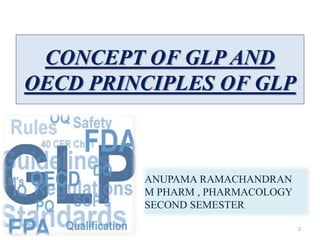
CONCEPT OF GLP AND
OECD PRINCIPLES OF GLP
ANUPAMA RAMACHANDRAN
M PHARM , PHARMACOLOGY
SECOND SEMESTER
2
CONTENTS
• INTRODUCTION
• OECD
• OBJECTIVES
• PRINCIPLES OF GLP
• BENEFITS
• GLP IN OUR COUNTRY
• CONCLUTION
• REFERENCE
3
WHAT IS A GOOD
LABORATORY PRACTICE ?
4
Good Laboratory Practice (GLP) is a quality system
concerned with the organizational process and the
conditions under which non-clinical health and
environmental safety studies are planned, performed,
monitored, recorded, archived and reported
5
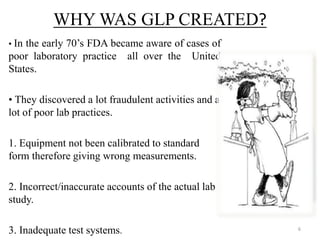
WHY WAS GLP CREATED?
• In the early 70’s FDA became aware of cases of
poor laboratory practice all over the United
States.
• They discovered a lot fraudulent activities and a
lot of poor lab practices.
1. Equipment not been calibrated to standard
form therefore giving wrong measurements.

2. Incorrect/inaccurate accounts of the actual lab
study.
3. Inadequate test systems. 6
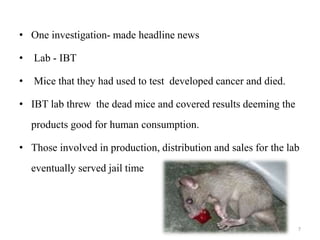
• One investigation- made headline news
• Lab - IBT
• Mice that they had used to test developed cancer and died.
• IBT lab threw the dead mice and covered results deeming the
products good for human consumption.
• Those involved in production, distribution and sales for the lab
eventually served jail time
7
GLP was instituted in US following cases of fraud generated by
toxicology labs in data submitted to the FDA by pharmaceutical
companies. As a result of these findings, FDA promulgated the
Good Laboratory Practice (GLP) Regulations, 21 CFR part 58,
on December 22, 1978 (43FR 59986). The regulations became
effective on June 1979.
8
As an international standard:
In 1981 an organization named OECD produced GLP
principles that are international standards of the OECD
Council, data generated in the testing of chemicals in one
OECD Member Country, in accordance with OECD Test
Guidelines and the Principles of GLP are accepted in all
other OECD Member Countries
9
OECD
• An intergovernmental organization.
• Representatives of 30 industrialized countries in North America,
Europe, Pacific and the European Commission.
• To co-ordinate and harmonize policies, discuss issues of mutual
concern, and work together to respond to international problems
• The Principles of GLP have been developed to promote the quality
and validity of test data used for determining the safety of chemicals
and chemical products
10
OBJECTIVES OF GLP
• data submitted are a true reflection of the results that are
obtained during the study.
• not to indulge in any fraud activity by labs.
• international acceptance of tests
11
GOOD LABORATORY
PRACTICE
PRINCIPLES
12
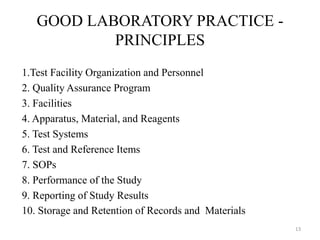
GOOD LABORATORY PRACTICE -
PRINCIPLES
1.Test Facility Organization and Personnel
2. Quality Assurance Program
3. Facilities
4. Apparatus, Material, and Reagents
5. Test Systems
6. Test and Reference Items
7. SOPs
8. Performance of the Study
9. Reporting of Study Results
10. Storage and Retention of Records and Materials
13
1.Test Facility Organization and Personnel
A. Test Facility Management’s Responsibilities
B. Study Director’s Responsibilities
C. Principal Investigator’s Responsibilities
D. Study Personnel’s Responsibilities
14
A)Test Facility Management’s Responsibilities.
• Sufficient no. of qualified personnel, appropriate facilities,
equipment, and materials are available for the timely and
proper conduct of the Study
• Maintenance of a record of the qualifications, training,
experience.
• Job description for each professional and technical individual.
• Documented approval of the study plan by the Study Director.
15
B. Study Director’s Responsibilities.
• Approve the study plan.
• Any amendments to the study plan by dated Signature.
• Availability of SOPS to the personnel.
• Raw data generated are fully documented and recorded.
• Computerized systems used in the study have been validated.
• Sign and date the final report to indicate acceptance of responsibility for the
validity of the data.
• Ensure that after completion of the study, the study plan, the final report,
raw data and supporting material are archived.
16
C. Principal Investigator’s Responsibilities
Ensure that the delegated phases of the study are conducted in
accordance with the applicable Principles of Good Laboratory Practice
17
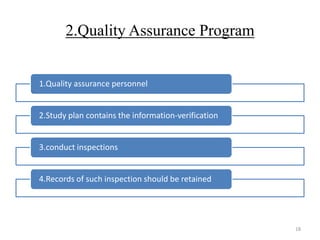
2.Quality Assurance Program
1.Quality assurance personnel
2.Study plan contains the information-verification
3.conduct inspections
4.Records of such inspection should be retained
18
3. Facilities
• Isolation of test systems and the isolation of individual projects involving
substances or organisms known to be or suspected of being bio hazardous.
• Areas as needed for supplies and equipment.
• Areas should be available for the diagnosis, treatment and control of diseases, in
order to ensure that there is no unacceptable degree of deterioration of test systems
Test system facilities
19
Archive Facilities
• Provided for the secure storage and retrieval of study plans,
raw data, final reports, samples of test items and specimens.
• Archive design and archive conditions should protect contents
from deterioration
20
Waste disposal
Handling and disposal of wastes should be carried out in such a
way as not to jeopardise the integrity of studies. This includes
provision for appropriate collection, storage and disposal
facilities, and decontamination and transportation procedures
21
4. Apparatus, Material, and Reagents
• Apparatus, including validated computerized systems, used for the generation, storage
and retrieval of data, and for controlling environmental factors relevant to the study.
• Apparatus used in a study should be periodically inspected, cleaned, maintained, and
calibrated according to SOPs
• Apparatus and materials used in a study should not interfere adversely with the test
systems.
• Chemicals, reagents, and solutions should be labeled to indicate
identity, expiry date and specific storage instructions.
• Information concerning source, preparation date and stability should be available.
22
5) Test Systems
• Physical and chemical test systems.
• Biological test systems.
• Records of source, date of arrival, and arrival conditions of test systems.
• Proper identification of test systems in their container or when removed.
• Cleaning and sanitization of containers.
• Pest control agents to be documented
23
6. Test and Reference Items
• Receipt, handling, sampling and storage
• Characterization.
• Known stability of test and reference items.
• Stability of the test item in its vehicle (container).
• Experiments to determine stability in tank mixers used in the field studies.
• Samples for analytical purposes for each batch
24
7.Standard Operating
Procedures (SOP)
• Written procedures for a laboratories program.
• They define how to carry out protocol specified activities.
• Most often written in a chronological listing of action steps.
• They are written to explain how the procedures are suppose to
work
25
• Routine inspection, cleaning, maintenance, testing and
calibration.
• Actions to be taken in response to equipment failure.
• Keeping records, reporting, storage, mixing, and retrieval of
data.
• Definition of raw data.
• Analytical methods
26
8).Performance of the Study
A. Study Plan
B. Content of the Study Plan
C. Dates
D. Test Methods
E. Issues (where applicable)
F. Records.
G. A list of records to be retained.
H. Conduct of the Study.
27
STUDY PLAN
• Identification of the study, the test item and reference item.
• Information concerning the sponsor and the test facility.
• Dates
• Test Methods
• Records
28
CONDUCT OF THE STUDY
• A unique identification should be given to each study, all items concerning this
study should carry this identification
• Specimens from the study should be identified to confirm their origin.
• Conducted in accordance with the study plan
• Data generated should be recorded directly, promptly, accurately and signed
and dated
29
9).Reporting of Study Results
• The final report should be signed and dated by the SD to indicate
acceptance of responsibility for the validity of the data.
• The extent of compliance with the principles of GLP should be indicated.
• Amendments should clearly specify the reason for the corrections or
additions and should be signed and dated by the SD
30
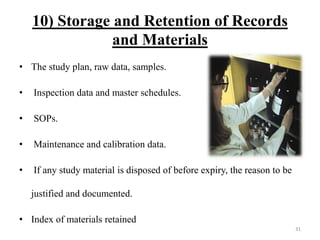
10) Storage and Retention of Records
and Materials
• The study plan, raw data, samples.
• Inspection data and master schedules.
• SOPs.
• Maintenance and calibration data.
• If any study material is disposed of before expiry, the reason to be
justified and documented.
• Index of materials retained
31
What Good Laboratory Must
Contain.?
• Area should be free from smoke, smell, dust etc.
• Ensure good ventilation, proper illumination and prefer natural
light.
• Air conditioned the lab with humidity control.
• Enough space for measuring and testing instrument
32
• Proper arrangement of testing.
• Take care of all safety points including proper earthing as well
as fire safety.
• Avoid uncleanable spots in floors, walls, ceiling.
• Establish proper areas for storage of incoming samples as well
as test–completed samples.
• Also provide sample collection place as well as packing and
disposal of tested samples. 33
Do this for GLP
• Keep the things at its location after use.
• Store heavy things at bottom & if possible on Trollies.
• Give name of location to everything.
• Follow “Everything has the place & Everything at its place” principle.
• Prepare location list & display it.
• Put ladders for things stored on top.
• Identify everything with its name/ purpose.
• Follow “FIFO” to prevent old accumulation for
laboratory chemicals
34
Benefits of good laboratory
practices.
• It will give better image of company as a Quality producer in
Global market.
• Provide hot tips on analysis of data as well as measure uncertainty
and perfect record keeping.
• Provide guideline for doing testing and measurement in detail
• Provide guidelines and better control for maintenance of instruments,
environment control, preservation of test records etc
35
GLP IN OUR
COUNTRY
36
• National GLP-compliance Monitoring Authority was
established by the Department of Science & Technology
• Approval of the Union Cabinet on April 24, 2002
• A provisional member of the OECD for GLP.
• India is an Observer to the OECD’s Working Group on GLP
• The Authority has trained 33 experts in the country as GLP
inspectors
37
CONCLUSION
GLP is an FDA regulation which is accepted and
approved as international standards by OECD to
avoid the fraud activities of the testing laboratories for
pesticides , pharmaceuticals , food additives , dyes, to
save the human and environmental health and also erect
good international trade and establish good relationship
among the countries
38
REFERENCE
1) Good Laboratory Practice. By European Chemical Industry
Ecology and Toxicology Centre (ECETOC), Monograph No.
1,Brussels October 1979.
2) Good Laboratory Practice. by G.E. Paget, MTP Press
Limited, Lancaster 1979
39
THANK YOU…
40

Glp

  • 1.
  • 2.
    CONCEPT OF GLPAND OECD PRINCIPLES OF GLP ANUPAMA RAMACHANDRAN M PHARM , PHARMACOLOGY SECOND SEMESTER 2
  • 3.
    CONTENTS • INTRODUCTION • OECD •OBJECTIVES • PRINCIPLES OF GLP • BENEFITS • GLP IN OUR COUNTRY • CONCLUTION • REFERENCE 3
  • 4.
    WHAT IS AGOOD LABORATORY PRACTICE ? 4
  • 5.
    Good Laboratory Practice(GLP) is a quality system concerned with the organizational process and the conditions under which non-clinical health and environmental safety studies are planned, performed, monitored, recorded, archived and reported 5
  • 6.
    WHY WAS GLPCREATED? • In the early 70’s FDA became aware of cases of poor laboratory practice all over the United States. • They discovered a lot fraudulent activities and a lot of poor lab practices. 1. Equipment not been calibrated to standard form therefore giving wrong measurements. 2. Incorrect/inaccurate accounts of the actual lab study. 3. Inadequate test systems. 6
  • 7.
    • One investigation-made headline news • Lab - IBT • Mice that they had used to test developed cancer and died. • IBT lab threw the dead mice and covered results deeming the products good for human consumption. • Those involved in production, distribution and sales for the lab eventually served jail time 7
  • 8.
    GLP was institutedin US following cases of fraud generated by toxicology labs in data submitted to the FDA by pharmaceutical companies. As a result of these findings, FDA promulgated the Good Laboratory Practice (GLP) Regulations, 21 CFR part 58, on December 22, 1978 (43FR 59986). The regulations became effective on June 1979. 8
  • 9.
    As an internationalstandard: In 1981 an organization named OECD produced GLP principles that are international standards of the OECD Council, data generated in the testing of chemicals in one OECD Member Country, in accordance with OECD Test Guidelines and the Principles of GLP are accepted in all other OECD Member Countries 9
  • 10.
    OECD • An intergovernmentalorganization. • Representatives of 30 industrialized countries in North America, Europe, Pacific and the European Commission. • To co-ordinate and harmonize policies, discuss issues of mutual concern, and work together to respond to international problems • The Principles of GLP have been developed to promote the quality and validity of test data used for determining the safety of chemicals and chemical products 10
  • 11.
    OBJECTIVES OF GLP •data submitted are a true reflection of the results that are obtained during the study. • not to indulge in any fraud activity by labs. • international acceptance of tests 11
  • 12.
  • 13.
    GOOD LABORATORY PRACTICE- PRINCIPLES 1.Test Facility Organization and Personnel 2. Quality Assurance Program 3. Facilities 4. Apparatus, Material, and Reagents 5. Test Systems 6. Test and Reference Items 7. SOPs 8. Performance of the Study 9. Reporting of Study Results 10. Storage and Retention of Records and Materials 13
  • 14.
    1.Test Facility Organizationand Personnel A. Test Facility Management’s Responsibilities B. Study Director’s Responsibilities C. Principal Investigator’s Responsibilities D. Study Personnel’s Responsibilities 14
  • 15.
    A)Test Facility Management’sResponsibilities. • Sufficient no. of qualified personnel, appropriate facilities, equipment, and materials are available for the timely and proper conduct of the Study • Maintenance of a record of the qualifications, training, experience. • Job description for each professional and technical individual. • Documented approval of the study plan by the Study Director. 15
  • 16.
    B. Study Director’sResponsibilities. • Approve the study plan. • Any amendments to the study plan by dated Signature. • Availability of SOPS to the personnel. • Raw data generated are fully documented and recorded. • Computerized systems used in the study have been validated. • Sign and date the final report to indicate acceptance of responsibility for the validity of the data. • Ensure that after completion of the study, the study plan, the final report, raw data and supporting material are archived. 16
  • 17.
    C. Principal Investigator’sResponsibilities Ensure that the delegated phases of the study are conducted in accordance with the applicable Principles of Good Laboratory Practice 17
  • 18.
    2.Quality Assurance Program 1.Qualityassurance personnel 2.Study plan contains the information-verification 3.conduct inspections 4.Records of such inspection should be retained 18
  • 19.
    3. Facilities • Isolationof test systems and the isolation of individual projects involving substances or organisms known to be or suspected of being bio hazardous. • Areas as needed for supplies and equipment. • Areas should be available for the diagnosis, treatment and control of diseases, in order to ensure that there is no unacceptable degree of deterioration of test systems Test system facilities 19
  • 20.
    Archive Facilities • Providedfor the secure storage and retrieval of study plans, raw data, final reports, samples of test items and specimens. • Archive design and archive conditions should protect contents from deterioration 20
  • 21.
    Waste disposal Handling anddisposal of wastes should be carried out in such a way as not to jeopardise the integrity of studies. This includes provision for appropriate collection, storage and disposal facilities, and decontamination and transportation procedures 21
  • 22.
    4. Apparatus, Material,and Reagents • Apparatus, including validated computerized systems, used for the generation, storage and retrieval of data, and for controlling environmental factors relevant to the study. • Apparatus used in a study should be periodically inspected, cleaned, maintained, and calibrated according to SOPs • Apparatus and materials used in a study should not interfere adversely with the test systems. • Chemicals, reagents, and solutions should be labeled to indicate identity, expiry date and specific storage instructions. • Information concerning source, preparation date and stability should be available. 22
  • 23.
    5) Test Systems •Physical and chemical test systems. • Biological test systems. • Records of source, date of arrival, and arrival conditions of test systems. • Proper identification of test systems in their container or when removed. • Cleaning and sanitization of containers. • Pest control agents to be documented 23
  • 24.
    6. Test andReference Items • Receipt, handling, sampling and storage • Characterization. • Known stability of test and reference items. • Stability of the test item in its vehicle (container). • Experiments to determine stability in tank mixers used in the field studies. • Samples for analytical purposes for each batch 24
  • 25.
    7.Standard Operating Procedures (SOP) •Written procedures for a laboratories program. • They define how to carry out protocol specified activities. • Most often written in a chronological listing of action steps. • They are written to explain how the procedures are suppose to work 25
  • 26.
    • Routine inspection,cleaning, maintenance, testing and calibration. • Actions to be taken in response to equipment failure. • Keeping records, reporting, storage, mixing, and retrieval of data. • Definition of raw data. • Analytical methods 26
  • 27.
    8).Performance of theStudy A. Study Plan B. Content of the Study Plan C. Dates D. Test Methods E. Issues (where applicable) F. Records. G. A list of records to be retained. H. Conduct of the Study. 27
  • 28.
    STUDY PLAN • Identificationof the study, the test item and reference item. • Information concerning the sponsor and the test facility. • Dates • Test Methods • Records 28
  • 29.
    CONDUCT OF THESTUDY • A unique identification should be given to each study, all items concerning this study should carry this identification • Specimens from the study should be identified to confirm their origin. • Conducted in accordance with the study plan • Data generated should be recorded directly, promptly, accurately and signed and dated 29
  • 30.
    9).Reporting of StudyResults • The final report should be signed and dated by the SD to indicate acceptance of responsibility for the validity of the data. • The extent of compliance with the principles of GLP should be indicated. • Amendments should clearly specify the reason for the corrections or additions and should be signed and dated by the SD 30
  • 31.
    10) Storage andRetention of Records and Materials • The study plan, raw data, samples. • Inspection data and master schedules. • SOPs. • Maintenance and calibration data. • If any study material is disposed of before expiry, the reason to be justified and documented. • Index of materials retained 31
  • 32.
    What Good LaboratoryMust Contain.? • Area should be free from smoke, smell, dust etc. • Ensure good ventilation, proper illumination and prefer natural light. • Air conditioned the lab with humidity control. • Enough space for measuring and testing instrument 32
  • 33.
    • Proper arrangementof testing. • Take care of all safety points including proper earthing as well as fire safety. • Avoid uncleanable spots in floors, walls, ceiling. • Establish proper areas for storage of incoming samples as well as test–completed samples. • Also provide sample collection place as well as packing and disposal of tested samples. 33
  • 34.
    Do this forGLP • Keep the things at its location after use. • Store heavy things at bottom & if possible on Trollies. • Give name of location to everything. • Follow “Everything has the place & Everything at its place” principle. • Prepare location list & display it. • Put ladders for things stored on top. • Identify everything with its name/ purpose. • Follow “FIFO” to prevent old accumulation for laboratory chemicals 34
  • 35.
    Benefits of goodlaboratory practices. • It will give better image of company as a Quality producer in Global market. • Provide hot tips on analysis of data as well as measure uncertainty and perfect record keeping. • Provide guideline for doing testing and measurement in detail • Provide guidelines and better control for maintenance of instruments, environment control, preservation of test records etc 35
  • 36.
  • 37.
    • National GLP-complianceMonitoring Authority was established by the Department of Science & Technology • Approval of the Union Cabinet on April 24, 2002 • A provisional member of the OECD for GLP. • India is an Observer to the OECD’s Working Group on GLP • The Authority has trained 33 experts in the country as GLP inspectors 37
  • 38.
    CONCLUSION GLP is anFDA regulation which is accepted and approved as international standards by OECD to avoid the fraud activities of the testing laboratories for pesticides , pharmaceuticals , food additives , dyes, to save the human and environmental health and also erect good international trade and establish good relationship among the countries 38
  • 39.
    REFERENCE 1) Good LaboratoryPractice. By European Chemical Industry Ecology and Toxicology Centre (ECETOC), Monograph No. 1,Brussels October 1979. 2) Good Laboratory Practice. by G.E. Paget, MTP Press Limited, Lancaster 1979 39
  • 40.