GLP IN PHARMACEUTICAL
INDUDTERY
SCOPE
Scope of this Presentation is to cover Good
Laboratory Practice (GLP) required for
Pharmaceutical Products also known as “Drug
Product”
DEFINATION & IMPORTANCE
 The principles of Good Laboratory Practice
(GLP) define a set of rules and criteria for a
quality system concerned with the
organizational process and the conditions
under which laboratory studies are planned,
performed, monitored, recorded, reported and
archived
 The GLP plays an important to ensure safety,
quality and uniformity of Pharmaceutical
products.
MAIN FEATURES OF GLP
 Laboratory Safety
 Accuracy
 Reliability
 Reproducibility
 Documentation
 Training
 Review/Check
OBJECTIVES OF GLP
 GLP makes sure that the data submitted are a
true reflection of the results that are obtained
during the study.
 GLP also makes sure that data is traceable.
 Promotes international acceptance of tests.
MISSION OF GLP
 Test systems
 Archiving of records and materials.
 Apparatus, material and reagent facilities.
 Quality assurance programs.
 Performance of the study.
 Reporting of study results.
 Standard operating procedures (SOP)
 Personnel and test facility organization
STANDARD OPERATING PROCEDURES (SOP)
 Written procedures for a laboratories program.
 They define how to carry out protocol-specified
activities.
 Most often written in a chronological listing of action
steps.
 They are written to explain how the procedures are
suppose to work
INSTRUMENTATION VALIDATION
 This is a process necessary for any analytical laboratory.
 Data produced by “faulty” instruments may give the
appearance of valid data.
 The frequency for calibration, re-validation and testing depends
on the instrument and extent of its use in the laboratory.
 Whenever an instrument’s performance is outside the “control
limits” reports must be discontinued
REAGENTS AND SOLUTIONS
Requirements:
 Reagents and solutions shall be labeled
 Deteriorated or outdated reagents and solutions shall not
be used
 Include Date opened
 Stored under ambient temperature
 Expiration date
LABORATORY SAFETY
 It is very important to be safe when working in a laboratory.
 Wear Personal Protective Equipment (PPE) such as Goggles &
Gloves
 Avoid exposure to Hazardous Material by planning all
procedures before starting any laboratory work.
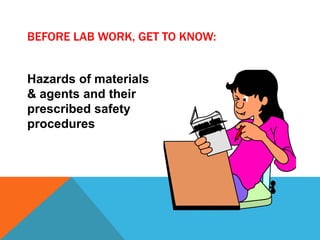
BEFORE LAB WORK, GET TO KNOW:
Hazards of materials
& agents and their
prescribed safety
procedures
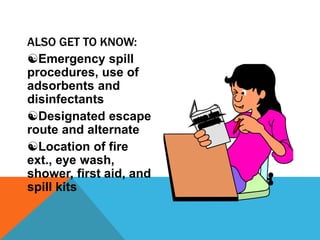
ALSO GET TO KNOW:
Emergency spill
procedures, use of
adsorbents and
disinfectants
Designated escape
route and alternate
Location of fire
ext., eye wash,
shower, first aid, and
spill kits
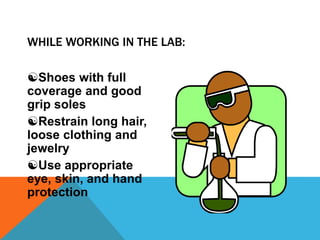
WHILE WORKING IN THE LAB:
Shoes with full
coverage and good
grip soles
Restrain long hair,
loose clothing and
jewelry
Use appropriate
eye, skin, and hand
protection
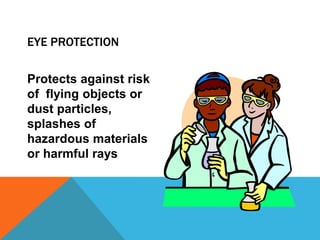
EYE PROTECTION
Protects against risk
of flying objects or
dust particles,
splashes of
hazardous materials
or harmful rays
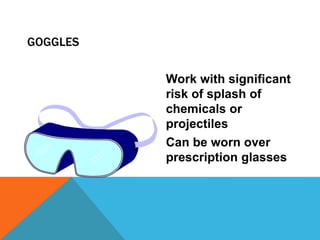
GOGGLES
Work with significant
risk of splash of
chemicals or
projectiles
Can be worn over
prescription glasses
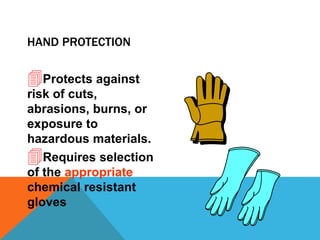
HAND PROTECTION
Protects against
risk of cuts,
abrasions, burns, or
exposure to
hazardous materials.
Requires selection
of the appropriate
chemical resistant
gloves
WHILE WORKING IN THE LAB:
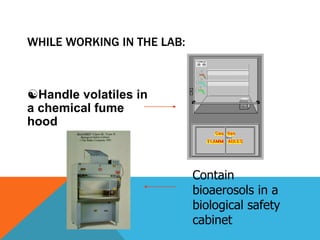
Handle volatiles in
a chemical fume
hood
Contain
bioaerosols in a
biological safety
cabinet
WHILE WORKING IN THE LAB:
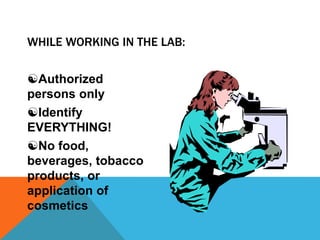
Authorized
persons only
Identify
EVERYTHING!
No food,
beverages, tobacco
products, or
application of
cosmetics
BEFORE LEAVING THE LAB:
Turn off:
Gas
Water
Power supplies
Vacuum lines
Compression lines
Heating apparatus
TRAINING
Requirements for training of Lab. Colleagues:
 Certification of Analysts
 Job competency standards
 Job descriptions
 Continuing education programs and annual refreshers are
fundamental for GLP Compliance.
WHAT ARE THOSE GOOD LABORATORY PRACTICES?
CHEMICAL LABORATORY:
 All analytical data generated by an Analysts must be counter check by
second analyst with full signature and date.
 All the documents must carry the name of the products and batch# and
date.
 Use of Blanco or other similar correction fluid must be prohibited in the
Lab.
 Correction can be done by simple cross once and sign.
 Testing must be done as per approved Method or SOP.
 No manual correction should be done on already approved method or
SOP.
 If any such method need correction, then proper procedure of such
revision must be in place.
 All raw data must be available for review and check.
 All the instrument must be calibrated as per procedure and frequency
defined.
 Handling and storage of Reference Standard both Primary and
Secondary.
CONCLUSION:
The result of GLP is that the performance of a
laboratory is improved and its working effectively
controlled. This results in an improved reputation
for the laboratory (and for the institute as a whole).
In short, the message is:
- say what you do
- do what you say
- do it better
- be able to show what you have done
Thank You

GLP PPT.ppt

  • 1.
  • 2.
    SCOPE Scope of thisPresentation is to cover Good Laboratory Practice (GLP) required for Pharmaceutical Products also known as “Drug Product”
  • 3.
    DEFINATION & IMPORTANCE The principles of Good Laboratory Practice (GLP) define a set of rules and criteria for a quality system concerned with the organizational process and the conditions under which laboratory studies are planned, performed, monitored, recorded, reported and archived  The GLP plays an important to ensure safety, quality and uniformity of Pharmaceutical products.
  • 4.
    MAIN FEATURES OFGLP  Laboratory Safety  Accuracy  Reliability  Reproducibility  Documentation  Training  Review/Check
  • 5.
    OBJECTIVES OF GLP GLP makes sure that the data submitted are a true reflection of the results that are obtained during the study.  GLP also makes sure that data is traceable.  Promotes international acceptance of tests.
  • 6.
    MISSION OF GLP Test systems  Archiving of records and materials.  Apparatus, material and reagent facilities.  Quality assurance programs.  Performance of the study.  Reporting of study results.  Standard operating procedures (SOP)  Personnel and test facility organization
  • 7.
    STANDARD OPERATING PROCEDURES(SOP)  Written procedures for a laboratories program.  They define how to carry out protocol-specified activities.  Most often written in a chronological listing of action steps.  They are written to explain how the procedures are suppose to work
  • 8.
    INSTRUMENTATION VALIDATION  Thisis a process necessary for any analytical laboratory.  Data produced by “faulty” instruments may give the appearance of valid data.  The frequency for calibration, re-validation and testing depends on the instrument and extent of its use in the laboratory.  Whenever an instrument’s performance is outside the “control limits” reports must be discontinued
  • 9.
    REAGENTS AND SOLUTIONS Requirements: Reagents and solutions shall be labeled  Deteriorated or outdated reagents and solutions shall not be used  Include Date opened  Stored under ambient temperature  Expiration date
  • 10.
    LABORATORY SAFETY  Itis very important to be safe when working in a laboratory.  Wear Personal Protective Equipment (PPE) such as Goggles & Gloves  Avoid exposure to Hazardous Material by planning all procedures before starting any laboratory work.
  • 11.
    BEFORE LAB WORK,GET TO KNOW: Hazards of materials & agents and their prescribed safety procedures
  • 12.
    ALSO GET TOKNOW: Emergency spill procedures, use of adsorbents and disinfectants Designated escape route and alternate Location of fire ext., eye wash, shower, first aid, and spill kits
  • 13.
    WHILE WORKING INTHE LAB: Shoes with full coverage and good grip soles Restrain long hair, loose clothing and jewelry Use appropriate eye, skin, and hand protection
  • 14.
    EYE PROTECTION Protects againstrisk of flying objects or dust particles, splashes of hazardous materials or harmful rays
  • 15.
    GOGGLES Work with significant riskof splash of chemicals or projectiles Can be worn over prescription glasses
  • 16.
    HAND PROTECTION Protects against riskof cuts, abrasions, burns, or exposure to hazardous materials. Requires selection of the appropriate chemical resistant gloves
  • 17.
    WHILE WORKING INTHE LAB: Handle volatiles in a chemical fume hood Contain bioaerosols in a biological safety cabinet
  • 18.
    WHILE WORKING INTHE LAB: Authorized persons only Identify EVERYTHING! No food, beverages, tobacco products, or application of cosmetics
  • 19.
    BEFORE LEAVING THELAB: Turn off: Gas Water Power supplies Vacuum lines Compression lines Heating apparatus
  • 20.
    TRAINING Requirements for trainingof Lab. Colleagues:  Certification of Analysts  Job competency standards  Job descriptions  Continuing education programs and annual refreshers are fundamental for GLP Compliance.
  • 21.
    WHAT ARE THOSEGOOD LABORATORY PRACTICES? CHEMICAL LABORATORY:  All analytical data generated by an Analysts must be counter check by second analyst with full signature and date.  All the documents must carry the name of the products and batch# and date.  Use of Blanco or other similar correction fluid must be prohibited in the Lab.  Correction can be done by simple cross once and sign.  Testing must be done as per approved Method or SOP.  No manual correction should be done on already approved method or SOP.  If any such method need correction, then proper procedure of such revision must be in place.  All raw data must be available for review and check.  All the instrument must be calibrated as per procedure and frequency defined.  Handling and storage of Reference Standard both Primary and Secondary.
  • 22.
    CONCLUSION: The result ofGLP is that the performance of a laboratory is improved and its working effectively controlled. This results in an improved reputation for the laboratory (and for the institute as a whole). In short, the message is: - say what you do - do what you say - do it better - be able to show what you have done
  • 23.