     
MUNKHTULGA G.
   Structure and functions of glomeruli
   Introduction of Glomerulonephritis /GN/
   Prevalence
   Etiology and risk factor
   Classification and types
   Pathogenesis and pathologic changes
   Clinical features and symptoms
   Diagnosis
   Treatment
   Differential diagnosis
   Complications
   Screening
   Prevention
   Reference
Range
Pressure
              /mmHg/
Hydrostatic   60-90
 Oncotic      25-30
Glomerular
              10-20
 capsules
Lacis cells –
Гурмагтиг
   GN is group disease of glomerulus, an inflammatory
    process that involves glomerular structures, caused by
    immune disruption, is the leading cause of renal
    interstitial tissue damage.
   2-7% of internal patients have GN.
Exogenic                                 Endogenic
- Infectious                             - HLA - A2, BW 35, B7, B8, B15
    - Bacterial /β-streptococcal-1, 4,   - Cancer, tuberculosis …
       12, 18, 25, 55, 60;               - Disturbance of T/B lymphocyte ratio
       staphylacoccal, pneumococcal/     - Congenital deficiency of T
    - Viral                                lymphocyte
- Non-infectious /sulfanylamid,          - Deficiency of complement
  penicillin, iodine, mercury, brome,      synthesize
  aspirin . . ./                         - Auto-antigen


                                                     “Бөөр судлал” Гэлэгжамц.Х нар
By clinical and disease progress
   Acute GN
    o Nephrotic Acute GN /minimal GN/
    o Nephritic AGN
    o Classical type
   Rapidly progressive GN /Crescentic GN/
   Chronic GN
    o Latent Chronic GN
    o With Hematuria
    o Nephrotic CGN
    o Hypertensive CGN


                                        “Бөөр судлал” Гэлэгжамц.Х нар
Source: Robbins & Cotran Pathologic Basis of Disease
   Auto-Antibody/autoimmune/ - In situ
   Immune complex
Granular, IC deposition   Linear, IC deposition

Nephrotic syndrome          Nephritic syndrome
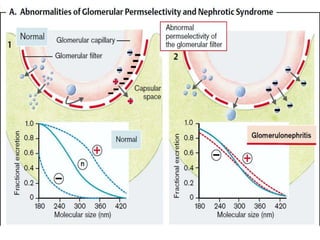
Proteinuria >3,5 g/l        Hematuria
Lipiduria, hyperlipidemia   Cylinderuria
Hypoproteinemia,            Leucocyturia, Glucosuria,
Hypoalbuminemia             Ketonuria,
Edema                       Hypo-Hyperstenuria …
   By far the most common cause of nephrotic syndrome in adolescent
   Declining to about 25% of cases of nephrotic syndrome in older
    adults


   Lesion of podocytes constitution
   GBMs charge changed
   No depositions in GBM
   Present with nephrotic syndrome
   No RBC and WBC in urine
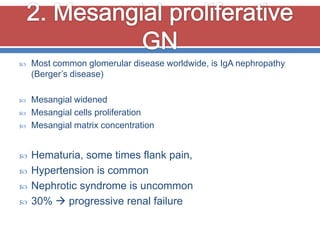
   Most common glomerular disease worldwide, is IgA nephropathy
    (Berger’s disease)

   Mesangial widened
   Mesangial cells proliferation
   Mesangial matrix concentration


   Hematuria, some times flank pain,
   Hypertension is common
   Nephrotic syndrome is uncommon
   30%  progressive renal failure
   IC accumulated in
    mesangiocyte &
    endothelium 
    mesangium thickened
   IgG, IgA, C3

   Berger’s disease
   Etiology is unknown
   Sub-epithelial immune deposits, thickened GBM
   Most common cause of nephrotic syndrome in adults


   Prognosis:
   25%  End stage renal disease over 25 years
   25%  spontaneous remission
   Second most common cause of nephrotic syndrome in
    adults

   Prognosis: Up to 75%  develop progressive renal
    failure over 20 years.
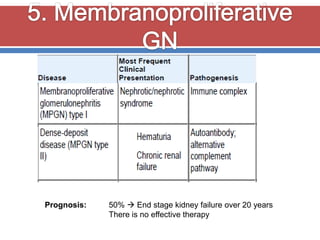
Prognosis:   50%  End stage kidney failure over 20 years
             There is no effective therapy
Type 1   Type 2
1.   Acute GN
2.   Membranous GN
3.   Membrano-
     proliferative GN
4.   Mesangial GN or
     IgA GN
 Glomerulonephritis    is an inflammatory process
  affecting primarily the glomerulus, with infiltration
  and proliferation of acute inflammatory cells.
 These are principally mononuclear cells and
  neutrophils in post-infectious glomerulonephritis.
   The inflammation is immunologically mediated with
    immune deposits in the glomerulus. Onset of symptoms
    is usually acute.

   Usually Acute GN occurs after upper respiratory tracts
    infection, 10-21 days.

   Children and guys
* Post streptococcal GN
                                         1. Bacterial: endocarditis,
                                         pneumococcal pneumonia,
                             * Non-      meningococcecemia
1   Infectious
                         streptococcal   2. Viral: B, C hepatitis, салхин
                               GN        цэцэг, Коксаки
                                         3. Parasite: mosquito, malaria,
                                         toxoplasmosis
2   Systemically disease: SLE, RA, Schonlein-Henoch vasculitis
    Primary renal disease: Mesangial capillary GN, Berger’s disease,
3
    Mesangial proliferative GN
4   Холимог: serum disease, Гийен-Баррын хам шинж

A groups, 4, 19, 25, 49 β hemolytic streptococcal angina
                                                    “Бөөр судлал” Гэлэгжамц.Х нар
   Acute Nephritic syndrome
    o Hypertension /Hypervolemia, hyperhydration/
    o Hematuria
    o Swelling, urine volume ↓
   Facies nephritica
   Dry skin /lose nutrient/
   Striae distansae
   Fragile nail and hair
   Swelling  weakness, anasarca
   Edema  Face, back around, abdomen, genital organ
   Tachypnea,
   Palpitation,
   Loss of appetite
   Tympanitis
   Thirst
   Oligo-anuria
   Weakness
   Presented with nephritic syndrome
   Classical type of AGN
   Presented with nephrotic syndrome
   Slowly beginning
   Puffiness around the eyes and face
   Flank pain
   Usually no urine color changes
   Symptoms are Latent  chronic nephritis
   Mild hypertension /70-80%/
   Proteinuria less than 1 gr/l
   RBC, cylinder is seen in the urine
   Macrohematuria occurs in few cases
   Acute Nephritic syndrome is clear
   GFR ↓
   Sodium reabsorption in tubule ↑                Nephritic
    edema
   Imbalance of water-salt exchange
   Nephritic edema level < Nephrotic edema level
   Arterial Hypertension 140/100 – 170/110 ↑
   Palpitation, tachypnea, left ventricle failure
   Proteinuria 1-3 gr/l
   Urine volume ↓
Heavy condition: pre-eclampsia, eclampsia, acute kidney and heart failure
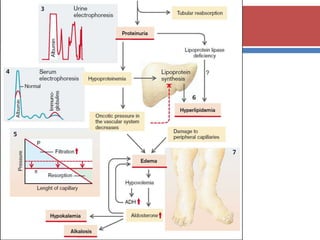
   Proteinuria >3gr/l per day
   Decreased protein in blood  serum oncotic pressure ↓
      Edema
   Anasarca
   Foam in urine (slowly removed)
   Hyperlipidemia
   No hematuria
   Arterial hypertension is rare
   Acute Heart failure
   Eclampsia
   Nephrotic crisis
   Acute renal failure
   After 14-21 days of angina and other infections, young
    people could have acute nephritic syndrome and
    backache.
   Important things:
    o Never had renal disease
    o Never had changes in the urinalysis
   In urinalysis:
    o Proteinuria 1-3 gr/l [in heavy case: 3-20gr/l]
    o Detected erythrocytes, few leucocytes/lymphocytes/ and
      cylinders
    o Specific gravity is normal [during excess proteinuria  SG ↑]
   CBCC /Complete Blood Cell Count/
    o Decreased hemoglobin /water accumulated in body then it leads
      dissolved blood/
    o Lightly increased WBC, УЭТХ ↓
   Blood Function Test
    o During nephrotic syndrome, Serum protein and albumin ↓
    o γ-globulin↑, disproteinemia
    o Lipid and cholesterol ↑
    o C3 ↓, after 6-8 weeks becomes normal
    o GFR slightly ↓
    o During heavy acute nephritis, serum creatinine, urea, leftover
      nitrogen ↑
 Scan     tests:
   Fundus photography:
    o Arterial hypertension  arterioles constricted, bulbous n. opticus
      swollen and stroke
   Ultrasound:
    o Renal size is normal or little enlarged.
   Urinalysis, identify: protein in daily urine
   CBCC: Hgb
   Хоолойн арчдас авч, нян ургуулах
   BFT: total protein, protein group, total
    lipid, cholesterol, leftover nitrogen, creatinine, K+ Na+ C-
    reactive protein
   Coagulogram: protrombin, fibrinogen
   Immunology: ЦИК, IgA, M, G, complement, T, B
    lymphocytes
   Renal ultrasound: Size, cortex thick
   Renal biopsy
   Fundus photography, chest x-ray, ECG
   Chronic GN
    o Whether patient had renal disease or urine changes
    o After grater influenced, GNs symptoms and edema increased within
        short term
    o   During Chronic GN, urine changes keeps for long term
    o   Arterial hypertension increased, constantly
    o   GFR ↓ - constantly, irreversible
    o   Ultrasound: Parenchymal dense ↑, kidney size normal or small
   Pyelonephritis
    o Dysuria, чинэрч өвдөнө, шээлэйн дагуу дамжиж өвдөнө
    o Fever, loss of appetite, weakness
    o Palpate or push to Angle cost-vertebral/Symptom Pasternatski/:
      Clear
    o Urinalysis: Protein 0,5-1,0 gr/l, leucocyte and bacterium +
   Administrate to hospital for 30 days
   Keep treatment for 3 months to 1 year
   In not heavy case: symptomatic therapy for 14 days
    o Anti-infection treatment: if it caused by infection
    o Immunosupressant: if immune activation is high or heavy nephrotic
      syndrome
   General principle of treatment
    o Regimen
    o Diet
    o Drug
    o Sanatorium care
 Bed rest or decubitus for 14-21 days
Diet:
 First 1-2 days restraint food, only given apple, fruit juice
  & rice glop
 Next 5-7 days, limited animal protein 0,5 gr/kg, only use
  non-animal protein
 After 10 days, protein 1gr/kg
 Kcal – 2300-2800 kcal
 No salt /2-3 week/
   Post-streptococcal:
    o Хагас нийлэг penicillin oxicillin, amoxicillin – 1-2 mill U/day
    o Penicillin G 1-2 mill U/day by injection
    o Vitamin C oral or inject
   Keep symptomatic treatment for 2-6 months
   Immunosuppressant/if there is no result >2 months/:
    o During nephrotic syndrome, prednisone 0,8-1,2 mg/day, slowly
      decrease dosage by clinical and laboratory changes
    o Keep treatment for 6 months to 1 year
    o If patient can’t use glucocorticoid, We can use cytostatic drugs
   Improve renal blood supply:
    o Heparin 15000-20000 ED/day
    o Anti-aggregant: Curantil 200-300 mg/day for 2-4 months by
      slowly decrease dosage
    o Nicotine acid 1%
   Anti-hypertensive and diuretics
    o Anti-hypertensive drugs /6 groups/
    o Diuretics: Thiazides – furosemide 20-80 mg/day 2-3 times
   Under doctors control for 2 years
   Avoid manual labor about 1 year
   Second prevention!!!
   Urinalysis - every 3 months
   Blood function test – every 3months
   Zimnitskii, Reberg’s test and isotopic renogram - every
    1 year
   If there was no deterioration or were no changes in
    analysis in 2 years we will suggest that the patient is
    recovered
   Rapidly progressive glomerulonephritis (RPGN) is a
    syndrome associated with severe glomerular injury and
    does not denote a specific etiologic form of
    glomerulonephritis. It is characterized clinically by rapid
    and progressive loss of renal function associated with
    severe oliguria and signs of nephritic syndrome; if
    untreated, death from renal failure occurs within weeks
    to months.[7]

   The U.S – 7:1,000,000
   The U.K – 2:100,000
   Male : Female – 1:1
   2-92 age
Rapidly Progressive
Glomerulonephritides
            TYPE I (ANTI-GBM ANTIBODY)
Renal limited
Goodpasture syndrome
             TYPE II (IMMUNE COMPLEX)
Idiopathic
Post-infectious glomerulonephritis
Lupus nephritis
Henoch-Schönlein purpura (IgA nephropathy)
Others
              TYPE III (PAUCI - IMMUNE)
ANCA-associated
Idiopathic
Wegener granulomatosis
Microscopic polyangiitis   Source: Robbins & Cotran Pathologic Basis of Disease
   Hematuria
   Edema                   acute
   Arterial hypertension

   After 2-3 months:
    o Azotemia
    o Anemia


   RENAL BIOPSY
   4 complexes treatment:
    o Hormone
    o Cytostatic
    o Plasmophoresis
    o Hemosorbtive


   2nd  combination treatment
   Nearly all forms of acute glomerulonephritis have a
    tendency to progress to chronic glomerulonephritis. The
    condition is characterized by irreversible and progressive
    glomerular and tubulo-interstitial fibrosis, ultimately
    leading to a reduction in the glomerular filtration rate
    (GFR) and retention of uremic toxins. If disease
    progression is not halted with therapy, the net results
    are chronic kidney disease(CKD), end-stage renal
    disease (ESRD), and cardiovascular disease.[10]
   Exogenic
   Endogenic

   Immunogenic
   Non-Immunogenic
    o Renal function
    o Circulatory
    o Coagulation
    o Metabolism
By Clinical
   Latent CGN
    o CGN with Proteinuria   Nephritic syndrome
    o CGN with Hematuria
   Nephrotic CGN
   CGN with arterial hypertension
   CGN холимог хэлбэр
   Only Urine changes
   No complains,
   No urine color & volume changes
   In few case: swelling
   Urinalysis:
    o Protein less than 3 gr/l
    o Erythrocytes and cylinder is seen
   Renal functions measurements keep normal range foe
    20-30 year
   Usually occurs children, young people
   Hematuria
   Decreased blood in urine within few days
   Protein in urine: 1-2 gr/L
   Old erythrocytes and cylinder in urine
   No renal pain, no edema, no hypertension
   Disease progress: 30-40 years
   Dry skin
   Urine has foam
   Daily urine volume ↓
   First, puffiness around the eyes and face,
   Then, anasarca
   Sometimes, fluid accumulated in organ that has cavity
   Loss of appetite
   Sensitive to cold
   Proteinuria: 3,5-20 gr/l
   Anemia
   Complication of infection /immune weakness/
   Fluid accumulation in thorax leads wound(pus)
   Pneumonia
   Urinary tract infection
   Venous thrombosis
   Tingle around kidney
   Blood pressure ↓
   Acute Renal failure
   Nephrotic crisis  fever, nausea, vomiting, tingle around
    abdomen, detected symptom of peritonitis
   High blood pressure
   Nephritic syndrome
   Initial phase – normal blood pressure
   Deterioration period – high blood pressure
   Headache, dizziness, worsen eyesight, pain around the
    heart.
   2nd sound loudly around the aorta and systolic clamor
   Left ventricle hypertrophy, arhythmia/heavy case/
   Urinalysis: 1-3 gr/l protein, few erythrocyte & cylinder
   BFT: Lipid↑, cholesterol↑
   Hypertension + Nephrotic syndrome
   Swelling, hypertension
   Complication: After 3-5 years  Renal failure
   Decreased production of erythropoietin, thus resulting in
    anemia
   Decreased production of vitamin D, resulting in
    hypocalcemia, secondary
    hyperparathyroidism, hyperphosphatemia, and renal
    osteodystrophy
   Reduction in acid, potassium, salt, and water
    excretion, resulting in
    acidosis, hyperkalemia, hypertension, and edema
   Platelet dysfunction, leading to increased bleeding
    tendencies
   After deteriorate, suddenly swelling
   During deterioration: Urine changes ↑, long term
   Ultrasound: shallow parenchyma, kidney size ↓

   Necessary test:
    o CBCC, Urinalysis
    o Identify protein in daily urine
    o Ничепоренко, Аддис-Каковскийн сорил
    o Зимницкийн сорил
    o Blood function test: Total protein, proteins group, lipid,
      cholesterol, creatinine, BUN, leftover nitrogen, K, Na, Ca, P
   Cystitis
   Renal tuberculosis
   Hereditary nephritis
   Chronic Pyelonephritis:
    o Urine color and odor changes, smoky urine
    o Neutrophilic leucocyturia and microbe in urine
    o Fever, pain around kidney
    o Scan test: Detected calyx and pelvis changes
   Acute GN ???
   Interstitial tissue and tubular nephritis/toxicosis/
   During deterioration, administrate to hospital for 14-30 days


   Regimen and nutrient therapy
   Pathophysiological treatment
     o Glucocorticoid – Prednisone 1mg/kg for 2-9 weeks
     o Cytostatic – Имуран/азатиоприн/ 100-150 мг, циклофосфамид
       2-3 мг/кг/өдөр
     o Anti-coagulant – Heparin 10,000-40,000 U/day
     o Anti-aggregant – Дипиридамол/курантил/ 225-400 мг/өдөр
     o Anti-hypertensive
     o Symptomatic
   Specific therapy for each types of CGN
   Bed rest or decubitus for 2-3 weeks
   Nephrotic, Hypertensive GN:
    o Protein 0,5 gr/kg, after 3rd week 1 gr/kg
    o Hyperproteinuria, hypoalbuminemia : add egg, fish, chicken
    o 2800-3000 kcal/day
    o Apple, banana, cream, honey, jam – allow
    o Parching, grilled, preserved products, spicy… - Not-allowed
    o Salt decrease about 2-3 gr  hypertension
Stage     GFR                   The action plan
         mL/min
 1      ≥90     Diagnosis and treatment,
                Treatment of comorbid conditions,
                Slowing of the progressing of kidney disease
                Reduction of cardiovascular disease risks
 2      60-90   Estimation of the progression of kidney
                disease
 3      30-59   Evaluation and treatment of complications
 4      15-29   Preparation for renal replacement therapy
 5      -         Kidney failure, Kidney replacement if the
                  patient is uremic
                                          www.emedicine.medscape.com
   Urinalysis – every 3 months
   BFT – every 6 months
   On time treatment:
    o Respiratory tract infection
    o Every deterioration of CGN
1.    Бөөр судлал, Гэлэгжамц.Х, Ариунаа.Т нар, 2010 он
2.    Color atlas of pathophysiology, Silbernagl et al. 2000
3.    Color atlas of physiology, 5th edition Agamemnon
      Despopoulos et al. 2003
4.    Clinical nephrology, Woo Keng Thye, 1998
5.    Fox: Human physiology, 8th edition, 2003
6.    Harrison's Principles of Internal Medicine, 17th edition
7.    Pathologic Basis of Disease, Robbins & Cotran, 8th edition,
      2009
8.    Pathophysiology: Concepts of Altered Health States, Carol
      Mattson Porth, 7th edition, 2004
9.    Textbook of medical physiology, 11th edition Guyton & Hall,
      2006
10.   www.emedicine.medscape.com
Glomerulonephritis /HSUM/

Glomerulonephritis /HSUM/

  • 1.
     MUNKHTULGA G.
  • 2.
    Structure and functions of glomeruli  Introduction of Glomerulonephritis /GN/  Prevalence  Etiology and risk factor  Classification and types  Pathogenesis and pathologic changes  Clinical features and symptoms  Diagnosis  Treatment  Differential diagnosis  Complications  Screening  Prevention  Reference
  • 5.
    Range Pressure /mmHg/ Hydrostatic 60-90 Oncotic 25-30 Glomerular 10-20 capsules
  • 6.
  • 9.
    GN is group disease of glomerulus, an inflammatory process that involves glomerular structures, caused by immune disruption, is the leading cause of renal interstitial tissue damage.
  • 10.
    2-7% of internal patients have GN.
  • 11.
    Exogenic Endogenic - Infectious - HLA - A2, BW 35, B7, B8, B15 - Bacterial /β-streptococcal-1, 4, - Cancer, tuberculosis … 12, 18, 25, 55, 60; - Disturbance of T/B lymphocyte ratio staphylacoccal, pneumococcal/ - Congenital deficiency of T - Viral lymphocyte - Non-infectious /sulfanylamid, - Deficiency of complement penicillin, iodine, mercury, brome, synthesize aspirin . . ./ - Auto-antigen “Бөөр судлал” Гэлэгжамц.Х нар
  • 12.
    By clinical anddisease progress  Acute GN o Nephrotic Acute GN /minimal GN/ o Nephritic AGN o Classical type  Rapidly progressive GN /Crescentic GN/  Chronic GN o Latent Chronic GN o With Hematuria o Nephrotic CGN o Hypertensive CGN “Бөөр судлал” Гэлэгжамц.Х нар
  • 14.
    Source: Robbins &Cotran Pathologic Basis of Disease
  • 15.
    Auto-Antibody/autoimmune/ - In situ  Immune complex
  • 17.
    Granular, IC deposition Linear, IC deposition
  • 20.
  • 21.
    Nephrotic syndrome Nephritic syndrome Proteinuria >3,5 g/l Hematuria Lipiduria, hyperlipidemia Cylinderuria Hypoproteinemia, Leucocyturia, Glucosuria, Hypoalbuminemia Ketonuria, Edema Hypo-Hyperstenuria …
  • 22.
    By far the most common cause of nephrotic syndrome in adolescent  Declining to about 25% of cases of nephrotic syndrome in older adults  Lesion of podocytes constitution  GBMs charge changed  No depositions in GBM  Present with nephrotic syndrome  No RBC and WBC in urine
  • 23.
    Most common glomerular disease worldwide, is IgA nephropathy (Berger’s disease)  Mesangial widened  Mesangial cells proliferation  Mesangial matrix concentration  Hematuria, some times flank pain,  Hypertension is common  Nephrotic syndrome is uncommon  30%  progressive renal failure
  • 24.
    IC accumulated in mesangiocyte & endothelium  mesangium thickened  IgG, IgA, C3  Berger’s disease  Etiology is unknown
  • 25.
    Sub-epithelial immune deposits, thickened GBM  Most common cause of nephrotic syndrome in adults  Prognosis:  25%  End stage renal disease over 25 years  25%  spontaneous remission
  • 26.
    Second most common cause of nephrotic syndrome in adults  Prognosis: Up to 75%  develop progressive renal failure over 20 years.
  • 27.
    Prognosis: 50%  End stage kidney failure over 20 years There is no effective therapy
  • 29.
    Type 1 Type 2
  • 30.
    1. Acute GN 2. Membranous GN 3. Membrano- proliferative GN 4. Mesangial GN or IgA GN
  • 31.
     Glomerulonephritis is an inflammatory process affecting primarily the glomerulus, with infiltration and proliferation of acute inflammatory cells.  These are principally mononuclear cells and neutrophils in post-infectious glomerulonephritis.
  • 32.
    The inflammation is immunologically mediated with immune deposits in the glomerulus. Onset of symptoms is usually acute.  Usually Acute GN occurs after upper respiratory tracts infection, 10-21 days.  Children and guys
  • 33.
    * Post streptococcalGN 1. Bacterial: endocarditis, pneumococcal pneumonia, * Non- meningococcecemia 1 Infectious streptococcal 2. Viral: B, C hepatitis, салхин GN цэцэг, Коксаки 3. Parasite: mosquito, malaria, toxoplasmosis 2 Systemically disease: SLE, RA, Schonlein-Henoch vasculitis Primary renal disease: Mesangial capillary GN, Berger’s disease, 3 Mesangial proliferative GN 4 Холимог: serum disease, Гийен-Баррын хам шинж A groups, 4, 19, 25, 49 β hemolytic streptococcal angina “Бөөр судлал” Гэлэгжамц.Х нар
  • 34.
    Acute Nephritic syndrome o Hypertension /Hypervolemia, hyperhydration/ o Hematuria o Swelling, urine volume ↓  Facies nephritica  Dry skin /lose nutrient/  Striae distansae  Fragile nail and hair  Swelling  weakness, anasarca  Edema  Face, back around, abdomen, genital organ
  • 35.
    Tachypnea,  Palpitation,  Loss of appetite  Tympanitis  Thirst  Oligo-anuria  Weakness
  • 36.
    Presented with nephritic syndrome  Classical type of AGN  Presented with nephrotic syndrome
  • 37.
    Slowly beginning  Puffiness around the eyes and face  Flank pain  Usually no urine color changes  Symptoms are Latent  chronic nephritis  Mild hypertension /70-80%/  Proteinuria less than 1 gr/l  RBC, cylinder is seen in the urine  Macrohematuria occurs in few cases
  • 38.
    Acute Nephritic syndrome is clear  GFR ↓  Sodium reabsorption in tubule ↑ Nephritic edema  Imbalance of water-salt exchange  Nephritic edema level < Nephrotic edema level  Arterial Hypertension 140/100 – 170/110 ↑  Palpitation, tachypnea, left ventricle failure  Proteinuria 1-3 gr/l  Urine volume ↓ Heavy condition: pre-eclampsia, eclampsia, acute kidney and heart failure
  • 39.
    Proteinuria >3gr/l per day  Decreased protein in blood  serum oncotic pressure ↓   Edema  Anasarca  Foam in urine (slowly removed)  Hyperlipidemia  No hematuria  Arterial hypertension is rare
  • 40.
    Acute Heart failure  Eclampsia  Nephrotic crisis  Acute renal failure
  • 41.
    After 14-21 days of angina and other infections, young people could have acute nephritic syndrome and backache.  Important things: o Never had renal disease o Never had changes in the urinalysis  In urinalysis: o Proteinuria 1-3 gr/l [in heavy case: 3-20gr/l] o Detected erythrocytes, few leucocytes/lymphocytes/ and cylinders o Specific gravity is normal [during excess proteinuria  SG ↑]
  • 42.
    CBCC /Complete Blood Cell Count/ o Decreased hemoglobin /water accumulated in body then it leads dissolved blood/ o Lightly increased WBC, УЭТХ ↓  Blood Function Test o During nephrotic syndrome, Serum protein and albumin ↓ o γ-globulin↑, disproteinemia o Lipid and cholesterol ↑ o C3 ↓, after 6-8 weeks becomes normal o GFR slightly ↓ o During heavy acute nephritis, serum creatinine, urea, leftover nitrogen ↑
  • 43.
     Scan tests:  Fundus photography: o Arterial hypertension  arterioles constricted, bulbous n. opticus swollen and stroke  Ultrasound: o Renal size is normal or little enlarged.
  • 44.
    Urinalysis, identify: protein in daily urine  CBCC: Hgb  Хоолойн арчдас авч, нян ургуулах  BFT: total protein, protein group, total lipid, cholesterol, leftover nitrogen, creatinine, K+ Na+ C- reactive protein  Coagulogram: protrombin, fibrinogen  Immunology: ЦИК, IgA, M, G, complement, T, B lymphocytes  Renal ultrasound: Size, cortex thick  Renal biopsy  Fundus photography, chest x-ray, ECG
  • 45.
    Chronic GN o Whether patient had renal disease or urine changes o After grater influenced, GNs symptoms and edema increased within short term o During Chronic GN, urine changes keeps for long term o Arterial hypertension increased, constantly o GFR ↓ - constantly, irreversible o Ultrasound: Parenchymal dense ↑, kidney size normal or small  Pyelonephritis o Dysuria, чинэрч өвдөнө, шээлэйн дагуу дамжиж өвдөнө o Fever, loss of appetite, weakness o Palpate or push to Angle cost-vertebral/Symptom Pasternatski/: Clear o Urinalysis: Protein 0,5-1,0 gr/l, leucocyte and bacterium +
  • 46.
    Administrate to hospital for 30 days  Keep treatment for 3 months to 1 year  In not heavy case: symptomatic therapy for 14 days o Anti-infection treatment: if it caused by infection o Immunosupressant: if immune activation is high or heavy nephrotic syndrome  General principle of treatment o Regimen o Diet o Drug o Sanatorium care
  • 47.
     Bed restor decubitus for 14-21 days Diet:  First 1-2 days restraint food, only given apple, fruit juice & rice glop  Next 5-7 days, limited animal protein 0,5 gr/kg, only use non-animal protein  After 10 days, protein 1gr/kg  Kcal – 2300-2800 kcal  No salt /2-3 week/
  • 48.
    Post-streptococcal: o Хагас нийлэг penicillin oxicillin, amoxicillin – 1-2 mill U/day o Penicillin G 1-2 mill U/day by injection o Vitamin C oral or inject  Keep symptomatic treatment for 2-6 months  Immunosuppressant/if there is no result >2 months/: o During nephrotic syndrome, prednisone 0,8-1,2 mg/day, slowly decrease dosage by clinical and laboratory changes o Keep treatment for 6 months to 1 year o If patient can’t use glucocorticoid, We can use cytostatic drugs
  • 49.
    Improve renal blood supply: o Heparin 15000-20000 ED/day o Anti-aggregant: Curantil 200-300 mg/day for 2-4 months by slowly decrease dosage o Nicotine acid 1%  Anti-hypertensive and diuretics o Anti-hypertensive drugs /6 groups/ o Diuretics: Thiazides – furosemide 20-80 mg/day 2-3 times
  • 50.
    Under doctors control for 2 years  Avoid manual labor about 1 year  Second prevention!!!  Urinalysis - every 3 months  Blood function test – every 3months  Zimnitskii, Reberg’s test and isotopic renogram - every 1 year  If there was no deterioration or were no changes in analysis in 2 years we will suggest that the patient is recovered
  • 51.
    Rapidly progressive glomerulonephritis (RPGN) is a syndrome associated with severe glomerular injury and does not denote a specific etiologic form of glomerulonephritis. It is characterized clinically by rapid and progressive loss of renal function associated with severe oliguria and signs of nephritic syndrome; if untreated, death from renal failure occurs within weeks to months.[7]  The U.S – 7:1,000,000  The U.K – 2:100,000  Male : Female – 1:1  2-92 age
  • 52.
    Rapidly Progressive Glomerulonephritides TYPE I (ANTI-GBM ANTIBODY) Renal limited Goodpasture syndrome TYPE II (IMMUNE COMPLEX) Idiopathic Post-infectious glomerulonephritis Lupus nephritis Henoch-Schönlein purpura (IgA nephropathy) Others TYPE III (PAUCI - IMMUNE) ANCA-associated Idiopathic Wegener granulomatosis Microscopic polyangiitis Source: Robbins & Cotran Pathologic Basis of Disease
  • 54.
    Hematuria  Edema acute  Arterial hypertension  After 2-3 months: o Azotemia o Anemia  RENAL BIOPSY
  • 55.
    4 complexes treatment: o Hormone o Cytostatic o Plasmophoresis o Hemosorbtive  2nd  combination treatment
  • 56.
    Nearly all forms of acute glomerulonephritis have a tendency to progress to chronic glomerulonephritis. The condition is characterized by irreversible and progressive glomerular and tubulo-interstitial fibrosis, ultimately leading to a reduction in the glomerular filtration rate (GFR) and retention of uremic toxins. If disease progression is not halted with therapy, the net results are chronic kidney disease(CKD), end-stage renal disease (ESRD), and cardiovascular disease.[10]
  • 58.
    Exogenic  Endogenic  Immunogenic  Non-Immunogenic o Renal function o Circulatory o Coagulation o Metabolism
  • 60.
    By Clinical  Latent CGN o CGN with Proteinuria Nephritic syndrome o CGN with Hematuria  Nephrotic CGN  CGN with arterial hypertension  CGN холимог хэлбэр
  • 61.
    Only Urine changes  No complains,  No urine color & volume changes  In few case: swelling  Urinalysis: o Protein less than 3 gr/l o Erythrocytes and cylinder is seen  Renal functions measurements keep normal range foe 20-30 year
  • 62.
    Usually occurs children, young people  Hematuria  Decreased blood in urine within few days  Protein in urine: 1-2 gr/L  Old erythrocytes and cylinder in urine  No renal pain, no edema, no hypertension  Disease progress: 30-40 years
  • 63.
    Dry skin  Urine has foam  Daily urine volume ↓  First, puffiness around the eyes and face,  Then, anasarca  Sometimes, fluid accumulated in organ that has cavity  Loss of appetite  Sensitive to cold  Proteinuria: 3,5-20 gr/l  Anemia
  • 64.
    Complication of infection /immune weakness/  Fluid accumulation in thorax leads wound(pus)  Pneumonia  Urinary tract infection  Venous thrombosis  Tingle around kidney  Blood pressure ↓  Acute Renal failure  Nephrotic crisis  fever, nausea, vomiting, tingle around abdomen, detected symptom of peritonitis
  • 65.
    High blood pressure  Nephritic syndrome  Initial phase – normal blood pressure  Deterioration period – high blood pressure  Headache, dizziness, worsen eyesight, pain around the heart.  2nd sound loudly around the aorta and systolic clamor  Left ventricle hypertrophy, arhythmia/heavy case/  Urinalysis: 1-3 gr/l protein, few erythrocyte & cylinder  BFT: Lipid↑, cholesterol↑
  • 66.
    Hypertension + Nephrotic syndrome  Swelling, hypertension  Complication: After 3-5 years  Renal failure
  • 67.
    Decreased production of erythropoietin, thus resulting in anemia  Decreased production of vitamin D, resulting in hypocalcemia, secondary hyperparathyroidism, hyperphosphatemia, and renal osteodystrophy  Reduction in acid, potassium, salt, and water excretion, resulting in acidosis, hyperkalemia, hypertension, and edema  Platelet dysfunction, leading to increased bleeding tendencies
  • 68.
    After deteriorate, suddenly swelling  During deterioration: Urine changes ↑, long term  Ultrasound: shallow parenchyma, kidney size ↓  Necessary test: o CBCC, Urinalysis o Identify protein in daily urine o Ничепоренко, Аддис-Каковскийн сорил o Зимницкийн сорил o Blood function test: Total protein, proteins group, lipid, cholesterol, creatinine, BUN, leftover nitrogen, K, Na, Ca, P
  • 69.
    Cystitis  Renal tuberculosis  Hereditary nephritis  Chronic Pyelonephritis: o Urine color and odor changes, smoky urine o Neutrophilic leucocyturia and microbe in urine o Fever, pain around kidney o Scan test: Detected calyx and pelvis changes  Acute GN ???  Interstitial tissue and tubular nephritis/toxicosis/
  • 70.
    During deterioration, administrate to hospital for 14-30 days  Regimen and nutrient therapy  Pathophysiological treatment o Glucocorticoid – Prednisone 1mg/kg for 2-9 weeks o Cytostatic – Имуран/азатиоприн/ 100-150 мг, циклофосфамид 2-3 мг/кг/өдөр o Anti-coagulant – Heparin 10,000-40,000 U/day o Anti-aggregant – Дипиридамол/курантил/ 225-400 мг/өдөр o Anti-hypertensive o Symptomatic  Specific therapy for each types of CGN
  • 71.
    Bed rest or decubitus for 2-3 weeks  Nephrotic, Hypertensive GN: o Protein 0,5 gr/kg, after 3rd week 1 gr/kg o Hyperproteinuria, hypoalbuminemia : add egg, fish, chicken o 2800-3000 kcal/day o Apple, banana, cream, honey, jam – allow o Parching, grilled, preserved products, spicy… - Not-allowed o Salt decrease about 2-3 gr  hypertension
  • 72.
    Stage GFR The action plan mL/min 1 ≥90 Diagnosis and treatment, Treatment of comorbid conditions, Slowing of the progressing of kidney disease Reduction of cardiovascular disease risks 2 60-90 Estimation of the progression of kidney disease 3 30-59 Evaluation and treatment of complications 4 15-29 Preparation for renal replacement therapy 5 - Kidney failure, Kidney replacement if the patient is uremic www.emedicine.medscape.com
  • 73.
    Urinalysis – every 3 months  BFT – every 6 months  On time treatment: o Respiratory tract infection o Every deterioration of CGN
  • 74.
    1. Бөөр судлал, Гэлэгжамц.Х, Ариунаа.Т нар, 2010 он 2. Color atlas of pathophysiology, Silbernagl et al. 2000 3. Color atlas of physiology, 5th edition Agamemnon Despopoulos et al. 2003 4. Clinical nephrology, Woo Keng Thye, 1998 5. Fox: Human physiology, 8th edition, 2003 6. Harrison's Principles of Internal Medicine, 17th edition 7. Pathologic Basis of Disease, Robbins & Cotran, 8th edition, 2009 8. Pathophysiology: Concepts of Altered Health States, Carol Mattson Porth, 7th edition, 2004 9. Textbook of medical physiology, 11th edition Guyton & Hall, 2006 10. www.emedicine.medscape.com