Glomerulonephritis:
Definition, Classification,
Pathogenesis
and Morphology
4/24/2022 1
Normal Anatomy of Kidney
4/24/2022 2
4/24/2022 3
Normal glomerulus
• Glomerulus has been cut through the
vascular pole which is seen at 6 o’clock.
4/24/2022 4
• Glomerular filtration membrane/barrier
4/24/2022 5
4/24/2022 6
• Definition:
– Inflammation of glomeruli is called
glomerulonephritis.
– Glomerular diseases which do not have a cellular
inflammatory component are called
glomerulopathy.
4/24/2022 7
Classification of glomerulonephritis
A]. Acute glomerulonephritis
B]. Chronic glomerulonephritis
4/24/2022 8
Acute Glomerulonephritis
1. Acute Proliferative GN
(Poststreptococcal/Postinfectious GN)
2. Membranous glomerulopathy
3. Membranoproliferative GN
4. Minimal change disease
4/24/2022 9
5. Focal Segmental Glomerulosclerosis
6. Rapidly Progressive GN (Crescentic GN)
7. HIV nephropathy
8. IgA nephropathy
9. Henoch-Schönlein Purpura
4/24/2022 10
• Chronic glomerulonephritis refers to
end-stage glomerular disease.
• It is of two types:
a). Chronic GN developing secondary to acute
glomerulonephritis
b). Chronic GN developing de novo:
- These cases develop without antecedent acute
glomerulonephritis.
4/24/2022 11
Chronic Glomerulonephritis
Causes of Chronic Glomerulonephritis
1. Membranous glomerulopathy,
2. Membranoproliferative glomerulonephritis,
3. IgA nephropathy,
4. Focal Segmental Glomerulosclerosis
5. Acute Poststreptococcal GN in adults
6. Crescentic glomerulonephritis
4/24/2022 12
Second method of Classification of Glomerular
Diseases
A]. Primary Glomerulopathies:
– Acute proliferative GN
– Rapidly progressive (crescentic) GN
– Membranous glomerulopathy
– Minimal-change disease
– Focal segmental glomerulosclerosis
– Membranoproliferative GN
– IgA nephropathy
– Chronic GN
4/24/2022 13
B]. Systemic Diseases with Glomerular
Involvement:
– Systemic lupus erythematosus
– Diabetes mellitus
– Amyloidosis
– Goodpasture syndrome
– Microscopic polyarteritis/polyangitis
– Wegener granulomatosis
– Henoch-Schönlein purpura
– Bacterial endocarditis
4/24/2022 14
Third method of classification of glomerular
diseases
• Glomerular diseases can also be classified in
the following way:
a). Glomerular diseases which cause nephrotic
syndrome
b). Glomerular diseases which cause nephritic
syndrome
4/24/2022 15
Etiology of Nephrotic Syndrome
A]. Primary causes:
a). Most common causes are:
1. Minimal change disease (MCD):
- most frequent cause of nephrotic syndrome in children.
2. Focal segmental glomerulosclerosis (FSGS):
- 20-30% cases of nephrotic syndrome
3. Membranous glomerulopathy (MGN)
b). Other causes are:
1. Membranoproliferative Glomerulonephritis (MPGN)
2. IgA Nephropathy
4/24/2022 16
B]. Secondary causes:
1. Diabetic nephropathy
2. Preeclampsia (new-onset hypertension and
proteinuria after 20 wk gestation)
3. Lupus nephritis
4. Hypertensive nephropathy due to malignant HTN
(hypertensive emergency)
5. Amyloidosis
4/24/2022 17
• Memory clue:
- Diseases which cause effacement of foot
processes of podocytes cause nephrotic
syndrome: MCD, MGN, Diabetic nephropathy
and FSGS.
4/24/2022 18
Etiology of Nephritic syndrome
1. Hereditary nephritis (Alport’s syndrome)
2. Ig A nephropathy
3. Rapidly Progressive Glomerulonephritis (RPGN)
4. Acute Proliferative Glomerulonephritis (APGN)
5. Lupus nephritis
• IgA nephropathy and Lupus nephritis also can
cause nephrotic syndrome and mixed
nephritic-nephrotic syndrome.
4/24/2022 19
HIRA Lal
Nephrotic syndrome
• Nephrotic syndrome is characterized by:
a). Heavy proteinuria (>3.5 gm/24 hours)
b). Hypoalbuminemia (<3.0 gm/dL)
c). Hyperlipidemia and lipiduria: fatty casts and oval fat
bodies are seen in urine.
e). Generalized edema: Severe generalized edema is called
anasarca.
4/24/2022 20
Pathophysiology of Nephrotic syndrome
• Following events occur sequentially:
1). Glomerular diseases
2). Heavy proteinuria
3). Hypoalbuminaemia
4). Compensatory increase in protein synthesis by
the liver including lipoproteins LDL and VLDL =
Hyperlipidemia.
5). Hyperlipidemia leads to loss of lipid in urine =
lipiduria.
4/24/2022 21
6). Hypercoagulability:
• The causes of hypercoagulability are:
– Loss of antithrombin III
– Increased hepatic synthesis of clotting factors
– Hyperviscosity caused by hypovolemia.
7). Edema is due to a decrease in oncotic pressure
because of:
- Hypoalbuminaemia and
- Primary defect in sodium excretion.
4/24/2022 22
Complications of nephrotic syndrome
1. Thromboembolism especially renal vein
thrombosis and pulmonary embolism.
– Occurs in up to 5% of children and 40% of adults.
• The causes of hypercoagulability are:
– Loss of antithrombin III
– Increased hepatic synthesis of clotting factors
– Hyperviscosity caused by hypovolemia
4/24/2022 23
2. Increased risk of infection:
- due to loss of immunoglobulins and complement
in urine.
3. Coronary artery disease in adults due to
hyperlipidemia.
4. Anemia due to loss of erythropoietin and
transferrin.
4/24/2022 24
• Components of nephrotic syndrome: a to d.
a). Heavy proteinuria: >3.5 gm/24 hours
b). Hypoalbuminemia (< 3.0 gm/dL)
c). Hyperlipidemia and lipiduria
d). Generalized edema
• Patients presenting with proteinuria without
other components of nephrotic syndrome:
– nephrotic-range proteinuria.
4/24/2022 25
Nephritic Syndrome
• Nephritic syndrome is characterized by the
presence of following features:
– Hematuria with dysmorphic RBCs and RBC casts in the urine.
– Proteinuria: <3.5 g/day (non nephrotic-range proteinuria)
– Edema
– Hypertension
– Uremia
– Azotemia
– Oliguria (urine output <400 mL/day)
4/24/2022 26
• Azotemia:
– elevation of blood urea nitrogen (BUN) (reference
range: 8-20 mg/dL) and/or
– serum creatinine (normal value: 0.6-1.2 mg/dL)
levels.
• Uremia:
– Azotemia plus clinical manifestations.
4/24/2022 27
• Hypertension in glomerular diseases is due to a
number of factors:
1. Activation of renin-angiotensin-aldosterone system
(RAS):
- Hypovolemia in nephritic syndrome activates renin-
angiotensin-aldosterone system.
2. Increased activity of RAS causes:
- Increased sodium reabsorption from collecting ducts and
thus sodium retention by aldosterone.
- Increased total peripheral resistance because of
vasoconstriction. Vasoconstriction is caused by
angiotensin.
4/24/2022 28
3. Activation of sympathetic nervous system:
- Intrarenal ischemia also causes increased activity of
sympathetic nervous system leading to vasoconstriction.
4. Endothelial cell dysfunction (decreased NO activity)
leading to reduced vasodilation.
4/24/2022 29
Acute Proliferative (Poststreptococcal, Postinfectious) GN
• Streptococcal infections are associated with
overcrowding and poor hygiene.
• Etiology:
A]. Group A β-hemolytic streptococci:
- 90% cases are due to 12,4,1 serotypes.
- Infection occurs in the pharynx or skin (impetigo).
- Age group: 6 to 10 yrs, but adults may also get
affected.
4/24/2022 30
B]. Non-streptococcal postinfectious glomerulonephritis
(less common):
:Bacteria other than streptococci- staphylococcal
endocarditis, pneumococcal pneumonia, and
meningococcemia.
:Viral- hepatitis B and C, mumps, HIV, varicella
:Parasitic- malaria, toxoplasmosis
4/24/2022 31
Pathogenesis of APGN
APGN is an immune complex mediated disease
(type 3 hypersensitivity rxn):
1). First event is exposure to antigen of microbe:
APGN appears 1 to 4 wks after the infection.
2). Formation of immune complex:
- Antibodies are formed in blood against microbial
antigens which bind with antigens to form immune
complexes.
- They are carried by blood to kidneys and they are
deposited in the glomerular capillary wall.
4/24/2022 32
Pathogenesis of APGN continued
3). Classical pathway of complement system is
activated by the immune complexes:
- Complement products C3a and C5a are produced which
attract neutrophils and monocytes to the glomeruli.
- Inflammatory cells produce lysosomal enzymes and
reactive oxygen species which injure glomeruli.
4/24/2022 33
Membranous Glomerulopathy (MGN)
• Aka: Membranous nephropathy
• It is an immune complex mediated disease.
a). 75 % of cases are primary:
 Primary membranous glomerulopathy (idiopathic MG).
 It is an autoimmune disease.
 Antigen is present in podocytes. Major antigen is
phospholipase A2.
b). 25 % cases are secondary:
 Secondary membranous glomerulopathy
Associated with other diseases: presented in the following
slide.
4/24/2022 34
• Causes of secondary membranous glomerulopathy:
• These antigens are planted in the podocytes:
1. Drugs: NSAIDs, Gold, Penicillamine.
2. Underlying malignant tumors: Ca of lung and colon,
and melanoma.
3. Viral infections: Hepatitis B and C
4. Bacterial infections: syphilis, malaria
5. Autoimmune disease: 10% to 15% of
glomerulonephritis in SLE is of the membranous type.
4/24/2022 35
Pathogenesis of Primary MGN
Primary MGN is an autoimmune disease.
1). Formation of autoantibodies (IgG4) to an antigen
in the visceral epithelial cells (podocytes):
- phospholipase A2 receptor is the most common
antigen.
2). Immune complex (antibody+antigen) forms
in-situ which activates the lectin pathway of
complement system.
- IgG4 subtype, that is formed in this disease, cannot
activate classical pathway of complement system.
4/24/2022 36
3). Membrane attack complex (C5b-C9) is the
product of complement activation:
 It activates glomerular epithelial and mesangial
cells.
The cells produce proteases and ROS, which injure
GFM.
• Inflammatory cells are scant in the glomeruli
because C3a and C5a do not have a role in the
pathogenesis.
4/24/2022 37
Pathogenesis of Secondary Membranous
Glomerulopathy continued
• Antibodies are formed against microbes, drugs
or neoplastic cells.
• Antibodies bind with antigen and immune
complexes are formed.
• Immune complexes activate classical pathway
of complement system.
4/24/2022 38
Membranoproliferative Glomerulonephritis
(MPGN)
Synonym: mesangiocapillary glomerulonephritis
It can be primary or secondary.
Primary MPGN is of two types:
- Type 1 and Type 2
- Now it is thought that type 1 and type 2 are different
disease processes.
4/24/2022 39
Pathogenesis of type 1 MPGN
1. Antigens: not known (idiopathic).
2. Immune complexes (antibodies+ antigens)
are deposited in the glomerular capillary wall=
Type 3 hypersensitivity rxn.
3. Activation of Classical Pathway of
Complement system and inflammation by C3a
and C5a fragments.
4/24/2022 40
Pathogenesis of type 2 MPGN
1. Type 2 MPGN= dense deposit disease.
2. It is now kept under “C3 glomerulopathy”
3. Activation of alternative pathway of complement
system. Inciting antigen: unknown.
4/24/2022 41
4. Patients have an autoantibody (C3 nephritic
factor) which binds with C3 convertase and
stabilizes it; that means it can not be
degraded.
 Persistent generation of C3a and C5a occurs
because of persistent activation of C3 by C3
convertase.
4/24/2022 42
Secondary MPGN
• Pathogenesis is similar to type I.
• Arises in the following settings:
Chronic infections: HIV, hepatitis B and C infection,
chronic visceral abscesses.
Autoimmune disease: SLE
Malignant diseases: CLL and lymphoma
4/24/2022 43
Minimal-Change Disease (MCD)
• Synonym: lipoid nephrosis
• More common in children (2 to 6 yrs).
• Sometimes follows a respiratory infection or
immunization.
4/24/2022 44
Pathogenesis of MCD
• Exact mechanism is not clearly known.
• Two hypotheses are as follows:
a). Loss of charge-dependent barrier function
of glomerular filtration membrane:
 It occurs because some kind of immune
dysfunction produces loss of glomerular
polyanions.
4/24/2022 45
Pathogenesis of MCD continued
b). Loss of size-dependent barrier function of GFM
occurs because of mutations in structural proteins,
which are localized in the filtration slits.
4/24/2022 46
Focal Segmental Glomerulosclerosis (FSGS)
• FSGS occurs in the following settings:
1. As a primary disease (Idiopathic FSGS): no
associated systemic diseases.
2. Secondary to other diseases (Secondary FSGS): HIV
infection, sickle-cell disease and massive obesity.
3. As an adaptive response to loss of renal tissue in
other renal disorders (hypertensive nephropathy,
unilateral renal agenesis).
4. Mutations in genes that encode proteins of
filtration slits.
4/24/2022 47
• Pathogenesis is similar to that of MCD.
4/24/2022 48
Rapidly progressive GN (Crescentic GN)
 Does not denote a specific disease process.
 Is a syndrome associated with severe
glomerular injury because of other glomerular
diseases.
 Rapid and progressive loss of renal function
and death from RF can occur within weeks to
months.
4/24/2022 49
Classification of Causes of RPGN
A). Type 1: cause is anti-GBM antibody
- Renal limited and
- Good Pasture Syndrome
B). Type 2: caused by deposition of ICs in the
glomeruli:
 APGN
 Lupus nephritis
 Henoch-Schönlein purpura
 IgA nephropathy
4/24/2022 50
C). Type 3: vasculitic diseases
- Wegener granulomatosis
- Microscopic polyangitis
In 50% cases, the disorder is idiopathic: cause is
not known.
4/24/2022 51
HIV Nephropathy
• HIV infection can cause:
- Postinfectious glomerulonephritis
- Secondary MPGN
- FSGS
4/24/2022 52
Ig A Nephropathy
• Synonym: Berger disease.
• It was first described by Berger and Hinglais in
1968.
• Most common type of glomerulonephritis
worldwide.
• It is an autoimmune disease.
4/24/2022 53
• Ig A:
– two subclasses: Ig A1 and Ig A2
• Only Ig A1 can cause nephropathy.
• Some experts think that IgA nephropathy is a
localized form of Henoch Schonlein Purpura.
4/24/2022 54
Pathogenesis of IgA Nephropathy
a). IgA1 is abnormally glycosylated (it is galactose-deficient) in
this disease.
b). The abnormal Ig A1 induces formation of antibody (IgG)
against it.
- Immune complexes containing Ig A1 and IgG are
deposited in the mesangium of glomerulus.
c). Immune complexes activate mesangial cells to proliferate
and produce mesangial matrix, growth factors and
cytokines. Cytokines recruit inflammatory cells.
4/24/2022 55
c). ICs also activate alternative pathway of
complement system and hence the presence
of C3 and the absence of C1q and C4 in
glomeruli are typical of this disorder.
4/24/2022 56
Henoch-Schönlein Purpura
• It is an acute IgA–mediated disorder.
• Generalized vasculitis involving the small vessels
of:
– Skin, GI tract, Kidneys,
– Joints, and,
– rarely, lungs and CNS.
• Most common in children 3 to 8 years old, but it
also occurs in adults, in whom the renal
manifestations are usually more severe.
• Onset often follows an URTI.
4/24/2022 57
• Pathogenesis same as in IgA nephropathy.
• IgA nephropathy and Henoch-Schönlein
purpura are thought to be manifestations of
the same disease.
4/24/2022 58
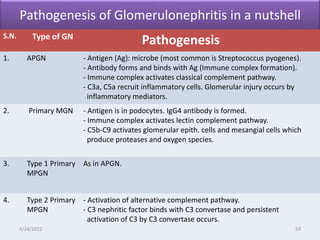
Pathogenesis of Glomerulonephritis in a nutshell
S.N. Type of GN
Pathogenesis
1. APGN - Antigen (Ag): microbe (most common is Streptococcus pyogenes).
- Antibody forms and binds with Ag (Immune complex formation).
- Immune complex activates classical complement pathway.
- C3a, C5a recruit inflammatory cells. Glomerular injury occurs by
inflammatory mediators.
2. Primary MGN - Antigen is in podocytes. IgG4 antibody is formed.
- Immune complex activates lectin complement pathway.
- C5b-C9 activates glomerular epith. cells and mesangial cells which
produce proteases and oxygen species.
3. Type 1 Primary
MPGN
As in APGN.
4. Type 2 Primary
MPGN
- Activation of alternative complement pathway.
- C3 nephritic factor binds with C3 convertase and persistent
activation of C3 by C3 convertase occurs.
4/24/2022 59
Pathogenesis of Glomerulonephritis in a nutshell
SN Type of GN Pathogenesis
6. Secondary
MPGN
Same as in APGN
7. MCD a. Loss of charge-dependent barrier function of glomerulus
b. Loss of size-dependent barrier function of glomerulus
8. FSGS Same as in Minimal-change disease
9. Ig A
Nephropathy
- Deposition of immune complex containing Ig A1+antibody in
the mesangium which induce proliferation of mesangial cells
and secretion of growth factor and cytokines. Mesangial matrix
expansion and inflammation occur.
- Alternative pathway of complement system also activated.
4/24/2022 60
Morphological features of Glomerulonephritis
Acute postinfectious Glomerulonephritis:
 enlarged, diffusely hypercellular glomeruli.
Hypercellularity is caused by:
1. Inflammatory cells: neutrophils and monocytes;
2. Proliferation of endothelial and mesangial cells;
and
3. In severe cases crescent formation occurs.
4/24/2022 61
Morphology of APGN continued
4. Swelling of endothelial cells.
5. Combination of
proliferation, swelling, and
leukocyte infiltration
obliterates the capillary
lumens.
4/24/2022 62
Immunofluorescence microscopic features in APGN
Deposits of IgG, IgM, C1, C4 and C3 are found
in:
Deposits are mainly in subepithelial location in the
form of humps.
4/24/2022 63
Subepithelial humps
4/24/2022 64
Immunofluorescence microscopic picture of
APGN
Deposits are seen as bright
green fluorescence in a
granular, bumpy pattern.
4/24/2022 65
Electron microscopic picture of APGN
Subepithelial location
of deposits, often
having the appearance
of “humps”
4/24/2022 66
Morphology of MGN
• Uniform, diffuse filtration membrane thickening
due to:
a). Subepithelial deposits of immune complexes:
- Deposits between BM and visceral epithelium.
b). Diffusely thickened GBM: subepithelial immune deposits
stimulate glomerular epithelial cells to secrete basement
membrane material.
4/24/2022 67
Electron microscopic features of MGN
GBM spikes are present:
The spikes represent intervening matrix of
basement membrane between the subepithelial
deposits (spike and dome pattern).
4/24/2022 68
• Foot processes of podocytes are effaced in
MGN.
4/24/2022 69
4/24/2022 70
Immunofluorescence microscopic features in
Primary Membranous Glomerulopathy
• Deposits of IgG4 and C3
appear in a diffuse
granular pattern by
immunofluorescence.
- C1 and C4 are absent.
Presence of C1 and C4
indicate secondary MGN.
4/24/2022 71
Immunofluorescence microscopic features in
Secondary Membranous Glomerulopathy
• Deposits of IgG, C1, C4
and C3 appear in a
diffuse granular pattern
by
immunofluorescence.
4/24/2022 72
Minimal-change disease
• Glomeruli are normal by light microscopy.
4/24/2022 73
EM features in MCD
• The only lesion is diffuse effacement of foot
processes of visceral epithelial cells.
4/24/2022 74
Morphology of MCD
• Effacement of foot processes is d/t flattening,
retraction and swelling of the processes.
– It is also seen in membranous glomerulopathy, FSGS
and diabetic nephropathy.
• Diagnosis of MCD = normal glomeruli by light
microscopy + effacement of foot proceses.
4/24/2022 75
4/24/2022 76
Morphology in MPGN
A]. Light microscopic features:
• By light microscopy, both types of MPGN are
similar.
1. Glomeruli are large and hypercellular.
• Hypercellularity is produced by:
- Proliferation of mesangial cells and endothelial cells.
- Infiltration of glomerulus by leukocytes.
2. Expansion of mesangial matrix.
4/24/2022 77
Morphology in MPGN continued
3. Lobular accentuation:
 Glomeruli have an accentuated “lobular”
appearance due to proliferating mesangial cells and
increased mesangial matrix.
4/24/2022 78
Morphology in MPGN continued
4. Crescents are present in
many cases.
– These are made up of
proliferating cells.
4/24/2022 79
Morphologic features specific to Type 1 MPGN
5. GBM is thickened in type I MPGN.
• Glomerular capillary wall often shows a
“double-contour” or “tram-track” appearance,
especially evident in silver or PAS stains.
4/24/2022 80
• Tram-tracking is caused by “duplication” of the
basement membrane (also commonly referred
to as splitting), b/o new basement membrane
synthesis in response to subendothelial
deposits of immune complexes.
4/24/2022 81
• Tram in Oslo • Tram track in Belgium
4/24/2022 82
4/24/2022 83
EM features in MPGN
• Type 1 and type 2 MPGN differ in their ultrastructural
features.
A]. Type 1 MPGN:
- Presence of discrete subendothelial electron-dense
deposits.
- Tram tracking of GBM
4/24/2022 84
• Interposition of mesangial cytoplasm occurs
into the split GBM.
4/24/2022 85
4/24/2022 86
B]. Type 2 MPGN (Dense
Deposit Disease):
- ribbon-like electron-dense
deposition of dense
material of unknown
composition in the GBM.
4/24/2022 87
Immunofluorescence microscopy in
MPGN
• Type 1 MPGN:
– Classical Pathway Complement components C3, C1
and C4 and Ig G are deposited in a granular pattern.
• Type 2 MPGN:
- C3 is present in linear or granular pattern but classical
pathway complement components (C1, C4) and Ig G
absent. It indicates alternative complement pathway
activation.
- C3 is also present in the mesangium in characteristic
circular aggregates (mesangial rings).
4/24/2022
• Mesangial rings in type II MPGN
4/24/2022 89
Light microscopic features in FSGS
In this disease:
There is sclerosis of <50%
glomeruli (thus, it is focal)
and in the affected
glomeruli, only a portion
of the capillary tuft is
involved (thus, it is segmental).
4/24/2022 90
• In the focus of sclerosis, there is:
- collapse of capillary loops,
- increase in mesangial matrix, and
- deposition of plasma proteins along the capillary wall
(hyalinosis)
- presence of lipid droplets and foam cells.
4/24/2022 91
• EM features in FSGS:
• In both sclerotic and nonsclerotic areas:
- There is diffuse effacement of foot processes of
podocytes.
• IF microscopic features in FSGS:
– IgM and C3 may be present in the sclerotic areas
and/or in the mesangium.
– These deposits neither represent immune
complexes nor are pathogenic.
4/24/2022 92
Morphology of glomerulus in IgA nephropathy
Light microscopy:
• Morphology is variable:
– Glomeruli may appear normal.
– Inflammation may be present in only
a segment of some glomeruli (focal
segmental inflammation).
– Mesangial cells may be increased.
– Widening of mesangium may be seen
due to increased synthesis of
mesangial matrix.
4/24/2022 93
IF microscopic features
• C3, IgA1 and IgG are
present in the mesangial
deposits, but C1 and C4
are absent.
4/24/2022 94
Electron microscopic features of Ig A
Nephropathy
• Electron-dense deposits in the mesangium
4/24/2022 95
Light microscopic features of glomerular diseases in a
nutshell
S.N. Type of GN Light microscopic changes in the glomerulus
1. APGN • Enlarged, diffusely hypercellular glomeruli
(inflammatory cells, mesangial cells and endothelial cells)
• Obliteration of capillary lumen
2. MGN  Diffuse filtration membrane thickening
3. MCD  Glomeruli appear normal by light microscopy.
4. MPGN  Glomeruli are large and hypercellular ( inflammatory cells,
mesangial cells and endothelial cells).
 Increased mesangial matrix
 Lobular accentuation
4/24/2022 96
Light microscopic features of glomerular diseases in a nutshell
continued
S.N. Type of Glomerulonephritis Light microscopic changes in the glomerulus
5. FSGS  Focal and segmental sclerosis of glomeruli
6. Ig A nephropathy  Expansion of mesangial matrix
 Proliferation of endothelial and mesangial cells
4/24/2022 97
Electron microscopic features of glomerulonephritis in a
nutshell
S.N. Type of Glomerulonephritis Electron microscopic features
1. APGN  Subepithelial deposition of immune complex in the form
of humps
2. MGN  Discrete subepithelial deposition of immune complex
 GBM spikes
 Effacement of foot processes of podocytes
3. MCD o Effacement of foot processes of podocytes
3. Type 1 MPGN  Discrete subendothelial electron-dense deposits
 Tram-track appearance of GBM
4. Type 2 MPGN • Ribbon like electron-dense deposit in the GBM
4/24/2022 98
Electron microscopic features of glomerulonephritis in a
nutshell continued
S.N. Type of GN Electron microscopic features
5. Ig A nephropathy Electron-dense deposits in the mesangium
6. FSGS Effacement of foot processes of podocytes
4/24/2022 99
Immunofluorescence microscopic features of
glomerulonephritis in a nutshell
S.N. Type of GN Immunofluorescence microscopic features
1. APGN Deposits are seen as bright green fluorescence in a granular, bumpy
pattern. C1, C4, C3 (classic pathway complement system products)
and Ig G present.
2. Primary MGN Deposits of IgG and complement C5b-C9 appear in a diffuse granular
pattern
3. Secondary MGN Deposits having C1 and C4 indicate secondary MGN.
4. Type 1 MPGN Deposits contain same components as in APGN.
5. Type 2 MPGN C3 present in linear or granular pattern but classical pathway
components and Ig G absent.
C3 present in mesangial rings.
4/24/2022 100
Immunofluorescence microscopic features of
glomerulonephritis in a nutshell continued
S.N. Type of GN Immunofluorescence microscopic features
6. Ig A Nephropathy Immune complex deposit containing Ig A1 and C3 in the
mesangium.
Classical pathway components not present.
7. FSGS IgM and C3 may be present in the sclerotic areas and/or in
the mesangium.
Classical pathway components not present.
4/24/2022 101
Type 3 hypersensitivity
reaction (immune complex
diseases)
1. APGN
2. MGN
3. Type 1 MPGN
4. Secondary MPGN
5. IgA nephropathy
Activation of alternative
complement pathway
1. Type 2 MPGN
2. Ig A nephropathy
4/24/2022 102
• Classical pathway of
complement activation:
1. APGN
2. Type 1 MPGN
3. Secondary MPGN
• Lectin pathway of complement
activation
- Primary MGN
Effacement of foot processes of podocytes
1. Minimal-change disease
2. Focal segmental glomerulosclerosis
3. Membranous glomerulopathy
4. Diabetic nephropathy
4/24/2022 103
Subepithelial deposits
1. Acute Proliferative
Glomerulonephritis
2. Membranous
glomerulopathy
1. Type 1 MPGN
Subendothelial deposits
Deposits in the GBM
1. Type 2 MPGN
4/24/2022 104
Morphology in RPGN
• Kidneys are enlarged and pale.
• Petechial hemorrhages on the cortical
surfaces.
• Crescents are formed by:
– Parietal epithelial cells and
– Inflammatory cells in the bowman’s space
(monocytes, macrophages, neutrophils,
lymphocytes).
– Fibrin strands are frequently prominent between
the cellular layers in the crescents.
4/24/2022 105
Crescents
4/24/2022 106
Morphology in RPGN contd.
• Crescents eventually obliterate Bowman space
and compress the glomerular tuft.
• Electron microscopy may show ruptures in the
GBM, the severe injury that allows leukocytes,
proteins, and inflammatory mediators to reach
the urinary space, where they trigger the
crescent formation.
• In time, most crescents undergo sclerosis.
4/24/2022 107
Good Pasture Syndrome (Anti-GBM antibody disease)
• It is an autoimmune disease in which
autoantibodies are formed against antigen located
in the glomerular basement membrane and
alveolar basement membrane.
• Goodpasture syndrome most often manifests
as diffuse alveolar hemorrhage and
glomerulonephritis together.
– But it can occasionally cause glomerulonephritis (10 to
20%) or pulmonary disease (10%) alone.
– M > F.
4/24/2022 108
• Renal failure can occur in days: rapidly
progressive glomerulonephritis.
– Patient present with hematuria and other features of
renal failure.
• Commonly the first lung symptoms develop days,
weeks or months before kidney damage becomes
evident. :
– Clinical manifestations vary from dry cough and minor
dyspnea to severe lung hemorrhage.
– Hemoptysis is a useful presenting symptom.
• Anti-GBM antibody-mediated disease
4/24/2022 109
Pathogenesis of GPS
• Classical pathway of complement system is
activated by the immune complexes.
• Complement fragments C3a and C5a recruit
inflammatory cells to the glomerulus.
4/24/2022 110
• People with HLA-DRB1 antigen are found to be
genetically susceptible to develop the disease.
• There is negative association with HLA-DR7.
(Absence of this antigen is protective.)
4/24/2022 111
• Light microscopy:
– Crescents are seen in the glomeruli.
– Inflammatory cells infiltration
– Proliferation of mesangial cells and endothelial
cells.
• Immunofluorescence microscopy:
– The disease is characterized by linear deposits of
IgG, C1, C4 and C3 in the GBM.
4/24/2022 112
4/24/2022 113
4/24/2022 114
4/24/2022 115
• Thank You !!
4/24/2022 116
Glomerular filtration membrane:
- Is highly permeable to water.
- Permeability of solute is size and charge-dependent:
larger, the less permeable and the more cationic, the more
permeable.
- So, the membrane prevents the passage of large
and/or negatively charged molecules (anionic
molecules), such as albumin. This barrier is called
glomerular filtration barrier.
4/24/2022 117
Factors responsible for glomerular filtration
barrier
1). Negatively charged molecules(proteoglycans of GBM and
sialoglycoproteins of epithelial and endothelial cell
membrane)are responsible for charge-dependent glomerular
filtration barrier function of glomerular filtration membrane.
2). Filtration slits and the proteins in the slits are responsible for
size-dependent as well as charge-dependent glomerular
filtration barrier function.
4/24/2022 118
• Entire glomerular tuft is
supported by mesangial
cells and mesangial
matrix lying between
the capillaries.
4/24/2022 119
• Mesangial cells:
- are contractile and phagocytic
- are capable of proliferation,
- can lay down both matrix and collagen
- can secrete several biologically active mediators.
Normal mesangium contains about 2 to 4
mesangial cells.
4/24/2022 120
• About 15% of
glomerular filtration
occurs through the
mesangium, with the
remainder through the
fenestrated
endothelium.
4/24/2022 121
Composition of Urine
• water 95%
• urea
• chloride
• sodium
• potassium
• creatinine
4/24/2022 122
• Protein and glucose are not present in urine
because of glomerular filtration barrier.
4/24/2022 123
Normal glomerulus
• Glomerular capillary loops thin and delicate.
• Endothelial and mesangial cells normal in number
• Surrounding tubules normal
4/24/2022 124
Normal glomerulus stained with PAS stain
• Basement membranes of glomerular capillary loops and tubular
epithelium highlighted.
• Capillary loops of this normal glomerulus are well-defined and thin.
• Endothelial cells are seen in capillary loops.
• Mesangial regions are of normal size.
• Podocytes along visceral epithelial surface. Bowman's space is seen along
with parietal epithelial cells.
4/24/2022 125
4/24/2022 126
4/24/2022 127
4/24/2022 128

M Glomerulonephritis (1).pptx

  • 1.
  • 2.
    Normal Anatomy ofKidney 4/24/2022 2
  • 3.
  • 4.
    Normal glomerulus • Glomerulushas been cut through the vascular pole which is seen at 6 o’clock. 4/24/2022 4
  • 5.
    • Glomerular filtrationmembrane/barrier 4/24/2022 5
  • 6.
  • 7.
    • Definition: – Inflammationof glomeruli is called glomerulonephritis. – Glomerular diseases which do not have a cellular inflammatory component are called glomerulopathy. 4/24/2022 7
  • 8.
    Classification of glomerulonephritis A].Acute glomerulonephritis B]. Chronic glomerulonephritis 4/24/2022 8
  • 9.
    Acute Glomerulonephritis 1. AcuteProliferative GN (Poststreptococcal/Postinfectious GN) 2. Membranous glomerulopathy 3. Membranoproliferative GN 4. Minimal change disease 4/24/2022 9
  • 10.
    5. Focal SegmentalGlomerulosclerosis 6. Rapidly Progressive GN (Crescentic GN) 7. HIV nephropathy 8. IgA nephropathy 9. Henoch-Schönlein Purpura 4/24/2022 10
  • 11.
    • Chronic glomerulonephritisrefers to end-stage glomerular disease. • It is of two types: a). Chronic GN developing secondary to acute glomerulonephritis b). Chronic GN developing de novo: - These cases develop without antecedent acute glomerulonephritis. 4/24/2022 11 Chronic Glomerulonephritis
  • 12.
    Causes of ChronicGlomerulonephritis 1. Membranous glomerulopathy, 2. Membranoproliferative glomerulonephritis, 3. IgA nephropathy, 4. Focal Segmental Glomerulosclerosis 5. Acute Poststreptococcal GN in adults 6. Crescentic glomerulonephritis 4/24/2022 12
  • 13.
    Second method ofClassification of Glomerular Diseases A]. Primary Glomerulopathies: – Acute proliferative GN – Rapidly progressive (crescentic) GN – Membranous glomerulopathy – Minimal-change disease – Focal segmental glomerulosclerosis – Membranoproliferative GN – IgA nephropathy – Chronic GN 4/24/2022 13
  • 14.
    B]. Systemic Diseaseswith Glomerular Involvement: – Systemic lupus erythematosus – Diabetes mellitus – Amyloidosis – Goodpasture syndrome – Microscopic polyarteritis/polyangitis – Wegener granulomatosis – Henoch-Schönlein purpura – Bacterial endocarditis 4/24/2022 14
  • 15.
    Third method ofclassification of glomerular diseases • Glomerular diseases can also be classified in the following way: a). Glomerular diseases which cause nephrotic syndrome b). Glomerular diseases which cause nephritic syndrome 4/24/2022 15
  • 16.
    Etiology of NephroticSyndrome A]. Primary causes: a). Most common causes are: 1. Minimal change disease (MCD): - most frequent cause of nephrotic syndrome in children. 2. Focal segmental glomerulosclerosis (FSGS): - 20-30% cases of nephrotic syndrome 3. Membranous glomerulopathy (MGN) b). Other causes are: 1. Membranoproliferative Glomerulonephritis (MPGN) 2. IgA Nephropathy 4/24/2022 16
  • 17.
    B]. Secondary causes: 1.Diabetic nephropathy 2. Preeclampsia (new-onset hypertension and proteinuria after 20 wk gestation) 3. Lupus nephritis 4. Hypertensive nephropathy due to malignant HTN (hypertensive emergency) 5. Amyloidosis 4/24/2022 17
  • 18.
    • Memory clue: -Diseases which cause effacement of foot processes of podocytes cause nephrotic syndrome: MCD, MGN, Diabetic nephropathy and FSGS. 4/24/2022 18
  • 19.
    Etiology of Nephriticsyndrome 1. Hereditary nephritis (Alport’s syndrome) 2. Ig A nephropathy 3. Rapidly Progressive Glomerulonephritis (RPGN) 4. Acute Proliferative Glomerulonephritis (APGN) 5. Lupus nephritis • IgA nephropathy and Lupus nephritis also can cause nephrotic syndrome and mixed nephritic-nephrotic syndrome. 4/24/2022 19 HIRA Lal
  • 20.
    Nephrotic syndrome • Nephroticsyndrome is characterized by: a). Heavy proteinuria (>3.5 gm/24 hours) b). Hypoalbuminemia (<3.0 gm/dL) c). Hyperlipidemia and lipiduria: fatty casts and oval fat bodies are seen in urine. e). Generalized edema: Severe generalized edema is called anasarca. 4/24/2022 20
  • 21.
    Pathophysiology of Nephroticsyndrome • Following events occur sequentially: 1). Glomerular diseases 2). Heavy proteinuria 3). Hypoalbuminaemia 4). Compensatory increase in protein synthesis by the liver including lipoproteins LDL and VLDL = Hyperlipidemia. 5). Hyperlipidemia leads to loss of lipid in urine = lipiduria. 4/24/2022 21
  • 22.
    6). Hypercoagulability: • Thecauses of hypercoagulability are: – Loss of antithrombin III – Increased hepatic synthesis of clotting factors – Hyperviscosity caused by hypovolemia. 7). Edema is due to a decrease in oncotic pressure because of: - Hypoalbuminaemia and - Primary defect in sodium excretion. 4/24/2022 22
  • 23.
    Complications of nephroticsyndrome 1. Thromboembolism especially renal vein thrombosis and pulmonary embolism. – Occurs in up to 5% of children and 40% of adults. • The causes of hypercoagulability are: – Loss of antithrombin III – Increased hepatic synthesis of clotting factors – Hyperviscosity caused by hypovolemia 4/24/2022 23
  • 24.
    2. Increased riskof infection: - due to loss of immunoglobulins and complement in urine. 3. Coronary artery disease in adults due to hyperlipidemia. 4. Anemia due to loss of erythropoietin and transferrin. 4/24/2022 24
  • 25.
    • Components ofnephrotic syndrome: a to d. a). Heavy proteinuria: >3.5 gm/24 hours b). Hypoalbuminemia (< 3.0 gm/dL) c). Hyperlipidemia and lipiduria d). Generalized edema • Patients presenting with proteinuria without other components of nephrotic syndrome: – nephrotic-range proteinuria. 4/24/2022 25
  • 26.
    Nephritic Syndrome • Nephriticsyndrome is characterized by the presence of following features: – Hematuria with dysmorphic RBCs and RBC casts in the urine. – Proteinuria: <3.5 g/day (non nephrotic-range proteinuria) – Edema – Hypertension – Uremia – Azotemia – Oliguria (urine output <400 mL/day) 4/24/2022 26
  • 27.
    • Azotemia: – elevationof blood urea nitrogen (BUN) (reference range: 8-20 mg/dL) and/or – serum creatinine (normal value: 0.6-1.2 mg/dL) levels. • Uremia: – Azotemia plus clinical manifestations. 4/24/2022 27
  • 28.
    • Hypertension inglomerular diseases is due to a number of factors: 1. Activation of renin-angiotensin-aldosterone system (RAS): - Hypovolemia in nephritic syndrome activates renin- angiotensin-aldosterone system. 2. Increased activity of RAS causes: - Increased sodium reabsorption from collecting ducts and thus sodium retention by aldosterone. - Increased total peripheral resistance because of vasoconstriction. Vasoconstriction is caused by angiotensin. 4/24/2022 28
  • 29.
    3. Activation ofsympathetic nervous system: - Intrarenal ischemia also causes increased activity of sympathetic nervous system leading to vasoconstriction. 4. Endothelial cell dysfunction (decreased NO activity) leading to reduced vasodilation. 4/24/2022 29
  • 30.
    Acute Proliferative (Poststreptococcal,Postinfectious) GN • Streptococcal infections are associated with overcrowding and poor hygiene. • Etiology: A]. Group A β-hemolytic streptococci: - 90% cases are due to 12,4,1 serotypes. - Infection occurs in the pharynx or skin (impetigo). - Age group: 6 to 10 yrs, but adults may also get affected. 4/24/2022 30
  • 31.
    B]. Non-streptococcal postinfectiousglomerulonephritis (less common): :Bacteria other than streptococci- staphylococcal endocarditis, pneumococcal pneumonia, and meningococcemia. :Viral- hepatitis B and C, mumps, HIV, varicella :Parasitic- malaria, toxoplasmosis 4/24/2022 31
  • 32.
    Pathogenesis of APGN APGNis an immune complex mediated disease (type 3 hypersensitivity rxn): 1). First event is exposure to antigen of microbe: APGN appears 1 to 4 wks after the infection. 2). Formation of immune complex: - Antibodies are formed in blood against microbial antigens which bind with antigens to form immune complexes. - They are carried by blood to kidneys and they are deposited in the glomerular capillary wall. 4/24/2022 32
  • 33.
    Pathogenesis of APGNcontinued 3). Classical pathway of complement system is activated by the immune complexes: - Complement products C3a and C5a are produced which attract neutrophils and monocytes to the glomeruli. - Inflammatory cells produce lysosomal enzymes and reactive oxygen species which injure glomeruli. 4/24/2022 33
  • 34.
    Membranous Glomerulopathy (MGN) •Aka: Membranous nephropathy • It is an immune complex mediated disease. a). 75 % of cases are primary:  Primary membranous glomerulopathy (idiopathic MG).  It is an autoimmune disease.  Antigen is present in podocytes. Major antigen is phospholipase A2. b). 25 % cases are secondary:  Secondary membranous glomerulopathy Associated with other diseases: presented in the following slide. 4/24/2022 34
  • 35.
    • Causes ofsecondary membranous glomerulopathy: • These antigens are planted in the podocytes: 1. Drugs: NSAIDs, Gold, Penicillamine. 2. Underlying malignant tumors: Ca of lung and colon, and melanoma. 3. Viral infections: Hepatitis B and C 4. Bacterial infections: syphilis, malaria 5. Autoimmune disease: 10% to 15% of glomerulonephritis in SLE is of the membranous type. 4/24/2022 35
  • 36.
    Pathogenesis of PrimaryMGN Primary MGN is an autoimmune disease. 1). Formation of autoantibodies (IgG4) to an antigen in the visceral epithelial cells (podocytes): - phospholipase A2 receptor is the most common antigen. 2). Immune complex (antibody+antigen) forms in-situ which activates the lectin pathway of complement system. - IgG4 subtype, that is formed in this disease, cannot activate classical pathway of complement system. 4/24/2022 36
  • 37.
    3). Membrane attackcomplex (C5b-C9) is the product of complement activation:  It activates glomerular epithelial and mesangial cells. The cells produce proteases and ROS, which injure GFM. • Inflammatory cells are scant in the glomeruli because C3a and C5a do not have a role in the pathogenesis. 4/24/2022 37
  • 38.
    Pathogenesis of SecondaryMembranous Glomerulopathy continued • Antibodies are formed against microbes, drugs or neoplastic cells. • Antibodies bind with antigen and immune complexes are formed. • Immune complexes activate classical pathway of complement system. 4/24/2022 38
  • 39.
    Membranoproliferative Glomerulonephritis (MPGN) Synonym: mesangiocapillaryglomerulonephritis It can be primary or secondary. Primary MPGN is of two types: - Type 1 and Type 2 - Now it is thought that type 1 and type 2 are different disease processes. 4/24/2022 39
  • 40.
    Pathogenesis of type1 MPGN 1. Antigens: not known (idiopathic). 2. Immune complexes (antibodies+ antigens) are deposited in the glomerular capillary wall= Type 3 hypersensitivity rxn. 3. Activation of Classical Pathway of Complement system and inflammation by C3a and C5a fragments. 4/24/2022 40
  • 41.
    Pathogenesis of type2 MPGN 1. Type 2 MPGN= dense deposit disease. 2. It is now kept under “C3 glomerulopathy” 3. Activation of alternative pathway of complement system. Inciting antigen: unknown. 4/24/2022 41
  • 42.
    4. Patients havean autoantibody (C3 nephritic factor) which binds with C3 convertase and stabilizes it; that means it can not be degraded.  Persistent generation of C3a and C5a occurs because of persistent activation of C3 by C3 convertase. 4/24/2022 42
  • 43.
    Secondary MPGN • Pathogenesisis similar to type I. • Arises in the following settings: Chronic infections: HIV, hepatitis B and C infection, chronic visceral abscesses. Autoimmune disease: SLE Malignant diseases: CLL and lymphoma 4/24/2022 43
  • 44.
    Minimal-Change Disease (MCD) •Synonym: lipoid nephrosis • More common in children (2 to 6 yrs). • Sometimes follows a respiratory infection or immunization. 4/24/2022 44
  • 45.
    Pathogenesis of MCD •Exact mechanism is not clearly known. • Two hypotheses are as follows: a). Loss of charge-dependent barrier function of glomerular filtration membrane:  It occurs because some kind of immune dysfunction produces loss of glomerular polyanions. 4/24/2022 45
  • 46.
    Pathogenesis of MCDcontinued b). Loss of size-dependent barrier function of GFM occurs because of mutations in structural proteins, which are localized in the filtration slits. 4/24/2022 46
  • 47.
    Focal Segmental Glomerulosclerosis(FSGS) • FSGS occurs in the following settings: 1. As a primary disease (Idiopathic FSGS): no associated systemic diseases. 2. Secondary to other diseases (Secondary FSGS): HIV infection, sickle-cell disease and massive obesity. 3. As an adaptive response to loss of renal tissue in other renal disorders (hypertensive nephropathy, unilateral renal agenesis). 4. Mutations in genes that encode proteins of filtration slits. 4/24/2022 47
  • 48.
    • Pathogenesis issimilar to that of MCD. 4/24/2022 48
  • 49.
    Rapidly progressive GN(Crescentic GN)  Does not denote a specific disease process.  Is a syndrome associated with severe glomerular injury because of other glomerular diseases.  Rapid and progressive loss of renal function and death from RF can occur within weeks to months. 4/24/2022 49
  • 50.
    Classification of Causesof RPGN A). Type 1: cause is anti-GBM antibody - Renal limited and - Good Pasture Syndrome B). Type 2: caused by deposition of ICs in the glomeruli:  APGN  Lupus nephritis  Henoch-Schönlein purpura  IgA nephropathy 4/24/2022 50
  • 51.
    C). Type 3:vasculitic diseases - Wegener granulomatosis - Microscopic polyangitis In 50% cases, the disorder is idiopathic: cause is not known. 4/24/2022 51
  • 52.
    HIV Nephropathy • HIVinfection can cause: - Postinfectious glomerulonephritis - Secondary MPGN - FSGS 4/24/2022 52
  • 53.
    Ig A Nephropathy •Synonym: Berger disease. • It was first described by Berger and Hinglais in 1968. • Most common type of glomerulonephritis worldwide. • It is an autoimmune disease. 4/24/2022 53
  • 54.
    • Ig A: –two subclasses: Ig A1 and Ig A2 • Only Ig A1 can cause nephropathy. • Some experts think that IgA nephropathy is a localized form of Henoch Schonlein Purpura. 4/24/2022 54
  • 55.
    Pathogenesis of IgANephropathy a). IgA1 is abnormally glycosylated (it is galactose-deficient) in this disease. b). The abnormal Ig A1 induces formation of antibody (IgG) against it. - Immune complexes containing Ig A1 and IgG are deposited in the mesangium of glomerulus. c). Immune complexes activate mesangial cells to proliferate and produce mesangial matrix, growth factors and cytokines. Cytokines recruit inflammatory cells. 4/24/2022 55
  • 56.
    c). ICs alsoactivate alternative pathway of complement system and hence the presence of C3 and the absence of C1q and C4 in glomeruli are typical of this disorder. 4/24/2022 56
  • 57.
    Henoch-Schönlein Purpura • Itis an acute IgA–mediated disorder. • Generalized vasculitis involving the small vessels of: – Skin, GI tract, Kidneys, – Joints, and, – rarely, lungs and CNS. • Most common in children 3 to 8 years old, but it also occurs in adults, in whom the renal manifestations are usually more severe. • Onset often follows an URTI. 4/24/2022 57
  • 58.
    • Pathogenesis sameas in IgA nephropathy. • IgA nephropathy and Henoch-Schönlein purpura are thought to be manifestations of the same disease. 4/24/2022 58
  • 59.
    Pathogenesis of Glomerulonephritisin a nutshell S.N. Type of GN Pathogenesis 1. APGN - Antigen (Ag): microbe (most common is Streptococcus pyogenes). - Antibody forms and binds with Ag (Immune complex formation). - Immune complex activates classical complement pathway. - C3a, C5a recruit inflammatory cells. Glomerular injury occurs by inflammatory mediators. 2. Primary MGN - Antigen is in podocytes. IgG4 antibody is formed. - Immune complex activates lectin complement pathway. - C5b-C9 activates glomerular epith. cells and mesangial cells which produce proteases and oxygen species. 3. Type 1 Primary MPGN As in APGN. 4. Type 2 Primary MPGN - Activation of alternative complement pathway. - C3 nephritic factor binds with C3 convertase and persistent activation of C3 by C3 convertase occurs. 4/24/2022 59
  • 60.
    Pathogenesis of Glomerulonephritisin a nutshell SN Type of GN Pathogenesis 6. Secondary MPGN Same as in APGN 7. MCD a. Loss of charge-dependent barrier function of glomerulus b. Loss of size-dependent barrier function of glomerulus 8. FSGS Same as in Minimal-change disease 9. Ig A Nephropathy - Deposition of immune complex containing Ig A1+antibody in the mesangium which induce proliferation of mesangial cells and secretion of growth factor and cytokines. Mesangial matrix expansion and inflammation occur. - Alternative pathway of complement system also activated. 4/24/2022 60
  • 61.
    Morphological features ofGlomerulonephritis Acute postinfectious Glomerulonephritis:  enlarged, diffusely hypercellular glomeruli. Hypercellularity is caused by: 1. Inflammatory cells: neutrophils and monocytes; 2. Proliferation of endothelial and mesangial cells; and 3. In severe cases crescent formation occurs. 4/24/2022 61
  • 62.
    Morphology of APGNcontinued 4. Swelling of endothelial cells. 5. Combination of proliferation, swelling, and leukocyte infiltration obliterates the capillary lumens. 4/24/2022 62
  • 63.
    Immunofluorescence microscopic featuresin APGN Deposits of IgG, IgM, C1, C4 and C3 are found in: Deposits are mainly in subepithelial location in the form of humps. 4/24/2022 63
  • 64.
  • 65.
    Immunofluorescence microscopic pictureof APGN Deposits are seen as bright green fluorescence in a granular, bumpy pattern. 4/24/2022 65
  • 66.
    Electron microscopic pictureof APGN Subepithelial location of deposits, often having the appearance of “humps” 4/24/2022 66
  • 67.
    Morphology of MGN •Uniform, diffuse filtration membrane thickening due to: a). Subepithelial deposits of immune complexes: - Deposits between BM and visceral epithelium. b). Diffusely thickened GBM: subepithelial immune deposits stimulate glomerular epithelial cells to secrete basement membrane material. 4/24/2022 67
  • 68.
    Electron microscopic featuresof MGN GBM spikes are present: The spikes represent intervening matrix of basement membrane between the subepithelial deposits (spike and dome pattern). 4/24/2022 68
  • 69.
    • Foot processesof podocytes are effaced in MGN. 4/24/2022 69
  • 70.
  • 71.
    Immunofluorescence microscopic featuresin Primary Membranous Glomerulopathy • Deposits of IgG4 and C3 appear in a diffuse granular pattern by immunofluorescence. - C1 and C4 are absent. Presence of C1 and C4 indicate secondary MGN. 4/24/2022 71
  • 72.
    Immunofluorescence microscopic featuresin Secondary Membranous Glomerulopathy • Deposits of IgG, C1, C4 and C3 appear in a diffuse granular pattern by immunofluorescence. 4/24/2022 72
  • 73.
    Minimal-change disease • Glomeruliare normal by light microscopy. 4/24/2022 73
  • 74.
    EM features inMCD • The only lesion is diffuse effacement of foot processes of visceral epithelial cells. 4/24/2022 74
  • 75.
    Morphology of MCD •Effacement of foot processes is d/t flattening, retraction and swelling of the processes. – It is also seen in membranous glomerulopathy, FSGS and diabetic nephropathy. • Diagnosis of MCD = normal glomeruli by light microscopy + effacement of foot proceses. 4/24/2022 75
  • 76.
  • 77.
    Morphology in MPGN A].Light microscopic features: • By light microscopy, both types of MPGN are similar. 1. Glomeruli are large and hypercellular. • Hypercellularity is produced by: - Proliferation of mesangial cells and endothelial cells. - Infiltration of glomerulus by leukocytes. 2. Expansion of mesangial matrix. 4/24/2022 77
  • 78.
    Morphology in MPGNcontinued 3. Lobular accentuation:  Glomeruli have an accentuated “lobular” appearance due to proliferating mesangial cells and increased mesangial matrix. 4/24/2022 78
  • 79.
    Morphology in MPGNcontinued 4. Crescents are present in many cases. – These are made up of proliferating cells. 4/24/2022 79
  • 80.
    Morphologic features specificto Type 1 MPGN 5. GBM is thickened in type I MPGN. • Glomerular capillary wall often shows a “double-contour” or “tram-track” appearance, especially evident in silver or PAS stains. 4/24/2022 80
  • 81.
    • Tram-tracking iscaused by “duplication” of the basement membrane (also commonly referred to as splitting), b/o new basement membrane synthesis in response to subendothelial deposits of immune complexes. 4/24/2022 81
  • 82.
    • Tram inOslo • Tram track in Belgium 4/24/2022 82
  • 83.
  • 84.
    EM features inMPGN • Type 1 and type 2 MPGN differ in their ultrastructural features. A]. Type 1 MPGN: - Presence of discrete subendothelial electron-dense deposits. - Tram tracking of GBM 4/24/2022 84
  • 85.
    • Interposition ofmesangial cytoplasm occurs into the split GBM. 4/24/2022 85
  • 86.
  • 87.
    B]. Type 2MPGN (Dense Deposit Disease): - ribbon-like electron-dense deposition of dense material of unknown composition in the GBM. 4/24/2022 87
  • 88.
    Immunofluorescence microscopy in MPGN •Type 1 MPGN: – Classical Pathway Complement components C3, C1 and C4 and Ig G are deposited in a granular pattern. • Type 2 MPGN: - C3 is present in linear or granular pattern but classical pathway complement components (C1, C4) and Ig G absent. It indicates alternative complement pathway activation. - C3 is also present in the mesangium in characteristic circular aggregates (mesangial rings). 4/24/2022
  • 89.
    • Mesangial ringsin type II MPGN 4/24/2022 89
  • 90.
    Light microscopic featuresin FSGS In this disease: There is sclerosis of <50% glomeruli (thus, it is focal) and in the affected glomeruli, only a portion of the capillary tuft is involved (thus, it is segmental). 4/24/2022 90
  • 91.
    • In thefocus of sclerosis, there is: - collapse of capillary loops, - increase in mesangial matrix, and - deposition of plasma proteins along the capillary wall (hyalinosis) - presence of lipid droplets and foam cells. 4/24/2022 91
  • 92.
    • EM featuresin FSGS: • In both sclerotic and nonsclerotic areas: - There is diffuse effacement of foot processes of podocytes. • IF microscopic features in FSGS: – IgM and C3 may be present in the sclerotic areas and/or in the mesangium. – These deposits neither represent immune complexes nor are pathogenic. 4/24/2022 92
  • 93.
    Morphology of glomerulusin IgA nephropathy Light microscopy: • Morphology is variable: – Glomeruli may appear normal. – Inflammation may be present in only a segment of some glomeruli (focal segmental inflammation). – Mesangial cells may be increased. – Widening of mesangium may be seen due to increased synthesis of mesangial matrix. 4/24/2022 93
  • 94.
    IF microscopic features •C3, IgA1 and IgG are present in the mesangial deposits, but C1 and C4 are absent. 4/24/2022 94
  • 95.
    Electron microscopic featuresof Ig A Nephropathy • Electron-dense deposits in the mesangium 4/24/2022 95
  • 96.
    Light microscopic featuresof glomerular diseases in a nutshell S.N. Type of GN Light microscopic changes in the glomerulus 1. APGN • Enlarged, diffusely hypercellular glomeruli (inflammatory cells, mesangial cells and endothelial cells) • Obliteration of capillary lumen 2. MGN  Diffuse filtration membrane thickening 3. MCD  Glomeruli appear normal by light microscopy. 4. MPGN  Glomeruli are large and hypercellular ( inflammatory cells, mesangial cells and endothelial cells).  Increased mesangial matrix  Lobular accentuation 4/24/2022 96
  • 97.
    Light microscopic featuresof glomerular diseases in a nutshell continued S.N. Type of Glomerulonephritis Light microscopic changes in the glomerulus 5. FSGS  Focal and segmental sclerosis of glomeruli 6. Ig A nephropathy  Expansion of mesangial matrix  Proliferation of endothelial and mesangial cells 4/24/2022 97
  • 98.
    Electron microscopic featuresof glomerulonephritis in a nutshell S.N. Type of Glomerulonephritis Electron microscopic features 1. APGN  Subepithelial deposition of immune complex in the form of humps 2. MGN  Discrete subepithelial deposition of immune complex  GBM spikes  Effacement of foot processes of podocytes 3. MCD o Effacement of foot processes of podocytes 3. Type 1 MPGN  Discrete subendothelial electron-dense deposits  Tram-track appearance of GBM 4. Type 2 MPGN • Ribbon like electron-dense deposit in the GBM 4/24/2022 98
  • 99.
    Electron microscopic featuresof glomerulonephritis in a nutshell continued S.N. Type of GN Electron microscopic features 5. Ig A nephropathy Electron-dense deposits in the mesangium 6. FSGS Effacement of foot processes of podocytes 4/24/2022 99
  • 100.
    Immunofluorescence microscopic featuresof glomerulonephritis in a nutshell S.N. Type of GN Immunofluorescence microscopic features 1. APGN Deposits are seen as bright green fluorescence in a granular, bumpy pattern. C1, C4, C3 (classic pathway complement system products) and Ig G present. 2. Primary MGN Deposits of IgG and complement C5b-C9 appear in a diffuse granular pattern 3. Secondary MGN Deposits having C1 and C4 indicate secondary MGN. 4. Type 1 MPGN Deposits contain same components as in APGN. 5. Type 2 MPGN C3 present in linear or granular pattern but classical pathway components and Ig G absent. C3 present in mesangial rings. 4/24/2022 100
  • 101.
    Immunofluorescence microscopic featuresof glomerulonephritis in a nutshell continued S.N. Type of GN Immunofluorescence microscopic features 6. Ig A Nephropathy Immune complex deposit containing Ig A1 and C3 in the mesangium. Classical pathway components not present. 7. FSGS IgM and C3 may be present in the sclerotic areas and/or in the mesangium. Classical pathway components not present. 4/24/2022 101
  • 102.
    Type 3 hypersensitivity reaction(immune complex diseases) 1. APGN 2. MGN 3. Type 1 MPGN 4. Secondary MPGN 5. IgA nephropathy Activation of alternative complement pathway 1. Type 2 MPGN 2. Ig A nephropathy 4/24/2022 102 • Classical pathway of complement activation: 1. APGN 2. Type 1 MPGN 3. Secondary MPGN • Lectin pathway of complement activation - Primary MGN
  • 103.
    Effacement of footprocesses of podocytes 1. Minimal-change disease 2. Focal segmental glomerulosclerosis 3. Membranous glomerulopathy 4. Diabetic nephropathy 4/24/2022 103
  • 104.
    Subepithelial deposits 1. AcuteProliferative Glomerulonephritis 2. Membranous glomerulopathy 1. Type 1 MPGN Subendothelial deposits Deposits in the GBM 1. Type 2 MPGN 4/24/2022 104
  • 105.
    Morphology in RPGN •Kidneys are enlarged and pale. • Petechial hemorrhages on the cortical surfaces. • Crescents are formed by: – Parietal epithelial cells and – Inflammatory cells in the bowman’s space (monocytes, macrophages, neutrophils, lymphocytes). – Fibrin strands are frequently prominent between the cellular layers in the crescents. 4/24/2022 105
  • 106.
  • 107.
    Morphology in RPGNcontd. • Crescents eventually obliterate Bowman space and compress the glomerular tuft. • Electron microscopy may show ruptures in the GBM, the severe injury that allows leukocytes, proteins, and inflammatory mediators to reach the urinary space, where they trigger the crescent formation. • In time, most crescents undergo sclerosis. 4/24/2022 107
  • 108.
    Good Pasture Syndrome(Anti-GBM antibody disease) • It is an autoimmune disease in which autoantibodies are formed against antigen located in the glomerular basement membrane and alveolar basement membrane. • Goodpasture syndrome most often manifests as diffuse alveolar hemorrhage and glomerulonephritis together. – But it can occasionally cause glomerulonephritis (10 to 20%) or pulmonary disease (10%) alone. – M > F. 4/24/2022 108
  • 109.
    • Renal failurecan occur in days: rapidly progressive glomerulonephritis. – Patient present with hematuria and other features of renal failure. • Commonly the first lung symptoms develop days, weeks or months before kidney damage becomes evident. : – Clinical manifestations vary from dry cough and minor dyspnea to severe lung hemorrhage. – Hemoptysis is a useful presenting symptom. • Anti-GBM antibody-mediated disease 4/24/2022 109
  • 110.
    Pathogenesis of GPS •Classical pathway of complement system is activated by the immune complexes. • Complement fragments C3a and C5a recruit inflammatory cells to the glomerulus. 4/24/2022 110
  • 111.
    • People withHLA-DRB1 antigen are found to be genetically susceptible to develop the disease. • There is negative association with HLA-DR7. (Absence of this antigen is protective.) 4/24/2022 111
  • 112.
    • Light microscopy: –Crescents are seen in the glomeruli. – Inflammatory cells infiltration – Proliferation of mesangial cells and endothelial cells. • Immunofluorescence microscopy: – The disease is characterized by linear deposits of IgG, C1, C4 and C3 in the GBM. 4/24/2022 112
  • 113.
  • 114.
  • 115.
  • 116.
    • Thank You!! 4/24/2022 116
  • 117.
    Glomerular filtration membrane: -Is highly permeable to water. - Permeability of solute is size and charge-dependent: larger, the less permeable and the more cationic, the more permeable. - So, the membrane prevents the passage of large and/or negatively charged molecules (anionic molecules), such as albumin. This barrier is called glomerular filtration barrier. 4/24/2022 117
  • 118.
    Factors responsible forglomerular filtration barrier 1). Negatively charged molecules(proteoglycans of GBM and sialoglycoproteins of epithelial and endothelial cell membrane)are responsible for charge-dependent glomerular filtration barrier function of glomerular filtration membrane. 2). Filtration slits and the proteins in the slits are responsible for size-dependent as well as charge-dependent glomerular filtration barrier function. 4/24/2022 118
  • 119.
    • Entire glomerulartuft is supported by mesangial cells and mesangial matrix lying between the capillaries. 4/24/2022 119
  • 120.
    • Mesangial cells: -are contractile and phagocytic - are capable of proliferation, - can lay down both matrix and collagen - can secrete several biologically active mediators. Normal mesangium contains about 2 to 4 mesangial cells. 4/24/2022 120
  • 121.
    • About 15%of glomerular filtration occurs through the mesangium, with the remainder through the fenestrated endothelium. 4/24/2022 121
  • 122.
    Composition of Urine •water 95% • urea • chloride • sodium • potassium • creatinine 4/24/2022 122
  • 123.
    • Protein andglucose are not present in urine because of glomerular filtration barrier. 4/24/2022 123
  • 124.
    Normal glomerulus • Glomerularcapillary loops thin and delicate. • Endothelial and mesangial cells normal in number • Surrounding tubules normal 4/24/2022 124
  • 125.
    Normal glomerulus stainedwith PAS stain • Basement membranes of glomerular capillary loops and tubular epithelium highlighted. • Capillary loops of this normal glomerulus are well-defined and thin. • Endothelial cells are seen in capillary loops. • Mesangial regions are of normal size. • Podocytes along visceral epithelial surface. Bowman's space is seen along with parietal epithelial cells. 4/24/2022 125
  • 126.
  • 127.
  • 128.

Editor's Notes

  • #4 Functional unit of kidney is nephron. Parts of a nephron are: Glomerulus, Proximal and distal convoluted tubule, Collecting duct
  • #5 Visceral epithelium is incorporated into the capillary wall, separated from endothelial cells by a basement membrane. The visceral epithelial cells (podocytes) possess interdigitating processes embedded in and adherent to the lamina rara externa of the basement membrane. Parietal epithelium lines the urinary space, the cavity in which glomerular filtrate first collects. Urinary space= Bowman space
  • #6 Glomerular filtration membrane/barrier: Fenestrated endothelium of capillaries. Fused basement membrane of capillaries and visceral epithelium (podocytes) and filtration slits of podocytes. The space between two adjacent foot processes of podocytes is called filtration slit which is 20 to 30 nm wide. The visceral epithelial cell is important for the maintenance of glomerular barrier function; its slit diaphragm presents a size-selective distal diffusion barrier to the filtration of proteins, and it is the cell type that is largely responsible for synthesis of GBM components.
  • #9 Our current “naming” (classification) of glomerulonephritis into the various pathologic entities recognized in clinical nephrology is based on unrelated and seemingly random parameters, which include: the site of immune-complex deposition and cellular proliferation (“mesangioproliferative” glomerulonephritis), descriptive pathology of affected structures (“membranous,” or “membranoproliferative,” indicating basement membrane thickening with or without cellular proliferation, respectively), the ultrastructural target of circulating antibodies (“anti-GBM” disease), the type of reactive antibody (“IgA nephropathy”), the underlying systemic disease (“lupus nephritis”), or the predominant anatomic distribution of inflammatory changes (“focal segmental glomerulonephritis”).
  • #12 The de novo cases may represent the end result of relatively asymptomatic forms of glomerulonephritis, either known or still unrecognized, that progress to uremia.
  • #13 Poststreptococcal glomerulonephritis is a rare antecedent of chronic glomerulonephritis in children. If patients survive the acute phase, patients with crescentic glomerulonephritis can develop chronic glomerulonephritis.
  • #17 1. Membranous glomerulonephropathy: most common cause in adults. In USA, this rank goes to FSGS. 2. Minimal-change disease: most common cause in children.
  • #18 Eclampsia is unexplained generalized seizures in patients with preeclampsia. Diagnosis is clinical and by urine protein measurement. Treatment is usually with IV Mg sulfate and delivery at term. Preeclampsia affects 3 to 7% of pregnant women. Preeclampsia and eclampsia develop after 20 wk gestation; up to 25% of cases develop postpartum, most often within the first 4 days but sometimes up to 6 wk postpartum.
  • #19 Etiology is unknown; however, risk factors include the following: Nulliparity, Preexisting chronic hypertension, Vascular disorders (eg, renal disorders, diabetic vasculopathy), Preexisting or gestational diabetes, Older (> 35) or very young (eg, < 17) maternal age, Family history of preeclampsia, Preeclampsia or poor outcome in previous pregnancies, Multifetal pregnancy, Obesity, Thrombotic disorders (eg, antiphospholipid antibody syndrome)
  • #20 Alport’s syndrome: caused by a mutation in the COL4A5 gene that encodes the alpha-5 chain of type IV collagen and results in altered type IV collagen strands. The disorder is most commonly inherited in X-linked fashion, although autosomal recessive and, rarely, autosomal dominant varieties exist. Cases with X-linked inheritance may be clinically categorized as Juvenile form: Renal insufficiency develops between 20 and 30 yr; Adult form: Renal insufficiency develops in people > 30 yr. Sensorineural hearing loss frequently is present, affecting higher frequencies; it may not be noticed during early childhood. Ophthalmologic abnormalities—cataracts (most common). In patients with X-linked Alport syndrome, sensorineural hearing loss usually manifests in childhood, whereas renal disease often does not manifest until adulthood.
  • #21 >3.5 gm/1.73 sq m/24 hours. A random urine protein-to-creatinine ratio provides information as acceptable as that of a timed (usually 24-hour) collection. Urine random (spot) protein/creatinine ratio ≥ 3 can also be used for the diagnosis of nephrotic syndrome. First morning specimens are preferred, but random specimens are acceptable if first morning specimens are not available.
  • #24 In most cases, screening with urine dipsticks is acceptable for detecting proteinuria: Standard urine dipsticks are acceptable for detecting increased total urine protein. Albumin-specific dipsticks are acceptable for detecting albuminuria. Patients with a positive dipstick test (1+ or greater) should undergo confirmation of proteinuria by a quantitative measurement (protein-to-creatinine ratio or albumin-to-creatinine ratio) within 3 months.
  • #25 Patients with two or more positive quantitative tests temporally spaced by 1 to 2 weeks should be diagnosed as having persistent proteinuria and undergo further evaluation and management for chronic kidney disease as stated in Guideline 2. (http://www2.kidney.org/professionals/kdoqi/guidelines_ckd/p5_lab_g5.htm) Monitoring proteinuria in patients with chronic kidney disease should be performed using quantitative measurements.
  • #26 The urine protein:creatinine ratio is calculated as follows: (Urine protein(g/L) X 1000)/Urine creatinine(mmol/L) REFERENCE RANGE: <15 mg/mmol Creatinine = Normal 15 – 49 mg/mmol Creatinine = Trace Proteinuria. Consider ACEI or ARB in diabetes. 50 – 99 mg/mmol Creatinine = Significant proteinuria. Repeat using early am sample. Consider ACEI or ARB in hypertension. 100 – 300 mg/mmol Creatinine = High proteinuria. If new finding, seek nephrology advice regardless of eGFR. >300 mg/mmol Creatinine = “Nephrotic range” proteinuria. If new finding, seek nephrology advice regardless of eGFR.
  • #27 Merck manual: presence of one or more criteria. Pathophysiology of preeclampsia and eclampsia is poorly understood. Factors may include poorly developed uterine placental spiral arterioles (which decrease uteroplacental blood flow during late pregnancy), a genetic abnormality on chromosome 13, immunologic abnormalities, and placental ischemia or infarction. Lipid peroxidation of cell membranes induced by free radicals may contribute to preeclampsia.
  • #29 Increased and unregulated renin secretion is due to luminal narrowing of preglomerular vessels because of vascular sclerosis. Intrarenal ischemia causes increased sympathetic activity and stimulation of RAA axis. http://semmelweis.hu/immun-patofiziologia/files/2013/02/m4_Adamczak_Kidney_and_Hypertension_Hyperton_Neph_2003.pdf Accumulation of endogenous nitric oxide synthase (NOS) inhibitors in chronic renal failure (CRF) such as asymmetric dimethyl arginine inhibit NO production.
  • #31 Streptococci are facultatively anaerobic, Gram-positive organisms that often occur as chains or pairs (figures 1 and 2) and are catalase-negative (in contrast, staphylococci are catalase positive).  Three types of hemolysis reaction (alpha, beta, gamma) are seen after growth of streptococci on sheep blood agar. Alpha= partial hemolysis with a green coloration (from production of an unidentified product of hemoglobin) seen around the colonies; beta refers to complete hemolysis and gamma= no lysis. 
  • #32 infectious mononucleosis= EBV
  • #33 Group A and group B streptococci are beta hemolytic, whilst D are usually alpha or gamma. GROUP A STREPTOCOCCUS (S. PYOGENES).
  • #34 Antibiotic treatment of the prodromal disease does not prevent acute GN, but treatment is important as a public health measure to prevent the spread of the nephritogenic bacteria. Although difficult to determine with certainty, the overall risk of developing APSGN after infection with a nephritogenic strain is in the range of 10% to 15%. The true incidence is difficult to determine, because 50% to 85% of patients with APSGN are asymptomatic. 
  • #35  MGN is linked to certain HLA alleles such as HLA-DQA1. Infections (chronic hepatitis B, hepatitis C, syphilis, schistosomiasis, malaria); Other autoimmune disorders such as thyroiditis can be associated with secondary membranous nephropathy.
  • #36 The most frequent glomerulopathy in patients infected with hepatitis B virus is MGN followed by membranoproliferative GN. The antigens Core (HBcAg) and e (HBeAg) seem the most important in the pathogenesis of hepatitis B-associated MGN. In this infection disease also secondary MGN can appear, although membranoproliferative GN is more frequent.
  • #37 Autoimmune disease linked to certain HLA alleles such as HLA-DQA1. Name of antigen is ‘M-type phospholipase A2 receptor (PLA2R)’. A subclass of IgG, IgG4, which differs from other IgG subclasses in being a poor activator of the classical complement pathway, is the principal immunoglobulin deposited in cases of primary membranous nephropathy. The lesions bear a striking resemblance to those of experimental Heymann nephritis which is induced by antibodies to the megalin antigenic complex present in the rat podocyte, which is the antigenic counterpart of the human phospholipase A2 receptor.
  • #39 A subclass of IgG, IgG4, which differs from other IgG subclasses in being a poor activator of the classical complement pathway, is the principal immunoglobulin deposited in cases of primary membranous nephropathy.
  • #40 h
  • #41 Chemical mediators secreted by inflammatory cells activate endothelial cells of capillary blood vessels and mesangial cells which increase in number. Mesangial matrix expands. 7. Injury to capillary wall by lysosomal enzymes and reactive oxygen species secreted by the cells. Most patients are adolescents or young adults.
  • #42 Type II MPGN belongs to a group of disorders called C3 glomerulopathies. The alternative pathway of complement activation depends on spontaneous hydrolysis of C3 in plasma leading to the formation of C3 (H2O). This molecule binds to factor B. Subsequent activation by factor D results in the formation of C3 (H2O) Bb. This complex cleaves additional C3 to C3a and C3b constantly and at a low rate. In the presence of an activating surface (e.g. a bacterial wall), C3b is protected from inactivation by regulatory proteins like factor I and H. As a result the more active alternative pathway C3 convertase C3bBb is formed, which is further stabilized by properdin.
  • #44 More common in adults.
  • #45 Passage of plasma proteins larger than 70 kd across the glomerular basement membrane is believed to be normally restricted by a charge-selective barrier and a size-selective barrier. The former is thought to be mainly the result of polyanionic glycosaminoglycans in the glomerular basement membrane, which restrict the passage of small polyanionic plasma proteins (70 to 150 kd), primarily albumin. The size-selective barrier, which is thought to consist of pores in the glomerular-basement-membrane meshwork, restricts the passage of larger plasma proteins (more than 150 kd).
  • #46 Investigations have revealed that the defect in minimal-change glomerulopathy results mainly from a loss of charge selectivity, whereas the defect in membranous glomerulonephritis results mainly from a loss of size selectivity.
  • #47 Despite massive proteinuria, renal function remains good. Proteinuria usually is highly selective, most of the protein being albumin (selective proteinuria).
  • #48 In contrast to minimal change disease, patients with FSGS are more likely to have non-selective proteinuria, hematuria, progression to chronic renal failure, and poor response to corticosteroid therapy.
  • #49 Some investigators have suggested that FSGS and minimal-change disease are part of a continuum and that minimal-change disease may transform into FSGS, but others believe them to be distinct clinicopathologic entities from the outset.
  • #52 Granulomatosis with polyangitis (GPA), formerly known as Wegener granulomatosis, is a rare multisystem autoimmune disease of unknown etiology. Its hallmark features include necrotizing granulomatous inflammation and pauci-immune vasculitis in small- and medium-sized blood vessels. The pathologic hallmarks of GPA are vasculitis of the small- to medium-sized vessels, "geographic" necrosis, and granulomatous inflammation, particularly in the airways. The initial pathologic lesion is that of the granuloma believed to be caused by cellular immune processes.
  • #53 Microscopic polyangiitis (MPA) is vasculitis of small vessels. It was initially considered as a microscopic form of polyarteritis nodosa (PAN). Vasculitis in small vessels, including arterioles, capillaries, and venules, a characteristic of MPA, is absent in polyarteritis nodosa. This absence is the proposed distinguishing feature between MPA and PAN. Granulomatosis with polyangiitis (Wegener granulomatosis), MPA, and Churg-Strauss syndrome comprise a category of small vessel vasculitis related to antineutrophil cytoplasmic antibodies (ANCAs) and are characterized by a paucity of immune deposits.
  • #54 The main Ig in mucosal secretions is Ig A. Even though the course of the disease is indolent in most patients, a significant number are at risk of ultimately developing end-stage renal disease (ESRD).
  • #56 The deposited IgA and IgA containing immune complexes activate the complement system via the alternate pathway, and hence the presence of C3 and the absence of C1q and C4 in glomeruli are typical of this disorder. It is believed that a key facet of IgA nephropathy is a hereditary or acquired defect in the normal formation or attachment of galactose-containing sugar chains called O-linked glycans to the hinge region of the IgA molecule (particularly to those of the IgA1 subclass) prior to their secretion by B cells. This aberrantly glycosylated IgA1 is either deposited by itself in glomeruli or it elicits an autoimmune response and forms immune complexes in the circulation with IgG autoantibodies directed against the abnormal IgA molecules. The immune complexes are deposited in the mesangium; alternatively, the abnormal IgA1 is deposited in the mesangium with subsequent formation of immune complexes in situ.
  • #58 IgA nephropathy almost exclusively involves young adults and typically affects only the kidneys. IgA nephropathy has developed in patients with a history of HSP, and HSP and IgA nephropathy have occurred in the same families. Overall, the data tend to support the view that HSP and IgA nephropathy are distinct diseases.
  • #64 Subepithelial humps are characteristic features of APGN.
  • #81 Silver-stained section shows tram-tracking.
  • #91 Focal: <50% glomeruli are affected. Diffuse: >50% glomeruli are affected. Segmental: only a part of the glomerular tuft is affected.
  • #106 Fibrin strands are frequently prominent between the cellular layers in the crescents; indeed, as discussed earlier, the escape of procoagulant factors, fibrin and cytokines into Bowman space may contribute to crescent formation.
  • #109 The antigen is alpha-3 chain of type IV collagen. Ernest Good Pasture first described this disease in 1919.
  • #118 Protein (albumin) is absent in urine normally because it is anionic. GFB is impermeable to proteins of the size of albumin (~3.6-nm radius; 70 kilodaltons [kD] molecular weight) or larger.