ECONOMIC
GLOBALIZATION
HISTORY
 THE INDUS VALLEY CIVILIZATION all the way to
MESOPOTAMIA
Early as 4000 BC
Mesopotamia - TOKEN SYSTEM as COMMODITY
MONEY
ECONOMIC GLOBALIZATION
COMMUNICATION
TRANSPORTATION
TRADE
DISTINCTION BETWEEN
GLOBALIZATION AND
ECONOMICAL
GLOBALIZATIONForeign Direct Investment
Technological Innovation
Economies of Scale
 COMMUNICATION
MODERN COMMUNICATION TECHNOLOGY AND
MASS MEDIA ARE GLOBAL STANDARD.
IT’S RELATIVELY EASY AND INEXPENSIVE TO STAY
IN TOUCH.
 TRANSPORTATION
TRAVEL AND SHIPPING ARE CHEAP AND SAFE.
 TRADE
MULTI-NATIONAL CORPORATION HAVE GLOBAL
REACH AND INCREASING POWER
e.g.. McDonald Corp., Intel Corp. etc.
GOVERNMENTS HAVE DECREASES TARIFFS
AND REGULATION ON INT’L TRADE
FORMS OF ECONOMY
PROTECTIONISM
vs.
TRADE LIBERATION
 Protecting one’s economy from foreign competition by creating trade
barriers.
 Domestic products > Imported goods
 TARIFF- tax levied by a government on imports and exports.
The money collected from tariffs is called a
customs duty.
 IMPORT QUOTA- limits on the number of products that can be
imported into a country.
 BANS- forbid products on import goods.
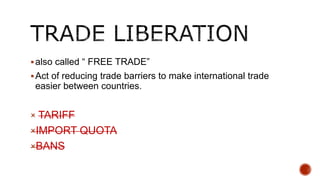
also called “ FREE TRADE”
Act of reducing trade barriers to make international trade
easier between countries.
× TARIFF
×IMPORT QUOTA
×BANS
HOW TO MAKE TRADES MORE
EASIER?
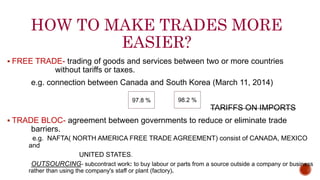
 FREE TRADE- trading of goods and services between two or more countries
without tariffs or taxes.
e.g. connection between Canada and South Korea (March 11, 2014)
TARIFFS ON IMPORTS
 TRADE BLOC- agreement between governments to reduce or eliminate trade
barriers.
e.g. NAFTA( NORTH AMERICA FREE TRADE AGREEMENT) consist of CANADA, MEXICO
and
UNITED STATES.
OUTSOURCING- subcontract work: to buy labour or parts from a source outside a company or business
rather than using the company's staff or plant (factory).
97.8 % 98.2 %
World Bank
International Monetary Fund (IMF)
World Trade Organization (WTO)
- originates after the World War II by United States and
United Kingdom (Bretton Woods Conference,1944).
WORLD BANK
Also called Int’l Bank for Reconstruction
and Development (IBRD)
Increases in economic growth and decreases poverty in
developing countries.
e.g. Increases in education since 1962 like
Bangladesh, Chad and Afghanistan.
WORLD TRADE
ORGANIZATION (WTO)
 Formerly known as General Agreement on Tariffs and Trade (GATT)
 Deals with the rules of trade between nations, settles trades disputes and conduct
straight negotiations.
e.g. (May 2013) Japan and European Union bought a case to WTO
regarding unfair renewable energy serves offered in Ontario.
INTERNATIONAL
MONETARY FUND (IMF)
Provides short term loans to countries when an emergency
occurs.
e.g. Yemen receive 93 Million USD (2012) during struggle
to terrorism.
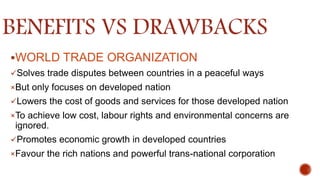
BENEFITS VS DRAWBACKS
WORLD TRADE ORGANIZATION
Solves trade disputes between countries in a peaceful ways
×But only focuses on developed nation
Lowers the cost of goods and services for those developed nation
×To achieve low cost, labour rights and environmental concerns are
ignored.
Promotes economic growth in developed countries
×Favour the rich nations and powerful trans-national corporation
SUSTAINABILITY
The degree to which the Earth can provide resource for human
needs.
 Specifically developing the world in a way where the needs of a
present day generations are met while preserving resources for future
generations.
(2008) Canada pass the Federal Sustainable Development Act
SUSTAINABLE DEVELOPMENT
 Baldwin, R., P. Martin, and G. Ottaviano. 2001. Global income divergence, trade,
and industrialization: The geography of growth take-offs. Journal of Economic
Growth 6 (1): 5–37.
 Crafts, N. and Venebles, A. 2003. Globalization in History:A Geographical Perspective,
University of Chicago Press.
 Audinet, J.P. (2006, April ). Globalization, Liberalization and Protectionism. Retrieved
from http://www.ruralpovertyportal.org/documents/654016/100542/DLFE-1614.pdf
 Erixon, F., & Sally, R. (2010, November ). Ecipe.org. TRADE,GLOBALISATION AND
EMERGING PROTECTIONISM SINCE CRISIS.
 Helen, M. (2001, ). Georgetown.edu. Globalization, Development, and International
Institutions: Normative and Positive Perspectives. Retrieved from
http://faculty.georgetown.edu/jrv24/milner_05.pdf

Economic globalization

  • 1.
  • 2.
    HISTORY  THE INDUSVALLEY CIVILIZATION all the way to MESOPOTAMIA Early as 4000 BC Mesopotamia - TOKEN SYSTEM as COMMODITY MONEY
  • 3.
  • 4.
    DISTINCTION BETWEEN GLOBALIZATION AND ECONOMICAL GLOBALIZATIONForeignDirect Investment Technological Innovation Economies of Scale
  • 5.
     COMMUNICATION MODERN COMMUNICATIONTECHNOLOGY AND MASS MEDIA ARE GLOBAL STANDARD. IT’S RELATIVELY EASY AND INEXPENSIVE TO STAY IN TOUCH.
  • 6.
     TRANSPORTATION TRAVEL ANDSHIPPING ARE CHEAP AND SAFE.
  • 7.
     TRADE MULTI-NATIONAL CORPORATIONHAVE GLOBAL REACH AND INCREASING POWER e.g.. McDonald Corp., Intel Corp. etc. GOVERNMENTS HAVE DECREASES TARIFFS AND REGULATION ON INT’L TRADE
  • 8.
  • 9.
     Protecting one’seconomy from foreign competition by creating trade barriers.  Domestic products > Imported goods  TARIFF- tax levied by a government on imports and exports. The money collected from tariffs is called a customs duty.  IMPORT QUOTA- limits on the number of products that can be imported into a country.  BANS- forbid products on import goods.
  • 10.
    also called “FREE TRADE” Act of reducing trade barriers to make international trade easier between countries. × TARIFF ×IMPORT QUOTA ×BANS
  • 11.
    HOW TO MAKETRADES MORE EASIER?  FREE TRADE- trading of goods and services between two or more countries without tariffs or taxes. e.g. connection between Canada and South Korea (March 11, 2014) TARIFFS ON IMPORTS  TRADE BLOC- agreement between governments to reduce or eliminate trade barriers. e.g. NAFTA( NORTH AMERICA FREE TRADE AGREEMENT) consist of CANADA, MEXICO and UNITED STATES. OUTSOURCING- subcontract work: to buy labour or parts from a source outside a company or business rather than using the company's staff or plant (factory). 97.8 % 98.2 %
  • 12.
    World Bank International MonetaryFund (IMF) World Trade Organization (WTO) - originates after the World War II by United States and United Kingdom (Bretton Woods Conference,1944).
  • 13.
    WORLD BANK Also calledInt’l Bank for Reconstruction and Development (IBRD) Increases in economic growth and decreases poverty in developing countries. e.g. Increases in education since 1962 like Bangladesh, Chad and Afghanistan.
  • 14.
    WORLD TRADE ORGANIZATION (WTO) Formerly known as General Agreement on Tariffs and Trade (GATT)  Deals with the rules of trade between nations, settles trades disputes and conduct straight negotiations. e.g. (May 2013) Japan and European Union bought a case to WTO regarding unfair renewable energy serves offered in Ontario.
  • 15.
    INTERNATIONAL MONETARY FUND (IMF) Providesshort term loans to countries when an emergency occurs. e.g. Yemen receive 93 Million USD (2012) during struggle to terrorism.
  • 16.
    BENEFITS VS DRAWBACKS WORLDTRADE ORGANIZATION Solves trade disputes between countries in a peaceful ways ×But only focuses on developed nation Lowers the cost of goods and services for those developed nation ×To achieve low cost, labour rights and environmental concerns are ignored. Promotes economic growth in developed countries ×Favour the rich nations and powerful trans-national corporation
  • 17.
    SUSTAINABILITY The degree towhich the Earth can provide resource for human needs.  Specifically developing the world in a way where the needs of a present day generations are met while preserving resources for future generations. (2008) Canada pass the Federal Sustainable Development Act SUSTAINABLE DEVELOPMENT
  • 18.
     Baldwin, R.,P. Martin, and G. Ottaviano. 2001. Global income divergence, trade, and industrialization: The geography of growth take-offs. Journal of Economic Growth 6 (1): 5–37.  Crafts, N. and Venebles, A. 2003. Globalization in History:A Geographical Perspective, University of Chicago Press.  Audinet, J.P. (2006, April ). Globalization, Liberalization and Protectionism. Retrieved from http://www.ruralpovertyportal.org/documents/654016/100542/DLFE-1614.pdf  Erixon, F., & Sally, R. (2010, November ). Ecipe.org. TRADE,GLOBALISATION AND EMERGING PROTECTIONISM SINCE CRISIS.  Helen, M. (2001, ). Georgetown.edu. Globalization, Development, and International Institutions: Normative and Positive Perspectives. Retrieved from http://faculty.georgetown.edu/jrv24/milner_05.pdf

Editor's Notes

  • #13 \
  • #16 The IMF makes loans so that countries can maintain the value of their currencies and repay foreign debt. Countries accumulate foreign debt when they buy more from the rest of the world than they sell abroad. They then need to borrow money to pay the difference, which is known as balancing their payments. After banks and other institutions will no longer lend them money, they turn to the IMF to help them balance their payments position with the rest of the world. The IMF initially focused on Europe, but by the 1970s it changed its focus to the less-developed economies. By the early 1980s a large number of developing countries were having trouble financing their foreign debts. In 1982 the IMF had to offer more loans to Mexico, which was then still a developing country, and other Latin American (Spain, Portugal)nations just so they could pay off their original debts. Terrorism- bombing, kidnapping, assassination carried out for political purposes.