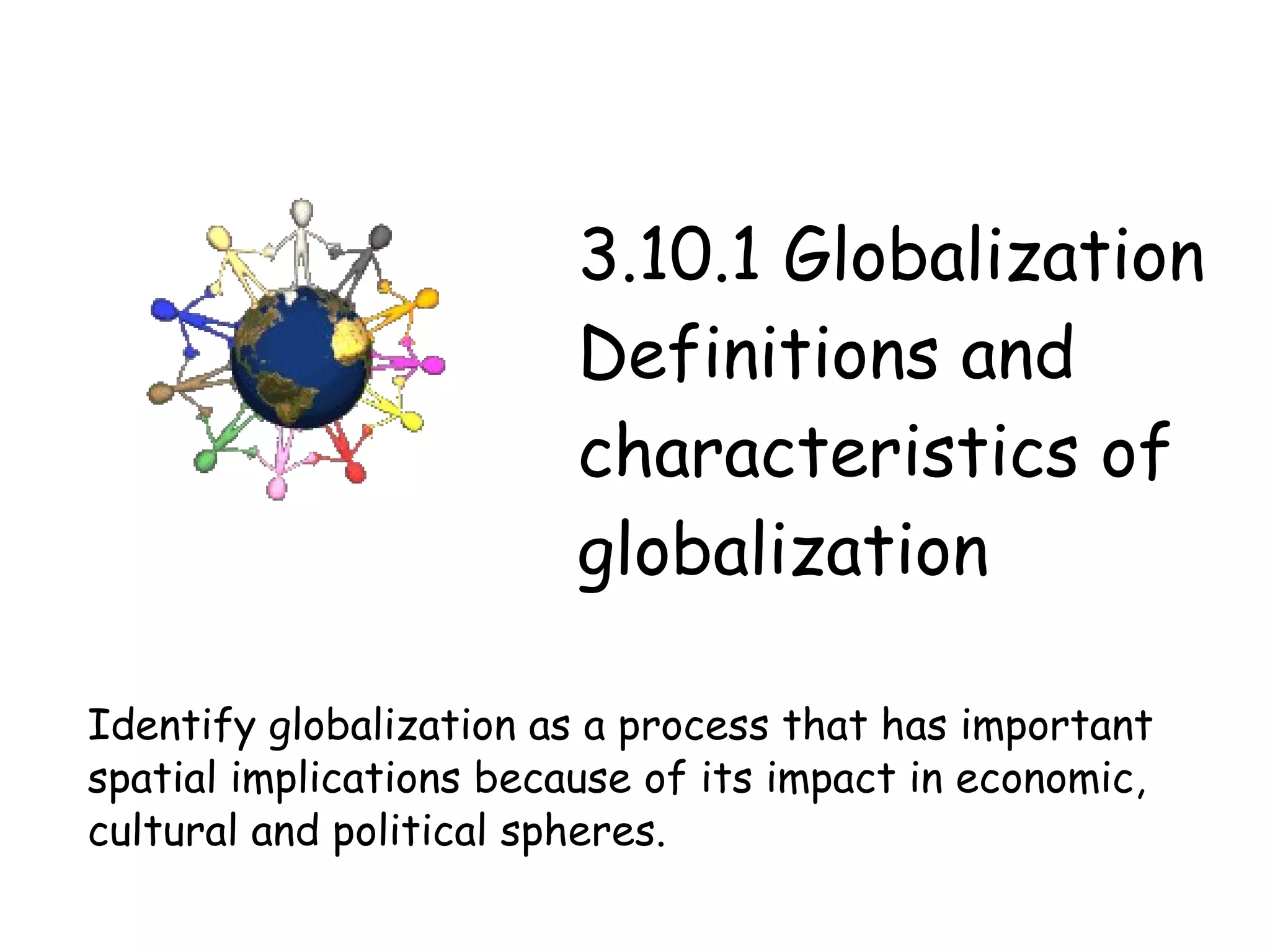
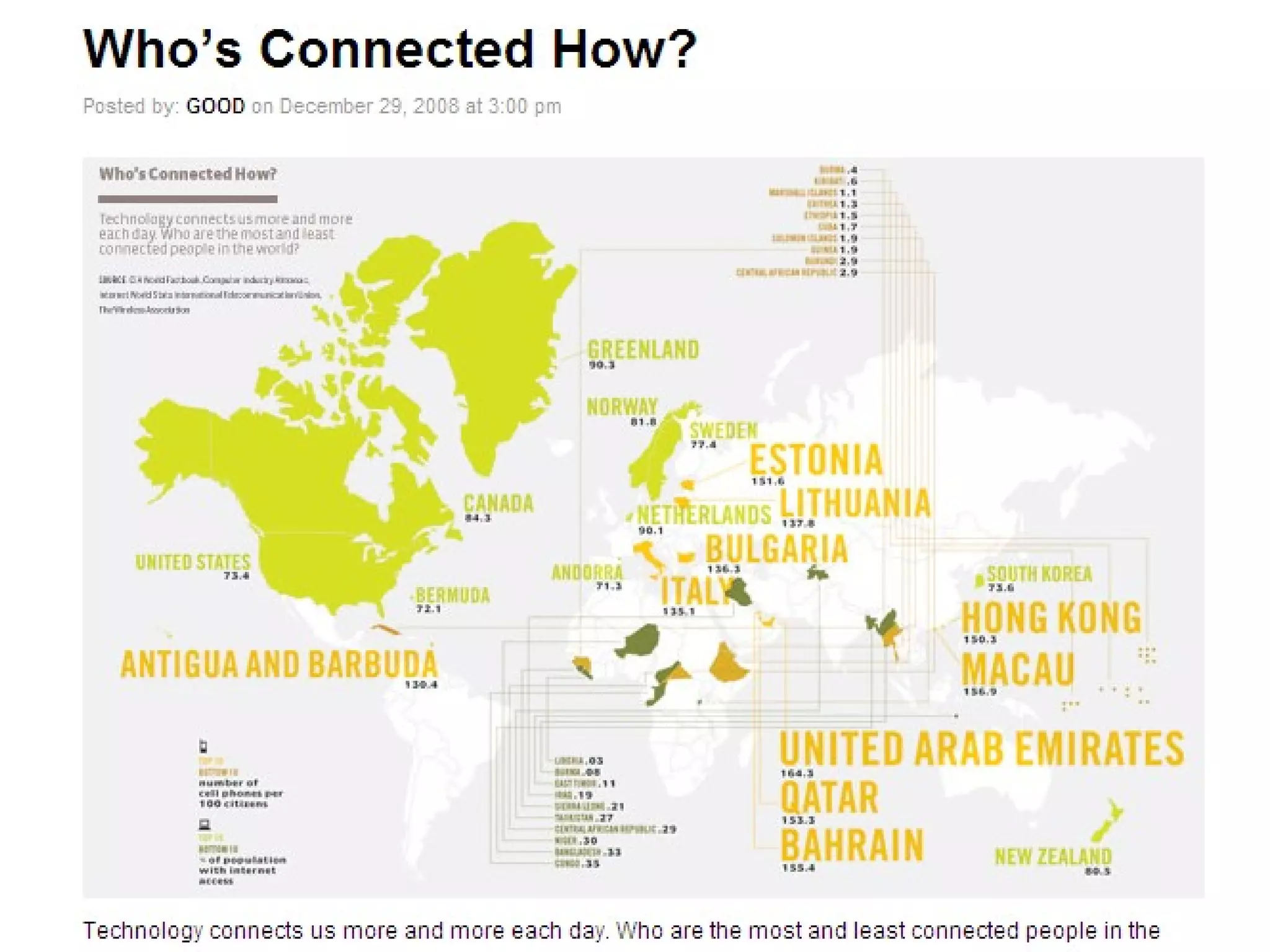
3.10.1 Globalization Definitions and characteristics of globalization Identify globalization as a process that has important spatial implications because of its impact in economic, cultural and political spheres.
It really boils down to this: that all life is  interrelated . We are all caught in an inescapable  network of mutuality , tied into a single garment of destiny. Whatever affects one directly,  affects all  indirectly. We are made to  live together  because of the  interrelated structure  of reality. Did you ever stop to think that you can't leave for your job in the morning without being dependent on most of the world? You get up in the morning and go to the bathroom and reach over for the sponge, and that's handed to you by a Pacific islander. You reach for a bar of soap, and that's given to you at the hands of a Frenchman. And then you go into the kitchen to drink your coffee for the morning, and that's poured into your cup by a South American. And maybe you want tea: that's poured into your cup by a Chinese. Or maybe you're desirous of having cocoa for breakfast, and that's poured into your cup by a West African. And then you reach over for your toast, and that's given to you at the hands of an English-speaking farmer, not to mention the baker. And before you finish eating breakfast in the morning, you've depended on more than half the world. This is the way our universe is structured, this is its interrelated quality.  We aren't going to have peace on Earth until we recognize this basic fact of the interrelated structure of all reality .  Martin Luther King 1967
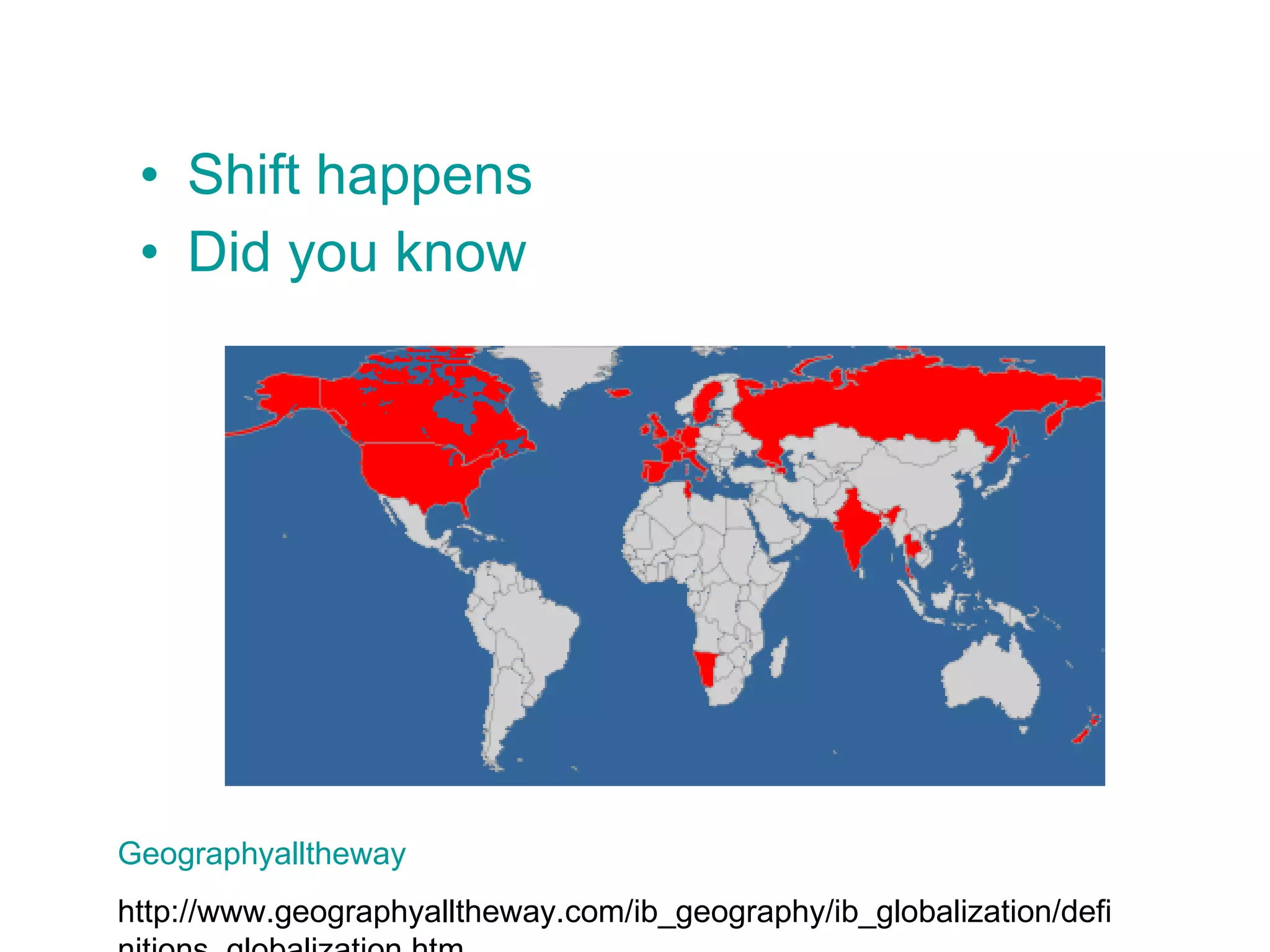
Shift happens Did you know Geographyalltheway http://www.geographyalltheway.com/ib_geography/ib_globalization/definitions_globalization.htm
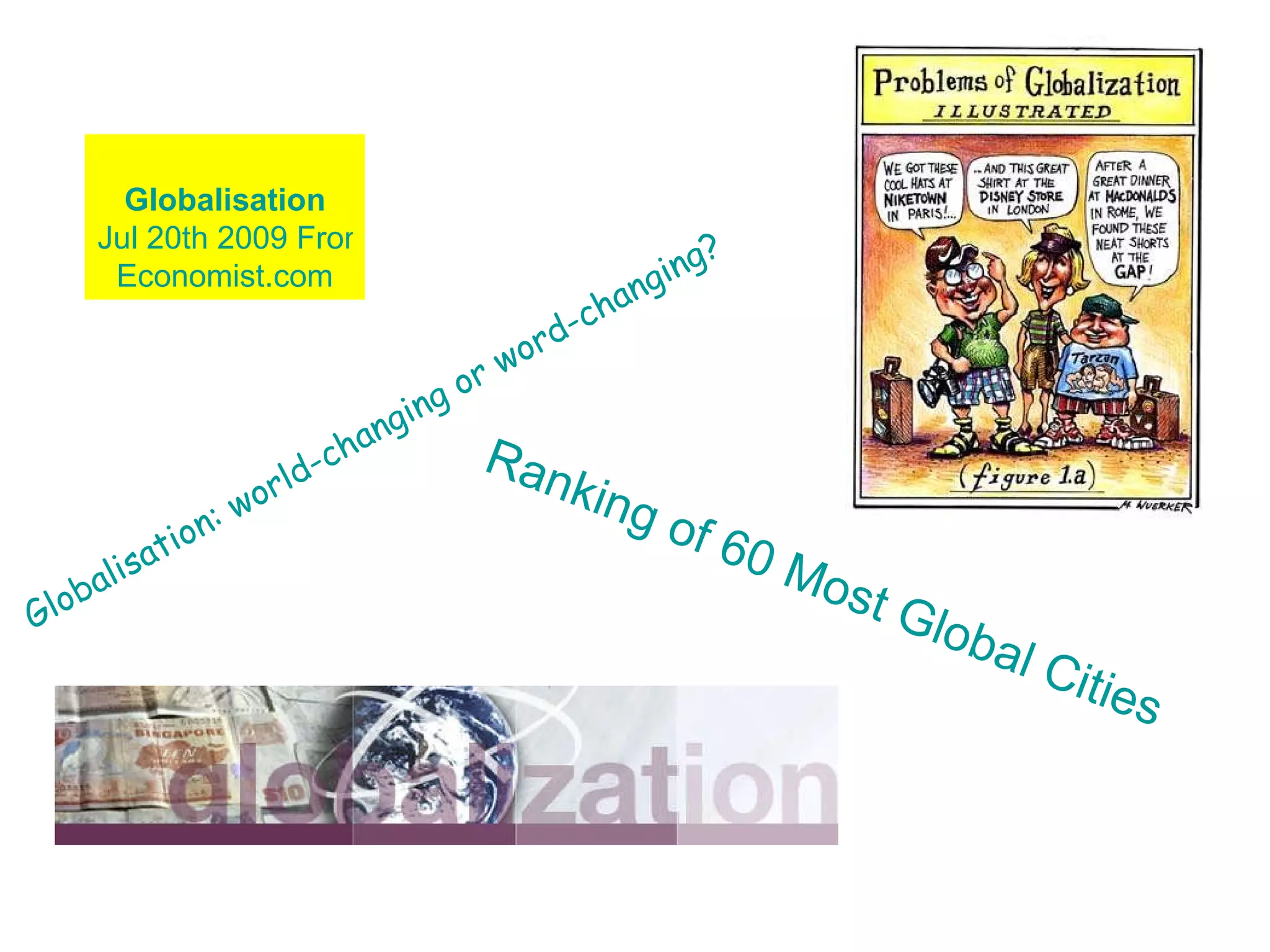
Globalisation Jul 20th 2009 From  Economist.com Ranking of 60 Most Global Cities   Globalisation: world-changing or word-changing?
 
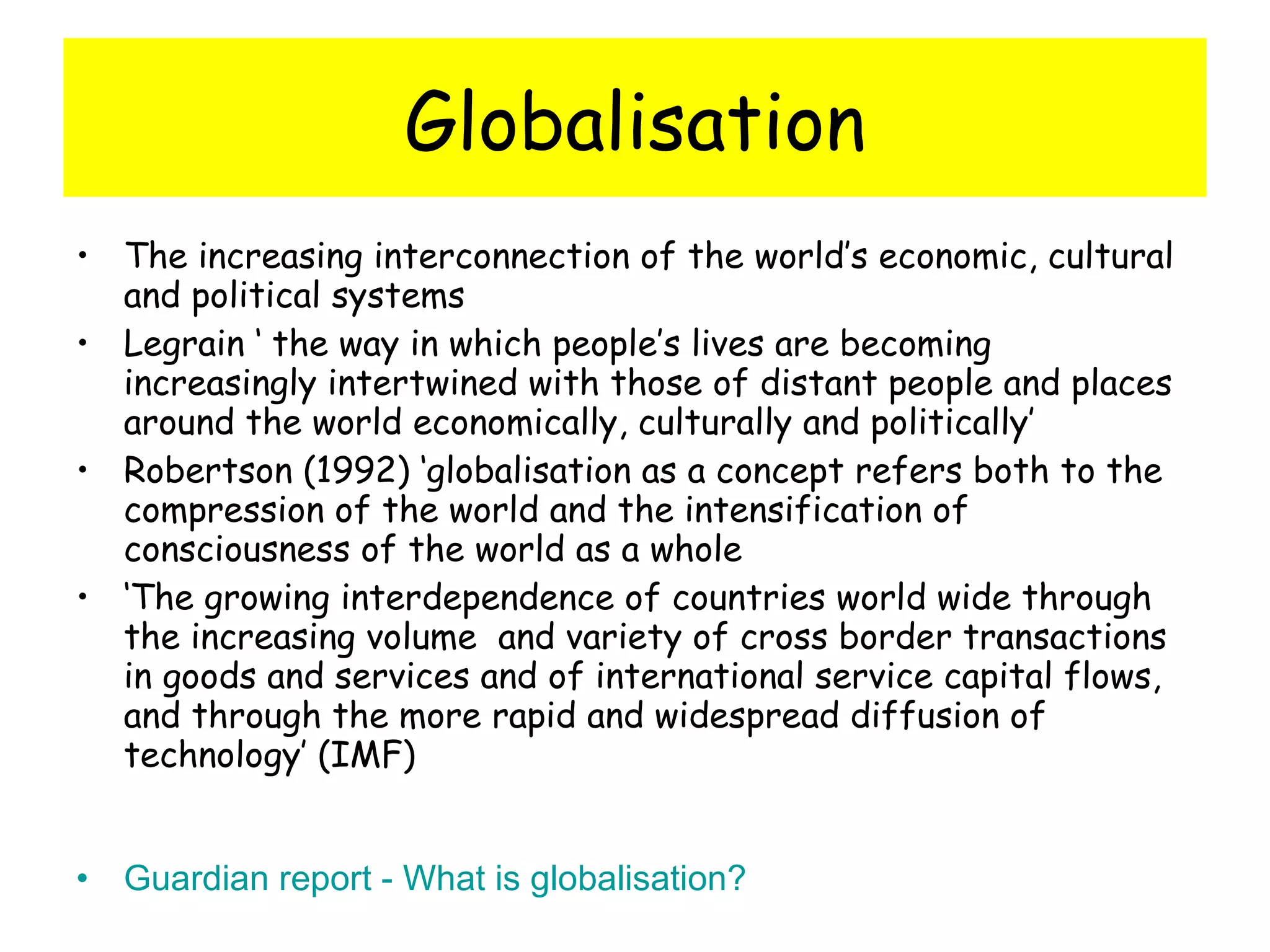
Globalisation The increasing interconnection of the world’s economic, cultural and political systems Legrain ‘ the way in which people’s lives are becoming increasingly intertwined with those of distant people and places around the world economically, culturally and politically’ Robertson (1992) ‘globalisation as a concept refers both to the compression of the world and the intensification of consciousness of the world as a whole ‘ The growing interdependence of countries world wide through the increasing volume  and variety of cross border transactions in goods and services and of international service capital flows, and through the more rapid and widespread diffusion of technology’ (IMF)  Guardian report - What is globalisation?
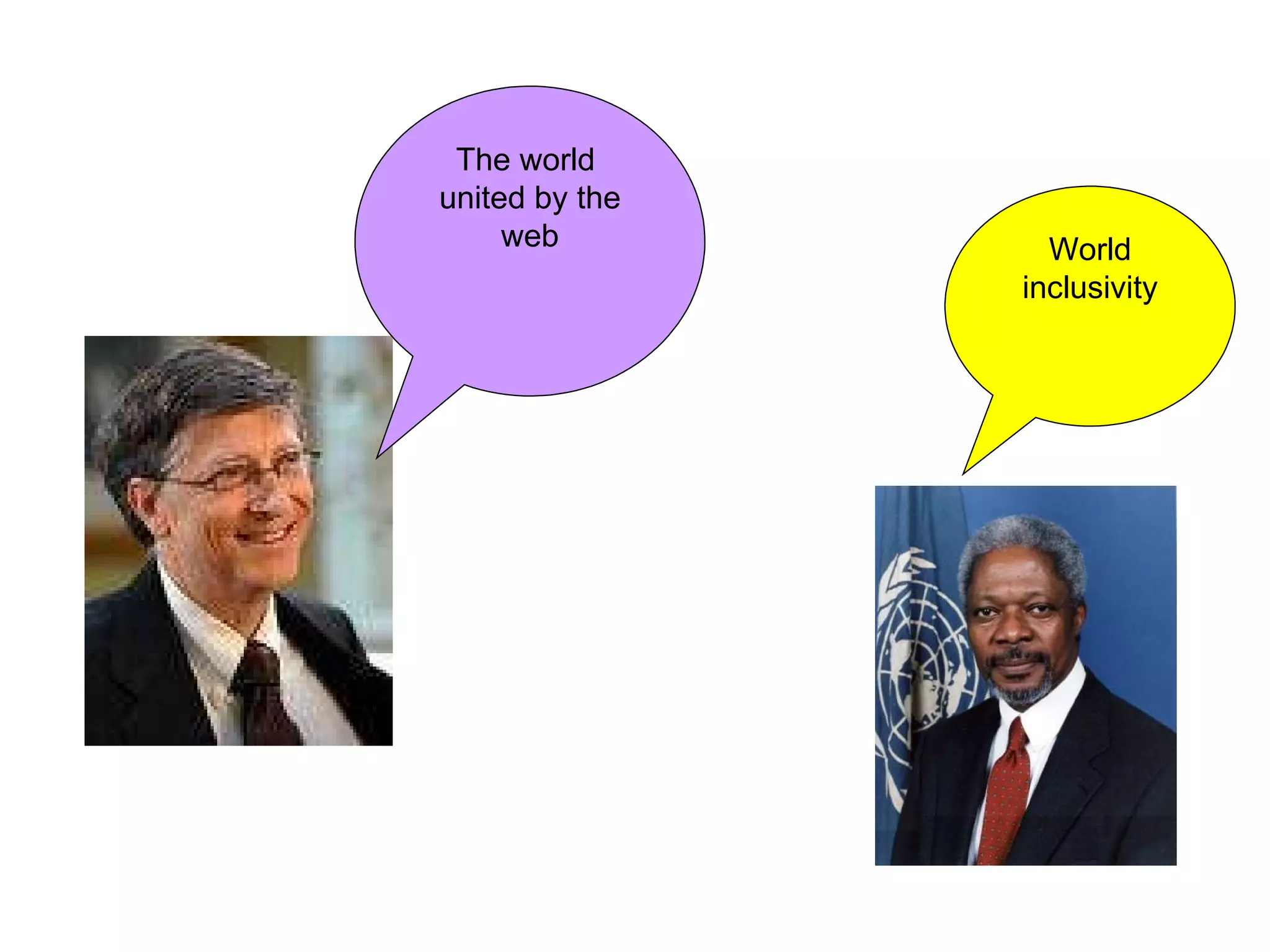
The world  united by the web World inclusivity
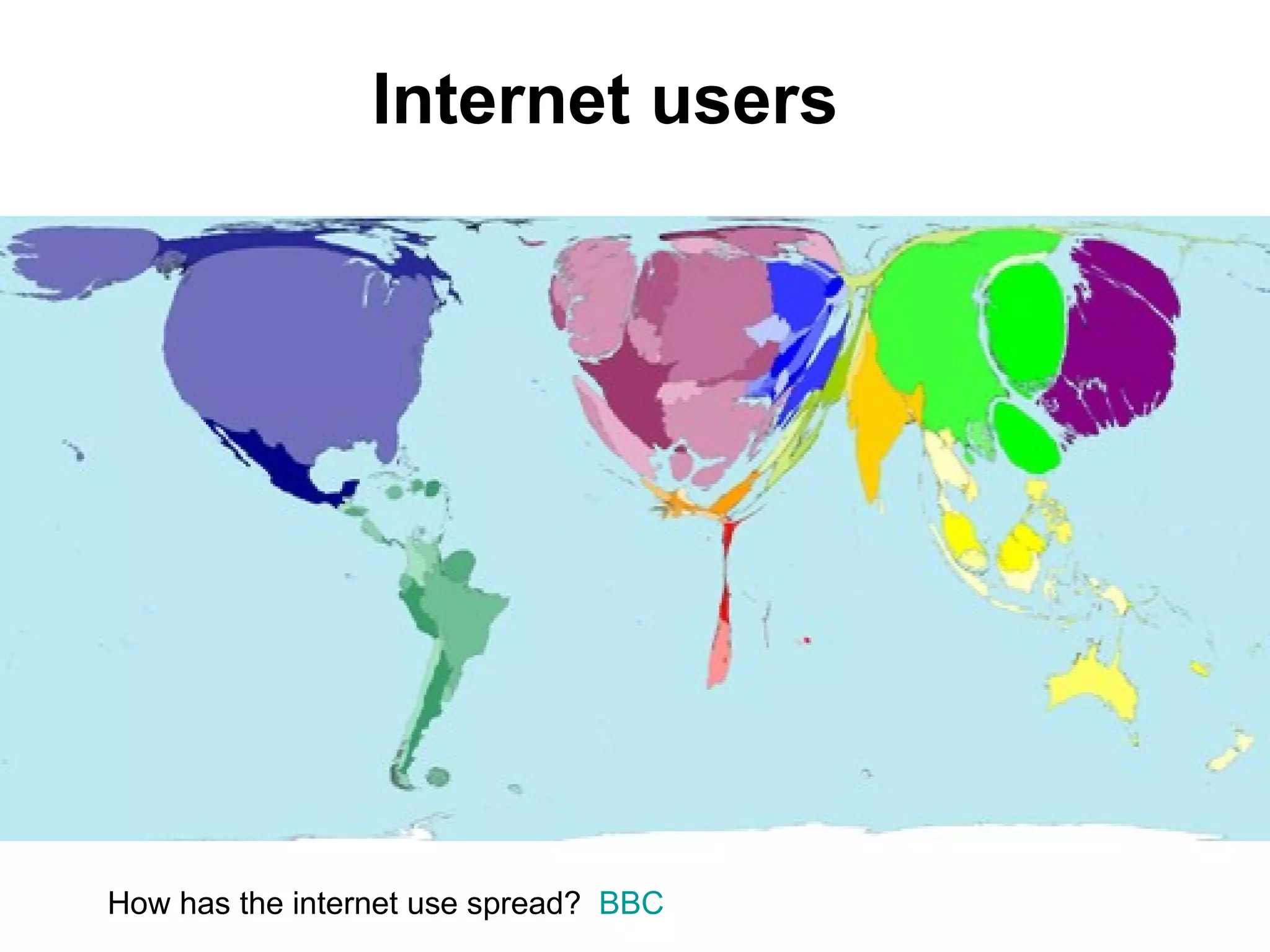
Internet users How has the internet use spread?  BBC
Glocalization The term was invented to emphasize that the globalization of a product is more likely to succeed when the product or service is adapted specifically to each locality or culture it is marketed in. The increasing presence of McDonald’s restaurants worldwide is globalization while the changes in the menus of the restaurant chain that are designed to appeal to local tastes are an example of glocalization (e.g. India, Thailand, HSBC – ‘the world’s local bank’)
3 main forms of globalisation 1. Economic Under both the General Agreement on Tarrifs and Trade (GATT) and its successor the World Trade Organisation (WTO), world trade has expanded rapidly. TNCs have been the major force in increasing economic interdependence and several generations of newly industrialised countries have emerged.
2. Cultural Mixing of cultures has occurred through Migration Rapid spread of news, ideas and fashons through the media, trade and travel Growth of global brands – Nike, Coca cola, MacDonalds Western culture has diffused to all parts of the world through television, cinema, the internet, newspapers and magazines.  This has been reflected in media, art, sport and leisure pursuits.
3. Political The influence of nation states has diminished in many areas as more and more countries organise themselves into  trade blocs .  The influence of western democracies on developing countries has also been strong Relationships are also political – the increasing role played by the United Nations around the world epitomises the  developing cooperation between nations. Growing importance of  cross border pressure  groups – Friends of the Earth, Amnesty International –  ‘global civil society’  .  Their actions have led to international rules on trade, environment, human rights, war etc.
Globalisation can be seen in terms of: Urban:  - a hierarchy of global cities has emerged to act as centres for the global economy Demographic  – the growth of international migration and the rise of multicultural societies Linguistic  – the emergence of English as the working language of the ‘global village’ Environmental  – the impact of activity in one country has a clear impact in others – e.g. the spread of pollutants and the impacts of global warming
History of globalisation Late 19 th  C Transport and communications networks expanded rapidly around the world World trade began to grow with an increase in the level of interdependence between rich and poor nations Capital flows began to expand as European companies started operations in other parts of the world
Since 1950s  Fragmentation of production processes across national boundaries has changed the geographical pattern of specialisation at a global scale International trade has become more complex A growing number of NICs  - Malaysia, India Integration of Soviet Union and countries of E. Europe into capitalist system Opening up of large economies of China and India to outside world
Markets Late 20 th  C Emergence of  free market  ideas which were promoted in 1980s by governments in UK and USA.  These radical ideas spread and were copied to a varying degree by other economies. The  deregulation of world financial markets.   Before banks, insurance companies, investment companies had been confined within countries.  Financial institutions were now able to look for the best investments across the globe
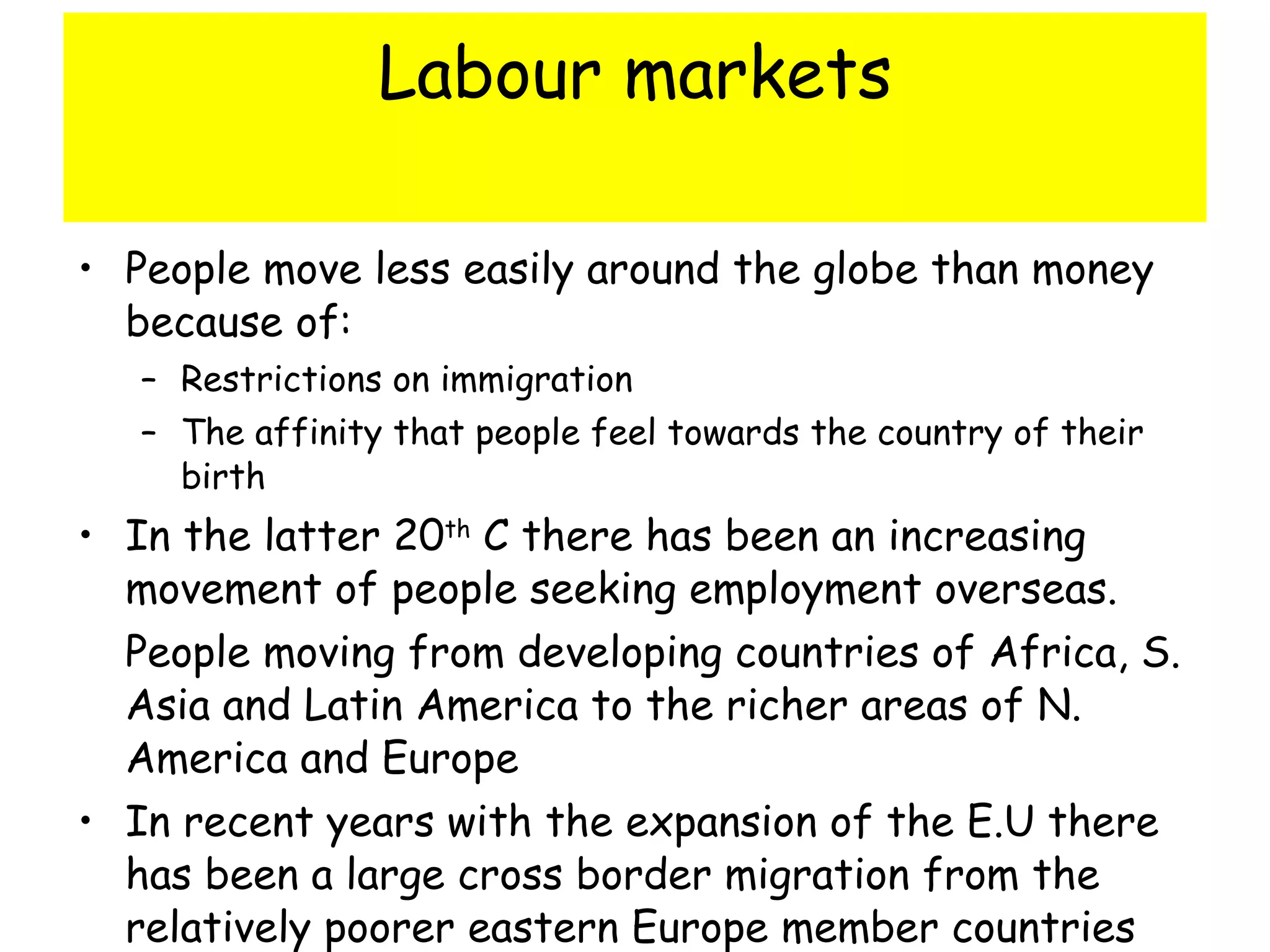
Labour markets People move less easily around the globe than money because of: Restrictions on immigration The affinity that people feel towards the country of their birth In the latter 20 th  C there has been an increasing movement of people seeking employment overseas.  People moving from developing countries of Africa, S. Asia and Latin America to the richer areas of N. America and Europe In recent years with the expansion of the E.U there has been a large cross border migration from the relatively poorer eastern Europe member countries such as Poland and Estonia to the richer west – particularly the UK
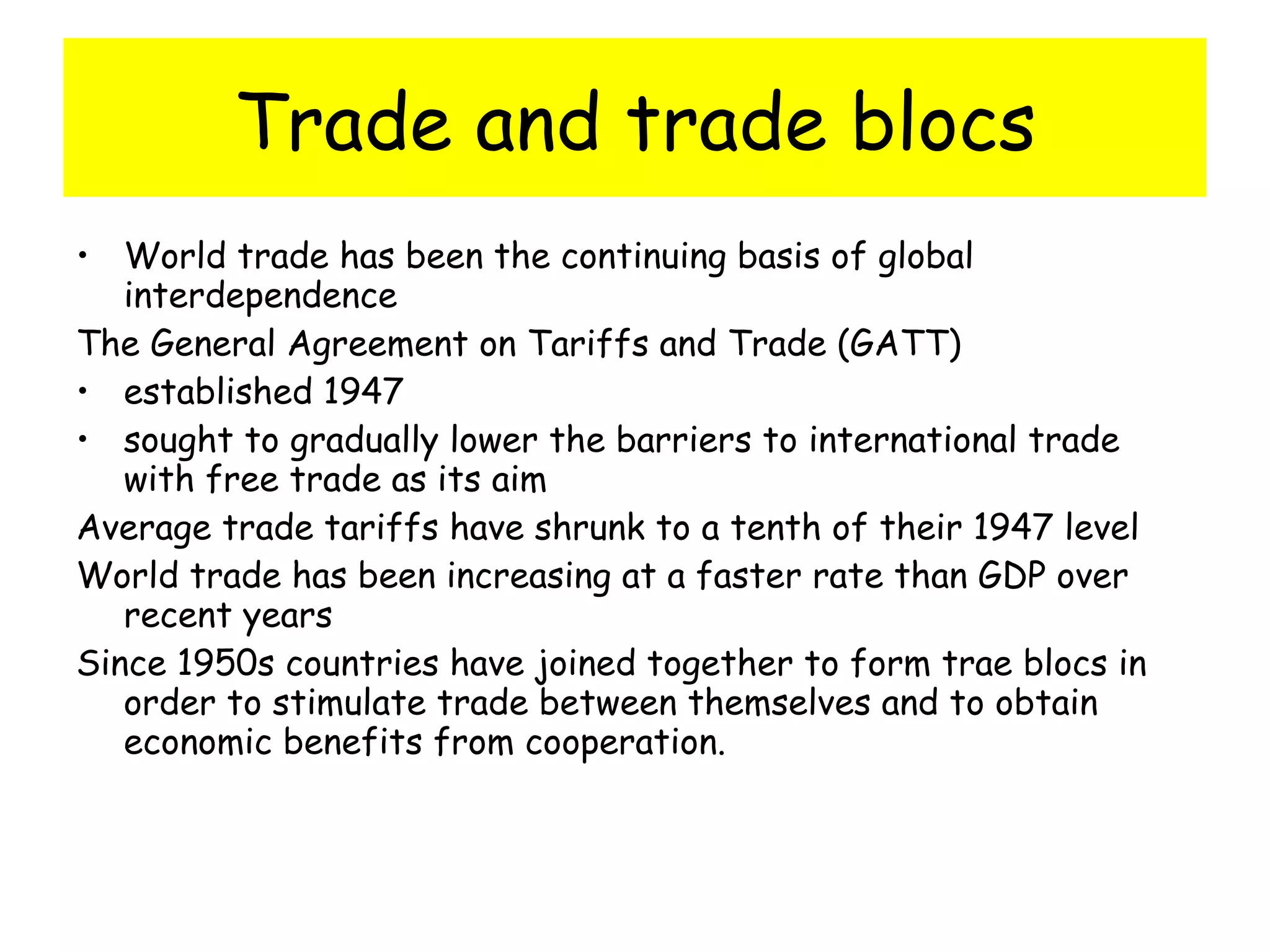
Trade and trade blocs World trade has been the continuing basis of global interdependence The General Agreement on Tariffs and Trade (GATT)  established 1947 sought to gradually lower the barriers to international trade with free trade as its aim Average trade tariffs have shrunk to a tenth of their 1947 level World trade has been increasing at a faster rate than GDP over recent years Since 1950s countries have joined together to form trae blocs in order to stimulate trade between themselves and to obtain economic benefits from cooperation.
 
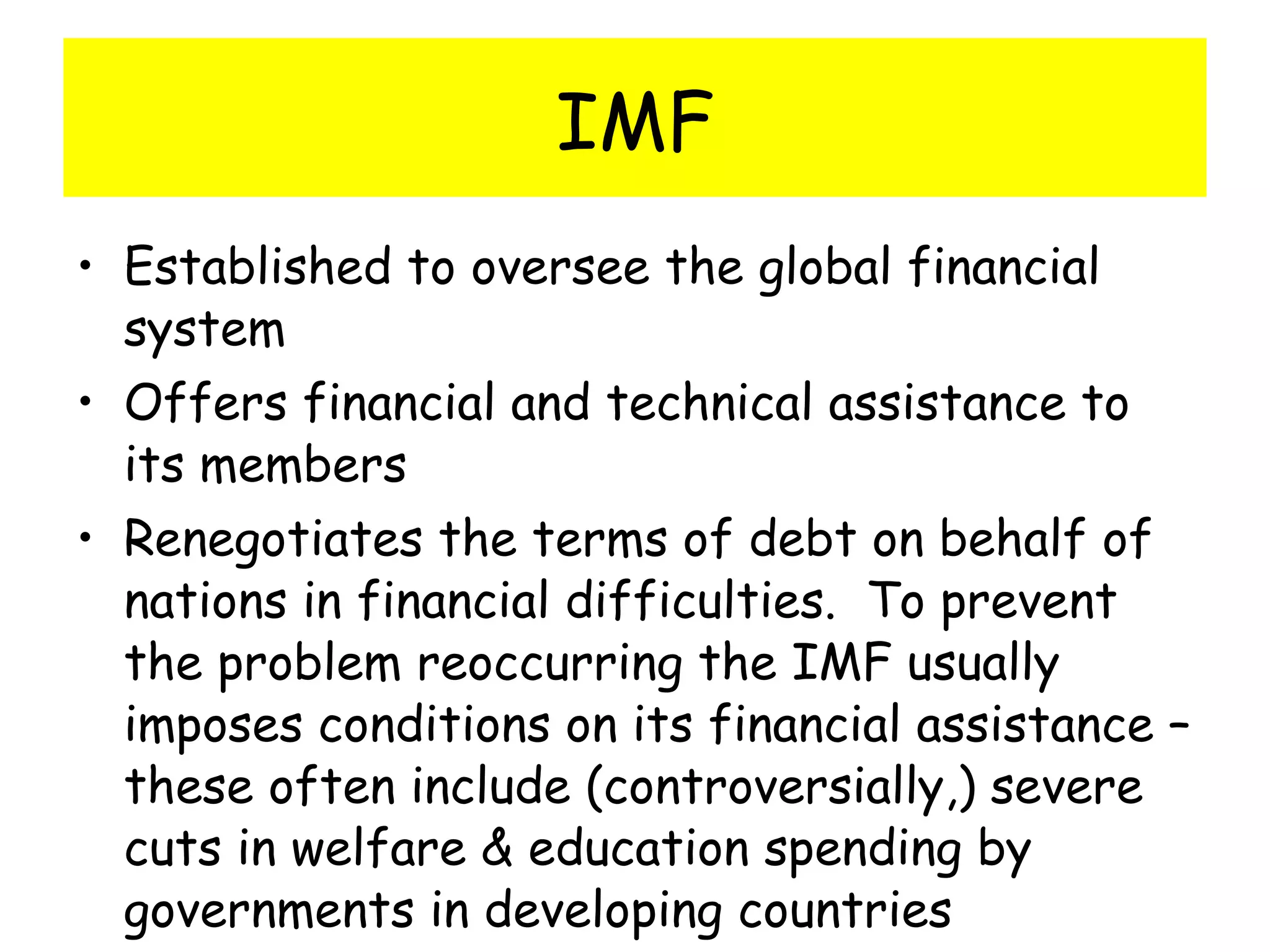
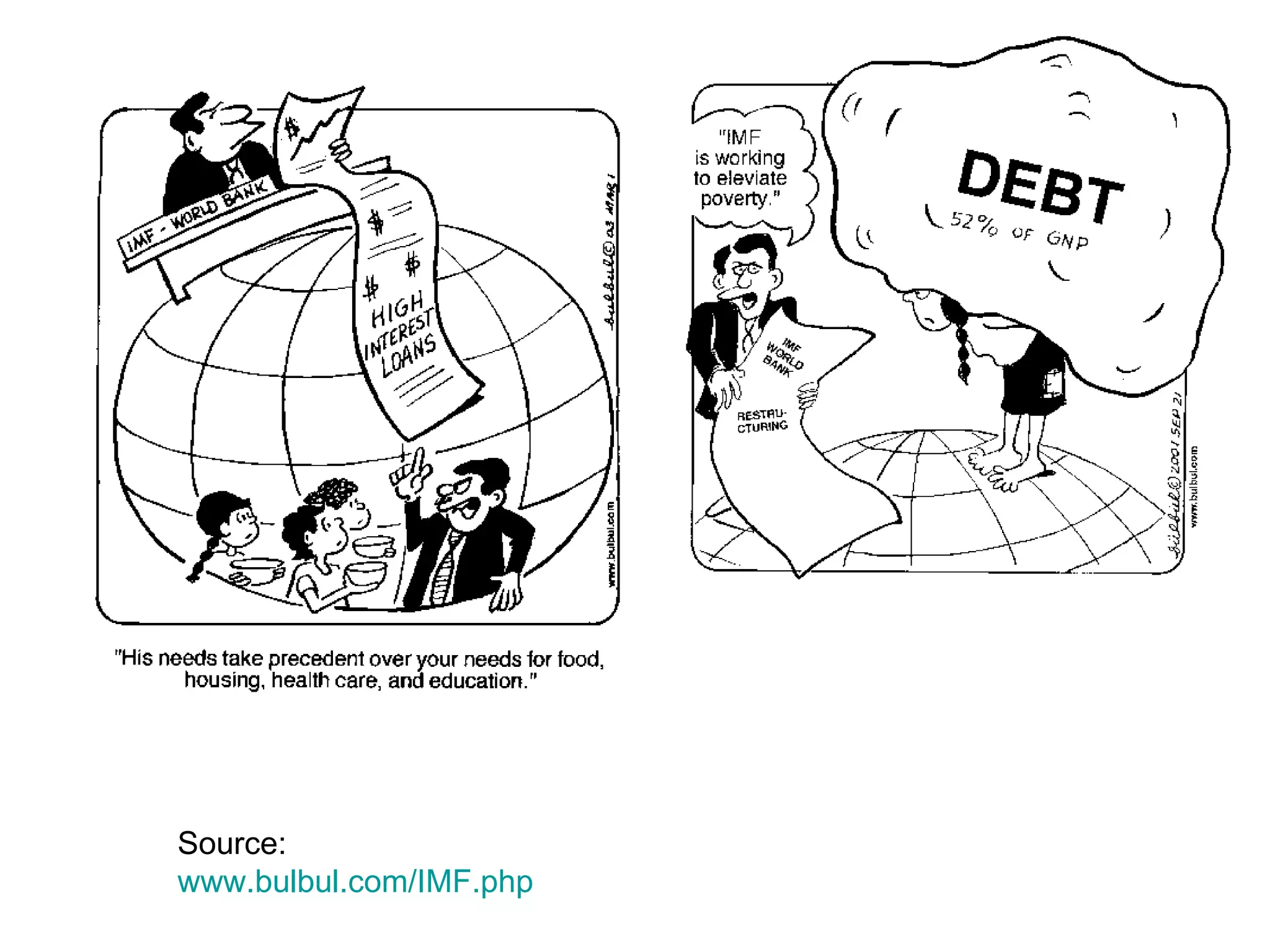
IMF Established to oversee the global financial system Offers financial and technical assistance to its members Renegotiates the terms of debt on behalf of nations in financial difficulties.  To prevent the problem reoccurring the IMF usually imposes conditions on its financial assistance – these often include (controversially,) severe cuts in welfare & education spending by governments in developing countries
Source:  www.bulbul.com/IMF.php
The World Bank International Bank for Reconstruction and Development Deals mainly with internal investment project usually in developing countries with the aim of reducing poverty. Loan are set at the current market rate International Development Association (IDA) provides interest free loans with long repayment periods to countries with very low percapita incomes. Since 1990s the bank has claimed that it promotes sustainable development with most funding going to small scale projects Critics argue that conditions attached to loans have not always had the effect of reducing poverty and dependency
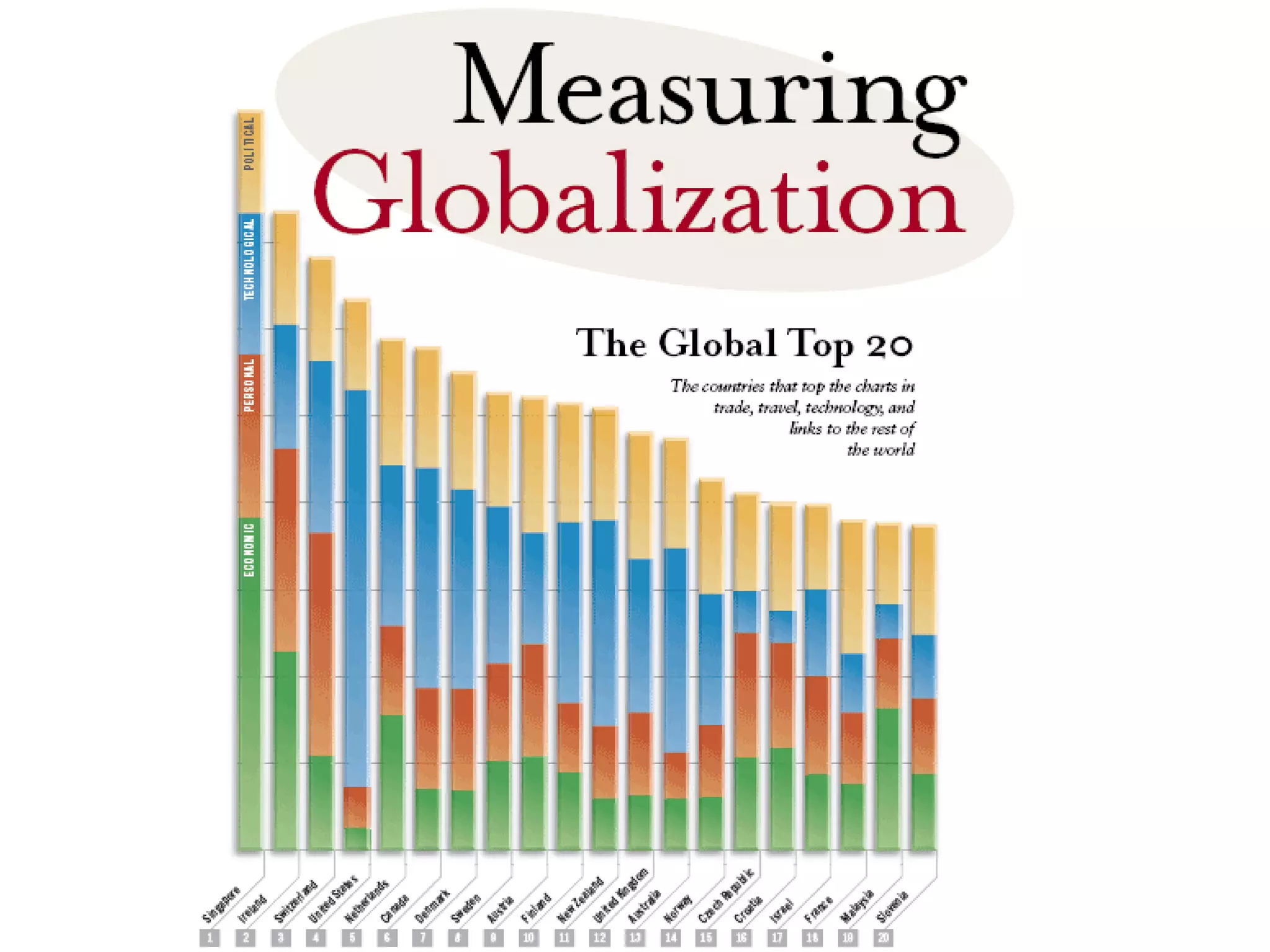
Globalization index The AT Kearney index is one of several measures of globalization.  It tracks changes in the four key components of global integration: Trade and investment flows Movement of people across borders Volumes of international telephone traffic and internet usage Participation in international organisations (AT Kearney Foreign policy)
KOF Index of Globalization   The  KOF Index of Globalization  measures the three main dimensions of globalization:  economic  social  and political. In addition to three indices measuring these dimensions, we calculate an overall index of globalization and sub-indices referring to  actual economic flows  economic restrictions  data on information flows  data on personal contact  and data on cultural proximity. Data are available on a yearly basis for 158 countries over the period 1970 - 2006 .  See IB study Guide pg 150  http://globalization.kof.ethz.ch/
 
May 05 Referring to trade agreements and tourism, assess how far globalization reduces the differences between places. [20 marks]
The answer should show an understanding of the process of globalization and the ways in which it reduces or increases the differences between places. The differences should be identified and may be social, economic, environmental, landscape-related and political. Trade and tourism should be discussed in terms of the way that they influence these processes and outcomes. Trade agreements can reduce the differences between places within the trade area by economic convergence, whereas those countries excluded maintain their differences. Broader references to the effects of trade in general and its effect of transferring goods should be made. This can express itself in homogenized cultural landscapes and economic systems. Tourism has a similar effect of spreading cultural, moral and behavioural traits leading to similarities, but it may also result in sharp economic contrasts between tourist enclaves and unattractive peripheries. The mark allocation need not be equally distributed between the two parts: trade agreements and tourism, but responses that focus only on trade agreements or tourism may not move beyond band E. Any responses that are purely descriptive and fail to assess may not move beyond band F.
Nov 06 Define the term  globalization .  [2 marks] (ii) Suggest  two  indicators which might have been used to make up the globalization index. Explain your answer.  [4 marks] (iii) Describe and explain the relationship between the globalization index and life expectancy for the countries shown on the graph.  [4 marks] (iv) Referring to examples, discuss the ways in which globalization decreases the differences between countries.  [10 marks]
Further reading…. Globalization: Threat or Opportunity? BBC news special report Globalisation   Key facts: The global economy  Bibliography 184 – 188 AQA A2 Geog

3.10.1 Globalisation Definitions And Characteristics

  • 1.
    3.10.1 Globalization Definitionsand characteristics of globalization Identify globalization as a process that has important spatial implications because of its impact in economic, cultural and political spheres.
  • 2.
    It really boilsdown to this: that all life is interrelated . We are all caught in an inescapable network of mutuality , tied into a single garment of destiny. Whatever affects one directly, affects all indirectly. We are made to live together because of the interrelated structure of reality. Did you ever stop to think that you can't leave for your job in the morning without being dependent on most of the world? You get up in the morning and go to the bathroom and reach over for the sponge, and that's handed to you by a Pacific islander. You reach for a bar of soap, and that's given to you at the hands of a Frenchman. And then you go into the kitchen to drink your coffee for the morning, and that's poured into your cup by a South American. And maybe you want tea: that's poured into your cup by a Chinese. Or maybe you're desirous of having cocoa for breakfast, and that's poured into your cup by a West African. And then you reach over for your toast, and that's given to you at the hands of an English-speaking farmer, not to mention the baker. And before you finish eating breakfast in the morning, you've depended on more than half the world. This is the way our universe is structured, this is its interrelated quality. We aren't going to have peace on Earth until we recognize this basic fact of the interrelated structure of all reality . Martin Luther King 1967
  • 3.
    Shift happens Didyou know Geographyalltheway http://www.geographyalltheway.com/ib_geography/ib_globalization/definitions_globalization.htm
  • 4.
    Globalisation Jul 20th2009 From Economist.com Ranking of 60 Most Global Cities Globalisation: world-changing or word-changing?
  • 5.
  • 6.
    Globalisation The increasinginterconnection of the world’s economic, cultural and political systems Legrain ‘ the way in which people’s lives are becoming increasingly intertwined with those of distant people and places around the world economically, culturally and politically’ Robertson (1992) ‘globalisation as a concept refers both to the compression of the world and the intensification of consciousness of the world as a whole ‘ The growing interdependence of countries world wide through the increasing volume and variety of cross border transactions in goods and services and of international service capital flows, and through the more rapid and widespread diffusion of technology’ (IMF) Guardian report - What is globalisation?
  • 7.
    The world united by the web World inclusivity
  • 8.
    Internet users Howhas the internet use spread? BBC
  • 9.
    Glocalization The termwas invented to emphasize that the globalization of a product is more likely to succeed when the product or service is adapted specifically to each locality or culture it is marketed in. The increasing presence of McDonald’s restaurants worldwide is globalization while the changes in the menus of the restaurant chain that are designed to appeal to local tastes are an example of glocalization (e.g. India, Thailand, HSBC – ‘the world’s local bank’)
  • 10.
    3 main formsof globalisation 1. Economic Under both the General Agreement on Tarrifs and Trade (GATT) and its successor the World Trade Organisation (WTO), world trade has expanded rapidly. TNCs have been the major force in increasing economic interdependence and several generations of newly industrialised countries have emerged.
  • 11.
    2. Cultural Mixingof cultures has occurred through Migration Rapid spread of news, ideas and fashons through the media, trade and travel Growth of global brands – Nike, Coca cola, MacDonalds Western culture has diffused to all parts of the world through television, cinema, the internet, newspapers and magazines. This has been reflected in media, art, sport and leisure pursuits.
  • 12.
    3. Political Theinfluence of nation states has diminished in many areas as more and more countries organise themselves into trade blocs . The influence of western democracies on developing countries has also been strong Relationships are also political – the increasing role played by the United Nations around the world epitomises the developing cooperation between nations. Growing importance of cross border pressure groups – Friends of the Earth, Amnesty International – ‘global civil society’ . Their actions have led to international rules on trade, environment, human rights, war etc.
  • 13.
    Globalisation can beseen in terms of: Urban: - a hierarchy of global cities has emerged to act as centres for the global economy Demographic – the growth of international migration and the rise of multicultural societies Linguistic – the emergence of English as the working language of the ‘global village’ Environmental – the impact of activity in one country has a clear impact in others – e.g. the spread of pollutants and the impacts of global warming
  • 14.
    History of globalisationLate 19 th C Transport and communications networks expanded rapidly around the world World trade began to grow with an increase in the level of interdependence between rich and poor nations Capital flows began to expand as European companies started operations in other parts of the world
  • 15.
    Since 1950s Fragmentation of production processes across national boundaries has changed the geographical pattern of specialisation at a global scale International trade has become more complex A growing number of NICs - Malaysia, India Integration of Soviet Union and countries of E. Europe into capitalist system Opening up of large economies of China and India to outside world
  • 16.
    Markets Late 20th C Emergence of free market ideas which were promoted in 1980s by governments in UK and USA. These radical ideas spread and were copied to a varying degree by other economies. The deregulation of world financial markets. Before banks, insurance companies, investment companies had been confined within countries. Financial institutions were now able to look for the best investments across the globe
  • 17.
    Labour markets Peoplemove less easily around the globe than money because of: Restrictions on immigration The affinity that people feel towards the country of their birth In the latter 20 th C there has been an increasing movement of people seeking employment overseas. People moving from developing countries of Africa, S. Asia and Latin America to the richer areas of N. America and Europe In recent years with the expansion of the E.U there has been a large cross border migration from the relatively poorer eastern Europe member countries such as Poland and Estonia to the richer west – particularly the UK
  • 18.
    Trade and tradeblocs World trade has been the continuing basis of global interdependence The General Agreement on Tariffs and Trade (GATT) established 1947 sought to gradually lower the barriers to international trade with free trade as its aim Average trade tariffs have shrunk to a tenth of their 1947 level World trade has been increasing at a faster rate than GDP over recent years Since 1950s countries have joined together to form trae blocs in order to stimulate trade between themselves and to obtain economic benefits from cooperation.
  • 19.
  • 20.
    IMF Established tooversee the global financial system Offers financial and technical assistance to its members Renegotiates the terms of debt on behalf of nations in financial difficulties. To prevent the problem reoccurring the IMF usually imposes conditions on its financial assistance – these often include (controversially,) severe cuts in welfare & education spending by governments in developing countries
  • 21.
  • 22.
    The World BankInternational Bank for Reconstruction and Development Deals mainly with internal investment project usually in developing countries with the aim of reducing poverty. Loan are set at the current market rate International Development Association (IDA) provides interest free loans with long repayment periods to countries with very low percapita incomes. Since 1990s the bank has claimed that it promotes sustainable development with most funding going to small scale projects Critics argue that conditions attached to loans have not always had the effect of reducing poverty and dependency
  • 23.
    Globalization index TheAT Kearney index is one of several measures of globalization. It tracks changes in the four key components of global integration: Trade and investment flows Movement of people across borders Volumes of international telephone traffic and internet usage Participation in international organisations (AT Kearney Foreign policy)
  • 24.
    KOF Index ofGlobalization The KOF Index of Globalization measures the three main dimensions of globalization: economic social and political. In addition to three indices measuring these dimensions, we calculate an overall index of globalization and sub-indices referring to actual economic flows economic restrictions data on information flows data on personal contact and data on cultural proximity. Data are available on a yearly basis for 158 countries over the period 1970 - 2006 . See IB study Guide pg 150 http://globalization.kof.ethz.ch/
  • 25.
  • 26.
    May 05 Referringto trade agreements and tourism, assess how far globalization reduces the differences between places. [20 marks]
  • 27.
    The answer shouldshow an understanding of the process of globalization and the ways in which it reduces or increases the differences between places. The differences should be identified and may be social, economic, environmental, landscape-related and political. Trade and tourism should be discussed in terms of the way that they influence these processes and outcomes. Trade agreements can reduce the differences between places within the trade area by economic convergence, whereas those countries excluded maintain their differences. Broader references to the effects of trade in general and its effect of transferring goods should be made. This can express itself in homogenized cultural landscapes and economic systems. Tourism has a similar effect of spreading cultural, moral and behavioural traits leading to similarities, but it may also result in sharp economic contrasts between tourist enclaves and unattractive peripheries. The mark allocation need not be equally distributed between the two parts: trade agreements and tourism, but responses that focus only on trade agreements or tourism may not move beyond band E. Any responses that are purely descriptive and fail to assess may not move beyond band F.
  • 28.
    Nov 06 Definethe term globalization . [2 marks] (ii) Suggest two indicators which might have been used to make up the globalization index. Explain your answer. [4 marks] (iii) Describe and explain the relationship between the globalization index and life expectancy for the countries shown on the graph. [4 marks] (iv) Referring to examples, discuss the ways in which globalization decreases the differences between countries. [10 marks]
  • 29.
    Further reading…. Globalization:Threat or Opportunity? BBC news special report Globalisation Key facts: The global economy Bibliography 184 – 188 AQA A2 Geog

Editor's Notes

  • #7 Most experts agree that globalisation is the way in which different countries and parts of the world are becoming ever more closely connected by: Increasing trade The develoment of transport links The development of global communications and information technology Global tourism Countries are becoming increasingly interdependent and rely on each other for economic development
  • #24 Pg 149 IB study guide