Anti-Globalization
--Another Type of Globalization
Yingxia Hou
Peng Chen
Agenda
 Definition and influence of Globalization
 Pros and Cons of Globalization
 Definition, movements and causes of Anti-
globalization
 Why anti-globalization?
 Example victims of globalization
 Conclusions and recommendations
What is Globalization?
 Increasing global connectivity.
 Integration and interdependence in the
economic, social, technological, cultural,
political, and ecological spheres.
 An umbrella term and is perhaps best
understood as a unitary process inclusive of
many sub-processes that are increasingly
binding people and the biosphere more tightly
into one global system.
The influence of globalization
 Industrial - emergence of worldwide production
markets and broader access to a range of goods for
consumers and companies.
 Financial - emergence of worldwide financial
markets and better access to external financing for
corporate, national and subnational borrowers.
 Economic - realization of a global common market,
based on the freedom of exchange of goods and
capital.
The influence of globalization
 Political - Political globalization is the
creation of a world government which
regulates the relationships among nations
and guarantees the rights arising from social
and economic globalization.
 Social - the achievement of free circulation
by people of all nations.
 Informational - increase in information flows
between geographically remote locations.
The influence of globalization
 Cultural - growth of cross-cultural contacts;
cultural diffusion; "world culture".
 Ecological- the advent of global
environmental challenges that can not be
solved without international cooperation, such
as climate change, cross-boundary water and
air pollution, over-fishing of the ocean, and
the spread of invasive species.
Pros and Cons of Globalization
 Pros
 Productivity grows more quickly when countries produce
goods and services in which they have a comparative
advantage. Living standards can go up faster.
 Global competition and cheap imports keep a lid on prices,
so inflation is less likely to derail economic growth.
 An open economy spurs innovation with fresh ideas from
abroad.
 Accelerated the development and innovation of technology
and communication
Pros and Cons of Globalization
 Cons
 Millions of westerns have lost jobs due to imports or
production shifts abroad. Most find new jobs that pay less.
 Millions of others fear losing their jobs, especially at those
companies operating under competitive pressure.
 Workers face pay-cut demands from employers, which
often threaten to export jobs.
 Service and white-collar jobs are increasingly vulnerable to
operations moving offshore.
 western employees can lose their comparative advantage
when companies build advanced factories in low-wage
countries, making them as productive as those at home.
Other faces of Globalization
 Globalization= Imperialism
 Globalization = Americanization
 Globalization = Delocalization
 Globalization = Multinational corporations
 Globalization = Branding
 Globalization = the rich gets richer, the poor gets
poorer
What is anti-globalization?
 The political attitude of people and
organizations that resist certain aspects of
globalization.
 social movements
 participants are united in opposition to the
political power of large corporations
 Self-consciously internationalist, organizing
globally an advocating for the cause of
oppressed people around the world
Anti-globalization Movements
 J18
 June 18, 1999
 London, UK; Eugene, Oregon
 Seattle/N30
 November 30, 1999
 5,000 protesters blocked delegates’ entrance to WTO meetings in
Seattle
 Protesters forced the cancellation of the opening ceremony and lasted
the length of the meeting until December 3
 Genoa
 July 18 – July 20, 2001
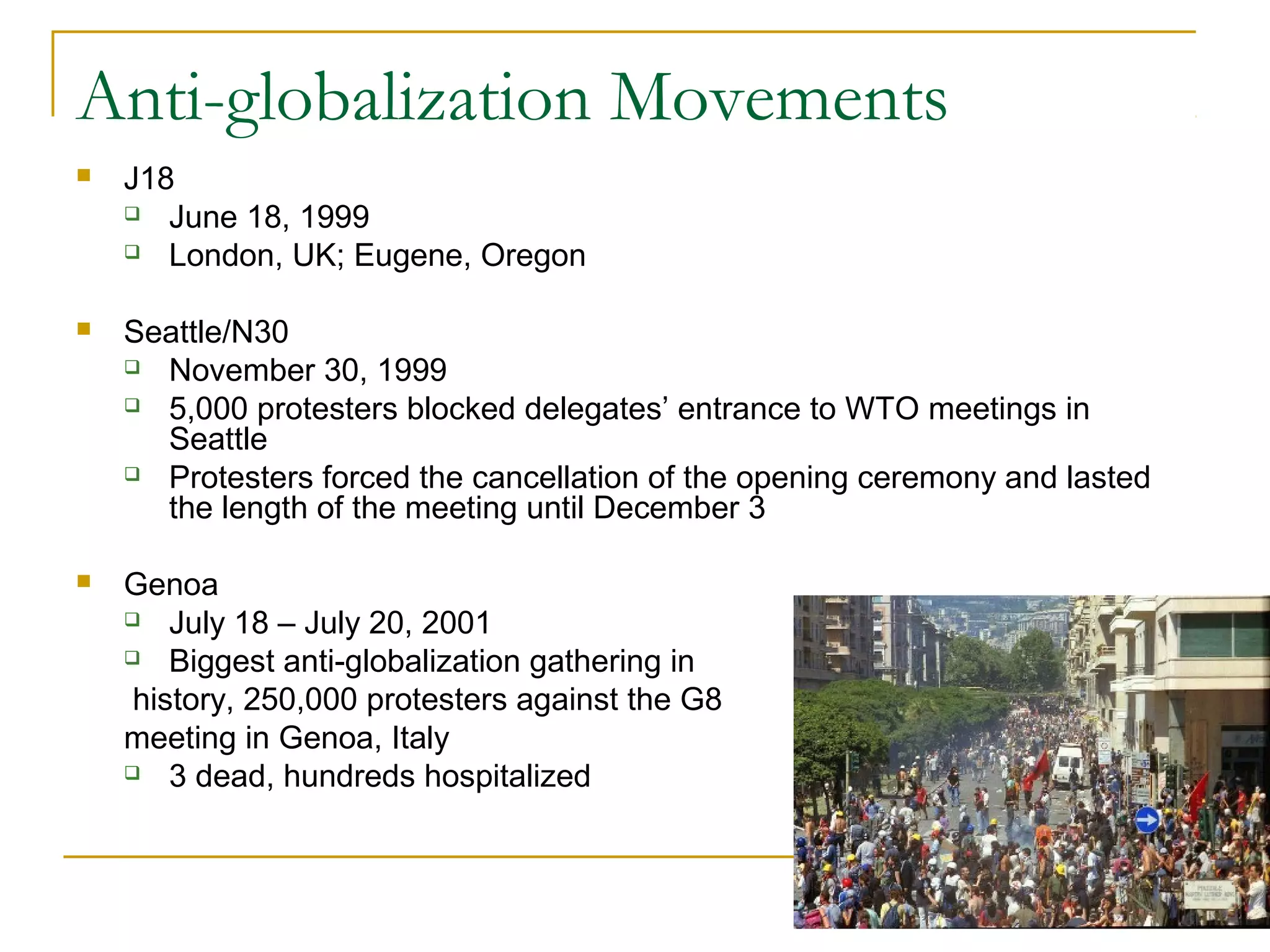
 Biggest anti-globalization gathering in
history, 250,000 protesters against the G8
meeting in Genoa, Italy
 3 dead, hundreds hospitalized
Causes of Anti-globalization Movement
 Globalization globalizes money and
corporations, but not people and unions
 Outsourcing and offshoring caused millions of
westerns lost jobs or paid less
 Fear losing jobs in western countries
 Exploitation of the resources in the
developing countries by western countries
Why anti-globalization? (cont’d)
 Economical
 Exploitation of the resources in the third world
country
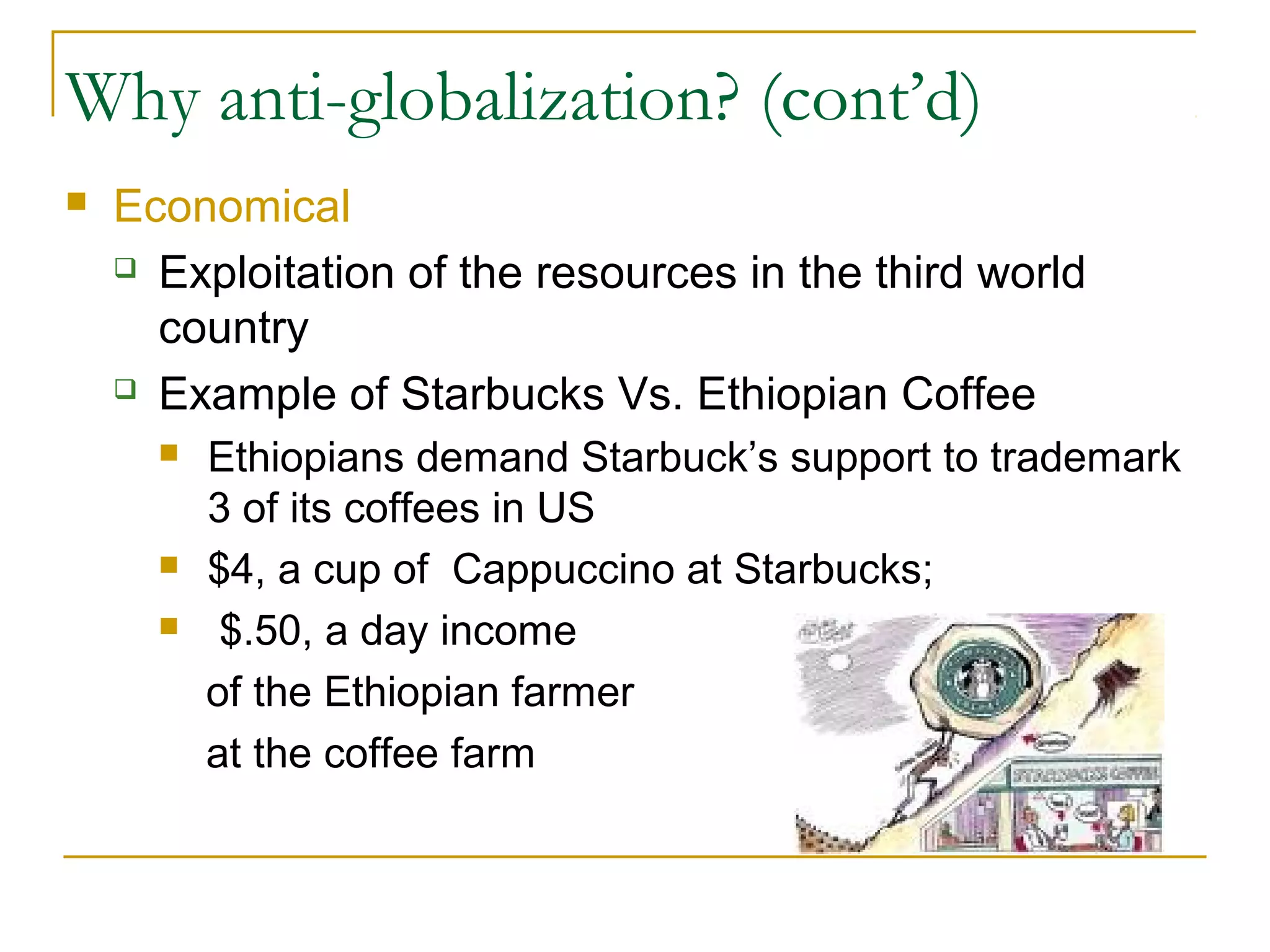
 Example of Starbucks Vs. Ethiopian Coffee
 Ethiopians demand Starbuck’s support to trademark
3 of its coffees in US
 $4, a cup of Cappuccino at Starbucks;
 $.50, a day income
of the Ethiopian farmer
at the coffee farm
Why anti-globalization? (cont’d)
 Cultural
 Local or minority culture are facing the fate of
disappearing
 Western culture invaded into developing countries
 Example: McDonalds
 More than 100 countries
 30,000 restaurants
 Serves 50 million people daily
Why anti-globalization? (cont’d)
 Environmental
 Aggravated pollution, Global warming, losses in biodiversity
and species extinction
 Average global temperatures are estimated to rise 1- 3.5
centigrade (33.8 – 38.5 degrees) by 2050
 Developed industrial countries export hazardous waste to
third world countries
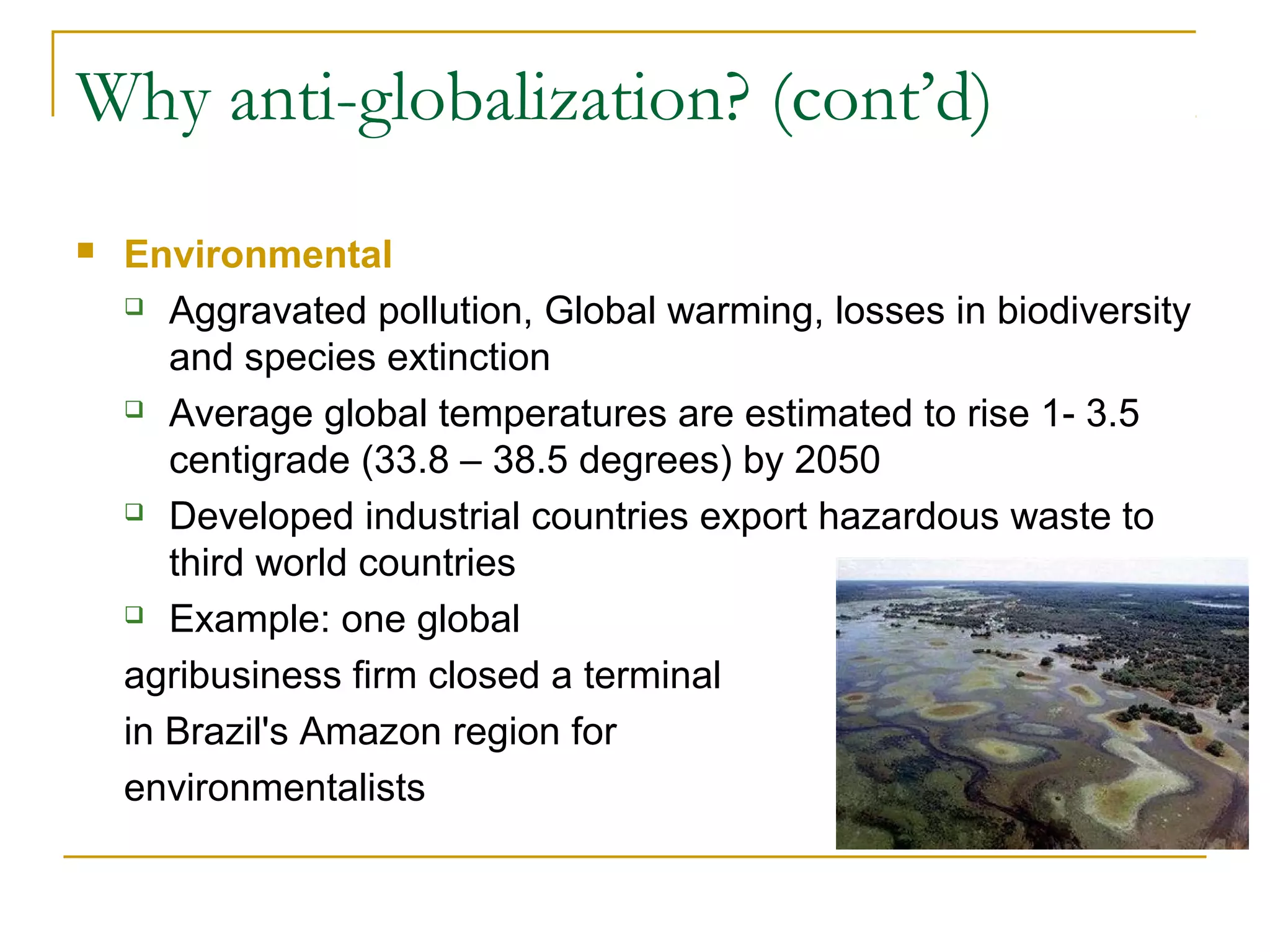
 Example: one global
agribusiness firm closed a terminal
in Brazil's Amazon region for
environmentalists
Why anti-globalization? (cont’d)
 Women and children
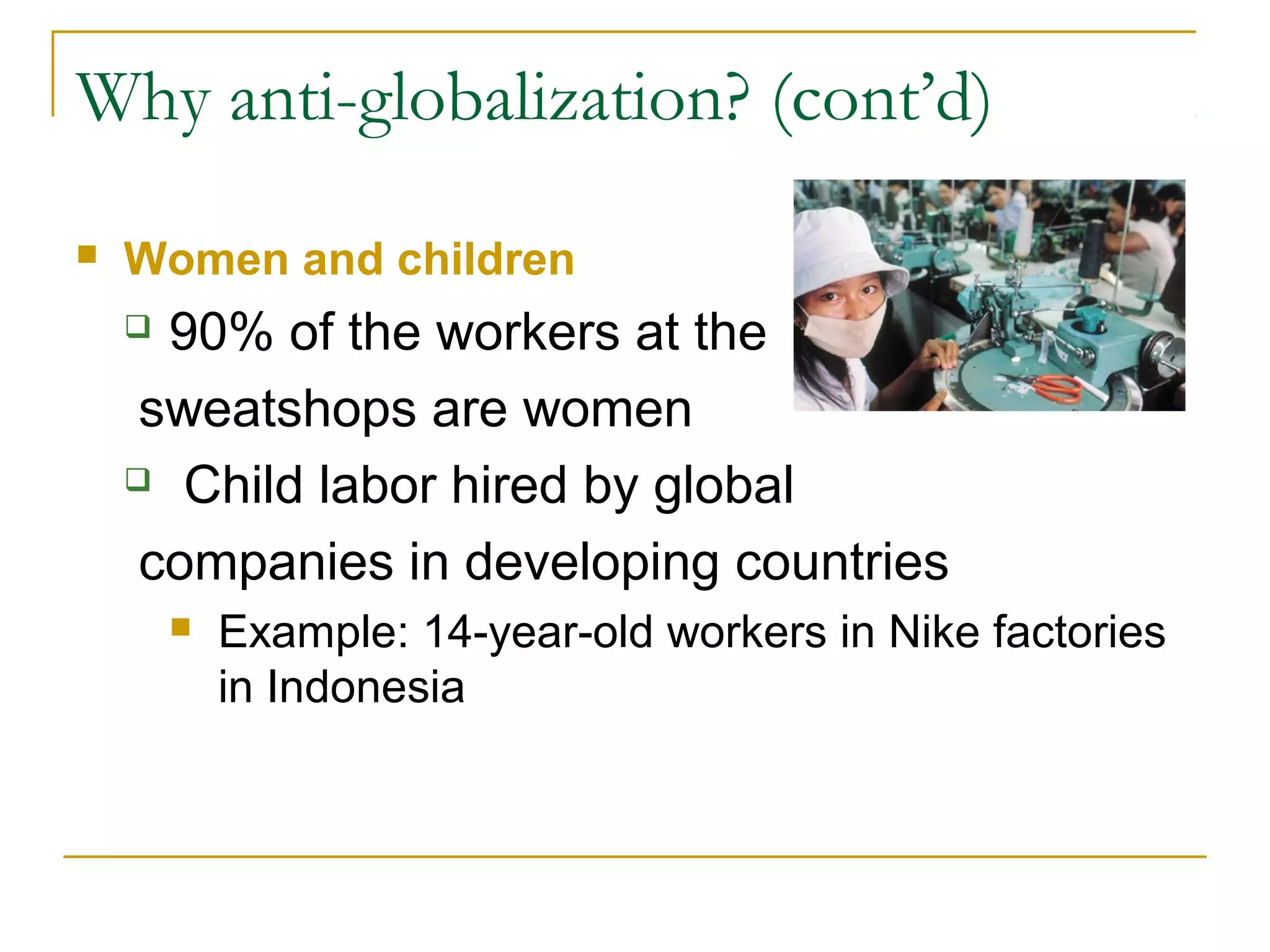
 90% of the workers at the
sweatshops are women
 Child labor hired by global
companies in developing countries
 Example: 14-year-old workers in Nike factories
in Indonesia
Why anti-globalization? (cont’d)
 Human rights
 More and more strict immigration restrictions in
developed countries, no free move for labors
 In sweatshops in developing countries, harsh working
conditions, low pay and overtime working are common
 Example: The Pouty Bratz dolls factory in Southern
China
 Working 94 hours a week
 17 cents, workers are paid for making each doll;
$19, retail price in US
 More than 120 million Bratz dolls sold in US since 2001
Why anti-globalization? (cont’d)
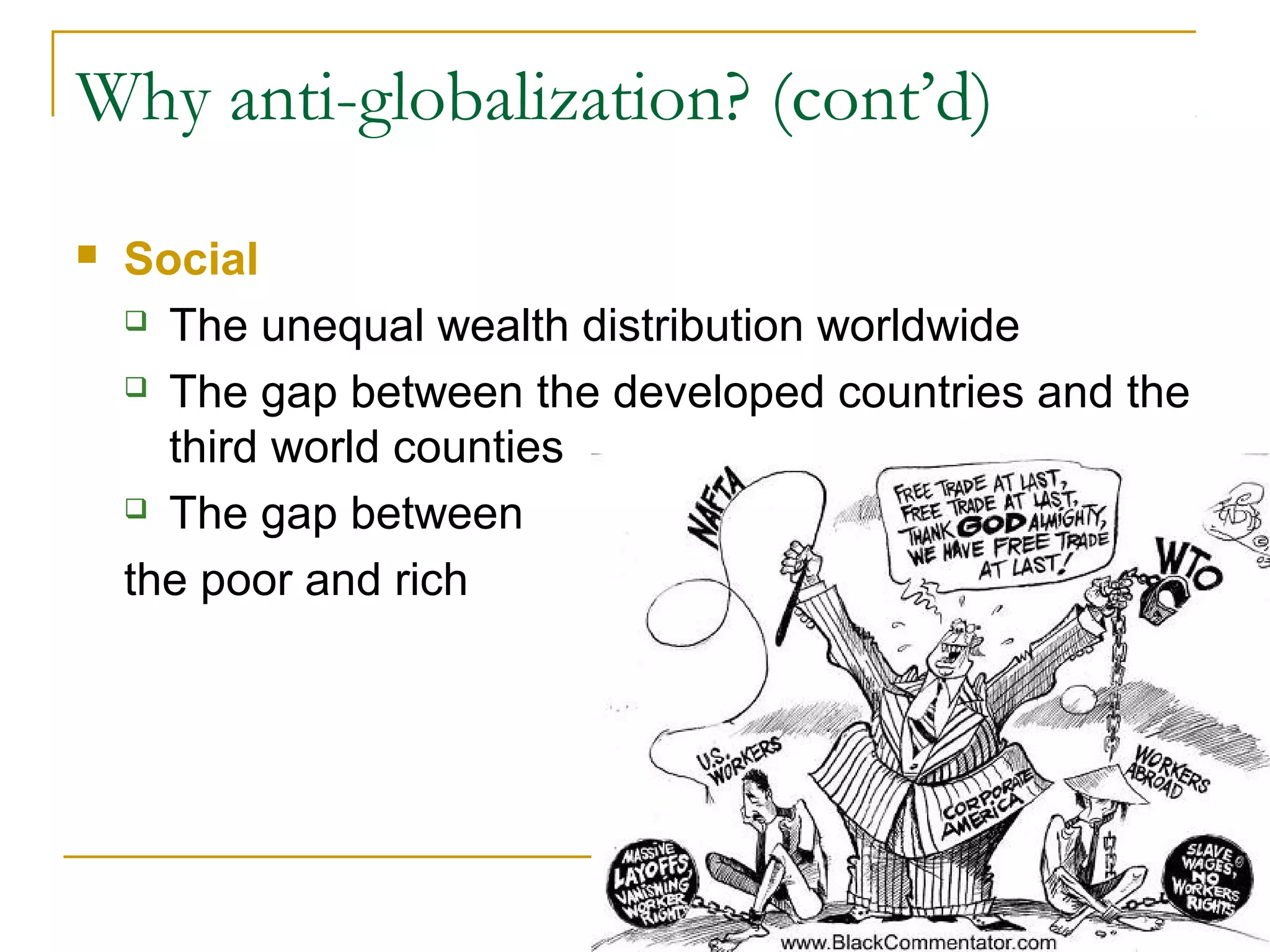
 Social
 The unequal wealth distribution worldwide
 The gap between the developed countries and the
third world counties
 The gap between
the poor and rich
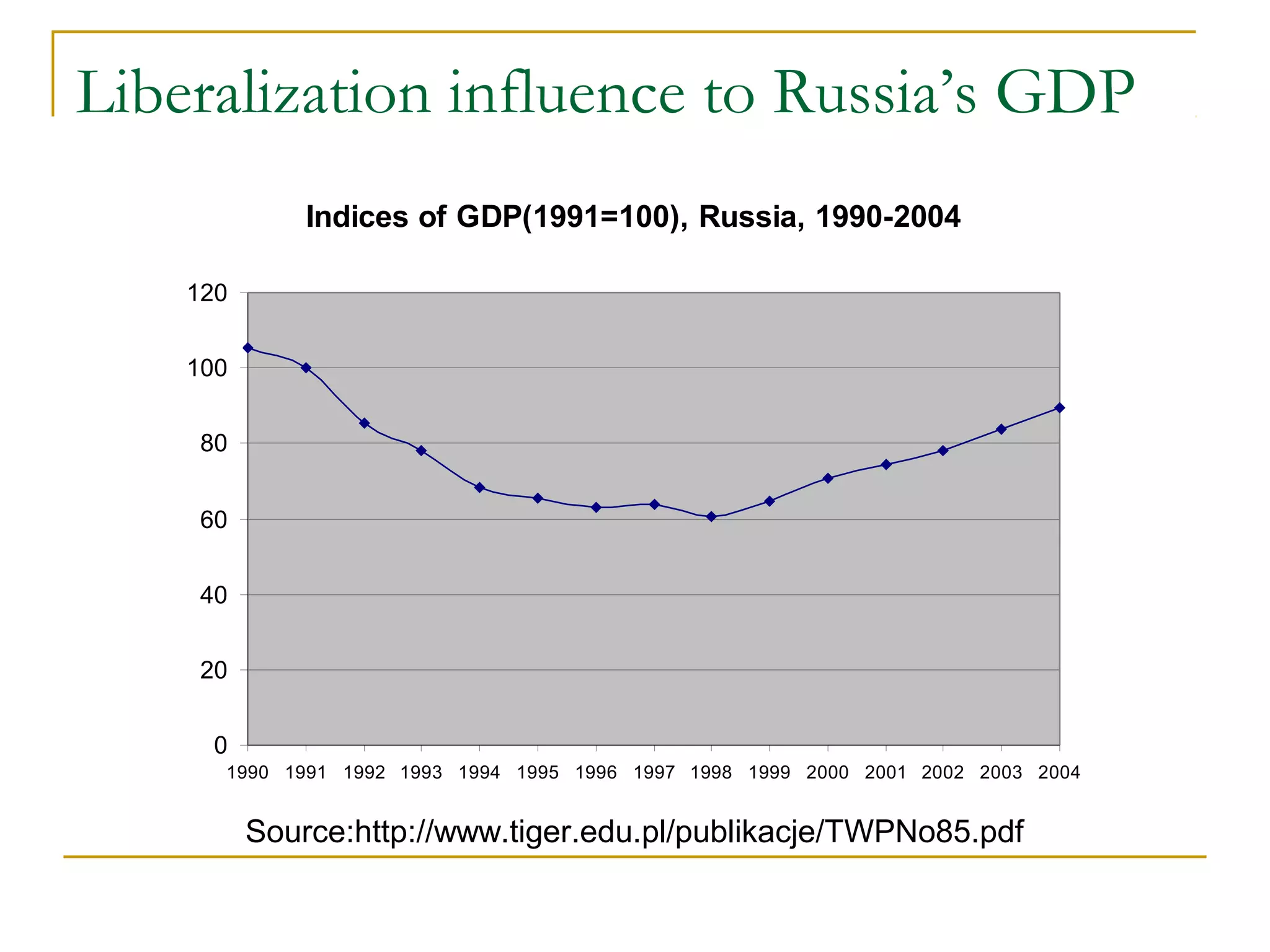
Liberalization influence to Russia’s GDP
Indices of GDP(1991=100), Russia, 1990-2004
0
20
40
60
80
100
120
1990 1991 1992 1993 1994 1995 1996 1997 1998 1999 2000 2001 2002 2003 2004
Source:http://www.tiger.edu.pl/publikacje/TWPNo85.pdf
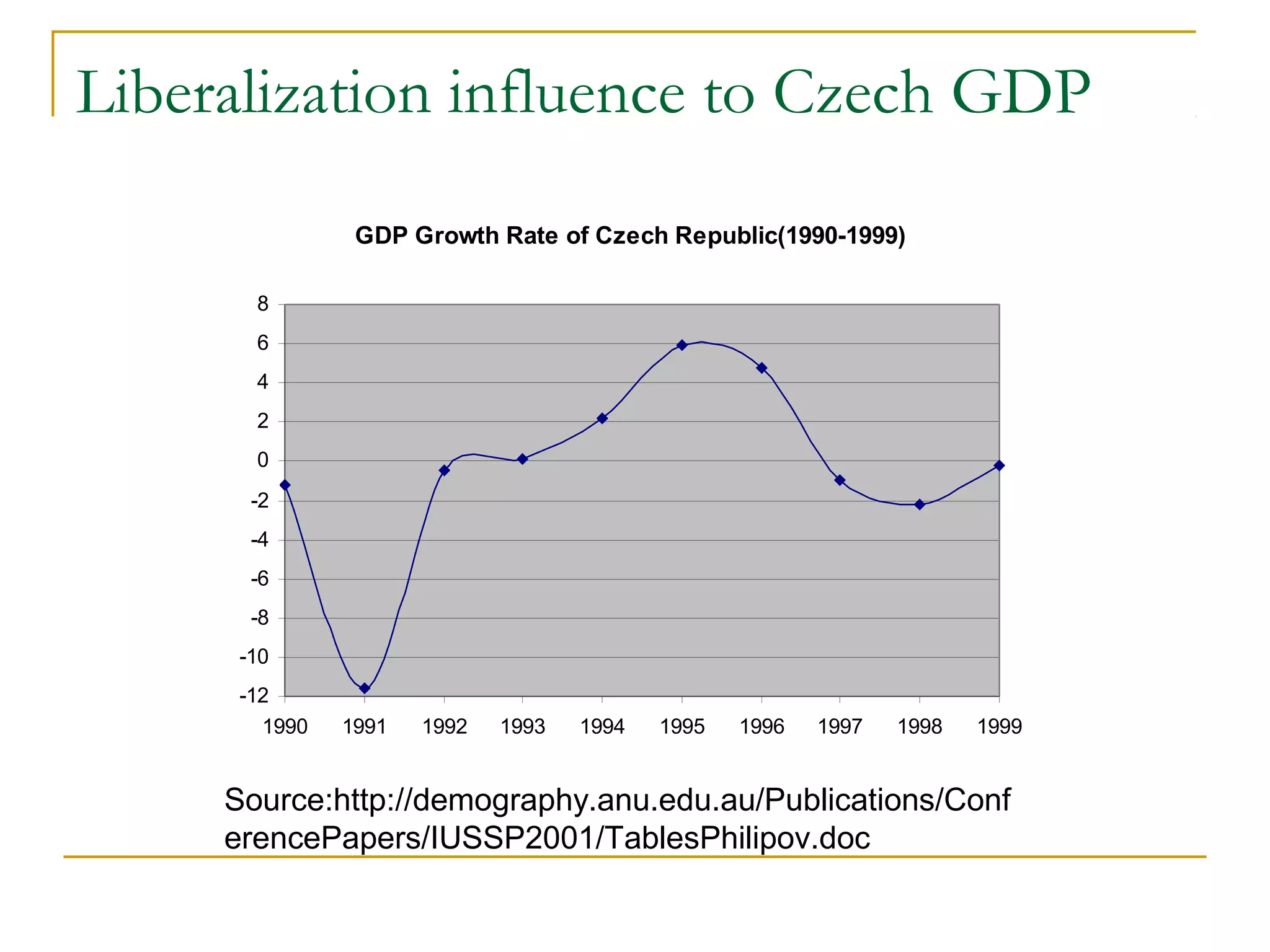
Liberalization influence to Czech GDP
GDP Growth Rate of Czech Republic(1990-1999)
-12
-10
-8
-6
-4
-2
0
2
4
6
8
1990 1991 1992 1993 1994 1995 1996 1997 1998 1999
Source:http://demography.anu.edu.au/Publications/Conf
erencePapers/IUSSP2001/TablesPhilipov.doc
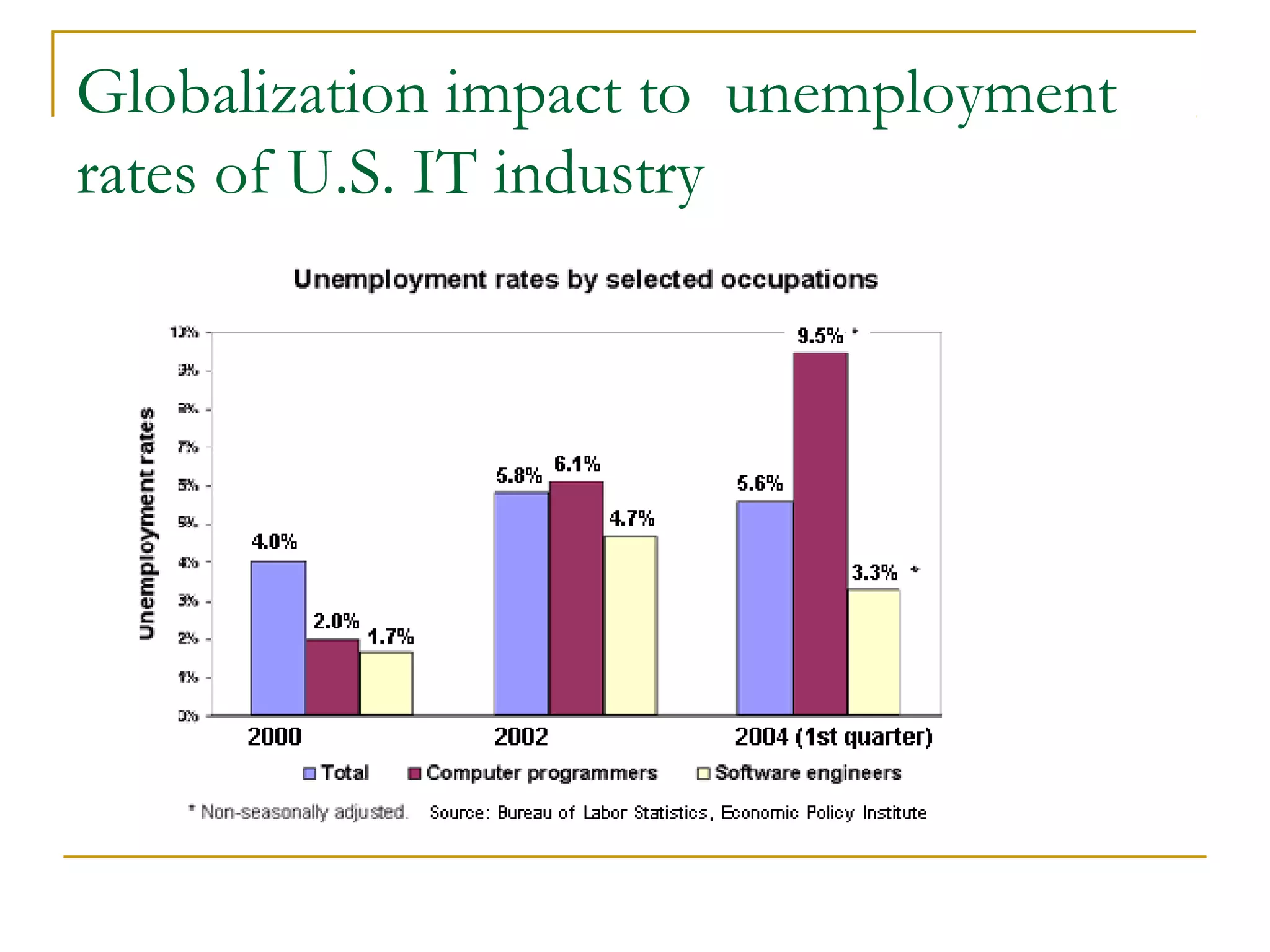
Globalization impact to unemployment
rates of U.S. IT industry
Globalization might be harmful to
Developed Countries in the future
 China is striving to create global automobile
and electronics brands.
 India’s skill-intensive service sectors like IT
and outsourcing are rising very fast.
 Western firms would face unprecedented
competition from the two and other
developing countries.
Conclusions
 Anti-globalization movements are the
indication of self-protection.
 Globalization already resulted in many
adverse effects and made a portion of people
worse-off.
 Globalization makes highly liberalized
countries expose their vulnerabilities to the
rest of the world.
Can All Countries Benefit from
Globalization?
 Establish international monitoring system
 Domestic:
 each country should build up a system that can integrate into
the global market
 protectionism in the domestic market
 International:
 International institutions should reform to fit into the needs of
the globalization, such as IMF, World Bank, UN
 Be more responsible for all the countries, rather than some or
few countries
 Be more transparent and be monitored by member countries
from third world
Can All Countries Benefit from
Globalization?
 To enhance corporations between countries and
regions
 Make free trade free and fair for both developing
and developed countries
 Eliminate or reduce the trade barriers
 Get more countries involved into the global
market
 Equal and balance development in the global
market
Questions and Comments

Anti-globalization in the world

  • 1.
    Anti-Globalization --Another Type ofGlobalization Yingxia Hou Peng Chen
  • 2.
    Agenda  Definition andinfluence of Globalization  Pros and Cons of Globalization  Definition, movements and causes of Anti- globalization  Why anti-globalization?  Example victims of globalization  Conclusions and recommendations
  • 3.
    What is Globalization? Increasing global connectivity.  Integration and interdependence in the economic, social, technological, cultural, political, and ecological spheres.  An umbrella term and is perhaps best understood as a unitary process inclusive of many sub-processes that are increasingly binding people and the biosphere more tightly into one global system.
  • 4.
    The influence ofglobalization  Industrial - emergence of worldwide production markets and broader access to a range of goods for consumers and companies.  Financial - emergence of worldwide financial markets and better access to external financing for corporate, national and subnational borrowers.  Economic - realization of a global common market, based on the freedom of exchange of goods and capital.
  • 5.
    The influence ofglobalization  Political - Political globalization is the creation of a world government which regulates the relationships among nations and guarantees the rights arising from social and economic globalization.  Social - the achievement of free circulation by people of all nations.  Informational - increase in information flows between geographically remote locations.
  • 6.
    The influence ofglobalization  Cultural - growth of cross-cultural contacts; cultural diffusion; "world culture".  Ecological- the advent of global environmental challenges that can not be solved without international cooperation, such as climate change, cross-boundary water and air pollution, over-fishing of the ocean, and the spread of invasive species.
  • 7.
    Pros and Consof Globalization  Pros  Productivity grows more quickly when countries produce goods and services in which they have a comparative advantage. Living standards can go up faster.  Global competition and cheap imports keep a lid on prices, so inflation is less likely to derail economic growth.  An open economy spurs innovation with fresh ideas from abroad.  Accelerated the development and innovation of technology and communication
  • 8.
    Pros and Consof Globalization  Cons  Millions of westerns have lost jobs due to imports or production shifts abroad. Most find new jobs that pay less.  Millions of others fear losing their jobs, especially at those companies operating under competitive pressure.  Workers face pay-cut demands from employers, which often threaten to export jobs.  Service and white-collar jobs are increasingly vulnerable to operations moving offshore.  western employees can lose their comparative advantage when companies build advanced factories in low-wage countries, making them as productive as those at home.
  • 9.
    Other faces ofGlobalization  Globalization= Imperialism  Globalization = Americanization  Globalization = Delocalization  Globalization = Multinational corporations  Globalization = Branding  Globalization = the rich gets richer, the poor gets poorer
  • 10.
    What is anti-globalization? The political attitude of people and organizations that resist certain aspects of globalization.  social movements  participants are united in opposition to the political power of large corporations  Self-consciously internationalist, organizing globally an advocating for the cause of oppressed people around the world
  • 11.
    Anti-globalization Movements  J18 June 18, 1999  London, UK; Eugene, Oregon  Seattle/N30  November 30, 1999  5,000 protesters blocked delegates’ entrance to WTO meetings in Seattle  Protesters forced the cancellation of the opening ceremony and lasted the length of the meeting until December 3  Genoa  July 18 – July 20, 2001  Biggest anti-globalization gathering in history, 250,000 protesters against the G8 meeting in Genoa, Italy  3 dead, hundreds hospitalized
  • 12.
    Causes of Anti-globalizationMovement  Globalization globalizes money and corporations, but not people and unions  Outsourcing and offshoring caused millions of westerns lost jobs or paid less  Fear losing jobs in western countries  Exploitation of the resources in the developing countries by western countries
  • 13.
    Why anti-globalization? (cont’d) Economical  Exploitation of the resources in the third world country  Example of Starbucks Vs. Ethiopian Coffee  Ethiopians demand Starbuck’s support to trademark 3 of its coffees in US  $4, a cup of Cappuccino at Starbucks;  $.50, a day income of the Ethiopian farmer at the coffee farm
  • 14.
    Why anti-globalization? (cont’d) Cultural  Local or minority culture are facing the fate of disappearing  Western culture invaded into developing countries  Example: McDonalds  More than 100 countries  30,000 restaurants  Serves 50 million people daily
  • 15.
    Why anti-globalization? (cont’d) Environmental  Aggravated pollution, Global warming, losses in biodiversity and species extinction  Average global temperatures are estimated to rise 1- 3.5 centigrade (33.8 – 38.5 degrees) by 2050  Developed industrial countries export hazardous waste to third world countries  Example: one global agribusiness firm closed a terminal in Brazil's Amazon region for environmentalists
  • 16.
    Why anti-globalization? (cont’d) Women and children  90% of the workers at the sweatshops are women  Child labor hired by global companies in developing countries  Example: 14-year-old workers in Nike factories in Indonesia
  • 17.
    Why anti-globalization? (cont’d) Human rights  More and more strict immigration restrictions in developed countries, no free move for labors  In sweatshops in developing countries, harsh working conditions, low pay and overtime working are common  Example: The Pouty Bratz dolls factory in Southern China  Working 94 hours a week  17 cents, workers are paid for making each doll; $19, retail price in US  More than 120 million Bratz dolls sold in US since 2001
  • 18.
    Why anti-globalization? (cont’d) Social  The unequal wealth distribution worldwide  The gap between the developed countries and the third world counties  The gap between the poor and rich
  • 19.
    Liberalization influence toRussia’s GDP Indices of GDP(1991=100), Russia, 1990-2004 0 20 40 60 80 100 120 1990 1991 1992 1993 1994 1995 1996 1997 1998 1999 2000 2001 2002 2003 2004 Source:http://www.tiger.edu.pl/publikacje/TWPNo85.pdf
  • 20.
    Liberalization influence toCzech GDP GDP Growth Rate of Czech Republic(1990-1999) -12 -10 -8 -6 -4 -2 0 2 4 6 8 1990 1991 1992 1993 1994 1995 1996 1997 1998 1999 Source:http://demography.anu.edu.au/Publications/Conf erencePapers/IUSSP2001/TablesPhilipov.doc
  • 21.
    Globalization impact tounemployment rates of U.S. IT industry
  • 22.
    Globalization might beharmful to Developed Countries in the future  China is striving to create global automobile and electronics brands.  India’s skill-intensive service sectors like IT and outsourcing are rising very fast.  Western firms would face unprecedented competition from the two and other developing countries.
  • 23.
    Conclusions  Anti-globalization movementsare the indication of self-protection.  Globalization already resulted in many adverse effects and made a portion of people worse-off.  Globalization makes highly liberalized countries expose their vulnerabilities to the rest of the world.
  • 24.
    Can All CountriesBenefit from Globalization?  Establish international monitoring system  Domestic:  each country should build up a system that can integrate into the global market  protectionism in the domestic market  International:  International institutions should reform to fit into the needs of the globalization, such as IMF, World Bank, UN  Be more responsible for all the countries, rather than some or few countries  Be more transparent and be monitored by member countries from third world
  • 25.
    Can All CountriesBenefit from Globalization?  To enhance corporations between countries and regions  Make free trade free and fair for both developing and developed countries  Eliminate or reduce the trade barriers  Get more countries involved into the global market  Equal and balance development in the global market
  • 26.