G
L
O
B
A
L
I
Z
A
T
I
O
N
By: Mian Muhammad Zafar
to: Sir Abdul khaliq
Presented
Globalization
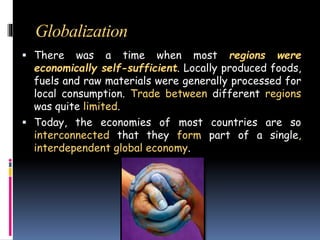
 There was a time when most regions were
economically self-sufficient. Locally produced foods,
fuels and raw materials were generally processed for
local consumption. Trade between different regions
was quite limited.
 Today, the economies of most countries are so
interconnected that they form part of a single,
interdependent global economy.
Globalization
 Globalization is the new buzzword that has come
to dominate the world since the nineties of the
last century with the end of the cold war and the
break-up of the former Soviet Union.
 The term implies worldly integration/interaction
of various cultures, styles, economic policies,
ideas, etc.
 It must not be confused with “making things
common around the world”. It is an integration,
not simulation
Globalization
 Globalization is a consequence of increase
trade across nations.
 Anthony Giddens (1990) describes
globalization as “the intensifications of
worldwide social relations which link distinct
localities in such a way that local happenings
are shaped by events occurring miles away.”
Why globalization..???
 “increasing dominance of the so-called world
cities of New York, Tokyo and London” and the
impact on the spatial planning system especially
with respect to the increasing demand for
suitable services and infrastructure and the
formation of a new social structure within global
cities.
 The advancements in transportation,
communication and technology have had a
profound effect on the geographic distance and
connectivity at a new level of human interaction.
Globalization
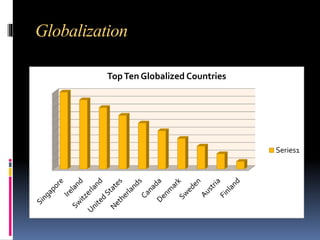
TopTen Globalized Countries
Series1
Globalization of Law
 Globalization of law may be defined as the worldwide
progression of transnational legal structures and
discourses along the dimensions of extensity, intensity,
velocity, and impact.
 Research demonstrates that globalization is variably
contested in several domains of research on law:
 (a) the construction and regulation of global
markets,
 (b) crimes against humanity and genocide,
 (c) the diffusion of political liberalism and
constitutionalism, and
 (d) the institutionalization of women's rights.
Globalization of Law
 Effectiveness: the farther globalizing legal norms
and practices are located from core local cultural
institutions and beliefs, the less likely global norms will
provoke explicit contestation and confrontation. Future
research will be productively directed to where and how
global law originates, how and when global norms and
law are transmitted and enforced, and how global-local
settlements are negotiated.
Types of Globalization
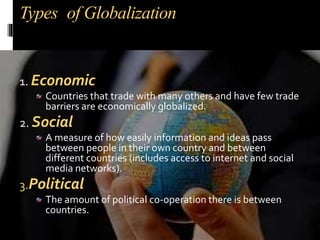
1. Economic
Countries that trade with many others and have few trade
barriers are economically globalized.
2. Social
A measure of how easily information and ideas pass
between people in their own country and between
different countries (includes access to internet and social
media networks).
3.Political
The amount of political co-operation there is between
countries.
Causes of Globalization:
1. Improved Communications
 The development of communication
technologies such as internet, email and
mobile phones have been vital to the growth
of globalization because they help MNCs to
operate throughout the world.
 The development of satellite TV channels such
as Sky and CNN have also provided worldwide
marketing avenues for the concept and
products of globalization.
Causes of Globalization
2. Improved Transport
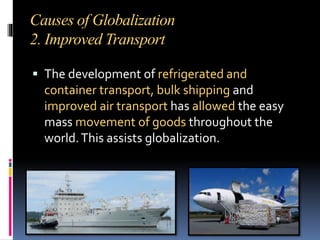
 The development of refrigerated and
container transport, bulk shipping and
improved air transport has allowed the easy
mass movement of goods throughout the
world.This assists globalization.
Causes of Globalization:
3. Free Trade Agreements
 MNCs and rich capitalist countries have
always promoted global free trade as a way
of increasing their own wealth and influence.
 International organisations such as theWorld
Trade Organisation and the IMF also promote
free trade.
Causes of Globalization:
4. Global Banking
 Modern communication technologies allow vast
amounts of capital to flow freely and instantly
throughout the world.
 The equivalent of up to $US1.3 trillion is traded
each day through international stock exchanges
in cities such as NewYork, London andTokyo.
Causes of Globalization:
5. The Growth of MNCs
 The rapid growth of big MNCs such as Microsoft,
McDonalds and Nike is a cause as well as a consequence
of globalization.
 The investment of MNCs in farms, mines and factories
across the world is a major part of globalization.
 Globalization allows MNCs to produce goods and
services and to sell products on a massive scale
throughout the world.
The Effects of Globalization:
1. Changed Food Supply
 Food supply is no longer tied to the seasons.
We can buy food anywhere in the world at
any time of the year.
The Effects of Globalisation:
2. Division of Labour
 Because MNCs search for the cheapest
locations to manufacture and assemble
components, production processes may be
moved from developed to developing
countries where costs are lower.
The Effects of Globalization:
3. Less Job Security
 In the global economy jobs are becoming more
temporary and insecure.
 A survey of American workers showed that
people now hold 7 to 10 jobs over their working
life.
The Effects of Globalization:
4. Damage to the Environment
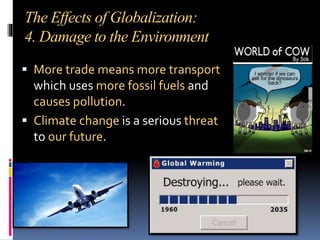
 More trade means more transport
which uses more fossil fuels and
causes pollution.
 Climate change is a serious threat
to our future.
The Effects of Globalization:
5. Cultural Impact
 Websites such asYouTube connect people
across the planet. As the world becomes
more unified, diverse cultures are being
ignored. MNCs can create a monoculture as
they remove local competition and thereby
force local firms to close.
Replacing
The Effects of Globalization
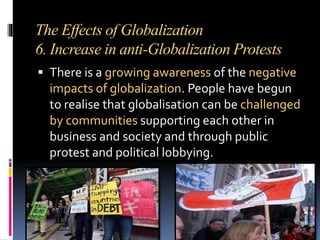
6. Increase in anti-Globalization Protests
 There is a growing awareness of the negative
impacts of globalization. People have begun
to realise that globalisation can be challenged
by communities supporting each other in
business and society and through public
protest and political lobbying.
Why some are against globalization..??
 Globalization is used as an ideology by the
powerful to deceive the people about illusory
benefits of a dehumanizing system; in other
words, globalization is a form of false
consciousness that prevents people from
seeing their true interests.
 It perpetuates the inequity and exploitation
inherent in capitalism; globalization polarizes
the globe and therefore creates an even more
unjust world.
Why some are against globalization..??
 It is not subject to democratic control and
therefore cannot serve the interests of the
people at large; new forms of democratic
governance and economic regulation will
be needed to overcome this problem.
 Due to the scale of change, it intensifies
long-standing problems, such as the
deterioration of the environment.
Analysis
Globalization Is Here to Stay!
Globalization does have problems and
negative effects, but it is not going to
disappear. So…
We need to learn how to reap its
benefits, and minimize its costs. To do
that, we must:
• Understand its impacts
• Work to remedy the problems
• Work to spread the benefits as widely as possible
Globalization

Globalization

  • 2.
    G L O B A L I Z A T I O N By: Mian MuhammadZafar to: Sir Abdul khaliq Presented
  • 3.
    Globalization  There wasa time when most regions were economically self-sufficient. Locally produced foods, fuels and raw materials were generally processed for local consumption. Trade between different regions was quite limited.  Today, the economies of most countries are so interconnected that they form part of a single, interdependent global economy.
  • 4.
    Globalization  Globalization isthe new buzzword that has come to dominate the world since the nineties of the last century with the end of the cold war and the break-up of the former Soviet Union.  The term implies worldly integration/interaction of various cultures, styles, economic policies, ideas, etc.  It must not be confused with “making things common around the world”. It is an integration, not simulation
  • 5.
    Globalization  Globalization isa consequence of increase trade across nations.  Anthony Giddens (1990) describes globalization as “the intensifications of worldwide social relations which link distinct localities in such a way that local happenings are shaped by events occurring miles away.”
  • 6.
    Why globalization..???  “increasingdominance of the so-called world cities of New York, Tokyo and London” and the impact on the spatial planning system especially with respect to the increasing demand for suitable services and infrastructure and the formation of a new social structure within global cities.  The advancements in transportation, communication and technology have had a profound effect on the geographic distance and connectivity at a new level of human interaction.
  • 7.
  • 8.
    Globalization of Law Globalization of law may be defined as the worldwide progression of transnational legal structures and discourses along the dimensions of extensity, intensity, velocity, and impact.  Research demonstrates that globalization is variably contested in several domains of research on law:  (a) the construction and regulation of global markets,  (b) crimes against humanity and genocide,  (c) the diffusion of political liberalism and constitutionalism, and  (d) the institutionalization of women's rights.
  • 9.
    Globalization of Law Effectiveness: the farther globalizing legal norms and practices are located from core local cultural institutions and beliefs, the less likely global norms will provoke explicit contestation and confrontation. Future research will be productively directed to where and how global law originates, how and when global norms and law are transmitted and enforced, and how global-local settlements are negotiated.
  • 10.
    Types of Globalization 1.Economic Countries that trade with many others and have few trade barriers are economically globalized. 2. Social A measure of how easily information and ideas pass between people in their own country and between different countries (includes access to internet and social media networks). 3.Political The amount of political co-operation there is between countries.
  • 11.
    Causes of Globalization: 1.Improved Communications  The development of communication technologies such as internet, email and mobile phones have been vital to the growth of globalization because they help MNCs to operate throughout the world.  The development of satellite TV channels such as Sky and CNN have also provided worldwide marketing avenues for the concept and products of globalization.
  • 12.
    Causes of Globalization 2.Improved Transport  The development of refrigerated and container transport, bulk shipping and improved air transport has allowed the easy mass movement of goods throughout the world.This assists globalization.
  • 13.
    Causes of Globalization: 3.Free Trade Agreements  MNCs and rich capitalist countries have always promoted global free trade as a way of increasing their own wealth and influence.  International organisations such as theWorld Trade Organisation and the IMF also promote free trade.
  • 14.
    Causes of Globalization: 4.Global Banking  Modern communication technologies allow vast amounts of capital to flow freely and instantly throughout the world.  The equivalent of up to $US1.3 trillion is traded each day through international stock exchanges in cities such as NewYork, London andTokyo.
  • 15.
    Causes of Globalization: 5.The Growth of MNCs  The rapid growth of big MNCs such as Microsoft, McDonalds and Nike is a cause as well as a consequence of globalization.  The investment of MNCs in farms, mines and factories across the world is a major part of globalization.  Globalization allows MNCs to produce goods and services and to sell products on a massive scale throughout the world.
  • 16.
    The Effects ofGlobalization: 1. Changed Food Supply  Food supply is no longer tied to the seasons. We can buy food anywhere in the world at any time of the year.
  • 17.
    The Effects ofGlobalisation: 2. Division of Labour  Because MNCs search for the cheapest locations to manufacture and assemble components, production processes may be moved from developed to developing countries where costs are lower.
  • 18.
    The Effects ofGlobalization: 3. Less Job Security  In the global economy jobs are becoming more temporary and insecure.  A survey of American workers showed that people now hold 7 to 10 jobs over their working life.
  • 19.
    The Effects ofGlobalization: 4. Damage to the Environment  More trade means more transport which uses more fossil fuels and causes pollution.  Climate change is a serious threat to our future.
  • 20.
    The Effects ofGlobalization: 5. Cultural Impact  Websites such asYouTube connect people across the planet. As the world becomes more unified, diverse cultures are being ignored. MNCs can create a monoculture as they remove local competition and thereby force local firms to close. Replacing
  • 21.
    The Effects ofGlobalization 6. Increase in anti-Globalization Protests  There is a growing awareness of the negative impacts of globalization. People have begun to realise that globalisation can be challenged by communities supporting each other in business and society and through public protest and political lobbying.
  • 22.
    Why some areagainst globalization..??  Globalization is used as an ideology by the powerful to deceive the people about illusory benefits of a dehumanizing system; in other words, globalization is a form of false consciousness that prevents people from seeing their true interests.  It perpetuates the inequity and exploitation inherent in capitalism; globalization polarizes the globe and therefore creates an even more unjust world.
  • 23.
    Why some areagainst globalization..??  It is not subject to democratic control and therefore cannot serve the interests of the people at large; new forms of democratic governance and economic regulation will be needed to overcome this problem.  Due to the scale of change, it intensifies long-standing problems, such as the deterioration of the environment.
  • 24.
    Analysis Globalization Is Hereto Stay! Globalization does have problems and negative effects, but it is not going to disappear. So… We need to learn how to reap its benefits, and minimize its costs. To do that, we must: • Understand its impacts • Work to remedy the problems • Work to spread the benefits as widely as possible

Editor's Notes

  • #9 Example : International court of justice
  • #10 Indigenous practices and craftsmanship- a dying art