A Seminar on 
GLOBAL POSITIONING SYSTEM 
(GPS) 
By: 
Pratik Patil 
M. Tech VLSI Design & Embedded Systems 
KLES Dr. MSSCET, Belgaum
Contents 
• What is GPS? 
• History 
• GPS Devices 
• Working 
• Applications 
• Advantages and Disadvantages
What is GPS? 
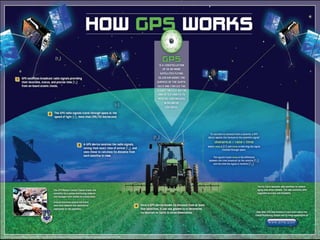
•The Global Positioning System(GPS) is a space based satellite 
navigation system that provides location and time 
information in all weather, anywhere on or near the Earth, 
where there is an unobstructed line of sight to four or more 
GPS satellites. 
•GPS was created and realised by the US department of 
defence and was originally run by 24 satellites.
HISTORY 
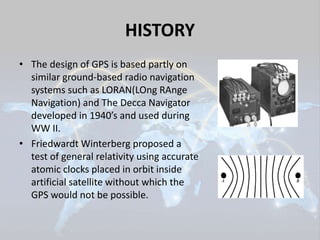
• The design of GPS is based partly on 
similar ground-based radio navigation 
systems such as LORAN(LOng RAnge 
Navigation) and The Decca Navigator 
developed in 1940’s and used during 
WW II. 
• Friedwardt Winterberg proposed a 
test of general relativity using accurate 
atomic clocks placed in orbit inside 
artificial satellite without which the 
GPS would not be possible.
GPS DEVICES 
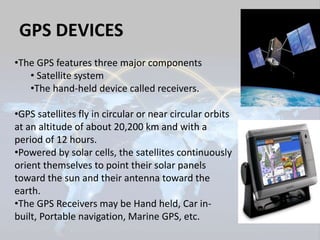
•The GPS features three major components 
• Satellite system 
•The hand-held device called receivers. 
•GPS satellites fly in circular or near circular orbits 
at an altitude of about 20,200 km and with a 
period of 12 hours. 
•Powered by solar cells, the satellites continuously 
orient themselves to point their solar panels 
toward the sun and their antenna toward the 
earth. 
•The GPS Receivers may be Hand held, Car in-built, 
Portable navigation, Marine GPS, etc.
WORKING 
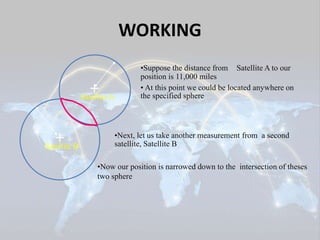
•Suppose the distance from Satellite A to our 
position is 11,000 miles 
• At this point we could be located anywhere on 
+ 
Satellite A the specified sphere 
•Next, let us take another measurement from a second 
+ 
Satellite B satellite, Satellite B 
•Now our position is narrowed down to the intersection of theses 
two sphere
Working 
Satellite A 
+ 
Satellite C 
Satellite B + 
+ 
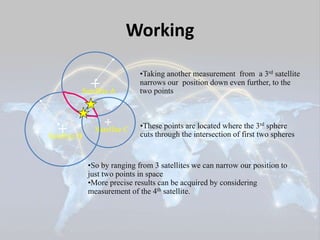
•Taking another measurement from a 3rd satellite 
narrows our position down even further, to the 
two points 
•These points are located where the 3rd sphere 
cuts through the intersection of first two spheres 
•So by ranging from 3 satellites we can narrow our position to 
just two points in space 
•More precise results can be acquired by considering 
measurement of the 4th satellite.
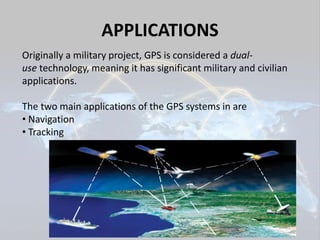
APPLICATIONS 
Originally a military project, GPS is considered a dual-use 
technology, meaning it has significant military and civilian 
applications. 
The two main applications of the GPS systems in are 
• Navigation 
• Tracking
Vehicle Tracking System 
Why Vehicle Tracking System? 
•Fuel and Power Saving 
•Effective Fleet Control 
•Instantaneous Fuel Level Monitoring 
•Decreasing the Accident Risk 
•Driver and Load Security 
•Evaluation of Drivers Performance 
•Monitoring the Delivery Time 
•Safer Vehicle Renting
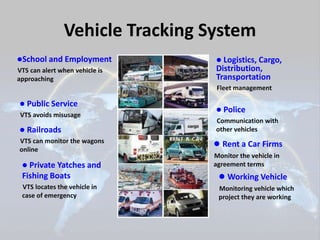
Vehicle Tracking System 
 Logistics, Cargo, 
Distribution, 
Transportation 
Fleet management 
School and Employment 
VTS can alert when vehicle is 
approaching 
 Public Service 
VTS avoids misusage 
 Railroads 
VTS can monitor the wagons 
online 
 Private Yatches and 
Fishing Boats 
VTS locates the vehicle in 
case of emergency 
 Police 
Communication with 
other vehicles 
 Rent a Car Firms 
Monitor the vehicle in 
agreement terms 
 Working Vehicle 
Monitoring vehicle which 
project they are working
Advantages of GPS Systems 
•GPS is extremely easy to navigate as it tells you to the direction for each turns you take or 
you have to take to reach to your destination. 
• GPS works in all weather conditions. 
•The most attractive feature of this system is its100% coverage on the planet. 
•Due to its low cost, it is very easy to integrate into other technologies like cell phone. 
Disadvantages 
•If you are using GPS on a battery operated device, there may be a battery failure and you 
may need a external power supply which is not always possible. 
•Sometimes the GPS signals are not accurate due to some obstacles to the signals such as 
buildings, trees, Mountains and sometimes by extreme atmospheric conditions such as 
geomagnetic storms.
GLOBAL POSITIONING SYSTEM(GPS)

GLOBAL POSITIONING SYSTEM(GPS)

  • 1.
    A Seminar on GLOBAL POSITIONING SYSTEM (GPS) By: Pratik Patil M. Tech VLSI Design & Embedded Systems KLES Dr. MSSCET, Belgaum
  • 2.
    Contents • Whatis GPS? • History • GPS Devices • Working • Applications • Advantages and Disadvantages
  • 3.
    What is GPS? •The Global Positioning System(GPS) is a space based satellite navigation system that provides location and time information in all weather, anywhere on or near the Earth, where there is an unobstructed line of sight to four or more GPS satellites. •GPS was created and realised by the US department of defence and was originally run by 24 satellites.
  • 4.
    HISTORY • Thedesign of GPS is based partly on similar ground-based radio navigation systems such as LORAN(LOng RAnge Navigation) and The Decca Navigator developed in 1940’s and used during WW II. • Friedwardt Winterberg proposed a test of general relativity using accurate atomic clocks placed in orbit inside artificial satellite without which the GPS would not be possible.
  • 5.
    GPS DEVICES •TheGPS features three major components • Satellite system •The hand-held device called receivers. •GPS satellites fly in circular or near circular orbits at an altitude of about 20,200 km and with a period of 12 hours. •Powered by solar cells, the satellites continuously orient themselves to point their solar panels toward the sun and their antenna toward the earth. •The GPS Receivers may be Hand held, Car in-built, Portable navigation, Marine GPS, etc.
  • 7.
    WORKING •Suppose thedistance from Satellite A to our position is 11,000 miles • At this point we could be located anywhere on + Satellite A the specified sphere •Next, let us take another measurement from a second + Satellite B satellite, Satellite B •Now our position is narrowed down to the intersection of theses two sphere
  • 8.
    Working Satellite A + Satellite C Satellite B + + •Taking another measurement from a 3rd satellite narrows our position down even further, to the two points •These points are located where the 3rd sphere cuts through the intersection of first two spheres •So by ranging from 3 satellites we can narrow our position to just two points in space •More precise results can be acquired by considering measurement of the 4th satellite.
  • 9.
    APPLICATIONS Originally amilitary project, GPS is considered a dual-use technology, meaning it has significant military and civilian applications. The two main applications of the GPS systems in are • Navigation • Tracking
  • 10.
    Vehicle Tracking System Why Vehicle Tracking System? •Fuel and Power Saving •Effective Fleet Control •Instantaneous Fuel Level Monitoring •Decreasing the Accident Risk •Driver and Load Security •Evaluation of Drivers Performance •Monitoring the Delivery Time •Safer Vehicle Renting
  • 11.
    Vehicle Tracking System  Logistics, Cargo, Distribution, Transportation Fleet management School and Employment VTS can alert when vehicle is approaching  Public Service VTS avoids misusage  Railroads VTS can monitor the wagons online  Private Yatches and Fishing Boats VTS locates the vehicle in case of emergency  Police Communication with other vehicles  Rent a Car Firms Monitor the vehicle in agreement terms  Working Vehicle Monitoring vehicle which project they are working
  • 12.
    Advantages of GPSSystems •GPS is extremely easy to navigate as it tells you to the direction for each turns you take or you have to take to reach to your destination. • GPS works in all weather conditions. •The most attractive feature of this system is its100% coverage on the planet. •Due to its low cost, it is very easy to integrate into other technologies like cell phone. Disadvantages •If you are using GPS on a battery operated device, there may be a battery failure and you may need a external power supply which is not always possible. •Sometimes the GPS signals are not accurate due to some obstacles to the signals such as buildings, trees, Mountains and sometimes by extreme atmospheric conditions such as geomagnetic storms.