PADMASRI DR. B.V.RAJU INSTITUTE OF
COMPUTER EDUCATION

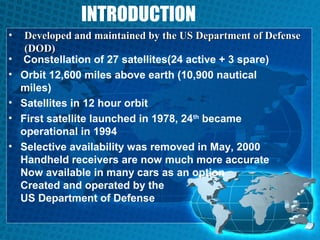
Global Positioning System
INTRODUCTION
•
•
•
•
•
•

Developed and maintained by the US Department of Defense
(DOD)
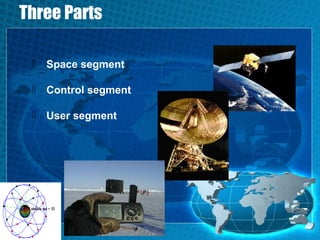
Constellation of 27 satellites(24 active + 3 spare)
Orbit 12,600 miles above earth (10,900 nautical
miles)
Satellites in 12 hour orbit
First satellite launched in 1978, 24th became
operational in 1994
Selective availability was removed in May, 2000
Handheld receivers are now much more accurate
Now available in many cars as an option
Created and operated by the
US Department of Defense
Three Parts
 Space segment
 Control segment
 User segment

3
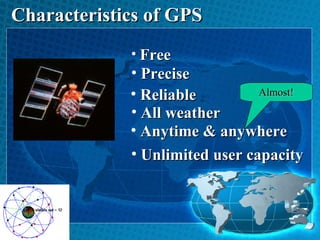
Characteristics of GPS
• Free

• Precise
Almost!
• Reliable
• All weather
• Anytime & anywhere
• Unlimited user capacity
Applications of GPS
•
•
•
•
•
•
•
•
•
•

In-vehicle Navigation (car, boat, airplane)
Asset Management
Construction
Geologic Research & Mining
Military Navigation and Operations
Mapping & Surveying
Precision Agriculture
Public Health
Public Safety
Wireless Communications
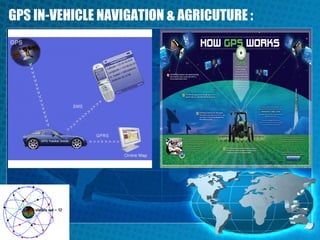
GPS IN-VEHICLE NAVIGATION & AGRICUTURE :
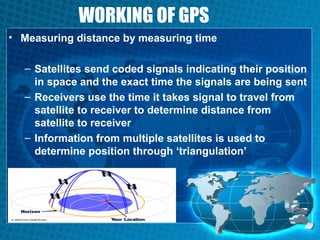
WORKING OF GPS
• Measuring distance by measuring time
– Satellites send coded signals indicating their position
in space and the exact time the signals are being sent
– Receivers use the time it takes signal to travel from
satellite to receiver to determine distance from
satellite to receiver
– Information from multiple satellites is used to
determine position through ‘triangulation’
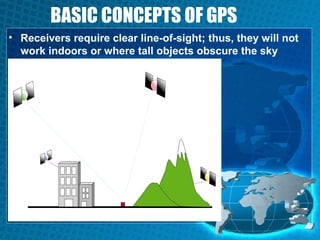
BASIC CONCEPTS OF GPS
• Receivers require clear line-of-sight; thus, they will not
work indoors or where tall objects obscure the sky
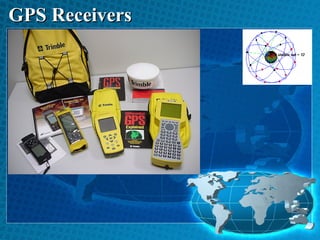
GPS Receivers
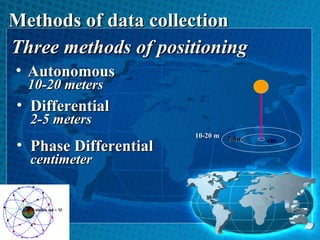
Methods of data collection
Three methods of positioning
• Autonomous
10-20 meters

• Differential
2-5 meters

• Phase Differential
centimeter

10-20 m

2-5m

cm
WAAS
• Wide Area Augmentation System.
• It provides FREE GPS differential correction data for
visible satellites
• Developed & operated by the FAA (Federal Aviation
Administration) for flight navigation but it’s available
free to GPS users
• WAAS-enabled receivers can provide sub-meter level
accuracy anywhere in most locations of the US and
southern Canada.
Common use of GPS
A. GIS data collection & mapping
B. Navigation
C. Recreation
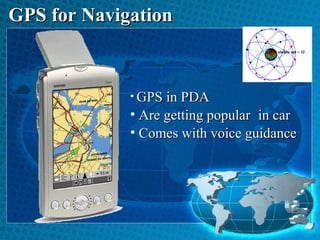
GPS for Navigation

• GPS in PDA

• Are getting popular in car
• Comes with voice guidance
ERROR SOURCES
•
•
•
•
•

Ionospheric and atmospheric delays
Satellite and Receiver clock errors
Dilution of precision
Multipath
Blenders
CONCLUSION
GPS was originally designed for military use at any
time, anywhere on the surface of the earth.
The civilians may also use GPS to marine navigation, car
navigation and surveying.
Global positioning system 1

Global positioning system 1

  • 1.
    PADMASRI DR. B.V.RAJUINSTITUTE OF COMPUTER EDUCATION Global Positioning System
  • 2.
    INTRODUCTION • • • • • • Developed and maintainedby the US Department of Defense (DOD) Constellation of 27 satellites(24 active + 3 spare) Orbit 12,600 miles above earth (10,900 nautical miles) Satellites in 12 hour orbit First satellite launched in 1978, 24th became operational in 1994 Selective availability was removed in May, 2000 Handheld receivers are now much more accurate Now available in many cars as an option Created and operated by the US Department of Defense
  • 3.
    Three Parts  Spacesegment  Control segment  User segment 3
  • 4.
    Characteristics of GPS •Free • Precise Almost! • Reliable • All weather • Anytime & anywhere • Unlimited user capacity
  • 5.
    Applications of GPS • • • • • • • • • • In-vehicleNavigation (car, boat, airplane) Asset Management Construction Geologic Research & Mining Military Navigation and Operations Mapping & Surveying Precision Agriculture Public Health Public Safety Wireless Communications
  • 6.
  • 7.
    WORKING OF GPS •Measuring distance by measuring time – Satellites send coded signals indicating their position in space and the exact time the signals are being sent – Receivers use the time it takes signal to travel from satellite to receiver to determine distance from satellite to receiver – Information from multiple satellites is used to determine position through ‘triangulation’
  • 8.
    BASIC CONCEPTS OFGPS • Receivers require clear line-of-sight; thus, they will not work indoors or where tall objects obscure the sky
  • 9.
  • 10.
    Methods of datacollection Three methods of positioning • Autonomous 10-20 meters • Differential 2-5 meters • Phase Differential centimeter 10-20 m 2-5m cm
  • 11.
    WAAS • Wide AreaAugmentation System. • It provides FREE GPS differential correction data for visible satellites • Developed & operated by the FAA (Federal Aviation Administration) for flight navigation but it’s available free to GPS users • WAAS-enabled receivers can provide sub-meter level accuracy anywhere in most locations of the US and southern Canada.
  • 12.
    Common use ofGPS A. GIS data collection & mapping B. Navigation C. Recreation
  • 13.
    GPS for Navigation •GPS in PDA • Are getting popular in car • Comes with voice guidance
  • 14.
    ERROR SOURCES • • • • • Ionospheric andatmospheric delays Satellite and Receiver clock errors Dilution of precision Multipath Blenders
  • 15.
    CONCLUSION GPS was originallydesigned for military use at any time, anywhere on the surface of the earth. The civilians may also use GPS to marine navigation, car navigation and surveying.