Nuclear micro-battery
By
VISHNU M T
SEM 7
ROLL NO: 90012068
Department of Instrumentation ,CUSAT
INTRODUCTION
 A burgeoning need exists today for small, compact, reliable, lightweight and self-
contained rugged power supply
 Its lifespan is decades and has 200 times more efficiency
 these power cells do not rely on a nuclear reaction or chemical process do not
produce radioactive waste products
 It is the answer for power supply to MEMS devices.
 Envisioned to be used in medical devices and remotely placed sensors.
 It will make its way to commonly used products like laptops and smart phones.
Surely its the batteries of near future.
Historical developments
 Idea came in beginning of 1950 at tracer lab
 Radio isotope electric power system developed by inventor Paul Brown was a scientific
breakthrough in nuclear power. . Brown’s first prototype power cell produced 100,000
times as much energy per gram of strontium -90(the energy source) than the most
powerful thermal battery yet in existence.
 The main drawback of Mr. Brown’s prototype was its low efficiency, and the reason for
that was when the radioactive material decays, many of the electrons lost from the
semiconductor material.
 With the enhancement of more regular pitting and introduction better fuels the nuclear
batteries are thought to be the next generation batteries and there is hardly any doubt
that these batteries will be available in stores within another decade.
Energy production mechanism
1) Betavoltaics
 Alternative energy technology that promises vastly extended battery life and power
density over current technologies.
 The functioning of a betavoltaics device is somewhat similar to a solar panel, which
converts photons (light) into electric current.
 Betavoltaic technique uses a silicon wafer to capture electrons emitted by a
radioactive gas, such as tritium.
 The junction between the two electrodes is comprised of a suitably ionisable medium
exposed to decay particles emitted from a radioactive source.
 Irradiated p-n junction produces electron hole pairs .
 It consist of 6 stages of energy transition of electrons .
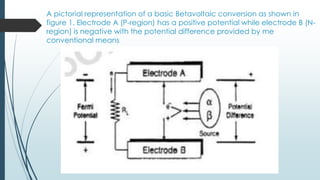
A pictorial representation of a basic Betavoltaic conversion as shown in
figure 1. Electrode A (P-region) has a positive potential while electrode B (N-
region) is negative with the potential difference provided by me
conventional means.
The energy conversion mechanism for this arrangement involves energy flow
in different stages .
Stage 1:- Before the radioactive source is introduced, a difference in
potential between to electrodes is provided by a conventional means.
 Stage 2:- Next, we introduce the radioactive source, say a beta emitter, to
the system.
 Stage 3:- Further the beta particle imparts an amount of energy in excess of
ionization potential
 Stage 4:- next, the electric field present in the junction acts on the ions and
drives the electrons into electrode A and a Fermi voltage is established.
Naturally, the electrons in electrode A seek to give up their energy and go
back to their ground state (law of entropy).
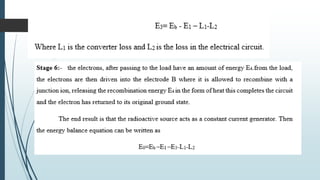
 Stage 5:- the Fermi voltage derives electrons from the electrode A through
the load where they give up their energy in accordance with conventional
electrical theory.
Eb-energy of β particle
E1-ionization potential of junction
E2- stage 2 energy
2) Direct charging generators
a)High Q LC tank circuit
 the primary generator consists of a high –Q LC tank circuit
 Core composed of radioactive nuclides connected in series with the primary winding of a
power transformer. . The core is fabricated from a mixture of three radioactive materials
which decay primarily by α emission and provides a greater flux of radioactive decay
products than the equivalent amount of single radioactive nuclei.
 Each α particles collide with more than one atoms and knocks out electrons imparting KE .
 Sustained oscillations are induced by absorption of radio active decay energy.
 Excess energy is transferred to load connected across transformer secondary
Schematic diagram of an LC resonant
circuit
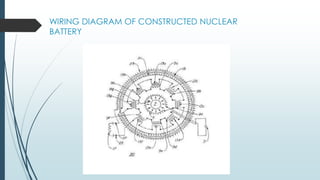
WIRING DIAGRAM OF CONSTRUCTED NUCLEAR
BATTERY
b)Self-reciprocating cantilever
 Also a direct charging method
 A resonator is created by inducing movement due to attraction or repulsion resulting from
the collection of charged particles.
 Electrostatic force is driving force
 The radioactive source used was 63Ni with an activity of 1 mCi. The beam is 5 cm *5 mm,
made from 60 μm thick copper.
 A CCD camera connected to a VCR is used to record the movement of the beam and its
periodicity
A more analytical approach
α represents current emitted by
radioactive source
V is the voltage across source and beam
represent current leakage by air ionization
C is the capacitance of source and beam
We obtain the above equation
3) optoelectrics
 Proposed by researchers of the kurchatov institute in Moscow.
 A beta emitter such as technetium-99 are strontium-90 is suspended in a gas or
liquid containing luminescent gas molecules of the exciter type, constituting “dust
plasma”.
 a comparably light weight low pressure, high efficiency battery can be realized.
 The surrounding weakly ionized plasma consists of gases or gas mixtures (e.g.
krypton, argon, xenon) with exciter lines, such that a considerable amount of the
energy of the beta electrons is converted into this light the surrounding walls
contain photovoltaic layers with wide forbidden zones.
 advantage of this design is that precision electrode assemblies are not needed
and most beta particles escape the finely-divided bulk material to contribute to
the batteries net power.
 disadvantage consists in the high price of the radionuclide and in the high
pressure of up to 10MPa (100bar) and more for the gas that requires an expensive
and heavy container.
Fuel considerations
The major criterions considered in the selection
of fuels are:
 Avoidance of gamma in the decay chain
 Half life
 Particle range
 Watch out for (alpha, n)reactions
Isotope selection
 A critical aspect of the creation of microbatteries for MEMS devices is the
choice of the isotope to be used as a power source.
 Isotope selection looks into : safety, reliability, cost, and activity.
 The half-life of the isotopes must be high enough so that the useful life of the
battery is sufficient for typical applications, and low enough to provide sufficient
activity.
 the new isotope resulting after decay should be stable, or it should decay
without emitting gamma radiation.
 The power dissipated for charging such an electromechanical capacitor would
be in the range of 10 to 100 nanowatts.
To explore the viability of the nuclear micro battery concept, some scoping calculations
need to be carried out. Using 210Po as an example, one can analyze the best case
scenario, assuming that the nuclear battery is created using pure 210Po. In this case, the
activity would be approximately 4,500 Ci per gram or 43,000 Ci per cubic centimeter. Thus,
for a characteristic source volume of 10-5 cubic centimeters (0.1 cm x 0.1cm x 10 microns),
one obtains approximately 0.5 Ci. Based on the results of previous experimental studies, the
available power would be on the order of 0.5 mW (about 1 mW/Ci). The power required for
MEMS devices can range from nanowatts to microwatts.
Incorporation of source into device
3 Methods
1) activation of layers within the MEMS device,
2) addition of liquid radioactive material into
fabricated devices
3) addition of solid radioactive material into
fabricated devices.
 Electroless plating is the plating of nickel without the use of electrodes but by
chemical reduction
 Metallic nickel is produced by the chemical reduction of nickel solutions with
hypophosphite using an autocatalytic bath.
 This type of nickel plating can be used on a large group of metals, such as steel,
iron, platinum, silver, nickel, gold, copper, cobalt, palladium and aluminum.
 The important factor influencing the plating process is the pH. The pH needs to be
maintained at 4.5-6 for plating to occur.
 Plating of nickel on gold was observed in about 15 minutes
 We have obtained glass microspheres (25 to 53 μm in diameter) that will emit low energy
3H beta radiation . These are obtained by irradiating 6Li glass silicate non-radioactive
microspheres in the UW Nuclear Reactor .
 Using this procedure, we can produce activities of up to 12.8 mCi per gram and per hour
of irradiation.
 This approaches will allow for higher power densities than the direct reactor activation
approach, but will provide less flexibility with respect to device design.
We are currently exploring the tradeoffs of the different options, and will shortly release
all the data needed to assess the viability of all of these approaches.
Waste disposal
Analysis proves that the environmental impact of disposing of these micro-devices once
their useful life has ended, as well as the associated costs are minimal. Since after three
half-lives the activity of the isotope has decayed to about 10% of the original activity, the
micro-batteries would be below background radiation level at the following times:
ADVANTAGES
 The most important feat of nuclear cells is the life span they offer, a minimum of
10years!
 As the energy associated with fissile material is several times higher than conventional
sources, the cells are comparatively much lighter and thus facilitates high energy
densities to be achieved.
 the efficiency of such cells is much higher simply because radioactive materials in little
waste generation .
 nuclear produced therein are substances that don’t occur naturally. example
strontium does not exist in nature but it is one of the several radioactive waste products
resulting from nuclear fission .
 . Thus substituting the future energy needs with nuclear cells and replacing the already
existing ones with these, the world can be seen transformed by reducing the green
house effects and associated risks.
DISADVANTAGES
 First and foremost, as is the case with most breathtaking technologies, the high initial
cost of production involved is a drawback but as the product goes operational and
gets into bulk production, the price is sure to drop .
 Size can sometimes be a problem . Eg : Xcell
 Complete efficiency is yet to be realized even though high efficiencies are realized in
laboratories
 A minor blow may come in the way of existing regional and country specific laws
regarding the use and disposal of radioactive materials
Applications
Nuclear batteries find many fold applications due to its long life time and
improved reliability. In the ensuing era, the replacing of conventional
chemical batteries will be of enormous advantages. This innovative
technology will surely bring break-through in the current technology which was
muddled up in the power limitations. MEMS devices, with their integrated
nuclear micro-battery will be used in large variety of applications, as sensors,
actuators, resonators, etc. It will be ensured that their use does not result in any
unsafe exposure to radiation
Space applications
 When the satellite orbits pass through radiation belts such as the van-Allen belts
around the Earth that could destroy the solar cells
 Operations on the Moon or Mars where long periods of darkness require heavy
batteries to supply power when solar cells would not have access to sunlight
 Space missions in the opaque atmospheres such as Jupiter, where solar cells would be
useless because of lack of light.
 At a distance far from the sun for long duration missions where fuel cells, batteries and
solar arrays would be too large and heavy.
 Heating the electronics and storage batteries in the deep cold of space at minus 245°
F is a necessity
Medical applications
 Used due to their increased longevity and better reliability.
 Can be used in for medical devices like pacemakers, implanted deep
fibrillations or other implanted devices that would otherwise require surgery
to replace or repair the best out of the box is use in ‘cardiac pacemakers .
 The definitions for some of the important parts of the battery and its
performances are parameters like voltage, duty cycle, temperature, shelf
life, service life, safety and reliability, internal resistance, specific energy
(watt-hour/ kg), specific power (watts/kg), and in all that means nuclear
batteries stands out. Compared to conventional batteries.
Mobile devices
 Xcell-N is a nuclear powered laptop battery that can provide between seven and
eight thousand times the life of a normal laptop battery-that is more than five year’s
worth of continuous power .
 Nuclear batteries are about forgetting things around the usual charging, battery
replacing and such bottlenecks
 a nuclear battery can endure at least up to five years. The Xcell-N is in continuous
working for the last eight months and has not been turned off and has never been
plugged into electrical power since .
 are going to replace the conventional batteries and adaptors, so the future will be of
exciting innovative new approach to powering portable devices.
Automobiles
 Although it is on the initial stages of development, it is highly promised that the nuclear
batteries will find a sure niche in the automobiles replacing the weary conventional
iconic fuels there will be no case such as running out of fuel and running short of time.
Military applications
 a transformation into a more responsive, deployable, and sustainable force, while
maintaining high levels of lethality, survivability and versatility.
 “TRACE photonics, U.S. Army Armaments Research, Development and Engineering
Centre” has harnessed radioisotope power sources to provide very high energy
density battery power to the men in action
 No power cords or transformers will be needed for the next generation of
microelectronics in which voltage-matched supplies are built into components .
 Safe, long-life, reliable and stable temperature is available from the direct
conversion of radioactive decay energy to electricity. This distributed energy source
is well suited to active radio frequency equipment tags, sensors and ultra wide-band
communication chips used on the modern battlefield.
Under water sea probes and sensors
 The recent flare up of Tsunami, Earthquakes and other underwater destructive
phenomenon has increased the demand for sensors that keeps working for a long
time and able to withstand any crude situations
 Perfect in inaccessible places or under extreme conditions, the researchers envision
its use as deep-sea probes and sensors, sub-surface, coal mines and polar sensor
application s, with a focus on the oil industry.
Conclusion
The world of tomorrow that science fiction dreams of and technology manifests
might be a very small one. It would reason that small devices would need small
batteries to power them. The use of power as heat and electricity from radioisotope
will continue to be indispensable. As the technology grows, the need for more
power and more heat will undoubtedly grow along with it.
Clearly the current research of nuclear batteries shows promise in future
applications for sure. With implementation of this new technology credibility and
feasibility of the device will be heightened. The principal concern of nuclear
batteries comes from the fact that it involves the use of radioactive materials. This
means throughout the process of making a nuclear battery to final disposal, all
radiation protection standards must be met. The economic feasibility of the nuclear
batteries will be determined by its applications and advantages. With several
features being added to this little wonder and other parallel laboratory works going
on, nuclear cells are going to be the next best thing ever invented in the human
history .
Reference
 “Power from radioisotopes,” USAEC, Division of Technical Information
 “Nuclear and radiochemistry” , Gerhardt Friedlander, Joseph.W.Kennedy and
Julian Malcolm Miller,
 “Particles and Nuclei, an Introduction to the Physical Concepts”. B.Povh, K.Rith, C.
Scolz and F.Zetche.
 Brown, Paul: "Resonant Nuclear Battery Supply", Raum & Zeit, 1(3) (August-
September, 1989
 Powerstream.com, “The Role of Chemical Power Sources in Modern Health Care”,
Curtis F. Holmes
 Powerpaper.com
 Technologyreview.com
 Wikipedia.com/ atomicbattery
Nuclear micro battery

Nuclear micro battery

  • 1.
    Nuclear micro-battery By VISHNU MT SEM 7 ROLL NO: 90012068 Department of Instrumentation ,CUSAT
  • 2.
    INTRODUCTION  A burgeoningneed exists today for small, compact, reliable, lightweight and self- contained rugged power supply  Its lifespan is decades and has 200 times more efficiency  these power cells do not rely on a nuclear reaction or chemical process do not produce radioactive waste products  It is the answer for power supply to MEMS devices.  Envisioned to be used in medical devices and remotely placed sensors.  It will make its way to commonly used products like laptops and smart phones. Surely its the batteries of near future.
  • 3.
    Historical developments  Ideacame in beginning of 1950 at tracer lab  Radio isotope electric power system developed by inventor Paul Brown was a scientific breakthrough in nuclear power. . Brown’s first prototype power cell produced 100,000 times as much energy per gram of strontium -90(the energy source) than the most powerful thermal battery yet in existence.  The main drawback of Mr. Brown’s prototype was its low efficiency, and the reason for that was when the radioactive material decays, many of the electrons lost from the semiconductor material.  With the enhancement of more regular pitting and introduction better fuels the nuclear batteries are thought to be the next generation batteries and there is hardly any doubt that these batteries will be available in stores within another decade.
  • 4.
    Energy production mechanism 1)Betavoltaics  Alternative energy technology that promises vastly extended battery life and power density over current technologies.  The functioning of a betavoltaics device is somewhat similar to a solar panel, which converts photons (light) into electric current.  Betavoltaic technique uses a silicon wafer to capture electrons emitted by a radioactive gas, such as tritium.  The junction between the two electrodes is comprised of a suitably ionisable medium exposed to decay particles emitted from a radioactive source.  Irradiated p-n junction produces electron hole pairs .  It consist of 6 stages of energy transition of electrons .
  • 5.
    A pictorial representationof a basic Betavoltaic conversion as shown in figure 1. Electrode A (P-region) has a positive potential while electrode B (N- region) is negative with the potential difference provided by me conventional means.
  • 6.
    The energy conversionmechanism for this arrangement involves energy flow in different stages . Stage 1:- Before the radioactive source is introduced, a difference in potential between to electrodes is provided by a conventional means.
  • 7.
     Stage 2:-Next, we introduce the radioactive source, say a beta emitter, to the system.  Stage 3:- Further the beta particle imparts an amount of energy in excess of ionization potential  Stage 4:- next, the electric field present in the junction acts on the ions and drives the electrons into electrode A and a Fermi voltage is established. Naturally, the electrons in electrode A seek to give up their energy and go back to their ground state (law of entropy).  Stage 5:- the Fermi voltage derives electrons from the electrode A through the load where they give up their energy in accordance with conventional electrical theory. Eb-energy of β particle E1-ionization potential of junction E2- stage 2 energy
  • 10.
    2) Direct charginggenerators a)High Q LC tank circuit  the primary generator consists of a high –Q LC tank circuit  Core composed of radioactive nuclides connected in series with the primary winding of a power transformer. . The core is fabricated from a mixture of three radioactive materials which decay primarily by α emission and provides a greater flux of radioactive decay products than the equivalent amount of single radioactive nuclei.  Each α particles collide with more than one atoms and knocks out electrons imparting KE .  Sustained oscillations are induced by absorption of radio active decay energy.  Excess energy is transferred to load connected across transformer secondary
  • 11.
    Schematic diagram ofan LC resonant circuit
  • 12.
    WIRING DIAGRAM OFCONSTRUCTED NUCLEAR BATTERY
  • 13.
    b)Self-reciprocating cantilever  Alsoa direct charging method  A resonator is created by inducing movement due to attraction or repulsion resulting from the collection of charged particles.  Electrostatic force is driving force  The radioactive source used was 63Ni with an activity of 1 mCi. The beam is 5 cm *5 mm, made from 60 μm thick copper.  A CCD camera connected to a VCR is used to record the movement of the beam and its periodicity
  • 15.
    A more analyticalapproach α represents current emitted by radioactive source V is the voltage across source and beam represent current leakage by air ionization C is the capacitance of source and beam
  • 16.
    We obtain theabove equation
  • 19.
    3) optoelectrics  Proposedby researchers of the kurchatov institute in Moscow.  A beta emitter such as technetium-99 are strontium-90 is suspended in a gas or liquid containing luminescent gas molecules of the exciter type, constituting “dust plasma”.  a comparably light weight low pressure, high efficiency battery can be realized.  The surrounding weakly ionized plasma consists of gases or gas mixtures (e.g. krypton, argon, xenon) with exciter lines, such that a considerable amount of the energy of the beta electrons is converted into this light the surrounding walls contain photovoltaic layers with wide forbidden zones.  advantage of this design is that precision electrode assemblies are not needed and most beta particles escape the finely-divided bulk material to contribute to the batteries net power.  disadvantage consists in the high price of the radionuclide and in the high pressure of up to 10MPa (100bar) and more for the gas that requires an expensive and heavy container.
  • 20.
    Fuel considerations The majorcriterions considered in the selection of fuels are:  Avoidance of gamma in the decay chain  Half life  Particle range  Watch out for (alpha, n)reactions
  • 22.
    Isotope selection  Acritical aspect of the creation of microbatteries for MEMS devices is the choice of the isotope to be used as a power source.  Isotope selection looks into : safety, reliability, cost, and activity.  The half-life of the isotopes must be high enough so that the useful life of the battery is sufficient for typical applications, and low enough to provide sufficient activity.  the new isotope resulting after decay should be stable, or it should decay without emitting gamma radiation.  The power dissipated for charging such an electromechanical capacitor would be in the range of 10 to 100 nanowatts.
  • 23.
    To explore theviability of the nuclear micro battery concept, some scoping calculations need to be carried out. Using 210Po as an example, one can analyze the best case scenario, assuming that the nuclear battery is created using pure 210Po. In this case, the activity would be approximately 4,500 Ci per gram or 43,000 Ci per cubic centimeter. Thus, for a characteristic source volume of 10-5 cubic centimeters (0.1 cm x 0.1cm x 10 microns), one obtains approximately 0.5 Ci. Based on the results of previous experimental studies, the available power would be on the order of 0.5 mW (about 1 mW/Ci). The power required for MEMS devices can range from nanowatts to microwatts.
  • 24.
    Incorporation of sourceinto device 3 Methods 1) activation of layers within the MEMS device, 2) addition of liquid radioactive material into fabricated devices 3) addition of solid radioactive material into fabricated devices.
  • 25.
     Electroless platingis the plating of nickel without the use of electrodes but by chemical reduction  Metallic nickel is produced by the chemical reduction of nickel solutions with hypophosphite using an autocatalytic bath.  This type of nickel plating can be used on a large group of metals, such as steel, iron, platinum, silver, nickel, gold, copper, cobalt, palladium and aluminum.  The important factor influencing the plating process is the pH. The pH needs to be maintained at 4.5-6 for plating to occur.  Plating of nickel on gold was observed in about 15 minutes
  • 26.
     We haveobtained glass microspheres (25 to 53 μm in diameter) that will emit low energy 3H beta radiation . These are obtained by irradiating 6Li glass silicate non-radioactive microspheres in the UW Nuclear Reactor .  Using this procedure, we can produce activities of up to 12.8 mCi per gram and per hour of irradiation.  This approaches will allow for higher power densities than the direct reactor activation approach, but will provide less flexibility with respect to device design. We are currently exploring the tradeoffs of the different options, and will shortly release all the data needed to assess the viability of all of these approaches.
  • 27.
    Waste disposal Analysis provesthat the environmental impact of disposing of these micro-devices once their useful life has ended, as well as the associated costs are minimal. Since after three half-lives the activity of the isotope has decayed to about 10% of the original activity, the micro-batteries would be below background radiation level at the following times:
  • 28.
    ADVANTAGES  The mostimportant feat of nuclear cells is the life span they offer, a minimum of 10years!  As the energy associated with fissile material is several times higher than conventional sources, the cells are comparatively much lighter and thus facilitates high energy densities to be achieved.  the efficiency of such cells is much higher simply because radioactive materials in little waste generation .  nuclear produced therein are substances that don’t occur naturally. example strontium does not exist in nature but it is one of the several radioactive waste products resulting from nuclear fission .  . Thus substituting the future energy needs with nuclear cells and replacing the already existing ones with these, the world can be seen transformed by reducing the green house effects and associated risks.
  • 29.
    DISADVANTAGES  First andforemost, as is the case with most breathtaking technologies, the high initial cost of production involved is a drawback but as the product goes operational and gets into bulk production, the price is sure to drop .  Size can sometimes be a problem . Eg : Xcell  Complete efficiency is yet to be realized even though high efficiencies are realized in laboratories  A minor blow may come in the way of existing regional and country specific laws regarding the use and disposal of radioactive materials
  • 30.
    Applications Nuclear batteries findmany fold applications due to its long life time and improved reliability. In the ensuing era, the replacing of conventional chemical batteries will be of enormous advantages. This innovative technology will surely bring break-through in the current technology which was muddled up in the power limitations. MEMS devices, with their integrated nuclear micro-battery will be used in large variety of applications, as sensors, actuators, resonators, etc. It will be ensured that their use does not result in any unsafe exposure to radiation
  • 31.
    Space applications  Whenthe satellite orbits pass through radiation belts such as the van-Allen belts around the Earth that could destroy the solar cells  Operations on the Moon or Mars where long periods of darkness require heavy batteries to supply power when solar cells would not have access to sunlight  Space missions in the opaque atmospheres such as Jupiter, where solar cells would be useless because of lack of light.  At a distance far from the sun for long duration missions where fuel cells, batteries and solar arrays would be too large and heavy.  Heating the electronics and storage batteries in the deep cold of space at minus 245° F is a necessity
  • 32.
    Medical applications  Useddue to their increased longevity and better reliability.  Can be used in for medical devices like pacemakers, implanted deep fibrillations or other implanted devices that would otherwise require surgery to replace or repair the best out of the box is use in ‘cardiac pacemakers .  The definitions for some of the important parts of the battery and its performances are parameters like voltage, duty cycle, temperature, shelf life, service life, safety and reliability, internal resistance, specific energy (watt-hour/ kg), specific power (watts/kg), and in all that means nuclear batteries stands out. Compared to conventional batteries.
  • 33.
    Mobile devices  Xcell-Nis a nuclear powered laptop battery that can provide between seven and eight thousand times the life of a normal laptop battery-that is more than five year’s worth of continuous power .  Nuclear batteries are about forgetting things around the usual charging, battery replacing and such bottlenecks  a nuclear battery can endure at least up to five years. The Xcell-N is in continuous working for the last eight months and has not been turned off and has never been plugged into electrical power since .  are going to replace the conventional batteries and adaptors, so the future will be of exciting innovative new approach to powering portable devices.
  • 34.
    Automobiles  Although itis on the initial stages of development, it is highly promised that the nuclear batteries will find a sure niche in the automobiles replacing the weary conventional iconic fuels there will be no case such as running out of fuel and running short of time.
  • 35.
    Military applications  atransformation into a more responsive, deployable, and sustainable force, while maintaining high levels of lethality, survivability and versatility.  “TRACE photonics, U.S. Army Armaments Research, Development and Engineering Centre” has harnessed radioisotope power sources to provide very high energy density battery power to the men in action  No power cords or transformers will be needed for the next generation of microelectronics in which voltage-matched supplies are built into components .  Safe, long-life, reliable and stable temperature is available from the direct conversion of radioactive decay energy to electricity. This distributed energy source is well suited to active radio frequency equipment tags, sensors and ultra wide-band communication chips used on the modern battlefield.
  • 36.
    Under water seaprobes and sensors  The recent flare up of Tsunami, Earthquakes and other underwater destructive phenomenon has increased the demand for sensors that keeps working for a long time and able to withstand any crude situations  Perfect in inaccessible places or under extreme conditions, the researchers envision its use as deep-sea probes and sensors, sub-surface, coal mines and polar sensor application s, with a focus on the oil industry.
  • 37.
    Conclusion The world oftomorrow that science fiction dreams of and technology manifests might be a very small one. It would reason that small devices would need small batteries to power them. The use of power as heat and electricity from radioisotope will continue to be indispensable. As the technology grows, the need for more power and more heat will undoubtedly grow along with it. Clearly the current research of nuclear batteries shows promise in future applications for sure. With implementation of this new technology credibility and feasibility of the device will be heightened. The principal concern of nuclear batteries comes from the fact that it involves the use of radioactive materials. This means throughout the process of making a nuclear battery to final disposal, all radiation protection standards must be met. The economic feasibility of the nuclear batteries will be determined by its applications and advantages. With several features being added to this little wonder and other parallel laboratory works going on, nuclear cells are going to be the next best thing ever invented in the human history .
  • 38.
    Reference  “Power fromradioisotopes,” USAEC, Division of Technical Information  “Nuclear and radiochemistry” , Gerhardt Friedlander, Joseph.W.Kennedy and Julian Malcolm Miller,  “Particles and Nuclei, an Introduction to the Physical Concepts”. B.Povh, K.Rith, C. Scolz and F.Zetche.  Brown, Paul: "Resonant Nuclear Battery Supply", Raum & Zeit, 1(3) (August- September, 1989  Powerstream.com, “The Role of Chemical Power Sources in Modern Health Care”, Curtis F. Holmes  Powerpaper.com  Technologyreview.com  Wikipedia.com/ atomicbattery

Editor's Notes